
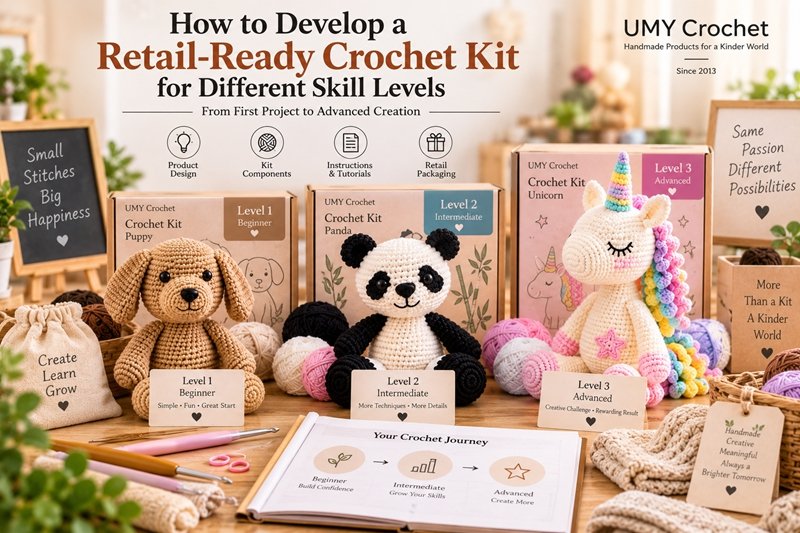
A retail-ready crochet kit should not simply contain yarn, a hook, and instructions. It should be designed around a specific maker experience.
For brands, craft companies, retailers, and e-commerce sellers, the first development question should be:
Who is expected to complete this kit, and what level of crochet knowledge can reasonably be expected from that customer?
A beginner, intermediate maker, and experienced crocheter may all be able to create the same general type of product, but they should not necessarily receive the same kit.
Skill level affects:
- Product complexity
- Number of crochet techniques
- Construction method
- Yarn selection
- Hook and accessory requirements
- Number of components
- Instruction detail
- Tutorial support
- Expected completion experience
- Packaging communication
A commercially effective product line can therefore be structured as:
Beginner → Intermediate → Advanced
rather than treating every crochet kit as a one-size-fits-all product.
For buyers, this creates a useful merchandising opportunity. Instead of selling isolated DIY kits, a brand can develop a skill-level architecture that helps customers choose the right project, progress to more challenging products, and potentially return for another kit.
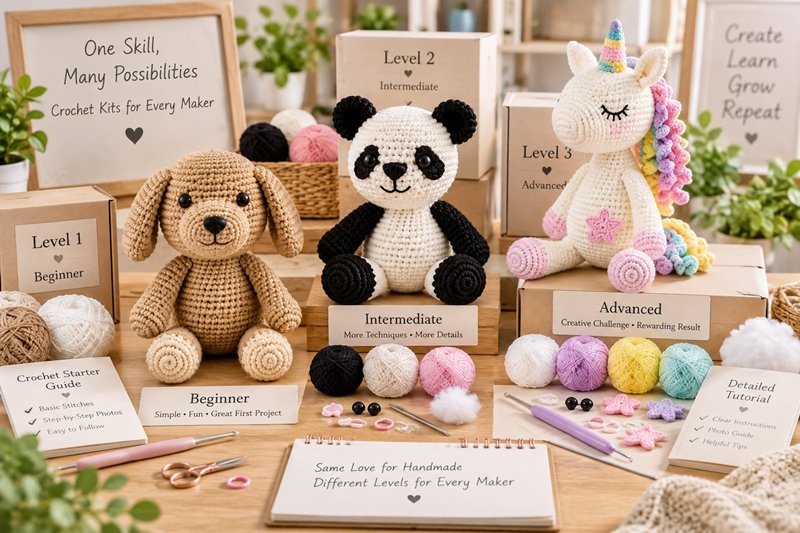
Why Skill Level Should Be Defined Before Designing the Crochet Kit
One of the easiest mistakes in crochet kit development is deciding what the finished product should look like before deciding who is expected to make it.
A highly detailed crochet animal may look attractive on a retail shelf.
But if the target customer is a first-time crocheter, the project could require too many techniques, too many components, or too much interpretation.
The opposite problem can also occur.
An experienced maker may find a very simple project insufficiently engaging.
This means the finished product and the making experience need to be developed together.
Before sampling a private-label crochet kit, buyers should define:
- Target maker
- Expected crochet experience
- Desired finished product
- Approximate project complexity
- Techniques required
- Number of components
- Tutorial format
- Packaging format
- Intended retail positioning
The goal is not simply:
Can this product be crocheted?
The better question is:
> Can the intended customer realistically crochet this product using what the kit provides?
Beginner, Intermediate, and Advanced Crochet Kits Serve Different Customers
There is no universal commercial definition that every crochet brand must use for skill levels.
A brand should define its own levels clearly and consistently.
A practical development framework might look like this:
| Development Area | Beginner | Intermediate | Advanced |
|---|---|---|---|
| Product structure | Simple | Moderate | More complex |
| Number of techniques | Limited | Several | Broader combination |
| Component count | Low | Moderate | Potentially high |
| Shaping | Basic | More varied | Detailed |
| Assembly | Simple | Multi-part | More demanding |
| Instructions | Highly guided | Guided with assumed basics | More concise where appropriate |
| Visual support | Extensive | Moderate to extensive | Focused on difficult stages |
| Customer objective | Successful first project | Skill progression | Challenge and detail |
This table should be treated as a product-development framework, not as a universal crochet grading standard.
Each brand should test whether its own audience interprets the levels as intended.
1. Beginner Kits Should Reduce Unnecessary Decisions
A beginner-friendly kit needs more than an easy-looking finished product.
First-time makers may need to understand:
- How to hold the hook
- How to begin
- How to read the instructions
- How to identify materials
- Where to change color
- How to shape components
- How to stuff the product
- How to assemble pieces
- How to finish the project
Every additional decision increases the cognitive load.
For that reason, beginner kit development often benefits from simplifying:
- Shape
- Color changes
- Component count
- Decorative details
- Assembly
- Technique variety
This does not mean the finished product must look generic.
A strong beginner product can still have a recognizable personality through:
Simple silhouette + clear colors + one or two distinctive details
The design challenge is to preserve the visual idea while removing complexity that does not add enough customer value.
2. Intermediate Kits Should Create a Sense of Progression
Intermediate kits have a different job.
The customer may already understand basic crochet and want a project that feels like a meaningful step forward.
Instead of removing nearly every challenge, the product can deliberately introduce additional complexity.
For example, an intermediate project might include:
- More shaping
- Several components
- Color changes
- Additional assembly
- Decorative crochet elements
- Clothing or accessories
- More detailed finishing
The key is progression.
A kit should not become "intermediate" simply because the instructions are less clear.
Difficulty should come from the project itself, not from missing information.
A good intermediate kit gives the customer enough support to complete a more ambitious product while allowing them to use skills they already possess.
3. Advanced Kits Can Prioritize Detail and Creative Challenge
An advanced kit can support a more complex finished result.
Depending on the concept, that might involve:
- Detailed shaping
- Multiple construction sections
- More sophisticated color work
- Complex accessories
- Clothing
- Layered decorative elements
- More demanding assembly
- Greater finishing precision
Advanced customers may tolerate more steps when the final result justifies the effort.
That creates an opportunity for brands to develop visually distinctive hero products.
However, complexity should still be purposeful.
Adding extra components only to make a project seem advanced can increase:
- Material requirements
- Packing complexity
- Instruction length
- Quality-control points
- Manufacturing cost
without necessarily creating a better customer experience.
A useful rule for buyers is:
Every additional technique or component should contribute either to the finished design or to the intended skill-building experience.
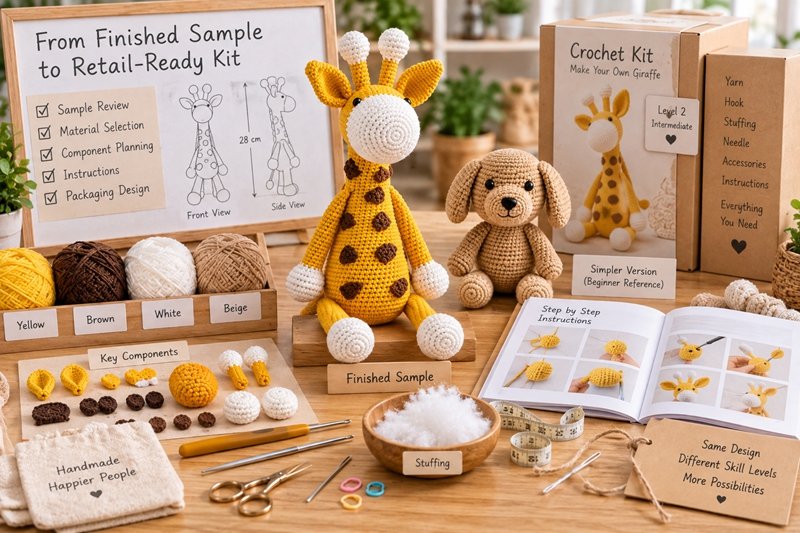
4. Start With the Finished Sample, Then Work Backward
For commercial crochet kit development, the finished sample performs several jobs.
It helps buyers evaluate:
- Visual appeal
- Size
- Proportions
- Color
- Difficulty
- Component count
- Construction
- Retail presentation
It also helps the development team work backward and determine what the customer will need.
A kit architecture can be viewed as:
Finished Sample
↓
Construction Steps
↓
Required Yarn
↓
Hook and Tools
↓
Stuffing / Components
↓
Instructions / Tutorial
↓
Packaging
If the finished sample changes significantly, several kit components may also need to change.
For example, adding a scarf may require:
- Another yarn color
- Additional instructions
- More packing space
- Another step in the tutorial
- Updated product photography
- Revised component checks
This is why the kit should be developed as one complete system rather than as a finished crochet item plus miscellaneous supplies.
5. Yarn Selection Affects Both the Product and the Learning Experience
Yarn is not only a visual decision.
It is also part of the user experience.
When evaluating yarn for a kit, product developers may need to consider:
- Appearance
- Texture
- Thickness
- Color range
- Compatibility with the design
- Required quantity
- Packaging volume
- Ease of handling for the intended maker
A yarn that creates a beautiful professional sample may not automatically be the best choice for every skill level.
For a beginner-oriented product, the development team should consider whether the yarn makes stitches reasonably visible and whether it works well with the intended construction.
For a more advanced kit, the design may justify a material or construction choice that requires greater maker confidence.
The important point is that [yarn selection should connect to:
Design + Skill Level + Instructions + Retail Positioning
rather than being evaluated only by color.](https://cottonworks.com/learning-hub/knitting/designing-knit-textiles/)
6. Every Included Tool Should Have a Clear Purpose
A retail-ready crochet kit may contain some combination of:
- Yarn
- Crochet hook
- Filling
- Needle
- Stitch marker
- Embroidery materials
- Product-specific components
- Printed instructions
- Supporting tutorial information
- Packaging
The exact contents depend on the product.
Buyers should avoid adding components merely to make the box appear fuller.
Each component affects:
- Cost
- Packing
- Inventory
- Quality control
- Customer expectations
At the same time, omitting a necessary tool can create a poor experience.
The buyer should therefore decide whether the kit is intended to be:
A More Complete Project Kit
Designed to provide most of the project-specific materials and tools the customer needs.
A Materials-Focused Kit
Designed for customers who are expected to own common crochet tools already.
Neither model is automatically better.
The packaging simply needs to make the distinction clear.
7. Instructions Should Match the Skill Level, Not Just the Product
Instruction design is one of the biggest differences between a crochet kit and a finished crochet product.
A factory can make a sample correctly because an experienced developer understands crochet construction.
The retail customer does not have that same context.
For beginner kits, instructions may need more support around:
- Material identification
- Basic techniques
- Abbreviations
- Component order
- Stitch counts
- Shaping
- Assembly
- Finishing
Intermediate customers may not need every basic technique explained repeatedly, but they still need clear guidance for product-specific construction.
Advanced makers may prefer concise instructions for familiar operations while still needing detailed guidance for unusual construction.
This means brands should not automatically reuse the same instruction template across all skill levels.
Test the Instructions Separately From the Sample
A finished sample proves that the product can be made.
It does not prove that the written instructions can successfully teach someone else to make it.
Whenever practical, the brand should review the instructions from the perspective of the intended maker rather than only from the perspective of the designer.
8. Visual Tutorials Can Reduce Ambiguity
Some crochet operations are easier to understand visually than through text alone.
Depending on the kit, useful visual support might include:
- Step photographs
- Diagrams
- Component illustrations
- Assembly views
- Short tutorial videos
- QR-linked digital instructions
For a beginner kit, visual support can help explain unfamiliar actions.
For intermediate and advanced kits, it can focus on the steps that are genuinely unusual or difficult.
A QR code can also connect physical packaging with digital support, but buyers should plan who will create, host, maintain, and update that content.
The manufacturer should not be assumed to own those responsibilities unless they are explicitly included in the project.
9. Component Control Becomes More Important as Complexity Increases
Every additional kit component creates another opportunity for a packing error.
Imagine an advanced animal kit containing:
- Five yarn colors
- Main hook
- Filling
- Needle
- Embroidery thread
- Stitch markers
- Decorative accessory
- Printed instructions
A missing component can prevent the customer from completing the project.
Quality control for crochet kits therefore needs to examine both:
Product-development accuracy and packing accuracy.
A useful kit component list can specify:
| Component | What Should Be Confirmed |
|---|---|
| Yarn | Correct color and planned quantity |
| Hook | Correct specification for the project |
| Filling | Included when part of the kit |
| Needle / tools | Correct components where specified |
| Accessories | Correct type and quantity |
| Instructions | Correct version |
| Tutorial reference | Correct destination where applicable |
| Packaging | Correct SKU and skill-level presentation |
For a multi-level range, the risk increases because similar kits may contain different components.
Clear SKU separation becomes important.
10. Skill Level Should Be Visible on the Packaging
A customer should not need to open the box to discover that a project is too difficult.
Packaging can help communicate:
- Finished product
- Skill level
- Main contents
- Approximate project scope
- Required tools not included
- Relevant tutorial information
- Brand story
- Other buyer-approved product information
The exact wording should reflect what the brand can substantiate.
For example, simply printing "Beginner" on a complicated project does not make it beginner-friendly.
The claim should be supported by the actual product architecture and instruction design.
Create a Consistent Skill-Level System
If a retailer offers several kits, it may be useful to develop a consistent visual system such as:
Level 1 — Beginner
Level 2 — Intermediate
Level 3 — Advanced
The names are less important than consistency.
Customers should be able to understand how one kit relates to another.
11. Retail Merchandising Should Show Progression
Skill levels can become more than packaging labels.
They can help organize an entire retail assortment.
For example:
| Retail Role | Possible Kit |
|---|---|
| Entry | Simple beginner animal |
| Beginner extension | Second easy character |
| Intermediate | More detailed animal or character |
| Intermediate extension | Product with clothing or accessories |
| Advanced hero | Detailed collectible-style project |
This structure creates a potential progression path:
First Project → Successful Completion → Next Challenge → More Detailed Project
For retailers, that can support repeat purchasing.
For brands, it creates a product-development roadmap.
Instead of continually inventing unrelated kits, the company can ask:
What should our customer make next?
That question can guide future SKU development.
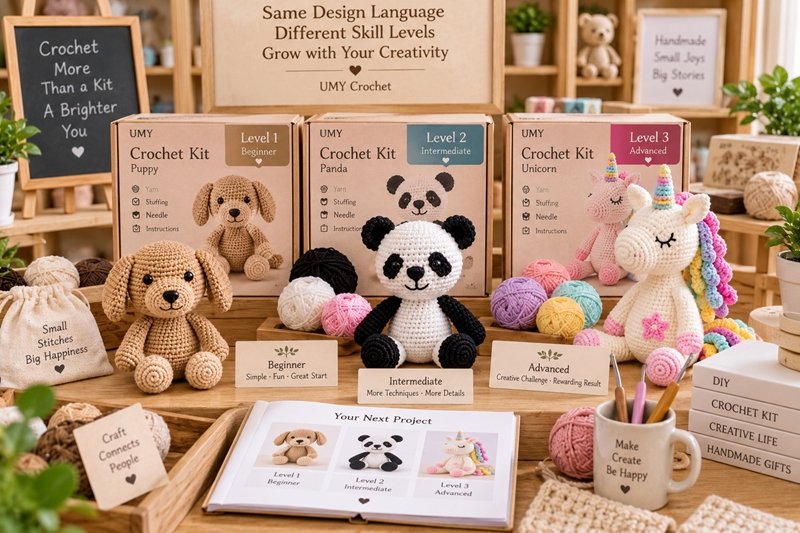
12. Different Skill Levels Can Share a Design Language
A skill-level collection does not need to look disconnected.
Several kits can share:
- Character family
- Color palette
- Packaging system
- Illustration style
- Brand story
- Retail display language
while varying in project complexity.
For example, an animal collection might include:
Beginner
A simplified animal with a basic body and limited components.
Intermediate
A related character with more shaping, color changes, or accessories.
Advanced
A detailed hero character with clothing or more complicated construction.
This creates two forms of consistency:
Visual consistency for the retailer
and
Difficulty progression for the maker
That combination can make a crochet kit range easier to understand and merchandise.
13. Do Not Confuse Product Size With Difficulty
A larger crochet product is not automatically more advanced.
A small product is not automatically easier.
Difficulty can come from:
- Number of techniques
- Shaping
- Color changes
- Component count
- Assembly
- Fine details
- Instruction complexity
A relatively large product with a simple structure may be easier than a small character containing many detailed parts.
This matters when buyers build price tiers.
Retail price, physical size, and skill level can influence one another, but they should not be treated as the same variable.
14. Do Not Create Skill Levels Only for Marketing
A three-level product range can look attractive in a presentation.
But it only works if customers can feel a meaningful difference between the levels.
If all three kits require essentially the same skills, the classification provides little value.
If the jump from beginner to intermediate is too large, customers may struggle to progress.
Brands should therefore evaluate:
- What does the customer learn in Level 1?
- What new challenge appears in Level 2?
- What makes Level 3 meaningfully more demanding?
- Does the finished product reward that additional effort?
Skill architecture should be a product decision before it becomes a marketing message.
15. Sampling Should Evaluate the Kit, Not Only the Crochet Product
Custom crochet sample development commonly focuses on the finished item.
For a kit, the development process needs to go further.
The buyer may need to evaluate:
- Finished crochet sample
- Yarn colors and quantities
- Hook and tools
- Filling and accessories
- Instructions
- Tutorial support
- Internal component organization
- Retail packaging
At UMY Crochet, custom sampling typically takes around 7–15 days, depending on the design, materials, accessories, revisions, and current project conditions.
A kit involving additional printed materials, packaging development, or tutorial assets may require separate coordination beyond the crochet sample itself.
The actual schedule should therefore be confirmed for the complete project rather than assuming the crochet sample timeline represents the entire retail-kit development timeline.
16. MOQ Should Be Evaluated at the SKU Level
Skill-level collections often contain several kits.
That creates an important sourcing question:
Does the MOQ apply to the complete collection or to each individual kit?
For UMY custom handmade crochet projects, the typical MOQ is around 500 pieces per style, while simpler designs may sometimes be evaluated from approximately 300 pieces per style.
Actual feasibility depends on the design and project.
Ready-stock products generally operate at much lower quantities, often around 10–50 pieces per style, subject to availability.
Buyers developing three skill levels should therefore discuss quantity architecture early.
For example, demand may not be equal across:
- Beginner
- Intermediate
- Advanced
17. Packaging Must Work for Both the Customer and the Retailer
A crochet kit box has several jobs.
It needs to organize components, communicate the project, support the brand, and work within the intended sales channel.
Buyers should consider:
- Box dimensions
- Component arrangement
- Product photography
- Skill-level visibility
- Instructions
- Branding
- Storytelling
- Shelf presentation
- E-commerce presentation
- Shipping requirements
A premium-looking box that is unnecessarily large may create inefficient shipping or storage.
A compact box that compresses materials excessively may create a poor opening experience.
Packaging development should therefore balance:
Presentation + Protection + Information + Logistics
18. Consider the Entire Customer Journey
The customer experience begins before the first stitch.
A useful journey map is:
See the Kit
↓
Understand the Skill Level
↓
Choose the Right Project
↓
Open and Identify Components
↓
Follow the Instructions
↓
Complete the Product
↓
Feel Successful
↓
Consider the Next Kit
For brands, the last two stages matter.
A kit that sells once but creates frustration may not support a long-term product line.
This is why product development should consider not only shelf appeal but also completion experience.
A Buyer Checklist for Developing a Multi-Level Crochet Kit Range
Before sampling, define the following.
Target Customer
- Who is expected to make the kit?
- What crochet knowledge can be assumed?
- Is the product positioned as learning, hobby, gifting, or a more advanced project?
Finished Product
- What will the customer make?
- Which details define its appeal?
- Which details can be simplified?
- How many components are required?
Skill Level
- Which techniques are needed?
- How much shaping is involved?
- How much assembly is required?
- What makes this level different from the level below or above?
Components
- Which yarns are required?
- Which tools are included?
- Is filling included?
- Are needles, markers, or accessories required?
- Are any additional customer-supplied tools necessary?
Instructions
- How much prior knowledge is assumed?
- Which stages need illustrations?
- Which stages need additional explanation?
- Is digital tutorial support useful?
Packaging
- Is the skill level easy to identify?
- Are the contents clear?
- Is the finished project visible?
- Does the box work for the intended retail channel?
- Can different levels be merchandised as one family?
Manufacturing
- Has the finished sample been approved?
- Are kit components standardized?
- Can similar SKUs be kept separate during packing?
- Are the correct instructions matched with each kit?
- Are packaging and component checks included in QC?
How UMY Approaches Crochet Kit Product Development
UMY has worked in product development and manufacturing since 2013.
For a crochet kit project, we look at the product as more than a set of raw materials.
A complete development path can include:
Concept → Finished Sample → Skill-Level Review → Materials → Components → Instructions → Packaging → Production Preparation → QC
The specific scope depends on the buyer's project.
Some buyers already have:
- Finished patterns
- Tutorials
- Brand artwork
- Packaging designs
and primarily need manufacturing and packing support.
Others begin with a product concept and need more development work before the kit becomes retail-ready.
That is why the most useful starting information usually includes:
- Target customer
- Desired finished product
- Intended skill level
- Expected order quantity
- Sales channel
- Packaging expectations
- Materials or tools that must be included
- Instruction and tutorial requirements
Common Mistakes When Building Skill-Level Crochet Kits
Mistake 1: Designing the Product Before Defining the Maker
The finished design may become too complicated or too simple for the intended customer.
Mistake 2: Calling a Kit "Beginner" Because It Looks Cute and Simple
Visual simplicity does not necessarily equal construction simplicity.
Review the actual techniques and assembly.
Mistake 3: Making Intermediate Kits Harder by Making Instructions Shorter
Difficulty should come from the project, not from poor guidance.
Mistake 4: Adding Too Many Components
More components increase cost and packing risk.
Include what creates real value.
Mistake 5: Treating the Instructions as an Afterthought
The customer receives a kit, not access to the factory's product developer.
Instructions are part of the product.
Mistake 6: Using Skill Levels Only as Packaging Labels
The difference between levels should exist in the actual project architecture.
Mistake 7: Ignoring the Next Purchase
A multi-level range should give successful customers a logical next project.
Frequently Asked Questions
What should be included in a retail-ready crochet kit?
Contents depend on the product, but a kit may include yarn, a crochet hook, filling, needles or other tools, product-specific components, instructions, tutorial support, and retail packaging. Buyers should define exactly what the customer is expected to receive and what, if anything, must be supplied separately.
What makes a crochet kit beginner-friendly?
A beginner-friendly kit typically reduces unnecessary construction complexity, uses clear instructions, limits difficult techniques where practical, and provides enough guidance for the intended first-time or early-stage maker. The exact definition should be established by the brand.
How is an intermediate crochet kit different from a beginner kit?
An intermediate kit can introduce additional shaping, components, color changes, assembly, or decorative techniques while assuming that the customer already understands some basic crochet skills.
What makes an advanced crochet kit commercially attractive?
Advanced kits can offer more detailed finished products and stronger creative challenges. They work best when the added complexity produces a result that feels worth the additional effort.
Should every crochet kit include a hook?
Not necessarily. Some kits are designed as more complete project kits, while others assume customers already own standard tools. The packaging should clearly communicate what is and is not included.
Can beginner, intermediate, and advanced kits use the same character theme?
Yes. A shared character family or visual language can help the products merchandise as one collection while construction complexity changes between skill levels.
How long does custom crochet kit development take?
At UMY, a custom crochet sample typically takes around 7–15 days depending on design complexity, materials, accessories, revisions, and actual project conditions. A complete kit may also require instruction, tutorial, component, and packaging development, so the full schedule should be evaluated separately.
What is the MOQ for custom crochet kits?
MOQ depends on the product and manufacturing model. For UMY custom handmade crochet projects, the typical MOQ is around 500 pieces per style, while simpler designs may sometimes be evaluated from approximately 300 pieces per style. Actual requirements should be confirmed for the project.
Final Buyer Takeaway
A strong crochet kit range should help customers answer two questions immediately:
Can I make this?
and
What should I make next?
The finished sample, yarn, tools, components, instructions, tutorials, packaging, and retail merchandising all need to support the intended maker.
For buyers, this changes crochet kit development from:
"Put the materials for this product in a box."
to:
"Design a complete making experience for a clearly defined customer."
That second approach creates a stronger foundation for private-label development, retail merchandising, repeat purchasing, and future SKU expansion.
For craft brands, retailers, gift companies, and e-commerce sellers developing a multi-level crochet kit range, UMY can support the manufacturing-development process from product concept and sampling through component planning, production, QC, and retail packaging. A useful first step is to define the target maker, intended skill level, finished product, expected quantity, included components, tutorial requirements, and sales channel before sampling begins.
 Chinese