
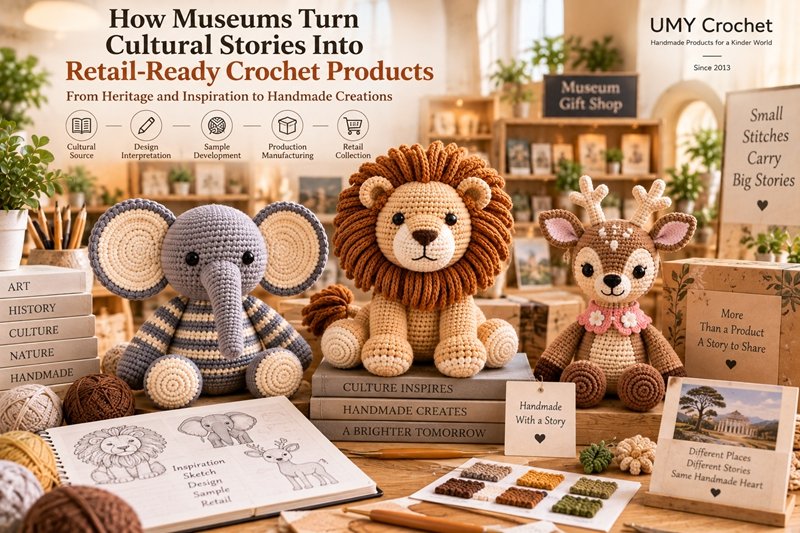
Turning a cultural story into a retail-ready crochet product requires more than choosing an attractive symbol and reproducing it in yarn. Museums and cultural institutions first need to identify what the product represents, which visual or cultural elements must remain accurate, what rights they have to use the source material, and how the concept should be adapted for manufacturing, packaging, and retail.
A practical development path is:
Cultural Source → Story Definition → Rights Review → Essential Visual Elements → Crochet Adaptation → Prototype → Cultural Review → Production Standard → Packaging → Retail Collection
This approach is different from simply selecting handmade souvenirs. The central question is not “Which product should the museum store buy?” It is:
How can an institution translate a cultural reference into a physical product without losing the meaning that makes the reference important?
That distinction matters when the starting point is an artwork, collection object, historical reference, local story, educational theme, institution-owned character, or other culturally significant material.
For buyers, successful development therefore requires collaboration between cultural or curatorial stakeholders, retail teams, designers, and the manufacturing partner. Cultural integrity and commercial feasibility need to be considered together from the beginning.
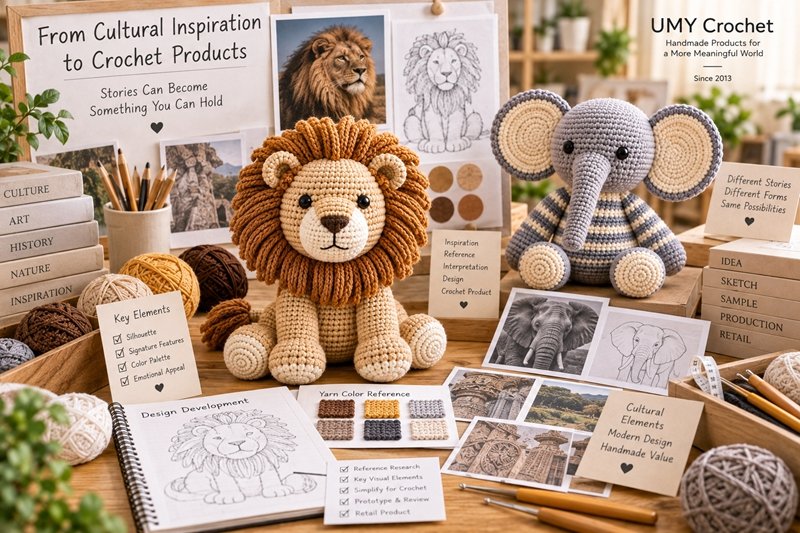
This Is a Product-Development Problem, Not Just a Souvenir-Selection Problem
Museum retail already involves familiar buying questions:
- Is the product relevant to the institution?
- Will visitors understand it?
- Is it giftable?
- Does the price fit the retail strategy?
- Is the quality appropriate?
- Can it be packaged effectively?
Those questions matter, but cultural product development begins one stage earlier.
The institution may not yet have a product.
It may have only:
- An object
- An artwork
- A historical reference
- A cultural narrative
- A local animal or plant
- An architectural detail
- An educational theme
- An authorized character
The development team's job is to determine what can become a product and how.
That creates a different workflow:
Source Material → Interpretation → Product Design → Manufacturing
rather than:
Existing Product → Buying Decision
1. Start With the Story Before Choosing the Product Format
A common development mistake is starting with:
“We want a crochet doll.”
That decision may be premature.
The better starting questions are:
- What story should the visitor remember?
- What object, character, symbol, or visual element carries that story?
- What is culturally or historically important about it?
- Which details help a visitor recognize the reference?
- What information requires explanation?
- Who is the intended retail customer?
Only then should the team decide whether the concept should become:
- A crochet character
- A miniature
- A keychain
- A decorative object
- A gift set
- A collectible
- A seasonal variation
- A broader product family
The product format should serve the cultural story.
The cultural story should not be forced into a format simply because that format is already available from a supplier.
2. Separate the Source From the Interpretation
When developing cultural merchandise, it is useful to distinguish three layers.
Layer 1 — The Source
This is the original material.
Examples might include:
- A museum object
- An authorized artwork
- A historical costume
- A local cultural reference
- A collection theme
- An institution-owned character
Layer 2 — The Interpretation
This determines what the institution wants customers to understand or remember.
For example, the important message might relate to:
- A particular historical period
- A traditional craft
- A regional animal
- A visual motif
- A character's role
- An exhibition theme
Layer 3 — The Product
This is the commercial expression of the interpretation.
It might become:
Full-size crochet character → Mini version → Keychain → Gift set
3. Confirm Rights Before Detailed Product Development
Cultural relevance does not automatically mean the source material is free to reproduce commercially.
Before detailed development, the project owner should establish whether it has the necessary rights or permissions for the intended use.
Depending on the project, questions may include:
- Who owns the artwork or character?
- Is the source in the public domain in the relevant jurisdiction?
- Are there contractual restrictions?
- Does an artist, estate, photographer, licensor, or other rights holder need to approve merchandise?
- Can the design be modified?
- Can packaging reproduce the reference?
- Can the product be sold internationally?
These questions are project-specific and may require qualified legal review.
A manufacturer should not assume that receiving an image means permission exists to manufacture merchandise from it.
At UMY, third-party IP should only move into custom development when the buyer has the appropriate authorization.
This protects both the project owner and the manufacturing process.
4. Identify the Cultural Elements That Must Not Be Lost
Crochet is not a photocopying process.
A detailed two-dimensional reference may need to be interpreted into:
- Yarn
- Stitches
- Three-dimensional forms
- Embroidery
- Attached components
- Clothing
- Accessories
Some simplification may be necessary.
The important question is:
What can be simplified, and what must remain recognizable or culturally accurate?
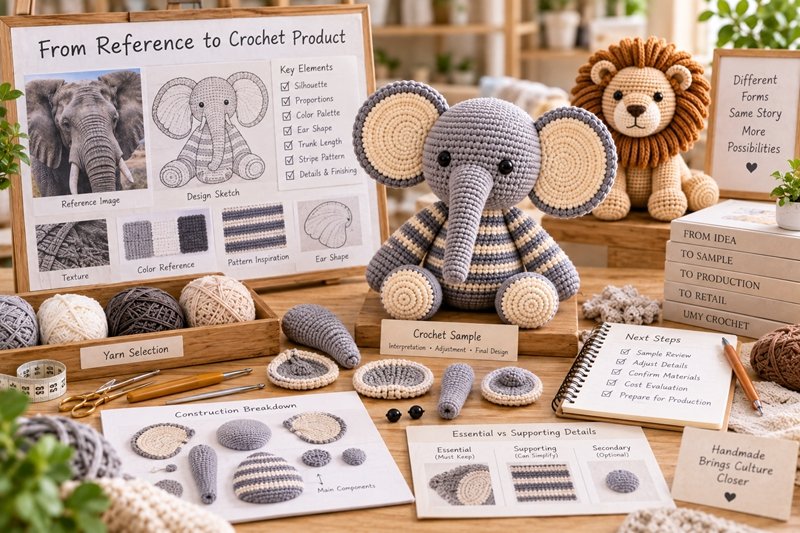
A useful development brief can divide features into three categories.
| Feature Type | Development Treatment |
|---|---|
| Essential | Must be preserved as closely as the agreed product format allows |
| Supporting | Important but may permit controlled simplification |
| Secondary | Can potentially be reduced if necessary for manufacturing or retail objectives |
Essential Features
These might include:
- Distinctive silhouette
- Signature colors
- Important clothing
- Symbolic accessories
- Recognizable facial characteristics
- Character-defining proportions
- Specific cultural motifs
Supporting Features
These may strengthen recognition but allow more interpretation.
Secondary Features
Very small details may sometimes add production complexity without materially improving recognition.
The institution should help determine these priorities.
A manufacturer should not decide cultural importance based only on what is easiest to crochet.
7. Build a Cultural Product Brief Before Sampling
A standard product brief may contain dimensions, colors, and materials.
A museum or cultural product can benefit from additional context.
A useful brief may include:
Source Information
- Reference images
- Object or character information
- Relevant visual views
- Authorized artwork where applicable
Cultural Priorities
- Essential features
- Symbolic colors
- Important clothing
- Important accessories
- Elements that must not be altered
Product Objectives
- Target customer
- Intended product category
- Desired size
- Retail positioning
- Target quantity
- Packaging direction
Review Requirements
- Who approves visual accuracy?
- Who approves cultural interpretation?
- Who approves retail presentation?
- Who gives final production approval?
8. Sampling Should Be an Interpretation Review, Not Just a Manufacturing Review
For an ordinary product, sample review may focus heavily on:
- Size
- Shape
- Color
- Workmanship
- Construction
For culturally derived products, another question needs to be added:
Does this sample still communicate the intended reference correctly?
The review may therefore examine:
- Recognition
- Cultural accuracy
- Proportions
- Important motifs
- Color
- Clothing
- Accessories
- Overall emotional tone
- Retail suitability
Why Physical Samples Matter
A concept that looks successful in artwork may feel different once converted into yarn.
For example:
- A symbolic accessory may become too small to notice.
- A garment may dominate the character.
- An important color may occupy too little visual area.
- A detailed motif may become visually confusing.
- A character's proportions may need adjustment.
Sampling provides an opportunity to solve these problems before production.
At UMY, custom crochet sampling typically takes around 7–15 days, depending on the design, materials, accessories, revisions, and actual project conditions.
Cultural review and stakeholder approval can add time beyond physical sample development, so buyers should plan those approval stages separately.
9. Use an Approval Matrix When Several Stakeholders Are Involved
Cultural institutions may have more stakeholders than an ordinary retail project.
Possible participants include:
- Retail
- Merchandising
- Curatorial teams
- Education teams
- Brand or marketing
- Licensing
- External rights holders
- Product-development partners
Without a clear process, one group may approve the product while another later requests major changes.
A simple approval matrix can help.
| Decision | Possible Responsible Stakeholder |
|---|---|
| Cultural interpretation | Institution-designated cultural/curatorial reviewer |
| Rights permission | Institution or rights-management team |
| Product design | Product/retail team |
| Sample appearance | Design + relevant cultural reviewer |
| Retail price architecture | Retail/buying team |
| Packaging story | Brand/content + cultural reviewer |
| Production approval | Authorized project owner |
The exact responsibilities vary by institution.
What matters is deciding who has authority to approve what before production begins.
10. Cost Engineering Should Protect Meaningful Features First
A prototype may be visually successful but too expensive for the intended retail position.
Cost engineering may then be necessary.
Possible adjustments can include:
- Reducing size
- Simplifying secondary details
- Reducing component count
- Simplifying accessories
- Changing packaging format
- Developing an entry-level version
However, cultural product development needs a clear priority:
Do not remove the features that carry the story merely because they are difficult to manufacture.
Instead, identify which details contribute most strongly to recognition and meaning.
A practical order for simplification can be:
Protect Essential Features → Review Supporting Features → Simplify Secondary Complexity
This approach is more useful than reducing every part of the design equally.
11. One Cultural Story Can Support Several Retail Price Points
A cultural concept does not have to become only one SKU.
After the hero product has been validated, the institution can consider a product family.
For example:
Entry Product
A small keychain or simplified miniature.
Core Product
The primary crochet character.
Gift Product
The core product with enhanced storytelling or packaging.
Premium Product
A more detailed product or gift-set presentation.
Limited Product
An exhibition-specific or seasonal interpretation, where appropriate.
The institution can preserve the same recognizable design language while adapting:
- Size
- Detail
- Packaging
- Product format
- Gift presentation
12. Packaging Can Carry Information the Crochet Product Cannot
Crochet is strong at communicating:
- Shape
- Color
- Texture
- Character
- Craft
It is less suitable for communicating detailed historical or educational information.
Packaging can fill that gap.
Depending on the project, storytelling surfaces might include:
- Hangtags
- Story cards
- Gift boxes
- Printed sleeves
- Collector cards
- Inserts
A story card could explain the source and significance of the product without requiring the physical crochet piece to reproduce every piece of information.
Keep the Story Connected to the Product
Packaging should answer:
- What does this represent?
- Why is it relevant here?
- What should the customer notice?
- How does it connect to the institution or exhibition?
This transforms packaging from decoration into part of the interpretation system.
13. Avoid Invented Cultural Claims in Packaging
Storytelling creates responsibility.
Institutions should verify:
- Names
- Dates
- Terminology
- Cultural descriptions
- Translations
- Attribution
- Source information
before printing.
This is particularly important when products relate to:
- Living cultures
- Indigenous traditions
- Religious material
- Historical communities
- Named artists
- Licensed exhibitions
- Sensitive historical subjects
The manufacturer can support the physical development of packaging, but authoritative cultural content should come from or be approved by the appropriate project stakeholder.
14. Production Standards Should Include Cultural Details
Once the sample is approved, the culturally important elements need to survive larger handmade production.
The approved reference may therefore need to control:
- Yarn colors
- Key dimensions
- Proportions
- Clothing
- Motifs
- Facial details
- Accessories
- Embroidery
- Component position
- Packaging version
This is especially important when an apparently small change has symbolic significance.
For an ordinary decorative product, a slight color substitution may seem harmless.
For a culturally derived product, that same color could be part of the identity.
15. Multi-SKU Collections Need a Shared Visual System
When one cultural story expands into several products, the challenge changes.
The team now needs to preserve consistency across the collection.
Shared elements might include:
- Color palette
- Character proportions
- Motifs
- Packaging
- Story-card format
- Illustration style
- Naming structure
The products themselves can vary in:
- Size
- Complexity
- Format
- Price
- Gift presentation
This creates a recognizable family without forcing every SKU to look identical.
A visitor should ideally be able to see several products together and understand that they belong to the same cultural story.
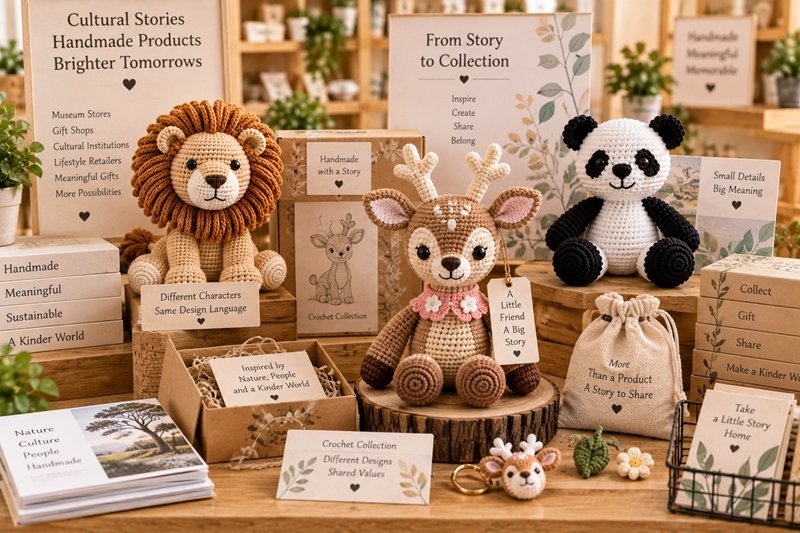
16. Retail Display Should Reconnect the Product With Its Source
Retail presentation can help restore that connection.
Depending on the institution and rights available, merchandising may use:
- Approved imagery
- Collection colors
- Exhibition graphics
- Educational copy
- Story cards
- Coordinated packaging
- Grouped product families
The objective is not to turn the store into another exhibition.
It is to help the customer understand why the merchandise belongs there.
This is particularly important when the crochet interpretation is intentionally simplified.
17. Decide Early Whether the Product Is a Souvenir, Collectible, Gift, or Toy
A crochet character can look similar across several retail categories while serving very different purposes.
The institution should clarify the intended positioning.
Souvenir
Primary purpose: memory of a visit, place, exhibition, or story.
Collectible
Primary purpose: collection building, character ownership, or special-edition appeal.
Gift
Primary purpose: emotional or premium presentation for another recipient.
Toy
Primary purpose: play or child-oriented use.
These categories can overlap commercially, but intended use matters for product development, communication, packaging, and potentially applicable compliance requirements.
Testing and certification requirements should be confirmed for the specific product, intended use, age positioning, components, and destination market rather than assumed from the fact that the product is crocheted.
18. Build Expansion Into the Original Development System
A successful cultural product may later expand.
The first product might become:
Hero Character
↓
Mini Character
↓
Keychain
↓
Gift Set
↓
Supporting Character
↓
Seasonal or Exhibition Variation
If future expansion is possible, buyers should preserve useful development references from the first project.
These can include:
- Approved visual references
- Yarn references
- Product specifications
- Packaging system
- Storytelling structure
- Approved terminology
This makes future development more coherent.
It also reduces the risk that every new SKU reinterprets the cultural source differently.
A Practical Development Workflow for Museum and Cultural Buyers
Stage 1 — Define the Cultural Source
Confirm:
- What is being represented?
- Why does it matter?
- What information supports the interpretation?
- Who has authority over the source?
Stage 2 — Confirm Rights
Determine:
- Who owns relevant rights?
- What commercial use is permitted?
- What approvals are required?
- Are there restrictions on adaptation?
Stage 3 — Identify Essential Features
Document:
- Recognizable characteristics
- Cultural details
- Colors
- Motifs
- Clothing
- Accessories
- Features that must not be changed
Stage 4 — Define the Retail Product
Decide:
- Target customer
- Product format
- Approximate size
- Retail positioning
- Target quantity
- Packaging direction
Stage 5 — Develop the Sample
Translate the reference into crochet while balancing:
Recognition + Cultural Integrity + Construction + Retail Feasibility
Stage 6 — Review and Revise
Evaluate:
- Cultural interpretation
- Visual recognition
- Product quality
- Commercial feasibility
- Packaging compatibility
Stage 7 — Approve the Production Reference
Confirm the correct:
- Sample
- Specification
- Materials
- Colors
- Critical details
- Packaging version
Stage 8 — Prepare Retail Storytelling
Develop approved:
- Hangtags
- Story cards
- Packaging
- Display materials
Stage 9 — Produce and Inspect
Stage 10 — Expand Carefully
Use customer response and institutional strategy to decide whether the concept should become additional SKUs.
How UMY Supports Cultural Crochet Product Development
UMY has worked in product development and manufacturing since 2013.
For museum and cultural projects, the manufacturing challenge is often not simply producing a crochet object.
It is converting a creative reference into a product system that can move through:
Design → Sampling → Approval → Production → QC → Packaging
A buyer may arrive with:
- Finished artwork
- An authorized character
- Product specifications
- A cultural concept
- Reference materials
- Packaging direction
The scope of development depends on how complete that starting information is.
UMY can evaluate the crochet construction, develop samples, refine production details, prepare for handmade manufacturing, and coordinate packaging requirements according to the agreed project.
For custom handmade crochet, the typical MOQ is around 500 pieces per style, while simpler designs may, after evaluation, sometimes start at approximately 300 pieces per style.
Sampling is typically around 7–15 days, subject to the actual design, materials, accessories, revisions, and project conditions.
For third-party artworks, characters, collections, or other protected material, appropriate authorization must be confirmed by the project owner. UMY should not manufacture unauthorized third-party IP.
Common Mistakes in Cultural Crochet Product Development
Mistake 1: Starting With a Generic Product
Selecting an existing crochet item and adding cultural graphics to the packaging may not create a meaningful cultural product.
Start with the story and determine what product naturally follows.
Mistake 2: Treating Every Visual Detail as Equally Important
This can make the product unnecessarily complicated.
Identify essential, supporting, and secondary details.
Mistake 3: Letting Manufacturing Convenience Decide Cultural Meaning
A supplier can advise what is technically difficult.
The institution should determine what is culturally important.
Mistake 4: Reviewing Only the Front View
Crochet products are three-dimensional.
Clothing, accessories, motifs, and proportions should be considered from relevant angles.
Mistake 5: Approving the Product Without the Right Stakeholders
Late cultural or licensing objections can cause major redevelopment.
Define approval responsibilities early.
Mistake 6: Using Packaging as Decoration Only
Story cards and packaging can communicate context that cannot reasonably be built into yarn.
Mistake 7: Inventing Historical or Cultural Claims
Mistake 8: Simplifying the Wrong Feature to Reduce Cost
Reduce secondary complexity before removing features that define recognition or meaning.
Frequently Asked Questions
How can a museum turn an artwork or cultural object into a crochet product?
Begin by identifying the authorized source, intended story, recognizable visual elements, and culturally important details. Those elements can then be evaluated for three-dimensional crochet construction, sampled, reviewed, and converted into an approved production reference.
Does every detail from the original reference need to appear on the crochet product?
Not necessarily. Crochet may require simplification. The institution and development team should identify which features are essential, which support recognition, and which secondary details can be simplified without damaging meaning.
Who should approve a culturally inspired crochet sample?
The appropriate stakeholders depend on the institution and source. Retail or product teams may review commercial suitability, while cultural, curatorial, licensing, brand, or rights-management stakeholders may need to approve other aspects.
Can a manufacturer reproduce artwork supplied by a museum?
Only when the project owner has the necessary rights or authorization for the intended commercial use. Providing an image to a manufacturer should not automatically be treated as proof of those rights.
Can one cultural concept become several crochet products?
Yes. Once the core design is validated, the concept may potentially expand into mini products, keychains, gift sets, supporting characters, or other authorized formats while preserving a shared visual and storytelling system.
How should cultural information appear on packaging?
Use verified information approved by the appropriate stakeholder. Story cards, hangtags, inserts, and boxes can explain the product's inspiration and connection to the institution without overloading the crochet design itself.
How long does a custom cultural crochet sample take?
At UMY, custom crochet sampling typically takes around 7–15 days depending on design complexity, materials, accessories, revisions, and actual project conditions. Institutional, cultural, or licensing approvals can extend the overall development schedule.
What is the MOQ for custom museum crochet products?
For UMY custom handmade crochet projects, the typical MOQ is around 500 pieces per style. Simpler designs may sometimes be evaluated from approximately 300 pieces per style. Actual feasibility should be confirmed for the specific design and project.
Final Buyer Takeaway
The strongest cultural merchandise does not begin by asking:
“What can we put in the museum shop?”
It begins by asking:
“What part of this story should visitors be able to take home?”
From there, the development process can identify the right product format, preserve essential cultural elements, simplify secondary complexity, establish an approved sample, build production standards, and use packaging to carry the deeper story.
For museum and cultural buyers, this creates a useful balance:
Cultural Integrity + Recognizable Design + Manufacturing Feasibility + Retail Value
Crochet is particularly suited to this process because shape, color, texture, character, and handmade construction can turn an abstract story into a tactile object.
But the manufacturing partner should not determine the cultural interpretation alone.
The institution provides the authoritative context and approvals. The product-development partner helps translate those requirements into a commercially workable physical product.
For museums, cultural institutions, gift companies, and authorized rights holders developing culturally relevant crochet merchandise, UMY can support the product-development and manufacturing process from reference evaluation and sampling through production standards, quality control, and retail packaging.
 Chinese