
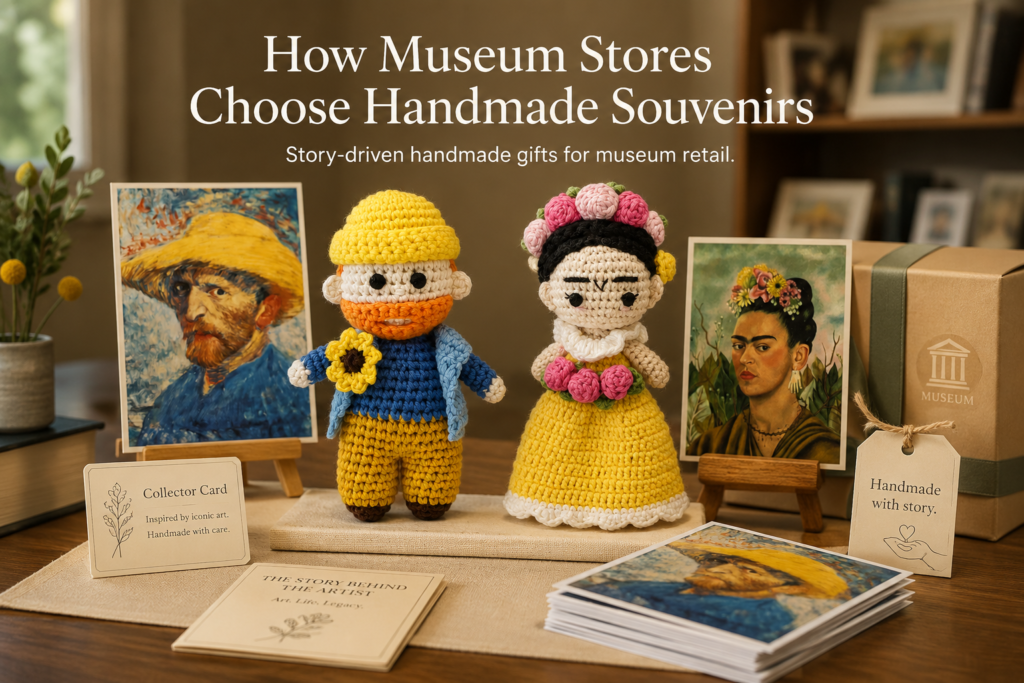
A Practical Guide to Product Selection, Storytelling, Quality, and Custom Development for Museum Retail
A museum souvenir has a different job from an ordinary retail product.
It must generate commercial value, but it should also connect visitors with:
- An exhibition
- An artwork
- A historical figure
- A cultural symbol
- A local story
- The museum itself
That is why museum stores rarely choose products based on appearance alone.
The strongest handmade souvenirs combine story relevance, design quality, giftability, practical retail economics, and reliable production.
At U-MY Crochet, we have specialized in handmade crochet manufacturing since 2013, supporting museums, cultural institutions, gift companies, retailers, and brands with custom crochet products and collections.
Through years of developing museum souvenirs, custom characters, gift products, and cultural merchandise, we have learned an important lesson:
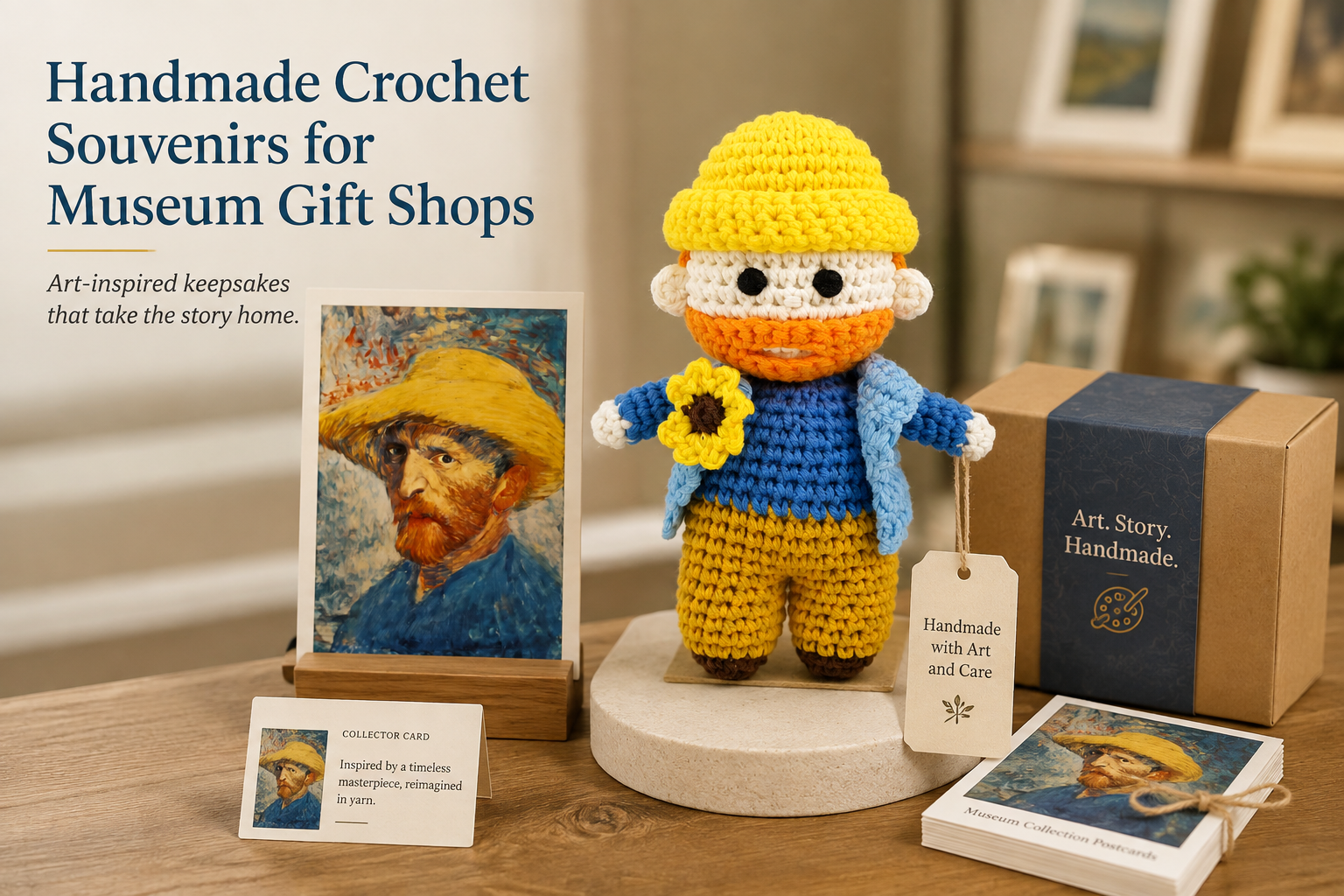
What Do Museum Stores Look for When Choosing Souvenirs?
Although every institution has different audiences, exhibitions, budgets, and retail strategies, museum buyers commonly evaluate several core factors:
- Relevance to the museum or exhibition
- Storytelling potential
- Distinctive design
- Product quality
- Giftability
- Appropriate retail pricing
- Reliable production
- Compliance for the intended market
- Packaging and display
- Potential for collection expansion
The best products usually perform across several of these areas at the same time.
1. The Souvenir Should Connect to a Real Museum Story
The first question is not:
Is this product cute?
A better question is:
Why does this product belong in this museum?
Museum retail works best when products have a clear connection to the visitor experience.
That connection might come from:
- A famous artwork
- An exhibition theme
- Architecture
- A historical object
- A cultural tradition
- Local flora or fauna
- A museum mascot
- An artist-inspired concept
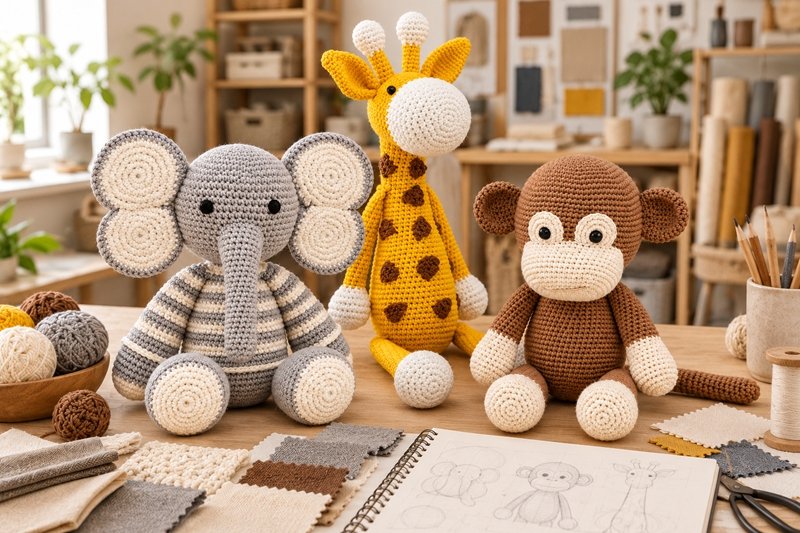
For example, a generic crochet animal may be attractive.
But a crochet character developed around an animal appearing in an exhibition, local cultural story, or museum collection creates much stronger relevance.
This difference turns an ordinary gift into a meaningful souvenir.
2. Storytelling Can Increase Perceived Value
Museum visitors often purchase souvenirs because they want to preserve a memory.
This gives museum products an important advantage:
The story itself can become part of the product value.
A handmade souvenir can communicate that story through:
- Character design
- Product colors
- Clothing
- Accessories
- Hangtags
- Story cards
- Packaging illustrations
A simple crochet product accompanied by a strong story may create more emotional value than a more complicated product without context.
From our experience with gift development, this is especially important for cultural merchandise.
The physical product attracts attention.
The story gives customers a reason to remember it.
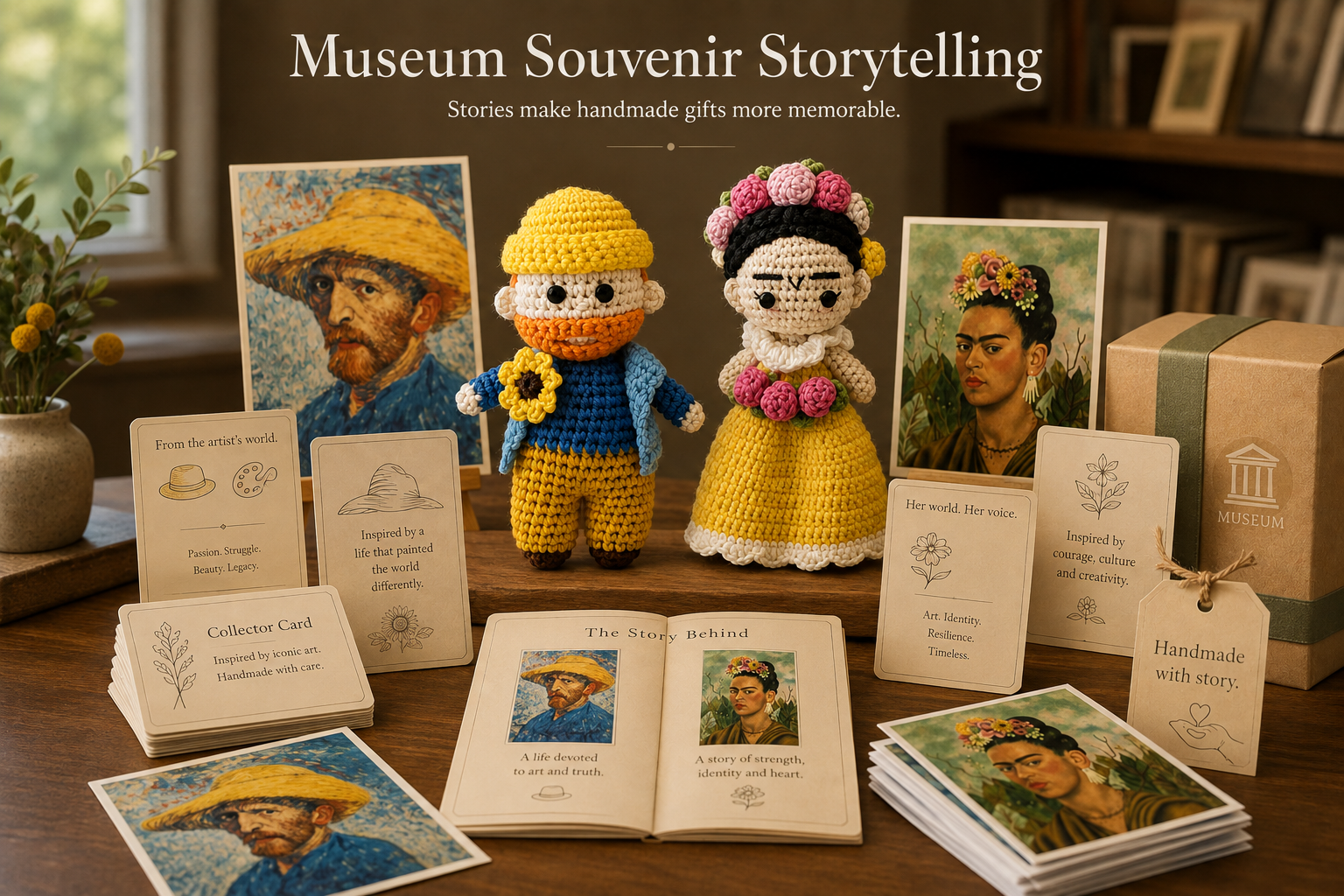
3. Handmade Craftsmanship Should Support the Museum Experience
Museums often represent:
- Culture
- Creativity
- Art
- History
- Education
- Human expression
Handmade products can fit naturally into this environment.
- Yarn texture
- Hand-formed stitches
- Soft construction
- Craftsmanship
- Tactile appeal
This can make handmade crochet particularly suitable for museums that want merchandise with a warmer, more craft-oriented identity.
However, handmade should not mean uncontrolled.
For commercial museum programs, craftsmanship still needs to be supported by production standards.
4. Originality Matters
Museum stores compete with ordinary gift shops, tourist stores, and online marketplaces.
Their merchandise should therefore offer visitors something they cannot easily find elsewhere.
This is why custom development can be valuable.
Instead of purchasing generic products, museums can develop souvenirs based on:
- Their own collections
- Exhibition artwork
- Cultural themes
- Museum characters
- Local symbols
- Educational concepts
For crochet products, customization may include:
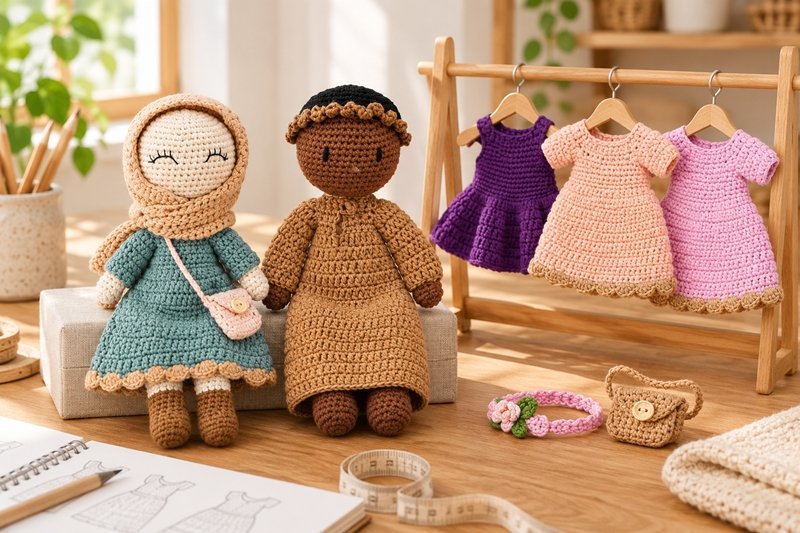
- Character shape
- Yarn colors
- Clothing
- Embroidery
- Accessories
- Size
- Labels
- Packaging
The goal is not simply to put a museum logo on an existing product.
The strongest projects integrate the museum identity into the product itself.
5. The Product Must Be Easy to Understand
Museum visitors make many purchasing decisions quickly.
A successful souvenir should therefore communicate its concept without requiring a long explanation.
This is particularly important for character products.
A customer should be able to recognize:
- What the product represents
- Why it relates to the museum
- What makes it special
If the connection requires several paragraphs of explanation before the product makes sense, the design may need refinement.
A strong museum product often has two layers:
Immediate visual appeal
*
A deeper story for customers who want to learn more
6. Giftability Is an Important Retail Factor
Not every museum souvenir is purchased by the visitor for themselves.
Many are bought as gifts.
Museum buyers should therefore consider:
- Is the product easy to give?
- Does it feel special?
- Is the price appropriate for gifting?
- Does the packaging explain the story?
- Can the recipient understand its connection to the museum?
Crochet products can work particularly well in this context because their handmade appearance naturally supports emotional gifting.
Common museum-friendly formats may include:
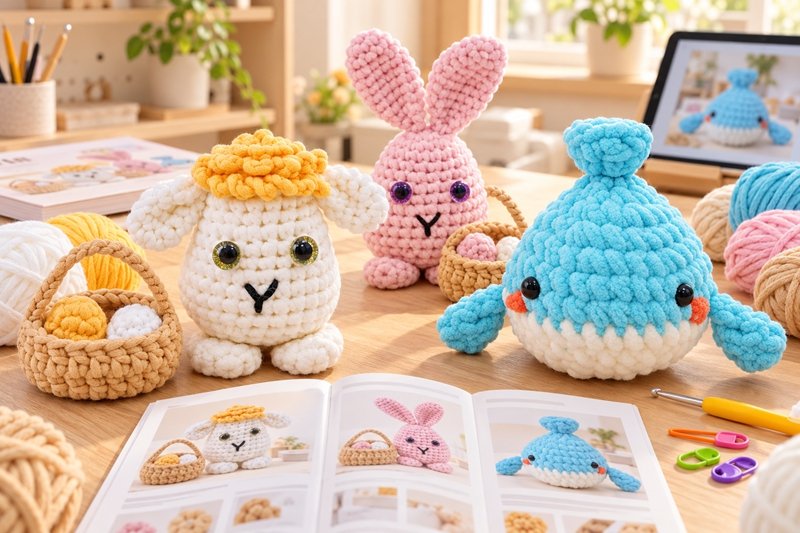
- Crochet dolls
- Mini characters
- Keychains
- Flowers
- Cultural mascots
- Gift sets
- Seasonal editions
7. Retail Price Must Be Considered During Development
One of the most important lessons in product development is that design and price should not be treated as separate decisions.
Before sampling, museum buyers should ideally define:
- Target retail price
- Expected wholesale cost
- Approximate order quantity
- Packaging expectations
This allows the manufacturer to develop the product within realistic commercial boundaries.
For example, a highly detailed 30 cm crochet character may be appropriate for a premium collector program.
The same design may not work for a museum that needs an accessible impulse-purchase souvenir.
The product architecture should match the retail strategy.
8. Different Price Points Can Serve Different Visitors
Museum stores often benefit from having several product tiers.
For example:
| Product Tier | Possible Crochet Format | Retail Role |
|---|---|---|
| Entry | Mini crochet keychain | Accessible souvenir |
| Core | Standard crochet character | Main gift product |
| Premium | Detailed character or gift set | Collector or premium gift |
| Limited | Special edition | Exhibition or seasonal release |
This allows one creative concept to serve multiple customer groups.
Instead of asking:
What is the best souvenir?
Museum buyers can ask:
What product family can serve different visitor purchasing occasions?
9. Packaging Should Continue the Museum Story
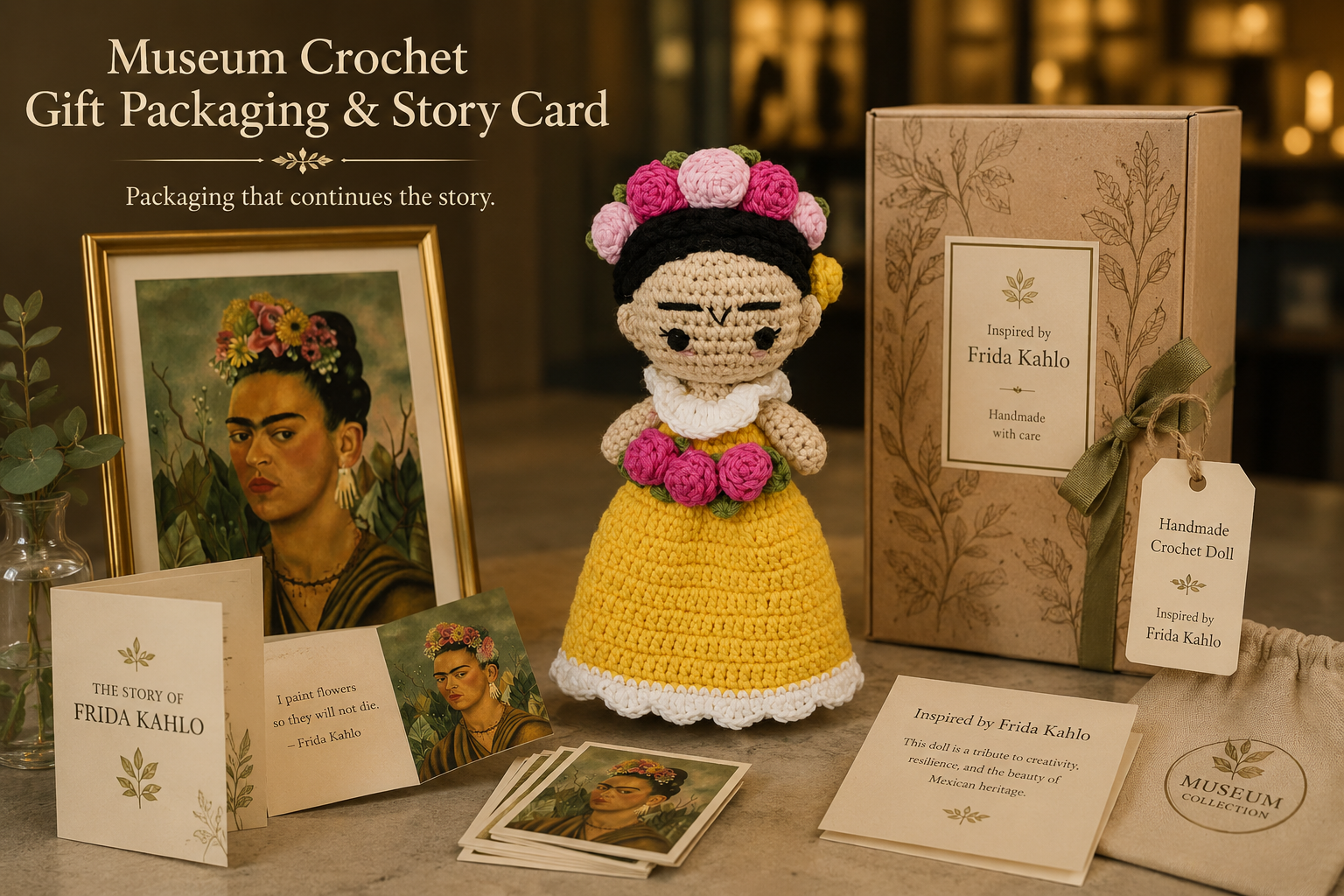
Packaging is especially important in museum retail because it can provide educational context.
A hangtag or story card might explain:
- The inspiration behind the character
- The artwork it represents
- The historical background
- The cultural meaning
- The museum collection
Packaging can therefore perform three jobs simultaneously:
Protect the product
*
Communicate the story
*
Increase gift value
For premium collections, museums may also consider:
- Custom gift boxes
- Collector cards
- Exhibition-specific packaging
- Limited-edition numbering
10. Product Quality Must Match the Institution's Reputation
A museum's reputation does not stop at the gallery exit.
Products sold in its store also represent the institution.
- Uneven finishing
- Incorrect colors
- Loose accessories
- Inconsistent sizing
- Poor packaging
can weaken the customer experience.
For handmade crochet products, professional production management should therefore establish standards for:
- Yarn
- Color references
- Dimensions
- Stitch structure
- Facial positioning
- Accessories
- Filling
- Finishing
- Packaging
Because crochet is handmade, slight variation is natural.
The objective is not to eliminate every sign of handmade production.
The objective is controlled consistency.
11. Museum Buyers Should Consider Compliance Early
If a souvenir is designed or marketed as a toy, particularly for children, applicable product-safety requirements may need to be considered.
Requirements depend on factors such as:
- Target market
- Product category
- Intended age group
- Materials
- Construction
- Accessories
Compliance planning should therefore begin during product development rather than after mass production.
For custom museum merchandise, buyers should discuss the intended market and product use with the manufacturer before finalizing the design.
12. Small Initial Orders Can Help Museums Test New Concepts
Not every new museum product needs to begin with a large order.
For new exhibitions or untested concepts, smaller initial programs can help buyers evaluate:
- Customer response
- Preferred characters
- Price sensitivity
- Best-selling sizes
- Packaging preferences
After market validation, successful products can be expanded.
This approach can be particularly useful when developing:
- New exhibition merchandise
- New museum mascots
- Seasonal programs
- Experimental collections
One lesson we have learned from custom development is:
From Museum Object to Handmade Souvenir
One of the most interesting parts of museum product development is translating cultural content into a commercially viable product.
The process might begin with:
Museum Object / Artwork / Story
↓
Identify Recognizable Elements
↓
Develop Product Concept
↓
Adapt for Crochet Construction
↓
Create Prototype
↓
Review Historical and Visual Accuracy
↓
Develop Packaging and Storytelling
↓
Prepare Production Standards
↓
Launch Retail Collection
This process requires collaboration between creative and commercial teams.
The manufacturer needs to understand not only how to make the product, but also which elements should never be lost during adaptation.
Real Development Insight: From Cultural Inspiration to Crochet Collection
In museum-related development, the initial brief may begin with a single visual reference.
The challenge is rarely simply:
"Can this be crocheted?"
The more important questions are:
- Which visual elements make it recognizable?
- Which details carry cultural meaning?
- What can be simplified?
- What must remain accurate?
- What product size fits the retail target?
- Can the concept expand into a collection?
After the first product is validated, the same creative direction may be expanded into:
- Additional characters
- Mini versions
- Keychains
- Gift sets
- Seasonal variations
This creates a stronger retail program than treating each souvenir as an unrelated product.
How Museum Stores Can Build a Souvenir Collection
A museum collection does not need dozens of products.
A focused collection can begin with:
Hero Product
The main character or object representing the collection.
Entry-Level Product
A smaller, accessible item such as a keychain.
Gift Product
A product with stronger packaging and emotional value.
Supporting Characters
Additional designs that expand the story.
Limited Edition
An exhibition-specific or seasonal version.
This creates a product architecture rather than a random assortment.
Why Collection Thinking Matters
A single souvenir creates one purchasing opportunity.
A collection can create:
- Choice
- Collectibility
- Repeat purchases
- Visual merchandising opportunities
- Future product expansion
This is particularly valuable when a museum has multiple:
- Exhibitions
- Characters
- Historical periods
- Artworks
- Cultural themes
A strong development system allows new products to be added without losing the overall identity.
What Should Museum Buyers Ask a Handmade Souvenir Supplier?
Before beginning a project, museum buyers should ask:
- Do you have experience developing custom handmade products?
- Can you work from artwork, historical references, or museum objects?
- How do you maintain consistency across handmade production?
- What is the sample development process?
- What customization options are available?
- Can you support custom packaging and story cards?
- What are the MOQ requirements?
- What is the production lead time?
- How do you manage quality control?
- Can you support applicable product testing requirements?
- How are customer designs and intellectual property handled?
- Can the original concept later expand into additional products?
The answers reveal much more than a supplier's price list.
Common Mistakes Museum Stores Make When Developing Handmade Souvenirs
Mistake 1: Choosing Generic Products and Adding a Logo
A logo alone does not create a meaningful museum souvenir.
Whenever practical, the product itself should connect to the institution's story.
Mistake 2: Developing Too Many SKUs Initially
[More products create:
- Higher inventory risk
- More sampling costs
- More complex forecasting](https://www.linkedin.com/posts/melanie-cruickshank-85060310_the-hidden-operational-activity-7468279751577772032-nKUe)
A focused initial collection can provide better market feedback.
Mistake 3: Ignoring Target Retail Price During Design
Complexity affects manufacturing cost.
Commercial targets should therefore be established before detailed sampling.
Mistake 4: Treating Packaging as an Afterthought
For cultural merchandise, packaging is an important storytelling surface.
Mistake 5: Selecting a Supplier Based Only on Unit Price
Museum merchandise involves more than production cost.
Buyers should also evaluate:
- Development capability
- Quality control
- Communication
- Compliance support
- Intellectual property handling
- Scalability
Mistake 6: Losing Cultural Accuracy During Simplification
[Some design simplification may be necessary for crochet manufacturing.
However, culturally or historically important elements should be identified before adaptation begins.](https://www.academia.edu/26763547/Museum_store_or_a_gift_shop_A_study_of_museum_store_from_a_merchandising_and_design_perspective)
How U-MY Supports Museum Crochet Souvenir Development
At U-MY Crochet, we have specialized in crochet manufacturing since 2013.
Our custom development capabilities include:
- Museum souvenirs
- Cultural characters
- Crochet dolls
- Mascots
- Gift products
- Keychains
- Collection development
- Custom packaging
For museum projects, our development process can include:
Concept Review
Understanding the:
- Cultural reference
- Product purpose
- Target customer
- Retail positioning
Design Adaptation
Translating artwork or references into crochet while preserving important visual characteristics.
Sampling
Creating physical prototypes for evaluation.
Revision
Adjusting:
- Proportions
- Colors
- Details
- Accessories
- Construction
Production Standardization
Establishing approved references for larger handmade production.
Packaging Development
Supporting gift-ready presentation, labels, and storytelling materials according to project requirements.
What Makes Crochet Particularly Suitable for Museum Souvenirs?
Crochet sits at an interesting intersection between:
Craft
Design
Storytelling
Retail
The technique itself has visible human characteristics.
That makes crochet particularly relevant for museum stores seeking products that communicate:
- Creativity
- Cultural warmth
- Craftsmanship
- Emotional connection
It also offers significant design flexibility.
A museum concept can potentially become:
Artwork-inspired character
↓
Crochet doll
↓
Mini souvenir
↓
Gift set
↓
Complete retail collection
Frequently Asked Questions
What types of handmade souvenirs work well in museum stores?
Products with a clear connection to the museum, exhibition, artwork, cultural story, or local identity generally create stronger relevance than generic souvenirs. Crochet characters, miniatures, keychains, gift sets, and culturally inspired products are possible formats.
Why do museums sell handmade products?
Can a museum develop a crochet product from an artwork?
Potentially, yes, provided the museum or project owner has the necessary rights to reproduce the artwork or design. The visual reference can then be adapted into a crochet product while preserving important recognizable elements.
Can museum souvenirs be produced in small quantities?
MOQ depends on the product, materials, customization, packaging, and manufacturer. For new concepts, discussing a smaller test order can help reduce initial inventory risk.
How long does it take to develop a custom museum crochet sample?
Development time depends on complexity, materials, and revision requirements. A custom crochet sample may commonly require approximately 7–15 working days for initial development.
Can museum stores create exclusive crochet collections?
Yes. Custom colors, characters, accessories, packaging, labels, and story elements can be developed specifically for an institution, subject to agreed manufacturing and intellectual-property terms.
How should museums protect their designs?
Museums and rights holders should clarify intellectual-property ownership, confidentiality, permitted use, and production rights before sharing valuable designs. Specific legal protection depends on the jurisdiction and should be reviewed with qualified legal counsel when necessary.
Conclusion
Museum stores do not simply choose souvenirs.
They choose physical extensions of the visitor experience.
The strongest handmade museum souvenirs combine:
- Cultural relevance
- Recognizable design
- Authentic storytelling
- Quality craftsmanship
- Appropriate pricing
- Giftability
- Reliable production
- Collection potential
For crochet products, this creates an opportunity to transform artwork, historical references, cultural symbols, and museum characters into tactile products that visitors can take home.
At U-MY Crochet, we believe the most valuable museum merchandise begins with the story rather than the product.
When that story is translated thoughtfully into design, craftsmanship, packaging, and retail strategy, a handmade souvenir can become much more than something purchased at the end of a museum visit.
It can become a lasting physical connection between the visitor and the cultural experience they came to discover.
 Chinese