
How Brands Turn Handmade Characters Into Recognizable and Lasting Brand Assets
A successful mascot does more than look cute.
It creates recognition.
It communicates personality.
And, most importantly, it gives customers something they can remember and emotionally connect with.
For brands, museums, retailers, cultural organizations, and marketing agencies, this matters because a mascot may eventually appear across:
- Retail products
- Marketing campaigns
- Events
- Social media
- Packaging
- Gift collections
- Licensed merchandise
But not every character automatically becomes a memorable mascot.
At U-MY Crochet, we have specialized in custom crochet manufacturing since 2013, helping brands and organizations transform illustrations, character concepts, and creative ideas into physical crochet products.
Through years of developing custom crochet dolls, mascots, souvenirs, promotional characters, and branded collections, we have learned one important lesson:
The most memorable crochet mascots are not necessarily the most complicated. They are the characters whose identity can be recognized quickly, reproduced consistently, and expanded into meaningful brand experiences.
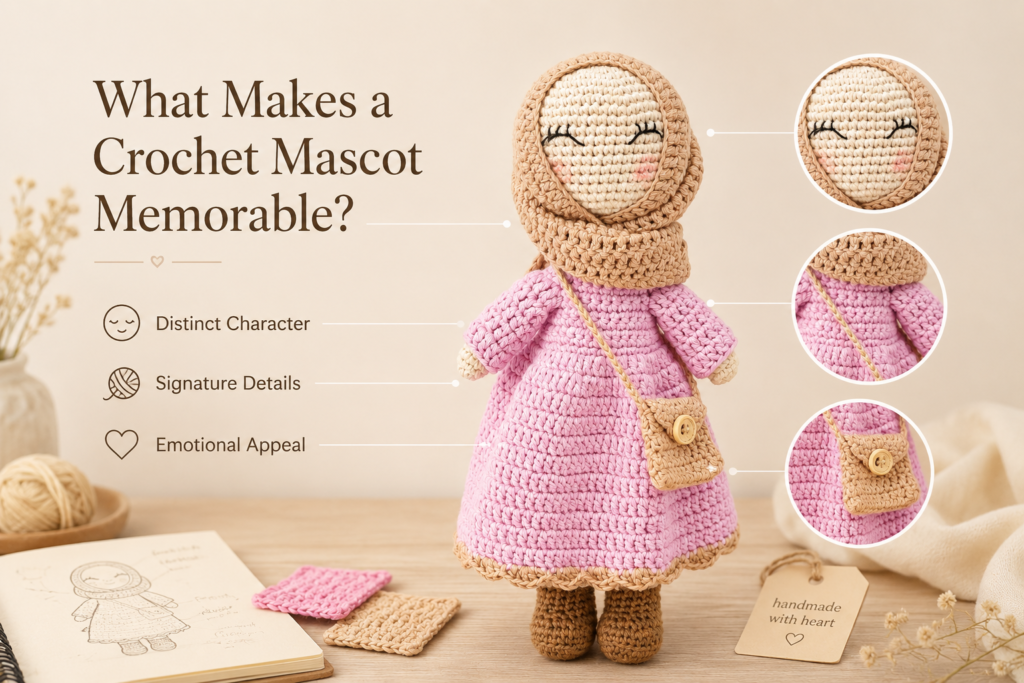
What Makes a Crochet Mascot Memorable?
A memorable crochet mascot usually combines six important qualities:
- A recognizable silhouette
- Distinctive visual features
- A clear personality
- Emotional appeal
- Consistent product execution
- Potential for future expansion
These elements work together.
A visually attractive character may attract attention once.
A strong mascot creates recognition repeatedly.
1. A Recognizable Silhouette
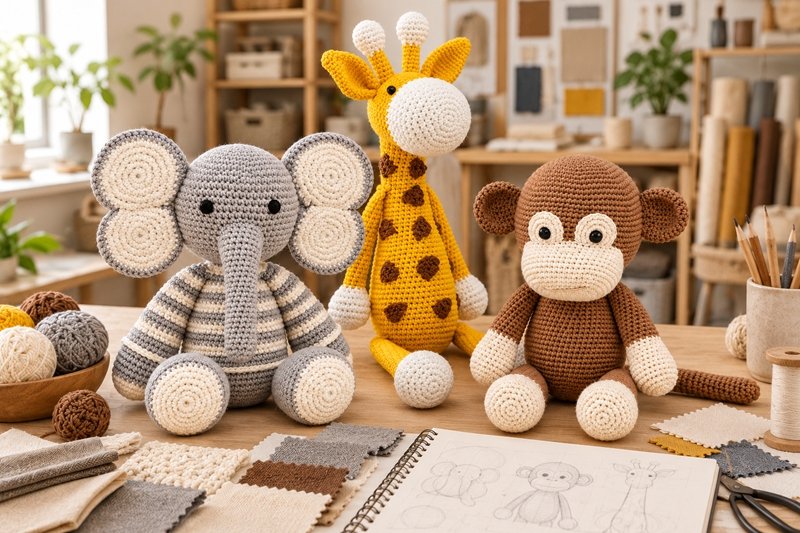
One of the first things we evaluate when developing a crochet mascot is its overall shape.
Imagine seeing the character from several meters away.
Would you still recognize it?
Strong mascots often have a distinctive:
- Head shape
- Body proportion
- Ear shape
- Hairstyle
- Hat
- Tail
- Clothing silhouette
- Signature accessory
This matters because crochet naturally simplifies some of the fine details found in digital artwork.
Practical Design Principle
When converting a character into crochet, identify the three to five features that make the character unmistakable.
Protect those features first.
Simplify secondary details only when necessary.
2. Distinctive Visual Features
After silhouette, recognizable details become critical.
These may include:
- Signature colors
- Facial expressions
- Clothing
- Accessories
- Embroidered details
- Hairstyles
- Cultural elements
- Brand symbols
The objective is not to reproduce every pixel from an illustration.
The objective is to preserve the character's identity.
At U-MY Crochet, this is an important part of character development.
During technical review, we often separate design elements into three groups:
| Priority | Design Elements | Development Approach |
|---|---|---|
| Essential | Features required for character recognition | Preserve as closely as practical |
| Supporting | Details that strengthen personality | Adapt for crochet production |
| Optional | Very small or complex decorative details | Simplify when necessary |
This approach helps balance:
Character accuracy + handmade aesthetics + production feasibility
3. A Clear Character Personality
Customers rarely build emotional relationships with shapes alone.
They connect with personality.
A memorable mascot might feel:
- Cheerful
- Brave
- Gentle
- Curious
- Playful
- Calm
- Funny
- Supportive
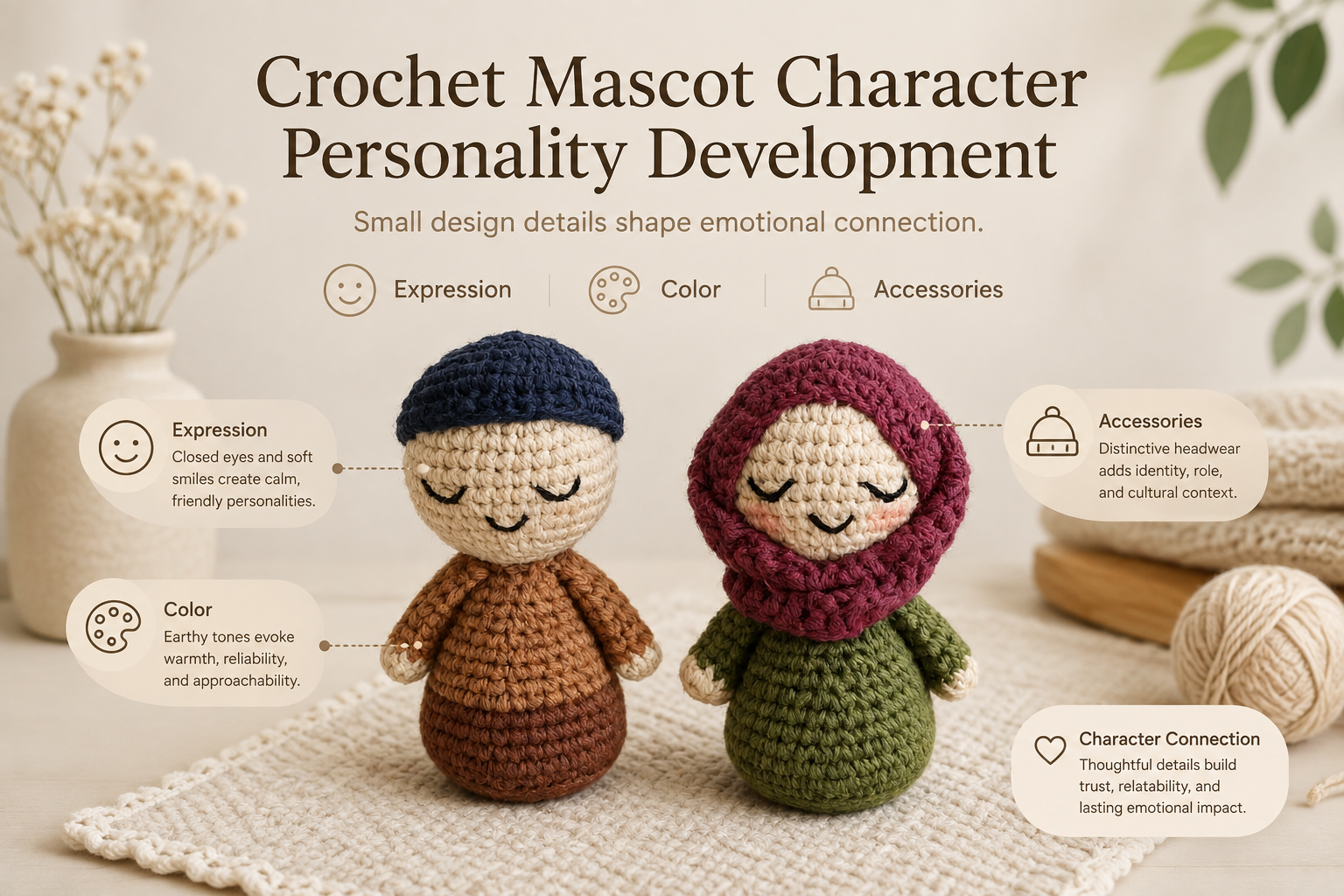
Personality can be communicated through surprisingly small details.
For example:
- Eye position
- Mouth shape
- Body posture
- Clothing
- Accessories
- Color combinations
That is why successful mascot development requires more than technical crochet skills.
It requires understanding what the character is supposed to make people feel.
4. Emotional Appeal
One of crochet's greatest advantages is its natural emotional quality.
Yarn has:
- Texture
- Softness
- Warmth
- Visible handmade details
These characteristics can make a character feel different from a flat graphic or conventional promotional item.
This is particularly valuable for brands developing:
- Emotional-support characters
- Children's products
- Museum souvenirs
- Corporate gifts
- Lifestyle products
- Collectibles
From our experience, customers often respond not only to what a crochet character looks like, but also to how it feels in the hand.
That tactile interaction can strengthen the relationship between the customer and the character.
A memorable mascot should create an emotional response before the customer even understands its complete story.
5. Simplicity Often Improves Recognition
One mistake brands sometimes make is adding too many details.
More details do not automatically create a stronger character.
They may instead create:
- Visual clutter
- Higher production costs
- Longer production times
- Greater consistency challenges
Some of the strongest mascot designs rely on a small number of distinctive features.
For example:
Simple body shape + recognizable color + signature accessory + clear expression
can be more memorable than a character containing dozens of decorative elements.
This becomes particularly important when the mascot needs to be reproduced across different product formats.
6. The Design Must Work in Three Dimensions
A digital illustration may look perfect from the front.
A physical mascot must work from:
- Front
- Side
- Back
- Multiple viewing angles
This creates one of the biggest differences between character illustration and crochet product development.
During sampling, manufacturers may need to evaluate:
- Head-to-body proportions
- Limb positioning
- Facial placement
- Accessory attachment
- Structural stability
- Overall balance
Sometimes a technically accurate interpretation of the original drawing does not create the best physical product.
Small adjustments may improve the character considerably.
From Illustration to Crochet Mascot: What Changes?
When a brand provides artwork, the development process typically begins by identifying the character's most important visual information.
For example:
Original Character
May contain:
- Complex shading
- Thin graphic lines
- Tiny patterns
- Detailed facial expressions
- Multiple material effects
Crochet Interpretation
May use:
- Yarn color blocking
- Embroidery
- Layered crochet pieces
- Fabric accessories
- Simplified shapes
The objective should not be blind duplication.
It should be:
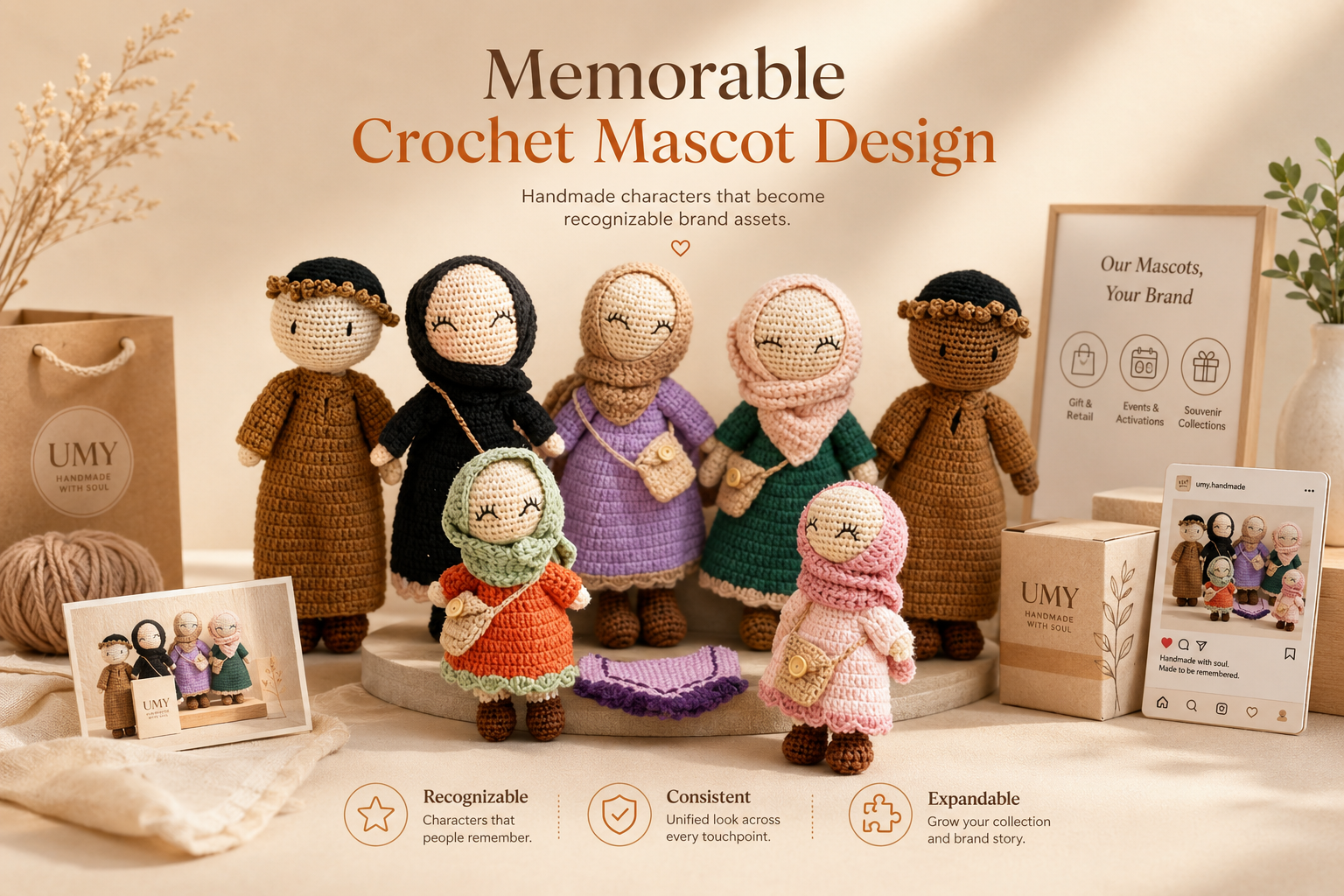
7. Consistency Makes a Mascot Recognizable at Scale
Creating one attractive prototype is only the beginning.
For commercial programs, brands may eventually need:
- Hundreds of units
- Thousands of units
- Multiple production batches
- Different product sizes
- Seasonal variations
The character still needs to look like the same character.
Professional crochet manufacturing therefore requires standardized references for:
- Yarn
- Colors
- Dimensions
- Stitch structure
- Facial placement
- Accessories
- Filling
- Finishing
Because crochet is handmade, minor variations are natural.
The objective is not machine-level uniformity.
The objective is controlled consistency.
This distinction is particularly important for brands developing recognizable character IP.
8. A Strong Mascot Should Work Across Multiple Products
One of the clearest signs of a strong mascot is its ability to expand.
A successful character might begin as:
20 cm Crochet Mascot
Then expand into:
Mini Mascot
↓
Keychain
↓
Seasonal Edition
↓
Gift Set
↓
Retail Collection
A character that works only in one exact format may have limited commercial flexibility.
A strong character system allows brands to maintain recognizable identity while changing:
- Size
- Clothing
- Accessories
- Packaging
- Seasonal themes
This is particularly important for companies that want to develop long-term intellectual property rather than a one-time promotional item.
Real Development Insight: From One Character to a Product Family
A common situation in custom development begins with a customer sending us one character illustration.
The initial objective may simply be:
"We want to make this character into a crochet doll."
During development, however, we often evaluate whether the character could also support future products.
For example:
- Can the character become a mini keychain?
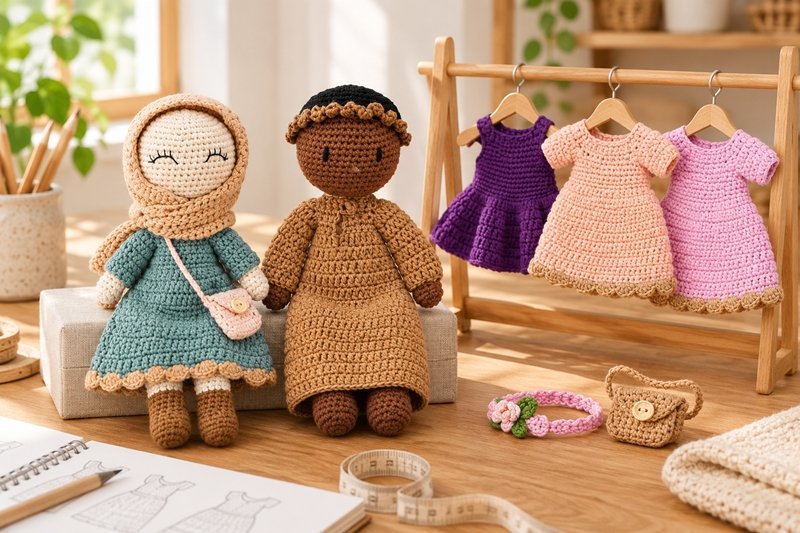
- Can its clothing change for different seasons?
- Can supporting characters be added?
- Can it work inside a gift set?
- Can packaging communicate its story?
Thinking about these questions early can prevent brands from designing themselves into a corner.
One lesson we have learned from character projects is:
A good mascot solves today's product requirement. A strong mascot also leaves room for tomorrow's collection.
9. Storytelling Strengthens Character Memory
A mascot becomes more powerful when customers understand who the character is.
A simple story can explain:
- Where the character comes from
- What it represents
- Its personality
- Its mission
- Its relationship with the brand
The story does not need to be complicated.
For example, an emotional-support character might represent encouragement.
A museum mascot might introduce visitors to a historical or cultural story.
A corporate mascot might represent company values.
Storytelling gives the physical product context.
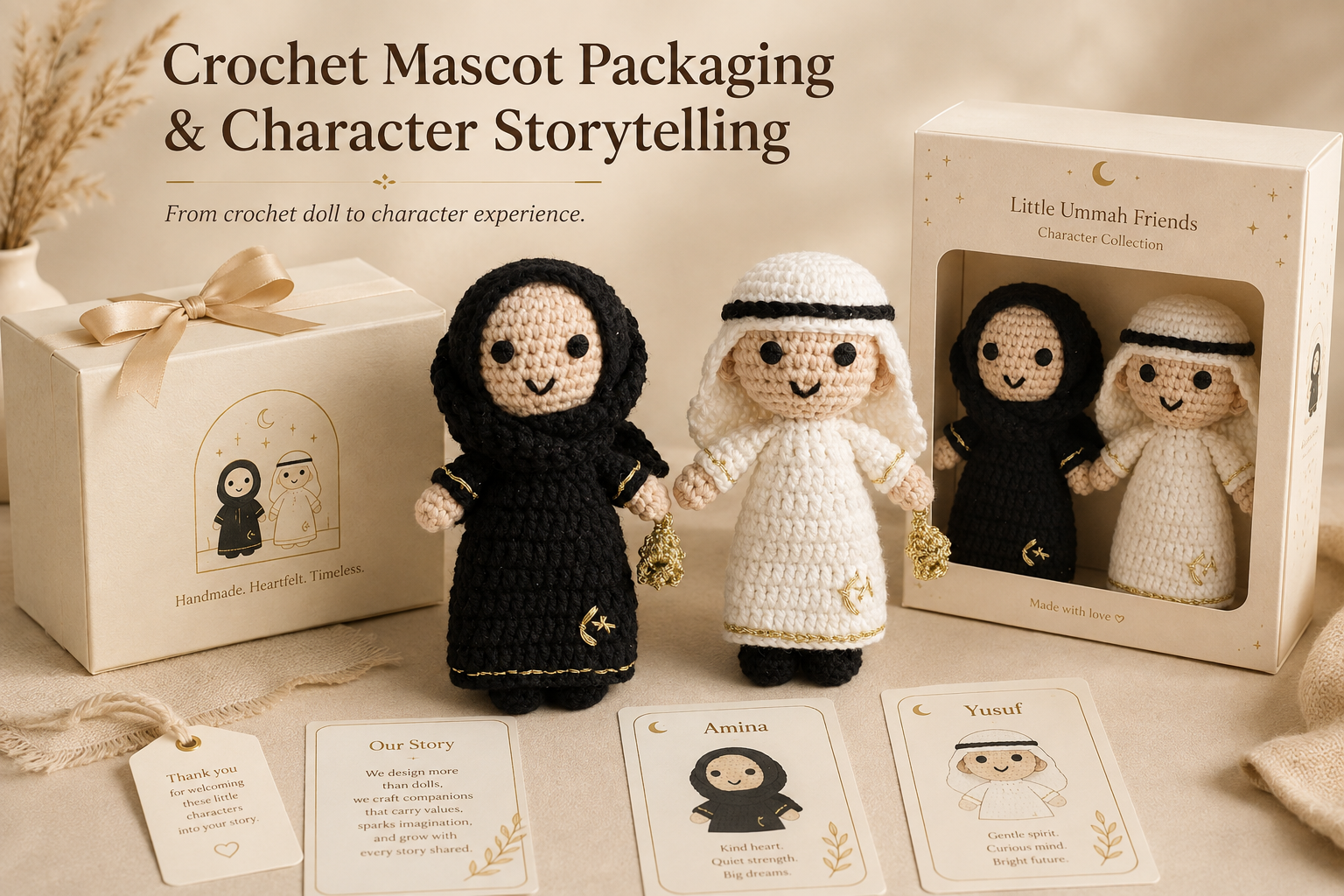
10. Packaging Can Extend the Mascot Story
Packaging should not be treated as an afterthought.
For character products, packaging can introduce:
- Character names
- Stories
- Illustrations
- Brand messages
- Collection information
Possible formats include:
- Story cards
- Gift boxes
- Hangtags
- Display packaging
- Collector cards
This turns the experience from:
Receiving a crochet doll
into:
Meeting a character
That difference can significantly strengthen perceived value.
What Makes a Crochet Mascot Suitable for Retail?
A memorable character and a commercially successful product are related, but they are not exactly the same thing.
Retailers should also consider:
Visual Impact
Does the product attract attention on a shelf or online listing?
Price Positioning
Can the design be produced at a cost appropriate for the intended retail price?
Giftability
Does the character feel suitable for gifting?
Collection Potential
Can additional SKUs be developed around it?
Packaging
Can it be displayed and communicated effectively?
Compliance
Does the intended product category and target market require specific testing, labeling, or documentation?
Successful mascot development combines creative design with these commercial considerations.
Common Mistakes When Designing Crochet Mascots
Mistake 1: Making the Character Too Complicated
Too many small details can increase cost without improving recognition.
Mistake 2: Focusing Only on Front-View Artwork
Physical products need to work from every angle.
Mistake 3: Changing Signature Features During Production
Simplification is sometimes necessary.
Removing the features that define the character is not.
Mistake 4: Ignoring Future Product Expansion
A mascot may eventually become much more than one doll.
Designing with future formats in mind creates more possibilities.
Mistake 5: Choosing the Cheapest Interpretation
Reducing cost by removing essential character details can weaken recognition.
Cost engineering should focus first on secondary complexity rather than the mascot's core identity.
Mistake 6: Approving a Sample Without Defining Production Standards
An approved prototype should become a reference for production.
Important specifications should be documented before larger orders begin.
How U-MY Develops Custom Crochet Mascots
At U-MY Crochet, our custom mascot development process typically includes:
1. Character Review
We review:
- Artwork
- Reference images
- Brand requirements
- Intended application
2. Technical Evaluation
Our team evaluates:
- Structure
- Yarn
- Colors
- Size
- Accessories
- Production feasibility
3. Sample Development
The character is transformed into a physical crochet prototype.
4. Customer Review
Customers evaluate:
- Appearance
- Proportions
- Colors
- Details
5. Sample Revision
Where necessary, adjustments are made before approval.
6. Production Standardization
The approved design becomes the reference for production and quality control.
U-MY Crochet Factory at a Glance
U-MY Crochet has specialized in handmade crochet manufacturing since 2013.
Our product-development experience covers:
- Custom crochet dolls
- Brand mascots
- Museum souvenirs
- Promotional characters
- Gift collections
- Crochet keychains
- Baby products
- DIY crochet products
We support both OEM and ODM projects, from customer-supplied artwork to broader product and collection development.
For brands developing character-based products, our objective is not simply to manufacture a doll.
It is to help translate the identity behind the character into a physical product that can be produced consistently and developed further.
Questions Brands Should Ask Before Developing a Crochet Mascot
Before beginning development, consider:
- What are the character's three most recognizable features?
- What emotion should the mascot communicate?
- Who is the target customer?
- Where will the product be sold or distributed?
- What retail price range is required?
- Could the character become multiple products?
- Which details must never change?
- Does the product require specific compliance planning?
- How will the mascot story appear in packaging or marketing?
- Who owns the character design and related intellectual property?
Frequently Asked Questions
What makes a good crochet mascot?
A good crochet mascot combines a recognizable silhouette, distinctive features, clear personality, emotional appeal, and practical production design.
How do you turn a character drawing into a crochet mascot?
The manufacturer identifies the character's essential features, adapts them to crochet construction, develops a physical sample, reviews proportions and details, and revises the prototype before production.
Should a crochet mascot look exactly like the original illustration?
It should preserve the character's recognizable identity, but some details may need to be adapted because yarn and crochet construction behave differently from digital artwork.
How long does custom crochet mascot sampling take?
Sampling time depends on complexity, materials, accessories, and revision requirements. A standard custom project may require approximately 7–15 working days for initial sample development.
Can a crochet mascot be produced in different sizes?
Yes. A mascot can often be developed into standard dolls, mini versions, keychains, and other formats, although proportions may need adjustment at different sizes.
Can crochet mascots be produced in bulk?
Can companies create seasonal versions of the same mascot?
Yes. Clothing, accessories, colors, packaging, and themes can be adapted for Christmas, Valentine's Day, anniversaries, exhibitions, campaigns, or other events while maintaining the character's core identity.
Can brands protect their crochet mascot designs?
Original character artwork, names, logos, and product designs may involve copyright, trademark, design-right, or contractual protections depending on the jurisdiction and circumstances. Brands should establish ownership and confidentiality arrangements before sharing valuable designs and seek qualified legal advice for specific IP questions.
Conclusion
A memorable crochet mascot is not created by adding more details.
It is created by making the right details matter.
Strong mascots combine:
- Recognizable design
- Clear personality
- Emotional connection
- Consistent execution
- Storytelling
- Collection potential
For brands, this transforms a handmade character from a single promotional product into something much more valuable:
a recognizable brand asset that can grow across products, campaigns, retail collections, and customer experiences.
At U-MY Crochet, we have learned that successful character development begins by asking one simple question:
What must customers remember about this character after they put it down?
When the answer is clear, the crochet product has a much stronger foundation for becoming a memorable mascot.
 Chinese