
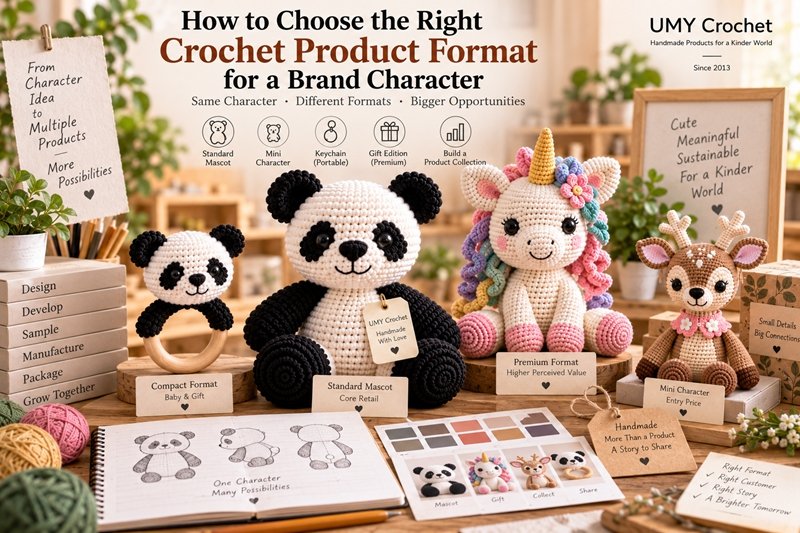
Choosing the right crochet product format for a brand character should begin with the business role of the product, not with the assumption that every character should become the same type of doll.
A brand character can potentially become a:
- Standard crochet mascot
- Mini character
- Keychain or bag charm
- Desk companion
- Retail collectible
- Gift-box product
- Gift-set centerpiece
- Seasonal or campaign edition
The best format depends on five questions:
- Who will receive or buy the product?
- Where will they encounter it?
- What should they do with it after purchase or distribution?
- Which character features must remain recognizable at that size?
- What commercial role must the SKU perform?
For example, a full-size mascot may be effective as a premium retail or corporate gift product, while a mini keychain may work better for events, entry-price merchandise, or everyday brand visibility. A gift-box version may be more suitable when presentation and perceived value matter more than portability.
The important principle is:
Do not shrink or enlarge the same character blindly. Choose the product format first, then adapt the character deliberately for that use.
That approach helps brands preserve character recognition while building products with clearer price positions, merchandising roles, packaging requirements, and future collection potential.
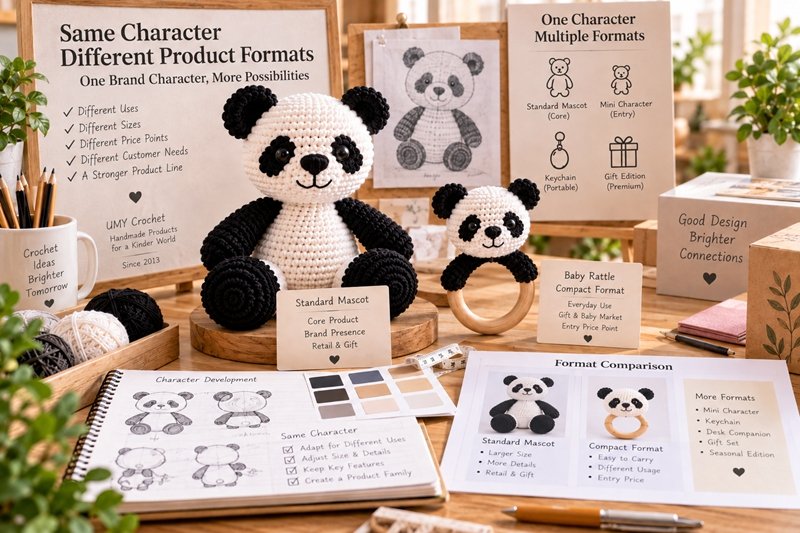
Product Format Is a Commercial Decision, Not Just a Design Decision
Brands often begin character merchandise development with a visual question:
“How should our character look as a crochet product?”
That matters, but there is an earlier question:
What job does this product need to do?
A character used as a conference giveaway has different requirements from one designed as a premium retail collectible.
A desk companion has different requirements from a bag charm.
A gift-set centerpiece has different requirements from an entry-price souvenir.
The same character identity can therefore lead to different product decisions.
A useful sequence is:
Character Identity
↓
Customer + Use Case
↓
Commercial Role
↓
Product Format
↓
Size and Construction
↓
Packaging
↓
Sampling
Starting with the format's business role prevents development teams from creating an attractive product that does not fit the intended channel.
First Protect the Character's Recognition System
Before comparing product formats, identify what makes the character recognizable.
This is especially important because changing size or application can force design simplification.
A brand character may depend on:
- Silhouette
- Head shape
- Body proportion
- Signature colors
- Facial expression
- Ears
- Hair
- Clothing
- Tail
- Hat
- Signature accessory
- Embroidered details
Not all details have equal importance.
A practical development framework is:
| Priority | Character Element | Format Decision |
|---|---|---|
| Essential | Required for immediate recognition | Protect across every format |
| Supporting | Strengthens personality or story | Adapt where necessary |
| Secondary | Small decorative detail | Simplify if format requires it |
This matters most when moving from a larger character to a mini product.
A detail that works well on a standard-size mascot may become:
- Too small
- Too crowded
- Difficult to manufacture consistently
- Visually unclear
on a keychain.
The objective should therefore be identity preservation, not literal miniaturization.
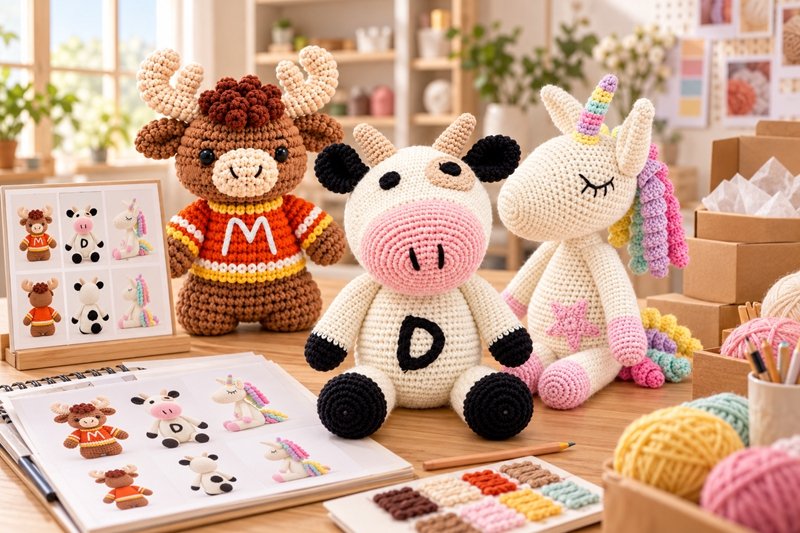
1. Standard Crochet Mascot: Best for Establishing the Character
A standard-size crochet mascot is often the strongest starting point when the objective is to establish the character physically.
Its larger format provides more room for:
- Recognizable proportions
- Clothing
- Accessories
- Color blocking
- Facial details
- Embroidery
- Character personality
It can also provide a useful master reference before smaller formats are developed.
Suitable Commercial Roles
A standard mascot may work well for:
- Core retail merchandise
- Brand stores
- Museum or cultural retail
- Corporate gifts
- Customer gifts
- Employee programs
- Character launches
- Collectible ranges
Main Advantage
The format gives the design team enough physical space to preserve character identity.
Main Trade-Off
A larger product usually requires more materials, more packing volume, and potentially more construction work than a simplified mini format.
It should therefore earn its place in the assortment through stronger:
- Perceived value
- Giftability
- Character presence
- Retail positioning
The standard mascot often works best as the core SKU around which smaller or more premium versions can later be organized.
2. Mini Crochet Character: Best When the Character Needs to Be More Accessible
A mini character can create a lower physical and commercial entry point into the brand world.
Possible applications include:
- Small gifts
- Entry-price retail
- Promotional merchandise
- Collectible series
- Event merchandise
- Add-on purchases
However, making a character smaller is not simply a matter of reducing every measurement proportionally.
Why Mini Characters Need Redesign
At a smaller scale:
- Facial details occupy less space
- Accessories can become oversized relative to the body
- Thin components may become impractical
- Complex clothing may become visually crowded
- Small color changes may lose impact
The development team may need to emphasize the strongest features.
For example:
Large Character
Signature head shape + clothing + accessory + embroidery + small decorative details
might become:
Mini Character
Signature head shape + main colors + one defining accessory
The simplified version can still be successful if customers recognize the character immediately.
3. Crochet Keychain or Bag Charm: Best for Portability and Everyday Visibility
A keychain changes the product from something primarily displayed to something potentially carried.
That creates additional development questions.
The product may need to consider:
- Compact size
- Character recognition at small scale
- Attachment position
- Hanging balance
- Accessory security
- Packaging
- Intended use
A keychain can be particularly useful when a brand wants:
- Entry-price merchandise
- Event products
- Travel-friendly souvenirs
- Add-on retail products
- Everyday character visibility
The format can also work as an extension of a larger mascot.
For example:
Core Mascot → Mini Keychain
allows customers to choose between a display-oriented product and a portable version of the same character.
Do Not Force Every Detail Onto the Keychain
The smaller the format, the more aggressively the design may need to prioritize.
A strong keychain often relies on:
Silhouette + Color + Face + Signature Feature
rather than trying to reproduce every element of the larger mascot.
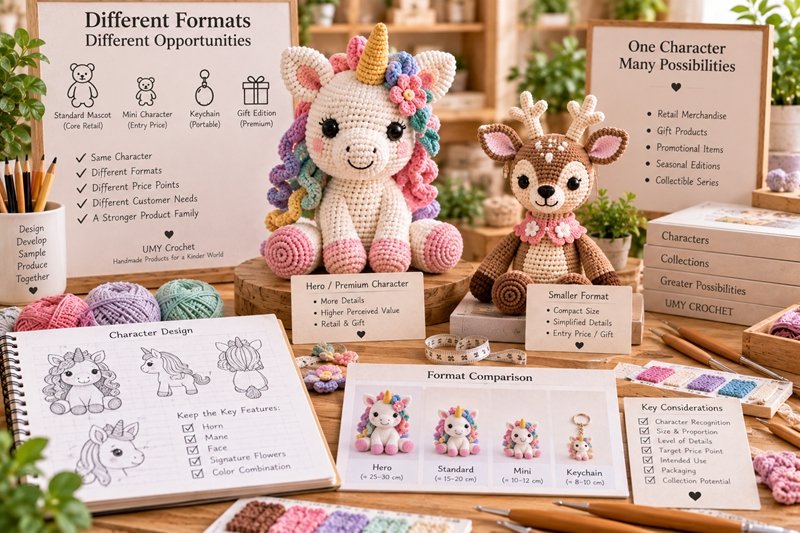
4. Desk Companion: Best When the Product Should Stay Visible
Some brand characters are intended to remain in the customer's environment rather than travel with them.
A desk companion can work well for:
- Employee gifts
- Customer appreciation
- Office campaigns
- Brand communities
- Wellness programs
- Membership programs
The commercial objective is different from a keychain.
The product should create:
Visibility + Personality + Emotional Presence
A desk-oriented character may benefit from:
- Stable proportions
- Clear front-facing expression
- Compact footprint
- Strong character silhouette
- Packaging that supports gifting
It does not necessarily need the same hanging components or portability considerations as a keychain.
For brands, this distinction matters.
A product designed to live on a desk should be evaluated as a small display object, not simply as a mini mascot without a keyring.
5. Retail Collectible: Best When Repeat Purchase Matters
A collectible format changes the commercial model again.
The product is no longer expected to succeed only as an individual character.
It may need to support a system.
That system could include:
- Multiple characters
- Different expressions
- Color variations
- Seasonal editions
- Themed accessories
- Numbered series
- Packaging families
A collectible program therefore needs stronger planning around:
- Character hierarchy
- SKU architecture
- Visual consistency
- Packaging
- Future releases
Ask Whether the Character Has Collection Logic
Before creating several variants, ask:
- What connects the SKUs?
- What makes each one different?
- Why would a customer want another?
- Is the difference meaningful enough to justify a separate SKU?
- Can customers recognize that the products belong together?
Changing only one small detail may not create enough perceived difference.
A stronger collection gives each SKU a role while maintaining a shared identity.
6. Gift-Box Character: Best When Presentation Is Part of the Value
Sometimes the crochet product itself does not need to change dramatically.
The product format changes because of presentation.
A character placed in a thoughtfully developed gift box can serve a different commercial role from the same character sold with a simple hangtag.
Gift packaging can support:
- Premium positioning
- Corporate gifting
- VIP programs
- Holiday gifting
- Brand launches
- Special editions
The package may include:
- Character story
- Brand message
- Illustration
- Collector card
- Greeting card
- Product information
This can shift the customer experience from:
Buying a character
to:
Receiving a complete branded gift experience
Packaging Must Be Evaluated With the Product
Do not finish the mascot and only then ask what box it fits into.
Product and packaging should be evaluated together for:
- Dimensions
- Presentation
- Protection
- Unboxing
- Shipping volume
- Retail display
7. Character Gift Set: Best When the Mascot Is the Emotional Centerpiece
A crochet character can also become one part of a broader gift system.
Possible combinations include:
- Character + message card
- Character + fabric pouch
- Character + notebook
- Character + story card
- Character + complementary merchandise
- Character + themed packaging
The crochet character provides the emotional and visual center.
Other components can support:
- Practical value
- Brand communication
- Occasion
- Presentation
This format can be useful for corporate buyers, gift companies, and brands that need a higher perceived-value product without making the crochet character itself excessively complicated.
The key is cohesion.
8. Seasonal Edition: Best for Refreshing a Character Without Rebuilding the IP
A recognizable character does not need a completely new design every season.
Brands may be able to retain the core character while changing controlled elements such as:
- Clothing
- Accessories
- Color accents
- Packaging
- Seasonal props
A character might therefore move through:
Core Edition
↓
Holiday Edition
↓
Anniversary Edition
↓
Event Edition
The essential identity should remain stable.
If too many defining characteristics change at once, customers may stop recognizing the character.
Protect the Core, Change the Layer
A useful design principle is:
Core Identity = Stable
Seasonal Layer = Flexible
This allows a brand to create novelty without repeatedly rebuilding the character from zero.
9. Promotional Format: Best When Distribution Scale Matters More Than Detail
Promotional programs can create different priorities from premium retail.
A buyer may need products for:
- Conferences
- Exhibitions
- Product launches
- Customer campaigns
- Employee events
- Brand activations
The product may need to balance:
- Recognition
- Quantity
- Budget
- Packaging simplicity
- Distribution
- Event timing
In these situations, a smaller or simplified character format may make more commercial sense than a highly detailed hero mascot.
But simplification should not remove the features that make the character recognizable.
The development objective becomes:
What is the simplest commercially workable version that still clearly represents the character?
That is different from asking for the cheapest possible version.
10. Premium Character: Best When Detail and Presentation Justify a Higher Position
At the other end of the range, a brand may want a more substantial character product.
A premium format may use:
- Larger size
- More detailed clothing
- Additional accessories
- More complex construction
- Enhanced packaging
- Storytelling materials
This can work for:
- VIP gifts
- Premium retail
- Special launches
- Collector products
- Important anniversaries
However, premium should not simply mean “larger.”
A larger product with no additional design or presentation value may only create:
- Higher material usage
- Larger packaging
- Higher shipping volume
Premium positioning should be visible in the complete product experience.
Match Product Format to Business Objective
A useful buyer framework is:
| Business Objective | Possible Character Format | Main Development Priority |
|---|---|---|
| Establish the character | Standard mascot | Recognition and personality |
| Entry-price retail | Mini character | Simplification without identity loss |
| Portable merchandise | Keychain / bag charm | Recognition, attachment, compactness |
| Desk visibility | Desk companion | Stability and front-facing character presence |
| Repeat purchase | Collectible series | SKU differentiation and collection logic |
| Premium gifting | Gift-box character | Presentation and perceived value |
| Corporate program | Character gift set | Message, packaging, recipient experience |
| Seasonal campaign | Seasonal edition | Novelty while preserving core identity |
| Event distribution | Simplified promotional format | Recognition, practicality, quantity planning |
This is not a universal product rule.
It is a development framework that helps buyers compare formats before sampling.
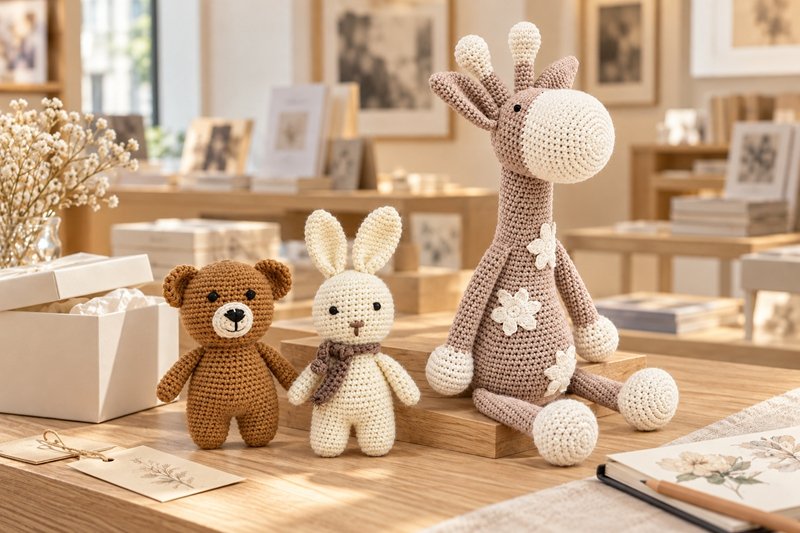
One Character May Need More Than One Size Architecture
A brand planning multiple formats should avoid choosing sizes independently.
Instead, consider the relationship between them.
For example:
Hero
Largest and most detailed representation.
Core
Main commercial size.
Mini
Simplified lower-entry version.
Keychain
Portable interpretation.
The sizes should feel intentionally related.
More importantly, the design complexity should also change intentionally.
If the mini version contains nearly the same component count as the hero product, reducing its physical size may not simplify manufacturing as much as expected.
This is why size architecture and construction architecture should be planned together.
Small Formats Can Be Technically More Difficult Than They Look
Buyers sometimes assume:
Smaller = Simpler = Cheaper
That relationship is not always automatic.
A small character may still require:
- Multiple color changes
- Tiny components
- Facial placement
- Embroidery
- Accessories
- Assembly
If every detail from the larger version is forced into a very small product, manufacturing complexity can remain high.
A better approach may be to redesign the small format.
For example:
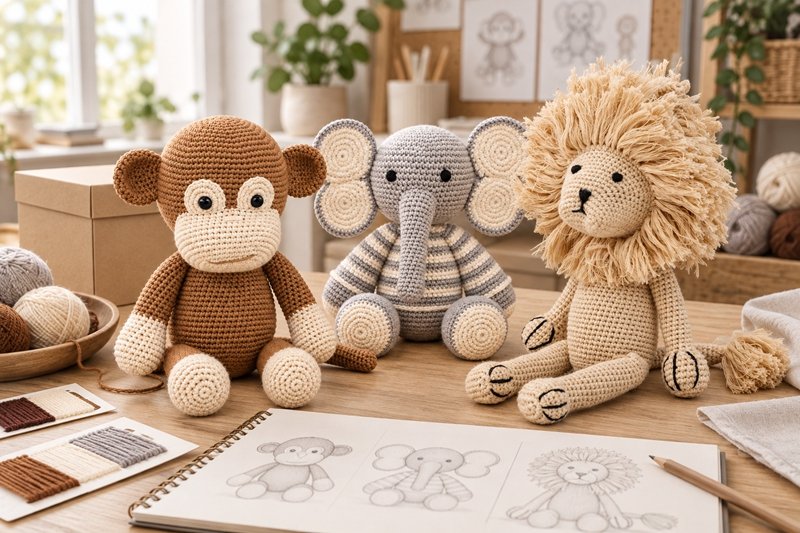
Complex Full Character
↓
Simplified Mini Body
↓
Preserved Face
↓
Preserved Signature Color
↓
One Signature Accessory
The result can be visually clearer and more suitable for the intended format.
Large Formats Create Different Cost and Logistics Questions
Larger characters provide more space for design, but they can affect:
- Yarn usage
- Filling
- Production work
- Packaging dimensions
- Carton utilization
- Storage
- Shipping volume
This means a premium hero product should be evaluated as a complete commercial item.
The buyer should not decide size only from an illustration.
A physical sample helps reveal how the product feels in:
- Hand
- Packaging
- Shelf display
- Gift presentation
The best size is the one that supports the intended product role.
Product Format Can Change the Packaging Architecture
Different character formats may require different packaging solutions.
For example:
| Format | Possible Packaging Direction |
|---|---|
| Standard mascot | Hangtag, sleeve, box, or other retail presentation |
| Mini character | Compact card, pouch, small box |
| Keychain | Hanging retail presentation or compact packaging |
| Collectible | Consistent series packaging |
| Premium character | Gift box |
| Gift set | Multi-component box or coordinated package |
The actual packaging should be developed according to the product, channel, shipping needs, and brand requirements.
A format that works well in e-commerce may need different presentation from one intended for a physical store.
Product Format Can Also Change the Compliance Question
A character's appearance alone does not determine all applicable requirements.
The intended product category, target customer, components, age positioning, destination market, labeling, and intended use may affect what testing or documentation is required.
For example, a product marketed for child play may need different compliance planning from a decorative or adult collectible product.
Brands should therefore establish intended use early and verify applicable requirements for the specific destination market and product configuration.
Do not assume that changing the package wording alone changes the underlying regulatory obligations.
Sample the Format, Not Just the Character
If a brand has already approved a standard mascot, it may be tempting to skip meaningful development work for the mini or keychain version.
That can create problems.
Each new format should be evaluated for:
- Recognition
- Proportions
- Construction
- Component size
- Facial placement
- Accessories
- Attachment points where relevant
- Packaging fit
- Overall perceived value
A standard mascot sample answers:
Does the physical character work?
A keychain sample answers a different question:
Does this character work as a keychain?
A gift-box sample answers another:
Does this character work as a complete gift presentation?
Those are separate product-development decisions.
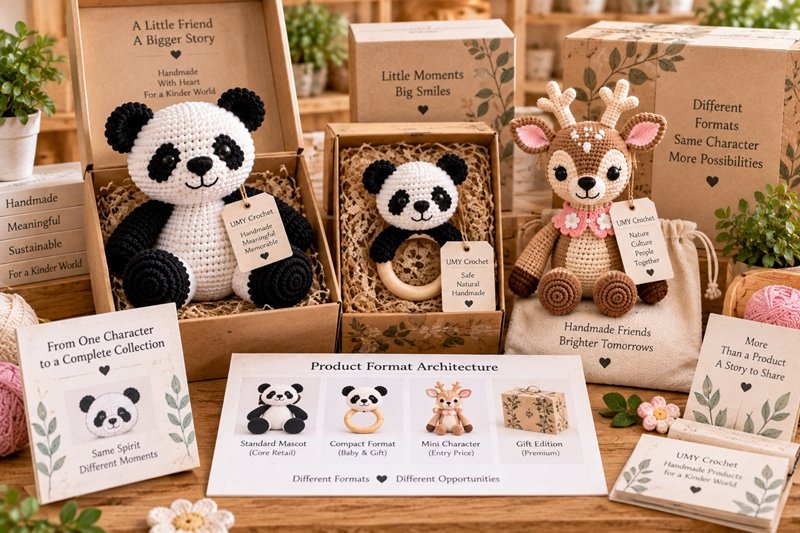
Build a Format Matrix Before Developing Multiple SKUs
Brands planning a character program can create a simple matrix before sampling.
| Decision | Hero / Standard | Mini | Keychain | Gift Edition |
|---|---|---|---|---|
| Primary customer | Define | Define | Define | Define |
| Main use | Define | Define | Define | Define |
| Character features to preserve | Define | Define | Define | Define |
| Details to simplify | Define | Define | Define | Define |
| Target size | Define | Define | Define | Define |
| Packaging | Define | Define | Define | Define |
| Retail / distribution role | Define | Define | Define | Define |
| Target quantity | Define | Define | Define | Define |
This forces the buyer to explain why each SKU exists.
If two proposed formats have the same:
- Customer
- Price role
- Use case
- Visual experience
the brand should ask whether both are necessary.
A strong collection usually gives each SKU a clear purpose.
Do Not Launch Every Possible Format at Once
A character may theoretically work as:
- Mascot
- Mini
- Keychain
- Collectible
- Ornament
- Gift set
- Seasonal edition
That does not mean all formats should enter production simultaneously.
Each additional SKU introduces:
- Development work
- Sampling
- MOQ considerations
- Materials
- Packaging
- Inventory
- Quality-control references
- Forecasting
Brands can instead build a development sequence.
For example:
Core Mascot
↓
Mini or Keychain
↓
Gift Edition
↓
Seasonal Extension
This gives the character room to grow while keeping the initial assortment more focused.
MOQ Should Be Considered Per Format
A multi-format character program can create a common sourcing misunderstanding.
The buyer may think:
“We are ordering one character.”
From a production perspective, however:
- Standard mascot
- Mini mascot
- Keychain
can be three different styles with different:
- Patterns
- Dimensions
- Component requirements
- Packaging
- Production references
For UMY custom handmade crochet projects, the typical MOQ is around 500 pieces per style, while simpler designs may sometimes be evaluated from approximately 300 pieces per style.
Actual feasibility depends on the project.
Ready-stock products generally operate at lower quantities, often around 10–50 pieces per style, subject to availability.
Sampling Time Should Be Planned Across Formats
At UMY, custom crochet sampling typically takes around 7–15 days, depending on the design, materials, accessories, revisions, and actual project conditions.
That timing should not be interpreted as a guaranteed complete-program timeline.
If a project includes:
- Standard mascot
- Mini version
- Keychain
- Custom packaging
- Gift set
each format may require separate development or review.
Packaging and other non-crochet elements may also require additional coordination.
The buyer should therefore plan the program around approved formats, not assume that approval of one character automatically approves every derivative SKU.
Keep the Character Consistent Across Different Formats
Different formats should feel different commercially without becoming different characters.
Brands can define a cross-format identity standard covering:
- Main colors
- Face
- Signature expression
- Core silhouette
- Character-defining accessory
- Important clothing elements
- Approved simplification rules
The goal is:
Same Character + Different Product Role
not:
Different Product Role + Unrecognizable Character
This becomes especially important as the assortment grows.
Packaging Can Help Connect Formats That Look Physically Different
Because the character may require different proportions at different sizes, packaging can help maintain collection consistency.
Shared packaging elements might include:
- Character name
- Illustration
- Color system
- Typography
- Story
- Collection naming
- Brand-approved graphics
This can visually connect a small keychain with a larger gift-box character even when their physical constructions differ.
Packaging therefore has two jobs:
Present the individual SKU
and
Connect the SKU to the broader character system
Think About Reorders Before Approving Too Many Variants
Multi-format collections create operational questions after launch.
For example:
- Will all formats reorder at the same rate?
- Which SKU is the core volume driver?
- Which one is seasonal?
- Which one requires special materials?
- Which packaging components are unique?
- Which colors must remain consistent across batches?
A successful character program should be designed not only for the first order but also for future replenishment.
How UMY Approaches Multi-Format Character Development
UMY has worked in product development and manufacturing since 2013.
When a buyer provides an original or properly authorized character, the development process can begin by identifying:
- Recognizable features
- Intended customer
- Intended use
- Target format
- Size
- Materials
- Accessories
- Packaging
- Quantity
The objective is not simply to reproduce one crochet doll at several scales.
Different formats may require different design decisions.
A practical development sequence can be:
Character Review
↓
Format Selection
↓
Technical Adaptation
↓
Sample Development
↓
Buyer Review
↓
Format-Specific Revision
↓
Approved Production Reference
↓
Packaging Coordination
↓
Production and QC
For brands developing several formats, we can also evaluate whether the character's essential features remain recognizable as the product changes in size and application.
UMY does not manufacture unauthorized third-party IP. Buyers developing licensed or third-party characters should have the appropriate rights or authorization for the intended project.
Common Mistakes When Choosing a Character Product Format
Mistake 1: Starting With Size Instead of Use Case
“Make it 10 cm” is not a complete product strategy.
First define what the 10 cm product needs to do.
Mistake 2: Shrinking Every Detail
Small formats often need simplification rather than proportional reduction.
Mistake 3: Assuming Smaller Automatically Means Simpler
Tiny components and complex color changes can keep manufacturing complexity high.
Mistake 4: Choosing a Keychain Only Because It Is Small
A keychain has an actual use case and attachment requirement. It should be designed for that role.
Mistake 5: Making the Premium Version Larger Without Adding Value
Premium positioning should consider detail, story, packaging, and presentation—not size alone.
Mistake 6: Giving Every SKU the Same Commercial Role
A collection is stronger when each format serves a distinct customer, price point, use case, or occasion.
Mistake 7: Approving One Sample for Every Format
Each format should be reviewed as its own physical product.
Mistake 8: Developing Too Many SKUs Before Confirming Quantity Architecture
Multiple formats can create multiple MOQ, inventory, packaging, and forecasting commitments.
Mistake 9: Losing the Character While Simplifying
Reduce secondary complexity before removing the features customers use to recognize the character.
Mistake 10: Developing Third-Party Characters Without Confirmed Authorization
Character merchandise should only proceed when the project owner has the appropriate rights for the intended commercial use.
Buyer Checklist: Which Crochet Character Format Should You Develop?
Before requesting samples, answer these questions.
Character
- What are the three to five most recognizable features?
- Which features cannot change?
- Which details can be simplified?
Customer
- Who will buy or receive the product?
- Is it for retail, gifting, events, promotion, collecting, or another use?
- Where will the customer keep or use it?
Commercial Role
- Is this an entry SKU?
- A core SKU?
- A premium SKU?
- A collectible?
- A seasonal product?
- A promotional item?
Product Format
- Standard mascot?
- Mini character?
- Keychain?
- Desk companion?
- Collectible?
- Gift-box character?
- Gift set?
- Seasonal edition?
Manufacturing
- Does the selected size preserve recognition?
- Are small components practical?
- Can secondary details be simplified?
- Does the format require unique accessories or attachments?
- Does each format need its own production reference?
Packaging
- How will it be displayed?
- How will it be protected?
- Does it need storytelling?
- Does it need to connect visually with other formats?
Quantity
- How many units are expected per format?
- Are all proposed SKUs commercially necessary?
- Which format is expected to reorder?
Frequently Asked Questions
What is the best crochet product format for a brand mascot?
There is no single best format. A standard mascot works well when character presence and detail matter, while mini characters and keychains can suit entry-price, portable, promotional, or add-on applications. Gift-box formats can support premium gifting, and collectible formats can support repeat purchase.
Should a brand develop the full-size mascot first?
Often it can be useful because a larger physical sample provides room to establish the character's proportions, colors, expression, and signature features. However, the correct starting format ultimately depends on the business objective.
Can the same crochet mascot be made as a keychain?
Often yes, but the keychain version may require redesigned proportions, simplified details, and an appropriate attachment system. It should be sampled as a separate format rather than treated as a mechanically scaled-down doll.
Does a smaller crochet mascot always cost less?
Not necessarily. Size is only one factor. Small components, color changes, embroidery, accessories, assembly, packaging, and production complexity can also affect cost.
Can one brand character support several retail price points?
Potentially. A character can be developed into entry, core, and premium formats when each SKU has a clear role and the character remains recognizable across the range.
Should every character become a collectible series?
No. A collectible range works best when there is a meaningful reason for customers to want multiple products and a clear system connecting the SKUs.
How long does it take to sample a custom character format?
At UMY, custom crochet sampling typically takes around 7–15 days depending on the design, materials, accessories, revisions, and actual project conditions. Multiple formats may require separate sampling or review.
What is the MOQ for a custom crochet character?
For UMY custom handmade crochet projects, the typical MOQ is around 500 pieces per style, while simpler designs may sometimes be evaluated from approximately 300 pieces per style. Each substantially different product format should be discussed as part of the SKU and quantity plan.
Can UMY manufacture a famous character supplied by a buyer?
Only when the project owner has the appropriate authorization or rights for the intended commercial use. Supplying an image alone should not be treated as proof of permission.
Final Buyer Takeaway
A brand character should not automatically become one standard crochet doll.
The stronger question is:
Which physical format gives this character the right job in the customer's life and in the brand's product strategy?
A standard mascot can establish character presence.
A mini version can create accessibility.
A keychain can create portability.
A desk companion can create ongoing visibility.
A collectible can encourage collection building.
A gift box can strengthen presentation.
A gift set can turn the character into a broader experience.
A seasonal edition can create novelty without replacing the core identity.
The development principle across all of them is the same:
Preserve the Character → Change the Format → Give Each SKU a Clear Commercial Role
For brands, gift companies, retailers, corporate buyers, and legitimate IP holders, this creates a more disciplined path from one character to a commercially useful product architecture.
UMY can support that process from character review and format evaluation through sampling, manufacturing preparation, quality control, and packaging coordination—while keeping the character's recognizable identity at the center of each format.
 Chinese