
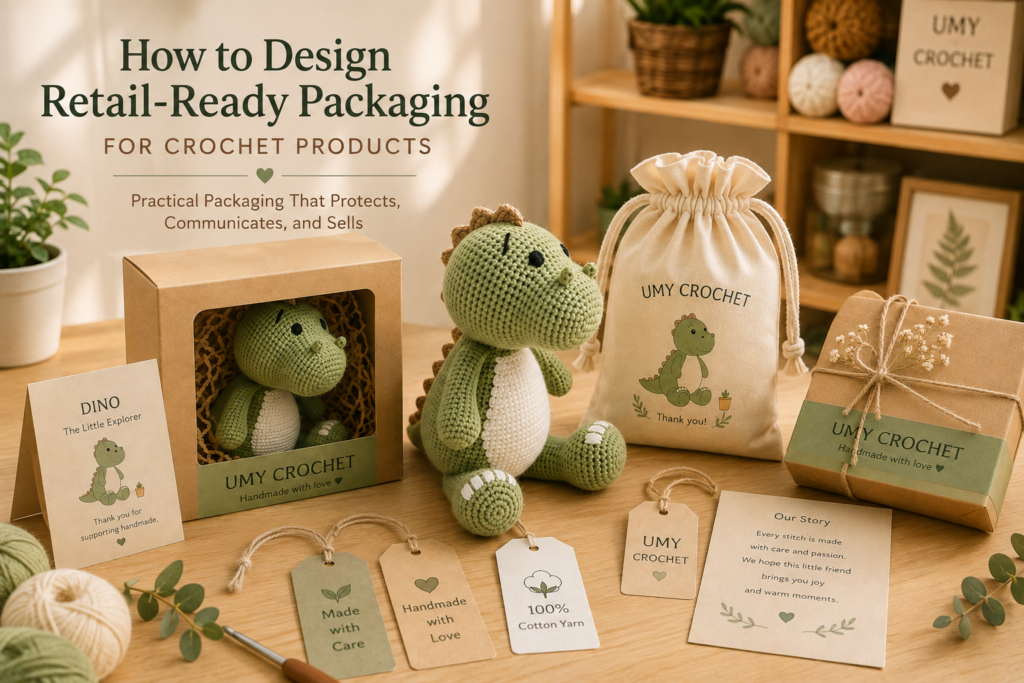
Retail-ready packaging for crochet products should do more than make a handmade item look attractive. It should protect the product, communicate its value, support the intended retail channel, provide space for necessary product information, and make the item practical to display, handle, pack, ship, and sell.
For B2B buyers, the best packaging is not automatically the most elaborate packaging. A small crochet keychain may only need a well-designed hangtag or backing card, while a premium crochet character, museum souvenir, baby gift, corporate gift, or crochet kit may benefit from a box, pouch, story card, insert, or multi-component presentation.
A practical development sequence is:
Product → Retail Channel → Packaging Format → Size & Structure → Branding & Story → Product Information → Sample → Packed-Unit Review → Production Standard
The key principle is simple:
Design the packaging around the approved crochet product and the way it will be sold—not the other way around.
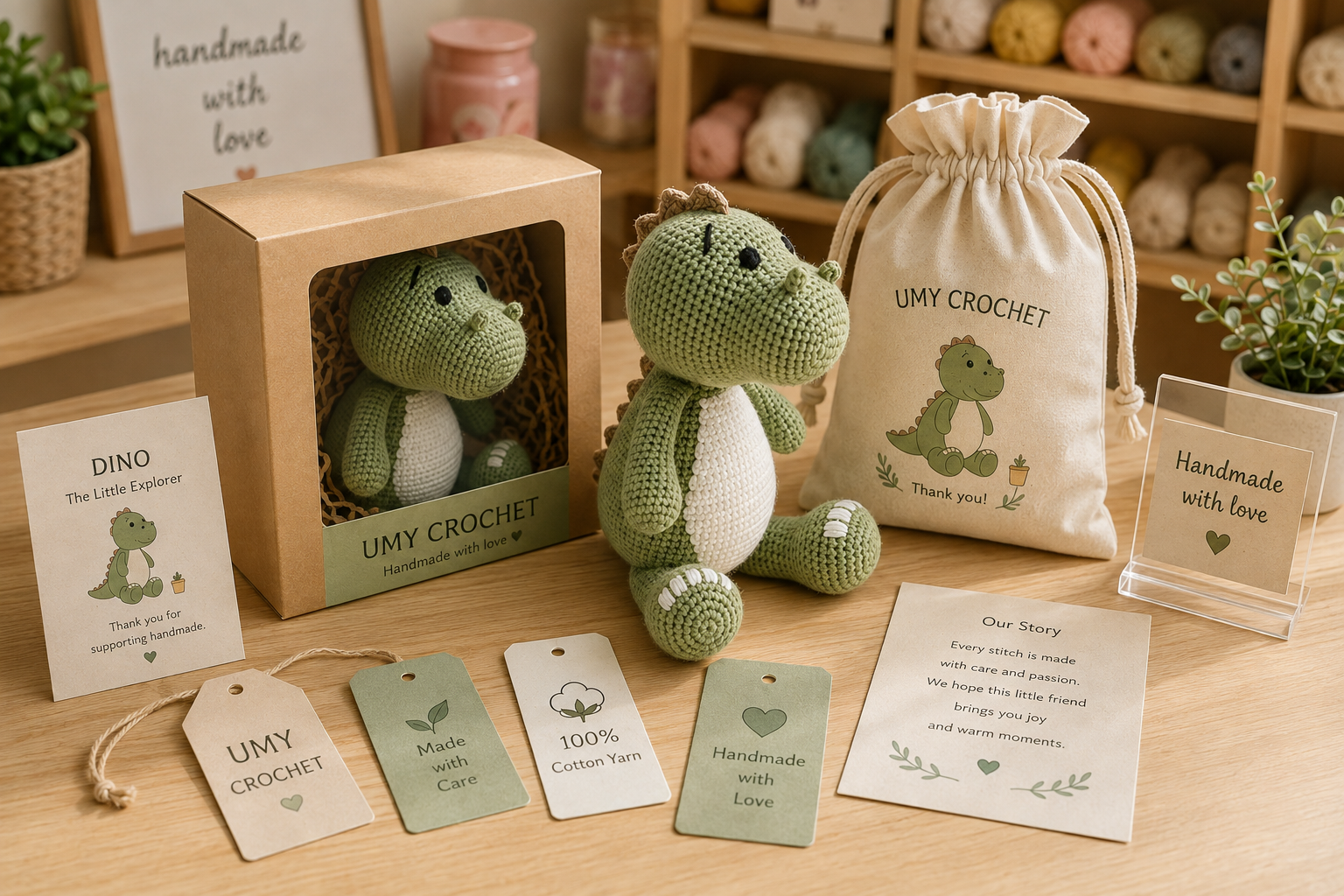
What Does Retail-Ready Packaging Mean?
That environment may be:
- An independent gift shop
- A museum store
- A baby boutique
- A lifestyle retailer
- An e-commerce store
- A corporate gifting program
- A seasonal retail display
- A tourism or cultural retail location
- A crochet kit or craft section
A retail buyer may need packaging to perform several jobs at the same time.
It may need to:
- Protect the crochet item
- Maintain product shape
- Keep accessories organized
- Show the product clearly
- Communicate brand identity
- Explain the product story
- Provide space for product information
- Support barcode or retailer-label placement
- Fit a shelf, hook, basket, counter display, or shipping carton
- Maintain a consistent appearance across multiple SKUs
Start With the Sales Channel, Not the Box
One of the most common packaging mistakes is choosing a structure because it looks attractive in a presentation.
A better question is:
Where will customers encounter this product, and how will they decide whether to buy it?
Different sales channels create different packaging priorities.
| Sales Channel | Main Packaging Priorities |
|---|---|
| Independent gift shop | Storytelling, giftability, compact merchandising |
| Museum or cultural store | Product context, story card, premium presentation |
| Baby boutique | Gift presentation, clear communication, information space |
| E-commerce | Protection, shipping efficiency, organized unboxing |
| Corporate gifting | Message, branding, presentation, recipient experience |
| Seasonal retail | Fast recognition, coordinated visual theme, assortment consistency |
| Crochet kit | Component organization, instructions, finished-result communication |
| Keychain or bag charm | Compact size, hanging display, easy SKU identification |
The same crochet item may therefore need different packaging for different channels.
A small crochet character sold near a checkout counter may work well with a branded hangtag or backing card.
The same character offered as a premium corporate gift may need a gift box, message card, and protective inner packaging.
Buyer Principle
Choose the retail experience first. Choose the packaging structure second.
Step 1: Define What the Packaging Must Do
Before discussing colors, graphics, printing, or finishes, define the functional requirements.
A useful packaging brief should answer:
- What product is inside?
- What is the approved finished size?
- Does the product have protruding or delicate accessories?
- Should customers be able to touch the crochet texture?
- Should the product remain visible before purchase?
- Will the package hang, stand, stack, sit in a basket, or remain inside a box?
- Is the item mainly a gift, collectible, souvenir, toy, accessory, decoration, or kit?
- Does the package need to hold cards, tools, accessories, or other components?
- Will e-commerce shipping be important?
- What information must appear on or with the product for the intended market and category?
These answers determine the physical and commercial role of the packaging.
The visual design should come afterward.
Step 2: Match the Packaging Format to the Product
Crochet products are soft, dimensional, and tactile.
Unlike rigid molded products, they may include:
- Rounded bodies
- Flexible limbs
- Ears
- Horns
- Hair
- Flowers
- Clothing
- Tails
- Hats
- Bags
- Embroidery
- Small accessories
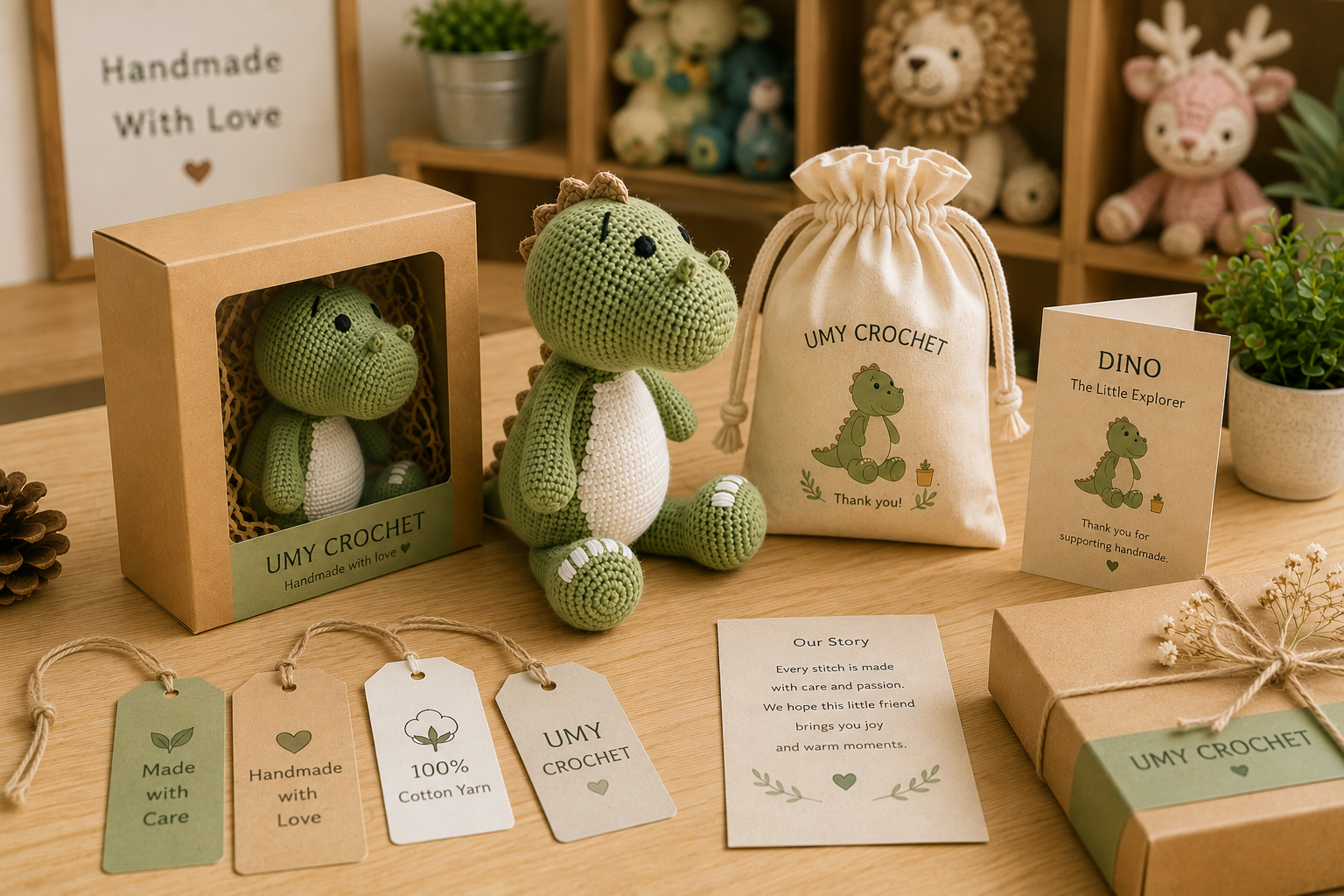
Hangtags
Hangtags work well when the crochet product itself should remain fully visible.
They may suit:
- Small dolls
- Keychains
- Bag charms
- Crochet flowers
- Hanging ornaments
- Small souvenirs
A hangtag can provide space for:
- Brand identity
- Product name
- Collection name
- Short story
- Care information
- Other project-specific information
Backing Cards
Backing cards can give smaller products a clearer retail footprint.
They may help:
- Keep the product facing forward
- Support hanging display
- Make several SKUs look consistent
- Provide space for branding and product identification
Backing cards are especially useful when a retailer needs several small products to appear as one coordinated collection.
Fabric Pouches
A fabric pouch can create a softer and more reusable presentation.
It may be appropriate for:
- Premium handmade gifts
- Cultural products
- Small accessories
- Corporate gifts
- Lifestyle collections
However, a closed pouch hides the product.
If the physical crochet item is the strongest sales feature, buyers may need:
- A product image
- A hangtag
- A display sample
- A story card
- A transparent or open display solution
to help customers understand what is inside.
Paper or Kraft Boxes
Boxes can improve product protection and gift value.
They may suit:
- Crochet dolls
- Custom characters
- Museum merchandise
- Baby gift sets
- Corporate gifts
- Seasonal products
- Premium retail collections
The correct box size should be developed around the actual physical sample.
Window Boxes
A window box can combine product visibility with structural protection.
For character products, the opening should reveal the most recognizable features, such as:
- Face
- Silhouette
- Clothing
- Signature accessory
- Yarn texture
A window that hides the face or most important feature weakens the presentation.
Gift-Set Packaging
Gift sets require additional planning because several products need to remain organized.
The package may need:
- Compartments
- Inserts
- Tissue
- Cards
- Sleeves
- Separators
- Protective inner bags
The objective is not to make the package as large as possible.
The objective is to make every component feel intentionally placed.
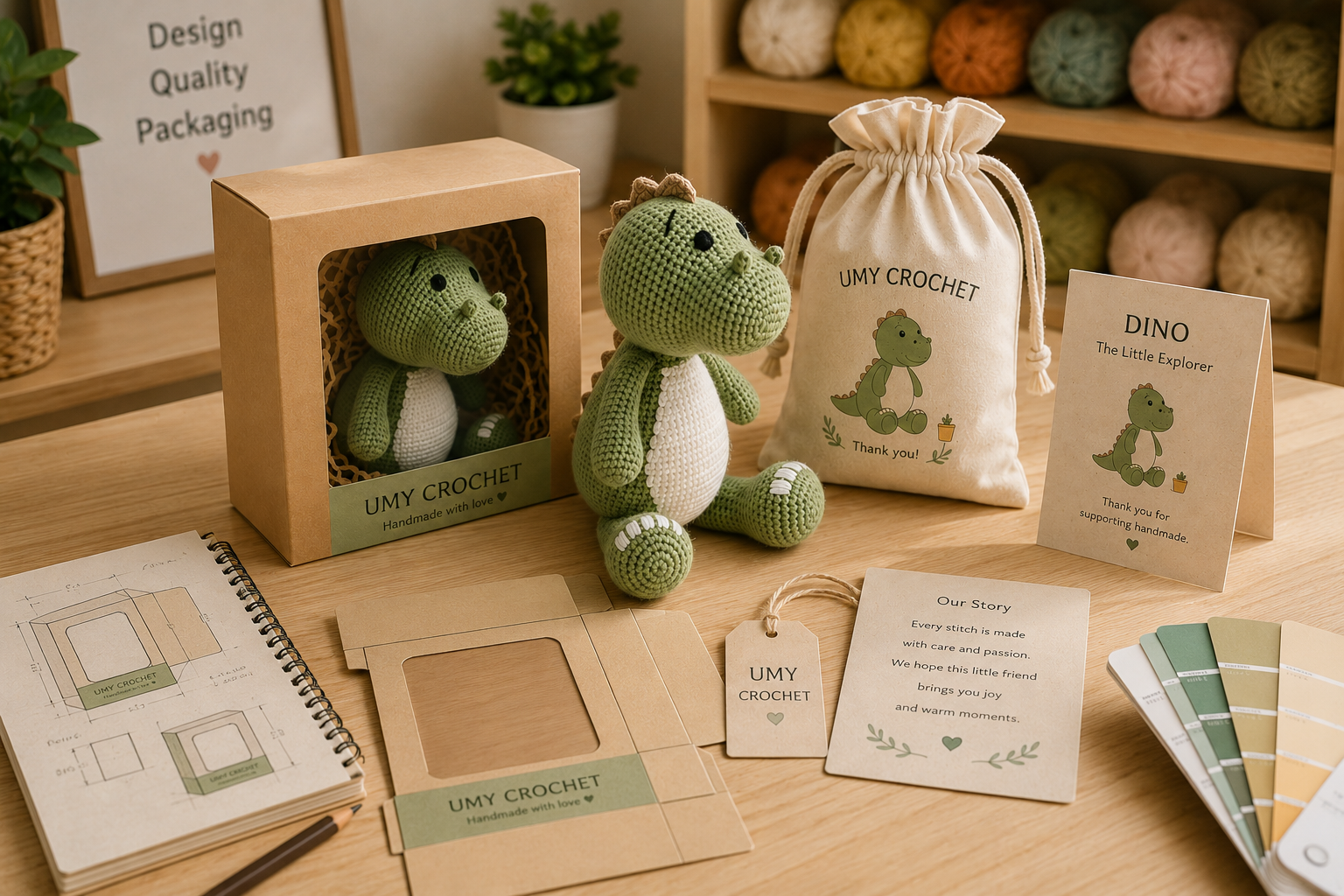
Step 3: Size the Package Around the Approved Crochet Sample
Packaging dimensions should follow the physical product.
This is particularly important for handmade crochet because the product does not behave like a rigid object.
A box that looks correct in a digital rendering may become too tight once the real crochet sample is inserted.
Packaging that is too small may:
- Compress the crochet body
- Flatten yarn texture
- Bend ears or accessories
- Distort clothing
- Change the product silhouette
- Make packing difficult
Packaging that is too large creates different problems:
- More packaging material
- More empty space
- More internal movement
- Higher shipping volume
- Lower shelf efficiency
- An under-filled appearance
A practical development method is to review the physical sample inside a packaging mock-up.
Check the product:
- From the front
- From the side
- After insertion
- After removal
- After normal handling
For boxed products, also review whether the item moves excessively when the package is tilted or transported.
Step 4: Decide What Customers Should See First
Crochet products often sell through emotional recognition.
A customer may first notice:
- A character's face
- A recognizable silhouette
- Yarn texture
- A color combination
- A handmade detail
- A gift presentation
Packaging should support that first impression.
For character products, the face is often visually important.
For crochet flowers, the color arrangement and overall shape may be the strongest feature.
For crochet kits, customers may need to understand both:
- What they will make
- What is included in the kit
For museum and cultural products, the connection between the item and the story may be an important part of the buying decision.
Use a Clear Visual Hierarchy
A useful starting hierarchy is:
Product first → Brand second → Story third → Supporting information fourth
This is not a fixed design rule, but it helps prevent packaging from becoming visually louder than the handmade product.
Too many:
- Logos
- Decorative patterns
- Illustrations
- Claims
- Colors
- Fonts
- Promotional messages
can make a small crochet product feel crowded.
Step 5: Use Story Cards and Hangtags to Add Meaning
Crochet packaging can do more than identify the item.
It can explain why the product exists.
A story card may communicate:
- Character name
- Design inspiration
- Collection concept
- Cultural context
- Gift message
- Brand story
- Product-family information
This is particularly useful for:
- Museum souvenirs
- Cultural collections
- Original brand mascots
- Corporate gifts
- Seasonal products
- Limited collections
A simple crochet product can become more meaningful when customers understand the idea behind it.
Keep Storytelling Accurate
Packaging is a high-visibility claim surface.
Do not use it to imply:
- An unverified artisan story
- Unsupported sustainability claims
- Unauthorized cultural endorsement
- Unconfirmed certifications
- A relationship with a third-party brand that has not been authorized
Storytelling should strengthen the product without creating inaccurate claims.
Step 6: Build Private-Label Branding Around the Product
Private-label packaging may include:
- Logos
- Brand colors
- Collection graphics
- Custom typography
- Labels
- Stickers
- Hangtags
- Sleeves
- Printed boxes
- Story cards
- Fabric pouches
But stronger branding does not always require larger branding.
For many handmade products, restrained brand presentation can make the item feel more premium.
This is particularly relevant for:
- Corporate gifts
- Museum souvenirs
- Baby gifts
- Premium collections
- Lifestyle brands
The package should connect the crochet product to the brand without making the physical item feel secondary.
A useful question is:
If the logo were smaller, would the product still feel desirable?
If not, the packaging may be depending too heavily on branding rather than product value.
Step 7: Design Packaging as a Collection System
Retail buyers rarely plan only one SKU forever.
A strong packaging system should make future expansion easier.
One crochet character may later become:
- Standard doll
- Mini keychain
- Premium gift edition
- Seasonal variation
- Crochet kit
- Multi-item gift set
The packaging structures do not need to be identical.
They should feel related.
- Color palette
- Logo position
- Illustration style
- Card proportions
- Typography
- Material direction
- Hangtag shape
- Story-card format
- Collection naming
One Character, Multiple Packaging Levels
| Product Format | Possible Packaging Direction |
|---|---|
| Mini keychain | Branded backing card |
| Standard doll | Hangtag + story card |
| Premium doll | Gift box |
| Corporate edition | Message card + branded box |
| Seasonal edition | Shared box + seasonal sleeve |
| Crochet kit | Component packaging + instruction system |
This allows a brand to create several retail and price levels without losing visual identity.
Step 8: Consider Packaging Cost Before Final Artwork
Packaging has its own cost structure.
Depending on the project, buyers may need to consider:
- Packaging material
- Printing
- Cutting or forming
- Inserts
- Cards
- Labels
- Pouches
- Assembly
- Packing labor
- Additional shipping volume
Packaging design should therefore be connected to the product's intended retail positioning.
A premium presentation box may make sense for a higher-value gift.
It may be commercially unsuitable for a small impulse-purchase keychain.
Packaging Components May Have Their Own Production Conditions
The crochet product and the packaging do not always share the same production constraints.
Custom printed:
- Boxes
- Cards
- Sleeves
- Pouches
- Inserts
- Labels
may have their own minimum quantities and setup conditions.
Buyers should therefore confirm:
- Product quantity
- Packaging quantity
- Number of packaging versions
- Number of SKUs
- Whether several SKUs can share one packaging structure
before approving artwork.
One possible way to reduce complexity is to share one base package across several designs and differentiate individual products through:
- Labels
- Stickers
- Cards
- Sleeves
- Color-coded identifiers
Whether this approach works depends on product size, retail positioning, and packaging supplier conditions.
Step 9: Prototype the Packaging Before Bulk Printing
Digital packaging artwork is useful.
A physical packaging mock-up is more useful.
Before bulk printing, review a prototype with the actual crochet sample whenever possible.
The review should cover:
Fit
Does the product fit comfortably without unnecessary compression?
Orientation
Does it sit in the intended position?
Visibility
Can customers see the most important product features?
Protection
Are delicate parts reasonably protected?
Removal
Can the product be removed without damaging the crochet item or packaging?
Repacking
If required, can the product be placed back into the package?
Information
Is important product information easy to find?
Collection Consistency
Does the packaging feel related to other SKUs?
Packing Efficiency
Can the packing team reproduce the intended presentation consistently?
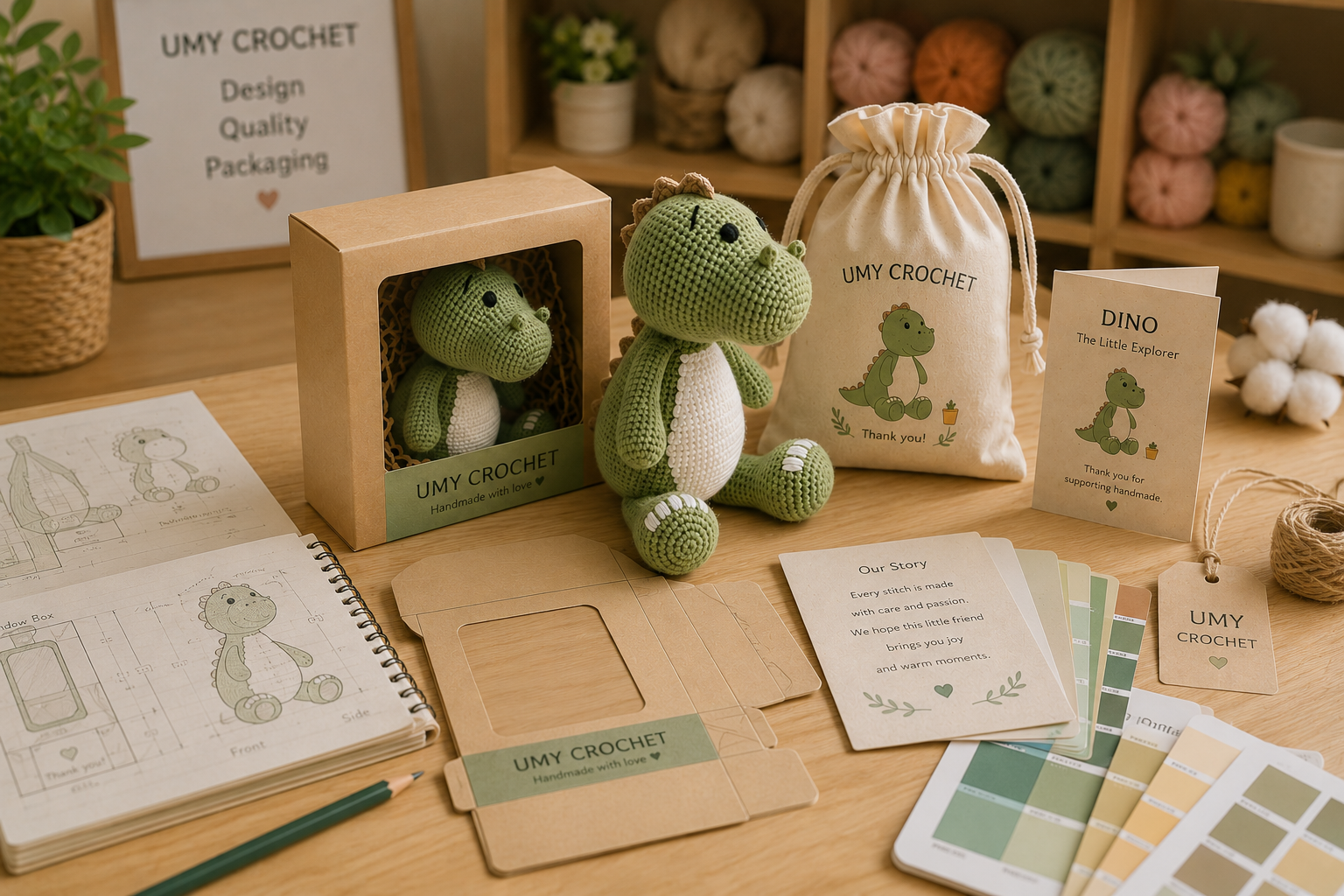
Step 10: Review the Complete Packed Unit
An empty box may look perfect.
The finished packed product can behave very differently.
A practical review should consider normal handling such as:
- Picking up the package
- Moving it between cartons
- Shelf placement
- Repeated handling
- Basic transport movement
- E-commerce packing where relevant
Look for issues such as:
- Product shifting
- Accessories bending
- Cards moving out of position
- Windows becoming blocked
- Packaging collapsing
- Surface scuffing
- Product compression
There is no single universal test for every crochet product.
The review method should match the:
- Product type
- Sales channel
- Shipment method
- Target market
- Buyer requirements
The objective is to identify packaging problems before the whole order is packed.
Step 11: Reserve Space for Product and Market Information
Visual design should not use every available surface.
Depending on the product category and target market, packaging may need space for information such as:
- Product identification
- Company or responsible-party information
- Materials or care information
- Intended-age or use information
- Warnings where applicable
- Country-of-origin information
- Barcode or retailer label
- Batch or traceability information
- Other market-specific information
What is actually required depends on the specific project, including:
- Target market
- Product category
- Intended age group
- Materials
- Product use
- Retailer requirements
These requirements should be confirmed for the individual product and destination market.
Do not copy:
- Certification marks
- Safety symbols
- Sustainability claims
- Regulatory statements
from another product simply because they appear on competitor packaging.
They should only be used when appropriate and supported by the actual product and applicable requirements.
Step 12: Connect Packaging With Quality Control
Packaging consistency is part of product consistency.
A final packing specification may define:
- Correct box or pouch version
- Correct hangtag
- Correct story card
- Correct SKU label
- Correct product orientation
- Correct accessory placement
- Correct insert
- Correct closure method
This becomes especially important when a collection contains similar SKUs.
Examples include:
- The same character in different colors
- The same box with different story cards
- Different seasonal sleeves
- Different language versions
- Retailer-specific labels
For this reason, approved packaging should become part of the production reference.
A Practical Packaging Decision Matrix
| Buyer Question | If Yes | Possible Packaging Implication |
|---|---|---|
| Must customers touch the crochet texture? | Yes | Consider a hangtag, backing card, open display, or accessible window |
| Is the item mainly a gift? | Yes | Consider a box, pouch, message card, or premium presentation |
| Is the product small and impulse-driven? | Yes | Keep packaging compact and easy to display |
| Does the story influence purchase? | Yes | Add a concise story card or hangtag |
| Does the product have delicate accessories? | Yes | Add structural protection or internal control |
| Is e-commerce important? | Yes | Review shipping protection and package volume |
| Are there many SKUs? | Yes | Build a clear identification system |
| Is the retail price entry-level? | Yes | Avoid packaging that consumes too much product value |
| Is it a premium collectible? | Yes | Consider stronger presentation and retention value |
Common Mistakes Buyers Make With Crochet Packaging
Mistake 1: Designing Packaging Before the Product Is Stable
Late changes to product size, clothing, or accessories can force packaging changes.
Mistake 2: Choosing an Oversized Box
Mistake 3: Hiding the Product's Best Feature
If the face, yarn texture, color, or signature accessory drives the purchase, the package should not block it.
Mistake 4: Adding Too Much Text
Customers should understand the product quickly.
Use clear hierarchy rather than filling every surface.
Mistake 5: Printing Unverified Claims
Do not add unsupported:
- Certifications
- Sustainability claims
- Licensing claims
- Cultural endorsements
Mistake 6: Ignoring the Display Method
A package may look attractive but still fail if it cannot:
- Stand
- Hang
- Stack
- Fit the retailer's fixture
Mistake 7: Reviewing the Package Without the Product
The physical crochet item and packaging should be approved together.
Mistake 8: Giving Every SKU a Completely Different Packaging Structure
Unnecessary variation can increase:
- Development complexity
- Printing complexity
- Packing complexity
- Inventory complexity
without creating enough additional retail value.
How UMY Approaches Retail-Ready Crochet Packaging
UMY has been involved in crochet product development and manufacturing since 2013.
For suitable custom projects, packaging can be coordinated as part of a broader product-development process:
Product Concept → Crochet Sample → Packaging Direction → Physical Fit → Branding & Story → Packaging Sample → Packing Specification → Production → Retail Presentation
Depending on the project, packaging development may include:
- Gift boxes
- Hangtags
- Story cards
- Fabric pouches
- Sleeves
- Inserts
- Private-label elements
- Collection presentation
- Retail-ready pack structures
The appropriate solution depends on:
- Product type
- Quantity
- Target market
- Sales channel
- Price positioning
- Buyer requirements
Packaging should therefore connect:
Product Development + Branding + Purchasing + Production + Logistics + Retail Merchandising
Buyer Checklist Before Approving Crochet Packaging
Before final approval, confirm:
- [ ] The crochet sample is sufficiently stable
- [ ] The intended sales channel is defined
- [ ] The packaging format matches the product
- [ ] Dimensions have been checked with the physical sample
- [ ] Product orientation is clear
- [ ] Important visual features remain visible
- [ ] Branding hierarchy is approved
- [ ] Story-card and hangtag content is accurate
- [ ] Required information areas have been reserved
- [ ] Packaging production conditions have been reviewed
- [ ] Artwork versions are controlled
- [ ] The complete packed unit has been reviewed
- [ ] SKU identification is clear
- [ ] Packing method is documented
- [ ] Shipping and handling needs have been considered
- [ ] Final claims and marks have been confirmed for the intended product and market
Frequently Asked Questions
What packaging works best for crochet products?
There is no single best format. Small accessories may work with hangtags or backing cards, while dolls, gift sets, museum products, baby gifts, corporate gifts, and premium products may benefit from boxes, pouches, story cards, or other structures. The choice should follow the physical product and sales channel.
Should a crochet product be visible through the packaging?
Often, visibility helps because crochet texture, facial features, and handmade details can influence purchase. However, premium gifting, e-commerce, or protection requirements may justify more enclosed packaging. The structure should support the intended buying experience.
Can crochet packaging be private-labeled?
Yes. Depending on the project, private-label elements may include logos, colors, boxes, hangtags, story cards, sleeves, labels, pouches, and collection graphics.
When should packaging development begin?
Packaging direction should be considered early, but final dimensions and artwork are best confirmed after the core physical product specification is reasonably stable.
Can custom packaging have a different MOQ from the crochet product?
Yes. Printed boxes, cards, pouches, sleeves, inserts, and other packaging components may each have their own production conditions. These should be evaluated together with the intended product quantity.
Can the same packaging be used for several crochet products?
Often, yes, if product dimensions and retail positioning are compatible. A shared base structure combined with SKU-specific cards, labels, sleeves, or identifiers can sometimes reduce complexity.
What information should appear on crochet product packaging?
It depends on the product category, target market, intended age group, materials, use, and retailer requirements. Buyers should confirm applicable labeling and compliance requirements for the specific project rather than copying another product's packaging.
Can packaging increase the perceived value of a crochet product?
Yes. Appropriate presentation, storytelling, organization, and giftability can strengthen the customer experience and perceived value. However, packaging should support a strong product rather than compensate for a weak product concept.
Conclusion
Retail-ready packaging is not simply the final decorative layer around a crochet product.
It is where several commercial decisions meet:
Product Design + Brand + Protection + Storytelling + Compliance Planning + Logistics + Merchandising
The strongest packaging solutions start with the actual crochet product and the way customers will encounter it.
They fit the product correctly.
They protect important details.
They communicate enough information without overwhelming the customer.
They support the brand story.
And they work operationally for packing, shipping, display, and future collection expansion.
For brands, retailers, gift companies, museums, cultural organizations, and e-commerce businesses, this approach turns packaging from a decorative afterthought into a practical part of product commercialization.
That is what makes a crochet product truly retail-ready.
 Chinese