
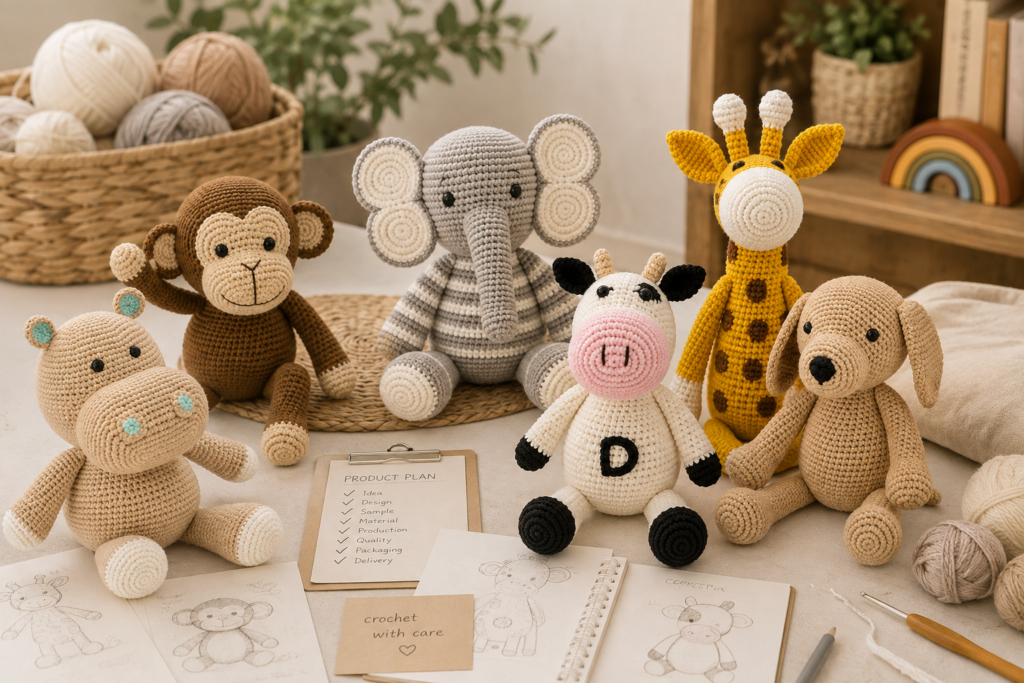
How Brands, Retailers, Museums, and Gift Companies Can Evaluate Crochet Manufacturers Before Building a Long-Term Partnership
Choosing a crochet manufacturing partner is not simply about finding someone who can make a product.
The right partner can influence:
- Product quality
- Sampling speed
- Development cost
- Compliance risk
- Delivery reliability
- Inventory planning
- Brand reputation
- Future collection growth
This is especially true for handmade crochet.
A supplier may be able to create one attractive sample.
The more important question is:
Can that supplier repeatedly turn your ideas into reliable, market-ready products as your business grows?
At U-MY Crochet, we have specialized in handmade crochet manufacturing since 2013, supporting retailers, gift brands, museum stores, distributors, e-commerce sellers, cultural organizations, and product developers across more than 150 countries and regions.
After more than a decade of custom development and international production, we have learned:
The best crochet manufacturing partner is not necessarily the cheapest, largest, or closest supplier. It is the supplier whose capabilities, systems, communication, and business model best match your product strategy.
This guide provides a practical framework for evaluating crochet manufacturers before beginning a long-term sourcing relationship.
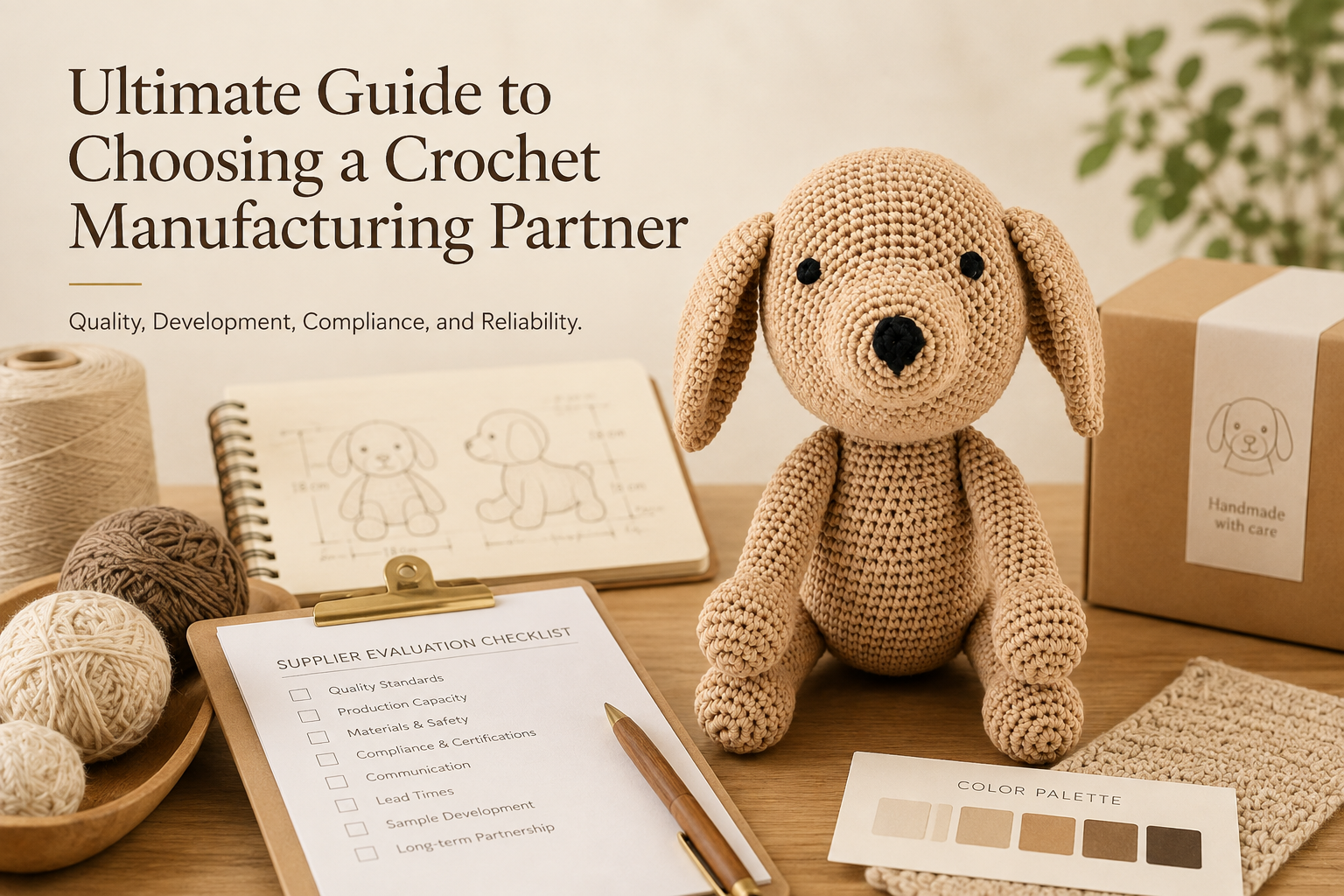
What Is a Crochet Manufacturing Partner?
A crochet manufacturing partner is more than a supplier that receives a purchase order and produces goods.
For custom B2B projects, a strong manufacturing partner may support:
- Product concept review
- OEM manufacturing
- ODM development
- Crochet pattern creation
- Material selection
- Sampling
- Cost optimization
- Quality control
- Compliance planning
- Packaging development
- Production scaling
- Repeat-order management
The relationship therefore extends beyond:
Buyer → Purchase Order → Factory
A stronger model looks like:
Business Goal
↓
Product Development
↓
Sample Validation
↓
Production
↓
Retail Launch
↓
Market Feedback
↓
Collection Expansion
The supplier becomes part of the customer's product-development system.
Why Choosing the Right Crochet Manufacturer Matters
Crochet is a labor-intensive craft.
Product quality can be influenced by:
- Artisan skill
- Stitch tension
- Pattern accuracy
- Filling
- Assembly
- Facial positioning
- Materials
- Finishing
Without professional management, these variables can create inconsistent results.
A capable manufacturer builds systems around handmade craftsmanship.
These systems may include:
- Approved master samples
- Standardized patterns
- Material specifications
- Artisan training
- Production scheduling
- In-process inspections
- Final quality checks
This is what allows handmade products to become reliable commercial products.
The 15 Most Important Factors When Choosing a Crochet Manufacturing Partner
A serious supplier evaluation should examine at least the following areas:
- Relevant crochet manufacturing experience
- Product specialization
- OEM and ODM capability
- Sample development
- Product-development expertise
- MOQ flexibility
- Production capacity
- Handmade quality control
- Materials and supply-chain management
- Compliance experience
- Packaging capability
- Communication and project management
- Intellectual-property protection
- Responsible production
- Long-term scalability
Price matters, but price should be evaluated within this broader system.
1. Evaluate Relevant Crochet Manufacturing Experience
Start with a simple question:
How long have you actually specialized in crochet products?
A company may have many years of general textile experience but limited knowledge of commercial crochet manufacturing.
Relevant experience should include understanding:
- Crochet construction
- Pattern standardization
- Artisan management
- Handmade tolerances
- Cost structure
- Quality control
Ask:
- When did you begin manufacturing crochet products?
- Which categories do you specialize in?
- Which markets have you exported to?
- Have you developed products similar to ours?
The more complex your product, the more important category-specific experience becomes.
2. Look Beyond the Number of Products in the Catalog
A large catalog does not automatically indicate strong manufacturing capability.
A supplier may display hundreds of designs while having limited experience with:
- Custom mascots
- Baby products
- Museum souvenirs
- Multi-item gift sets
Ask whether the supplier has experience relevant to your project.
For example:
Mascot Project
Look for experience in:
- Character interpretation
- Facial consistency
- Custom colors
- Accessories
- IP confidentiality
Baby Product Project
Look for:
- Material awareness
- Construction safety
- Compliance experience
Museum Project
Look for:
- Cultural adaptation
- Custom storytelling
- Exclusive design development
- Retail packaging
Choose expertise that matches your actual product rather than the largest catalog.
3. Understand the Difference Between OEM and ODM Capability
Not all crochet manufacturers provide the same development support.
OEM Crochet Manufacturing
Best suited when you already have:
- Artwork
- Technical specifications
- Product designs
- Brand requirements
The manufacturer converts those requirements into production.
ODM Crochet Manufacturing
Best suited when you have:
- A concept
- A theme
- A target market
- Reference images
but need help developing the final product.
ODM support may include:
- Product structure
- Character adaptation
- Material recommendations
- Collection planning
- Packaging direction
If your company has limited internal product-development resources, strong ODM capability can create significant value.
4. Test the Supplier Through Sample Development
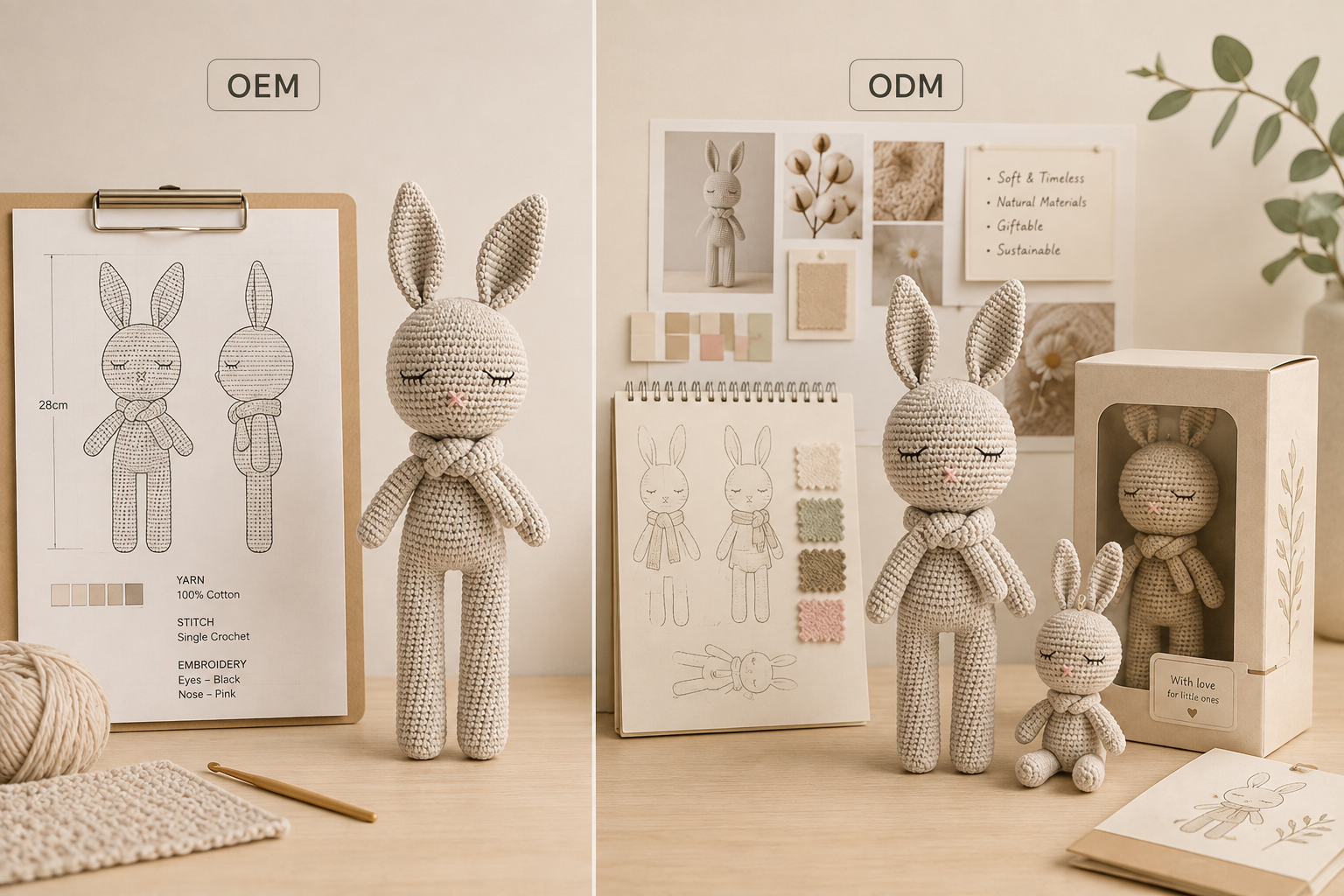
Sampling is one of the best ways to evaluate a crochet manufacturer.
A custom sample reveals:
- Technical capability
- Communication
- Speed
- Attention to detail
- Problem-solving
During sampling, observe:
- Does the supplier understand your artwork?
- Are proportions accurate?
- Are colors correct?
- Are revisions implemented properly?
- Does the supplier suggest improvements?
Initial custom crochet sample development may commonly require approximately 7–15 working days depending on complexity, materials, and feedback speed.
But the fastest sample is not always the best sample.
Accuracy and communication matter just as much as speed.
5. Evaluate How the Factory Solves Design Problems
A strong crochet manufacturer should not simply copy artwork blindly.
Digital designs often need adaptation before becoming physical crochet products.
For example:
A very small graphic detail may need to become:
- Embroidery
- Applique
- A separate crochet component
A complicated accessory may need simplification.
An experienced development team should explain:
- What can be reproduced accurately
- What should be adapted
- What will affect cost
- What may create production risk
One lesson we have learned is:
The best manufacturing partners do not say yes to every detail. They help buyers identify which details actually matter.
6. Ask About MOQ Before Assuming Low MOQ Is Always Better
MOQ is important, particularly for:
- Startups
- Small retailers
- New collections
- Market testing
But the lowest MOQ is not automatically the best commercial option.
MOQ may depend on:
- Design complexity
- Yarn colors
- Custom packaging
- Accessories
- Quantity per SKU
For example, product MOQ and packaging MOQ may be different.
A professional supplier should help you identify the most efficient launch quantity rather than simply advertise the smallest possible MOQ.
7. Ask Whether the Supplier Supports Different Business Stages
A useful manufacturing partner may support several sourcing models.
For example:
Ready Stock
Suitable for:
- Fast market entry
- Small wholesale testing
Light Customization
Suitable for:
- Custom colors
- Labels
- Packaging
Full OEM
Suitable for:
- Original artwork
- Exclusive designs
ODM
Suitable for:
- New collection development
This flexibility allows buyers to choose a sourcing model appropriate to their current stage.
8. Understand How Handmade Production Capacity Works
Crochet manufacturing capacity cannot be measured only by machines.
It depends on:
- Artisan network
- Product complexity
- Material availability
- Training
- Production allocation
- Quality-control capacity
Ask:
- How many artisans support production?
- How is work allocated?
- What is normal monthly capacity?
- What happens during peak season?
- How quickly can production scale?
A simple keychain and a complex mascot require very different amounts of labor.
Capacity figures therefore need context.
9. Ask How the Manufacturer Scales a Bestseller
This is one of the most useful supplier-evaluation questions:
What happens if our 500-piece test order becomes a 5,000-piece reorder?
A strong supplier should discuss:
- Material reservation
- Pattern standardization
- Artisan training
- Production allocation
- Inspection capacity
- Lead time
The ideal manufacturing partner should support both:
Low-Risk Market Testing
and
Future Commercial Scaling
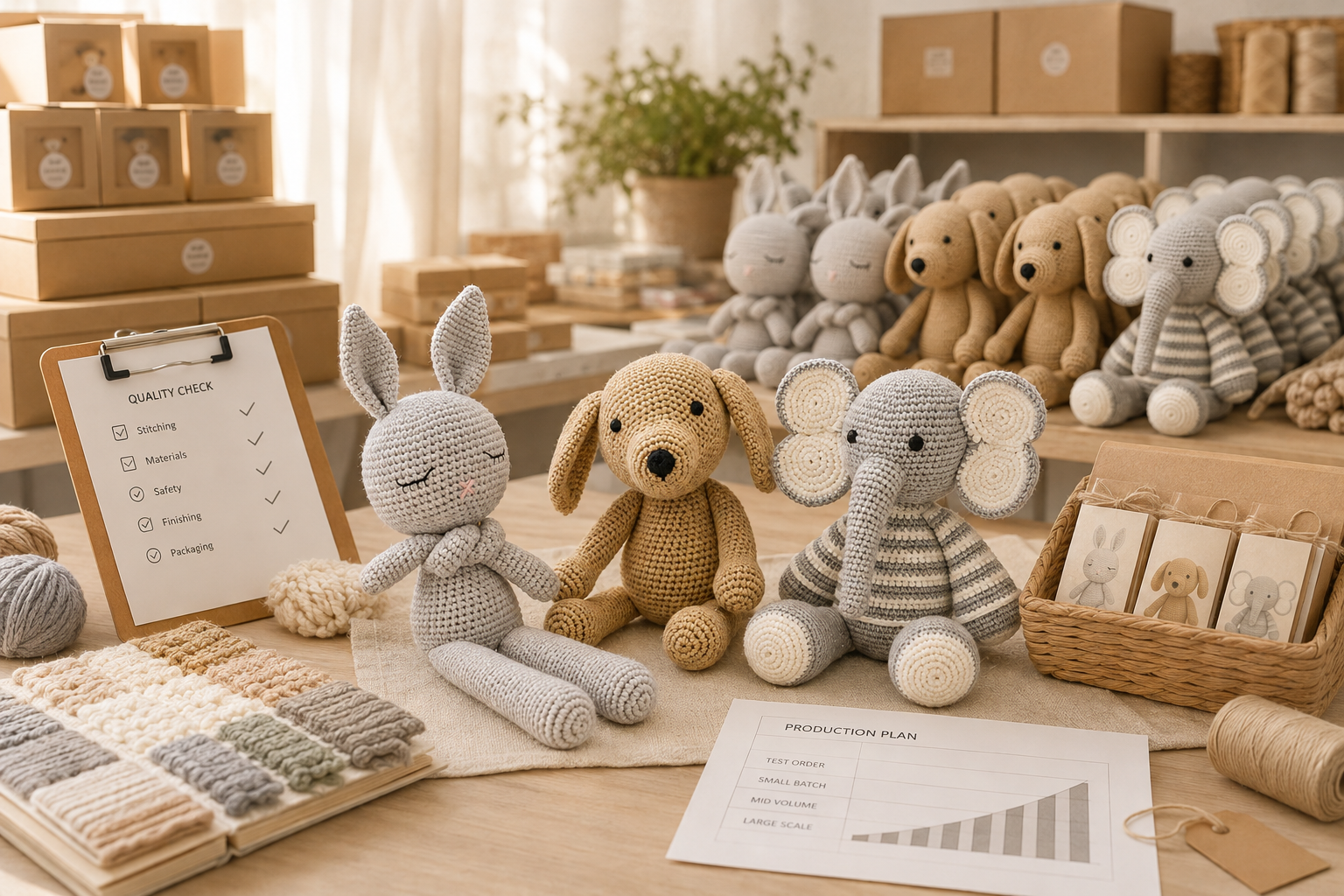
10. Evaluate the Quality-Control System
Every supplier claims good quality.
Ask how quality is actually controlled.
A professional handmade crochet quality system may include:
Incoming Inspection
Checking:
- Yarn
- Filling
- Accessories
- Packaging
First-Article Inspection
Confirming early production matches the approved sample.
In-Process Inspection
Checking:
- Dimensions
- Stitch consistency
- Component shape
Assembly Inspection
Checking:
- Facial positioning
- Limbs
- Accessories
Final Inspection
Checking:
- Overall appearance
- Workmanship
- Labels
- Packaging
Quality should be built into the process rather than inspected only at the end.
11. Ask About the Golden Sample
The approved sample becomes the production reference.
It may establish:
- Size
- Shape
- Color
- Expression
- Accessories
- Filling
- Packaging
This is particularly important for handmade production.
The factory should be able to explain how the approved product is translated into:
- Patterns
- Measurements
- Production instructions
- QC standards
Without this step, every artisan may interpret the design slightly differently.
12. Understand Handmade Tolerances
Handmade products naturally contain small variations.
This is not automatically a defect.
A professional manufacturer should distinguish between:
Acceptable Handmade Variation
and
Commercial Quality Problems
For example:
Slight stitch variation may be acceptable.
Incorrect color or significantly different product proportions may not be.
Buyers should agree on tolerances before large-scale production.
13. Examine Material Management
Materials affect:
- Appearance
- Safety
- Durability
- Cost
- Reorder consistency
Ask about:
- Yarn suppliers
- Batch control
- Color management
- Filling
- Accessories
- Alternative materials
For long-term collections, also ask:
Can the same yarn color be sourced again next season?
Material continuity becomes increasingly important for repeat orders and signature brand colors.
14. Evaluate Sustainable Material Options Carefully
Some brands require:
- Cotton
- Organic cotton
- Recycled fibers
These options can support sustainability positioning.
However, buyers should verify:
- Material performance
- Documentation
- Availability
- Cost
Avoid broad sustainability claims without evidence.
A responsible supplier should help distinguish between:
- Material marketing
- Material documentation
15. Review Compliance Experience
For children's products and toys, compliance can become one of the most important sourcing factors.
Requirements depend on:
- Product type
- Intended age
- Materials
- Destination market
Depending on the project, relevant requirements may include:
- ASTM F963
- CPSIA
- CPC
- EN71
- CE-related requirements
- UKCA-related requirements
- AS/NZS toy-safety requirements
A professional manufacturer should understand that compliance is product-specific.
A factory cannot simply say:
"We have CE."
and assume every future product is covered.
16. Verify Test Reports Instead of Trusting Certification Logos
Ask to see:
- Test date
- Product description
- Materials
- Testing standard
- Laboratory
Then compare the report with your actual product.
If your new design uses:
- Different yarn
- Different accessories
- Different wooden components
additional evaluation may be necessary.
Compliance planning is strongest when it begins during development.
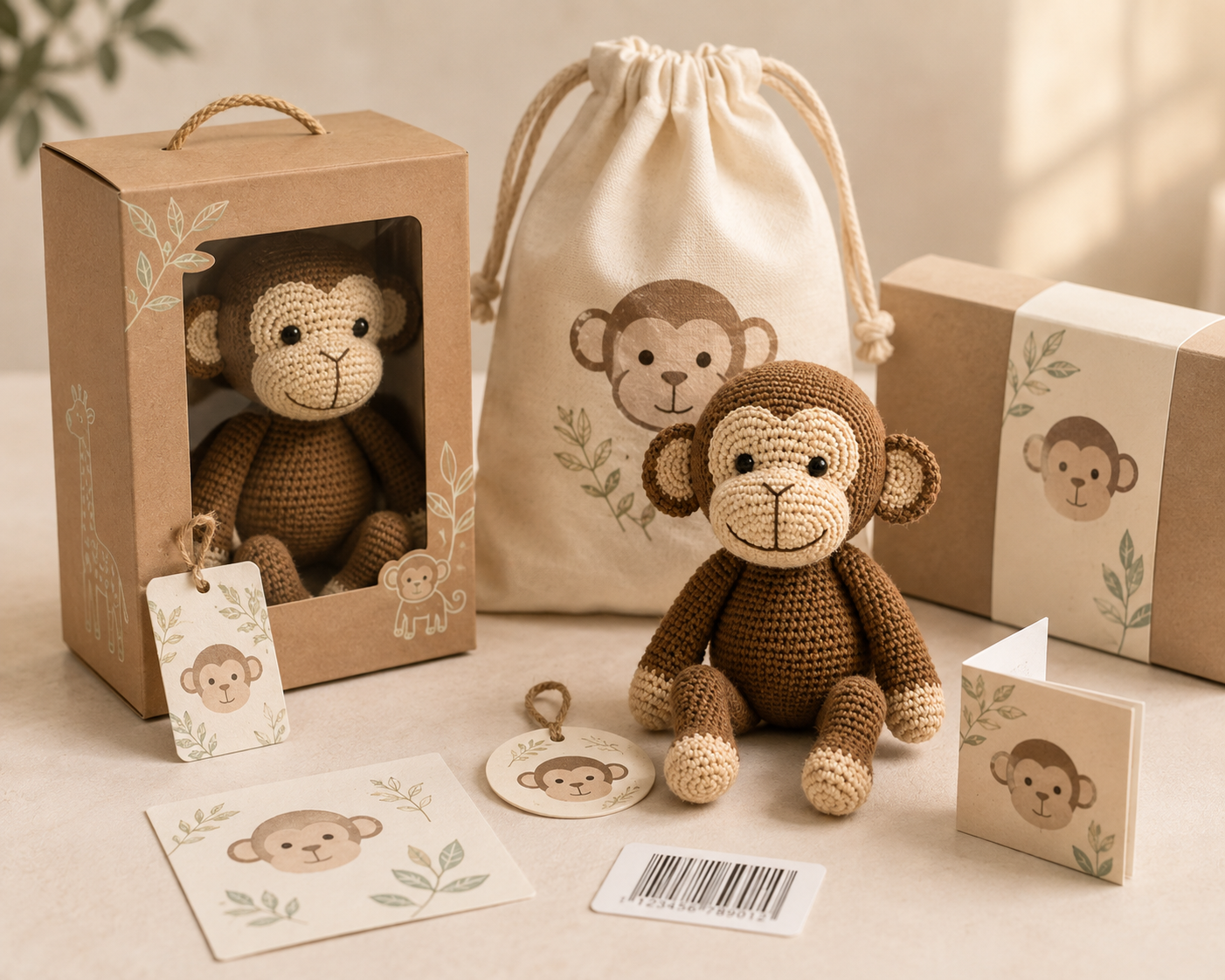
17. Evaluate Packaging Capability
Modern B2B buyers increasingly need retail-ready products.
A manufacturing partner may support:
- Gift boxes
- Window boxes
- Hangtags
- Story cards
- Barcodes
- Instruction cards
- Fabric bags
Packaging affects:
- Perceived value
- Retail display
- Shipping
- Customer experience
For gift brands and museum stores, packaging may be almost as important as the crochet product itself.
18. Look for Collection Development Capability
A strong manufacturer should understand how one successful product can grow.
For example:
Crochet Mascot
↓
Mini Version
↓
Keychain
↓
Gift Set
↓
Seasonal Edition
↓
Complete Collection
This is important because successful brands rarely want to keep developing unrelated products forever.
They want to build around proven concepts.
Factories that understand collection architecture can become more valuable long-term partners.
19. Evaluate Communication During Sampling
You can learn a great deal about a supplier before placing a large order.
During sampling, ask yourself:
- Do they understand feedback?
- Are they transparent about problems?
- Do they provide updates?
- Are technical explanations clear?
- Do they document revisions?
A manufacturer that communicates poorly during one sample may be difficult to manage during a 10,000-piece order.
Sampling is therefore also a test of the relationship.
20. Evaluate Intellectual-Property Protection
Original character designs can become valuable brand assets.
Before sharing sensitive artwork, buyers should clarify:
- Confidentiality
- Design ownership
- Pattern ownership
- Resale restrictions
- Photography permissions
Depending on the project, brands may use:
- NDAs
- Confidentiality agreements
- IP clauses
This is especially important for:
- Licensed characters
- Unreleased products
- Museum IP
- Original mascots
21. Understand the Human Side of Crochet Manufacturing
Responsible buyers increasingly want to understand:
- Who makes the products
- How artisans are organized
- Whether subcontracting is used
- How production is managed
Handmade does not automatically mean ethical.
Buyers with social-responsibility requirements may request:
- Social-audit information
- Production-network information
- Subcontracting disclosure
- Artisan-management information
A credible manufacturing partner should be able to explain the production system transparently.
22. Visit or Audit the Factory When Appropriate
For strategic suppliers, factory audits can provide valuable insight.
Do not only tour the showroom.
Follow the product journey:
Development
↓
Materials
↓
Production
↓
Assembly
↓
QC
↓
Packaging
↓
Warehouse
This helps determine whether the factory's systems support its marketing claims.
23. Compare Total Project Cost, Not Only Unit Price
Suppose Supplier A quotes:
$4.20
and Supplier B quotes:
$4.50
Supplier A appears cheaper.
But if Supplier A also creates:
- Extra sample rounds
- Higher defect rates
- Separate packaging coordination
- Delivery delays
the true project cost may be higher.
Buyers should evaluate:
- Product price
- Sampling
- Packaging
- Testing
- Quality inspection
- Freight
- Duties
- Rework
- Delay risk
The lowest quotation is not always the lowest landed cost.
24. Ask Whether the Manufacturer Understands Your Retail Business
The strongest suppliers understand more than manufacturing.
For example:
A museum store may care about:
- Cultural storytelling
- Exclusive souvenirs
A gift brand may care about:
- Emotional value
- Packaging
- Seasonal collections
An e-commerce seller may care about:
- Fast testing
- Restocking
- Content appeal
A manufacturer that understands the retail context can often make better development recommendations.
A Practical Crochet Manufacturer Comparison Scorecard
Buyers can score shortlisted suppliers using a structure such as:
| Evaluation Area | Suggested Weight |
|---|---|
| Product Quality | 20% |
| Product Development | 15% |
| Price & Commercial Terms | 15% |
| Production Capacity | 10% |
| Compliance | 10% |
| Delivery Reliability | 10% |
| Communication | 5% |
| Packaging | 5% |
| IP Protection | 5% |
| Responsible Production | 5% |
The weighting should change according to the project.
For example:
Custom IP Mascot
Increase weight for:
- Development
- Quality
- IP protection
Seasonal Retail Program
Increase weight for:
- Capacity
- Delivery
- Material planning
Baby Product
Increase weight for:
- Compliance
- Quality
- Material control
A professional sourcing decision should reflect actual business risk.
Warning Signs When Evaluating a Crochet Manufacturer
Some warning signs deserve additional investigation.
Extremely Low Price
Understand what is different.
Possibilities include:
- Smaller size
- Different yarn
- Reduced workmanship
- Different packaging
Every Question Gets “Yes”
Professional manufacturers should explain limitations.
No Clear Production System
A supplier should be able to explain:
- Who makes products
- Where finishing happens
- How QC works
No Approved Sample Procedure
This creates significant risk for handmade products.
Generic Certification Claims
Ask for product-specific documentation.
Unclear Subcontracting
Know where your products are actually made.
Weak IP Policies
Custom artwork should be treated as customer property according to agreed terms.
Which Country Is Best for Crochet Manufacturing?
There is no universally best country.
Different sourcing regions may offer different advantages.
China
May be attractive for:
- Integrated supply chains
- OEM/ODM development
- Packaging
- Multi-category collections
Vietnam
Has established exporters known for:
- Artisan-led production
- Baby products
- Handmade positioning
Bangladesh
Has recognized examples of:
- Community-based production
- Fair-trade positioning
India
Offers:
- Strong handicraft traditions
- Boutique production
Türkiye
Can suit:
- Premium
- Smaller boutique collections
Country matters.
But factory capability matters more.
Real Sourcing Insight: Choose for the Next Order, Not Only the First
A common sourcing mistake is selecting a supplier entirely around the first order.
Imagine the first order is:
500 Crochet Mascots
But demand grows.
Soon the business needs:
2,000 Keychains
*
1,500 Gift Sets
*
Christmas Edition
*
Custom Packaging
If the original supplier cannot support this expansion, the customer must restart sourcing.
A better question at the beginning is:
Can this supplier support where we want this product to go?
This changes supplier evaluation from short-term procurement into long-term product strategy.
A Step-by-Step Process for Choosing a Crochet Manufacturing Partner
Step 1
Shortlist suppliers with relevant crochet experience.
Step 2
Verify company information.
Step 3
Review relevant product categories.
Step 4
Discuss your project requirements.
Step 5
Compare development suggestions.
Step 6
Request samples.
Step 7
Evaluate sample quality and communication.
Step 8
Review QC and production systems.
Step 9
Verify compliance capability.
Step 10
Clarify pricing, MOQ, and lead time.
Step 11
Confirm packaging requirements.
Step 12
Clarify IP and confidentiality.
Step 13
Audit the factory if project risk justifies it.
Step 14
Begin with a controlled production order where practical.
Step 15
Measure supplier performance before scaling.
This staged approach reduces sourcing risk.
What Information Should You Send Before Requesting a Quote?
An accurate quotation needs an accurate brief.
Provide as much of the following as possible:
- Artwork
- Reference images
- Target size
- Quantity
- Yarn preference
- Accessories
- Packaging
- Target market
- Intended age group
- Target delivery date
Without these details, two suppliers may quote completely different interpretations of the same project.
Their prices cannot be compared fairly.
How U-MY Approaches Long-Term Crochet Manufacturing Partnerships
U-MY Crochet has specialized in handmade crochet manufacturing since 2013.
Our product-development capabilities include:
- Crochet dolls
- Custom mascots
- Baby gifts
- Crochet flowers
- Keychains
- DIY crochet kits
- Gift sets
- Museum souvenirs
- Seasonal collections
- Cultural and IP-based products
We support both OEM and ODM development.
Our broader manufacturing approach combines:
- Custom product development
- Skilled artisan production
- Standardized patterns
- Material management
- Quality-control procedures
- Packaging development
- International compliance planning
- Export support
Our objective is not simply to manufacture one purchase order.
We aim to support a complete development path:
Idea
↓
Sample
↓
Production
↓
Retail Launch
↓
Repeat Order
↓
Collection Expansion
Frequently Asked Questions
What should I look for in a crochet manufacturer?
How do I know whether a crochet factory is reliable?
Verify company information, request samples, understand its production model, review quality-control processes, assess communication, and consider factory audits or third-party inspections for higher-risk projects.
Is the cheapest crochet manufacturer usually the best option?
Not necessarily. Buyers should compare total project value, including quality, sampling, packaging, inspection, delivery reliability, and landed cost.
Should I work directly with a crochet factory or a trading company?
Both models can create value. Direct factories may offer closer technical communication for custom development, while experienced trading companies may help with multi-category sourcing and consolidation. Evaluate actual capabilities rather than labels alone.
What is a reasonable MOQ for custom crochet products?
MOQ depends on design complexity, materials, packaging, and manufacturing efficiency. There is no single universal MOQ for all custom crochet products.
How long does crochet sampling take?
Can handmade crochet products be produced at scale?
Yes. Commercial-scale crochet production can be managed through standardized patterns, trained artisan networks, material control, production planning, and quality-management systems.
What certifications do crochet products need?
Requirements depend on the product category, intended age group, materials, and destination market. Children's products may need to address standards or regulations such as ASTM F963, CPSIA, CPC, EN71, CE-related requirements, UKCA-related requirements, or applicable standards in other markets.
Should I sign an NDA before sending my mascot artwork?
For original, licensed, confidential, or unreleased designs, companies may choose to establish confidentiality and intellectual-property terms before sharing sensitive information.
Can one crochet supplier support an entire product collection?
A capable OEM/ODM manufacturer may support multiple sizes, keychains, gift sets, seasonal editions, packaging, and other collection extensions from one core concept.
The Final Supplier Selection Checklist
Before committing to a long-term manufacturing relationship, confirm that you understand:
- Who the supplier really is
- Where products are made
- How artisans are managed
- How patterns are standardized
- How quality is controlled
- What materials are used
- What the true MOQ is
- How capacity scales
- What compliance support is available
- How packaging is managed
- How designs are protected
- How communication works
- What happens when something goes wrong
- Whether the supplier can grow with your business
If these questions have clear answers, the supplier relationship has a much stronger foundation.
Conclusion
Choosing a crochet manufacturing partner is ultimately about managing uncertainty.
You need confidence that the supplier can protect:
- Your product
- Your quality standard
- Your timeline
- Your intellectual property
- Your customer experience
- Your ability to grow
Price is part of that decision.
But it is only one part.
After more than a decade in handmade crochet manufacturing, we believe the most valuable partnerships are created when buyer and manufacturer can move beyond:
“How much does this cost?”
and begin discussing:
“How do we build this product successfully, and what can it become next?”
That is the difference between buying from a supplier and building a true manufacturing partnership.
For brands, retailers, museums, gift companies, and product developers, the best crochet manufacturing partner is therefore not simply the company capable of making today's order.
It is the partner capable of helping today's product become tomorrow's successful collection.
 Chinese