
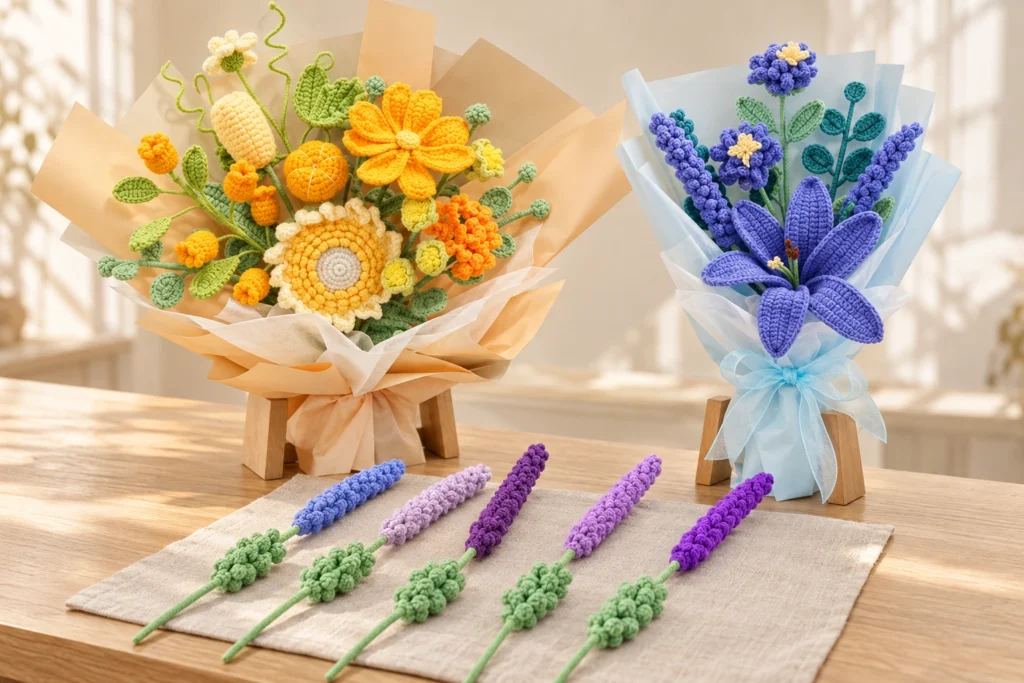
Wholesale crochet flower stems should be developed as a compatible assortment: each flower needs a defined size, stem construction and presentation role so retailers can combine different styles into workable bouquets. Buyers should approve both individual stems and representative mixed arrangements before confirming the range.
This guide is for florists, gift retailers, lifestyle brands and distributors sourcing finished crochet flowers for flexible bouquet assembly. It focuses on compatibility between stems, assortment planning and practical retail handling.
Start With How the Retailer Will Sell the Flowers
A crochet flower range can support several selling formats, but each creates different development requirements.
A retailer selling individual stems needs flowers that remain understandable and presentable on their own. A retailer assembling bouquets needs compatible lengths, manageable gathering points and combinations that can be repeated. A business selling fixed bouquets needs an approved arrangement and packing specification for each finished SKU.
Define the intended format before selecting flower styles.
| Selling format | What the buyer should define | What to review in samples |
|---|---|---|
| Individual stems | Product identity, individual presentation and customer selection method | Appearance, handling and visibility in the proposed display |
| Retailer-assembled bouquets | Compatible stem groups, bouquet recipes and finishing materials | Gathering, balance, wrapping and assembly effort |
| Fixed mixed bouquets | Exact flower quantities, arrangement and packaging | Repeatable appearance and packing sequence |
| Customer-selected combinations | Permitted choices and any combination limits | Whether common selections produce a workable arrangement |
If the same flowers will support several formats, review each format separately. A stem that looks effective in a tall display may require a different length or presentation method in a compact gift bouquet.
Define a Specification for Each Flower Stem
Flower names and colors are not enough to establish compatibility.
Buyers should define the flower head, stem and any leaves as one complete product. The specification should identify the visible features that matter, the dimensions to measure and the permitted handling method.
Useful specification fields include:
- Flower style and product reference.
- Approved yarn and color references.
- Overall length and the measurement position.
- Flower-head width, depth and orientation.
- Stem thickness and construction.
- Leaf quantity, position and direction, where included.
- Intended upright, angled or curved presentation.
- Agreed appearance and dimensional acceptance criteria.
- Individual or grouped packing requirements.
Stem construction should be stated explicitly. Do not assume every crochet flower contains wire, can be bent, can be trimmed or will hold an adjusted position.
Where shaping is intended, agree how the retailer may shape the stem and evaluate a physical sample using that method. Where cutting is not intended, provide a suitable finished length rather than leaving adjustment to the shop.
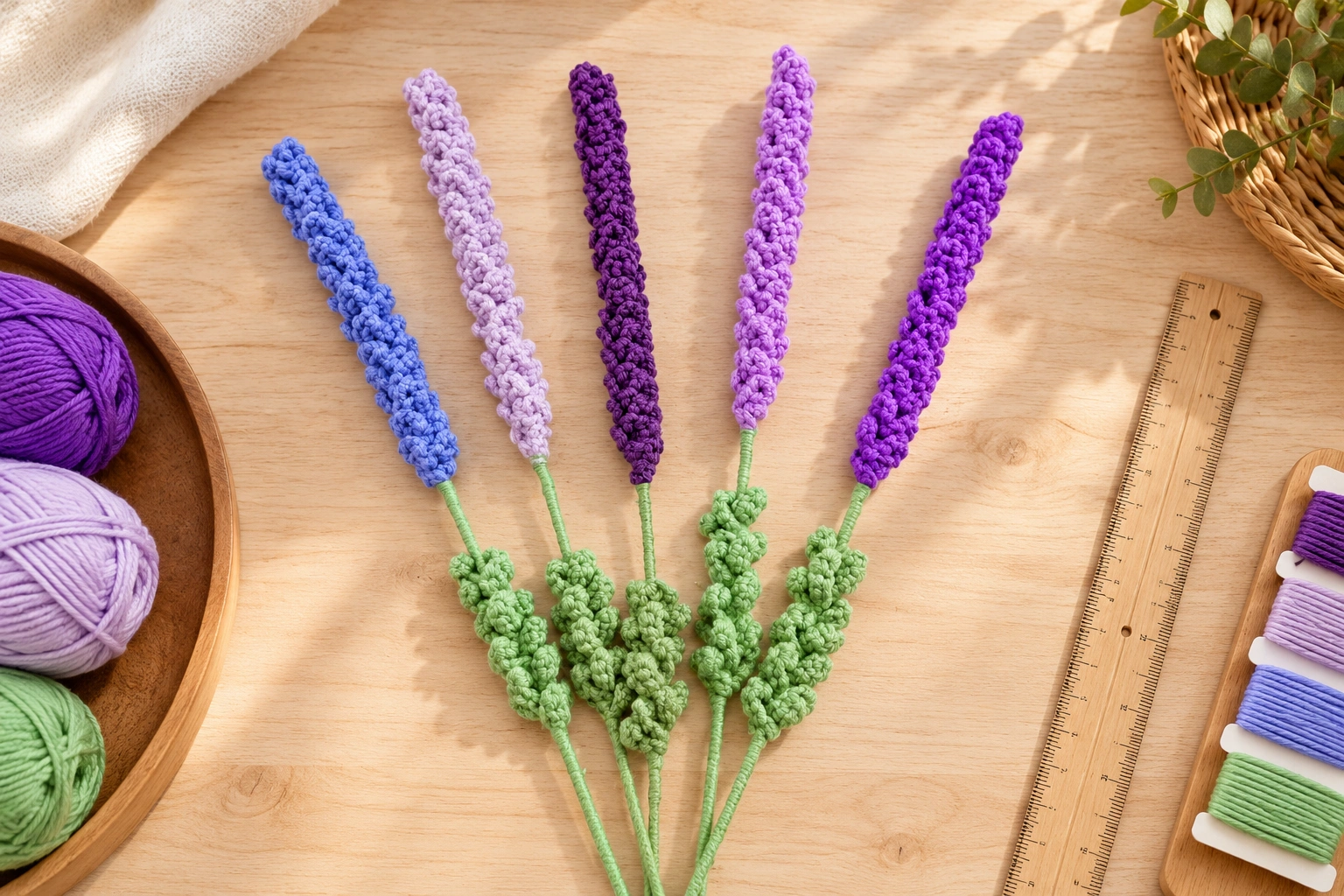
Check Compatibility at the Bouquet Gathering Point
Matching overall lengths does not automatically create a balanced bouquet.
Two flowers can have the same total length while their heads sit at different heights because their head shapes, leaf positions or intended stem angles differ. Thick or closely positioned leaves can also make a group difficult to gather.
Review the arrangement at the point where the stems will be held, tied or wrapped.
Check whether:
- The intended flower heads remain visible.
- Larger heads obscure smaller flowers.
- Leaves crowd the gathering area.
- The bundle becomes too bulky for the proposed wrap.
- Stems cross or twist in a way that changes the intended presentation.
- The arrangement remains manageable during assembly.
The objective is a usable relationship between the stems. Identical dimensions across every flower style are not always necessary.
Use Compatibility Groups Where Needed
A range may work better with separate groups for compact bouquets, taller arrangements or statement flowers.
Keep these groups clear in the product information. If certain combinations require different lengths or wrapping, identify that before ordering rather than treating the entire range as interchangeable.
Build the Assortment Around Flower Roles
Selecting one of every available flower can produce a broad catalog without producing a useful buying range.
Assign a role to each proposed style:
- Focal flowers: provide the main visual emphasis.
- Supporting flowers: connect the focal flowers through shape, color or scale.
- Smaller accents: fill selected gaps without hiding the main flowers.
- Foliage: frames or separates flowers where the approved range includes it.
These are planning roles, not fixed botanical categories. A flower may play different roles depending on its size and the other stems used.
Review color alongside shape. A cohesive palette can still look crowded if every flower head has similar visual weight. A varied palette can work when the arrangement has a clear focal point and controlled proportions.
For the wider collection framework, see How to Develop a Crochet Product Collection Instead of Isolated SKUs.
Validate Representative Bouquet Recipes
Buyers do not need to assemble every possible combination, but they should review combinations that represent the intended selling formats and likely compatibility problems.
A useful review set can include:
- The smallest intended mixed bouquet.
- A typical everyday arrangement.
- The fullest bouquet planned for the selected wrap.
- A combination containing the largest flower head.
- A combination containing the most visually contrasting styles.
For each recipe, record the stem references, quantities, arrangement method and finishing materials.
| Review point | Practical question | Evidence to retain |
|---|---|---|
| Visual balance | Is the intended focal flower clear? | Front and angled photographs |
| Flower visibility | Can the selected styles be seen without excessive adjustment? | Arrangement photographs and notes |
| Gathering | Can the stems be brought together at the intended position? | Assembly observations |
| Wrapping | Does the wrap close without crushing or hiding important details? | Wrapped sample reference |
| Handling | Can staff assemble and move the bouquet using the agreed method? | Handling notes |
| Repeatability | Can another assembler reproduce the intended presentation? | Recipe and second assembly review |
Treat these as product-development checks. They do not establish transport performance or substantiate durability claims.
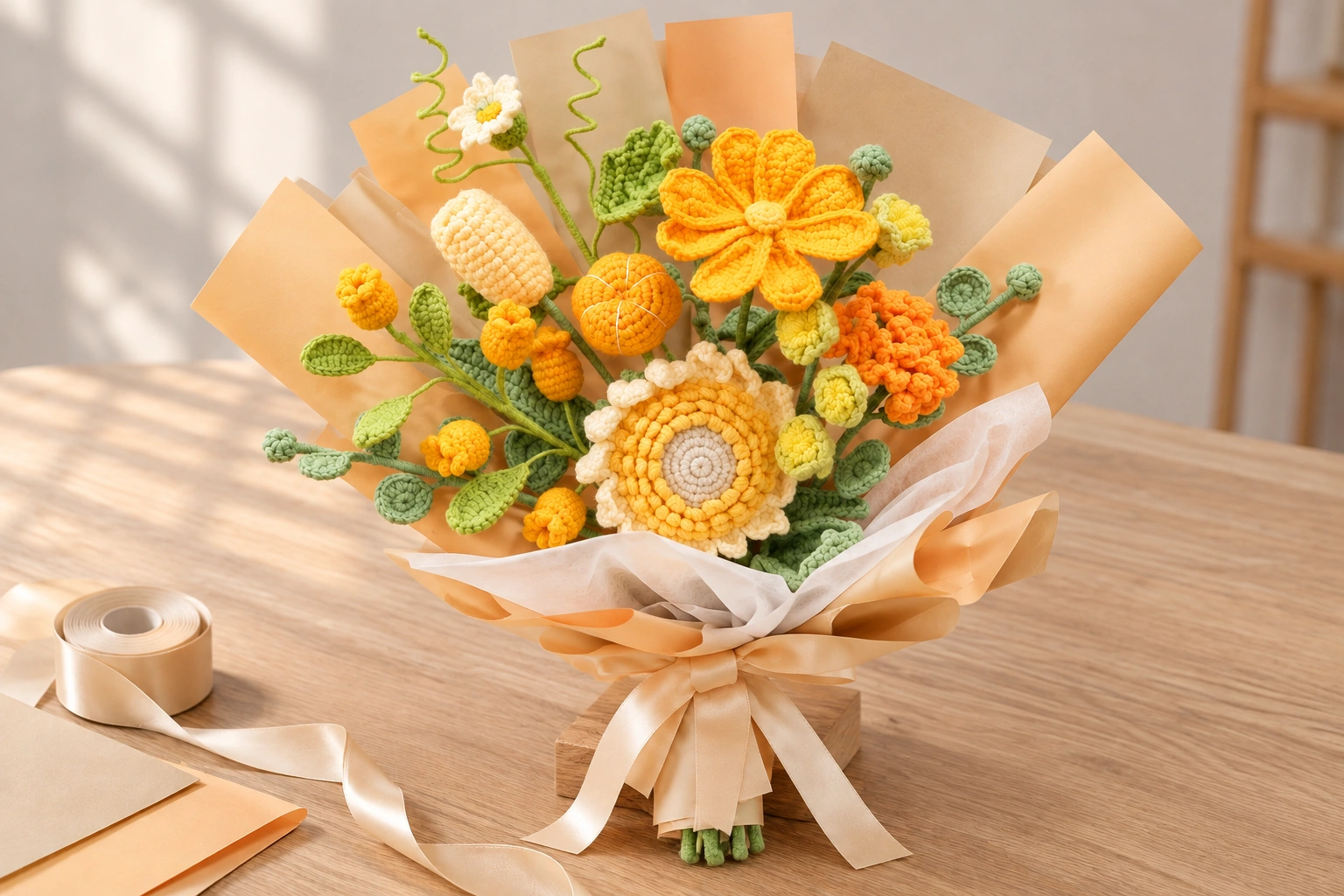
Translate Bouquet Recipes Into an Order Mix
An equal quantity of every flower style may not match the retailer's intended bouquet recipes.
Use the planned arrangements to estimate demand for each stem:
Required quantity of a stem style = the sum of its quantity in each bouquet recipe multiplied by the planned number of those bouquets, plus any separately planned single-stem sales.
Keep these categories separate:
- Stems allocated to fixed bouquet recipes.
- Stems intended for individual sale.
- Display samples.
- Any separately agreed operational reserve.
This makes the buying assumptions visible. It also helps buyers identify whether one frequently used flower will limit the number of complete bouquets they can assemble.
These calculations are planning inputs, not sales forecasts. Revise them using actual retail demand once the range launches.
Confirm minimum order quantities by style, color and configuration with the supplier. A total assortment quantity does not necessarily satisfy the requirements for every individual variant.
Specify How the Flowers Reach the Retailer
Loose stems, grouped stems and finished bouquets create different receiving tasks.
For a retailer assembling bouquets, clarify whether flowers arrive separated by style, grouped into recipe quantities or packed in another agreed format. Identify what the retailer must do before display: unpack, arrange, shape where permitted, add a tag or complete the wrapping.
Review the receiving workload alongside product price. A configuration that requires extensive sorting may be inconvenient for a small shop even when the individual stems are suitable.
Packaging development should cover both individual product presentation and the intended bouquet format. For broader packaging decisions, see How to Design Retail-Ready Packaging for Crochet Products.
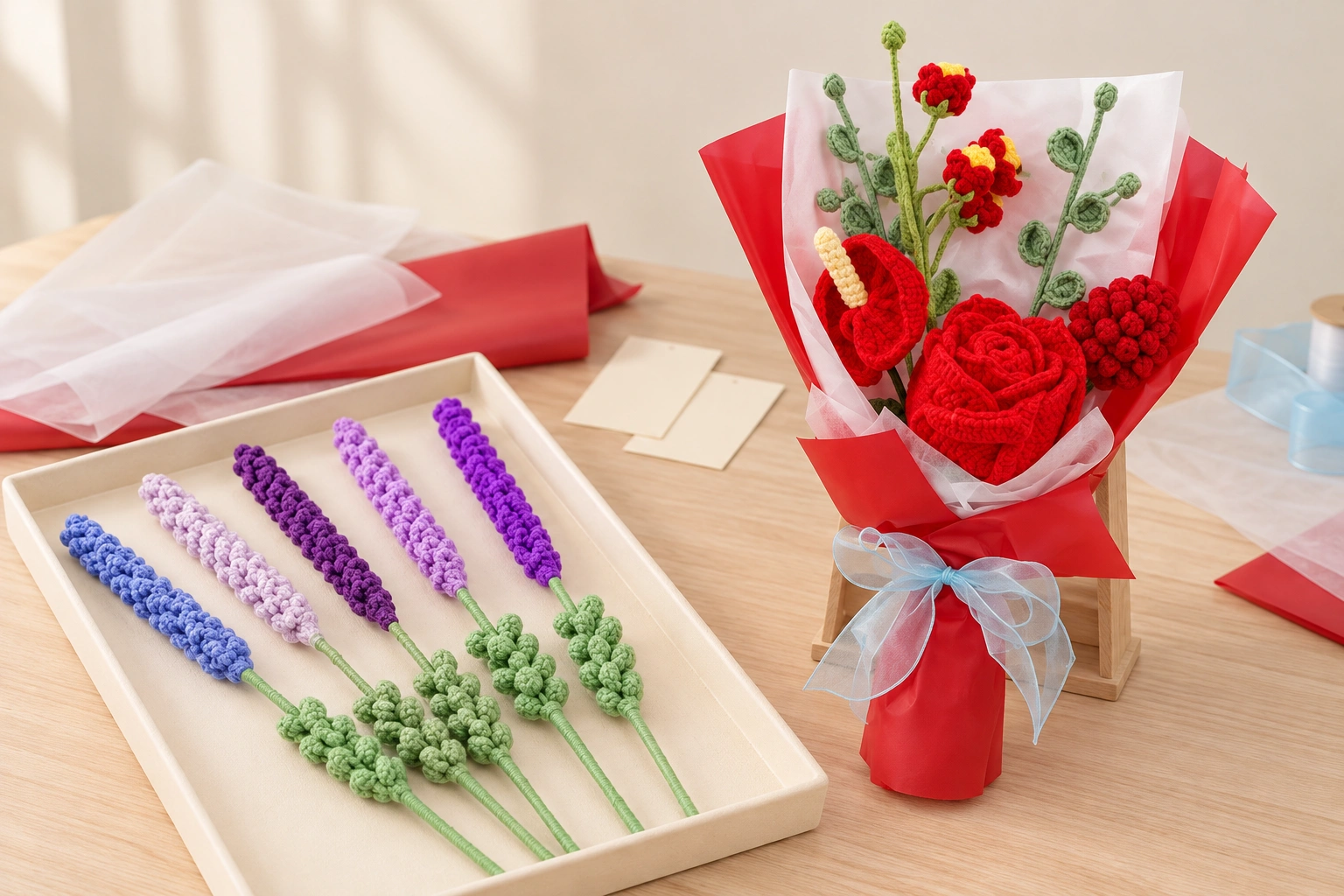
What to Include in a Development Review With UMY Crochet
UMY Crochet is a product development and manufacturing partner for crochet, DIY craft kits, knitted toys and creative gifts.
For a wholesale flower project, a useful starting package includes the proposed flower references, intended selling formats, target bouquet sizes, color direction, order assumptions and packaging references.
The development discussion should establish:
- Which flower styles are suitable for the intended range.
- Which dimensions and construction details need definition.
- Which combinations require physical sample review.
- Whether individual stems and finished bouquets need separate specifications.
- What remains subject to sample approval or quotation.
Confirm the project scope, available materials, sample requirements, quantities and timing before proceeding. Do not assume that a photographed flower style is currently available from stock or that every color and length can use the same commercial terms.
Frequently Asked Questions
Should all crochet flower stems have the same length?
Not necessarily. They need lengths that support the intended arrangement. Review flower-head height, gathering position and wrapping together before deciding whether one common length is appropriate.
Can one flower range support both single-stem sales and bouquets?
Yes, if both formats are reviewed. Individual stems may need their own presentation, while mixed bouquets need agreed recipes and compatible gathering and wrapping arrangements.
Can retailers bend or shorten the stems?
Only where the approved construction and agreed handling method allow it. Confirm this with the supplier rather than assuming that all stems contain suitable internal support or can be cut.
Should a wholesale assortment contain equal quantities of each flower?
Only if that matches the intended sales plan. Bouquet recipes may require more of some styles, while individual-stem demand may create a different mix.
Do leaves count as flowers in a bouquet quantity?
Define this clearly in the product specification and offer. State the number of flower stems and any additional foliage separately so buyers understand the configuration.
Is approving one mixed bouquet enough?
One sample may be sufficient for one fixed arrangement, but it does not establish compatibility across an unrestricted mix-and-match range. Review representative combinations and any combinations likely to be difficult.
Discuss Your Wholesale Crochet Flower Assortment
Share your flower references, intended sales format, target bouquet combinations and packaging direction with UMY Crochet. We can review the development requirements and identify which stem specifications and sample combinations should be evaluated before you confirm the assortment.
<!--[googlesitekit-end-of-content]-->
 Chinese