

A successful crochet product collection should be planned as a connected product system, not as a group of unrelated designs that happen to use the same material. For retailers, gift companies, e-commerce brands, museums, cultural institutions, and other B2B buyers, collection development means defining what products should share—such as visual language, yarn palette, character proportions, packaging structure, price positioning, and retail story—while giving each SKU enough distinction to justify its place in the assortment.
A practical collection-development process usually starts with a clear commercial theme and one or more anchor products. Buyers can then define shared design rules, select complementary product types, control color and material families, develop samples together, review the assortment as a group, and plan packaging and repeat orders at collection level.
The key principle is:
Do not ask whether every individual crochet product looks good. Ask whether the products make more commercial sense together than they do separately.
This distinction matters because adding more SKUs does not automatically create a stronger assortment. Every additional design introduces sampling, production, inventory, packaging, quality-control, and replenishment decisions. A focused collection can give customers meaningful choice while remaining practical for the buyer to launch and manage.

What Makes Several Crochet Products a Collection?
Products become a collection when customers can understand why they belong together.
That relationship can come from several sources:
- Shared characters
- A common story
- Coordinated colors
- Related animals or objects
- A seasonal theme
- A cultural theme
- A common function
- Matching construction details
- Consistent packaging
- A recognizable visual style
For example, four crochet animals made independently are simply four products.
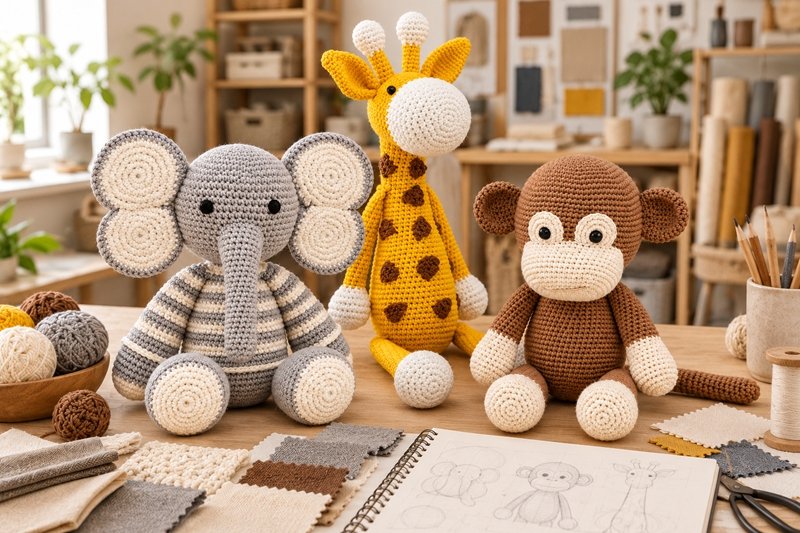
But four animals developed with a shared proportion system, coordinated yarn colors, related facial treatment, consistent packaging, and one retail story begin to operate as a collection.
The same principle can apply to:
- Mascot merchandise
- Museum souvenirs
- Seasonal gifts
- Baby gift products
- Crochet ornaments
- Home accessories
- Crochet kits
- Corporate merchandise
- Character families
The collection relationship should be visible without making every SKU look identical.
Why B2B Buyers Should Think at Collection Level
A single successful product can generate sales.
A well-designed collection can create additional commercial opportunities.
It may help buyers:
- Offer customer choice
- Increase visual shelf impact
- Build stronger brand recognition
- Create gift combinations
- Test different characters or colors
- Support seasonal merchandising
- Introduce entry and premium products
- Expand successful concepts later
- Build a repeatable replenishment program
However, more SKUs also increase complexity.
Every style may require decisions about:
- MOQ
- Sampling
- Yarn
- Colors
- Accessories
- Packaging
- Photography
- Inventory
- Forecasting
- Replenishment
Collection planning therefore requires balancing assortment value against operational complexity.
Step 1: Start With a Collection Idea, Not a Product List
One common mistake is beginning with:
"We want six crochet products."
That defines quantity, but it does not define the collection.
A stronger brief explains what connects those six products.
For example:
Weak brief:
- One bee
- One cow
- One deer
- One flower
- One bear
- One rabbit
Stronger brief:
A soft spring gift collection using warm cream, blush pink, sage green, and pale yellow, with friendly animal characters designed for coordinated gift presentation.
The second brief gives the development team a framework.
Individual designs can now be evaluated against the same direction.
Does the color belong?
Does the expression belong?
Does the product feel too visually complex?
Does one SKU look significantly more childish or more premium than the others?
A collection concept becomes a decision filter.
Step 2: Choose an Anchor Product
An anchor product is the item that most clearly expresses the collection idea.
It does not necessarily have to be:
- The largest product
- The most expensive product
- The first product developed
- The product with the highest forecast
It should simply provide a useful reference for the collection's visual and commercial direction.
The anchor can help establish:
- Yarn palette
- Character style
- Stitch appearance
- Proportions
- Facial treatment
- Detail level
- Packaging tone
- Photography direction
Once those characteristics are sufficiently stable, additional SKUs can be developed in relation to them.
Step 3: Define the Collection's Shared Design Language
Buyers should decide what must remain consistent across the assortment.
This can include several layers.
Color Language
A collection might use four or five recurring colors instead of giving every product an unrelated palette.
Shared colors can help connect products even when their shapes are different.
Character Language
If the collection contains characters, buyers can coordinate:
- Eye style
- Mouth treatment
- Expression
- Head-to-body proportions
- Limb style
- Embroidery approach
A deer and a cow do not need identical faces, but they can still feel like they belong to the same design family.
Material Language
Using related yarn types or textures can strengthen consistency.
Detail Language
If one product uses highly elaborate embroidery, multiple accessories, and complex decorative elements while another is extremely minimal, the collection may feel disconnected.
A shared level of visual complexity can help.
Packaging Language
Products can use common:
- Typography
- Color system
- Tag shape
- Story-card layout
- Box architecture
- Graphic elements
SKU-specific information can change while the overall system remains recognizable.
Step 4: Give Every SKU a Role
A strong collection does not need several products performing exactly the same commercial job.
Buyers can assign roles to different SKUs.
For example:
| SKU Role | Possible Purpose |
|---|---|
| Hero product | Represents the collection most strongly |
| Entry product | Lower-commitment introduction to the collection |
| Gift product | Designed for gifting and presentation |
| Functional product | Adds a practical use |
| Character variation | Expands customer choice |
| Premium product | Adds complexity or stronger presentation |
| Seasonal SKU | Creates a limited thematic extension |
| Add-on product | Supports cross-selling |
The exact roles depend on the business.
A museum shop may structure its assortment differently from an online gift brand.
The important point is that a new SKU should have a reason to exist beyond "we wanted another design."
Step 5: Decide Whether Variation Should Come From Color, Character, Size, or Function
There are several ways to expand a crochet concept.
Color Variation
One design can be offered in several coordinated colors.
This can work when color choice itself has customer value.
Character Variation
A shared construction system can be adapted into different animals or characters.
This creates visual variety while retaining a recognizable family style.
Size Variation
A product may be developed in different sizes where commercially appropriate.
However, resizing crochet products is not always a simple percentage change. Yarn, stitch count, construction, proportions, filling, and accessories may need to be reconsidered.
Functional Variation
One design language can sometimes expand into related products such as:
- Doll
- Ornament
- Rattle
- Keychain
- Decorative piece
- Pouch
- Gift set
This can be particularly useful when buyers want to extend one recognizable theme across different price points or use cases.

Step 6: Avoid Too Much Variation at Once
A collection needs variety, but unlimited variation can weaken it.
Imagine developing five SKUs where every product uses:
- A different yarn type
- A different color system
- Different facial features
- Different packaging
- Different accessories
- Different dimensions
- Different retail positioning
Technically, the products can still be sold together.
Operationally and visually, however, the buyer may be managing five independent projects.
A more deliberate collection identifies which elements should vary and which should remain shared.
For example:
Shared: yarn family, facial style, packaging system, color palette.
Variable: animal character, accessory, SKU name.
That creates controlled variety.
Step 7: Develop Related Samples Together
When several products belong to one collection, evaluating them only one at a time can hide inconsistencies.
A buyer may approve the first character, then the second, then the third.
Individually, each may look acceptable.
When placed together, problems become visible:
- One head is proportionally much larger.
- One pink is noticeably warmer.
- One character uses a different eye style.
- One product appears much more detailed.
- One item is significantly larger than expected.
- One accessory dominates the group.
- The packaging scale is inconsistent.
For this reason, collection samples should be reviewed together when practical.
The question changes from:
"Is this sample correct?"
to:
"Is this sample correct, and does it belong with the others?"
Step 8: Build a Collection Color System
Color is one of the easiest ways to create visual unity, but it needs control.
A buyer can define:
- Core colors
- Secondary colors
- Accent colors
- Character-specific colors
- Seasonal colors
For example, a collection might use cream and sage across all SKUs while giving each character one unique accent color.
This creates both recognition and differentiation.
Physical yarn references or approved samples become especially useful when the same colors need to appear across several products or repeat orders.
Step 9: Consider Material Sharing Across SKUs
Collection planning can also influence sourcing efficiency.
If several SKUs use overlapping yarn colors, accessories, labels, or packaging materials, production planning may be simpler than if every item requires completely unique components.
This does not mean products should be redesigned solely to reduce material variety.
Design and customer value remain important.
But buyers should understand the operational effect of adding a special yarn or component that appears in only one SKU.
Useful questions include:
- Can several products share core yarn colors?
- Is this unique accessory essential?
- Can one packaging structure support multiple SKUs?
- Does a special component create additional sourcing risk?
- Will the same material be available for replenishment?
These questions become more important as collections grow.
Step 10: Plan MOQ at SKU Level, Not Only Collection Level
One of the most important purchasing realities is that a collection quantity is not necessarily the same as a per-style MOQ.
At UMY, typical handmade custom crochet MOQ is around 500 pieces per style, while some simple designs may be evaluated from approximately 300 pieces per style.
Stock products usually have much lower MOQs, typically around 10–50 pieces per style, depending on availability.
Custom knitted or plush products typically start around 1,000 pieces per style.
These are general working ranges rather than guarantees for every project.
For buyers, the implication is important.
A six-SKU custom collection can represent a substantially different inventory commitment from a one-SKU project.
This is why assortment planning should happen before a buyer automatically expands the number of designs.
Should You Launch Every SKU at the Same Quantity?
Not necessarily, but feasibility must be evaluated for the actual production program.
From a commercial perspective, buyers may expect different demand levels across the collection.
A hero character may have stronger forecast demand than a more specialized variation.
However, manufacturing requirements, material preparation, packaging, and MOQ can limit how uneven quantities can be structured.
Buyers should therefore discuss SKU quantities early rather than assuming any quantity split will automatically be practical.
Step 11: Use Stock Products to Test Collection Directions
Buyers who are uncertain about a category do not necessarily need to begin with a large custom collection.
Where suitable stock products are available, smaller orders can help test:
- Animal preferences
- Color families
- Product sizes
- Gift formats
- Seasonal themes
- Customer response to crochet products
At UMY, stock MOQ is typically around 10–50 pieces per style, depending on actual availability.
The purpose of a stock test is not to copy a successful existing product into a custom design.
Instead, buyers can learn broader commercial preferences.
For example:
"Customers strongly preferred small pastel animals."
That insight can inform an original custom collection without copying the specific stock product.
Step 12: Plan Packaging as a Collection System
Packaging should reinforce the relationship between SKUs.
A buyer does not necessarily need a completely different box structure for every product.
Depending on product dimensions and requirements, a collection may be able to share:
- Packaging format
- Graphic layout
- Brand colors
- Story-card format
- Hangtag structure
- Typography
Then SKU-specific elements can identify:
- Character
- Product name
- Color
- Barcode
- Product information
This creates stronger shelf consistency and can make future collection expansion easier.
Packaging feasibility should still be evaluated against each physical product.
A box that works for one crochet character may compress the ears or accessories of another.
Step 13: Think About Retail Display Before Finalizing the Collection
Collection design should consider how products will appear together in the real sales environment.
Ask:
- Can customers understand the collection quickly?
- Are the products visually distinct enough?
- Does one SKU dominate unintentionally?
- Do the colors work together?
- Can products be displayed efficiently?
- Does the packaging create a coherent shelf block?
- Can smaller items be cross-merchandised with larger ones?
- Does the assortment photograph well together for e-commerce?
Retail display can reveal problems that individual product photography does not.
For example, six individually attractive products may create a chaotic shelf if their colors, scales, and packaging are unrelated.

Step 14: Build the Collection for Future Replenishment
Collection development should not end at launch.
If the assortment succeeds, buyers may need to:
- Reorder the entire collection
- Replenish selected winners
- Discontinue weaker SKUs
- Add new characters
- Introduce seasonal colors
- Change packaging
- Create gift sets
- Expand into new product formats
The original specifications become increasingly valuable at this stage.
This is particularly important when new products must sit beside inventory from earlier production runs.
When Should a Buyer Add a New SKU?
A new SKU should ideally solve a commercial or assortment problem.
Useful reasons can include:
- Customers are asking for another character.
- A price-point gap exists.
- A seasonal opportunity is clear.
- One theme is performing strongly.
- The collection needs a gift option.
- A functional extension makes sense.
- A retailer needs greater assortment depth.
- A cultural or exhibition story supports another product.
Less useful reasoning is simply:
"We have four products, so we should make six."
SKU count should follow strategy rather than an arbitrary target.
How to Expand a Successful Hero Product
Once an anchor product performs well, buyers have several possible expansion paths.
For example, a successful crochet deer could potentially inspire:
Character family: deer, rabbit, bear, fox.
Product family: deer doll, deer ornament, deer rattle, deer keychain.
Color family: core color plus carefully planned seasonal variations.
Gift family: individual product, paired set, premium gift box.
Not every extension should be developed.
The buyer should evaluate whether each one adds enough customer value to justify another SKU.
Collection Development for Brand Mascots
Mascot programs can benefit strongly from collection thinking.
A company may begin with one crochet mascot and later expand into:
- Smaller mascot
- Keychain
- Ornament
- Seasonal costume
- Gift set
- Related supporting character
The most important design features should remain recognizable across formats.
This does not mean mechanically shrinking or enlarging the original product.
Collection Development for Museums and Cultural Institutions
Museum merchandise can be organized around:
- One exhibition
- A historical period
- A group of collection objects
- Local wildlife
- Architecture
- Cultural motifs
- Institutional characters
A coherent collection can help the retail product tell a broader story.
However, cultural and intellectual-property considerations should be addressed during development.
UMY does not assume authorization to manufacture protected third-party artwork, characters, cultural assets, or other intellectual property. Buyers should confirm appropriate rights and permissions for the intended project.
Collection Development for Seasonal Retail
Seasonal collections require especially careful SKU discipline because the selling window is limited.
A retailer may want many Christmas, Easter, Halloween, or Valentine's Day designs, but excessive SKU count can create leftover inventory after the season ends.
A focused collection may combine:
- One hero product
- Several supporting products
- One giftable format
- Coordinated packaging
Buyers can then use sales results to determine which designs deserve replenishment or expansion in the next season.
Common Crochet Collection Development Mistakes
1. Designing Every SKU Independently
The products may look attractive individually but fail to create a recognizable collection.
2. Adding Too Many SKUs Too Early
Every SKU creates additional inventory and production complexity.
3. Using Too Many Unrelated Colors
A controlled palette can create stronger collection identity.
4. Making Every Product the Same
Consistency should not eliminate meaningful customer choice.
5. Ignoring Product Roles
Several SKUs may compete for the same customer without expanding the assortment's usefulness.
6. Reviewing Samples Only Individually
Collection-level inconsistencies become easier to see when products are evaluated together.
7. Forgetting MOQ Per Style
A multi-SKU custom program can require substantially more total inventory than a single design.
8. Designing Packaging After Every Product Is Finished
Packaging architecture is easier to coordinate when considered during collection development.
9. Ignoring Replenishment
Successful collections need specifications that can support repeat production.
How UMY Approaches Multi-SKU Crochet Development
Dongguan U-MY Garment Co., Ltd. has worked in product development and manufacturing since 2013.
For a multi-SKU crochet project, the development discussion can extend beyond whether individual samples are technically manufacturable.
Depending on the project, we can evaluate relationships across:
- Product concepts
- Character proportions
- Yarn selections
- Color families
- Accessories
- Sample revisions
- Packaging
- SKU differentiation
- Production requirements
- Repeat-order references
Custom crochet sampling typically takes around 7–15 days, depending on the actual design and project requirements.
For collections, development timing also depends on the number of SKUs, revision requirements, materials, packaging, and whether products can be evaluated in parallel.
The objective is to help turn a group of ideas into a commercially coherent product program rather than simply manufacture unrelated pieces.
Buyer Checklist for a Crochet Product Collection
Before approving a multi-SKU program, buyers can review:
- [ ] Collection concept is clearly defined
- [ ] Target customer is identified
- [ ] Sales channel is understood
- [ ] Anchor product is selected
- [ ] Every SKU has a commercial role
- [ ] Shared design language is defined
- [ ] Color palette is coordinated
- [ ] Materials are reviewed across SKUs
- [ ] Character proportions are compatible
- [ ] Detail level is reasonably consistent
- [ ] Products remain distinct from one another
- [ ] Samples have been reviewed together
- [ ] MOQ implications are understood per style
- [ ] Packaging is planned as a system
- [ ] Retail display has been considered
- [ ] Repeat-order references can be retained
- [ ] Future expansion paths are identified
- [ ] Appropriate IP rights or authorization are confirmed where required
FAQ
How many products should a crochet collection contain?
There is no universal ideal number. The right SKU count depends on customer demand, MOQ, budget, retail space, inventory strategy, and the role each product plays. A focused collection with clear product roles can be stronger than a larger assortment of unrelated designs.
Should every crochet product in a collection use the same colors?
No. Products can have individual colors while sharing a coordinated palette. The objective is visual relationship, not complete uniformity.
Can one crochet character be developed into several product types?
Potentially, yes. A character concept may be adapted into different formats such as a doll, ornament, rattle, keychain, or other suitable products. Each format should be evaluated for construction, intended use, and applicable requirements rather than treated as a simple resize.
Should all collection samples be approved at the same time?
They do not necessarily need to reach the same development stage on the same day, but reviewing related samples together is useful for identifying differences in color, scale, proportions, expression, and overall collection coherence.
What is the MOQ for a multi-SKU custom crochet collection?
UMY's typical custom handmade crochet MOQ is around 500 pieces per style, with some simple designs potentially evaluated from approximately 300 pieces per style. Actual feasibility depends on each design and project requirements. Buyers should not assume that the total collection quantity automatically replaces per-style production requirements.
Can stock products be used to test a collection concept?
Yes, where suitable products are available. Smaller stock orders can help buyers learn about category, color, size, and theme preferences before investing in an original custom collection.
Can several SKUs share packaging?
How do you keep a collection consistent on repeat orders?
Retain approved samples, yarn and color references, dimensions, construction details, accessories, packaging specifications, and SKU-specific records. Repeat production should be compared against these references rather than relying on memory.
Build a Product System, Not Just More Products
A crochet collection becomes commercially stronger when every SKU contributes to a shared idea while serving a clear purpose.
The development sequence can be summarized as:
collection concept → anchor product → shared design rules → SKU roles → coordinated sampling → packaging system → retail launch → replenishment → expansion
For buyers, this approach changes the question from:
"How many crochet designs can we make?"
to:
"Which products should exist together, and why will customers want the collection?"
That question leads to better decisions about design, MOQ, inventory, packaging, merchandising, and future development.
For brands, retailers, gift companies, museums, cultural institutions, e-commerce sellers, and corporate buyers planning more than one crochet SKU, UMY can support the transition from individual product ideas to a coordinated development and manufacturing program.
 Chinese