
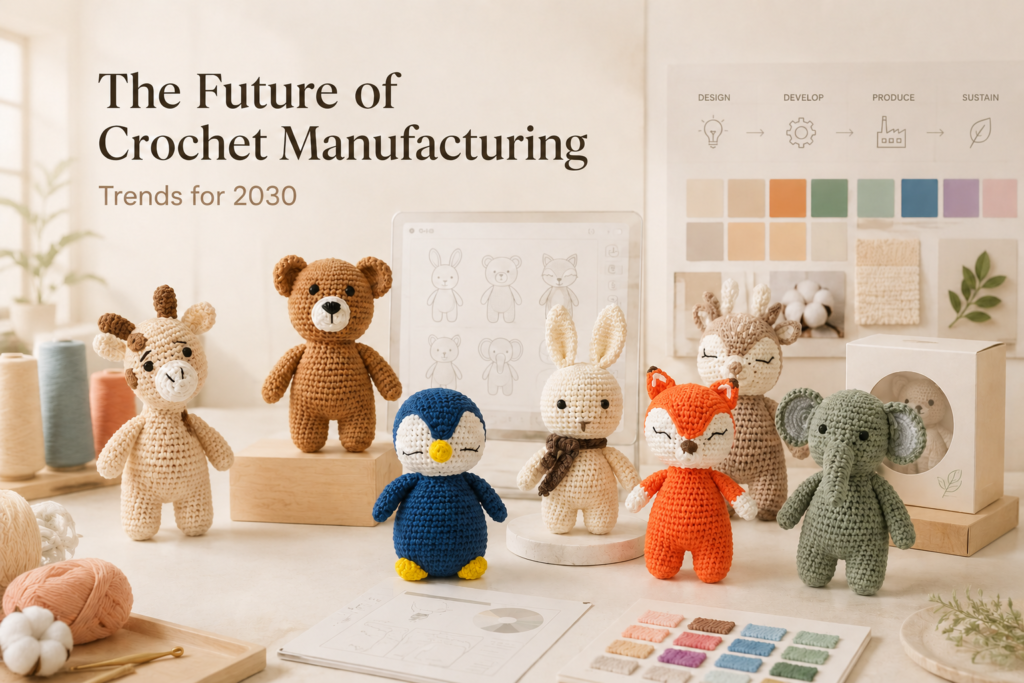
How Handmade Production, Technology, Sustainability, and Product Development May Reshape the Global Crochet Industry
Crochet manufacturing is entering a new stage.
For decades, crochet has been associated with:
- Traditional craftsmanship
- Small workshops
- Hobby production
- Handmade gifts
But the global market is changing.
- Human craftsmanship
- Customization
- Emotional value
- Responsible production
- Commercial scalability
At U-MY Crochet, we have specialized in handmade crochet manufacturing since 2013, supporting brands, retailers, gift companies, cultural institutions, and product developers across more than 150 countries and regions.
Based on the changes we have observed in product development, buyer requirements, retail behavior, customization demand, and international sourcing, we believe crochet manufacturing will evolve significantly by 2030.
However, one point is important:
The future of crochet manufacturing is unlikely to be about replacing handmade craftsmanship. It will be about using better systems, technology, materials, and product strategy to make handmade production more efficient, transparent, and commercially valuable.
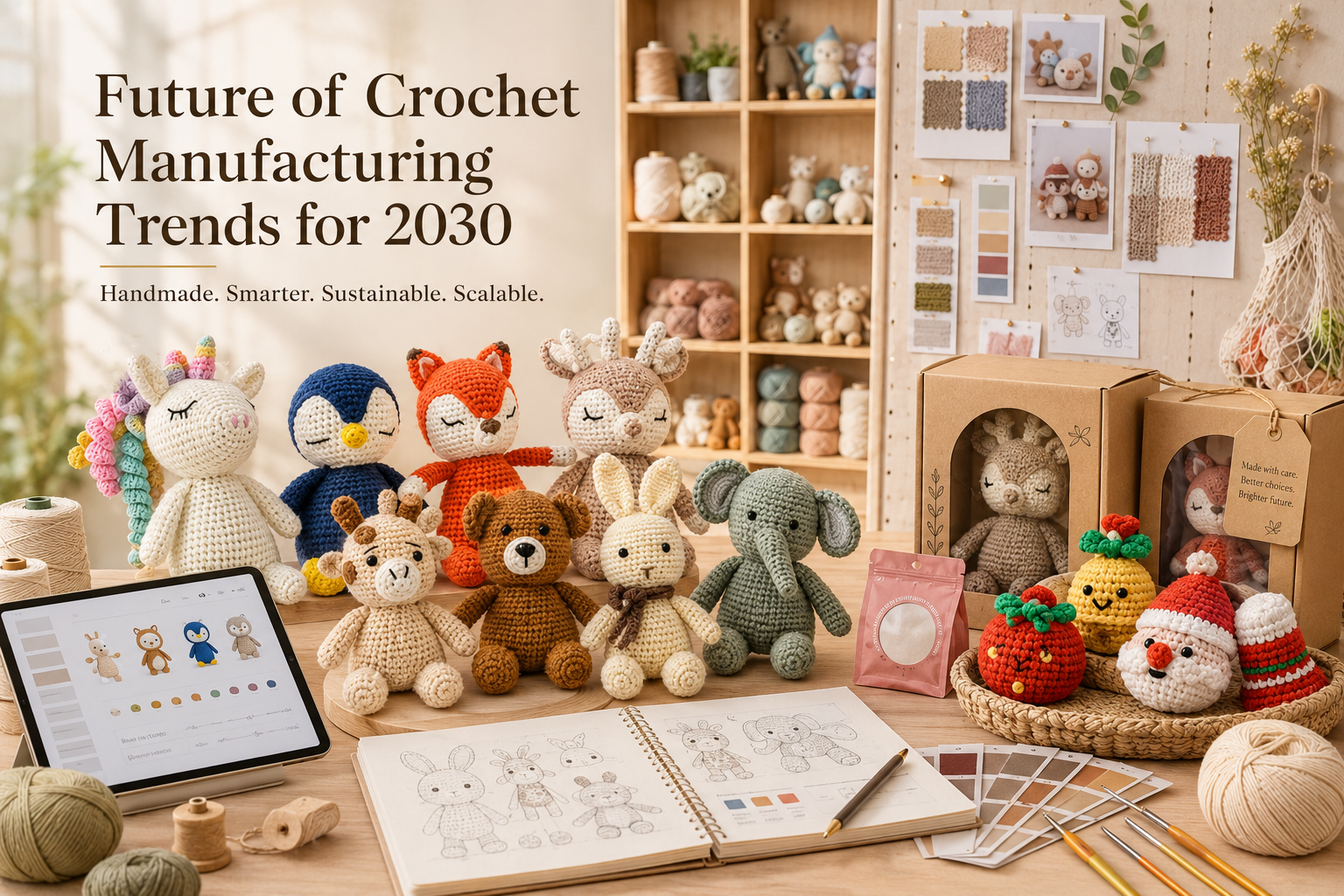
What Will Crochet Manufacturing Look Like by 2030?
Several forces are likely to shape the industry:
- More professional artisan production networks
- AI-assisted product development
- Faster digital sampling workflows
- Greater demand for customization
- Sustainable and traceable materials
- Stronger ethical sourcing requirements
- More IP and mascot-based products
- Smaller test orders followed by faster scaling
- Integrated retail-ready manufacturing
- Greater supply-chain transparency
These changes will not affect every market equally.
But together, they point toward a more professional and data-informed version of handmade manufacturing.
Trend 1: Handmade Production Will Become More Systemized
One of the biggest misconceptions about crochet is that handmade production must be informal.
By 2030, professional crochet manufacturers are likely to rely even more heavily on standardized systems.
These may include:
- Digital pattern libraries
- Approved sample databases
- Material coding
- Production allocation systems
- Quality-control records
- Artisan skill classification
- Batch tracking
The crochet itself may remain handmade.
But nearly everything surrounding the crochet process can become more structured.
This matters because commercial buyers increasingly expect:
- Predictable quality
- Stable lead times
- Clear documentation
- Repeatable production
The future of handmade manufacturing will depend on combining craftsmanship with industrial discipline.
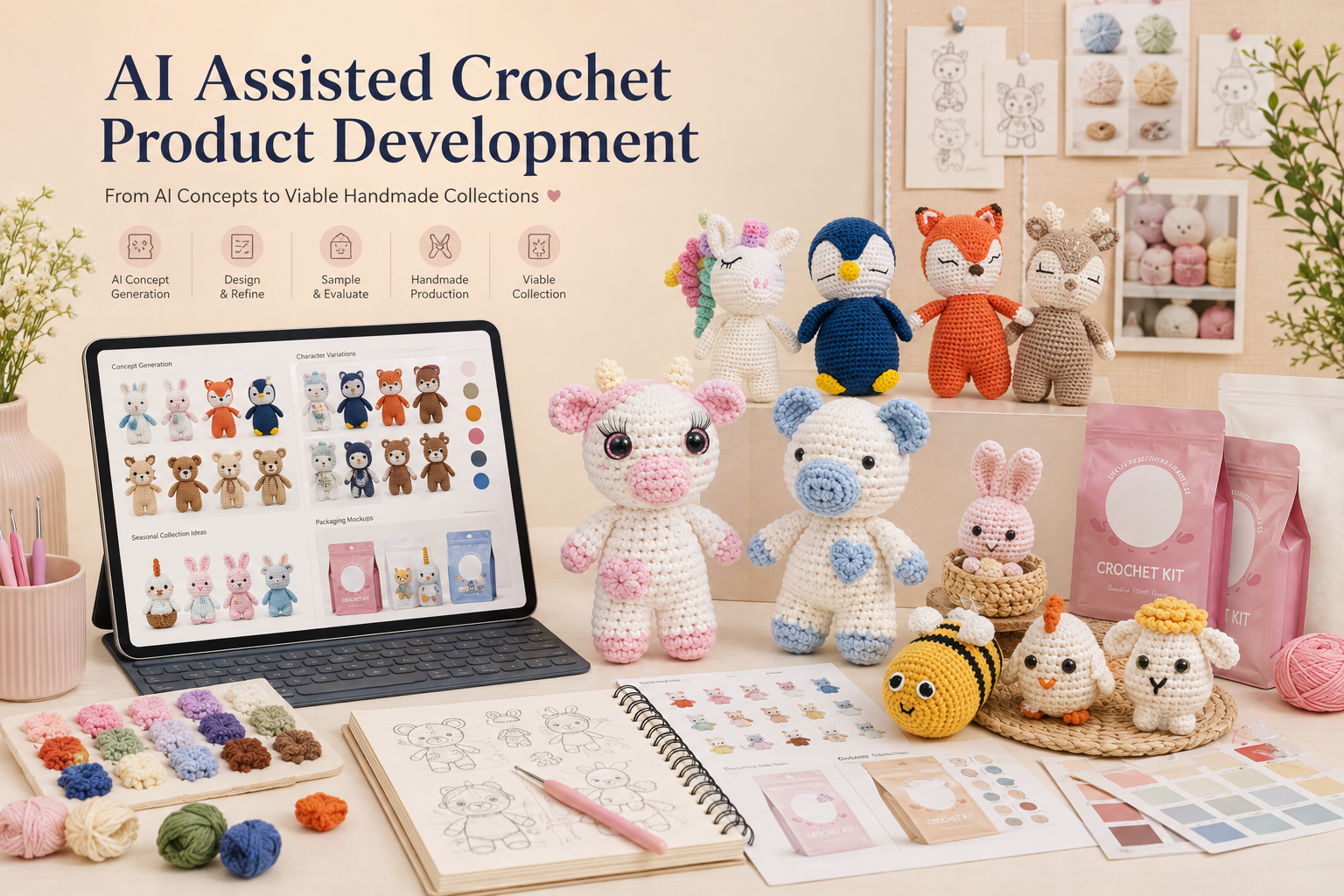
Trend 2: AI Will Change Product Development Before It Changes Crochet Production
It is easy to imagine AI replacing handmade production.
That is unlikely to be the most important change.
Instead, AI may have a much larger impact on the stages before production begins.
For example, brands may increasingly use AI to generate:
- Character concepts
- Color directions
- Seasonal collections
- Packaging ideas
- Product variations
- Marketing concepts
This can dramatically increase the number of ideas entering the product-development pipeline.
The challenge for manufacturers will shift from:
“Can you make this?”
to:
“Which of these ideas can become commercially viable products?”
Professional factories will therefore need stronger capabilities in:
- Design evaluation
- Cost engineering
- Production feasibility
- Product simplification
- Collection planning
AI can generate concepts quickly.
Manufacturing still requires technical judgment.
Trend 3: Digital Sampling Will Become More Important
Traditional product development often involves:
Concept
↓
Physical Sample
↓
Customer Feedback
↓
New Physical Sample
This process can take time.
By 2030, more manufacturers may use digital tools before physical sampling.
These could include:
- 3D visualization
- Digital color approvals
- Virtual packaging mockups
- AI-generated product previews
- Digital measurement references
These tools will not completely replace physical samples.
Crochet products still need to be evaluated for:
- Texture
- Proportions
- Filling
- Structure
- Hand feel
- Real material behavior
However, digital review may help eliminate obvious design problems before yarn is used.
That could reduce:
- Revision rounds
- Sampling time
- Development cost
Trend 4: Customization Will Become the Standard, Not the Exception
In the past, many buyers selected products from existing catalogs.
Increasingly, brands want products that are:
- Exclusive
- Recognizable
- Ownable
- Difficult to compare directly with competitors
By 2030, customization may become one of the main expectations in crochet sourcing.
Brands may request:
- Custom characters
- Private-label collections
- Exclusive colorways
- Custom packaging
- Branded accessories
- Seasonal versions
- Market-specific products
This is particularly important for:
- Gift brands
- Museum stores
- Lifestyle brands
- IP owners
- Corporate buyers
- Tourism retailers
Factories that only reproduce standard catalog products may face increasing competitive pressure.
Factories with strong OEM and ODM capabilities will become more valuable.
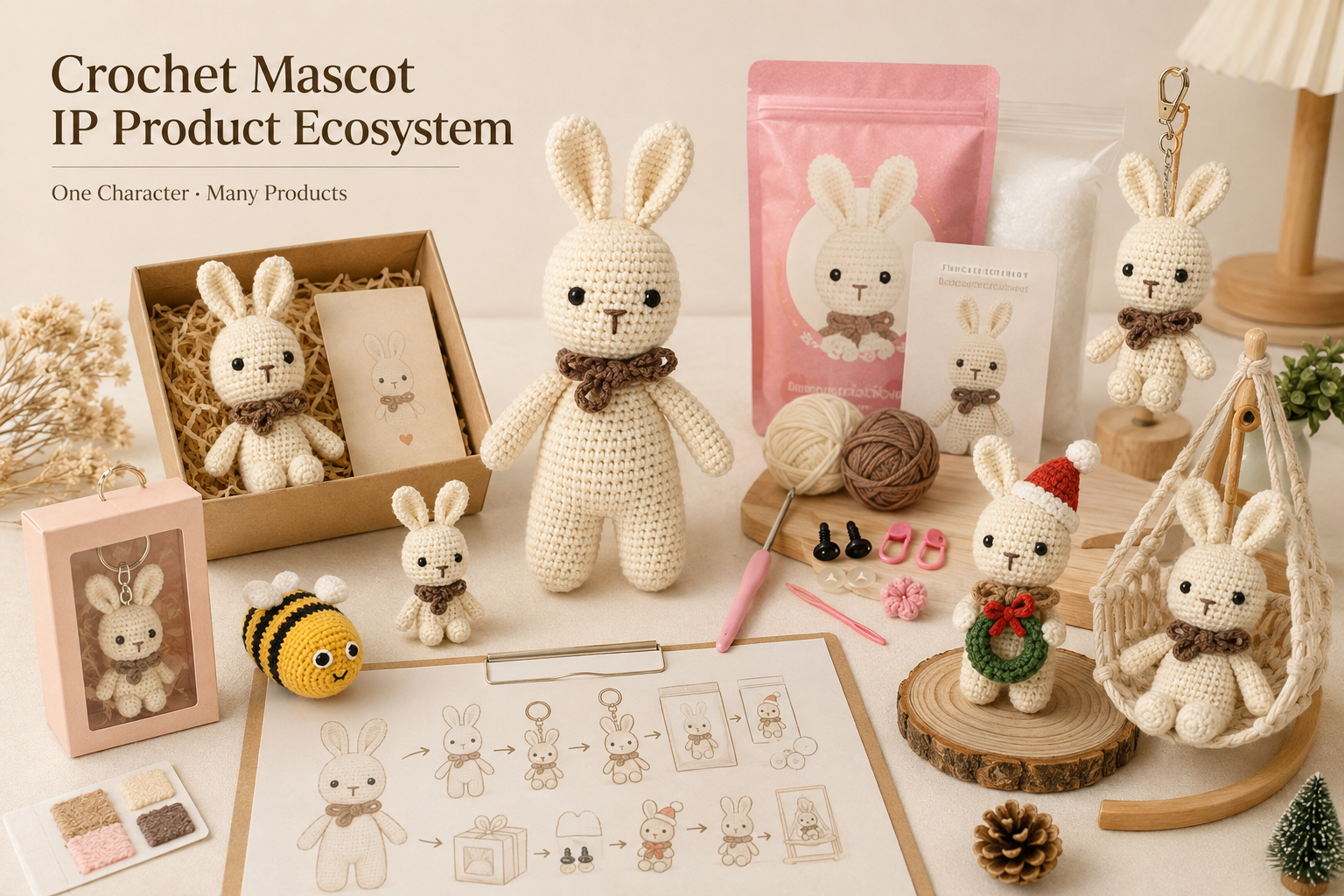
Trend 5: One Character Will Become Many Products
Character-based product development is likely to become a major growth area.
A brand may begin with one mascot.
By 2030, that same character may expand into:
- Crochet doll
- Mini collectible
- Keychain
- Gift set
- DIY kit
- Seasonal edition
- Home decoration
- Plush version
This reflects a broader shift from:
Product Manufacturing
to:
IP-Based Collection Development
For manufacturers, this means product-development capability will matter as much as production capability.
The most valuable suppliers will help brands answer:
How can this character become a long-term product ecosystem?
Trend 6: Small-Batch Testing Will Become More Important
Large first orders create risk.
Retailers increasingly want to test before scaling.
This trend is likely to become even stronger by 2030.
Buyers may begin with:
- 3–5 SKUs
- Limited quantities
- Multiple colors
- Different price points
Then use real market data to decide:
- Which product to reorder
- Which character to expand
- Which packaging performs better
- Which price point works
This creates a new sourcing model:
Test Small
↓
Measure Demand
↓
Scale Winners
For factories, flexible production models will become an important competitive advantage.
Trend 7: Reordering Speed Will Matter More Than Initial MOQ
MOQ remains important.
But future buyers may care even more about:
How quickly can a successful product be replenished?
A low-MOQ launch is useful only if the supplier can later scale.
By 2030, buyers may evaluate suppliers based on:
- Initial test flexibility
- Reorder speed
- Material availability
- Production scalability
- Seasonal capacity
The strongest suppliers will support both ends of the process:
Low-Risk Testing
and
Commercial Scaling
Trend 8: Sustainable Materials Will Become More Specific
Today, many brands use broad sustainability language.
By 2030, buyers may demand more specific information.
Instead of asking:
Is this sustainable?
they may ask:
- What fiber is used?
- Where does it come from?
- Is it recycled?
- Is it organic?
- Is there certification?
- Can the material be traced?
Potential crochet materials may include:
- Conventional cotton
- Organic cotton
- Recycled fibers
- Certified yarns
- Lower-impact blends
The key shift will be from:
Sustainability Claims
to:
Sustainability Evidence
Manufacturers will need better documentation to support brand claims.
Trend 9: Ethical Manufacturing Will Require More Transparency
Handmade production naturally raises questions about labor.
By 2030, global buyers may increasingly ask:
- Who makes the products?
- How are artisans organized?
- How are payments managed?
- Is subcontracting disclosed?
- What social audits are available?
The most credible manufacturers will avoid vague statements such as:
“Our products are ethically handmade.”
Instead, they will provide evidence appropriate to the claim.
This may include:
- Social audits
- Production records
- Artisan-management procedures
- Subcontracting disclosure
- Training systems
For handmade industries, transparency may become an important part of supplier competitiveness.
Trend 10: Artisan Networks Will Become a Strategic Production Asset
Crochet cannot scale simply by adding machines.
It scales through people.
This means skilled artisan networks will remain central to the industry's future.
Professional manufacturers will increasingly need systems for:
- Artisan recruitment
- Training
- Skill classification
- Production allocation
- Technical supervision
- Quality control
The size of the artisan network alone will not determine competitiveness.
Management quality will matter more.
A smaller, well-organized network may outperform a much larger but poorly coordinated one.
One principle will remain important:
Scaling handmade production is a management challenge before it is a labor challenge.
Trend 11: Product Compliance Will Move Earlier in Development
Compliance is often treated as something that happens after a product is designed.
That approach creates risk.
By 2030, experienced manufacturers are likely to integrate compliance planning earlier.
For example, during concept development, teams may already consider:
- Intended age group
- Target market
- Accessories
- Small parts
- Materials
- Labeling
This can prevent expensive redesigns later.
For international buyers, the development process may increasingly look like:
Concept
↓
Compliance Review
↓
Sample
↓
Testing
↓
Production
rather than waiting until the end.
Trend 12: Retail-Ready Manufacturing Will Become More Valuable
Many buyers no longer want only products.
They want:
Products ready to sell.
This may include:
- Custom packaging
- Hangtags
- Barcodes
- Story cards
- Gift boxes
- Instruction inserts
- Display cartons
By 2030, the boundary between:
Factory
and
Product-development partner
will become increasingly blurred.
Trend 13: Packaging Will Become Part of Product Strategy
Packaging will no longer be treated simply as protection.
It will support:
- Brand identity
- Storytelling
- Giftability
- Retail display
- Sustainability
For crochet products, this is particularly important because many products are purchased as gifts.
A simple product with thoughtful packaging may achieve greater perceived value than a more complicated product with poor presentation.
Trend 14: Emotional-Support and Meaning-Based Products May Continue Growing
Crochet products naturally fit categories where emotion matters.
These include:
- Encouragement gifts
- Friendship gifts
- Wellness products
- Emotional-support characters
- Appreciation gifts
By 2030, brands may increasingly design products around:
What should the customer feel?
rather than only:
What should the product look like?
This may create more products built around:
- Comfort
- Hope
- Encouragement
- Connection
- Belonging
Handmade construction naturally supports these messages.
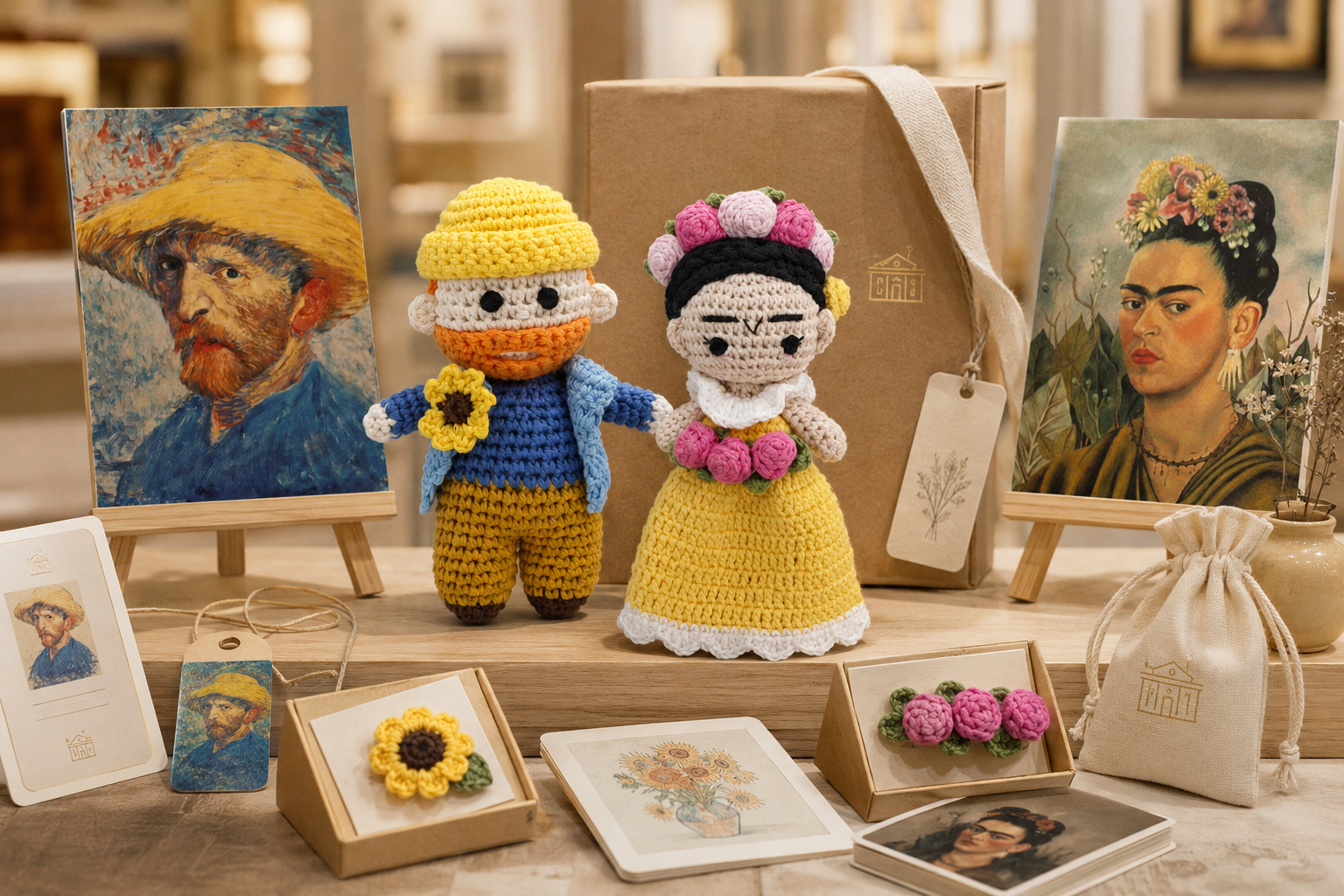
Trend 15: Museums and Cultural Organizations Will Create More Product IP
Museums and cultural institutions are increasingly looking beyond generic souvenirs.
They want products connected to:
- Exhibitions
- Artworks
- Local history
- Architecture
- Cultural symbols
Crochet offers an interesting format because it combines:
- Craftsmanship
- Storytelling
- Character design
By 2030, cultural retail may increasingly shift from:
Souvenir Selection
to:
Exclusive Cultural Product Development
This creates opportunities for manufacturers that understand both design adaptation and cultural sensitivity.
Trend 16: Corporate Gifts Will Become More Emotional
Corporate gifting is also changing.
Generic promotional items are increasingly competing with more personalized products.
Companies may choose crochet for:
- Employee appreciation
- Customer loyalty
- Events
- Company anniversaries
- Wellness campaigns
The strongest products may combine:
Corporate Mascot
+
Emotional Message
+
Gift Packaging
This shifts corporate merchandise from advertising toward relationship-building.
Trend 17: Cross-Category Manufacturing Will Become More Important
Brands increasingly want to expand successful concepts across multiple product formats.
For example:
One character may become:
- Crochet product
- Knitted product
- Plush product
- Keychain
- Kit
- Gift set
This creates a new supplier expectation.
The future of crochet manufacturing may therefore become more connected to broader soft-goods product development.
Trend 18: Data Will Influence Handmade Product Decisions
Handmade product development has traditionally relied heavily on intuition.
By 2030, retailers may increasingly use data such as:
- Sell-through rates
- Social engagement
- Search trends
- Customer reviews
- Return rates
to determine which products to expand.
This may change the development cycle from:
Design → Order → Hope
to:
Design → Test → Measure → Scale
Manufacturers that can respond quickly to these signals will become more competitive.
Trend 19: Faster Development Will Not Mean Eliminating Human Judgment
Technology can accelerate:
- Research
- Concept creation
- Visualization
- Communication
But crochet remains highly physical.
Experienced product developers still need to answer questions such as:
- Will the proportions work?
- Can artisans reproduce the detail?
- Is the construction stable?
- Is the cost commercially realistic?
- Which detail matters most?
Trend 20: The Best Crochet Factories Will Become Development Partners
The traditional sourcing model is:
Buyer sends design → Factory quotes → Factory produces.
The future model may look more like:
Buyer shares business objective → Factory helps develop the product strategy.
Manufacturers may increasingly support:
- Product concepts
- Cost optimization
- Collection planning
- Packaging
- Compliance
- Scaling strategy
This is especially valuable for smaller brands without large internal product-development teams.
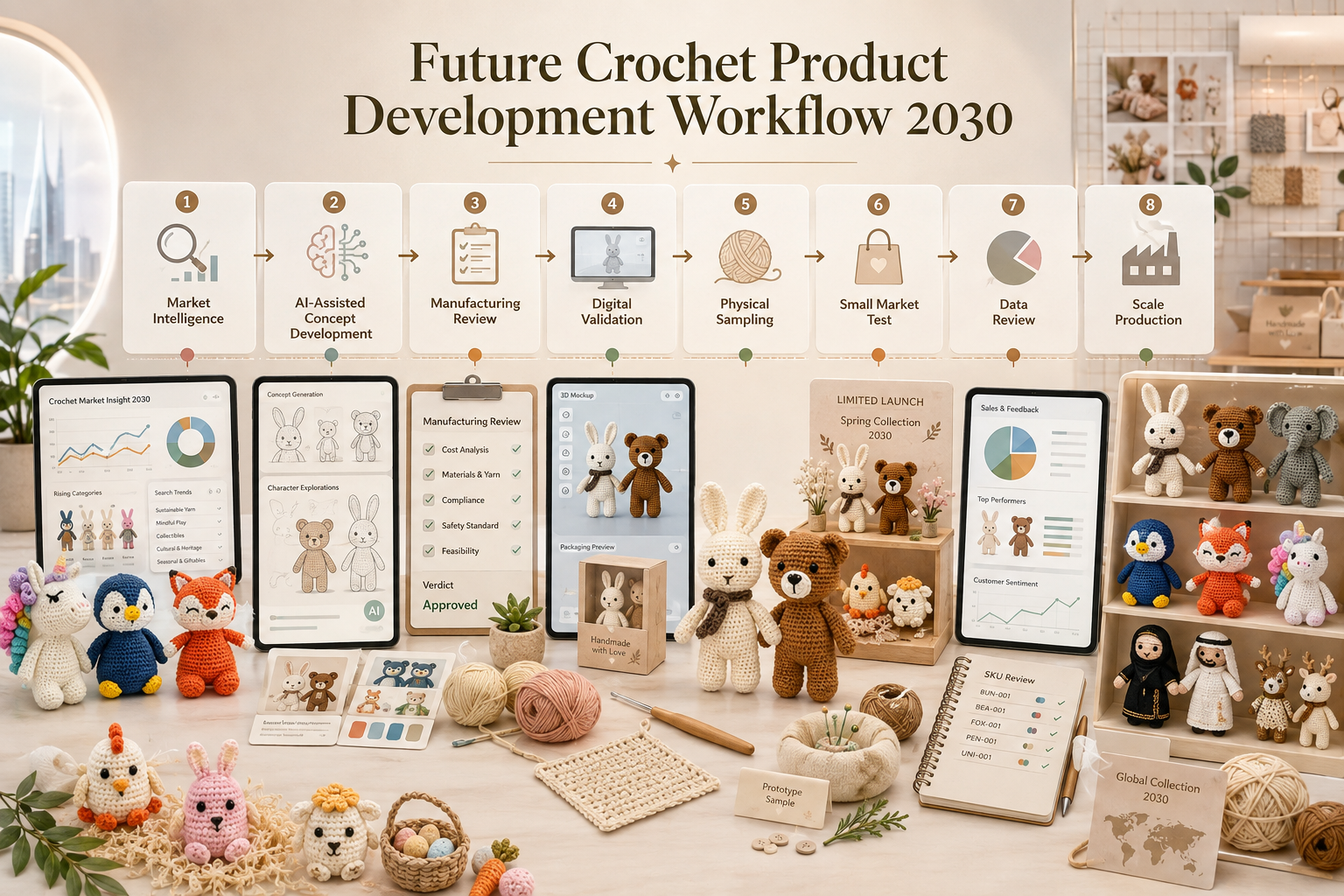
A Possible Crochet Manufacturing Workflow in 2030
The future workflow may look like this:
Stage 1 — Market Intelligence
Brands analyze:
- Search behavior
- Social trends
- Customer feedback
Stage 2 — AI-Assisted Concept Development
Generate:
- Characters
- Collections
- Color directions
Stage 3 — Manufacturing Review
Factory evaluates:
- Feasibility
- Cost
- Compliance
- Scalability
Stage 4 — Digital Validation
Review:
- Visual concepts
- Packaging
- Product architecture
Stage 5 — Physical Sampling
Produce and refine:
- Real materials
- Structure
- Texture
Stage 6 — Small Market Test
Launch limited quantities.
Stage 7 — Data Review
Identify winning SKUs.
Stage 8 — Scale Production
Expand validated products.
This does not remove artisans.
It helps ensure that artisan time is focused on products with stronger commercial potential.
What Will Not Change by 2030?
Despite all these changes, several fundamentals are unlikely to disappear.
Crochet Will Remain Human
The core handmade process depends on skilled people.
Quality Will Still Matter
Technology cannot compensate for weak workmanship.
Product-Market Fit Will Matter
A beautiful product can still fail if customers do not want it.
Communication Will Matter
Complex projects require strong collaboration between buyer and manufacturer.
Trust Will Matter
Long-term sourcing relationships depend on reliable delivery and transparency.
Technology changes the tools.
It does not eliminate the fundamentals.
What Buyers Should Look for in a Future-Ready Crochet Factory
Brands planning long-term sourcing relationships should consider whether a supplier can support:
- OEM development
- ODM development
- Fast sampling
- Flexible test orders
- Production scaling
- Material options
- Quality control
- International compliance
- Packaging development
- Collection expansion
- IP confidentiality
- Transparent production systems
The strongest factories will combine these capabilities rather than excelling in only one area.
How U-MY Is Preparing for the Future of Crochet Manufacturing
U-MY Crochet has specialized in handmade crochet manufacturing since 2013.
Our current product-development capabilities cover:
- Custom crochet dolls
- Crochet mascots
- Baby gifts
- Crochet flowers
- DIY crochet kits
- Keychains
- Gift sets
- Seasonal collections
- Cultural products
- Retail-ready packaging
We support both OEM and ODM development.
Our broader production system also combines:
- Product development
- Skilled artisan networks
- Material management
- Quality control
- Packaging
- International export experience
Our objective is not to predict every product that will succeed in 2030.
It is to build a manufacturing system flexible enough to help brands respond as customer expectations change.
Frequently Asked Questions
Will machines replace handmade crochet by 2030?
The core crochet process is still fundamentally manual. Technology is more likely to improve product development, planning, quality management, and communication than completely replace skilled artisans.
How will AI affect crochet manufacturing?
AI may accelerate character design, collection planning, trend research, visualization, and packaging concepts. Manufacturers will still need to evaluate manufacturability, cost, quality, and scalability.
Will sustainable materials become more important?
Will low MOQ become more important?
Flexible market testing is likely to remain important, but buyers may increasingly evaluate both low initial MOQ and the supplier's ability to scale successful products later.
Can handmade crochet really support global brands?
Will crochet mascots and IP products grow?
Character-based products have strong potential because one successful design can expand into multiple formats, seasonal editions, collections, and collaborations.
What will buyers expect from crochet factories in 2030?
Buyers are likely to expect stronger customization, faster development, better transparency, responsible sourcing, compliance support, packaging capability, and flexible scaling.
Conclusion
The future of crochet manufacturing will not be defined by a choice between:
Handmade or technology.
Craftsmanship or scale.
People or efficiency.
The strongest manufacturing models will combine them.
By 2030, crochet factories may become more:
- Digital
- Transparent
- Flexible
- Sustainable
- Data-informed
- Development-oriented
But the core value of crochet will remain human.
At U-MY Crochet, our experience since 2013 has shown us that brands do not choose handmade products because they want inefficiency.
They choose them because handmade products create something mass production often struggles to reproduce:
emotion, character, craftsmanship, and connection.
The future opportunity is therefore not to remove the handmade element.
It is to build better systems around it.
That is what may turn crochet manufacturing from a traditional craft-based industry into a modern, scalable, technology-supported product-development ecosystem for global brands.
 Chinese