
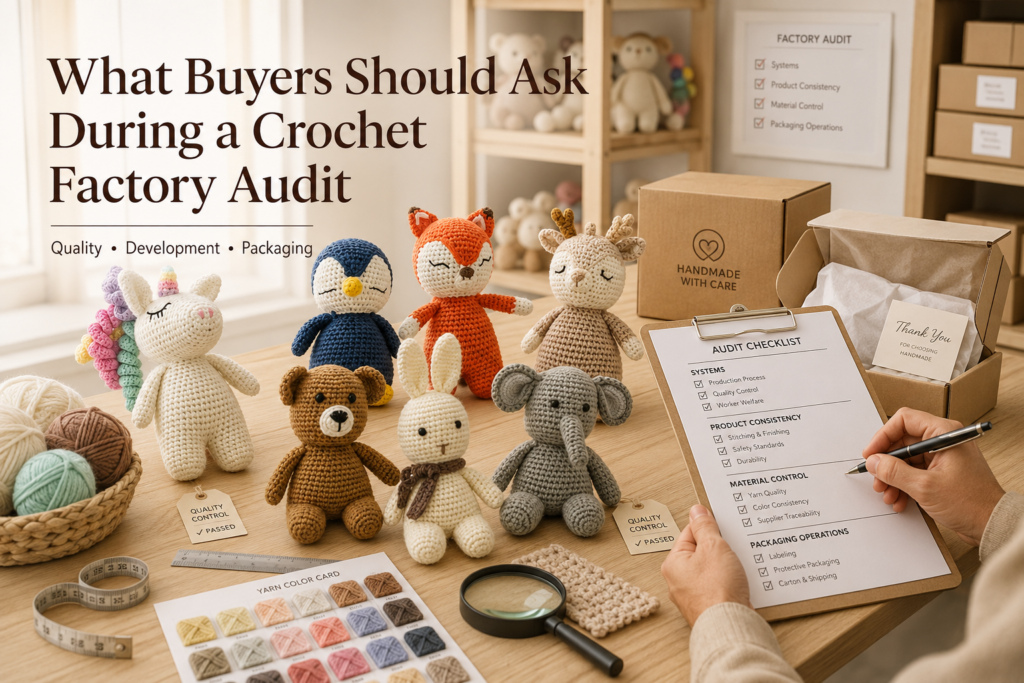
A Practical Audit Checklist for Brands, Retailers, Gift Companies, and Global Sourcing Teams
Visiting a crochet factory can reveal far more than reviewing a supplier's website, quotation, or product catalog.
For international buyers, a factory audit is an opportunity to verify whether the supplier can actually deliver what it promises.
This is especially important for handmade crochet production.
Unlike highly automated manufacturing, crochet depends on a combination of:
- Skilled artisans
- Standardized crochet patterns
- Material management
- Production planning
- Quality control
- Centralized finishing
- Packaging
- Compliance management
A supplier may be able to make one attractive sample.
The more important question is:
Can the supplier reproduce that sample consistently, responsibly, and on schedule across hundreds or thousands of handmade units?
At U-MY Crochet, we have specialized in handmade crochet manufacturing since 2013, supporting retailers, gift brands, museum stores, distributors, e-commerce sellers, and product developers across more than 150 countries and regions.
Through years of custom development and international production, we have learned one important lesson:
A good factory audit should verify systems—not simply confirm that a factory building exists.
This guide explains what buyers should ask, observe, and verify during a professional crochet factory audit.
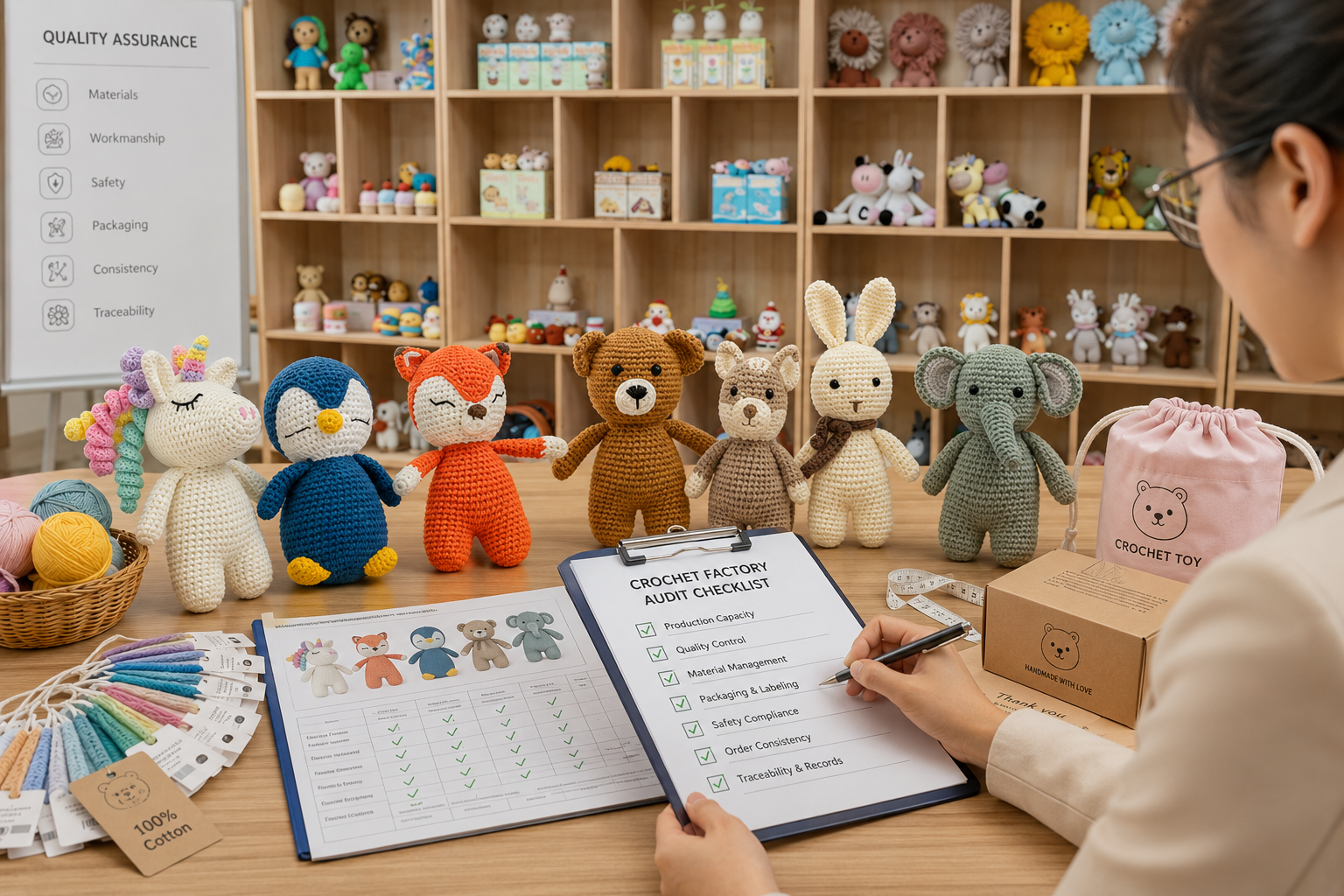
Why Is a Crochet Factory Audit Important?
Supplier websites usually show:
- Finished products
- Production photos
- Certifications
- Factory information
- Customer projects
These are useful starting points.
But they do not always show how production operates day to day.
A factory audit allows buyers to investigate:
- Who develops products
- Where materials are stored
- How artisans are organized
- How production is scheduled
- How quality is inspected
- Where finished products are assembled
- How defects are handled
- How packaging is controlled
For custom products, the audit also helps determine whether the supplier can become a long-term development partner rather than simply an order processor.
What Should Buyers Verify During a Crochet Factory Audit?
A complete audit should normally cover at least these areas:
- Company legitimacy
- Actual production model
- Product-development capability
- Artisan organization
- Material management
- Quality-control systems
- Production capacity
- Compliance management
- Needle and foreign-material control
- Packaging and warehousing
- Intellectual-property protection
- Social responsibility
- Communication and project management
- Traceability
- Business continuity and peak-season planning
The importance of each area depends on the product being sourced.
1. Start by Verifying the Company Itself
Before inspecting products, confirm that you understand who you are actually buying from.
Ask:
- What is the registered company name?
- When was the company established?
- Is this the production company or an affiliated trading company?
- Where is the registered address?
- Where are products actually produced?
- What are the company's main export markets?
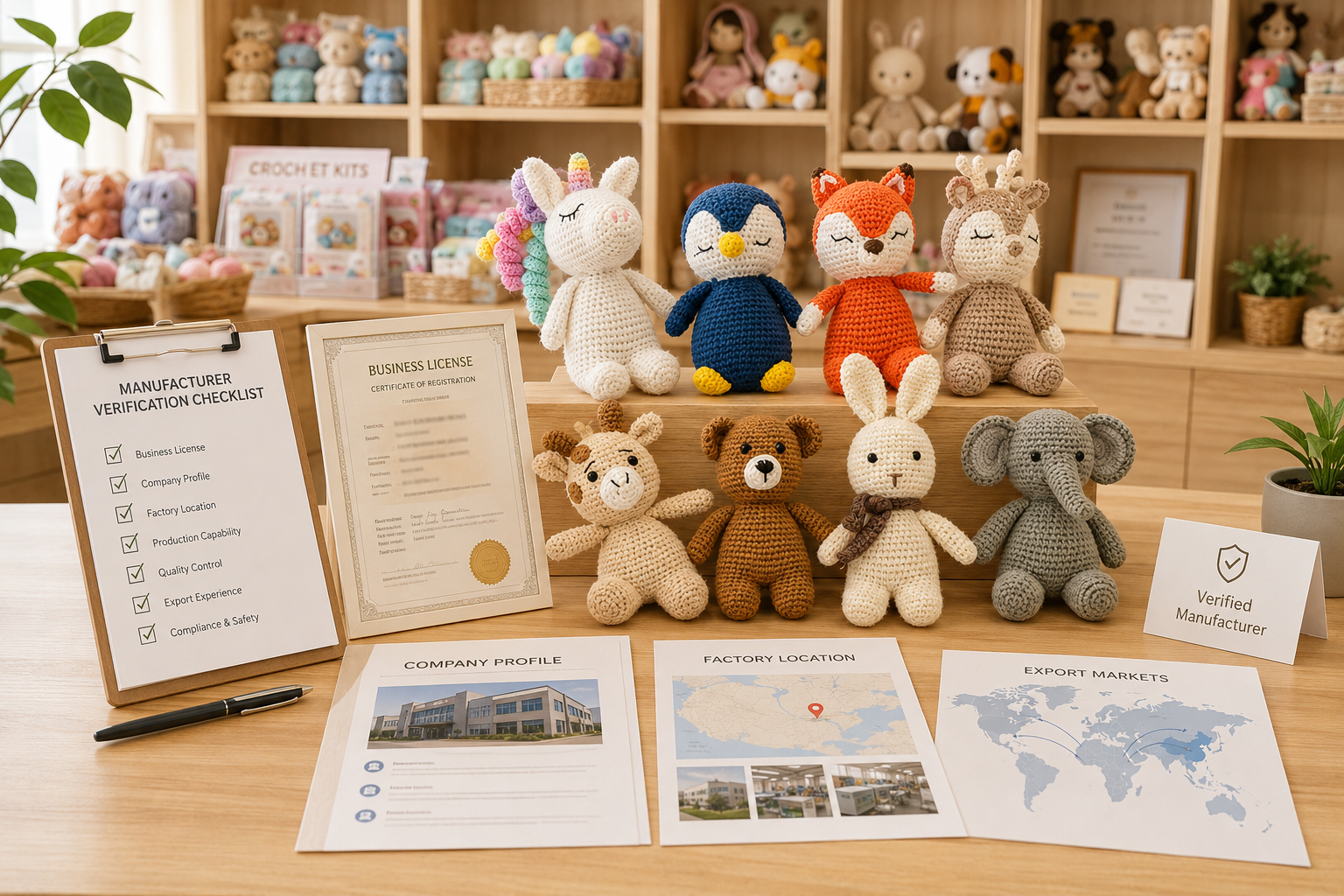
Buyers may request documents such as:
- Business license
- Export-related company information
- Factory address
- Relevant audit documentation
The objective is not simply to collect documents.
It is to confirm that the legal company, sales team, manufacturing operation, and production network are clearly understood.
2. Ask: Are You a Factory, a Trading Company, or Both?
This question sounds simple, but the answer may be more complicated in handmade production.
A professional crochet company may operate with:
- Central product-development teams
- Central material storage
- Central assembly and finishing
- Distributed artisan groups
- Central quality inspection
This is different from a trading company that simply buys finished products from unrelated factories.
Ask:
- Which production processes do you manage directly?
- Which processes happen outside this facility?
- Do you use subcontractors?
- How are outside artisan teams managed?
- Where are final products inspected and packed?
Do not automatically assume that distributed production is negative.
Crochet is handmade and may naturally use artisan networks.
The important issue is control and transparency.
3. Ask How the Artisan Network Is Organized
For handmade crochet, artisan management is one of the most important parts of the production system.
Ask:
- How many artisans regularly support production?
- Are artisans organized into teams?
- How are new artisans trained?
- How are complex products assigned?
- Who supervises production outside the central facility?
- How are finished crochet components returned for inspection?
A large artisan headcount sounds impressive.
But headcount alone does not prove manufacturing capability.
The real question is:
How does the factory coordinate those people around one approved production standard?
At U-MY Crochet, handmade production is supported by organized artisan resources together with centralized development, quality-management, and finishing processes.
4. Ask How New Artisans Are Trained
Commercial crochet production requires different skills from hobby crochet.
Artisans may need to learn:
- Standardized stitch counts
- Specific tension requirements
- Size tolerances
- Filling standards
- Accessory placement
- Facial embroidery
- Approved finishing methods
Ask the factory:
- Is there a formal training process?
- Do artisans practice before joining commercial production?
- Are senior artisans responsible for technical training?
- How are complex products assigned?
For character-based products, training is particularly important because small differences can change the appearance dramatically.
5. Ask to See the Product Development Department
A factory audit should not focus only on mass production.
For custom brands, product development may be equally important.
Ask:
- Who converts artwork into crochet products?
- Who develops crochet patterns?
- How many sample developers are available?
- Can you work from sketches or character artwork?
- How are sample revisions documented?
A professional development team should be able to explain why certain design elements may require:
- Embroidery
- Structural changes
- Simplification
- Different materials
The strongest suppliers do not simply say:
"Yes, we can make it."
They explain how the idea will become a manufacturable product.
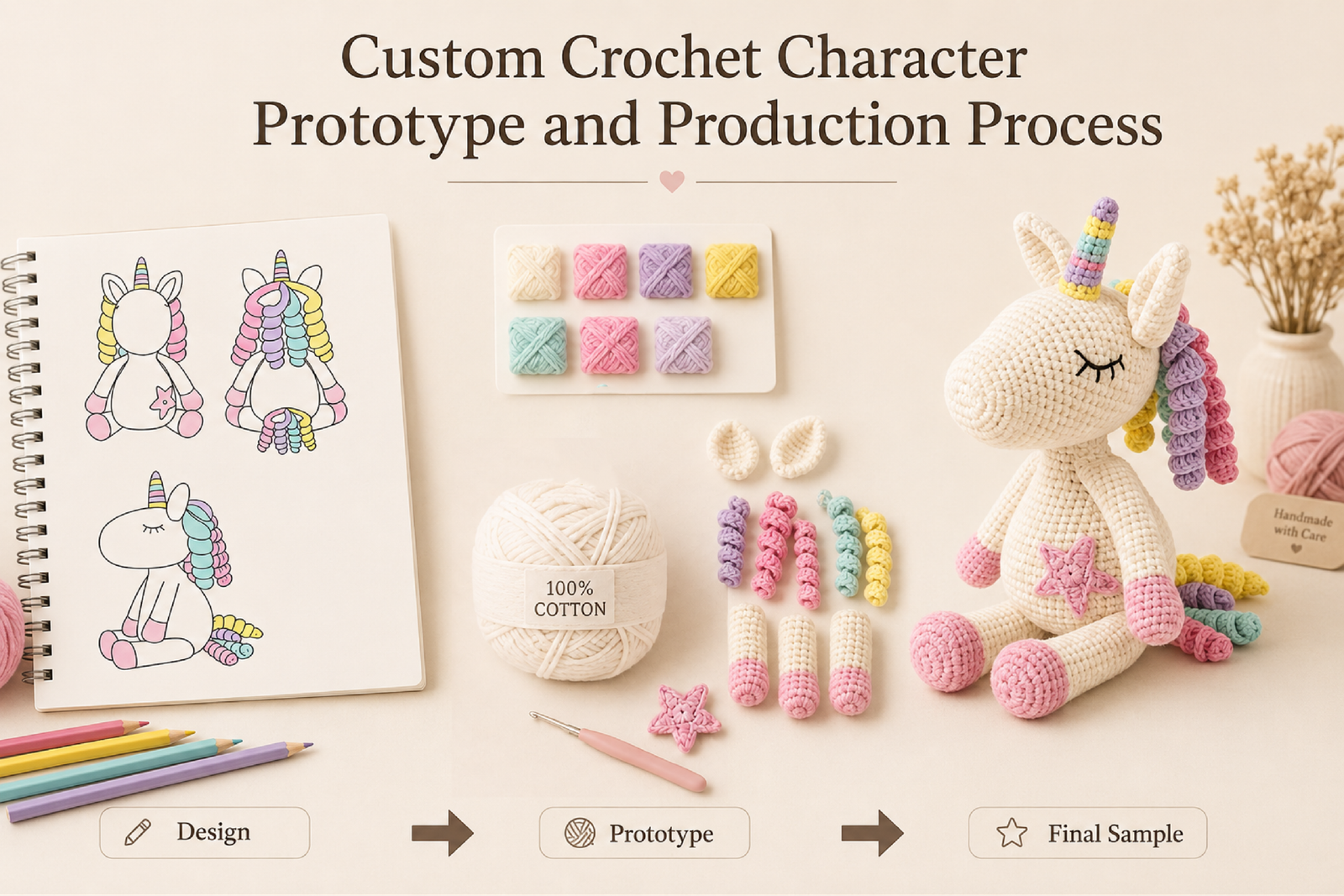
6. Ask to See the Golden Sample System
For handmade production, the approved sample is one of the most important quality references.
Ask:
- Where are approved samples stored?
- How are production teams given access to the reference?
- How are changes recorded?
- How do inspectors know which revision is current?
The golden sample may define:
- Height
- Width
- Shape
- Colors
- Facial expression
- Clothing
- Accessories
- Filling
- Packaging
If a factory cannot clearly explain how one approved sample becomes the reference for bulk production, consistency may become difficult to manage.
7. Ask How Crochet Patterns Are Standardized
A professional manufacturer should not depend entirely on each artisan's memory.
Ask:
- Are crochet patterns documented?
- Are stitch counts standardized?
- Are separate instructions created for difficult sections?
- Are measurements defined?
- Are photos used for positioning?
For custom mascots, this may include instructions for:
- Head structure
- Limb length
- Ear placement
- Clothing
- Facial embroidery
Good documentation allows a successful sample to become a repeatable commercial product.
8. Inspect the Material Storage Area
Materials directly affect product quality.
During the audit, inspect how the factory manages:
- Yarn
- Filling
- Safety eyes
- Wooden parts
- Hardware
- Labels
- Packaging
Ask:
- How are yarn colors identified?
- Are material batches separated?
- How are approved materials linked to specific orders?
- How are materials protected from dirt or moisture?
Poor storage can create problems even when the product design is excellent.
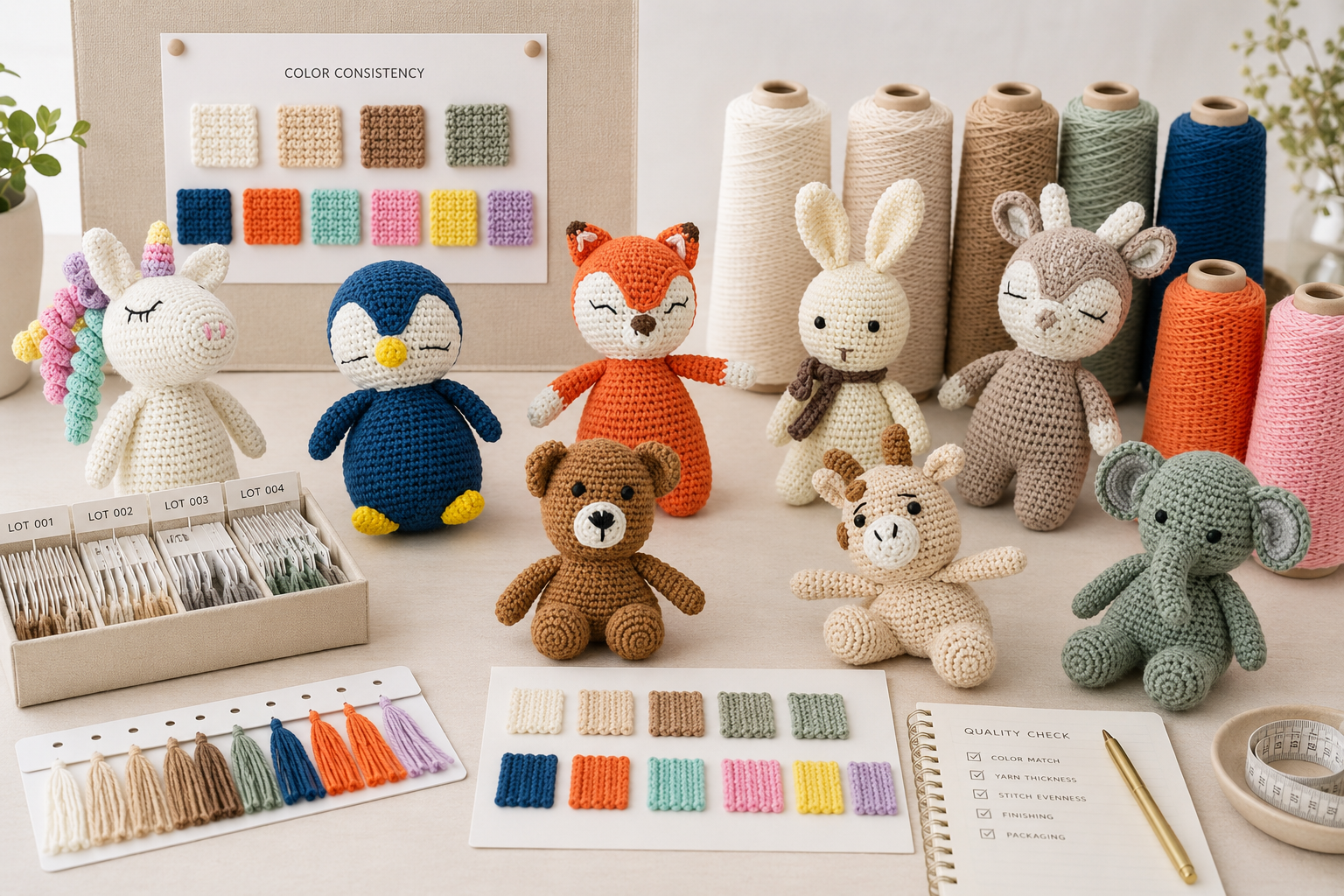
9. Ask How Yarn Color Consistency Is Controlled
Color is particularly important for:
- Brand mascots
- Licensed characters
- Coordinated collections
Ask:
- Do you record yarn codes?
- How do you handle color differences between lots?
- Can material be reserved for repeat orders?
- What happens if the original yarn is discontinued?
For larger collections, several SKUs may use the same signature color.
A visible mismatch can weaken the entire product presentation.
10. Ask About Incoming Material Inspection
Quality control should begin before crochet starts.
Ask whether incoming inspection covers:
- Yarn
- Filling
- Accessories
- Hardware
- Packaging
Possible checks include:
- Color
- Size
- Cleanliness
- Appearance
- Quantity
- Material specification
This reduces the risk of discovering material problems after production has already begun.
11. Ask to See In-Process Quality Control
Do not accept:
"We inspect everything before shipping."
as the complete QC explanation.
For handmade production, quality should be checked during production.
Ask:
- When is the first production batch checked?
- Who measures products?
- How often are components inspected?
- What happens when repeated defects are found?
Typical in-process checks may cover:
- Stitch quality
- Component dimensions
- Shape
- Color
- Assembly
The earlier a defect is identified, the less expensive it usually is to correct.
12. Ask How Handmade Tolerances Are Defined
A handmade crochet doll cannot realistically match machine-level dimensions on every unit.
Professional buyers should therefore ask:
- What dimensional tolerances do you normally use?
- Can custom tolerances be agreed?
- How are products outside tolerance handled?
The important concept is:
Handmade variation should be controlled rather than ignored.
A professional supplier should understand the difference between:
- Natural handmade variation
- Commercially unacceptable inconsistency
13. Inspect Assembly and Finishing
A crochet product can have excellent stitching but poor final appearance because of incorrect assembly.
Inspectors should control:
- Head alignment
- Limb symmetry
- Ear positioning
- Facial placement
- Accessories
- Filling
- Loose yarn ends
During an audit, ask to see:
- Unassembled components
- Partially finished products
- Finished products
This reveals more about production quality than examining only display samples.
14. Ask How Facial Features Are Controlled
For character products, the face may be the most sensitive quality area.
Ask:
- Are positioning references used?
- Are measurements provided?
- Who performs embroidery?
- How are facial differences inspected?
A few millimeters can change:
- Eye expression
- Symmetry
- Character recognition
For brand mascots, facial consistency may deserve stricter control than less important decorative features.
15. Ask About Filling Standards
Filling affects:
- Shape
- Hand feel
- Dimensions
- Appearance
Ask:
- Is filling quantity standardized?
- Is product firmness compared with the golden sample?
- How is uneven filling corrected?
Too much filling can distort the product.
Too little can cause it to collapse.
16. Ask About Needle Control
Needle management is especially important when sewing and embroidery processes are involved.
Ask:
- How are needles issued?
- Is broken-needle documentation maintained?
- What happens when a needle breaks?
- Are workstations checked?
- Is needle detection used where applicable?
The exact system depends on the product and manufacturing process.
The important issue is whether the factory has a defined procedure.
17. Ask How Defects Are Classified
Professional quality systems should distinguish between different levels of defects.
These may include:
Critical Defects
Potential safety or regulatory issues.
Major Defects
Problems that significantly affect function or customer acceptance.
Minor Defects
Smaller cosmetic issues.
Ask:
- How are defects recorded?
- Who decides whether products are reworked?
- Are recurring defects analyzed?
- How are corrective actions implemented?
Quality control should not simply remove defective units.
It should help prevent repeated defects.
18. Ask About AQL and Pre-Shipment Inspection
For larger orders, buyers may use AQL-based inspections or third-party inspection companies.
Ask:
- Do you support AQL inspections?
- Which inspection levels are commonly used?
- Can an external inspection company inspect goods before shipment?
- Where will inspection take place?
The inspection standard should ideally be agreed before production begins.
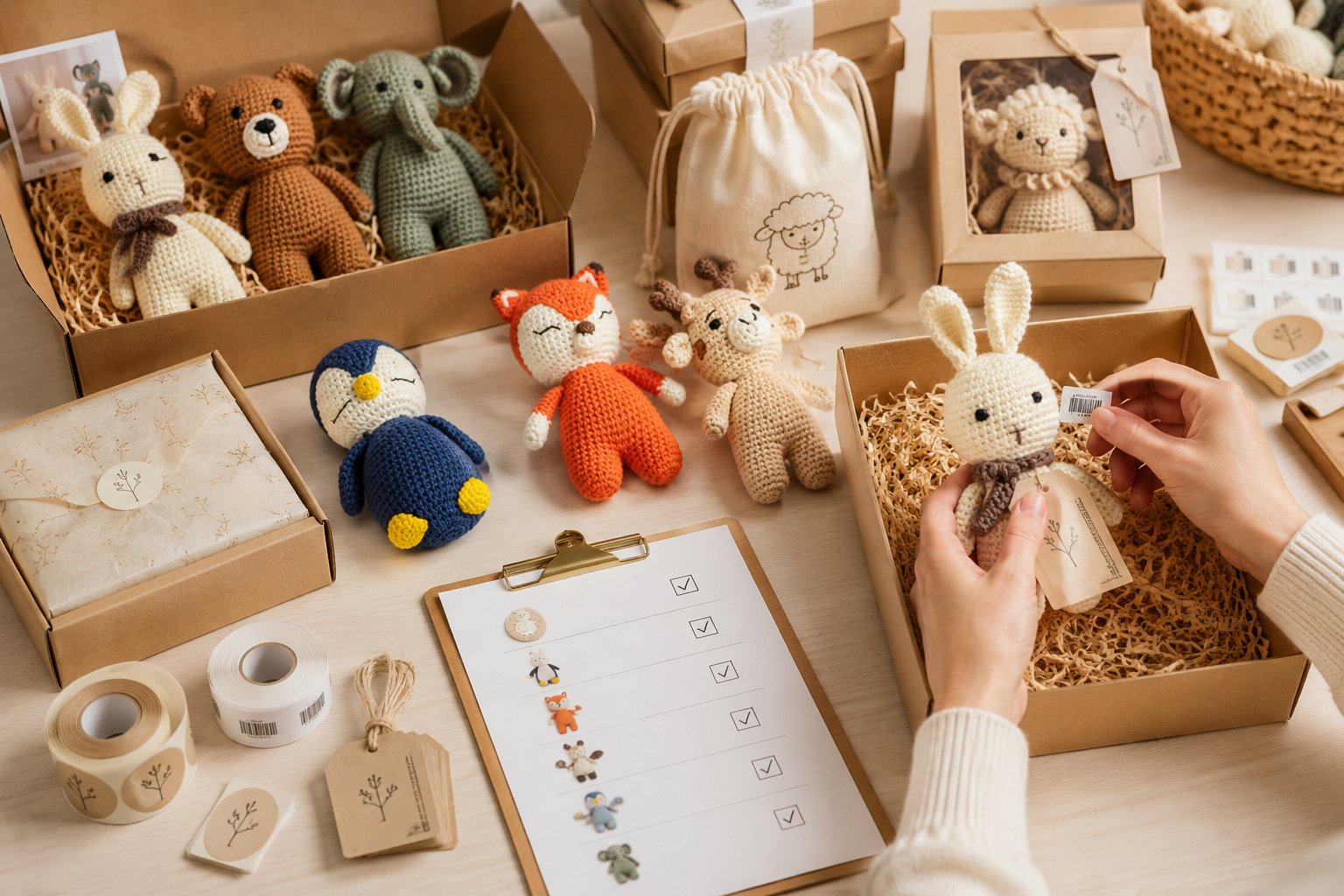
19. Ask to See Packaging Operations
Packaging errors are commercial quality problems.
Inspect how products are:
- Labeled
- Packed
- Counted
- Cartoned
Ask:
- How do you prevent SKU mix-ups?
- How are barcodes checked?
- How are gift-set components verified?
- How are carton markings controlled?
For retailers, accurate packaging can be just as important as product workmanship.
20. Ask About Product Traceability
Traceability is increasingly important for international buyers.
Ask:
- Can the factory identify which production batch an item belongs to?
- Are material lots recorded?
- Are production dates tracked?
- Can customer orders be linked to inspection records?
The exact traceability system depends on the product and market.
For children's products, tracking and labeling requirements may be particularly important.
21. Ask How Compliance Is Managed
Do not simply ask:
"Do you have CE?"
or:
"Do you have CPC?"
These questions are too broad.
A better approach is:
- Which markets have you supplied?
- Which product categories have you tested?
- Can we review recent reports?
- Which laboratory performed the testing?
- Does the report cover the same materials we plan to use?
Depending on the product and destination, relevant requirements may include:
- ASTM F963
- CPSIA
- CPC
- EN71
- CE-related requirements
- UKCA-related requirements
- AS/NZS toy safety requirements
A responsible manufacturer should understand that compliance depends on the specific product, materials, intended age group, and target market.
22. Verify Test Reports Carefully
When reviewing documents, check:
- Product description
- Tested materials
- Test date
- Applicable standards
- Laboratory name
- Applicant or manufacturer information
Do not assume that a certificate for one crochet toy automatically applies to every custom design.
This is especially important when changing:
- Yarn
- Accessories
- Wooden parts
- Surface treatments
Compliance planning should be project-specific.
23. Ask About Social Audits and Responsible Production
Handmade crochet is labor-intensive.
For brands with responsible-sourcing requirements, the human side of production deserves careful evaluation.
Ask:
- What social audits are available?
- How are artisan teams organized?
- How are external production groups managed?
- How is subcontracting controlled?
- How are working conditions monitored?
Depending on customer requirements, buyers may request documentation related to systems such as:
- BSCI
- Sedex/SMETA
- Other recognized social-compliance programs
Do not treat handmade production as automatically ethical.
Ethical sourcing should be supported by transparent practices and appropriate evidence.
24. Ask How Artisan Compensation Is Structured
For distributed handmade production, buyers with deeper ESG requirements may want to understand compensation practices.
Possible questions include:
- Is work paid by piece, time, or another system?
- How are piece rates determined?
- How are complex products treated differently?
- How are production standards communicated before work begins?
Not every supplier will disclose commercially sensitive details during an initial visit.
However, serious ethical-sourcing programs may require deeper verification.
25. Ask About Subcontracting
Subcontracting is not automatically a problem.
Undisclosed subcontracting can be.
Ask:
- Which processes are outsourced?
- Are outside artisans considered part of the approved production network?
- Are materials supplied centrally?
- How is quality supervised?
- Can production locations be disclosed during an audit?
The objective is transparency.
The buyer should understand where and how the order will actually be produced.
26. Ask About Production Capacity
Factories often quote impressive capacity figures.
Buyers should understand what those numbers mean.
Ask:
- What is normal monthly crochet capacity?
- What is peak capacity?
- How many active orders share that capacity?
- How does capacity vary by product complexity?
- How far in advance should seasonal capacity be reserved?
A simple keychain and a complex 30 cm mascot do not consume the same artisan time.
Capacity should therefore be discussed in the context of the actual product.
27. Ask How Peak Season Is Managed
Holiday programs can create concentrated production pressure.
Ask:
- Which months are busiest?
- How early should Christmas orders be confirmed?
- How is artisan capacity increased?
- How are materials reserved?
- What backup plans are available?
A supplier that can explain peak-season planning in detail is generally more credible than one that simply promises:
"No problem."
28. Ask What Happens if Your Product Becomes a Bestseller
This is an excellent question during an audit.
Ask:
If our first order is 500 units and the next order is 5,000, what changes?
Listen for discussion of:
- Material planning
- Additional artisan training
- Pattern standardization
- Production allocation
- Inspection
- Lead time
This reveals whether the supplier can support growth rather than only initial sampling.
29. Ask About On-Time Delivery Performance
Delivery reliability is difficult to judge from one factory visit, but buyers can ask about the management system.
Questions include:
- How are production schedules created?
- How are delays identified?
- Who communicates schedule changes?
- How is packaging coordinated with product completion?
For seasonal products, a late product may lose much of its commercial value.
The strongest manufacturers understand that delivery reliability is part of product quality.
30. Ask How Urgent Orders Are Handled
Some buyers occasionally require accelerated projects.
Ask:
- What parts of development can realistically be shortened?
- What cannot be rushed?
- Can stock yarn reduce lead time?
- Can standard packaging be used?
- Can existing product structures be adapted?
A professional supplier should explain trade-offs.
An unrealistic promise is not evidence of flexibility.
31. Ask About Intellectual Property Protection
For custom brands, intellectual property can be one of the most valuable assets entering the factory.
Ask:
- Who can access customer artwork?
- Can custom products be photographed?
- Can samples appear in catalogs?
- Can customer-specific patterns be reused?
- How are confidential files stored?
For sensitive projects, contracts may also clarify:
- NDA requirements
- Design ownership
- Pattern ownership
- Marketing-use permissions
A custom supplier should understand that customer artwork is not simply another factory sample.
32. Ask About Product Photography and Sample Display
This is an often-overlooked IP issue.
A manufacturer may want to show successful custom projects on:
- Websites
- Trade-show displays
- Social media
- Catalogs
Ask whether customer approval is required before custom designs are shown publicly.
For unreleased or licensed products, this may be particularly important.
33. Ask to See Previous Development Examples
If confidentiality permits, request examples showing:
Initial Concept
↓
First Sample
↓
Revision
↓
Final Product
This provides evidence of the factory's development capability.
It also shows whether the supplier can do more than reproduce existing catalog products.
34. Evaluate Communication During the Audit
A factory visit is also a test of the team.
Observe:
- Who answers technical questions?
- Does the salesperson need to guess?
- Can production managers explain processes?
- Are problems acknowledged honestly?
- Do different departments give consistent answers?
Professional organizations usually have clear internal ownership.
If every answer depends on one salesperson, deeper technical support may be limited.
35. Ask Who Will Manage Your Project After the Contract Is Signed
The person hosting the factory audit may not be the person managing daily production.
Ask:
- Who is the account manager?
- Who handles development?
- Who handles QC?
- Who handles production scheduling?
- Who handles shipping?
Understand the communication chain before placing the order.
A Practical Crochet Factory Audit Checklist
Use this checklist during a supplier visit.
| Audit Area | Questions to Verify |
|---|---|
| Company | Is the business legally registered and transparent? |
| Factory Model | Which processes are internal, distributed, or outsourced? |
| Development | Can the supplier create products from artwork or concepts? |
| Sampling | Is there a documented sample and revision system? |
| Artisans | How are artisans trained and managed? |
| Patterns | Are production patterns standardized? |
| Materials | Are yarn and accessories centrally controlled? |
| QC | Are inspections conducted during production? |
| Safety | Are needle and foreign-material procedures defined? |
| Compliance | Are reports relevant to the actual product and market? |
| Packaging | Are labeling and SKU controls reliable? |
| Capacity | Can production scale if demand increases? |
| Delivery | Is scheduling realistic and transparent? |
| IP | Are customer designs protected? |
| Social Responsibility | Are artisan and subcontracting systems transparent? |
| Traceability | Can products and batches be tracked? |
Red Flags Buyers Should Watch for During an Audit
Production Areas That Cannot Be Explained
If the supplier cannot explain where production actually happens, investigate further.
Display Samples but No Production Standards
Beautiful samples do not prove repeatable manufacturing capability.
No Golden Sample System
This creates risk for custom handmade products.
Material Storage Without Clear Identification
Uncontrolled yarn and accessories can cause inconsistency.
Quality Control Only at the Final Stage
Strong handmade production normally requires earlier checkpoints.
Certificates That Do Not Match the Product
Generic certificates should not replace project-specific compliance evaluation.
Unclear Subcontracting
Buyers should know who actually makes the products.
No Clear Answer About Customer Designs
IP-sensitive buyers should clarify confidentiality before sharing valuable artwork.
Unrealistically Fast Delivery Promises
Professional factories should explain how the timeline is calculated.
Real Audit Insight: Follow the Product, Not the Presentation Route
During a factory visit, suppliers naturally want to show their strongest areas first.
Buyers can learn more by following the actual product journey.
Start with:
Customer Artwork
↓
Visit:
Sample Development
↓
Then:
Material Storage
↓
Then:
Crochet Production
↓
Then:
Assembly
↓
Then:
Quality Control
↓
Then:
Packaging
↓
Then:
Warehouse
This creates a much clearer picture of manufacturing capability.
The most useful factory audit follows the product from idea to shipment.
How to Score a Crochet Factory After the Audit
Buyers can create a simple scoring system.
For example:
| Evaluation Area | Suggested Weight |
|---|---|
| Product Development | 15% |
| Product Quality | 20% |
| Quality Management | 15% |
| Production Capacity | 10% |
| Compliance | 10% |
| Delivery Management | 10% |
| Communication | 5% |
| IP Protection | 5% |
| Social Responsibility | 5% |
| Packaging & Retail Support | 5% |
Weights should reflect the project.
For example:
A custom IP mascot project may give more weight to:
- Product development
- IP protection
- Quality consistency
A large seasonal program may give more weight to:
- Capacity
- Delivery
- Material planning
There is no universal audit score.
The evaluation should reflect the buyer's actual sourcing risk.
Factory Audit vs Product Inspection: What Is the Difference?
These two processes answer different questions.
Factory Audit
Asks:
Can this supplier reliably operate as our manufacturing partner?
It evaluates:
- Systems
- People
- Processes
- Capacity
- Management
Product Inspection
Asks:
Does this shipment meet our agreed requirements?
It evaluates:
- Finished goods
- Workmanship
- Quantity
- Packaging
Strong sourcing programs may use both.
A good factory can still occasionally produce a problematic shipment.
A good shipment does not automatically prove that the factory has strong long-term systems.
How U-MY Approaches Professional Crochet Manufacturing
U-MY Crochet has specialized in handmade crochet manufacturing since 2013.
Our product-development and manufacturing experience includes:
- Crochet dolls
- Custom mascots
- Baby products
- Keychains
- Crochet flowers
- DIY crochet kits
- Gift sets
- Museum souvenirs
- Seasonal collections
Our approach combines:
- Product development
- Sample standardization
- Organized artisan production
- Material management
- Quality-control processes
- Packaging development
- International export experience
For custom B2B projects, our goal is not simply to create an attractive sample.
Frequently Asked Questions
What should buyers check during a crochet factory audit?
How can buyers verify whether a crochet supplier is a real manufacturer?
Review the company's legal documents and ask detailed questions about product development, materials, production, artisan organization, quality control, finishing, and packaging. Follow the actual production workflow rather than relying only on marketing claims.
Is distributed artisan production a red flag?
Not automatically. Crochet is handmade and can be organized through distributed artisan networks. The important questions are whether production is transparent, standardized, supervised, and centrally quality-controlled.
What is the most important question during a crochet factory audit?
There is no single question, but buyers should understand how the supplier converts one approved sample into consistent bulk production.
Should buyers request social-audit reports?
Buyers with responsible-sourcing requirements may request relevant social-audit documentation and additional information about artisan management, subcontracting, and production practices.
Should buyers inspect yarn storage?
Yes. Yarn management affects color consistency, material traceability, quality, and repeat-order reliability.
Why should buyers ask about golden samples?
The golden sample provides the physical reference used to control handmade production. Without a clear approved reference, subjective interpretation can create inconsistency.
Can buyers use third-party auditors?
Yes. Depending on project requirements, buyers may engage qualified third-party organizations for factory audits, social audits, product inspections, or laboratory testing.
Should an audit be completed before signing a long-term contract?
For strategically important or higher-risk sourcing programs, supplier verification before major commitments can help reduce uncertainty. The level of due diligence should match the scale and risk of the project.
Conclusion
A crochet factory audit should answer more than:
"Is this a real factory?"
The deeper questions are:
- Can this team develop our product?
- Can they reproduce it consistently?
- Can they control handmade variation?
- Can they scale when demand grows?
- Can they support our target market?
- Can they protect our designs?
- Can they explain who actually makes the products?
- Can they deliver when they promise?
At U-MY Crochet, our experience since 2013 has shown us that the most reliable handmade manufacturing relationships are built on transparency.
A professional factory should be willing to explain:
how products are developed, how artisans are organized, how quality is controlled, and how one successful sample becomes a reliable commercial production program.
For buyers visiting a crochet supplier, the best audit mindset is therefore simple:
Do not only look at what the factory wants to show you. Follow the product from idea to shipment and understand the system behind every stitch.
That is how a factory visit becomes a meaningful sourcing decision rather than simply a tour.
 Chinese