
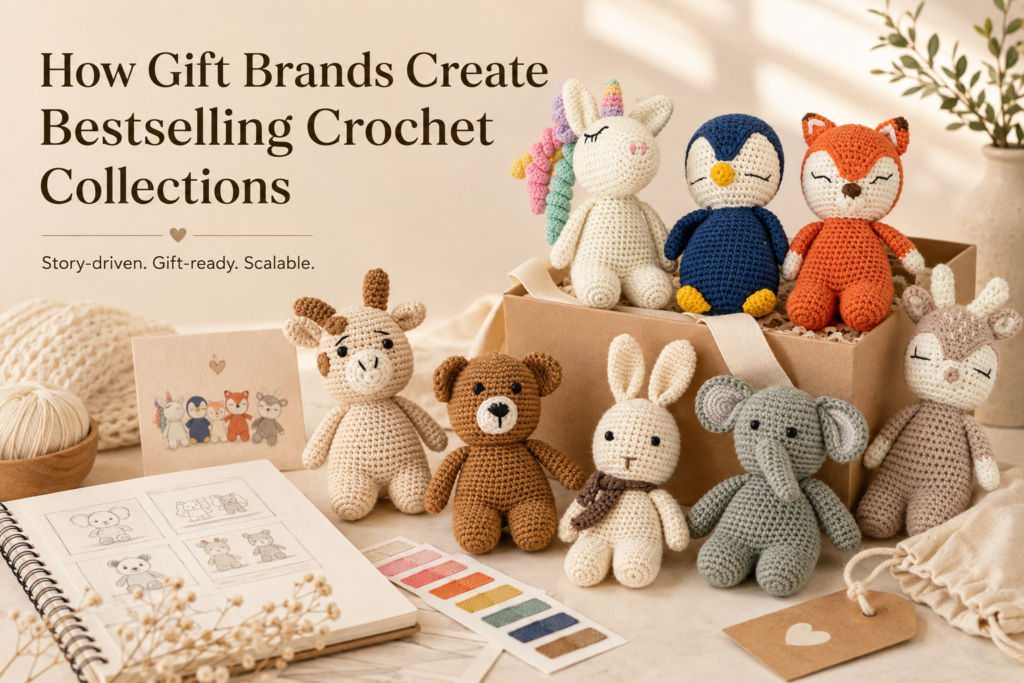
A Practical Guide to Product Strategy, Storytelling, Pricing, Packaging, and Scalable Handmade Development
A bestselling crochet collection rarely begins with the question:
“What is the cutest product we can make?”
Successful gift brands usually begin with a different set of questions:
- Who is the customer?
- What occasion are they buying for?
- What emotion should the gift create?
- Which product should attract attention first?
- What price points should the collection cover?
- Can the collection expand over time?
- Can the manufacturer reproduce it consistently at commercial scale?
At U-MY Crochet, we have specialized in handmade crochet manufacturing since 2013, supporting gift companies, retailers, museum stores, brands, distributors, and product developers across more than 150 countries and regions.
Through years of developing crochet dolls, gift sets, flowers, keychains, baby gifts, seasonal products, DIY kits, and custom character collections, we have learned one important lesson:
A strong collection combines emotional appeal with practical retail strategy.
What Makes a Crochet Collection Sell?
There is no universal formula that guarantees a bestseller.
Customer preferences vary by:
- Market
- Retail channel
- Price point
- Season
- Target audience
- Product category
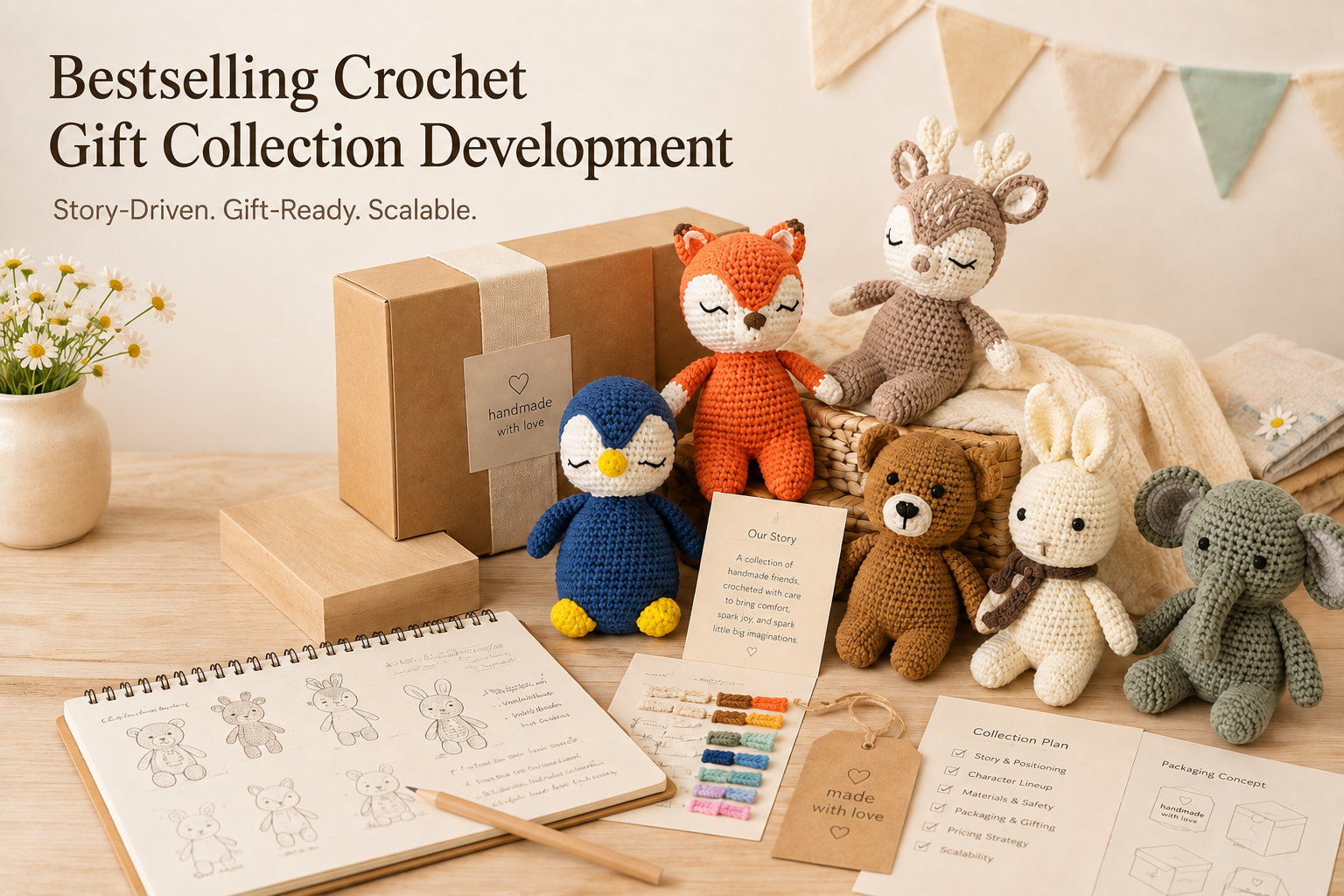
However, successful gift collections often share several characteristics.
They are:
- Easy to understand
- Emotionally relevant
- Visually consistent
- Available at multiple price points
- Gift-ready
- Easy to merchandise
- Built for future expansion
The commercial objective is not simply to make attractive crochet products.
It is to create a product system customers can discover, buy, gift, collect, and return to later.
Step 1: Start With the Gifting Occasion
Gift brands should first understand why the customer is buying.
Common gifting occasions include:
- Birthdays
- Baby showers
- Valentine's Day
- Mother's Day
- Christmas
- Easter
- Ramadan and Eid
- Employee appreciation
- Friendship
- Encouragement
- Thank-you gifts
- Museum and travel souvenirs
Each occasion creates different product expectations.
For example:
Emotional Support Gift
The customer may value:
- A comforting character
- An encouraging message
- Small portable size
- Gift-ready packaging
Baby Gift
The buyer may focus more on:
- Soft materials
- Product suitability
- Coordinated presentation
- Safety and compliance planning
Christmas Gift
The product may need:
- Seasonal colors
- Strong decorative appeal
- Gift packaging
- A clear holiday theme
Starting with the gifting occasion prevents the collection from becoming a random group of attractive products.
Step 2: Define the Target Customer Before Designing the Product
A product can look successful internally and still fail to connect with the intended customer.
Before development begins, gift brands should define:
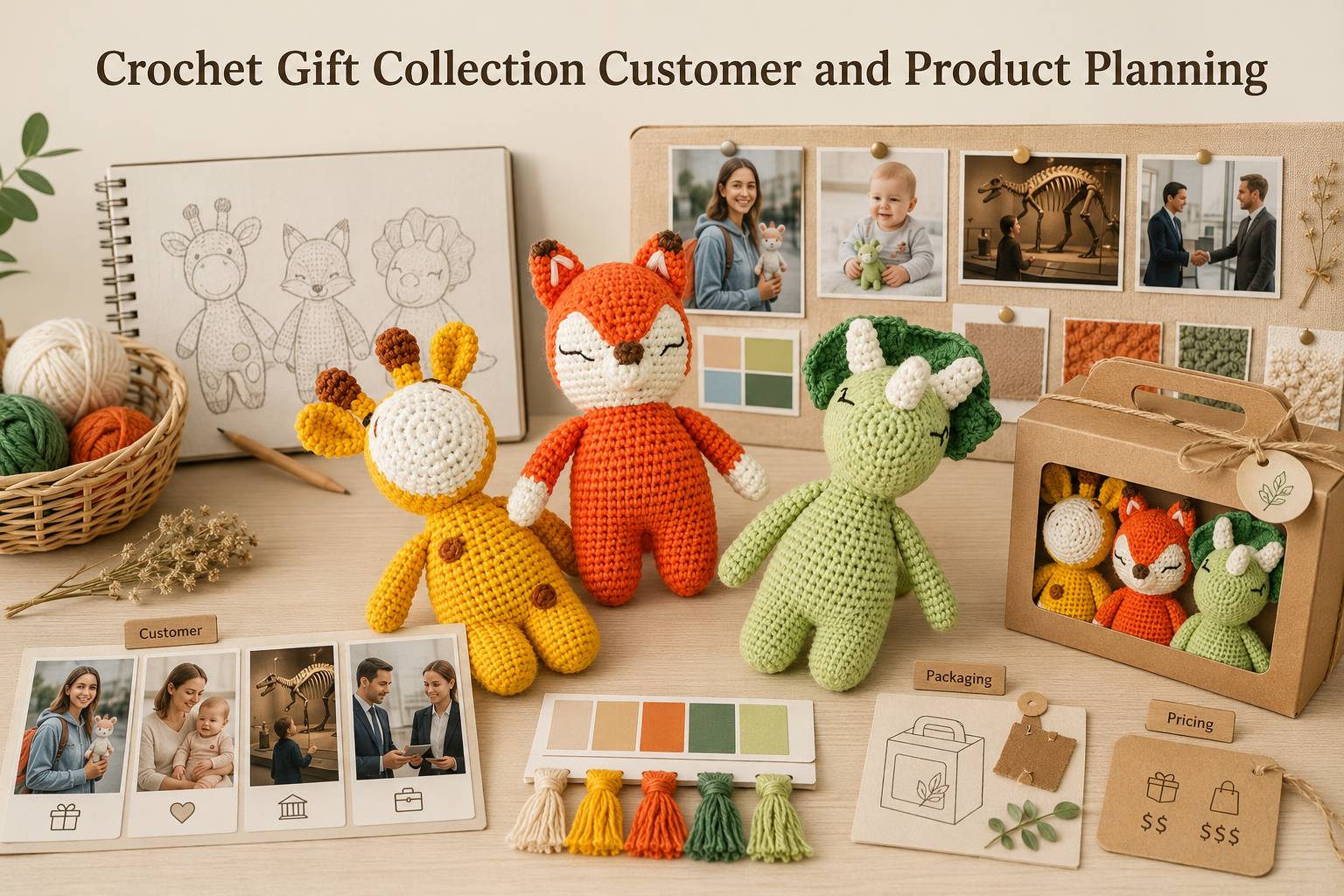
- Customer age
- Lifestyle
- Purchasing motivation
- Expected retail price
- Sales channel
- Gifting occasion
A collection for teenagers may look completely different from one designed for:
- New parents
- Museum visitors
- Corporate buyers
- Premium gift shoppers
The clearer the customer profile, the easier it becomes to make decisions about:
- Character style
- Product size
- Colors
- Packaging
- Pricing
Step 3: Build the Collection Around One Strong Hero Product
One of the most effective collection strategies is to begin with a hero product.
This is the product that:
- Defines the collection
- Attracts attention
- Communicates the theme
- Appears most prominently in marketing
For example, a “Bee Happy” collection might begin with:
Hero Product: Crochet Bee Character
The collection could later include:
- Mini bee keychain
- Crochet flower
- Encouragement card
- Gift box
- Seasonal bee edition
This structure is usually stronger than launching five unrelated products at the same time.
The hero product gives customers something memorable to associate with the collection.
Step 4: Create a Product Ladder With Multiple Price Points
Not every customer wants to spend the same amount.
A strong gift collection can provide several entry points.
For example:
| Product Role | Example | Commercial Purpose |
|---|---|---|
| Entry-Level | Mini crochet keychain | Impulse purchase |
| Core | Standard crochet character | Main sales product |
| Add-On | Small flower or accessory | Increase basket size |
| Premium | Gift-box edition | Higher perceived value |
| Collector | Limited seasonal version | Repeat purchase |
This allows one creative concept to serve different customers without losing brand consistency.
One lesson we have learned from gift development is:
Customers often enter a collection through price, but stay because of the story.
Step 5: Keep the Visual Language Consistent
A successful collection should look intentional when products are displayed together.
Consistency may come from:
- Yarn palette
- Character proportions
- Facial style
- Packaging
- Embroidery
- Accessories
- Typography
- Storytelling
For example, several animal characters may use different colors while sharing:
- Similar eye style
- Similar body proportions
- Matching tags
- The same packaging family
This creates immediate visual recognition.
For gift brands, collection consistency also improves:
- Photography
- E-commerce listings
- Retail displays
- Social media campaigns
Step 6: Design for Emotional Value
Gift customers rarely buy purely for function.
They often buy to communicate something.
A crochet gift can represent:
- Love
- Friendship
- Encouragement
- Celebration
- Comfort
- Memory
This makes emotional positioning especially important.
Instead of developing:
“A small crochet bear”
the brand might develop:
“A little bear designed to remind someone that they are loved.”
The physical product may remain relatively simple.
The emotional context changes its perceived value.
Why Emotional Positioning Works Particularly Well With Crochet
Crochet naturally communicates several qualities:
- Softness
- Warmth
- Craftsmanship
- Human touch
- Individual character
These qualities can reinforce emotional gift messages more naturally than many hard or highly standardized promotional products.
For this reason, crochet is often suitable for:
- Friendship gifts
- Encouragement products
- Baby gifts
- Emotional-support characters
- Romantic gifts
- Appreciation gifts
The product and the message support one another.
Step 7: Treat Packaging as Part of the Product
Packaging can determine whether a product looks like:
A handmade toy
or
A finished gift
This distinction matters commercially.
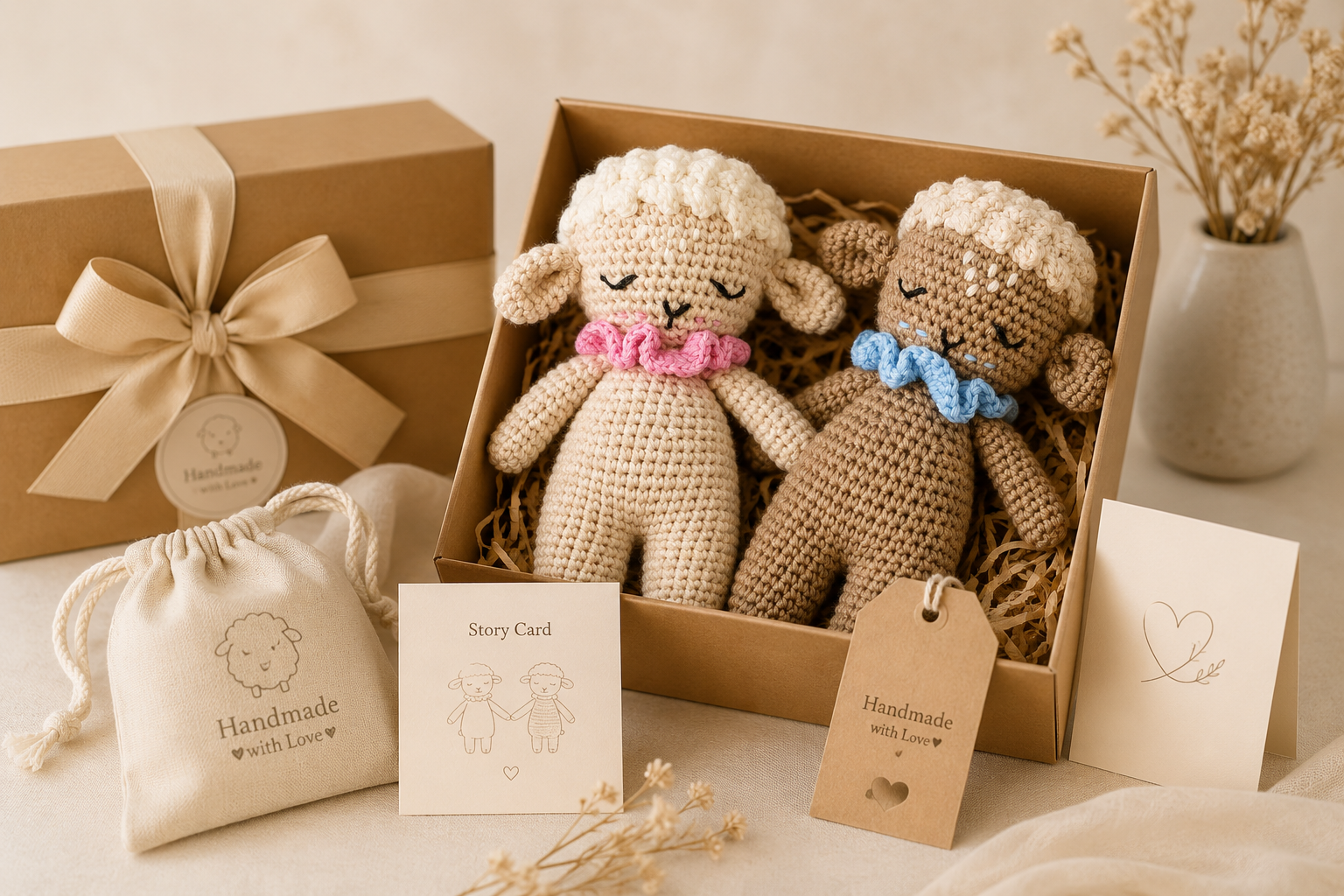
Gift-ready packaging can include:
- Kraft boxes
- Window boxes
- Story cards
- Greeting cards
- Hangtags
- Fabric pouches
- Branded sleeves
Packaging does not need to be complicated.
It needs to reinforce the reason the customer is buying.
Step 8: Use Story Cards to Explain the Meaning
One of the simplest ways to improve a gift product is to give it context.
A story card might explain:
- The character's name
- What the character represents
- A short encouragement message
- The inspiration behind the collection
- The gifting occasion
For example:
A crochet bee can simply be a cute product.
Add a message such as:
“Bee Happy — a little reminder that brighter days are always ahead.”
Now the buyer understands why they might give it to someone.
Step 9: Avoid Overdesigning the Product
More details do not automatically create more commercial value.
Every additional:
- Accessory
- Color change
- Embroidered element
- Separate component
- Clothing layer
may add production time.
Gift brands should therefore ask:
Does this detail meaningfully improve the customer experience?
If the answer is no, simplifying the design may improve:
- Cost
- Production efficiency
- Quality consistency
- Retail margin
The objective is not minimalism for its own sake.
It is commercially intelligent design.
Step 10: Design With the Target Retail Price in Mind
A common product-development mistake is designing first and discussing cost later.
A better process begins with:
Target Retail Price
↓
Target Landed Cost
↓
Target Factory Cost
↓
Product Complexity
This helps the development team understand what can realistically be included.
For example, a small impulse gift and a premium collector character should not follow the same design strategy.
The premium product may justify:
- More accessories
- Complex clothing
- Premium packaging
The entry-level product may benefit from:
- Simpler construction
- Fewer components
- Standard packaging
Both products can still belong to the same collection.
Step 11: Develop a Collection That Can Grow
A bestselling product should create future opportunities.
Before approving the first design, gift brands can ask:
- Can we add new characters?
- Can we create seasonal versions?
- Can the product become a keychain?
- Can it become a premium gift set?
- Can we create a larger size?
- Can we create limited editions?
For example:
Original Character
↓
Mini Version
↓
Gift Set
↓
Christmas Edition
↓
Valentine's Edition
↓
Supporting Characters
This creates a repeatable product-development engine.
Step 12: Test Before Placing the Largest Possible Order
A strong product concept still needs market validation.
Gift brands can test:
- Different characters
- Price points
- Packaging styles
- Color combinations
Useful signals include:
- Sell-through rate
- Customer comments
- Repeat orders
- Add-to-cart behavior
- Social-media response
- Requests for additional designs
One of the biggest advantages of testing is that brands can identify which part of the concept customers actually value.
Sometimes the result is unexpected.
Customers may prefer:
- The smallest character
- A certain color
- The gift-box version
- A supporting character rather than the hero product
Testing converts assumptions into evidence.
Real Development Insight: Perceived Value Comes From the Combination
One lesson we have learned from developing gift programs is that perceived value often comes from the combination rather than the individual product.
Imagine two products.
Option A
One detailed crochet character.
Option B
A simpler crochet character combined with:
- Story card
- Gift box
- Emotional message
Depending on the target customer, Option B may create a stronger gifting experience while remaining commercially manageable.
This is why gift development should consider the complete customer experience, not only manufacturing complexity.
Step 13: Build Collections Around Repeat Purchase Behavior
A customer buying one gift today can become tomorrow's collector.
Gift brands can encourage repeat purchases through:
- Character families
- Seasonal editions
- New colors
- Limited releases
- Matching accessories
For example:
A customer buys:
Character A
Then later discovers:
Character B
+
Christmas Edition
+
Matching Keychain
The collection now has a reason to continue.
That creates more long-term value than constantly replacing successful concepts with unrelated products.
Step 14: Use Seasonal Editions Without Rebuilding Everything
Seasonal products can create freshness without requiring completely new development.
An existing hero character can be adapted through:
- Clothing
- Accessories
- Colors
- Packaging
For example:
Core Bear Character
could become:
- Valentine's Bear
- Easter Bear
- Halloween Bear
- Christmas Bear
The recognizable character remains the same.
The context changes.
This can help brands build familiarity while continuing to offer new products.
Step 15: Build the Collection for Retail Presentation
Products should be designed to work together visually.
Consider how the collection appears:
- On retail shelves
- In window displays
- On e-commerce category pages
- In social-media photography
- Inside gift displays
A strong product hierarchy should make it easy to identify:
- Hero product
- Core assortment
- Entry-price options
- Premium gift options
Retail merchandising should influence development before production begins.
Step 16: Use Data to Decide What to Expand
Not every SKU deserves expansion.
After launch, brands can classify products into groups such as:
Hero Winners
High sales and strong customer recognition.
Action:
Expand into new formats.
Supporting Winners
Good add-on or gifting performance.
Action:
Keep within the collection.
Seasonal Winners
Strong performance during specific occasions.
Action:
Repeat or refresh next season.
Weak SKUs
Low demand.
Action:
Reduce or discontinue.
This prevents the collection from becoming unnecessarily large.
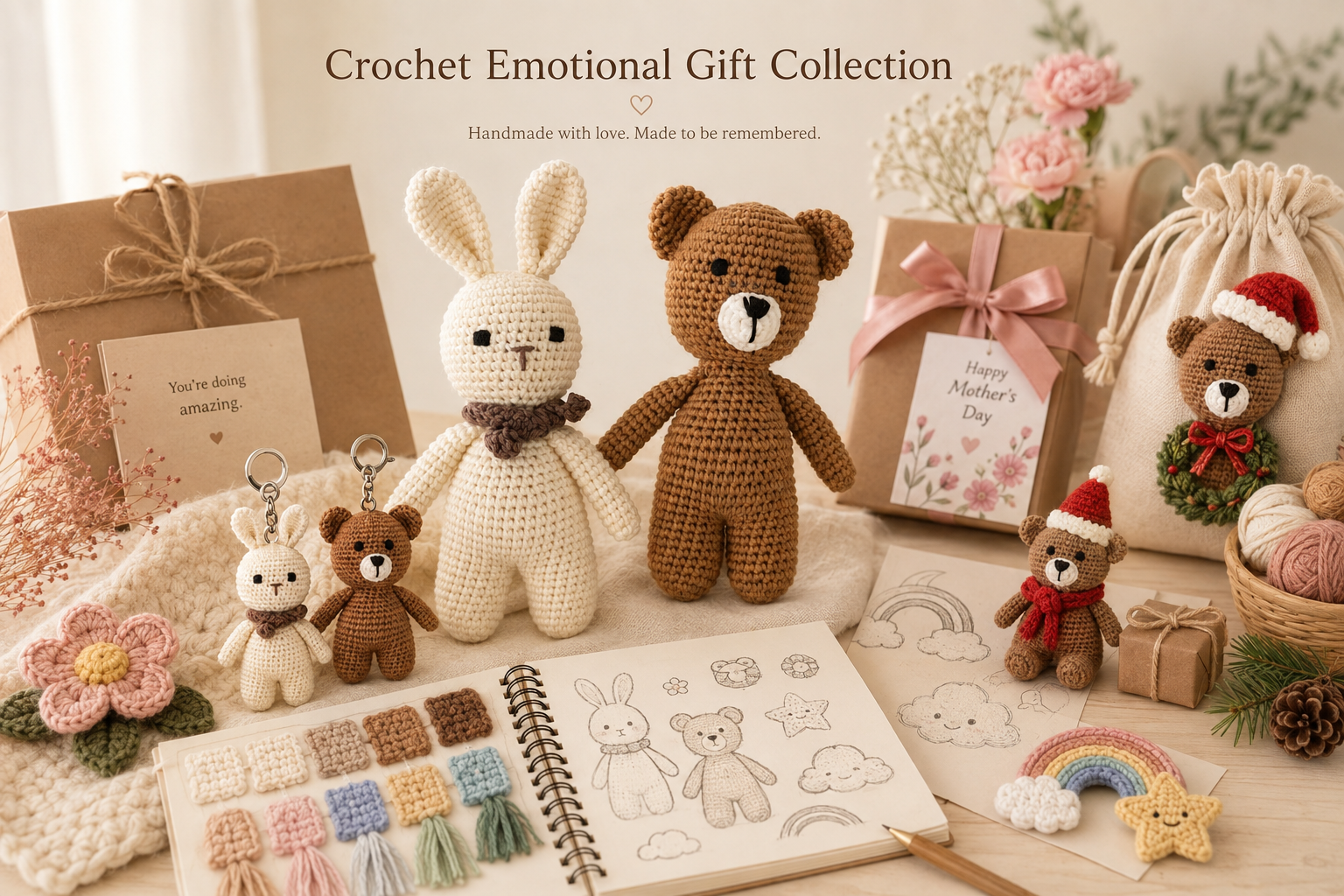
A Practical Example of a Crochet Gift Collection
Imagine a gift brand developing a positive-emotion collection.
The first product is:
Hero Character
Crochet Sunshine Doll
Message:
“A little sunshine for difficult days.”
The collection then expands into:
Entry-Level
Mini sunshine keychain.
Supporting Product
Crochet flower.
Gift Version
Character + encouragement card + kraft gift box.
Seasonal Version
Mother's Day or Christmas packaging.
Future Expansion
Cloud, rainbow, and star characters.
The brand is no longer selling one crochet product.
It is building a recognizable emotional gift universe.
What Successful Gift Brands Usually Do Differently
Based on our experience supporting custom product development, strong gift collections tend to follow several principles.
They:
- Start with one clear customer
- Focus on one emotional message
- Build around a hero product
- Create multiple price points
- Invest in packaging
- Test before scaling
- Expand proven concepts
- Maintain visual consistency
By contrast, weaker collections often:
- Target everyone
- Launch too many unrelated products
- Add excessive design complexity
- Ignore packaging
- Compete mainly on price
A successful gift collection is usually more focused than it first appears.
Common Mistakes Gift Brands Make When Developing Crochet Collections
Mistake 1: Selecting Products Without a Clear Theme
A collection needs a reason for the products to belong together.
Mistake 2: Creating Too Many SKUs Initially
More products create more:
- Inventory
- Sampling
- Packaging
- Forecasting complexity
Start with the strongest concepts.
Mistake 3: Ignoring Target Retail Price
Beautiful products still need commercially workable margins.
Mistake 4: Adding Details Customers Do Not Value
Manufacturing complexity should support perceived value.
Mistake 5: Treating Packaging as an Afterthought
Gift customers experience the package and product together.
Mistake 6: Scaling Before Testing
A large first order increases inventory risk when demand is still unknown.
Mistake 7: Abandoning a Winning Character Too Quickly
A successful hero product may have years of expansion potential.
How a Manufacturer Can Help Build a Stronger Collection
A professional crochet manufacturer should contribute more than production capacity.
During product development, the supplier may help evaluate:
- Crochet feasibility
- Material alternatives
- Product size
- Accessory complexity
- Cost structure
- Packaging
- Collection expansion
- Production consistency
This is particularly valuable for gift brands without large internal development teams.
The manufacturer becomes a development partner rather than only an order processor.
How U-MY Supports Crochet Gift Collection Development
U-MY Crochet has specialized in handmade crochet manufacturing since 2013.
We support custom development across product categories including:
- Crochet dolls
- Mascots
- Keychains
- Flowers
- Baby gifts
- Gift sets
- Seasonal collections
- DIY crochet kits
Our development process can support both OEM and ODM projects.
OEM Development
Suitable when the brand already has:
- Artwork
- Product designs
- Characters
- Technical requirements
Development can include:
- Crochet adaptation
- Sampling
- Material selection
- Production standardization
- Packaging
ODM Development
Suitable when a brand begins with:
- A market idea
- A gifting occasion
- A theme
- A target customer
Product-development support can include:
- Collection structures
- Product combinations
- Character directions
- Packaging concepts
- Seasonal extensions
The objective is to turn the commercial idea into a manufacturable collection.
Why Manufacturing Consistency Matters for Bestselling Products
Success creates a new challenge:
Reorders.
When a product performs well, the next order needs to resemble the first.
Handmade crochet naturally includes minor variation.
Professional production therefore relies on:
- Approved master samples
- Standardized crochet patterns
- Yarn specifications
- Color references
- Size tolerances
- Filling standards
- Quality checkpoints
The goal is not to remove the handmade character.
The goal is controlled consistency.
That becomes increasingly important as a collection grows.
Can Bestselling Handmade Products Scale?
Yes, if scaling is planned correctly.
Commercial handmade production can be expanded through:
- Standardized patterns
- Organized artisan networks
- Material planning
- Production allocation
- Quality-control systems
The first product should therefore be designed with future production in mind.
A beautiful sample that is extremely difficult to reproduce may not be the best commercial design.
The strongest products balance:
Creativity
+
Manufacturability
+
Customer value
What Information Should Gift Brands Provide Before Development?
A useful initial brief may include:
- Target customer
- Gifting occasion
- Target retail price
- Target factory cost
- Product references
- Preferred size
- Required quantity
- Target market
- Packaging expectations
- Delivery timeline
- Brand colors
- Artwork or mascots
Frequently Asked Questions
What crochet products work well for gift brands?
Popular formats can include crochet dolls, mascots, flowers, keychains, emotional-support characters, baby gifts, seasonal products, and curated gift sets. The best format depends on the target customer and gifting occasion.
How many products should a new crochet collection start with?
There is no fixed number, but a focused launch with several complementary SKUs can be easier to test than a large assortment. Many brands benefit from establishing a hero product, entry-level item, and premium gift option first.
What makes a crochet gift feel premium?
Can a single crochet character become a full collection?
Yes. One character can potentially expand into different sizes, keychains, gift sets, seasonal variations, supporting characters, and limited editions.
Should gift brands develop packaging at the same time as the product?
Ideally, yes. Packaging affects perceived value, shipping dimensions, MOQ, presentation, and overall cost, so it should be considered during development rather than after production is finalized.
How long does it take to develop a custom crochet sample?
Can handmade crochet collections be produced at commercial scale?
Is lower product cost always better for a gift collection?
No. Gift brands should evaluate margin and landed cost, but the cheapest construction may reduce perceived value. The objective is to create the strongest customer experience within the commercial cost target.
Conclusion
Bestselling crochet collections are not created simply by producing more designs.
They are built by making a series of connected decisions:
- Who the customer is
- Why they are buying
- What emotion the product should create
- Which product leads the collection
- How different price points work together
- How packaging supports the story
- How successful ideas can expand
At U-MY Crochet, our experience since 2013 has shown us that the strongest gift brands rarely begin by asking:
“How many crochet products should we launch?”
They begin by asking:
“What idea is strong enough to become a collection?”
Once that idea is validated, one crochet product can become a keychain, a gift set, a seasonal edition, a character family, and eventually a recognizable long-term product program.
That is how a handmade item moves from being simply attractive to becoming a scalable, giftable, and commercially valuable collection customers want to return to.
 Chinese