
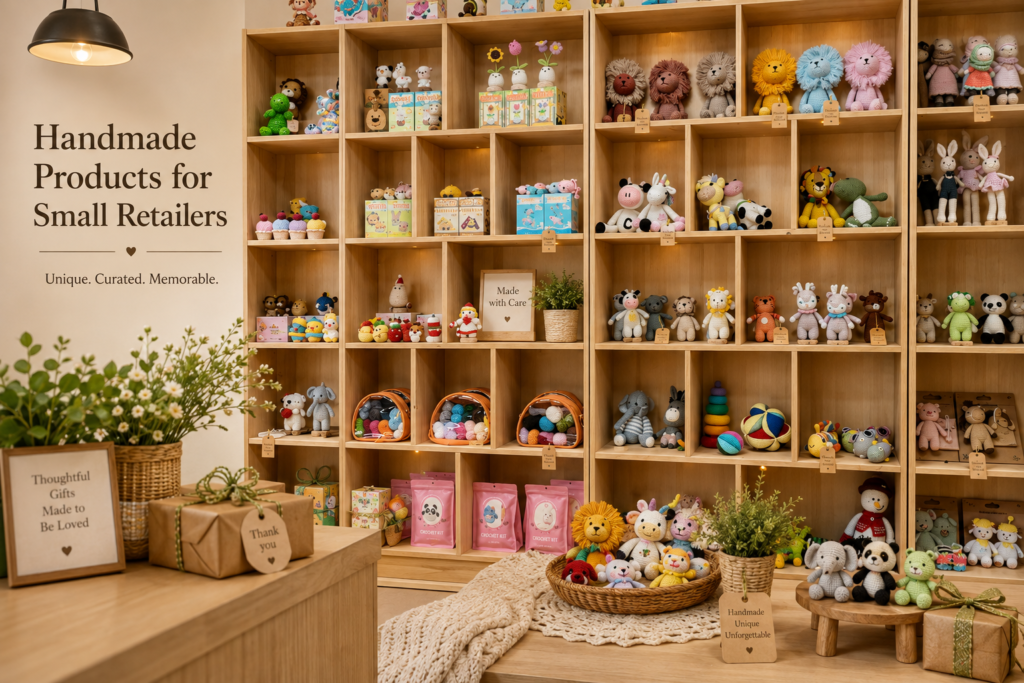
How Independent Stores Use Handmade Products, Flexible Collections, and Stronger Stories to Create a Competitive Advantage
Small retailers rarely have the same resources as large global brands.
They may have:
- Smaller marketing budgets
- Lower purchasing volumes
- Less bargaining power
- Fewer stores
- Smaller product-development teams
At first glance, this can make competition seem difficult.
Large brands can place bigger orders, negotiate lower unit prices, run national advertising campaigns, and launch hundreds of products at once.
But small retailers have advantages that large organizations often struggle to replicate:
- Speed
- Flexibility
- Local knowledge
- Curated product selection
- Authentic storytelling
- Close customer relationships
Handmade products can strengthen these advantages.
At U-MY Crochet, we have specialized in handmade crochet manufacturing since 2013, supporting retailers, gift companies, museum stores, e-commerce sellers, and brands across more than 150 countries and regions.
Through years of working with different types of buyers, we have learned:
Small retailers do not need to beat large brands at mass-market scale. They need to offer customers something large brands cannot easily reproduce.
For many independent retailers, handmade products provide exactly that opportunity.
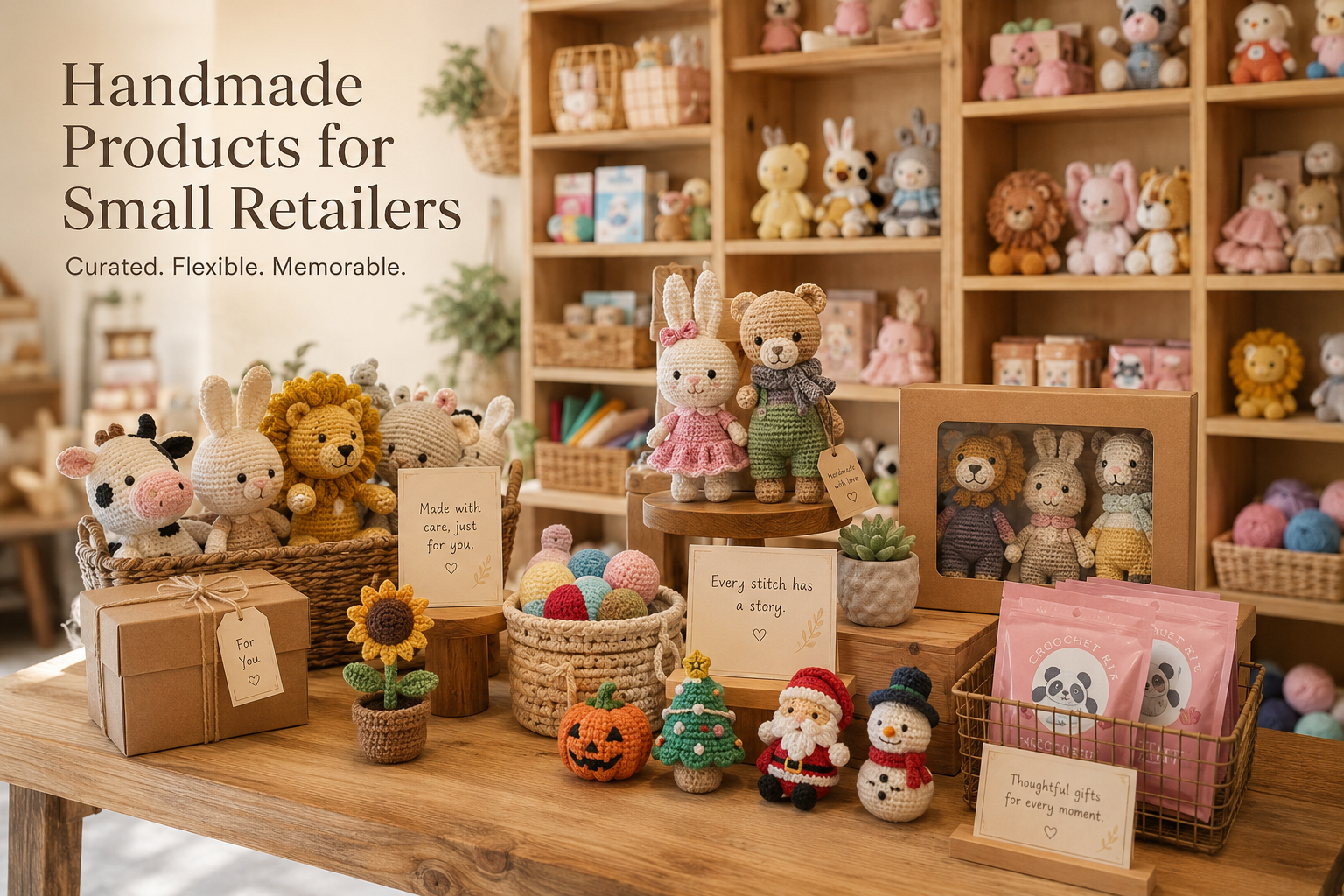
Why Competing on Price Alone Is Difficult for Small Retailers
Large retailers often have structural advantages in price competition.
They can:
- Purchase larger quantities
- Spread development costs across more units
- Negotiate better logistics rates
- Operate with higher inventory volumes
- Run aggressive promotions
Trying to copy that strategy can place smaller retailers under unnecessary pressure.
For example, continually lowering prices may reduce:
- Gross margin
- Packaging quality
- Product uniqueness
- Customer experience
A more sustainable approach is differentiation.
Instead of asking:
How can we sell the same product cheaper?
Small retailers can ask:
What can we offer that customers cannot easily find at a mass retailer?
Handmade products create several possible answers.
1. Handmade Products Help Retailers Escape Direct Price Comparison
One of the biggest problems with generic merchandise is that customers can compare identical products across many sellers.
When the same product appears on:
- Marketplaces
- Large retail chains
- Discount websites
- Multiple online stores
price becomes one of the easiest comparison points.
Custom or exclusive handmade products change that dynamic.
If a retailer develops:
- A unique crochet character
- An exclusive color collection
- A local souvenir
- A custom gift set
- A limited seasonal design
customers cannot simply search for the exact same product somewhere else.
This gives the retailer more control over:
- Brand positioning
- Retail price
- Product story
- Customer experience
2. Small Retailers Can Move Faster
Large organizations usually have longer decision-making processes.
A new product may need approval from:
- Buying teams
- Merchandising
- Finance
- Compliance
- Marketing
- Senior management
Smaller retailers often operate with fewer layers.
This can make it easier to:
- Test emerging trends
- Launch seasonal products
- React to customer feedback
- Develop limited collections
- Change packaging
- Introduce new characters
For handmade products, this agility can be especially valuable.
A retailer can begin with a small focused collection, observe customer response, and expand successful ideas rather than committing immediately to a large assortment.
3. Small Collections Can Be More Powerful Than Large Assortments
Large retailers often compete through variety.
Small retailers can compete through curation.
A thoughtfully selected five-product collection may create more impact than fifty unrelated products.
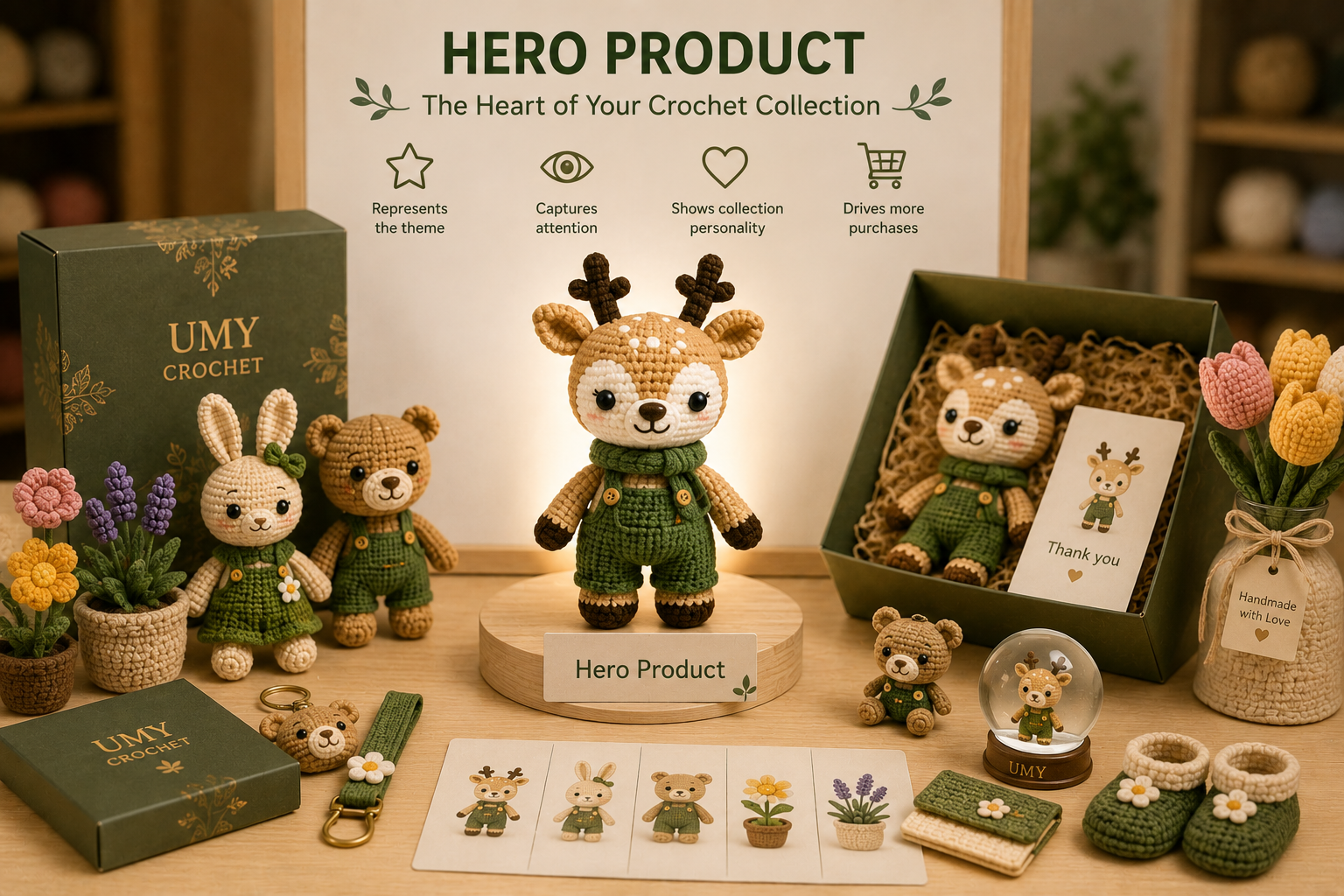
For example, a crochet gift collection might contain:
Hero Product
A recognizable crochet character.
Core Product
A standard-size version for the main customer segment.
Entry Product
A small keychain or hanging accessory.
Premium Product
A gift-box version.
Seasonal Product
A limited-edition variation.
This creates a complete retail story without requiring excessive inventory.
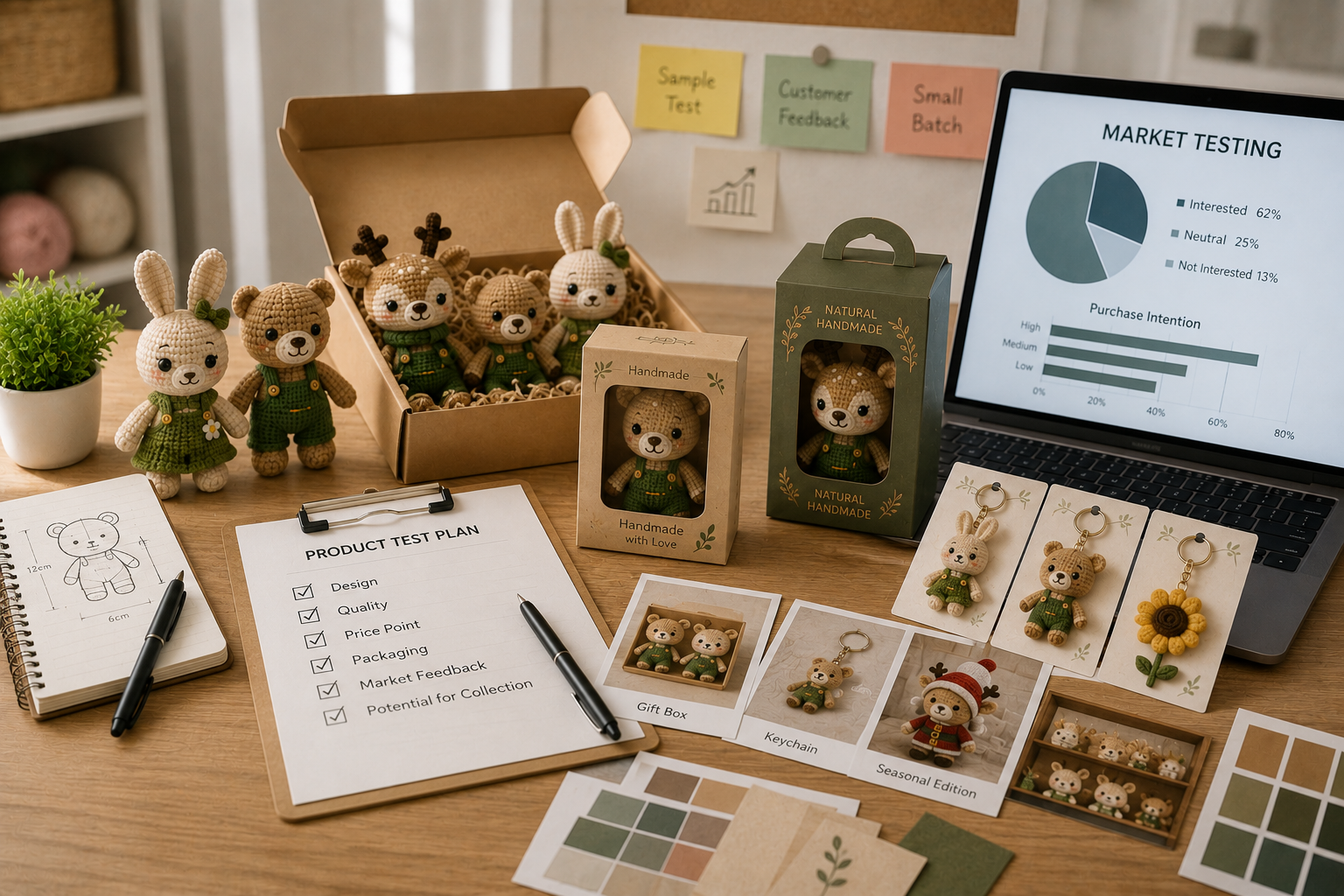
4. Handmade Products Give Small Retailers Better Stories to Tell
Independent retailers often have closer relationships with their customers than large chains.
This creates an opportunity to explain:
- Who designed the product
- Why the product was created
- What inspired the collection
- How the item was made
- What the character represents
A product might be inspired by:
- Local wildlife
- Regional culture
- A neighborhood story
- A museum collection
- A seasonal tradition
- The retailer's own mascot
The story creates differentiation before customers even compare prices.
5. Local Relevance Can Beat Global Scale
Large brands usually need products that appeal to broad audiences.
Small retailers can focus on specific communities.
This allows them to develop merchandise around:
- Local landmarks
- Regional animals
- Local legends
- Cultural traditions
- Community events
- Tourism themes
A local bookstore, museum shop, visitor center, or lifestyle store may understand its audience far better than a global retailer does.
That knowledge can become a competitive advantage.
A handmade crochet product designed specifically around a local story may have much stronger emotional relevance than a generic mass-market product.
6. Small Retailers Can Create Exclusivity
Scarcity is another advantage.
Large brands often need products that can be supplied across hundreds or thousands of stores.
Independent retailers can deliberately create:
- Limited editions
- Small seasonal collections
- Store-exclusive colors
- Numbered products
- Local collaborations
- Short-run gift sets
This changes the customer conversation from:
"Is this cheaper somewhere else?"
to:
"Will this still be available later?"
Limited availability can strengthen:
- Collectibility
- Urgency
- Perceived value
when used carefully.
7. Handmade Products Can Create Stronger Giftability
Many independent retailers operate in categories where customers are buying for emotional reasons.
Examples include:
- Gift stores
- Museum shops
- Lifestyle boutiques
- Baby stores
- Tourism retailers
- Specialty bookstores
- Cultural shops
In these environments, customers may care more about:
- Meaning
- Presentation
- Originality
- Story
than about finding the absolute lowest price.
Crochet can work particularly well because the handmade texture naturally communicates warmth.
Products can be positioned as:
- Friendship gifts
- Appreciation gifts
- Baby gifts
- Emotional-support gifts
- Seasonal gifts
- Cultural souvenirs
8. Packaging Can Turn a Simple Product Into a Retail Experience
Small retailers do not necessarily need complicated packaging.
They need packaging that supports the product's story.
A simple crochet character might be paired with:
- A kraft box
- A story card
- A branded hangtag
- A small greeting card
- A fabric pouch
This can change the perception from:
Handmade item
to:
Gift-ready product
Packaging also gives independent retailers another opportunity to reinforce their own identity.
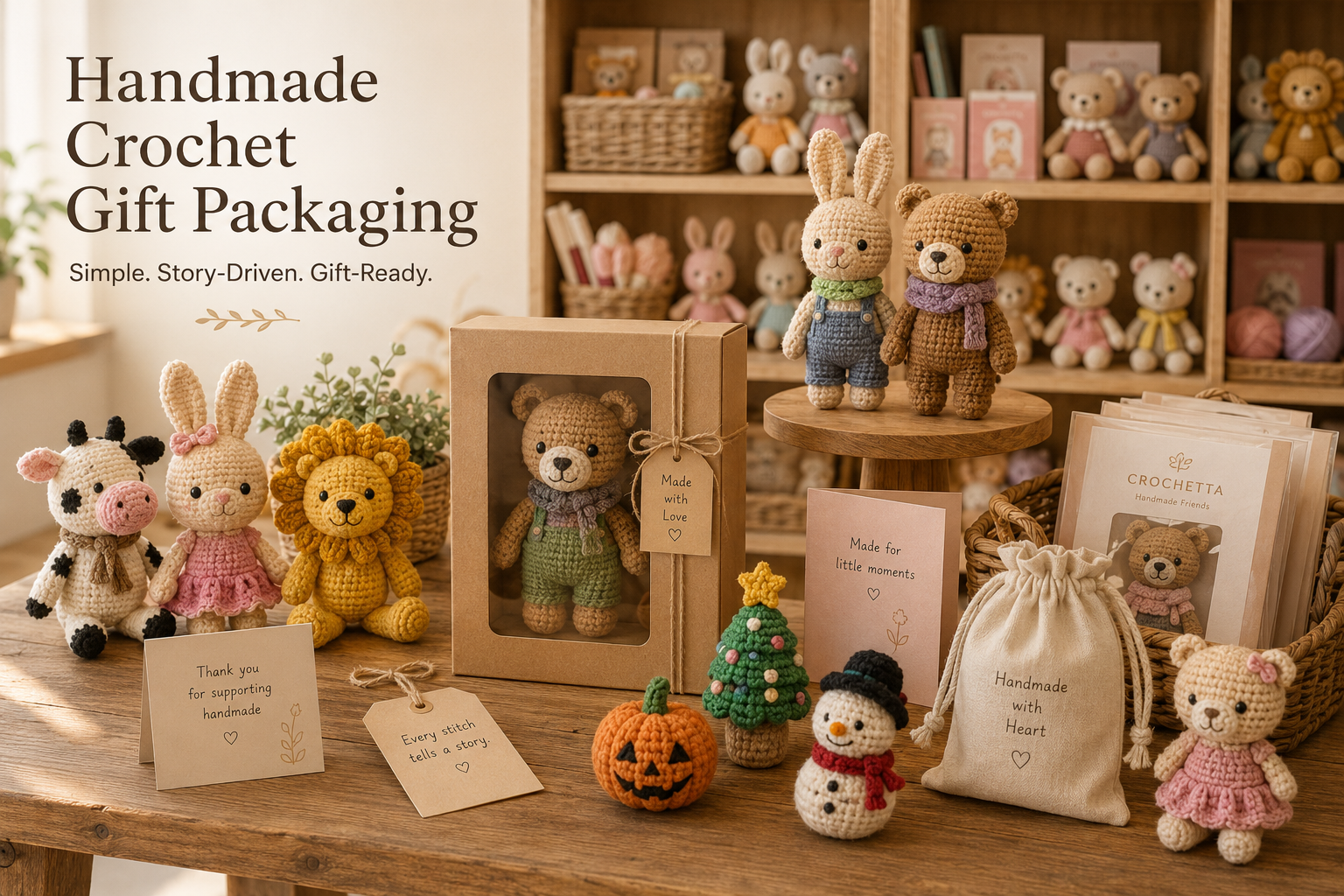
9. Small Retailers Can Test Before Scaling
One of the biggest advantages of working with flexible handmade-product suppliers is the ability to approach product development gradually.
Instead of launching a large collection immediately, a retailer may test:
- Three to five SKUs
- Several colorways
- Different price points
- Two packaging options
Then monitor:
- Sell-through
- Customer comments
- Repeat purchases
- Gift demand
- Social-media response
Successful products can be reordered or expanded.
Weak products can be discontinued without creating excessive inventory exposure.
This reduces the risk of relying only on buyer intuition.
A Practical Test-and-Scale Model
A small retailer might follow this development path:
Phase 1 — Market Test
Launch:
- 3 products
- Limited quantities
- Simple packaging
Goal:
Identify customer interest.
↓
Phase 2 — Validate
Analyze:
- Best-selling designs
- Price acceptance
- Customer feedback
↓
Phase 3 — Expand
Develop:
- Additional colors
- New characters
- Gift sets
- Seasonal editions
↓
Phase 4 — Build the Collection
Create:
- Repeatable core products
- Seasonal launches
- Limited editions
- Premium gift formats
This approach allows the business to grow around evidence rather than assumptions.
10. Character-Based Products Can Build Recognition
Large brands benefit from strong visual identity.
Small retailers can create the same effect on a smaller scale through characters.
For example, one original crochet character could become:
Retail Mascot
↓
Standard Crochet Doll
↓
Mini Keychain
↓
Seasonal Edition
↓
Gift Set
↓
Social Media Character
The character begins connecting different parts of the retail experience.
Over time, customers may recognize the character before they recognize individual products.
This creates a small but potentially valuable IP asset for the retailer.
11. Customer Relationships Give Small Retailers Better Product Data
Independent retailers often interact directly with buyers.
Store employees may hear comments such as:
- "Do you have this in another color?"
- "Is there a smaller version?"
- "Can I buy the matching character?"
- "Would this come in a gift box?"
- "Will there be a Christmas version?"
These conversations are valuable product-development information.
Large brands often rely on aggregated data.
Small retailers can combine sales data with direct human feedback.
This makes it easier to identify new product opportunities quickly.
12. Handmade Products Support Community-Led Marketing
Smaller retailers may not have large advertising budgets.
But they often have:
- Loyal customers
- Local communities
- Social media followers
- Strong word of mouth
Distinctive handmade products can support content such as:
- Product-development stories
- New-character reveals
- Behind-the-scenes videos
- Seasonal launch previews
- Customer photos
- Limited-edition announcements
The product becomes part of the marketing content itself.
This is especially useful for character-based collections because one mascot can appear repeatedly across campaigns.
Real Development Insight: One Product Can Become a Collection
A common development pattern begins with one product.
For example:
A retailer launches one crochet character.
Customers respond positively and begin requesting:
- Smaller sizes
- More characters
- Gift packaging
- Seasonal designs
Instead of immediately creating unrelated products, the retailer can expand around the validated concept.
The product architecture may become:
| Stage | Product | Commercial Purpose |
|---|---|---|
| 1 | Original character | Test demand |
| 2 | Mini character | Lower entry price |
| 3 | Second character | Expand collectibility |
| 4 | Gift set | Increase perceived value |
| 5 | Seasonal edition | Encourage repeat purchase |
This approach can gradually turn one successful SKU into a recognizable collection.
One principle we consistently see in product development is:
Small retailers often grow more effectively by expanding what customers already love rather than constantly replacing products with entirely new ideas.
13. Handmade Does Not Mean Unscalable
Some small retailers avoid handmade products because they worry:
What happens if the product becomes successful?
This is a valid question.
Commercial handmade production needs systems for:
- Standardized patterns
- Material management
- Artisan training
- Production allocation
- Quality inspection
- Approved samples
With the right manufacturing partner, a retailer can begin with smaller quantities and later increase volume if demand grows.
The production system should therefore support both:
Market testing
and
future scaling
14. Supplier Choice Becomes Part of the Retail Strategy
For independent retailers, the lowest-priced supplier is not automatically the best supplier.
A more useful partner may help with:
- Sample development
- Low-MOQ planning
- Design optimization
- Packaging
- Collection architecture
- Reorders
- Seasonal development
This is especially important for retailers without internal product-development teams.
The supplier becomes part of the product-development process rather than simply filling purchase orders.
What Small Retailers Should Ask a Handmade Manufacturer
Before beginning custom development, ask:
- Can we begin with a smaller test collection?
- What is the MOQ per design?
- Can we mix different SKUs?
- Can existing structures be customized?
- How long does sample development take?
- Can products be reordered later?
- Can one character be developed into different formats?
- Do you support packaging customization?
- How do you maintain quality in handmade production?
- What happens if our order volume increases significantly?
- Can you support seasonal collections?
- How is customer design ownership handled?
These questions help determine whether the supplier fits the retailer's growth model.
How Small Retailers Can Control Development Costs
Customization does not need to mean maximizing complexity.
Several strategies can make development more commercially manageable:
Use Shared Materials
Several products can use the same yarn palette.
Standardize Packaging
One box format can potentially serve several SKUs.
Start With Fewer Characters
Develop the strongest ideas first.
Use Existing Product Structures
Customize:
- Colors
- Clothing
- Accessories
- Branding
rather than redesigning every structural element.
Separate Core and Premium SKUs
Not every product needs the same level of detail.
The objective is to invest complexity where customers perceive the most value.
A Small-Retailer Crochet Collection Example
Imagine an independent botanical gift shop wants to launch a handmade collection.
Instead of ordering dozens of generic products, it develops:
Hero Product
A crochet bee character connected to pollinator education.
Core Product
A crochet flower.
Entry Product
A mini bee keychain.
Premium Product
Bee + flower gift set.
Story Element
A card explaining the importance of pollinators.
Seasonal Extension
Spring and Mother's Day packaging.
The products now work together.
The retailer is no longer competing directly with generic online crochet toys.
It is selling:
A curated story
*
A recognizable collection
*
A gift experience
That is a much more defensible position.
When Should Small Retailers Avoid Custom Development?
Custom handmade products are not automatically the right solution for every business.
They may be less suitable when:
- The retailer needs immediate delivery with no development time
- The market is entirely price-driven
- The retailer has no clear product concept
- The required volume is too low for the desired level of customization
- The business cannot support the target retail price
In these cases, ready-stock wholesale products or lighter customization may be more practical.
A good manufacturer should help the buyer distinguish between:
- Full customization
- Partial customization
- Ready-stock sourcing
rather than pushing every project toward the most complex option.
How U-MY Supports Small and Growing Retailers
U-MY Crochet has specialized in handmade crochet manufacturing since 2013.
Our product categories include:
- Crochet dolls
- Crochet mascots
- Flowers
- Keychains
- Baby gifts
- Seasonal products
- DIY kits
- Gift sets
For retailers at different stages of growth, we support several development paths.
Ready-Stock Wholesale
Suitable for buyers that need:
- Faster market entry
- Lower development requirements
- Product testing
Light Customization
Existing product structures may be adapted through:
- Colors
- Labels
- Accessories
- Packaging
OEM Development
For retailers with original:
- Artwork
- Mascots
- Product specifications
ODM Development
For retailers that need support with:
- Concepts
- Product structures
- Collection development
- Gift-set planning
This allows buyers to choose the development model that fits their current stage rather than committing immediately to the most complex solution.
What We Have Learned From Working With Retail Buyers
After years of supporting retailers and product developers, several patterns appear repeatedly.
Small retailers perform best when they:
- Understand their customer niche
- Start with focused collections
- Test before scaling
- Build around strong products
- Develop recognizable stories
- Use packaging strategically
- Create repeat-purchase opportunities
- Work with suppliers that can grow with them
They usually perform less effectively when they try to imitate large retailers product for product.
Scale is not their strongest competitive advantage.
Relevance is.
Frequently Asked Questions
How can small retailers compete with large brands?
Small retailers can compete through specialization, stronger customer relationships, faster product testing, curated assortments, exclusive products, and stories that large mass-market competitors cannot easily reproduce.
Why are handmade products useful for small retailers?
Do small retailers need large orders for custom crochet products?
MOQ depends on the design, materials, packaging, and manufacturing model. Buyers should discuss test quantities, mixed SKUs, ready-stock products, and lighter customization options with the manufacturer.
What should a small retailer customize first?
Prioritize elements customers notice most, such as character identity, color, signature accessories, labels, and packaging. Avoid unnecessary complexity that does not improve perceived value.
Can a small retailer build its own mascot?
How should small retailers test handmade products?
Begin with a focused number of SKUs and manageable quantities, then measure sell-through, customer feedback, price acceptance, repeat purchase behavior, and requests for related products.
Can handmade production scale if a product becomes popular?
Yes, provided the manufacturer has standardized patterns, material controls, organized artisan capacity, production planning, and quality-management systems.
Are handmade products always more expensive?
Not necessarily in every case, but handmade crochet is labor-intensive. Rather than competing only on unit price, retailers should evaluate perceived value, differentiation, margin potential, and the ability to avoid direct comparison with mass-market products.
Conclusion
Small retailers do not need to become smaller versions of big brands.
Their strongest competitive advantages are often completely different.
They can be:
- More focused
- More personal
- More responsive
- More local
- More experimental
- More emotionally connected to customers
Handmade products can reinforce each of these advantages.
A carefully developed crochet product can become:
- An exclusive SKU
- A gift
- A local souvenir
- A brand mascot
- A seasonal collection
- A storytelling tool
- The beginning of a larger product family
At U-MY Crochet, we have learned that independent retailers often create their strongest products when they stop asking:
"How can we look as big as the major brands?"
and start asking:
"What can we create that a major brand would struggle to make this personal?"
That is where handmade products can become more than merchandise.
They can become a strategic advantage built around originality, customer understanding, and meaningful retail experiences.
 Chinese