
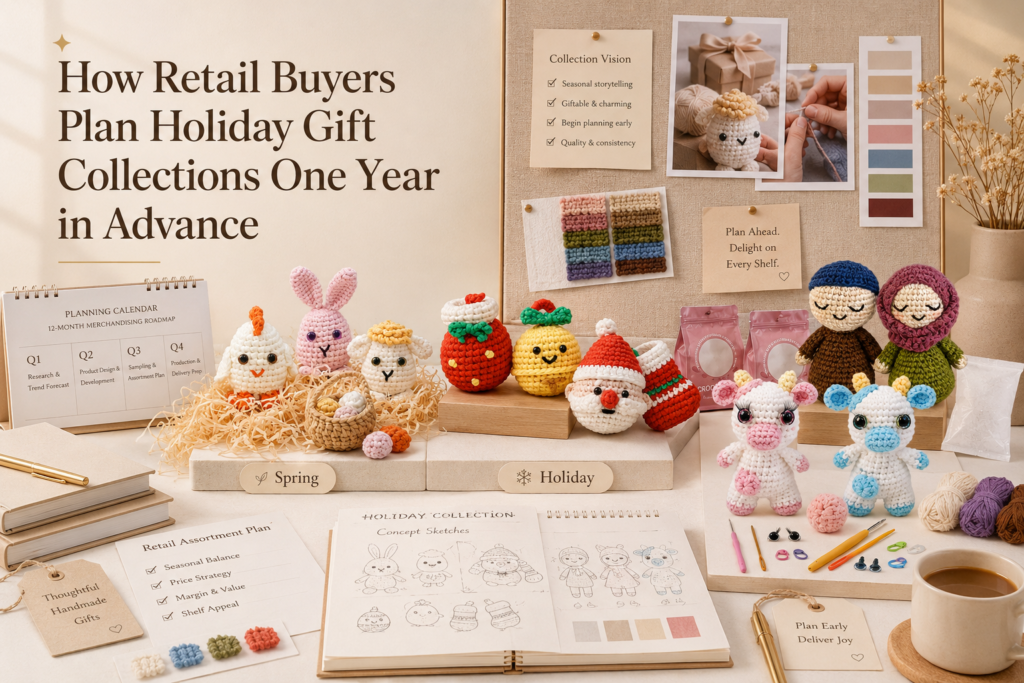
A Practical 12-Month Product Development Timeline for Christmas, Easter, Ramadan, Valentine's Day, and Other Seasonal Retail Programs
Holiday products may appear on store shelves for only a few weeks or months.
But behind a successful seasonal collection, product development often begins much earlier.
For custom products, retail buyers may need to coordinate:
- Market research
- Product concepts
- Design development
- Sampling
- Revisions
- Costing
- Compliance planning
- Packaging
- Production
- Quality control
- International shipping
- Warehouse distribution
- Store launch
This is especially important for handmade products.
At U-MY Crochet, we have specialized in crochet manufacturing since 2013, supporting retailers, gift companies, brands, museums, and organizations with custom crochet toys, characters, gift products, and seasonal collections.
Through years of working on custom and seasonal programs, we have learned an important lesson:
Holiday production problems often begin months before production starts. The earlier buyers confirm the concept, price, materials, packaging, and delivery schedule, the more flexibility the project has.
For major seasonal programs, planning approximately 9–12 months before the target selling period can provide a much safer development window, particularly when the project involves original designs, custom packaging, testing, or international shipping.
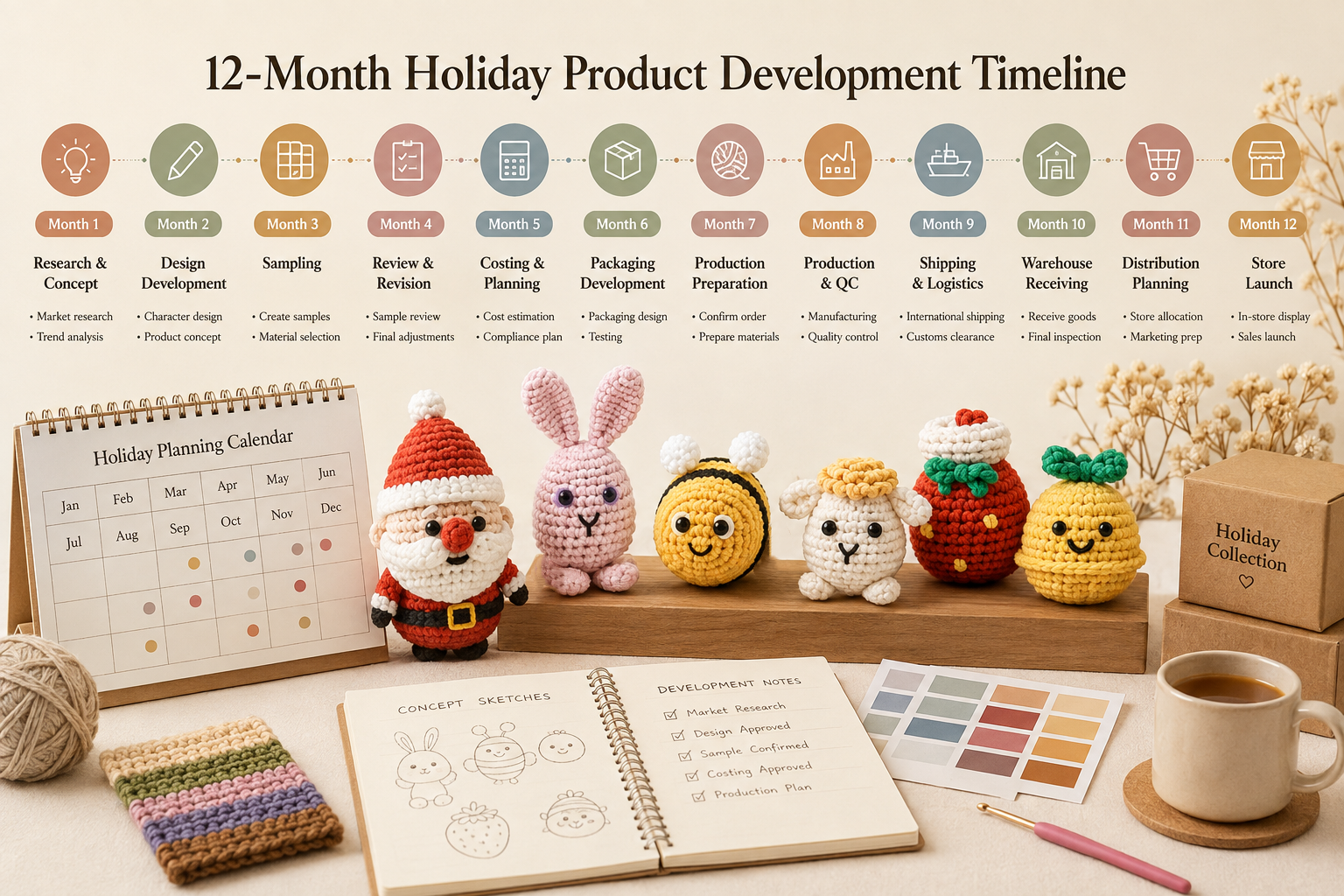
Why Do Retailers Plan Holiday Collections So Early?
A seasonal product has a fixed commercial deadline.
A Christmas product that arrives in January may have very little value for that year's Christmas selling season.
The same principle applies to:
- Valentine's Day
- Easter
- Mother's Day
- Halloween
- Ramadan
- Eid
- Christmas
- New Year
- Corporate holiday gifting
Unlike evergreen products, seasonal merchandise has a limited selling window.
This changes the way professional buyers approach product development.
They do not simply ask:
How long does production take?
They need to ask:
When must every stage be completed so the products are available before customers begin shopping?
That requires working backward from the retail launch date.
The Short Answer: When Should Holiday Product Development Start?
| Time Before Retail Launch | Main Activity |
|---|---|
| 10–12 months | Trend research and collection strategy |
| 8–10 months | Concept and product development |
| 7–9 months | Sampling and revisions |
| 6–8 months | Costing, assortment, and order decisions |
| 5–7 months | Compliance and packaging preparation |
| 3–6 months | Bulk production |
| 1–3 months | Inspection, shipping, warehousing, and distribution |
| Launch period | Retail sales and replenishment monitoring |
This is not a universal schedule.
Actual timelines depend on:
- Product complexity
- Number of SKUs
- Order quantity
- Materials
- Packaging
- Testing requirements
- Revision rounds
- Shipping method
- Destination market
However, the framework illustrates why experienced buyers often begin seasonal development long before consumers see the products.
Step 1: 10–12 Months Before Launch — Research the Market
A strong holiday collection should not begin with production.
It should begin with understanding the market.
- Previous holiday sales
- Best-performing SKUs
- Customer feedback
- Competitor collections
- Emerging colors
- Character trends
- Gift trends
- Price points
- Social media signals
For example, a retailer planning Christmas 2027 may begin reviewing ideas during or shortly after the 2026 Christmas season.
Why?
Because the previous season provides valuable information about:
- What sold
- What did not sell
- Which products sold out early
- Which price points performed well
- Which designs received customer attention
This information can guide the next collection.
Step 2: Define the Collection Strategy
Before creating individual products, buyers should determine what role the collection will play.
Possible objectives include:
- Seasonal gifting
- Impulse purchases
- Children's gifts
- Home decoration
- Collectibles
- Corporate gifts
- Premium gift sets
A collection designed for supermarket impulse purchases will look very different from a premium Christmas collection for a museum store.
Buyers should define:
Target Customer
Who will buy the product?
Target Retail Price
What price range should the final product achieve?
Product Positioning
Is it entry-level, mainstream, premium, or collectible?
Sales Channel
Will it be sold through:
- E-commerce
- Gift stores
- Museum stores
- Department stores
- Specialty retailers
- Corporate gifting programs?
These decisions should happen before detailed product development.
Step 3: 8–10 Months Before Launch — Build the Product Architecture
One common mistake is developing holiday products as unrelated individual SKUs.
Professional retail buyers often think in terms of a collection architecture.
For example, a Christmas crochet collection could include:
Hero Product
A larger crochet Santa, reindeer, snowman, or signature character.
Core Products
Several standard-size characters representing the main sales volume.
Entry-Level Products
Mini ornaments, keychains, or hanging decorations.
Premium Product
A gift set or larger collectible character.
Add-On Products
Small decorative products that complement the main collection.
This creates different purchasing opportunities without losing the visual identity of the collection.
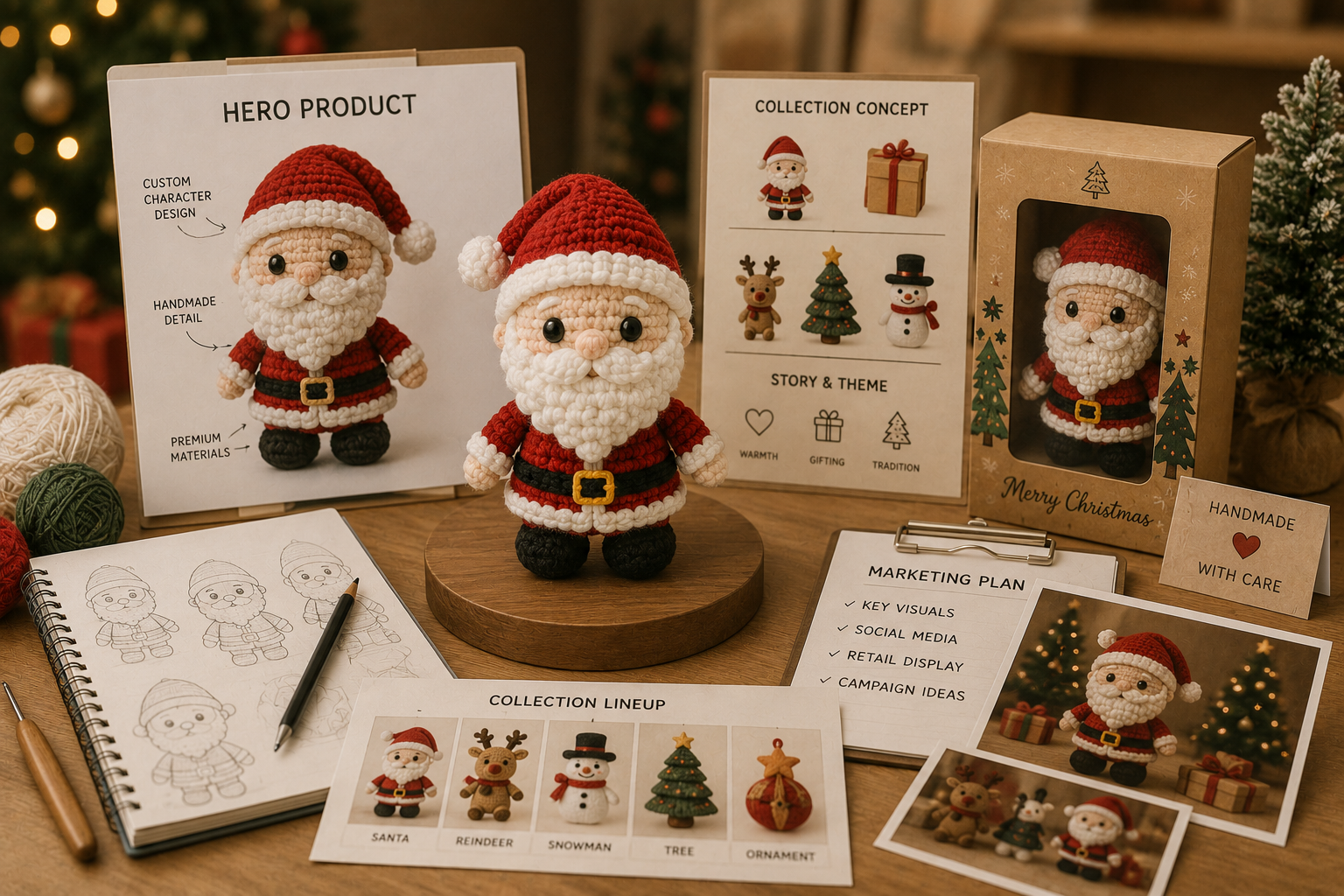
Step 4: Create a Consistent Seasonal Design Language
A collection should look like a family.
Consistency may come from:
- Yarn colors
- Character proportions
- Facial style
- Accessories
- Clothing
- Packaging
- Graphic elements
For example, a Christmas collection might use the same:
- Deep red
- Forest green
- Cream
- Warm brown
- Gold accents
across multiple characters.
The products can be different while still appearing visually connected.
This matters for retail merchandising.
Step 5: 7–9 Months Before Launch — Begin Sample Development
Once the initial concepts are approved, physical sampling can begin.
For crochet products, sample development may involve:
- Reviewing artwork
- Selecting yarn
- Developing the crochet structure
- Adjusting proportions
- Adding embroidery
- Developing accessories
- Reviewing colors
- Finalizing finishing details
An initial custom crochet sample may commonly require approximately 7–15 working days, depending on complexity and material availability.
However, the first sample is not always the final sample.
Buyers should allow time for revisions.
Why Sample Revisions Should Be Expected
A digital design and a physical crochet product are not the same thing.
During sampling, buyers may discover that:
- The head is too large
- The body is too narrow
- A color needs adjustment
- An accessory is difficult to produce consistently
- Embroidery needs repositioning
- The product is too expensive
- Packaging dimensions need changing
This is normal.
Sampling exists to identify these issues before mass production.
A rushed project may treat revisions as delays.
A well-planned project treats revisions as part of product development.
Step 6: Simplify Designs Before Scaling
One of the most important manufacturing decisions often happens during sampling.
Ask:
Does every decorative detail create enough value to justify its production cost?
Additional elements may require:
- More crochet components
- More sewing
- More embroidery
- More assembly
- More quality-control points
Sometimes removing one unnecessary accessory can reduce manufacturing complexity without significantly changing the customer's perception of the product.
This is why commercial product development is different from simply making a beautiful prototype.
The product must be:
Attractive
+
Repeatable
+
Cost-appropriate
+
Scalable
Step 7: 6–8 Months Before Launch — Finalize the Commercial Assortment
After sampling, buyers can make more informed decisions about which products should enter the final collection.
A retailer might initially develop ten concepts but ultimately order six.
That can be a good decision.
The objective is not to launch the maximum number of products.
The objective is to build the strongest assortment.
Buyers may evaluate each SKU based on:
- Sample appearance
- Target cost
- Expected retail price
- Customer relevance
- Giftability
- Shelf presentation
- Production complexity
This stage also helps determine the quantity mix between products.
Not Every SKU Needs the Same Quantity
Suppose a retailer develops six Christmas crochet products.
The forecast might look like:
| Product | Role | Relative Order Strategy |
|---|---|---|
| Reindeer | Hero character | Higher volume |
| Snowman | Core character | Higher volume |
| Santa | Core character | Higher volume |
| Christmas Tree | Decorative product | Medium volume |
| Mini Ornament | Entry-level product | Higher volume |
| Premium Gift Set | Premium product | Lower volume |
This is often more efficient than ordering equal quantities of every SKU.
Retail assortment planning should reflect expected product roles.
Step 8: Confirm the Target Landed Cost
Factory price is only one part of the commercial calculation.
Retail buyers should also consider:
- Packaging
- Testing
- Inspection
- Freight
- Import duties
- Customs fees
- Warehousing
- Domestic distribution
The relevant commercial question is not simply:
What is the factory price?
It is:
What will this product cost when it reaches the warehouse and is ready for retail distribution?
If the projected landed cost does not support the required retail margin, the product may need to be redesigned before bulk production.
Step 9: 5–7 Months Before Launch — Plan Compliance
Compliance should not be left until the product is already manufactured.
Requirements depend on:
- Product type
- Intended use
- Age grading
- Destination market
- Materials
- Construction
A crochet product sold as a children's toy may require different considerations from a decorative ornament intended for adults.
Depending on the target market and product classification, applicable requirements may include toy safety testing, labeling, traceability, chemical restrictions, or other regulatory obligations.
The exact requirements should be confirmed for the specific product and destination market.
The key planning principle is simple:
Determine compliance requirements before mass production, not after it.
Step 10: Develop Packaging in Parallel
Packaging is often treated as the final step.
For seasonal retail, that can create unnecessary delays.
Packaging may involve:
- Structural design
- Artwork
- Printing
- Color proofing
- Labels
- Barcodes
- Inserts
- Carton configuration
Packaging suppliers may also have their own MOQs and production lead times.
For this reason, packaging development should often run in parallel with final product development.
Step 11: 3–6 Months Before Launch — Move Into Bulk Production
Once the following elements are approved:
- Product design
- Golden sample
- Materials
- Colors
- Packaging
- Quantity
- Quality standards
- Compliance plan
bulk production can begin.
For handmade crochet, scaling requires organization rather than automation.
Professional production may involve:
- Standardized crochet patterns
- Approved yarn references
- Controlled color standards
- Artisan allocation
- Production scheduling
- Component inspection
- Assembly standards
- Final quality inspection
The objective is not machine-level uniformity.
The objective is controlled consistency across handmade production.
Why Production Capacity Should Be Reserved Early
Holiday seasons create concentrated demand.
Many retailers need products during similar periods.
This can create pressure on:
- Artisan capacity
- Yarn supply
- Packaging production
- Quality-control teams
- Shipping schedules
A manufacturer that has capacity in February may not have the same available capacity in August.
This is one reason early order confirmation can be valuable.
It allows the factory to plan:
- Materials
- Artisan allocation
- Production batches
- Packaging
- Inspection
- Shipment
rather than reacting to an urgent deadline.
Step 12: Plan Quality Control Before Production Starts
Quality control should not mean checking finished products only at the end.
For handmade products, quality management can begin much earlier.
Important control points may include:
Material Inspection
Confirm yarn, accessories, filling, and packaging materials.
First Production Review
Compare initial bulk units with the approved sample.
In-Process Inspection
Identify recurring problems while there is still time to correct them.
Final Inspection
Review finished products before shipment.
Important characteristics may include:
- Dimensions
- Shape
- Color
- Facial positioning
- Stitch consistency
- Accessories
- Filling
- Labels
- Packaging
Step 13: 1–3 Months Before Launch — Build Shipping Buffer
Manufacturing completion is not the same as retail readiness.
After production, products may still need:
- Final inspection
- Export preparation
- International transportation
- Customs clearance
- Warehouse receiving
- Inventory processing
- Domestic distribution
- Store allocation
Buyers should therefore build buffer time between the planned factory completion date and the actual retail launch.
The amount of buffer depends heavily on the shipping method and destination.
A seasonal collection should ideally arrive before the selling window begins, not during its peak.
A Practical 12-Month Christmas Crochet Collection Example
Imagine a retailer wants a custom crochet Christmas collection available for the 2027 holiday season.
A planning framework could look like this:
January–February
Review the previous Christmas season.
Analyze:
- Sales
- Customer response
- Bestsellers
- Competitors
- Emerging trends
February–March
Define:
- Collection theme
- Target customers
- Retail prices
- Product categories
- Initial concepts
March–April
Begin:
- Design development
- Material selection
- First samples
April–May
Complete:
- Sample revisions
- Cost optimization
- Assortment decisions
May–June
Finalize:
- Products
- Packaging
- Quantities
- Compliance planning
June–August
Begin and manage:
- Material preparation
- Handmade production
- Packaging production
- In-process quality control
August–September
Complete:
- Production
- Final inspection
- Shipment preparation
September–October
Allow time for:
- International transportation
- Customs
- Warehousing
- Distribution
October–November
Products are positioned for the main Christmas selling period.
The exact dates will vary by project, but the principle remains:
Work backward from the date the product must be available to the customer.
What Happens When Retailers Start Too Late?
Late development usually does not create just one problem.
It creates a chain of compromises.
For example:
Late concept approval
↓
Compressed sampling
↓
Fewer revision opportunities
↓
Late order confirmation
↓
Production pressure
↓
Less shipping flexibility
↓
Higher risk of missing the retail window
A late project may also force buyers to choose:
- Faster shipping
- Simpler packaging
- Existing materials
- Fewer SKUs
- Less customization
Sometimes these compromises are acceptable.
But they should be strategic choices, not emergency decisions.
Can Retailers Develop Holiday Collections Faster?
Yes, under the right conditions.
Not every seasonal program requires a full 12-month cycle.
Development can sometimes be shortened when buyers use:
- Existing product structures
- Stock yarn colors
- Standard packaging
- Fewer SKUs
- Simple customization
- Existing molds or accessories where applicable
- Previously approved product formats
For example, modifying the colors and accessories of an existing crochet character can usually be easier than developing an entirely new character from artwork.
This creates two different seasonal development strategies:
Full Custom Development
Best for:
- Exclusive collections
- Original characters
- Brand mascots
- Premium retail programs
Fast Seasonal Customization
Best for:
- Shorter timelines
- Market testing
- Smaller collections
- Lower development complexity
The right approach depends on the buyer's commercial objective.
How Smaller Retailers Can Reduce Seasonal Inventory Risk
Planning early does not necessarily mean ordering huge quantities early.
Smaller retailers can manage risk by:
- Starting with fewer SKUs
- Using a hero-product strategy
- Testing several samples before selecting final products
- Choosing lower-complexity packaging
- Using shared materials across the collection
- Negotiating practical MOQs
- Reordering proven products when lead times allow
A focused six-product collection may be commercially stronger than twenty untested designs.
The goal is not maximum variety.
The goal is productive variety.
Real Development Insight: Build the Collection Around Shared Components
One useful approach for seasonal crochet programs is to standardize selected elements across several products.
For example, a Christmas collection might share:
- The same yarn palette
- Similar scarves
- Matching hats
- Standardized hanging loops
- Common packaging sizes
This can create several benefits:
Stronger Visual Consistency
The collection looks intentionally designed.
Easier Material Planning
Fewer unique materials need to be managed.
Better Production Efficiency
Repeated structures are easier to standardize.
Easier Quality Control
Common components create fewer variables.
This is an example of how design decisions can directly influence manufacturing efficiency.
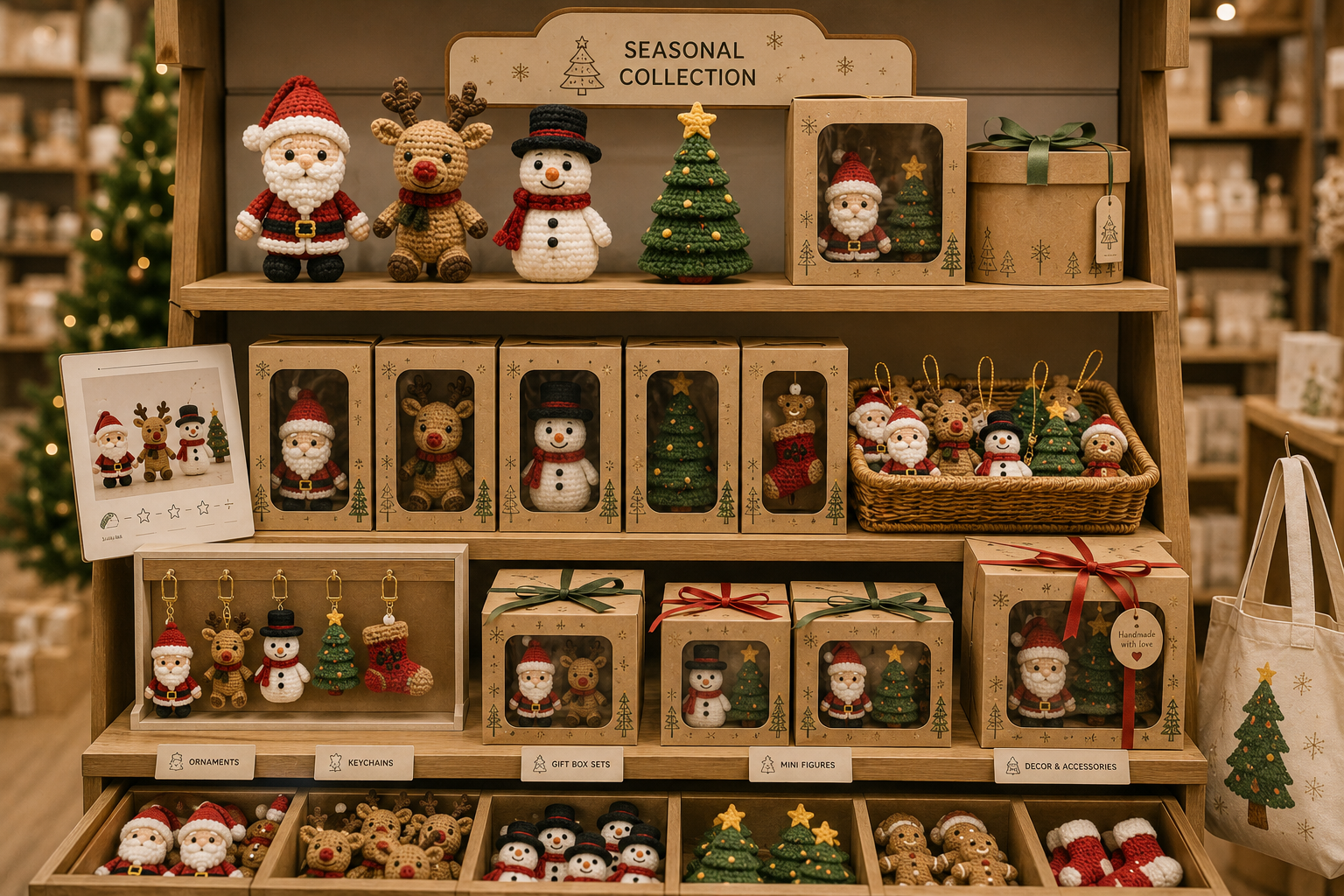
Holiday Gift Collections Should Be Designed for Merchandising
A product can look attractive individually but still perform poorly as part of a retail display.
Buyers should consider how the complete collection will appear:
- On shelves
- On hooks
- In gift displays
- In online category pages
- In promotional photography
Useful questions include:
- Are the colors visually coordinated?
- Is there enough product-size variation?
- Is there a clear hero product?
- Are entry-price products easy to identify?
- Does the packaging create a consistent family?
Retail presentation should influence development before production begins.
Why Gift Sets Need Additional Planning Time
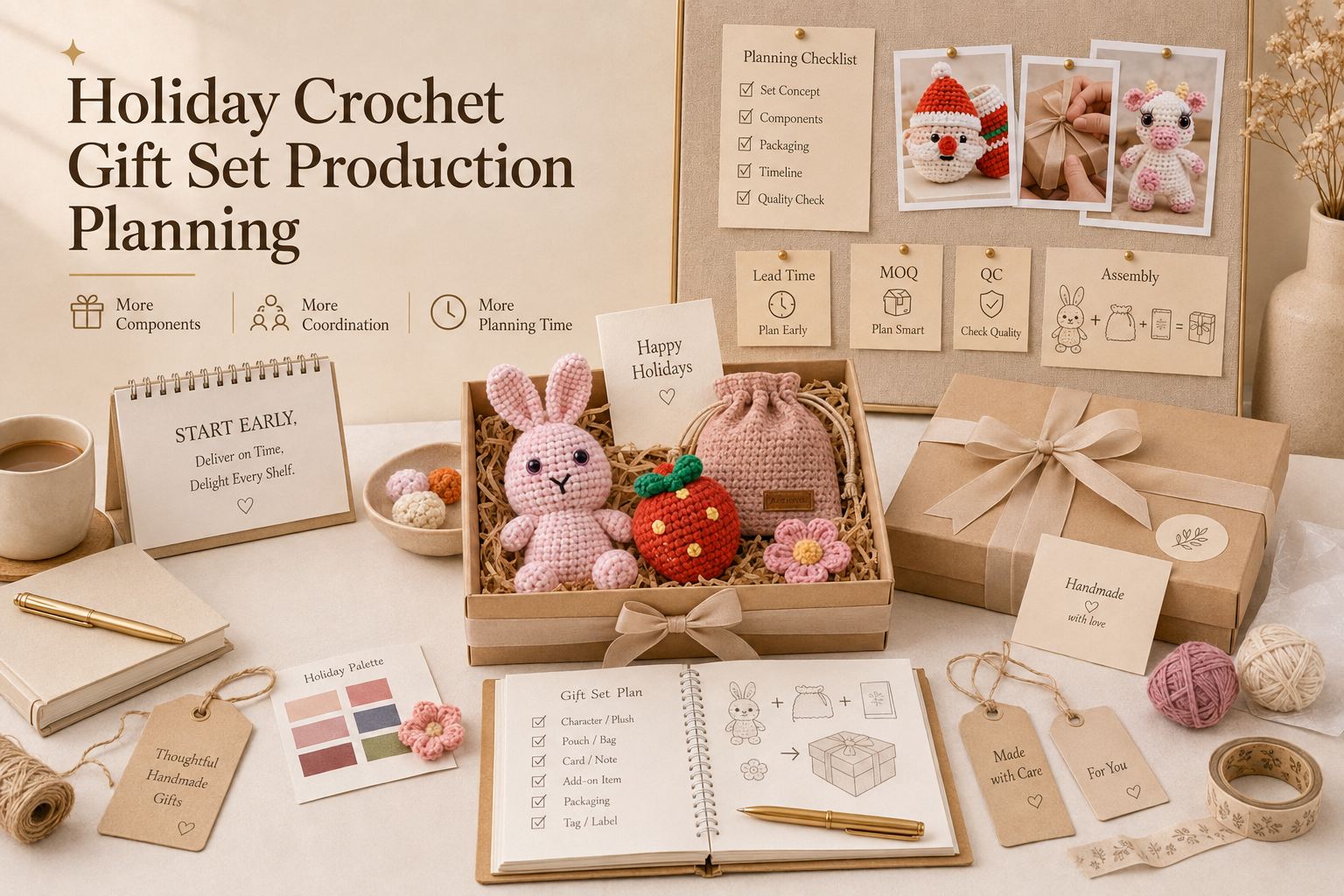
Holiday gift sets can create strong perceived value, but they also introduce more coordination.
A gift set may contain:
- Crochet product
- Greeting card
- Notebook
- Pouch
- Decorative item
- Custom box
Each component may have:
- A different supplier
- A different MOQ
- A different lead time
- A different quality standard
The final assembly also needs planning.
For this reason, gift-set development should usually begin earlier than development of a single crochet product.
Seasonal Collection Planning by Holiday
Different holidays may require different development strategies.
| Holiday | Common Crochet Opportunities | Planning Considerations |
|---|---|---|
| Valentine's Day | Hearts, flowers, couples, emotional gifts | Strong gifting focus |
| Easter | Rabbits, chicks, eggs, baskets | Children's and family gifting |
| Mother's Day | Flowers, gift sets, sentimental products | Presentation and emotional value |
| Halloween | Pumpkins, ghosts, characters | Short seasonal window |
| Ramadan & Eid | Crescent moons, stars, family characters, gift sets | Cultural relevance and respectful design |
| Christmas | Santa, reindeer, snowmen, trees, ornaments | Large assortment potential |
| New Year | Mascots, lucky symbols, limited editions | Market-specific cultural themes |
What Retail Buyers Should Send the Factory at the Beginning
A good initial brief can save significant development time.
Ideally, buyers should provide:
- Target holiday
- Target launch date
- Destination country
- Product references
- Artwork or sketches
- Approximate size
- Target quantity
- Target cost
- Target retail price
- Packaging requirements
- Intended age group
- Intended product use
- Required compliance information
If some details are still unknown, the manufacturer can help identify which decisions need to be made first.
Questions to Ask a Seasonal Crochet Manufacturer
Before confirming a holiday program, buyers should ask:
- How long does sampling normally take?
- How many revision rounds should we allow for?
- What materials are available?
- Can yarn colors be customized?
- What is the MOQ per design?
- Can multiple designs share materials?
- What is the estimated bulk-production lead time?
- How is artisan capacity organized during peak seasons?
- What quality-control process is used?
- Can you support custom packaging?
- What testing or compliance support is available?
- When should the order be confirmed for the required delivery date?
How U-MY Supports Seasonal Crochet Collection Development
At U-MY Crochet, we have specialized in crochet manufacturing since 2013.
Our seasonal development experience includes product categories such as:
- Crochet dolls
- Crochet animals
- Hanging ornaments
- Keychains
- Flowers
- Mascots
- Gift sets
- DIY crochet products
We support both OEM and ODM development.
OEM Seasonal Development
For retailers and brands with existing artwork or product concepts, development can include:
- Artwork review
- Crochet adaptation
- Material selection
- Sampling
- Revisions
- Packaging
- Production planning
ODM Seasonal Development
For buyers that need additional product-development support, possible areas include:
- Seasonal concepts
- Product combinations
- Color directions
- Character variations
- Collection structures
- Gift-set combinations
- Packaging directions
The objective is to turn a seasonal idea into a commercially workable collection.
Why Early Collaboration With the Manufacturer Matters
The manufacturer should not enter the process only when the buyer needs a price.
Early collaboration can help identify:
- Difficult construction
- Expensive details
- Material limitations
- Packaging MOQ issues
- Production bottlenecks
- Unrealistic timelines
These issues are much easier to solve during concept development than after an order has been confirmed.
One principle we consistently see in custom development is:
The cheapest time to solve a production problem is before mass production begins.
Frequently Asked Questions
How far in advance should retailers plan holiday gift collections?
For fully customized products, beginning approximately 9–12 months before the intended retail period can provide more time for research, design, sampling, revisions, packaging, production, compliance preparation, and international shipping. Simpler programs may require less time.
Why do retailers plan Christmas products so early?
Christmas merchandise has a fixed selling window. Buyers need enough time for product development, production, transportation, customs clearance, warehousing, and store distribution before peak holiday shopping begins.
How long does a custom crochet sample take?
Initial crochet sample development may commonly require around 7–15 working days, depending on design complexity, materials, accessories, and communication speed. Additional revisions require additional time.
Can retailers launch a seasonal crochet collection with a low MOQ?
Potentially. MOQ depends on product design, materials, packaging, and production requirements. Using shared yarn colors, standard packaging, and a focused assortment may make smaller launches easier to manage.
When should packaging development begin?
Can existing crochet products be customized for holidays?
Yes. Existing structures can potentially be adapted through colors, accessories, clothing, embroidery, labels, and packaging. This can reduce development complexity compared with creating an entirely new product.
Should compliance be considered before sampling?
The intended market, age group, and product use should be discussed as early as possible because they may affect materials, construction, labeling, and testing requirements.
How can retailers reduce the risk of missing a holiday deadline?
Work backward from the required retail date, confirm key decisions early, reserve production capacity, build shipping buffers, and avoid leaving packaging or compliance planning until the end.
Conclusion
Consumers may experience a holiday collection for only one season.
Retail buyers often spend most of the previous year preparing for that moment.
Successful seasonal product development requires coordination between:
- Market insight
- Design
- Sampling
- Costing
- Compliance
- Packaging
- Production
- Quality control
- Logistics
- Retail merchandising
For handmade crochet products, early planning is especially valuable because production depends on skilled human craftsmanship, material preparation, and organized artisan capacity.
At U-MY Crochet, our experience since 2013 has taught us that the strongest seasonal programs are rarely the ones developed under the most pressure.
They are the ones where the buyer and manufacturer have enough time to make good decisions.
For retailers planning Christmas, Easter, Ramadan, Valentine's Day, Mother's Day, or another major gifting season, the most useful question may therefore not be:
"How quickly can this product be made?"
It may be:
"What should we start today so the right product is ready when our customers want to buy it?"
That shift—from reacting to a holiday deadline to planning backward from it—is what turns seasonal product development into a repeatable retail strategy.
 Chinese