
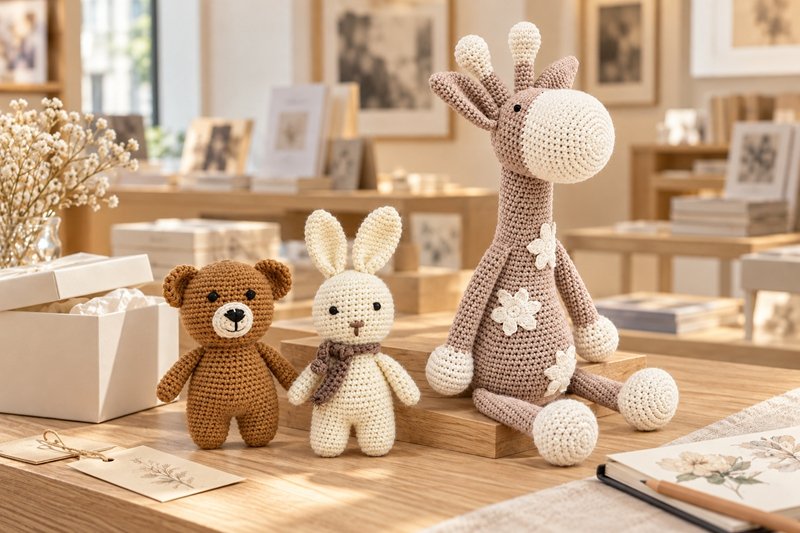
Develop crochet souvenirs around a target retail price by first defining the shop’s available product budget, then evaluating which size, construction, details and packaging can fit that budget while preserving the cultural reference. Ask the manufacturing partner to assess several clearly specified options before approving a sample.
A target shelf price is a useful starting point, but it is not a factory purchasing budget. Museum buyers need to connect the proposed retail price with their own margin requirements and purchasing costs.
Who Is This Guide For?
This guide is for museum shops, galleries, cultural institutions, destination retailers and merchandise developers planning custom crochet souvenirs.
It addresses a specific commercial question: how should a cultural product be developed when its intended selling price places limits on the purchasing budget?
It complements cultural interpretation and exhibition planning. It does not replace them.
For the earlier task of translating a cultural reference into a product, see How Museums Turn Cultural Stories Into Retail-Ready Crochet Products.
1. Define the Commercial Starting Point
Before requesting development, record:
- Intended retail price or price range.
- Whether that price includes applicable taxes.
- The shop’s required gross margin.
- The cost basis used to calculate that margin.
- Expected purchasing quantity and SKU mix.
- Required packaging.
- Costs included in the purchasing budget.
- Separate development or artwork budgets, if available.
Museum shops may use different accounting conventions. Agree internally which costs belong in the product assessment before comparing supplier proposals.
Distinguish Margin From Markup
Gross margin and markup are different calculations.
Using a consistently defined sales revenue and product cost:
Gross margin = (Sales revenue − Product cost) ÷ Sales revenue
Markup = (Sales revenue − Product cost) ÷ Product cost
If the shop uses gross margin to set its product budget:
Maximum product cost = Sales revenue × (1 − Target gross margin)
The revenue figure should follow the shop’s accounting treatment, including its treatment of tax.
This calculation establishes a budget under the selected assumptions. It does not establish profitability or the appropriate margin for a museum shop.
Convert the Product Budget Into a Supplier Brief
Clarify whether the available cost budget must cover:
- The finished product.
- Individual retail packaging.
- Freight and handling.
- Import-related costs.
- Any project-specific charges allocated to the order.
If the supplier quotation covers only the product and packaging, reserve the appropriate allowance for other costs instead of giving the supplier the entire available budget.
For a broader sourcing-cost framework, see How to Calculate Landed Cost for Imported Crochet Products.
2. Protect the Cultural Features That Make the Souvenir Relevant
A souvenir needs a recognizable connection to the institution, collection or destination.
Before simplifying the design, identify its essential features.
These might include:
- A distinctive silhouette.
- An animal associated with the collection.
- A recognizable clothing shape.
- A characteristic color arrangement.
- A meaningful motif.
- A specific facial expression or accessory.
- A short interpretive story supported by the institution.
Separate essential cultural features from optional decorative details.
For example, reducing the number of accessories may be acceptable if the main silhouette remains recognizable. Removing the feature that connects the product to the collection may undermine its purpose.
Ask the institution’s responsible reviewer to approve those priorities before development proceeds.
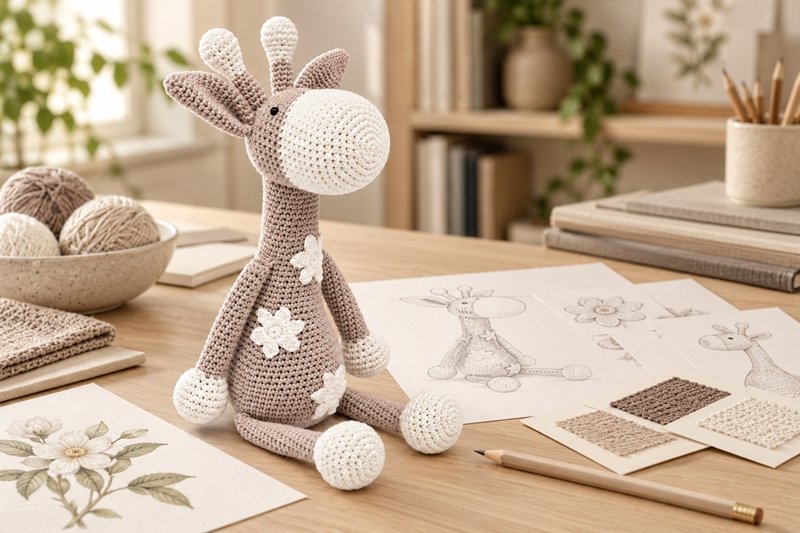
3. Turn the Budget Into Design Options
Ask for alternatives that explain what changes and what stays consistent.
A useful comparison might include:
| Development option | What changes | What the buyer should evaluate |
|---|---|---|
| Compact format | Overall size and some detail scale | Whether the cultural reference remains clear |
| Simplified character | Fewer separate pieces or decorative elements | Whether recognition survives the simplification |
| Reduced color complexity | Selected color changes or small contrasting details | Whether the revised palette remains appropriate |
| Different material proposal | Yarn specification or surface appearance | Whether texture, shape and perceived quality still suit the shop |
| Streamlined packaging | Presentation format and included inserts | Whether protection and interpretation remain adequate |
| More detailed version | Additional features or presentation elements | Whether the shop can support the resulting price position |
These are options for evaluation, not guaranteed cost reductions.
For example, a smaller product can retain intricate details that still require substantial work. Ask the manufacturer to explain the expected cost effect of each proposed change.
4. Examine Work Content, Not Size Alone
A crochet souvenir’s development and production requirements depend on more than its dimensions.
Review:
- Number of separately made pieces.
- Shaping complexity.
- Color changes.
- Embroidered features.
- Attachment and assembly steps.
- Accessories.
- Finishing requirements.
- Packaging preparation.
Two products of similar size may require different amounts of work.
Ask the manufacturing partner to identify which features drive the quotation. Then discuss targeted adjustments that preserve the design’s purpose.
A useful question is:
“Which changes would materially affect the quotation while retaining the approved cultural features?”
This gives the development team a clearer task than asking it to make the product cheaper without explaining the priorities.
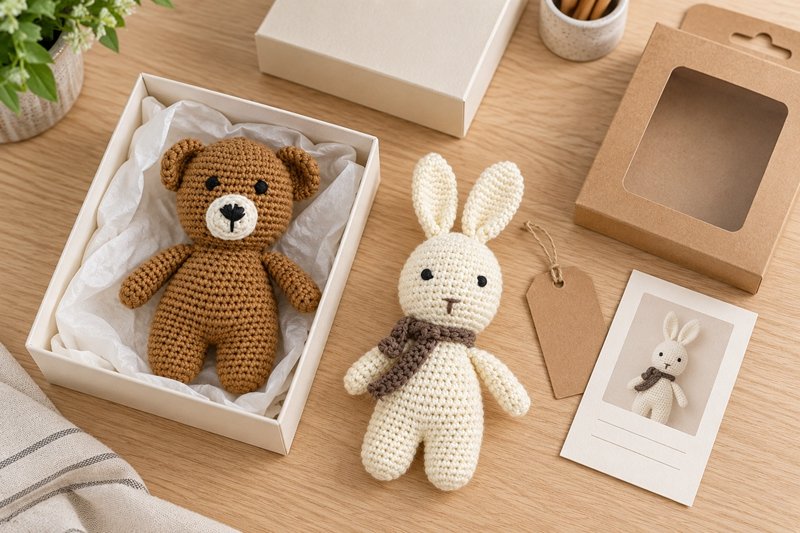
5. Decide What the Packaging Must Accomplish
Packaging has several possible jobs:
- Protecting the product.
- Holding it in a suitable display position.
- Explaining its cultural connection.
- Carrying the required product information.
- Supporting gifting.
- Fitting the shop’s shelves and handling process.
Define those jobs before selecting the format.
A box may be appropriate for one product. Another may work with a hangtag and a concise story card. The right choice depends on the product, presentation requirements and budget.
Avoid removing useful interpretation simply to reduce packaging. Instead, consider whether the story can be communicated more efficiently.
For example, a shorter institution-approved story card may be easier to integrate than a large printed booklet, provided it still gives visitors the relevant connection.
For packaging development, see How to Design Retail-Ready Packaging for Crochet Products.
6. Compare Quotations on the Same Basis
Before comparing proposals, align their assumptions.
Check:
| Quotation item | What to clarify |
|---|---|
| Product specification | Size, materials, details and construction version |
| Quantity | Quantity per design and total order |
| Packaging | Included format, contents and artwork scope |
| Development | Sample work, revisions and any separate charges |
| Delivery terms | What the quoted price includes |
| Outstanding decisions | Provisional materials, accessories or artwork |
| Validity | Conditions under which the quotation may change |
Do not compare an unpackaged simplified sample with a fully detailed boxed product as though the only difference were supplier pricing.
Likewise, a quotation for one quantity should not be treated as applicable to another quantity or SKU mix without confirmation.
7. Review the Sample as a Retail Proposition
The physical sample should be reviewed by both cultural and retail stakeholders.
Ask:
- Can visitors recognize the intended connection?
- Does the product communicate that connection without a long explanation?
- Does its material and finish suit the shop?
- Is it easy to display and handle?
- Does the packaging fit the intended presentation?
- Is the purchasing cost compatible with the agreed retail assumptions?
- What remains provisional?
If the sample does not fit the budget, return to the documented priorities.
Consider whether to revise the product, adjust the packaging, change the retail position or discontinue the concept. Repeatedly removing details without a clear reference can produce a product that meets the budget but loses its relevance.
Do Not Treat a Sample as Evidence of Demand
A well-developed sample establishes a proposed product. It does not prove how visitors will respond or how many units the shop will sell.
Where practical, use the shop’s own relevant sales history, buyer judgment and suitable customer feedback to evaluate the retail proposition.
Record the assumptions separately from confirmed results.
8. Keep Different Price Positions Distinct
A museum shop may want more than one price position within a related range.
If so, give each product a clear role.
For example:
- A compact souvenir with the essential motif.
- A more detailed character with stronger display presence.
- A gift presentation with additional packaging.
These are illustrative product roles, not a recommendation that every shop needs three tiers.
Each version should have its own specification and cost assessment. Do not assume that a smaller version can simply inherit the larger product’s features, packaging or margin assumptions.
For the broader task of organizing related products, see How to Develop a Crochet Product Collection Instead of Isolated SKUs.
9. Record the Commercial and Design Approval Together
Before proceeding, retain:
- Approved product reference.
- Essential cultural features.
- Material and construction specification.
- Packaging and story-card versions.
- Confirmed quotation scope.
- Order quantity and SKU allocation.
- Retail price assumptions used for the assessment.
- Separate development charges.
- Outstanding requirements and responsible reviewers.
If a later change affects the product or packaging cost, reassess the commercial assumptions before accepting it.
Similarly, if a cost adjustment changes an essential cultural feature, obtain the relevant design approval again.
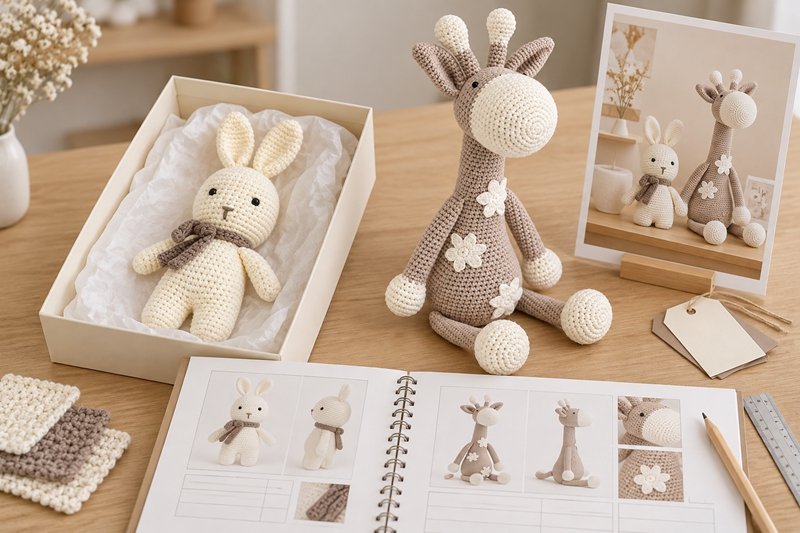
Discussing a Budget-Led Souvenir Project With UMY Crochet
UMY Crochet is a product development and manufacturing partner for crochet, DIY craft kits, knitted toys and creative gifts.
For a museum or cultural merchandise project, buyers can submit the cultural reference together with the commercial constraints so that product development considers both from the beginning.
A practical review can cover:
- The reference and features that must remain recognizable.
- The intended retail position and available purchasing budget.
- Product size, materials and construction options.
- Packaging and interpretation requirements.
- Proposed quantities and related designs.
- Sample evaluation and approval responsibilities.
The goal is to develop a feasible proposal whose design, quotation and retail assumptions are clear enough for the institution to assess.
Frequently Asked Questions
Should a museum provide its target retail price to the manufacturer?
It can help explain the intended retail position. Also provide the available purchasing budget and specify what that budget must include.
Does a smaller crochet souvenir always cost less?
No. Small products can still require intricate shaping, multiple pieces and detailed assembly. Request an assessment of the actual work content.
Should packaging be removed to meet the budget?
Evaluate what the packaging needs to accomplish first. A simpler format may be suitable, but protection, presentation and necessary information still need to be addressed.
Can one cultural reference support different price positions?
Potentially. Develop each version around a clear product role and its own specification rather than assuming that size alone creates a suitable range.
What if the sample exceeds the purchasing budget?
Review the main cost drivers and essential design features. Compare targeted revisions, a different retail position or an alternative concept before approving the order.
Does meeting the target gross margin prove the product will be profitable?
No. The calculation depends on the selected cost basis and does not establish demand or account for every operating cost.
Who should approve a cost-related design change?
The responsible commercial reviewer should assess the cost effect, and the cultural or design reviewer should confirm any change affecting the product’s meaning or appearance.
Request a Museum Souvenir Development Review
Share your cultural reference, essential design features, target retail position, available purchasing budget, expected quantity and packaging requirements with UMY Crochet.
Request a development review to compare feasible product options and identify which specifications should be sampled before the museum makes its purchasing decision.
 Chinese