
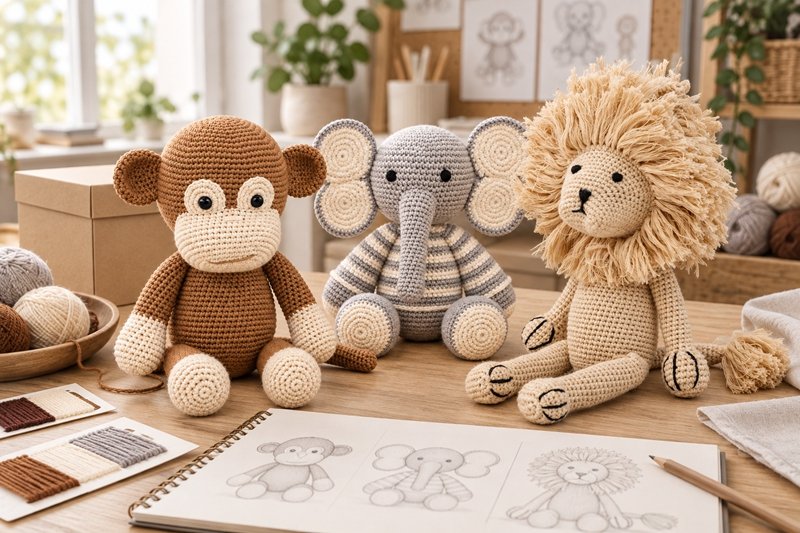
Choose handmade crochet when the crochet stitch texture and hand-shaped details are essential to the product concept. Evaluate machine knitting when the design can be developed successfully through a knitted construction and the proposed production route fits your quantity, budget and delivery requirements.
Neither method is automatically the better commercial choice. Compare physical samples, construction plans and quotations against the same product brief before deciding.
Who Is This Comparison For?
This guide is for toy brands, gift companies, retailers, IP owners and product development teams choosing a manufacturing method for a yarn-based character.
It is especially relevant when:
- A character needs to retain distinctive facial features or proportions.
- A brand is considering different manufacturing routes for a collection.
- A crochet concept needs a separate version for another retail price point.
- A project may combine knitted construction with handmade crochet details.
- Buyers need to understand what remains manual in a proposed production process.
The decision concerns how the product is made. It is separate from choosing whether the character becomes a doll, keychain or another merchandise format.
For that earlier decision, see How to Choose the Right Crochet Product Format for a Brand Character.
1. Clarify the Construction Being Quoted
Crochet and knitting are distinct yarn techniques. The Craft Yarn Council explains their different stitch-making methods and notes that yarn and stitch choices influence the resulting fabric.
A toy’s yarn appearance alone does not identify its manufacturing route.
For each proposal, ask the supplier to describe:
- How the outer body is formed.
- Which parts are crocheted or knitted.
- Whether knitted pieces are shaped directly or assembled from separate sections.
- How features and accessories are added.
- Which filling, joining and finishing steps remain manual.
“Machine-knitted” should not be interpreted as “made entirely without handwork.” Ask for the actual process rather than assuming how the finished toy is assembled.
Define Hybrid Construction Precisely
For this guide, a hybrid product combines different construction methods within one design, such as a knitted body with handmade crochet accessories.
The term is descriptive, not a universal manufacturing specification. Identify the method used for each component.
2. Compare the Methods Against Buyer Requirements
Use the following table as an evaluation framework. It is not a guarantee of cost, speed or performance.
| Buyer requirement | Handmade crochet: what to evaluate | Machine knitting: what to evaluate |
|---|---|---|
| Surface appearance | Whether the crochet stitches express the intended design | Whether the proposed knitted texture suits the brand |
| Character shape | How shaping and attached pieces reproduce the reference | How the knitted construction and assembly reproduce the reference |
| Fine details | Work required for features, embroidery and accessories | Which details can be incorporated and which need separate work |
| Production quantity | Work content, artisan organization and available capacity | Machine setup, production capacity and downstream manual work |
| Cost | Crochet work, materials, assembly and finishing | Development, setup, knitting, assembly and finishing |
| Consistency | Agreed references and checks for handmade variation | Controls for knitted pieces, assembly and finishing |
| Design changes | Effect on the pattern, work content and approved sample | Effect on programming, construction, setup and approved sample |
| Brand claims | Evidence supporting the stated handmade process | Accurate description of knitted and manually finished elements |
Request a project-specific assessment for both routes. A broad comparison cannot establish the best method for an individual character.
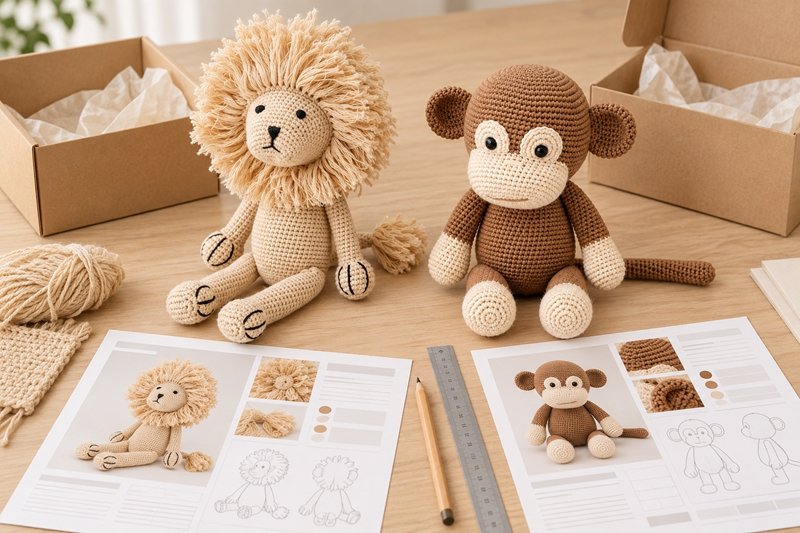
3. Identify the Features That Must Survive the Translation
Before asking for quotations, mark the character’s essential features.
These might include:
- Head-to-body proportion.
- Muzzle profile.
- Ear or horn shape.
- Facial expression.
- Clothing silhouette.
- Color placement.
- Surface texture.
- A distinctive accessory.
Separate these from details that can be adapted.
For example, a brand may accept a different stitch texture but require the same muzzle shape and expression. Another brand may consider the crochet surface itself essential to the product’s identity.
Give the supplier that distinction explicitly. Otherwise, the proposed construction may solve a manufacturing problem while weakening the character.
Compare Recognition From Several Angles
Review front, side, back and three-quarter views.
A sample may resemble the artwork from the front but lose its defining profile. Compare the complete form, including how filling and assembly affect it.
Do not assume that changing the manufacturing method will reproduce an existing crochet sample exactly. Treat the alternative as a new development requiring its own review.
4. Compare Costs Using Equivalent Specifications
A useful cost comparison starts with a shared brief.
Align:
- Intended product size.
- Materials and surface appearance.
- Required features and accessories.
- Filling and finishing expectations.
- Packaging scope.
- Order quantity and SKU mix.
- Required delivery point and commercial terms.
Then ask each proposal to identify what is included.
A lower quotation may reflect a simpler face, different yarn, fewer accessories or excluded packaging. Those differences should be visible before the buyer evaluates price.
Include Development and Setup
Review one-time development or setup charges alongside recurring unit costs.
Also clarify:
- What the sample fee includes.
- How revisions are handled.
- Whether changes require additional setup.
- Which specifications the quotation assumes.
- What would trigger a revised quotation.
Do not assume that machine knitting is cheaper for every design or that handmade crochet always supports a higher retail price. The actual product, order and channel determine the commercial result.
5. Review Capacity and Delivery as a Complete Process
A production method’s name does not establish an order’s delivery time.
Ask the supplier to explain the complete sequence:
- Product development and sampling.
- Material preparation.
- Crochet or knitting.
- Assembly and feature attachment.
- Filling and finishing.
- Inspection and any rework.
- Retail packing and shipment preparation.
Identify the stages that constrain the proposed order.
For handmade crochet, discuss how work is organized and checked across makers. For machine knitting, discuss both knitting capacity and the manual operations that follow it.
If several designs share a production window, ask how the SKU mix affects scheduling. An available machine or artisan team does not, by itself, confirm that every component and finishing stage is ready.
6. Evaluate Quality Through the Finished Construction
Both routes need a clear approved reference.
Review:
- Shape and proportions.
- Surface appearance.
- Visible openings and seams.
- Filling distribution.
- Feature alignment.
- Accessory attachment.
- Secured ends and clean finishing.
- Packaging fit.
Agree which characteristics can be checked visually and which require physical examination or a defined test.
Do not infer suitability for children, durability or market compliance from the manufacturing method alone. Establish those requirements separately for the intended product and market.
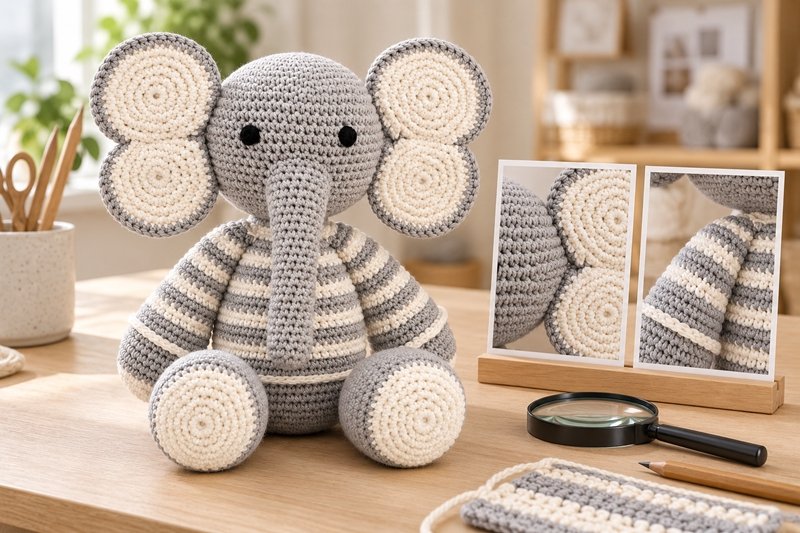
7. Consider a Hybrid Route Where It Solves a Specific Problem
A hybrid construction may be worth exploring when different parts of the design have different priorities.
For example, a buyer might request an evaluation of:
- A knitted body with crochet clothing.
- A knitted character with a handmade crochet accessory.
- A coordinated collection containing separate crochet and knitted products.
These are development options, not claims about completed projects.
A hybrid route still needs a complete cost and construction review. Additional methods can introduce more joining steps, material references and approval decisions.
Ask:
- What benefit does the combination provide?
- Which features justify the handmade work?
- How will the materials look together?
- How will components be attached?
- Who controls the combined production reference?
Choose the combination only when its benefit is clear in the sample and commercial proposal.
8. Review Physical Samples Before Committing to a Route
Where both methods are commercially plausible, request comparable samples or a scoped feasibility review.
Assess each proposal against the same decision criteria:
| Review question | Evidence to examine |
|---|---|
| Does it preserve the character? | Physical sample and multiple-angle photographs |
| Does the texture suit the brand? | Actual material and finished surface |
| Does the construction meet the brief? | Component and assembly explanation |
| Is the quotation comparable? | Specification, exclusions and commercial terms |
| Can the order be scheduled? | Proposed production sequence and dependencies |
| Can it be reordered consistently? | Reference retention and material control plan |
If a sample contains provisional materials, identify them before drawing conclusions.
Record why a route was selected. That decision helps future teams understand which features and assumptions must be preserved during revisions or replenishment.
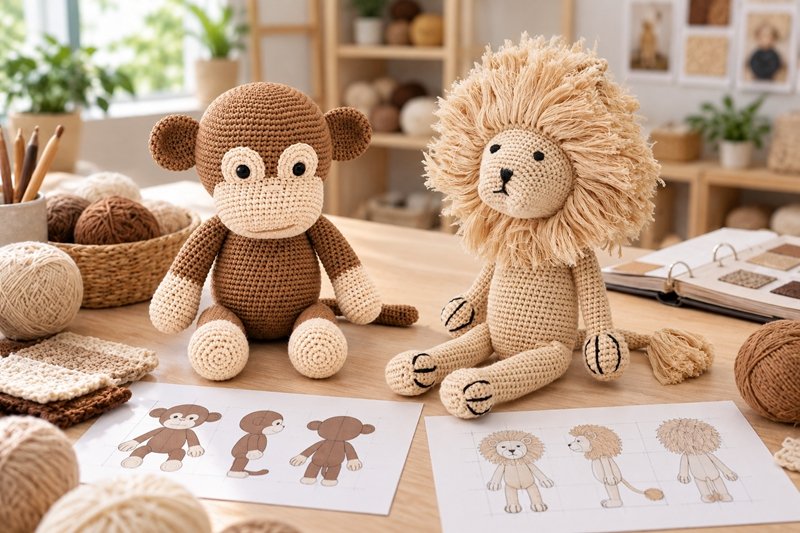
9. Describe the Finished Product Accurately
Product descriptions should match the actual construction.
Clarify which elements are handmade crochet, machine-knitted or manually assembled. Do not describe an entire product as handmade crochet when that description only applies to an accessory.
Similarly, avoid implying that a machine-knitted product has no manual contribution if assembly and finishing are performed by hand.
Keep manufacturing descriptions consistent across the buyer brief, quotation, approved sample and retail content.
Discussing Manufacturing Routes With UMY Crochet
UMY Crochet is a product development and manufacturing partner for crochet, DIY craft kits, knitted toys and creative gifts.
For a character project, buyers can request an evaluation of handmade crochet, knitted construction or a defined combination, subject to the design’s feasibility.
A practical review can begin with:
- Character artwork and essential visual features.
- Intended product size and use.
- Acceptable material and texture options.
- Expected quantity and SKU mix.
- Target purchasing budget.
- Packaging and delivery requirements.
The proposed route should then be assessed through construction details, sampling and project-specific commercial terms.
For the broader choice of development responsibility, see OEM vs ODM Crochet Manufacturing: Which Is Right for Your Brand?.
Frequently Asked Questions
Can machine knitting reproduce a handmade crochet toy exactly?
Do not assume an exact reproduction. Ask for a construction assessment and review a physical sample against the essential design features.
Is machine knitting always cheaper?
Is handmade crochet automatically the better premium option?
No. The product must suit the brand’s design, quality expectations and retail proposition. Evaluate the finished sample rather than relying on the technique’s name.
Can a machine-knitted toy still involve handwork?
Can brands combine knitting and crochet?
A combination may be feasible for a particular design. Define each component’s construction and assess the complete sample, cost and production plan.
Does either method automatically establish toy safety?
No. Manufacturing method alone does not establish safety or compliance. Define the intended use and target-market requirements separately.
What should buyers provide for a manufacturing comparison?
Provide artwork, essential features, size, material expectations, quantity, budget, packaging scope and delivery requirements.
Request a Manufacturing Feasibility Comparison
Share your character artwork, intended size, essential design features, expected order quantity and target purchasing budget with UMY Crochet.
Request a feasibility review to identify suitable construction routes and the sample evidence needed before choosing a production method.
Technical Reference
- Craft Yarn Council: Knit vs. Crochet vs. Crafting with Yarn — background on the distinction between knitting and crochet. This source does not establish factory costs, capacity or delivery times.
 Chinese