
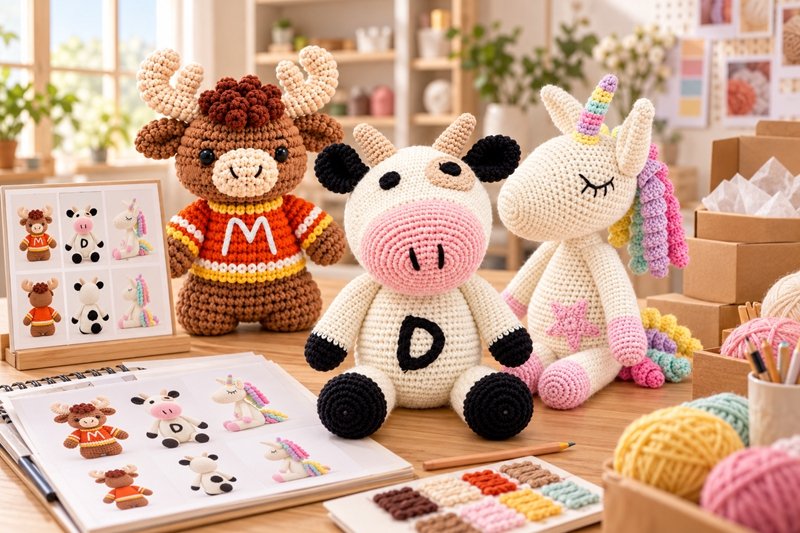
Manage approval rounds for licensed crochet character merchandise by agreeing who reviews each stage, which reference version applies and what evidence is needed before development proceeds. Consolidate feedback into one revision record, then document the approved version and any remaining conditions.
A recognizable sample is only part of the task. The development team also needs to know whose decision controls, which comments remain open and whether an approval covers the character, construction, packaging or all three.
Who Is This Guide For?
This guide is for IP owners, licensed brands, merchandise developers, creative agencies and purchasing teams coordinating custom crochet character products.
It focuses on the operational approval process:
- Translating character guidelines into a three-dimensional yarn product.
- Coordinating comments from several reviewers.
- Separating design approval from production approval.
- Managing sample and artwork versions.
- Preventing previously approved features from changing without review.
Approval procedures depend on the project’s governing agreements and the rights holder’s instructions. This guide provides a development framework; it does not establish permission to use a character.
For the earlier product-format decision, see How to Choose the Right Crochet Product Format for a Brand Character.
1. Confirm the Approval Route Before Sampling
Ask the buyer or authorized project owner to explain the required review process.
Record:
- Who submits materials to the character reviewer.
- Who may give binding approval for each stage.
- Which buyer teams also review the product.
- What must be submitted at each checkpoint.
- Whether physical samples are required.
- How feedback will be consolidated.
- Which activities depend on approval.
A manufacturer may receive feedback from a brand’s purchasing team without communicating directly with the rights holder. Make that route explicit.
Do not assume that approval from one project participant represents approval from every required reviewer.
2. Establish the Current Character Reference
Before development begins, gather the reference materials that apply to the proposed merchandise.
These may include:
- Character turnaround views.
- Approved color references.
- Proportion and expression guidelines.
- Clothing and accessory details.
- Permitted poses.
- Examples of acceptable product adaptations.
- Packaging artwork requirements.
- Any project-specific restrictions supplied by the authorized reviewer.
Identify the version and source of each reference.
If two documents conflict, ask the responsible project owner to resolve the conflict before sampling the affected feature.
Mark the Features That Carry Recognition
Highlight the features that must remain consistent.
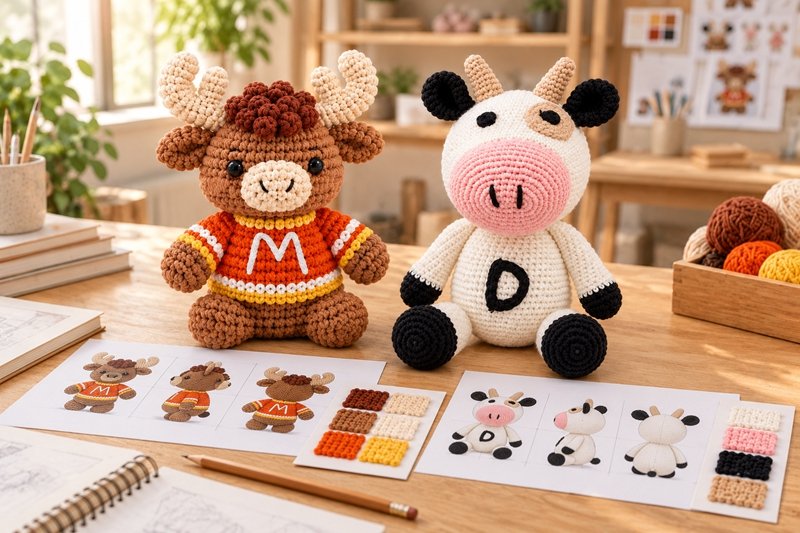
For a crochet character, these may include:
- Head-to-body proportion.
- Eye spacing and expression.
- Muzzle profile.
- Ear, horn or hair silhouette.
- Color boundaries.
- Clothing shape.
- A distinctive accessory.
Also identify which features may be adapted to the proposed size, material and construction.
This gives the developer a clearer task than asking for a general resemblance.
3. Agree Review Checkpoints That Match the Decisions
Avoid asking every reviewer to approve everything at every stage.
Use checkpoints that answer specific questions:
| Checkpoint | Main decision | Useful submission |
|---|---|---|
| Concept review | Is the proposed product direction suitable? | Product format, sketches and adaptation notes |
| Initial sample review | Does the three-dimensional interpretation preserve the character? | Physical sample or agreed photographs |
| Revision review | Have the requested changes been addressed? | Revised sample and change record |
| Production reference review | Is the product sufficiently defined for the authorized production step? | Final sample, materials and specifications |
| Packaging review | Does the packaging follow the applicable requirements? | Artwork and packaging prototype |
The actual checkpoints should follow the project’s required process. Some stages may be combined; others may need additional submissions.
4. Explain Construction Adaptations Before They Become Surprises
A flat character illustration does not specify every feature of a three-dimensional crochet product.
Development may require decisions about:
- How to shape the head and body.
- Whether a feature is crocheted separately or embroidered.
- How color areas follow the surface.
- How accessories are attached.
- How the character sits or stands.
- Which details remain visible at the selected size.
When proposing an adaptation, explain:
- The original reference requirement.
- The construction issue.
- The proposed interpretation.
- Its effect on appearance.
- What the reviewer is being asked to decide.
Do not silently simplify an essential feature.
A small detail may be commercially inconvenient but central to character recognition. The authorized reviewer should decide whether the proposed change is acceptable.
5. Submit Samples With Enough Visual Evidence
A single front photograph may not support a complete character review.
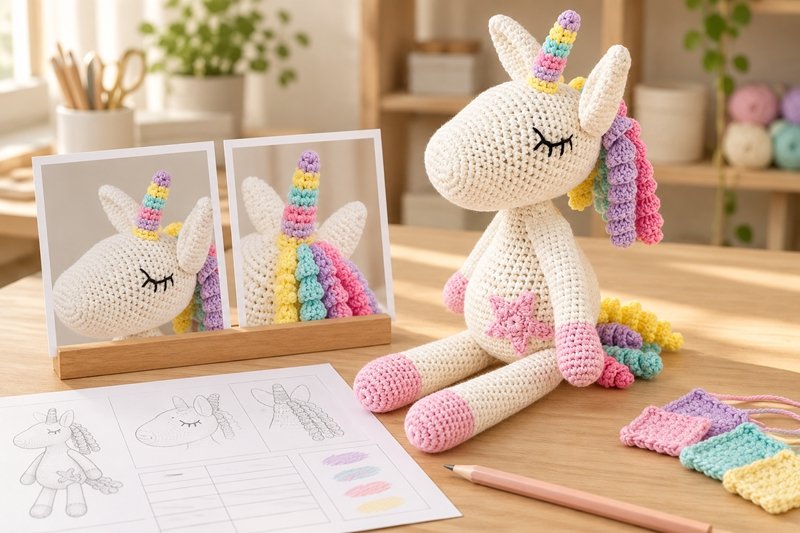
Prepare a consistent submission showing:
- Front.
- Back.
- Both sides.
- Three-quarter view.
- Important facial details.
- Defining accessories.
- Any feature changed since the previous submission.
Use neutral lighting and avoid filters that alter the material colors.
Where physical handling, profile or attachment cannot be adequately reviewed through photographs, agree whether a physical sample is needed.
Keep Presentation Consistent Across Rounds
Use similar camera angles and scale references when comparing revisions.
If the old photograph shows a seated character from above and the new photograph shows it from below, reviewers may struggle to distinguish a construction change from a camera effect.
The submission should make the change easier to assess, not merely make the product look attractive.
6. Consolidate Feedback Into One Actionable Record
Gather comments from design, purchasing, quality, packaging and the authorized character reviewer.
Resolve conflicting instructions before sending the next revision request.
Use a feedback table:
| Item | Reviewer observation | Required action | Evidence for the next review |
|---|---|---|---|
| Head proportion | Differs from the current character reference | Revise according to the marked reference | Front and side views |
| Facial expression | Needs clearer alignment with the approved expression | Adjust feature placement | Face close-up |
| Accessory | Construction proposal remains undecided | Submit an attachment option for review | Detail photograph or physical sample |
| Packaging | Artwork is still being developed | Submit the designated artwork version | Artwork file and packaging mockup |
These are illustrative entries, not findings from a specific licensed project.
Each comment should identify the feature, the required action and the relevant reference.
Avoid combining an optional suggestion with a mandatory correction without stating which is which.
7. Separate Character Approval From Production Readiness
A character reviewer may accept the appearance while other requirements remain open.
Production readiness may still depend on:
- Final material selection.
- Confirmed dimensions.
- Agreed construction details.
- Approved accessories.
- Packaging completion.
- Required product checks.
- A final quotation matching the approved specification.
Track these decisions separately.
For example, “character appearance approved” should not automatically authorize a substitute yarn or an unreviewed attachment method.
Before proceeding, state exactly which activities are permitted and which must wait.
8. Control Versions Across Samples, Photographs and Artwork
Give each submission a clear identifier.
Connect:
- Character reference version.
- Product sample version.
- Material specification.
- Submission photograph set.
- Revision record.
- Packaging artwork version.
- Approval decision.
Retain the Previous Approved State
After a revision, check that previously accepted features remain consistent.
Changing the head shape may also affect eye placement, ear angle or accessory fit. Reviewing only the requested change can overlook those effects.
Compare the revised product with both:
- The current revision instructions.
- The features already accepted in the earlier round.
Do not overwrite the reference record without preserving the reason for the change.
9. Plan Time for Review and Revision
Build the project schedule around approval dependencies.
Clarify:
- When complete submissions are due.
- Who collects and forwards them.
- Whether reviewers work in sequence or in parallel.
- How requested changes are returned to the developer.
- Which revisions require another physical sample.
- What happens if a reference or requirement changes.
Use review periods agreed with the responsible parties. Do not treat an unconfirmed response time as guaranteed.
If a deadline becomes difficult, discuss the available choices explicitly. These may include reducing the proposed scope, adjusting the schedule or submitting an alternative construction.
A deadline does not make an unresolved approval complete.
10. Record the Final Decision and Outstanding Conditions
Use a clear decision format.
Approved within the stated scope: identify the accepted version and authorized next activity.
Revision required: list the required changes and the evidence needed for another review.
Limited approval: identify accepted items, open conditions and activities that remain on hold.
Retain:
- The submission identifier.
- Decision date.
- Responsible reviewer or documented approval route.
- Approved scope.
- Outstanding conditions.
- Required follow-up.
- Matching physical and digital references.
Avoid vague decisions that leave the developer to infer what may proceed.
Coordinating Character Development With UMY Crochet
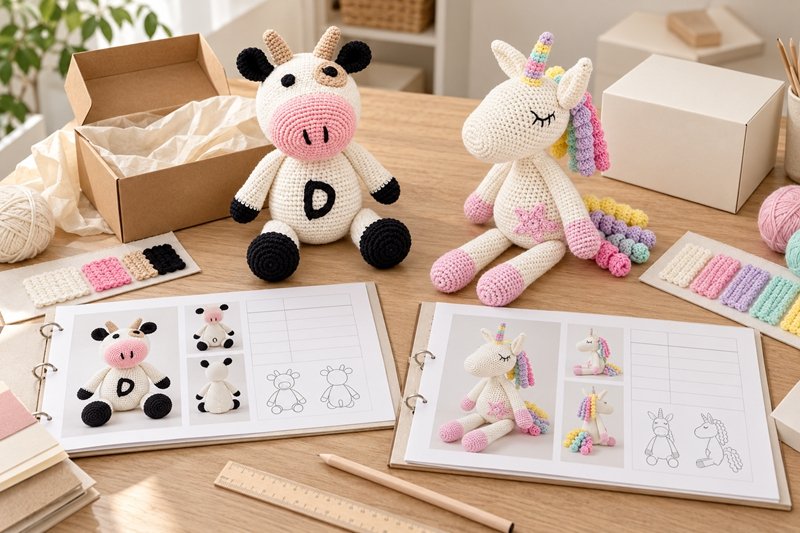
UMY Crochet is a product development and manufacturing partner for crochet, DIY craft kits, knitted toys and creative gifts.
For an authorized character project, buyers can provide the applicable character guidelines and approval route alongside the product brief.
A practical development discussion can cover:
- Essential character features and permitted adaptations.
- Product format, size and materials.
- The sample submission requirements.
- The buyer’s process for consolidating comments.
- Revision evidence and version control.
- The approvals needed before production and packing.
The project owner should communicate the applicable approval requirements. The development team can then organize sampling and revision work around those requirements.
Frequently Asked Questions
Who should consolidate comments?
Name one responsible project coordinator. That person should gather the required input and resolve conflicting instructions through the appropriate reviewers.
Does an approved concept authorize production?
Not automatically. Record what the concept approval covers and which later decisions remain necessary.
Can character details be simplified for crochet?
Only within the project’s permitted adaptation process. Explain the proposed change and obtain the required review before treating it as accepted.
Are photographs enough for sample approval?
That depends on the review requirements and the feature being assessed. Some decisions may require physical samples.
How should conflicting comments be handled?
Pause the affected revision and ask the responsible project owner to confirm the controlling instruction. Record that decision before implementing it.
What should be checked after a revision?
Check the requested change and verify that previously accepted features remain consistent.
What happens if the character guidelines change?
Identify the affected product, sample and artwork versions. Agree which stages need renewed review before proceeding.
Request a Character Development and Approval Review
Share your authorized character references, essential features, proposed product format, expected quantity and required approval checkpoints with UMY Crochet.
Request a development review to define sample submissions, clarify construction adaptations and organize revisions around a traceable approval process.
 Chinese