
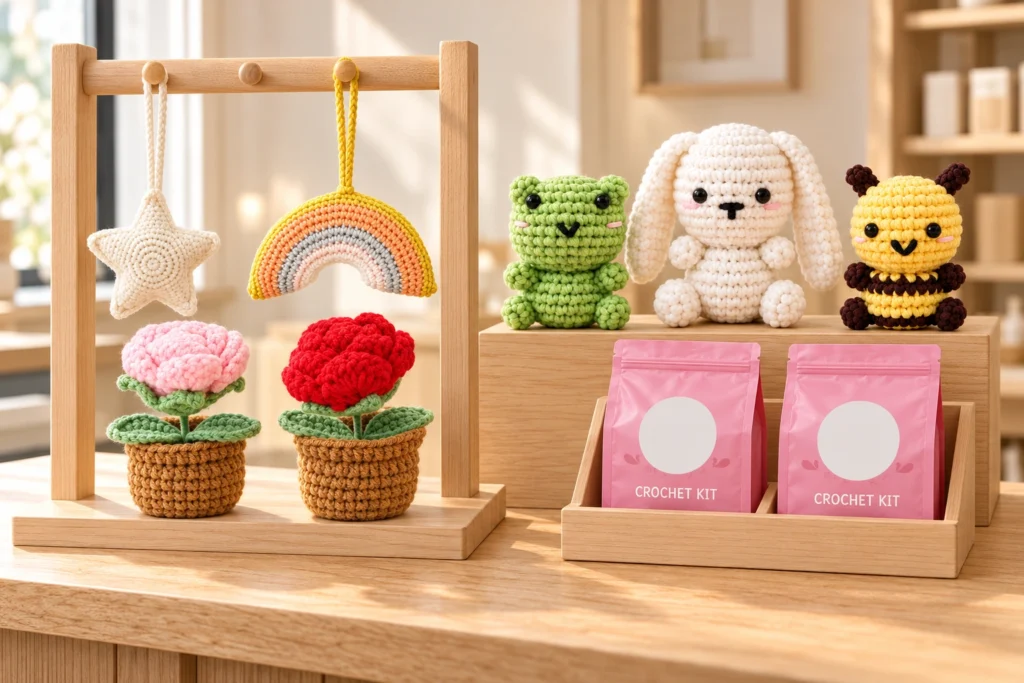
A countertop display for small crochet gifts should be developed around the actual products, available counter space and the way customers select an item. Buyers should approve a physical layout that demonstrates product visibility, stable support, practical capacity, easy removal and straightforward replenishment.
This guide is for gift retailers, distributors, museum shops and lifestyle brands planning displays for small crochet products. It focuses on the relationship between the merchandise and the display fixture, including loose products, hanging items and packaged gifts.
Define the Counter Location Before Designing the Display
A display can look effective in a photograph and still be unsuitable for the intended counter.
Start with the real location. Record the usable width, depth and height, along with any nearby equipment, payment area or customer access requirements.
Identify how customers approach the display:
- From the front only.
- From the front and one side.
- From several directions.
- Across a counter with staff assistance.
Also clarify whether customers select products themselves or ask staff to retrieve them. A self-service display needs accessible products and a clear place to return an item. A staff-assisted display may use a different arrangement.
Do not treat the full counter surface as available merchandising space. Agree the display boundary with the retailer before developing the fixture.
| Location detail | What the buyer should provide | What to check |
|---|---|---|
| Usable footprint | Available width and depth | Fixture and products remain within the agreed area |
| Height limit | Relevant sightlines and nearby equipment | Products and signage do not obstruct counter use |
| Viewing directions | Customer approach and staff position | Important product details remain visible |
| Selection method | Self-service or staff-assisted | Items can be retrieved and returned practically |
| Counter surface | Surface material and condition | Proposed base sits steadily in the intended location |
| Nearby activity | Payment, packing or service tasks | Display does not interfere with normal operations |
Build the Display Around Actual Product Samples
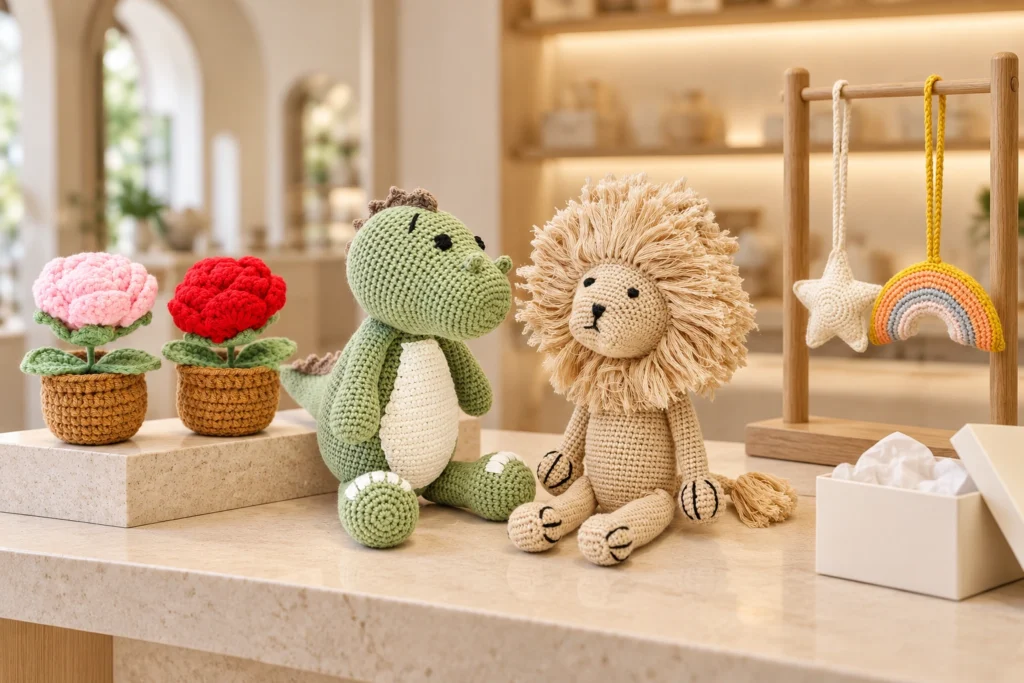
Small crochet products may have projecting ears, soft limbs, long hanging loops or packaging that extends beyond the product itself. These details influence spacing, support and access.
Use representative samples from the intended assortment. Include products that challenge the proposed layout, such as:
- The widest item.
- The tallest packaged product.
- A product that needs support to remain upright.
- A hanging item with a long loop.
- A design with details that are easily hidden.
Record the dimensions in the condition in which the product will be displayed. A loose item and the same item in retail packaging may require different spaces.
For broader assortment planning, see How to Develop a Crochet Product Collection Instead of Isolated SKUs.
Choose a Support Method for Each Product Format
A coordinated assortment does not require every product to use the same support.
Choose the display method according to the product's construction and intended presentation.
| Product format | Display approach to evaluate | Main review points |
|---|---|---|
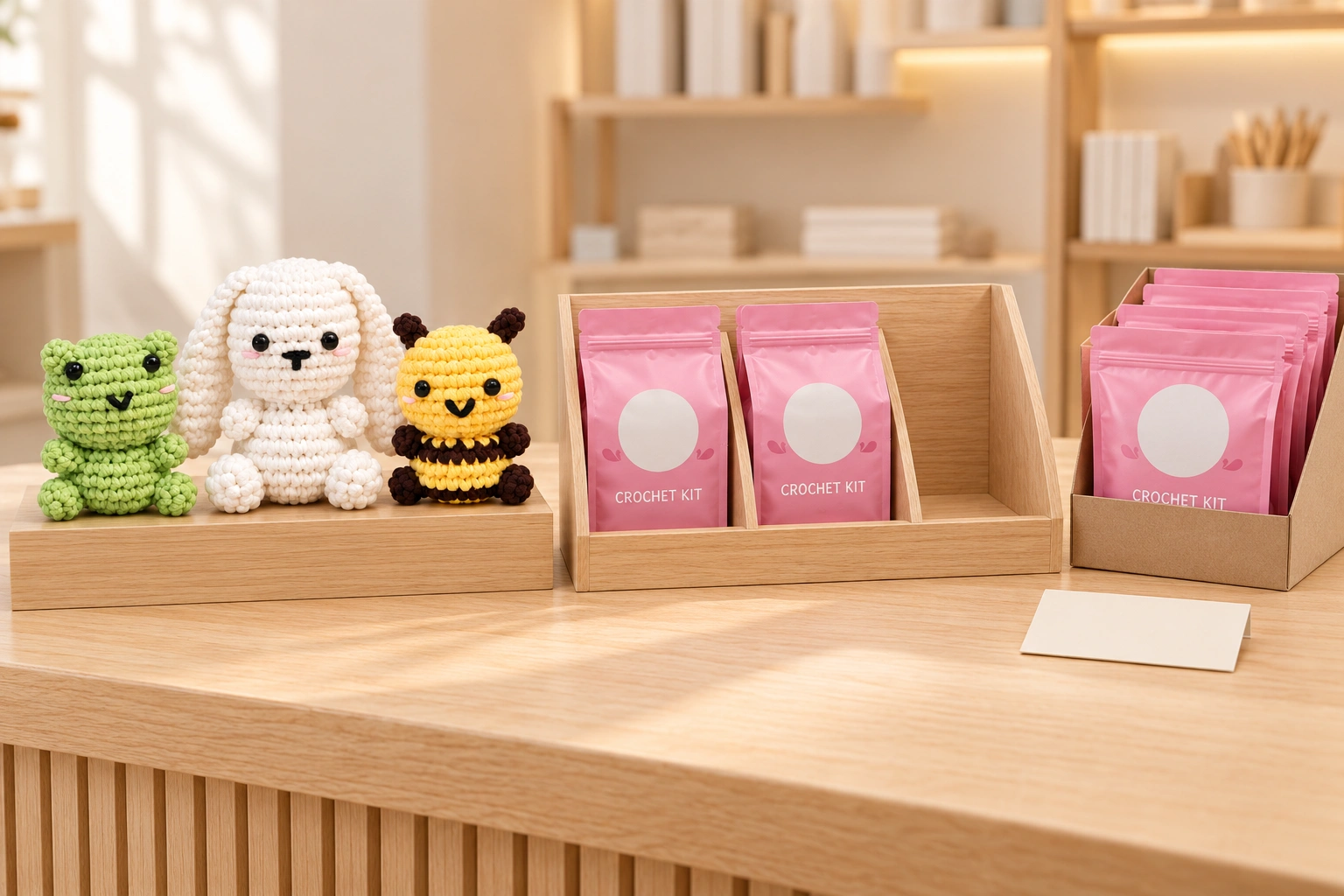
| Small standing or seated figures | Flat shelf, shallow compartment or discreet support | Stable position, visible face and accessible grip |
| Soft products that do not stand independently | Supported shelf, cradle or tray | Natural presentation without distortion |
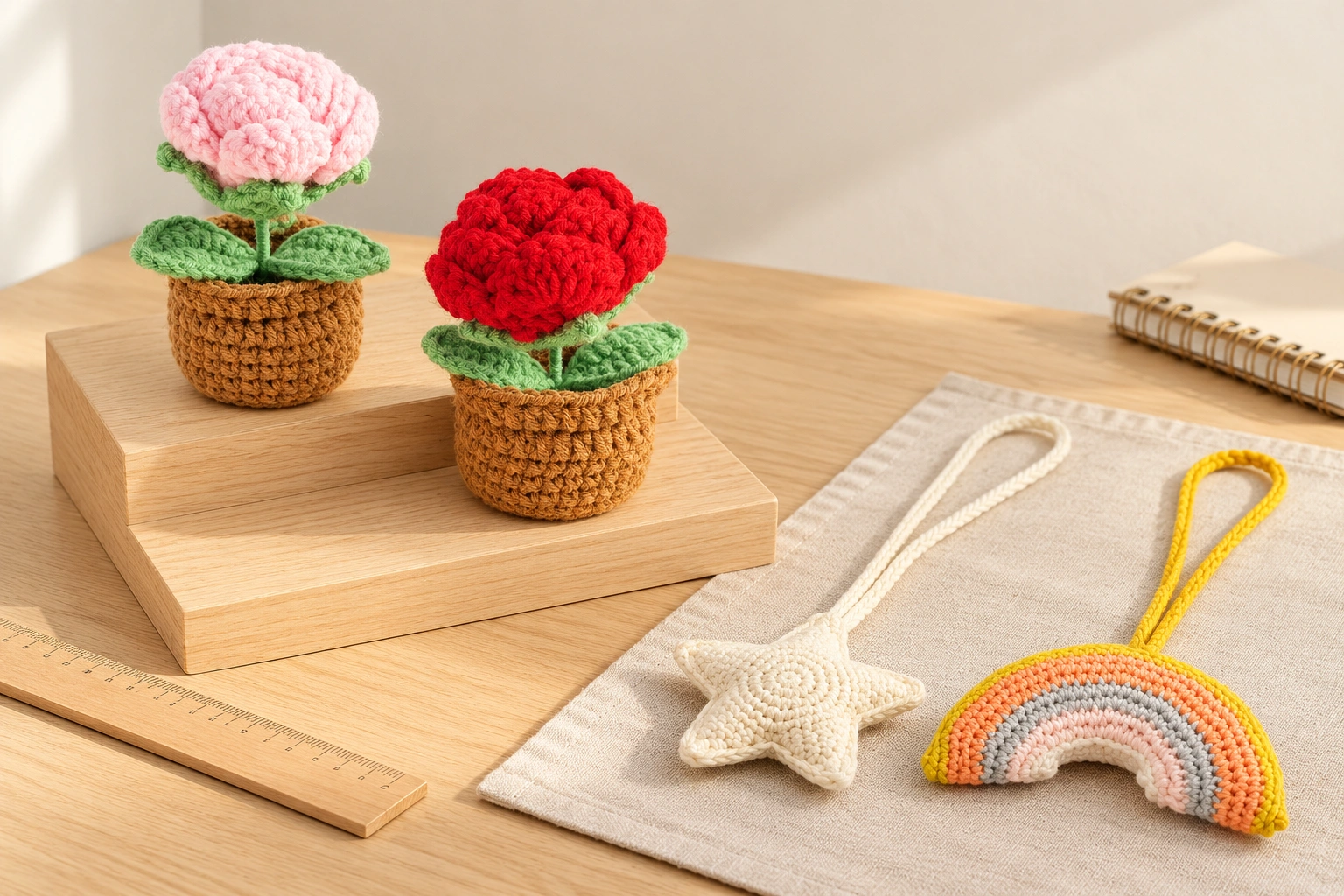
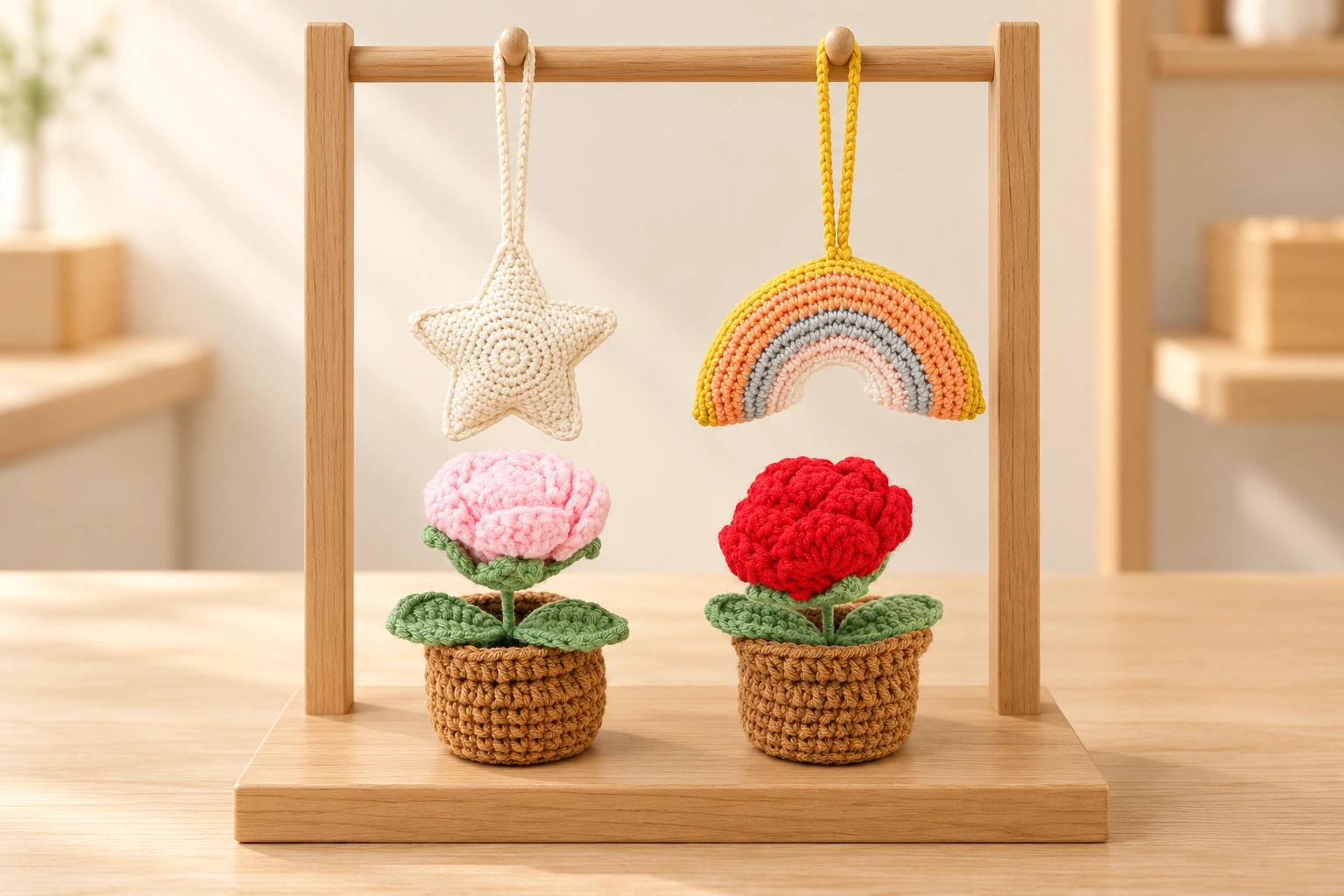
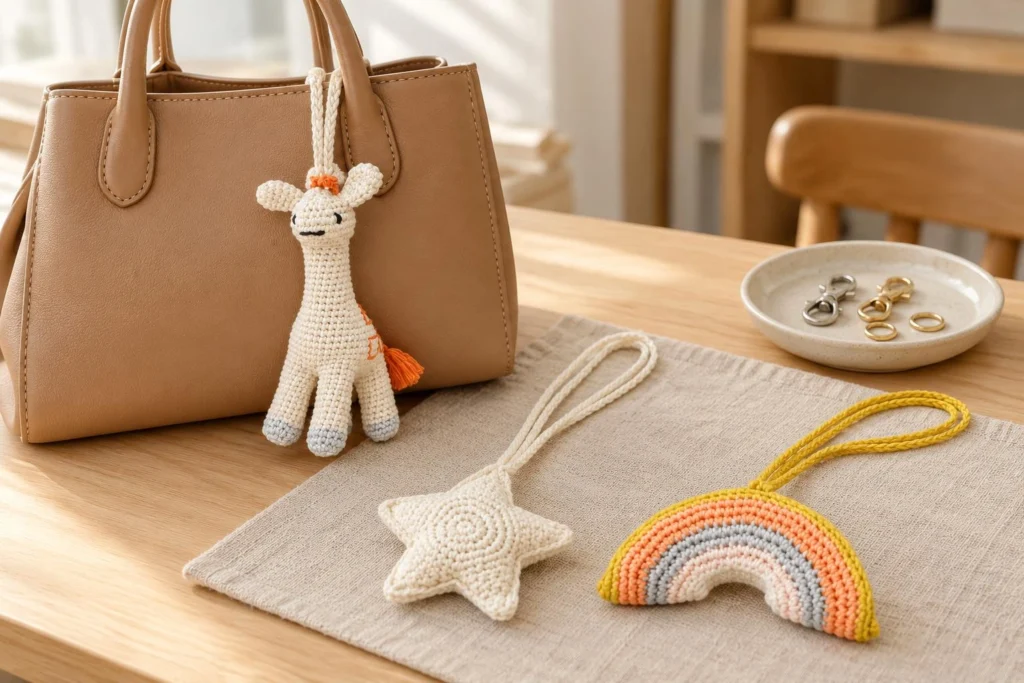
| Hanging ornaments | Peg or rail compatible with the existing loop | Hanging length, separation and removal path |
| Flat crochet items | Shallow tray or supported presentation surface | Design visibility and easy selection |
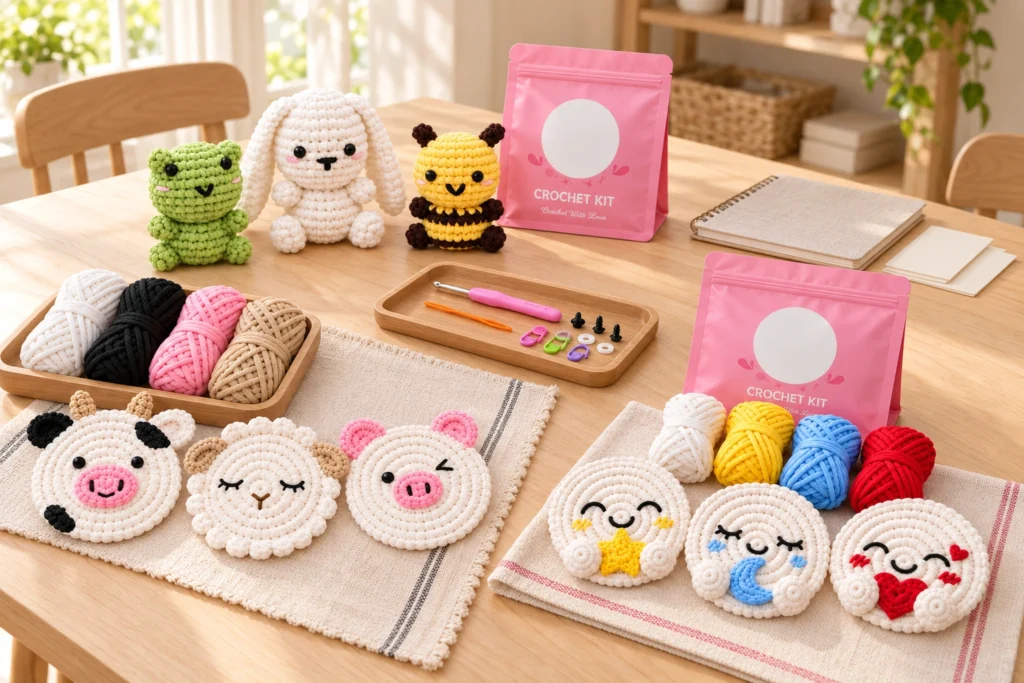
| Packaged kits or gifts | Compartment, shelf or pouch support | Package dimensions, identification and retrieval |
Do not force a soft product into an unsupported standing position simply to match a visual concept. If support is needed, include it in the prototype.
For hanging products, check the full loop and product together. A peg that accommodates the loop may still leave the product touching the shelf below or overlapping another design.
Distinguish Display Capacity From Visual Presentation
The maximum number of products that can fit is not necessarily the quantity that should be displayed.
Define three separate quantities:
- Visible selection: the products customers can clearly see and choose.
- Working display capacity: the quantity that can be held while preserving access and presentation.
- Reserve stock: additional units stored separately for replenishment.
A tightly packed fixture may hold more units but make individual designs harder to distinguish. It can also become difficult to remove one item without disturbing others.
For each shelf, compartment or peg, record:
- Which SKU or product group it holds.
- The proposed quantity.
- The arrangement method.
- Any required spacing.
- The point at which replenishment is needed.
If several products share a compartment, check whether staff and customers can distinguish the variants without emptying it.
Review Visibility From the Customer's Position
Assess the display from the actual viewing directions rather than only from a convenient photography angle.
Check whether faces, colors and distinguishing details remain visible. Look for products hidden behind taller items, hanging loops crossing faces, or packaging that conceals the merchandise.
Review identification at the same time. Where a price or product card is needed, establish its position without covering the product or blocking access.
Use the following questions:
- Can customers recognize the available designs?
- Can they distinguish variants?
- Is it clear which product belongs in each position?
- Do rear products remain visible when the front is full?
- Does the display remain understandable as stock is removed?
A display should be reviewed both fully stocked and partially stocked. The arrangement may change considerably after several products have been selected.
Test Removal, Return and Replenishment
A practical prototype review should reproduce normal retail handling.
Ask someone who did not arrange the display to select a product, remove it and return it. Observe whether the process requires explanation or disturbs adjacent items.
Then ask a staff member to replenish the display from the proposed stock packaging.
Record issues such as:
- Products catching on neighboring items.
- Hanging loops tangling.
- A compartment being too deep for easy access.
- Lightweight supports moving during selection.
- Packaged items needing excessive adjustment.
- Staff needing to dismantle the arrangement to refill it.
Repeat the review with the proposed working quantity and with some positions empty.
Do not describe this handling review as a formal stability or durability test. Any additional performance assessment should have an agreed scope, method and acceptance criteria.
Check the Fixture as a Physical Product
Appearance is only one part of display approval.
Review the prototype on the intended counter surface with the proposed merchandise. Examine its base, joints, shelves, pegs and any separate support pieces.
Confirm:
- The fixture rests steadily in the agreed location.
- Products remain within the intended footprint.
- Contact surfaces do not visibly snag or distort the crochet.
- Display components do not obstruct normal selection.
- Assembly instructions are clear where assembly is required.
- Routine cleaning and product replacement are practical.
The appropriate material and construction depend on the project. Do not assume that a visually similar fixture will perform the same way if its material, thickness, joints or dimensions change.
Plan How Products and Fixtures Will Arrive
Clarify whether the fixture and merchandise will be supplied together, separately or through different suppliers.
A display program may involve a crochet manufacturer, a packaging supplier, a fixture producer and the retailer. Assign responsibility for each part.
Agree:
- Who produces the fixture.
- Who supplies the product samples used for development.
- Who verifies physical fit.
- Whether the fixture arrives assembled or flat-packed.
- Whether products arrive loaded or separately packed.
- Who performs final store setup.
If products arrive separately, provide a clear setup reference identifying positions and quantities. A photograph can help, but it should match the final fixture and approved product versions.
For product packaging decisions, see How to Design Retail-Ready Packaging for Crochet Products.
Approve the Layout and Record Its Limits
Keep an approval package that connects the fixture to the intended assortment.
Useful records include:
- Fixture dimensions and material specification.
- Product and packaging versions used for review.
- SKU positions and working quantities.
- Support and assembly details.
- Photographs from relevant viewing directions.
- Setup and replenishment instructions.
- Any unresolved conditions.
State the limits of the approval. A fixture reviewed with one product range is not automatically suitable for a later assortment with larger packaging or different hanging lengths.
Recheck the affected layout when products, supports or fixture dimensions change.
Define the Product and Display Interface With UMY Crochet
UMY Crochet is a product development and manufacturing partner for crochet, DIY craft kits, knitted toys and creative gifts.
For a countertop program, share the proposed products, counter dimensions, selling method and any fixture concept or supplier drawings. Identify whether merchandise will be displayed loose, hanging or packaged.
The development discussion should establish the product dimensions, presentation requirements and samples needed for a physical fit review. Confirm separately who is responsible for fixture design, manufacture and validation; fixture supply should not be assumed to be included in a crochet product quotation.
Where display requirements affect the product or packaging, resolve those details before final sample approval.
Frequently Asked Questions
Can one display hold several types of crochet gifts?
Yes, if each product has suitable support, visibility and access. Different formats may need separate shelves, trays or hanging positions within the same fixture.
Should a display hold as much stock as possible?
Working capacity should preserve visibility and practical handling. Additional units can be held separately as replenishment stock.
Can the layout be approved from a digital rendering?
Do small crochet figures need individual supports?
Some do and some do not. Review the actual product in its intended position rather than assuming that every figure stands independently.
Should products be shipped already loaded into the display?
That depends on the fixture, merchandise and delivery arrangement. Compare the receiving and setup work for preloaded and separately packed configurations before deciding.
When should the display be reviewed again?
Recheck it when a change affects fit or handling, including product size, packaging, hanging loops, fixture construction or the proposed stock quantity.
Request a Product-to-Display Fit Review
Share your countertop dimensions, product shortlist, packaging format and proposed display layout with UMY Crochet. We can review the product and packaging inputs needed for development and clarify which samples should be checked with your display supplier before the program is approved.
<!--[googlesitekit-end-of-content]-->
 Chinese