
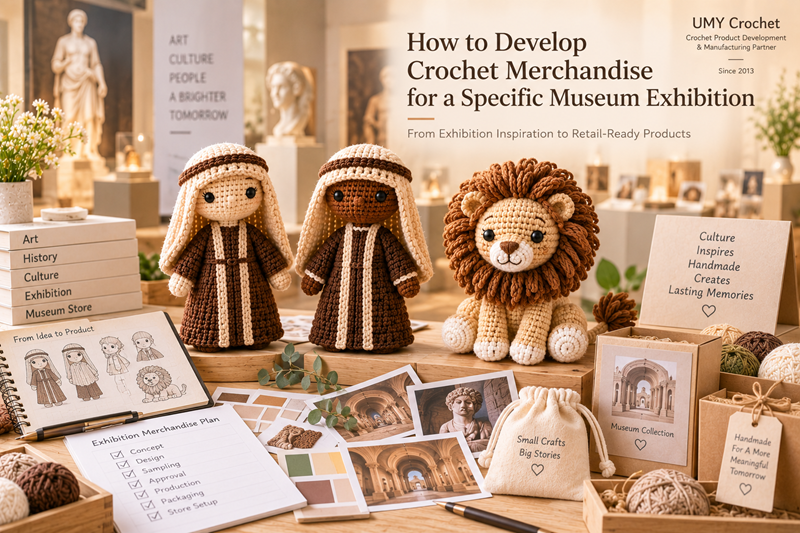
Developing crochet merchandise for a specific museum exhibition should start with the exhibition—not with a catalog of products.
Before deciding whether to make a crochet doll, miniature, ornament, keychain, or gift set, the museum team should identify what visitors are expected to remember from the exhibition, which visual or cultural references can legitimately be translated into merchandise, who is expected to buy it, and when the finished products must reach the museum store.
A practical exhibition-merchandise brief should therefore define:
- The exhibition theme and visitor story
- Approved objects, artworks, characters, symbols, or visual references
- Elements that must remain recognizable or historically accurate
- Intellectual-property and reproduction permissions
- Target visitor and gift recipient
- Intended product formats and retail price positions
- Exhibition opening date and required delivery date
- Estimated quantities and SKU structure
- Packaging and storytelling requirements
- Review and approval responsibilities
For crochet merchandise, these decisions should be made before detailed sampling. Crochet can simplify complex references into tactile, recognizable forms, but not every exhibition element translates equally well into yarn.
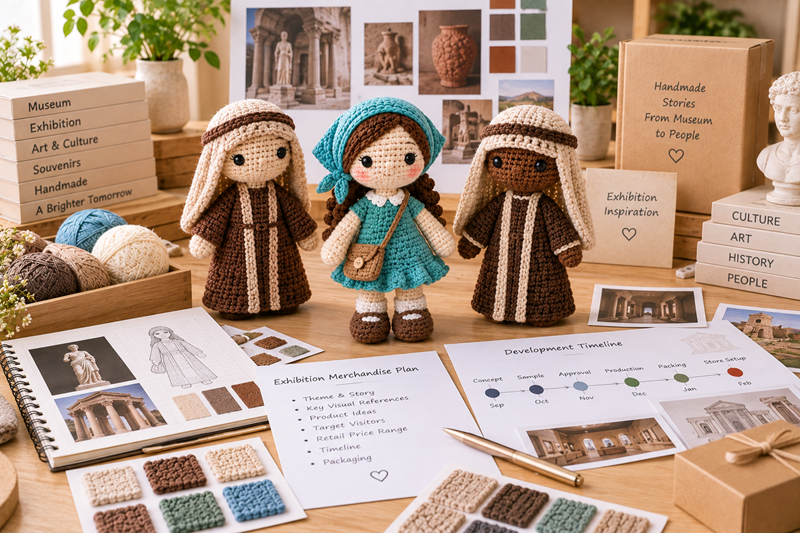
Why Exhibition-Specific Merchandise Requires a Different Development Process
Permanent museum-store merchandise and exhibition-specific merchandise share many purchasing considerations, but their planning constraints are different.
A permanent museum product may have a relatively flexible development calendar and a long selling period.
A temporary exhibition has a fixed commercial window.
That changes the procurement question from:
What crochet products could work for our museum?
to:
What products can communicate this particular exhibition and be ready when visitors arrive?
This introduces four important constraints.
| Constraint | Procurement Question |
|---|---|
| Exhibition relevance | Why does this product belong to this exhibition? |
| Reference accuracy | Which details must remain recognizable or culturally accurate? |
| Development calendar | How much time is available for design, sampling, approval, production, packing, and delivery? |
| Retail window | Can the assortment sell effectively during the exhibition period? |
A beautiful product that arrives after the exhibition opens may lose much of its commercial value.
Likewise, a product delivered on time but only weakly connected to the exhibition may feel like generic museum merchandise.
The development process therefore needs to manage meaning, manufacturability, retail practicality, and timing at the same time.
For broader museum-store buying criteria, see How Museum Stores Choose Handmade Souvenirs.
Step 1: Define the Exhibition Story Before Choosing Products
Start by reducing the exhibition to a clear merchandise brief.
This does not mean simplifying the scholarship behind the exhibition. It means identifying which parts of that story can realistically become physical retail products.
Ask:
- What is the exhibition fundamentally about?
- Which objects or images are likely to be visually memorable?
- Are there recurring characters, animals, costumes, shapes, colors, or motifs?
- Are there specific objects visitors are likely to recognize after seeing the exhibition?
- Which references are suitable for commercial reproduction?
- Which references should not be adapted into merchandise?
- Is the desired product educational, decorative, collectible, giftable, playful, or a combination?
The answers create the foundation for product development.
Build a Reference Hierarchy
Not every exhibition reference deserves equal importance.
A useful hierarchy is:
Primary reference
The main object, character, artwork, historical figure, animal, or motif that gives the product its identity.
Recognition details
Colors, clothing, silhouette, markings, accessories, shapes, or other elements required for recognition.
Supporting story details
Elements that enrich the product but are not essential to immediate recognition.
Optional decorative details
Features that may be simplified or removed if they make the crochet product unnecessarily complex.
This hierarchy becomes especially important during sampling.
When a complicated visual reference is translated into crochet, some simplification is usually unavoidable. The team needs to know which details can change and which cannot.
Step 2: Confirm Rights and Usage Boundaries Before Development
An exhibition may contain material controlled by different rights holders.
Depending on the project, relevant materials can include:
- Artwork
- Illustrations
- Photographs
- Character designs
- Logos
- Artist estates
- Licensed properties
- Archival materials
- Contemporary designs
- Exhibition graphics
A museum's ability to display an object does not automatically establish every possible merchandise reproduction right.
Before sending protected visual assets to a manufacturer, the responsible organization should determine what it is authorized to reproduce and what contractual restrictions apply.
The development brief should clarify practical questions such as:
- Which references are approved for product development?
- Can the reference be adapted into a three-dimensional crochet form?
- Can colors or proportions be modified?
- Can the product be sold outside the physical exhibition?
- Are there territory or time restrictions?
- Who approves the sample?
- Are specific credits required on the product or packaging?
- Can the manufacturer photograph or publicly display the finished product?
These questions involve project-specific contractual and legal considerations. Museums and rights holders should obtain appropriate professional advice where necessary.
For a broader discussion of design ownership and confidentiality, see How to Protect Your Crochet Design and Intellectual Property.
Step 3: Choose References That Translate Well Into Crochet
Crochet is a three-dimensional textile medium.
A reference that works beautifully on an exhibition poster may not automatically work as a crochet product.
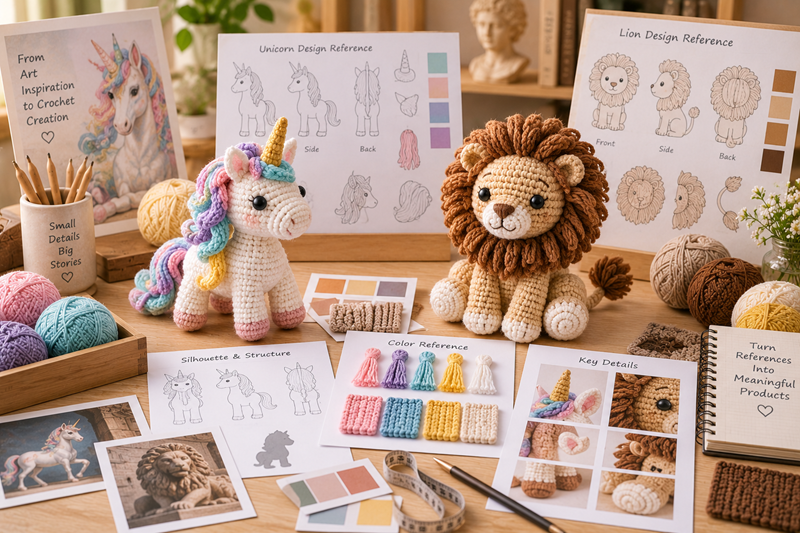
Before sampling, evaluate the reference for:
Silhouette
Can visitors recognize the subject from its overall shape?
A strong silhouette is particularly useful for:
- Characters
- Animals
- Historical costumes
- Architectural forms
- Distinctive objects
Color Blocking
Crochet generally communicates clear areas of color more easily than extremely subtle gradients or photographic effects.
Identify which colors are essential to recognition.
Three-Dimensional Structure
Ask how a two-dimensional reference will behave as a physical object.
A manufacturer may need to interpret:
- Front and back views
- Thickness
- Limb position
- Accessories
- Clothing layers
- Structural support
- Attachment methods
Detail Scale
A detail that is visible on a large artwork may become impractical on a small crochet souvenir.
Smaller products usually require more disciplined simplification.
Material Compatibility
Some visual effects may be represented through:
- Yarn color
- Crochet stitch structure
- Embroidery
- Separate crochet components
- Fabric details
- Approved accessories
The goal should be to preserve the reference's recognition system, not mechanically reproduce every visual detail.
Step 4: Decide What Role the Product Plays in the Exhibition Shop
Do not treat every SKU as the same type of souvenir.
An exhibition assortment may need different commercial roles.
Hero Product
The product with the strongest visual connection to the exhibition.
This might be a larger crochet character or distinctive object.
Its purpose is often to attract attention and communicate the exhibition theme immediately.
Accessible Souvenir
A smaller or simpler product designed for visitors who want an easy-to-carry reminder of the exhibition.
Possible formats include:
- Mini crochet characters
- Keychains
- Hanging ornaments
- Small decorative items
Gift Product
A product designed for someone other than the visitor.
Presentation and packaging become especially important here.
Collectible Product
If the exhibition contains multiple characters, objects, species, historical references, or themes, several related crochet products may form a small collection.
Premium Product
A more detailed product, larger format, or enhanced gift presentation may serve customers looking for a higher-value purchase.
The museum does not necessarily need all five roles.
The point is to give each proposed SKU a reason to exist.
Step 5: Build a Focused SKU Architecture
Exhibition teams can easily generate too many merchandise ideas.
Every additional crochet SKU creates additional work in:
- Design interpretation
- Sampling
- Revision
- Approval
- Material preparation
- Production
- Quality control
- Packaging
- Inventory management
For a time-bound exhibition, a smaller coordinated assortment may be more manageable than a large collection of unrelated products.
One possible architecture is:
| SKU Role | Example Format | Main Purpose |
|---|---|---|
| Hero | Standard crochet figure | Strong exhibition recognition |
| Entry | Mini figure or keychain | Accessible souvenir |
| Secondary | Different exhibition reference | Assortment variety |
| Gift | Product with story card or gift packaging | Giftability |
| Limited | Special variation | Exhibition-specific collectibility |
The exact structure should depend on the exhibition, audience, retail environment, budget, and expected demand.
There is no universal ideal SKU count.
Step 6: Set Retail and Cost Boundaries Before Sampling
One common development mistake is to create the ideal product first and discuss commercial targets later.
For exhibition merchandise, the reverse is usually more useful.
Before detailed sampling, define:
- Target retail position
- Target procurement-cost range
- Product size
- Expected packaging level
- Estimated quantity
- Required labeling
- Sales channel
- Market destination
These constraints affect product construction.
For example, a design with many separate components, elaborate clothing, complex embroidery, or multiple accessories may require substantially more manual work than a simplified version.
Use a Cost-versus-Recognition Test
When simplifying a concept, ask:
If we remove this detail, does the product become less recognizable or merely less complicated?
Protect the features that carry exhibition meaning.
Simplify features that add labor without adding enough recognition, storytelling, or retail value.
Step 7: Work Backward From the Exhibition Opening Date
The exhibition opening date is not the merchandise delivery date.
Products need to arrive early enough for:
- Receiving
- Inventory processing
- Merchandising
- Staff preparation
- Photography if required
- E-commerce setup if applicable
- Retail display installation
Build the project calendar backward.
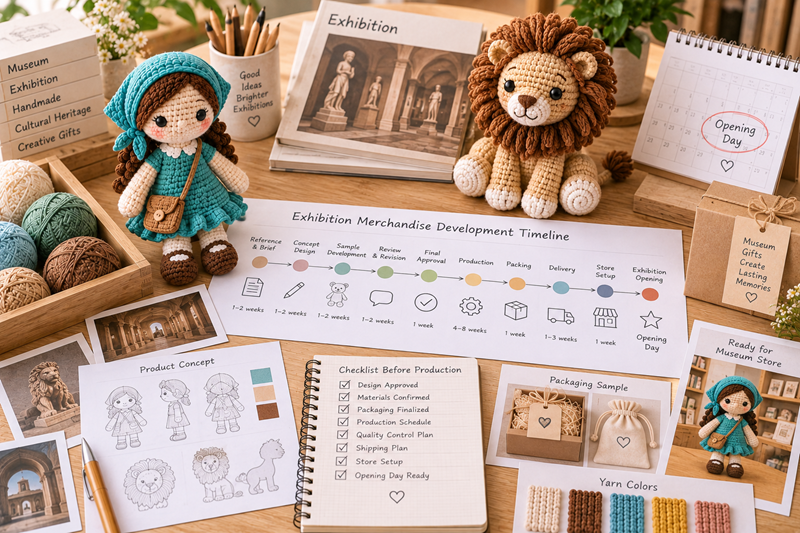
A practical sequence may include:
- Exhibition merchandise brief completed
- Rights and references confirmed
- Initial product concepts selected
- Manufacturer feasibility review
- Sample development
- Internal museum review
- Curatorial or rights-holder review where required
- Sample revisions
- Final sample approval
- Packaging approval
- Production
- Quality control
- Packing
- Transportation
- Museum receiving and merchandising
- Exhibition opening
Do not assume every project needs the same amount of time.
Protect Approval Time
Museum projects may involve more stakeholders than ordinary retail development.
Potential reviewers can include:
- Curatorial teams
- Retail buyers
- Exhibition teams
- Brand teams
- Education teams
- Rights holders
- Licensing partners
- External artists or designers
If several parties must approve a sample, approval time needs to be built into the calendar explicitly.
Step 8: Create a Sample Approval Standard
Sample feedback should identify measurable or visible changes.
Review the sample against a structured checklist.
Visual Accuracy
Check:
- Overall silhouette
- Main proportions
- Color placement
- Face or focal features
- Clothing
- Accessories
- Embroidery
- Important cultural or exhibition-specific details
Physical Construction
Check:
- Size
- Shape
- Stability
- Component attachment
- Filling
- Stitch appearance
- Material feel
Retail Suitability
Check:
- Display orientation
- Packaging fit
- Hangtag position
- Barcode or label space where required
- Story-card compatibility
- Giftability
- Shelf or hanging presentation
Exhibition Relevance
Finally ask:
If a visitor saw this product without the packaging, would the intended connection to the exhibition still be understandable?
If the answer is no, decide whether the problem belongs in the product design or in the storytelling system.
Step 9: Design Packaging as Part of the Exhibition Experience
Exhibition packaging should do more than contain the crochet product.
It can connect the retail object back to what the visitor has just seen.
Depending on the product and rights available, packaging may communicate:
- Product name
- Exhibition connection
- Short story
- Historical or cultural context
- Character information
- Artwork or object reference
- Museum branding
- Required credits
- Care information
- Required product information
The product and packaging should work together.
For practical packaging planning, see How to Design Retail-Ready Packaging for Crochet Products.
Step 10: Plan for Cultural and Historical Review
When merchandise draws from cultural heritage, historical clothing, traditional motifs, religious references, communities, or culturally significant objects, visual attractiveness is not the only consideration.
The development team should identify:
- Which details carry cultural meaning
- Which details may be simplified
- Which should not be altered
- Whether specialist or stakeholder review is needed
- Whether explanatory context should accompany the product
If a color, symbol, garment, or accessory has a specific meaning, treat it as information—not generic ornamentation.
For a broader framework, see How to Develop Culturally Relevant Crochet Gift Collections for Retail.
Step 11: Decide Whether the Merchandise Ends With the Exhibition
A temporary exhibition creates an additional inventory question:
What happens to remaining merchandise when the exhibition closes?
Before placing the order, clarify whether the products can continue to be sold:
- In the permanent museum store
- Through the museum's online store
- At another venue
- During a touring exhibition
- Through an authorized partner
- Not at all after a defined date
Rights agreements and project terms may affect these options.
This matters when deciding order quantities.
An exhibition-specific product with a narrow selling window creates different inventory risk from a product that can become part of the museum's permanent assortment.
Separate Evergreen and Exhibition-Limited Elements
Where appropriate and permitted, teams can consider whether some components are exhibition-specific while others have longer-term relevance.
For example:
- Product design may be exhibition-specific
- Story card may carry exhibition dates
- Outer packaging may carry exhibition graphics
- A related permanent SKU may use a broader museum story
This should be planned deliberately rather than decided after unsold stock remains.
What Should Be in the Manufacturer Brief?
By the time a museum approaches detailed crochet sampling, the manufacturer should ideally receive a consolidated brief.
| Brief Section | Information to Provide |
|---|---|
| Exhibition | Theme, opening date, retail context |
| Product reference | Approved artwork, object, character, motif, or visual source |
| Priority details | Features that must remain recognizable |
| Views | Front, side, back, and detail references where available |
| Colors | Approved color references where required |
| Size | Target dimensions and proportion priorities |
| Format | Doll, mini product, keychain, ornament, gift item, etc. |
| Materials | Required or prohibited materials if applicable |
| Components | Clothing, accessories, embroidery, attachments |
| Packaging | Box, pouch, hangtag, story card, labels |
| Quantity | Estimated quantity by SKU |
| Market | Intended country or region of sale |
| [Compliance | Applicable requirements identified by the buyer/project team](https://history.iowa.gov/media/34/download?inline) |
| Approval | Who reviews and approves samples |
| Timeline | Sample deadline, approval deadline, production/delivery requirement |
| Rights | Relevant restrictions on reproduction, photography, branding, or use |
How UMY Crochet Can Support Exhibition Merchandise Development
UMY's role in an exhibition project is best understood as a Crochet Product Development & Manufacturing Partner.
Once a museum, cultural institution, licensed merchandise company, or appointed buyer provides the relevant project references and commercial requirements, development can focus on translating those inputs into a manufacturable crochet product.
Depending on the project, that process may include:
Reference Review
Reviewing the supplied artwork, object references, character materials, colors, dimensions, and required visual features.
Crochet Interpretation
Determining how the reference can be represented through crochet construction, yarn, embroidery, proportions, accessories, and other approved components.
Sampling and Revision
Creating a physical sample for review and adjusting defined features according to feedback.
Product Standardization
After approval, establishing the accepted product reference so that production has a consistent target.
Packaging Coordination
Production and Quality Control
Producing against the approved reference and checking the agreed product characteristics during manufacturing.
The museum or rights holder remains responsible for supplying or approving the content, references, claims, and rights required for its project.
UMY's manufacturing role is to help turn those approved inputs into a practical crochet product.
For an existing museum-development example in our content library, see How a Museum Gift Shop Developed a Crochet Souvenir Collection.
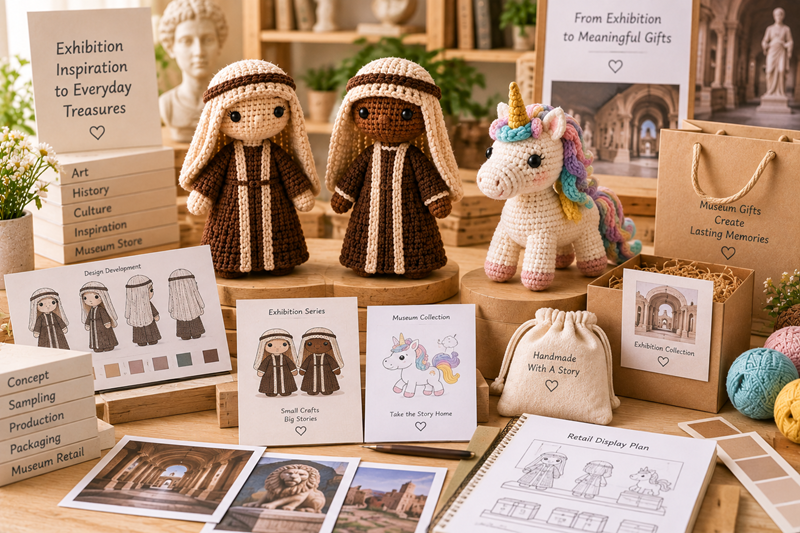
Exhibition Crochet Merchandise Development Checklist
Before approving production, confirm that the project team can answer the following.
Exhibition Connection
- [ ] The product has a clear reason to belong to this exhibition.
- [ ] The primary visual or cultural reference is identified.
- [ ] Recognition-critical details are documented.
- [ ] Unnecessary decorative additions have been avoided.
Rights and Approval
- [ ] Relevant reproduction and merchandise permissions have been addressed.
- [ ] Approved reference materials are clearly identified.
- [ ] Sample approvers are known.
- [ ] Any required credits or restrictions are documented.
Product
- [ ] Product format has a defined retail role.
- [ ] Target size is confirmed.
- [ ] Colors and materials are defined where necessary.
- [ ] Accessories and components are listed.
- [ ] Product complexity is compatible with commercial targets.
Retail
- [ ] Target visitor or buyer is defined.
- [ ] Target retail position has been considered.
- [ ] SKU roles are clear.
- [ ] Packaging format is defined.
- [ ] Storytelling content has an owner and approval process.
Timing
- [ ] Exhibition opening date is confirmed.
- [ ] Required warehouse/store arrival date is confirmed.
- [ ] Sampling and revision time is included.
- [ ] Stakeholder approval time is included.
- [ ] Production, packing, and transportation are included.
- [ ] Store setup time is protected.
Post-Exhibition
- [ ] The permitted sales period is understood.
- [ ] Remaining-stock options have been considered.
- [ ] Touring or online sales requirements are known where applicable.
Common Mistakes to Avoid
Starting With a Generic Product Catalog
Selecting a generic crochet item and adding exhibition branding may be fast, but it does not automatically create exhibition relevance.
Start with the exhibition reference and visitor story.
Waiting Too Long to Discuss the Opening Date
The opening date should influence development from the beginning.
A late timeline can force rushed approvals, reduced product choices, or unnecessary logistics pressure.
Sending Only One Visual Reference
A single front image may leave unanswered questions about sides, back, accessories, construction, or hidden details.
Provide the best available reference set.
Treating Every Detail as Equally Important
Trying to reproduce everything can make a small crochet product complicated without improving recognition.
Prioritize the details visitors actually need to recognize the subject.
Adding Cultural Details Without Evidence
Do not fill visual gaps with invented "traditional" decoration.
When information is uncertain, seek an approved reference rather than improvising.
Leaving Packaging Until Production Is Nearly Finished
Packaging affects product dimensions, labels, presentation, storytelling, packing, and sometimes cost.
Develop it alongside the product.
Ordering Without a Post-Exhibition Plan
A short retail window can turn excess stock into a larger problem than it would be for evergreen merchandise.
Understand the permitted selling period before finalizing quantities.
Frequently Asked Questions
What types of crochet products work for a museum exhibition?
Possible formats include crochet figures, miniatures, keychains, hanging products, ornaments, gift sets, and other custom forms. The appropriate format depends on the exhibition reference, audience, retail position, portability, design complexity, and commercial requirements.
Should an exhibition product copy an artwork exactly?
Not necessarily. Crochet is a different medium, so adaptation may be required. The project team should identify which features must remain recognizable and which can be simplified. Any adaptation must also stay within the rights and approvals applicable to the project.
When should merchandise development begin?
Work backward from the required store-arrival date rather than only from the exhibition opening date. Allow time for reference approval, feasibility review, sampling, stakeholder feedback, revisions, final approval, packaging, production, quality control, packing, transportation, receiving, and merchandising.
How many crochet SKUs should an exhibition launch?
There is no universal number. A focused assortment with clearly differentiated SKU roles can be easier to develop and manage than a large assortment. Quantity and SKU count should reflect expected demand, retail space, budget, development capacity, selling period, and inventory risk.
Can one exhibition reference become several crochet products?
Yes, when the reference remains recognizable across formats. A primary character or object might potentially be developed as a standard figure, miniature, keychain, or gift presentation. Smaller formats may require proportion and detail changes.
Can the same merchandise continue selling after the exhibition closes?
That depends on the product concept, rights, licensing terms, exhibition agreements, and the museum's retail strategy. The permitted sales period and channels should be clarified before ordering.
What should museums send a crochet manufacturer first?
A useful starting package includes the exhibition context, approved visual references, recognition-critical details, target product format and size, commercial targets, quantity estimate, packaging needs, intended market, approval structure, and required timeline.
Final Takeaway
The most effective exhibition merchandise is not simply a museum product with an exhibition label attached.
It is developed backward from a specific visitor experience.
A strong process connects:
Exhibition story
↓
Approved reference
↓
Recognition priorities
↓
Crochet product format
↓
Commercial boundaries
↓
Sample and stakeholder approval
↓
Packaging and storytelling
↓
Production and quality control
↓
Store arrival before opening
For museum buyers, the central procurement question is therefore not just:
Can this reference be made in crochet?
It is:
Can this reference become a recognizable, appropriate, commercially workable crochet product within the exhibition's approval and retail timeline?
When that question is answered early, the development team has a much clearer basis for making decisions about design, cost, sampling, quantity, packaging, and production.
Planning crochet merchandise for an upcoming exhibition? Prepare the exhibition reference package, target product format, approximate quantity, intended market, packaging needs, and required delivery date before beginning detailed sampling. A structured brief gives both the museum team and the manufacturing partner a clearer path from exhibition concept to retail-ready product.
 Chinese