
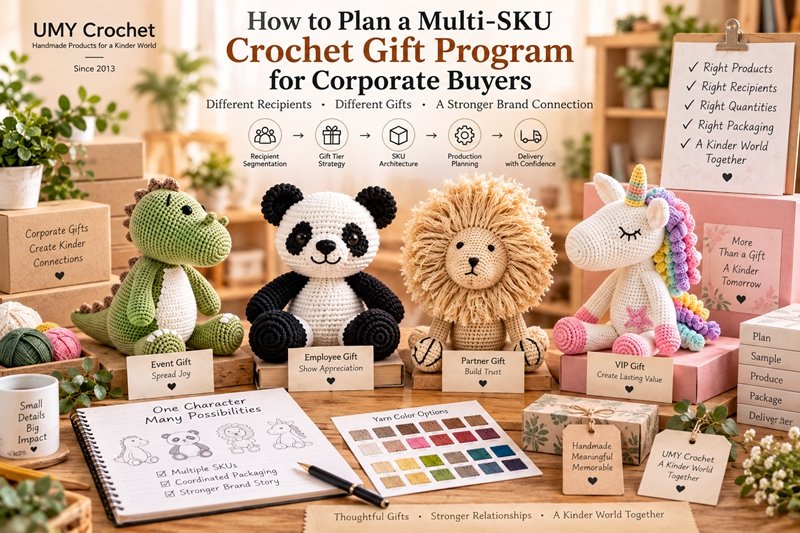
A multi-SKU corporate crochet gift program should not begin by choosing several attractive products and putting them into different boxes. It should begin by defining recipient groups, gifting occasions, budget levels, product roles, quantity requirements, packaging systems, and delivery priorities.
A practical structure is:
Corporate Objective → Recipient Segmentation → Gift Tiers → SKU Architecture → Shared Design Language → Sampling → Quantity Allocation → Packaging → Production Standards → Fulfillment
For example, one corporate program might include:
- A compact crochet item for event attendees
- A standard character for employees
- A gift-box version for customers
- A premium gift set for VIP partners
The products do not need to be identical, and their quantities do not need to be equal. What matters is that every SKU has a clear reason to exist.
This is the key difference between ordering several promotional products and building a coordinated corporate gift program.
For procurement teams, the most useful planning question is therefore:
Which recipients need which gift experience, and how can those different products be developed as one manageable manufacturing program?
Answering that question early helps buyers control assortment complexity, sampling, MOQ, packaging, quality standards, inventory, and deadline risk.
Multi-SKU Corporate Gifting Is an Assortment Problem
A single corporate gift project is relatively straightforward.
There may be:
One Product + One Recipient Group + One Packaging Format
A multi-SKU program introduces additional variables.
There may be:
- Several recipient groups
- Several product formats
- Several budget levels
- Several packaging configurations
- Different quantities by SKU
- Different distribution destinations
- Different gifting occasions
The procurement problem therefore changes.
Instead of asking:
“What crochet gift should we order?”
the buyer should ask:
“What assortment gives each recipient group an appropriate gift without creating unnecessary operational complexity?”
This shift is important because adding SKUs is easy during brainstorming.
Managing them during sampling, production, packaging, QC, and distribution is much harder.
1. Start With Recipient Segmentation
The first spreadsheet in a multi-SKU gift program should not necessarily be a product list.
It can be a recipient matrix.
Corporate programs may serve:
- Employees
- New hires
- Long-service employees
- Customers
- Loyalty members
- Distributors
- Business partners
- Event attendees
- VIP clients
- Community participants
These groups do not necessarily need the same gift.
For example, a product designed for thousands of event attendees may prioritize compactness and straightforward distribution.
A product for a smaller VIP group may prioritize presentation and perceived value.
An employee anniversary gift may need stronger storytelling around appreciation and belonging.
The recipient should therefore determine the product tier.
2. Define the Purpose of Each Gift Tier
Recipient segmentation alone is not enough.
The buyer also needs to define what the gift should communicate.
Possible objectives include:
- Appreciation
- Welcome
- Celebration
- Recognition
- Brand awareness
- Customer loyalty
- Partnership
- Event participation
- Holiday connection
- Company milestone
Consider two employee programs.
One is for onboarding.
The other is for a ten-year service anniversary.
Both recipients are employees, but the emotional purpose is different.
The product, message card, packaging, and perceived value may therefore need to be different.
A useful planning formula is:
Recipient + Occasion + Message = Gift Role
Only after that should the buyer select the physical SKU.
3. Build Gift Tiers Before Choosing Individual Products
Once recipient groups and objectives are clear, buyers can build a tier structure.
For example:
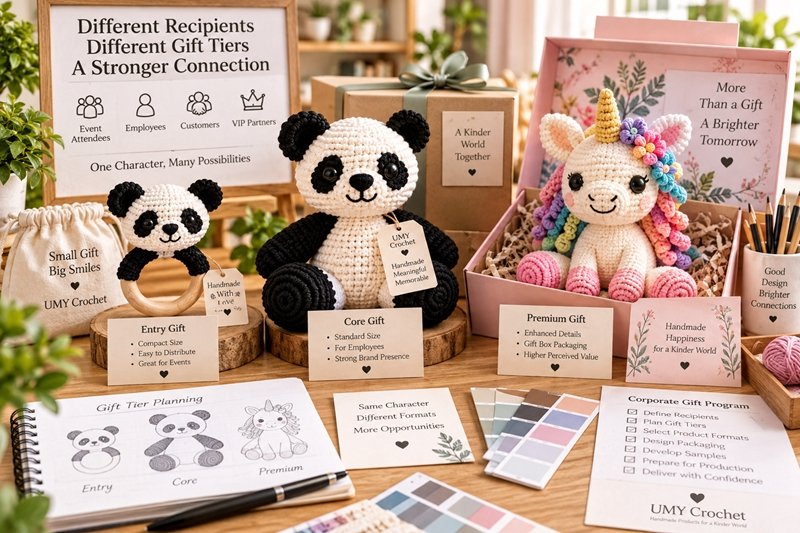
| Gift Tier | Possible Recipient | Possible Crochet Format | Main Role |
|---|---|---|---|
| Entry | Event attendees | Compact crochet product | Broad distribution |
| Core | Employees or customers | Standard crochet character | Main program gift |
| Premium | Key customers or partners | Character with enhanced packaging | Higher perceived value |
| VIP | Selected partners or executives | Coordinated gift set | Complete gifting experience |
| Special Edition | Anniversary or campaign group | Controlled character variation | Occasion-specific recognition |
This is a framework rather than a universal formula.
A company may need only two tiers.
Another may need four.
The objective is not to maximize the number of gift levels.
It is to make the differences between them intentional.
4. Give Every SKU a Job
A strong multi-SKU program should be explainable without referring only to appearance.
For every SKU, the procurement team should be able to state:
- Who receives it
- Why they receive it
- When they receive it
- What price or budget role it serves
- How it differs from other SKUs
- What packaging it requires
- Approximately how many units are needed
If two products serve the same:
- Recipient
- Occasion
- Budget
- Distribution method
- Brand message
the buyer should question whether both are necessary.
Avoid Assortment Inflation
During creative development, teams may request:
- Three character colors
- Two sizes
- Two packaging styles
- A seasonal version
That can quickly turn one idea into twelve combinations.
Each combination may create additional requirements for:
- Sampling
- Specifications
- Materials
- Packaging
- QC
- Inventory
More choice is not automatically a better corporate program.
A focused assortment is often easier to execute consistently.
5. Use One Creative System Across Multiple Gift Levels
Different gift tiers should not feel like unrelated purchasing decisions.
A shared creative system can connect them.
For a character-based program, common elements may include:
- Character identity
- Brand-approved colors
- Facial style
- Signature accessory
- Message
- Packaging graphics
- Story-card design
The physical products can then change by tier.
For example:
Core Character
↓
Compact Interpretation
↓
Gift-Box Edition
↓
Premium Gift Set
This creates hierarchy while maintaining recognition.
The recipient receiving the entry product and the recipient receiving the premium set should still understand that both belong to the same corporate program.
6. Do Not Create Premium Tiers by Adding Random Products
A common gift-set mistake is assuming that premium means:
More Items = More Value
This can lead to boxes filled with unrelated merchandise.
A stronger premium tier has a clear concept.
For example:
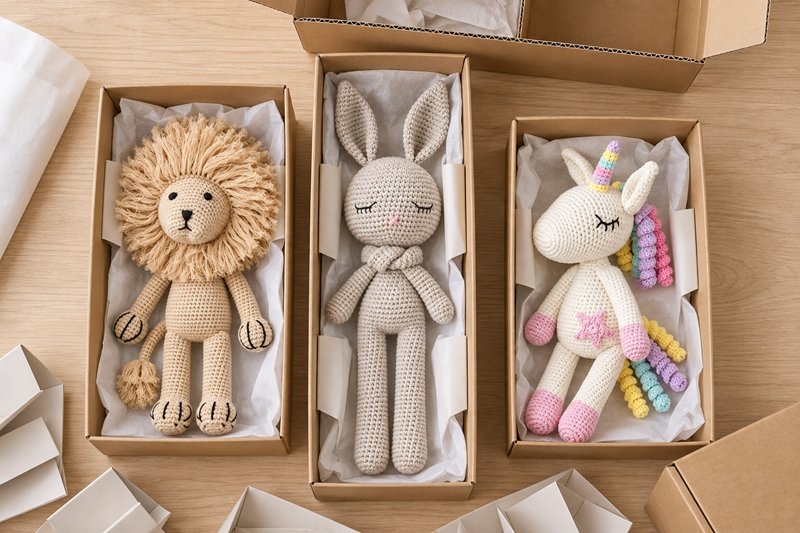
Crochet Character + Message Card + Coordinated Pouch + Gift Box
can feel more intentional than:
Crochet Character + Random Office Item + Unrelated Accessory + Generic Packaging
The crochet item can act as the emotional centerpiece.
Other components should reinforce:
- The occasion
- The recipient
- The brand story
- The intended use
[The result should feel like one gift, not several procurement items sharing a box.](How to Choose the Right Crochet Product Format for a Brand Character)
7. Separate Product Complexity From Perceived Value
Corporate procurement teams frequently work within fixed budgets.
That makes cost engineering necessary.
But perceived gift value does not come only from product complexity.
Recipients also experience:
- Presentation
- Story
- Personal relevance
- Exclusivity
- Packaging
- Unboxing
This creates several ways to differentiate tiers.
Product-Level Differentiation
Change:
- Size
- Detail
- Accessories
- Product format
Packaging-Level Differentiation
Change:
- Hangtag
- Pouch
- Sleeve
- Gift box
- Insert
Story-Level Differentiation
Change:
- Message card
- Occasion-specific content
- Recipient-specific message
A premium gift may therefore use a relatively straightforward crochet character but create greater perceived value through thoughtful packaging and presentation.
Premium should describe the recipient experience, not merely the component count.
8. Plan Quantity by SKU Instead of Dividing the Order Equally
Multi-SKU programs rarely need equal quantities of every product.
Suppose a company has:
- 2,000 event attendees
- 800 employees
- 200 important customers
- 50 VIP partners
An equal four-way product split would not reflect the recipient structure.
Instead, quantity planning should begin with:
Recipient Count
plus
Distribution Allowance
plus
Project-Specific Buffer
where appropriate.
The resulting SKU mix may be heavily weighted toward the entry and core tiers.
The premium and VIP products may represent much smaller portions of the overall program.
This matters because quantity affects:
- Product-format decisions
- MOQ feasibility
- Material planning
- Packaging
- Production scheduling
The quantity architecture should therefore be discussed before every proposed SKU enters detailed sampling.
9. MOQ Applies to the SKU Architecture, Not Just the Total Program
A buyer may say:
“Our total program is 3,000 pieces.”
But manufacturing feasibility depends on how those 3,000 pieces are divided.
For example:
- 1,500 units of Product A
- 800 units of Product B
- 500 units of Product C
- 200 units of Product D
is very different from:
- 300 units each across ten different custom products
even though both total 3,000 pieces.
For UMY custom handmade crochet projects, the typical MOQ is around 500 pieces per style.
Simpler designs may sometimes be evaluated from approximately 300 pieces per style, depending on the actual project.
Ready-stock products typically have much lower quantities, often around 10–50 pieces per style, subject to stock availability.
This means corporate buyers should discuss MOQ per SKU, not only the combined program quantity.
10. Decide Where Custom and Ready-Stock Products Belong
Not every corporate gift program requires every component to be fully custom.
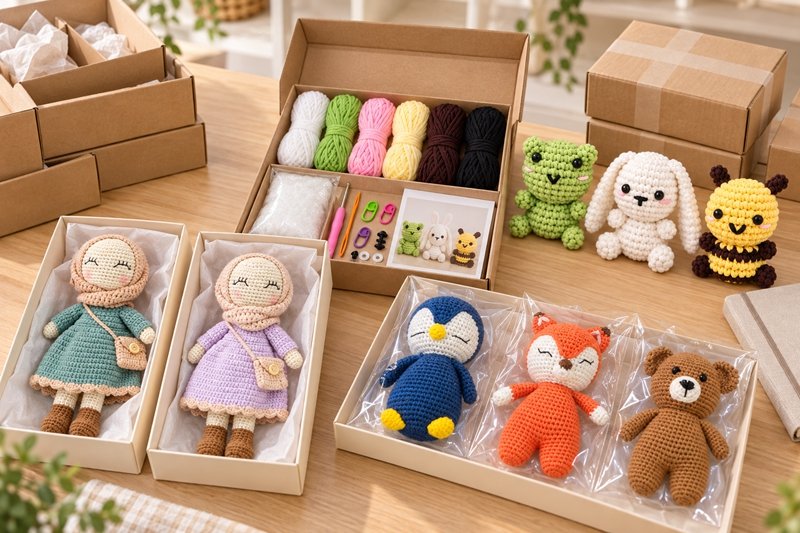
A buyer may potentially combine:
- Custom hero product
- Custom packaging
- Ready-stock supporting products
or use existing structures as a starting point where appropriate.
The decision should depend on the program.
Full Custom May Be Appropriate When:
- The company's own character is central
- Brand recognition is important
- The occasion requires exclusivity
- The product needs distinctive construction
Existing Products May Be Useful When:
- Quantities are small
- Timing is limited
- The product is a supporting gift component
- Full character customization is unnecessary
The buyer should not treat these as competing sourcing philosophies.
They are tools that can potentially be used at different levels of the same gifting strategy.## 11. Build a SKU Matrix Before Sampling
11. Build a SKU Matrix Before Sampling
Before developing physical prototypes, create one master matrix.
For example:
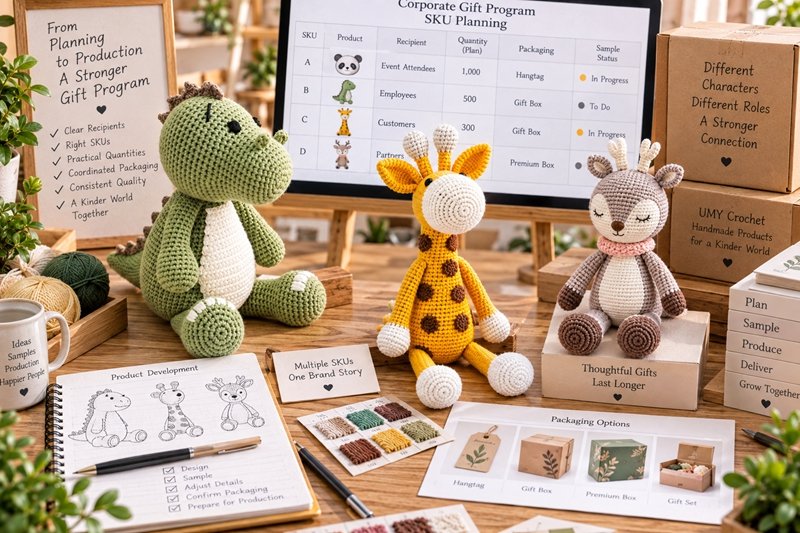
| SKU | Recipient | Gift Role | Product | Quantity | Customization | Packaging |
|---|---|---|---|---|---|---|
| A | Event attendee | Entry | Compact crochet format | Define | Brand colors / tag | Simple presentation |
| B | Employee | Core | Standard character | Define | Character customization | Branded package |
| C | Customer | Premium | Character edition | Define | Character + message | Gift box |
| D | VIP partner | VIP | Coordinated gift set | Define | Full program story | Premium presentation |
The exact fields can be expanded.
Useful additions may include:
- Target budget
- Required delivery date
- Destination
- Approval owner
- Sample status
- Packaging status
- Compliance status
This matrix becomes a practical management tool throughout development.
12. Sample the Program in the Right Sequence
Sampling every SKU simultaneously is not always the most efficient approach.
When several products share the same character or design language, a logical sequence can be:
Stage 1 — Approve the Core Identity
Confirm:
- Main character
- Colors
- Proportions
- Signature features
- General material direction
Stage 2 — Develop Format Variations
Then evaluate:
- Compact version
- Standard version
- Premium version
- Special edition
Stage 3 — Develop Packaging
Test the approved physical products with:
- Hangtags
- Pouches
- Boxes
- Inserts
- Message cards
Stage 4 — Review the Complete Tier System
Place all gift levels together and ask:
- Is the hierarchy clear?
- Does every SKU feel connected?
- Is the premium tier meaningfully different?
- Does the entry tier still feel intentional?
- Is any SKU unnecessary?
This sequence can reduce the risk of several samples moving in different creative directions.
13. Sampling Time Should Be Planned Per Development Requirement
At UMY, custom crochet sampling typically takes around 7–15 days, depending on the design, materials, accessories, revisions, and actual project conditions.
A multi-SKU program should not interpret this as:
“The complete assortment will automatically be finished in 7–15 days.”
Different products may require:
- Separate patterns
- Different materials
- Different accessories
- Different revision rounds
Packaging development may also operate on its own schedule.
Corporate teams should therefore distinguish between:
Initial Crochet Sample Timing
and
Complete Program Development Timing
The second depends on the number of SKUs and the complexity of the approval process.
14. Create a Shared Material Strategy Where It Makes Sense
Multi-SKU programs can become difficult when every product introduces unique materials.
Where the designs allow it, buyers and manufacturers can evaluate whether products can share:
- Yarn colors
- Main yarn types
- Accessories
- Labels
- Packaging materials
- Printed components
This does not mean forcing every SKU to be identical.
It means identifying unnecessary variation.
For example, if four character formats are supposed to represent the same brand character, using a controlled color reference across those formats can support both:
- Brand consistency
- Production management
The same principle applies to packaging.
A common card size or shared graphic system may simplify the program while still allowing tier-specific messaging.
15. Separate Shared Components From SKU-Specific Components
A useful operational exercise is to classify everything in the program.
Shared
Used across multiple SKUs:
- Main yarn colors
- Brand label
- Core story
- Graphic system
- Standard message-card structure
SKU-Specific
Used only for one product:
- Unique accessory
- Special embroidery
- Premium box
- VIP insert
- Seasonal component
This distinction helps the buyer see where complexity is accumulating.
A premium SKU may justify several unique components.
An entry SKU intended for broad distribution may benefit from fewer unique components.
16. Packaging Should Create Hierarchy Without Breaking the Program
Corporate packaging has several jobs.
It may need to:
- Protect the product
- Communicate the occasion
- Carry the brand message
- Identify the recipient tier
- Improve perceived value
- Support distribution
A coordinated packaging hierarchy might look like:
Entry Tier
Simple hangtag or compact presentation.
Core Tier
Branded sleeve, pouch, or box depending on the project.
Premium Tier
Gift box plus message or story card.
VIP Tier
Coordinated multi-component gift presentation.
The graphic language can remain connected across all tiers.
This creates:
One Program
with
Several Levels of Presentation
rather than four unrelated packaging projects.
17. Review the Complete Unboxing Experience
Procurement approval should not stop with the crochet sample.
For every gift tier, review:
Outer Presentation → Opening → Product Position → Message → Product Experience
Questions may include:
- Is the correct product immediately visible?
- Does the package feel appropriate for the recipient?
- Is the message clear?
- Is the branding balanced?
- Does the product move excessively inside the package?
- Are all components easy to identify?
- Does the gift feel intentional?
A corporate gift should feel like a gift first.
18. Keep Branding Proportionate to the Gift
Corporate buyers naturally want brand visibility.
But larger logos do not automatically create stronger brand value.
Brand identity can potentially be communicated through:
- Character
- Colors
- Clothing
- Accessory
- Hangtag
- Message card
- Packaging
The appropriate solution depends on the product.
The product should ideally remain attractive even outside the immediate campaign context.
19. Define Approval Ownership Before the Samples Arrive
Multi-SKU programs can involve many internal stakeholders.
Possible teams include:
- Procurement
- Marketing
- HR
- Sales
- Brand
- Events
- Corporate communications
- Management
Problems occur when everyone comments on every decision but no one has final approval authority.
A simple approval structure can help.
| Decision | Suggested Project Owner |
|---|---|
| Recipient strategy | Corporate program owner |
| Budget | Procurement / finance |
| Brand identity | Brand or marketing |
| Product specification | Product/project team |
| Message copy | Communications / program owner |
| Packaging | Brand + procurement |
| Final production approval | Authorized project owner |
Actual responsibilities vary by organization.
The important point is to establish them before final production approval.
20. Build One Master Approval System
Each SKU should have a clear approved reference.
Depending on the project, that may include:
- Approved physical sample
- Dimensions
- Yarn
- Colors
- Stitch structure
- Facial placement
- Embroidery
- Accessories
- Filling
- Labels
- Packaging
- Printed insert
For multi-SKU programs, these references should be controlled individually.
Do not assume:
“The panda is approved.”
Instead, approval may need to distinguish:
- Panda standard character
- Panda compact version
- Panda premium gift version
Each can have different specifications.
21. Quality Control Should Work at Two Levels
A multi-SKU program requires both SKU-level QC and program-level consistency.
SKU-Level QC
Check whether each product matches its own approved reference.
Depending on the product, this may include:
- Dimensions
- Colors
- Construction
- Facial placement
- Accessories
- Finishing
- Packaging
Program-Level Review
Check whether the complete assortment still looks coordinated.
For example:
- Do shared colors remain consistent?
- Do character features remain recognizable?
- Are packaging graphics coordinated?
- Are the correct inserts matched to the correct SKUs?
- Are premium and entry products clearly separated?
Because crochet is handmade, slight variation is natural.
The objective is not machine-level uniformity.
It is controlled consistency across the program.
22. Packaging Accuracy Becomes More Important as SKU Count Grows
Imagine four products with four different message cards.
The crochet products can all pass QC while the final gifts are still wrong if:
- Product A receives Card B
- Premium packaging receives the entry product
- A VIP insert is placed into the wrong box
Multi-SKU projects therefore need attention to configuration accuracy.
Useful controls can include clearly defined:
- SKU names
- Packaging versions
- Insert versions
- Packing instructions
- Approved reference sets
The more variants a program contains, the more important clear identification becomes.
23. Plan for Multiple Destinations Early
Corporate gifts are not always shipped to one warehouse.
Programs may involve:
- Corporate headquarters
- Regional offices
- Event venues
- Distributors
- Fulfillment centers
The sourcing brief should identify the required destination structure as early as possible.
This can influence:
- Carton planning
- Packaging
- Labeling
- Packing lists
- Shipping coordination
The manufacturer should not be expected to infer the final distribution structure from the product quantity alone.
If individual-recipient fulfillment is required, that should also be discussed specifically because it is different from bulk delivery to a corporate location.
24. Fixed Event Dates Change the Risk Calculation
Some corporate gifts are tied to dates that cannot move.
Examples include:
- Conferences
- Company anniversaries
- Product launches
- Holiday events
- Employee celebrations
A product arriving after the event may have far less value.
Corporate buyers should therefore plan backward from the required delivery date.
The project schedule may need to accommodate:
Brief → Design → Sampling → Revision → Approval → Packaging → Production → QC → Shipping → Distribution
Actual lead times depend on:
- Product complexity
- SKU count
- Quantity
- Materials
- Packaging
- Revision rounds
- Destination
- Shipping method
- Project requirements
Do not treat the sample-development time as the complete order lead time.
25. Compliance Should Be Defined by the Actual Product and Market
A corporate gift is not automatically exempt from product requirements simply because it is distributed rather than sold.
Applicable requirements depend on factors such as:
- Product category
- Intended use
- Target recipient
- Age positioning
- Materials
- Components
- Destination market
If one SKU is intended for a different use or recipient group from another, its requirements may also differ.
Testing, labeling, documentation, and certification requirements should therefore be confirmed for the actual project and destination market.
They should not be assumed solely from the fact that the products are handmade crochet.
26. IP Authorization Still Applies to Corporate Programs
Companies frequently want corporate gifts based on:
- Brand mascots
- Licensed characters
- Collaboration artwork
- Campaign illustrations
If the company owns the character, the development path may be straightforward from a rights perspective.
If third-party material is involved, appropriate authorization should be confirmed.
UMY should not manufacture unauthorized third-party IP.
27. Reorders Should Be Considered Before the First Order
Some corporate programs are genuinely one-time projects.
Others may become recurring.
Examples include:
- Employee onboarding
- Annual recognition
- Customer loyalty
- Partner gifts
- Recurring events
If repeat ordering is likely, identify:
- Core SKUs
- Permanent colors
- Packaging components
- Seasonal components
- Shared materials
- Reorder-critical specifications
A permanent employee mascot may need a different replenishment strategy from a one-time anniversary edition.
This creates another useful classification:
Evergreen SKU
versus
Campaign SKU
Evergreen products need stronger continuity planning.
Campaign products may prioritize a specific date or story.
28. Avoid Making Every Recipient Tier a Completely Different Product
It is possible to build:
- One product for employees
- Another for customers
- Another for partners
- Another for VIPs
But if none share materials, visual identity, packaging, or story, the company may accidentally create four separate development projects.
A more efficient architecture may use a shared core.
For example:
One Character Identity
↓
Compact Format
Standard Format
Premium Packaging
Gift-Set Extension
This creates differentiation without abandoning the common product system.
The exact solution depends on the program, but the principle is useful:
Create meaningful recipient differences with the minimum necessary manufacturing complexity.
29. Know When a Single SKU Is Actually Better
Not every corporate program needs multiple products.
A single SKU may be stronger when:
- All recipients have a similar relationship to the company
- One message applies to everyone
- Quantities per proposed variant would be too low
- The deadline is tight
- Operational simplicity is important
- The brand wants one recognizable campaign object
Multi-SKU planning should solve a business problem.
It should not become a goal by itself.
If segmentation does not create meaningful recipient value, one strong product may be the better procurement decision.
30. A Practical Multi-SKU Corporate Gift Workflow
Stage 1 — Define the Program
Document:
- Business objective
- Occasion
- Required delivery date
- Destination
- Overall quantity
Stage 2 — Segment Recipients
Define:
- Recipient groups
- Approximate quantity per group
- Relationship to the company
- Intended gift experience
Stage 3 — Build Gift Tiers
Assign:
- Entry
- Core
- Premium
- VIP
- Special edition
only where those distinctions are useful.
Stage 4 — Build the SKU Architecture
For each SKU, establish:
- Product format
- Customization
- Quantity
- Target budget
- Packaging
- Recipient group
Stage 5 — Review MOQ Feasibility
Evaluate quantities per style, not only total program volume.
Stage 6 — Develop the Core Creative System
Approve:
- Character or product concept
- Colors
- Brand elements
- Story
- Packaging direction
Stage 7 — Sample
Develop the required physical products and evaluate each format separately.
Stage 8 — Develop Packaging
Test the product inside the actual intended presentation.
Stage 9 — Approve Every Configuration
Control:
- Product
- Packaging
- Message card
- Labels
- Inserts
as the correct SKU combination.
Stage 10 — Standardize Production
Create approved references for larger handmade manufacturing.
Stage 11 — Quality Control
Check individual SKU quality and cross-program consistency.
Stage 12 — Pack and Distribute
Follow the agreed configuration and destination requirements.
A Corporate Buyer Brief for Multi-SKU Crochet Programs
Before approaching a manufacturing partner, prepare as much of the following information as possible.
Program Information
- Program purpose
- Required date
- Destination market
- Total expected quantity
Recipient Information
- Recipient groups
- Approximate count per group
- Gift occasion
- Desired experience
Product Information
- Character or product concept
- Reference artwork
- Preferred formats
- Target sizes
- Customization requirements
Commercial Information
- Target budget by tier
- Approximate quantity by SKU
- Number of proposed SKUs
Packaging Information
- Gift-box requirements
- Hangtags
- Story or message cards
- Pouches
- Other components
Brand Information
- Brand colors
- Approved graphics
- Character guidelines
- Required messaging
Project Requirements
- Intended use
- Target recipient/age positioning where relevant
- Required testing or documentation if already known
- Delivery structure
Not every detail needs to be final at the first discussion.
However, the clearer the recipient and quantity architecture, the easier it is to evaluate a commercially realistic product program.
How UMY Supports Multi-SKU Corporate Crochet Development
UMY has worked in product development and manufacturing since 2013.
For a multi-SKU corporate program, support can extend beyond producing one crochet item.
Depending on the project, development may involve:
- Product-format evaluation
- Crochet adaptation
- Sample development
- Color coordination
- SKU development
- Gift-set coordination
- Packaging development
- Production standardization
- Quality control
The objective is to turn several gifting requirements into a manageable physical product system.
A buyer may arrive with a complete corporate mascot and packaging brief.
Another may have only:
- Recipient groups
- Brand colors
- Budget levels
- A gifting objective
The amount of product-development support required will differ accordingly.
For custom handmade crochet, UMY's typical MOQ is around 500 pieces per style, while simpler designs may sometimes be evaluated from approximately 300 pieces per style.
Ready-stock products typically start at much lower quantities, often around 10–50 pieces per style, subject to availability.
Custom crochet sampling typically takes around 7–15 days, depending on the design, materials, accessories, revisions, and actual project conditions.
Bulk-production, packaging, testing, shipping, and complete program lead times should be evaluated separately for the actual project.
Common Mistakes in Multi-SKU Corporate Gift Programs
Mistake 1: Selecting Products Before Segmenting Recipients
The assortment should follow the recipient strategy.
Mistake 2: Giving Every Recipient the Same Experience at a Different Cost
A higher-cost product should create meaningful additional value, not simply cost more.
Mistake 3: Creating Too Many SKUs
Every SKU introduces additional development and operational requirements.
Mistake 4: Dividing Quantity Equally
Allocate quantities according to recipient counts and program roles.
Mistake 5: Looking Only at Total MOQ
MOQ feasibility should be reviewed by style and configuration.
Mistake 6: Making Premium Mean “More Random Items”
Premium gift sets should feel coherent.
Mistake 7: Reviewing Products Without Packaging
Recipients experience the complete gift.
Mistake 8: Allowing Every Department to Approve Everything
Define approval ownership.
Mistake 9: Losing Track of Packaging Versions
Configuration accuracy becomes critical when several SKUs use different cards, boxes, or inserts.
Mistake 10: Treating the Sample Timeline as the Complete Project Timeline
Production, packaging, testing, logistics, and distribution require separate planning.
Frequently Asked Questions
What is a multi-SKU corporate gift program?
It is a gifting program that uses more than one product or product configuration to serve different recipients, occasions, budget levels, or gifting roles within a coordinated corporate strategy.
How many SKUs should a corporate gift program have?
There is no universal number. Use only as many SKUs as necessary to create meaningful differences between recipient groups or gift roles. If two SKUs perform essentially the same job, simplifying the assortment may be better.
Should VIP recipients receive a completely different crochet product?
Not necessarily. A VIP tier can sometimes use the same core character with enhanced detail, packaging, storytelling, or complementary gift components. This can maintain program consistency while increasing perceived value.
Can different gift tiers use the same brand character?
Yes. A shared character can potentially be adapted into compact, standard, premium, or gift-set formats while preserving its recognizable identity.
Does MOQ apply to the total corporate order or each product?
For custom development, buyers should discuss MOQ per style rather than assuming that the combined program quantity satisfies the requirement for every SKU. At UMY, custom handmade crochet typically has an MOQ around 500 pieces per style, while simpler designs may sometimes be evaluated from approximately 300 pieces per style.
Can ready-stock crochet products be included in a corporate program?
Potentially, subject to availability and project requirements. Ready-stock products generally support lower quantities than fully customized handmade styles and may be useful for certain program components.
How long does custom corporate crochet sampling take?
At UMY, custom crochet sampling typically takes around 7–15 days depending on the design, materials, accessories, revisions, and actual project conditions. A multi-SKU program may require multiple samples and additional approval time.
Should packaging be developed separately for every gift tier?
Not necessarily. A shared packaging design system can connect the complete program while individual tiers use different formats, inserts, or presentation levels.
How can corporate buyers reduce multi-SKU complexity?
Start with recipient segmentation, give each SKU a clear role, share materials and graphic systems where appropriate, limit unnecessary variants, define approval ownership, and maintain a master SKU matrix throughout development.
Can a multi-SKU crochet program be reordered?
Yes, depending on the product, materials, packaging, and project conditions. Buyers expecting repeat programs should distinguish evergreen SKUs from one-time campaign products and maintain clear approved references.
Final Buyer Takeaway
A multi-SKU corporate gift program is successful when recipients experience thoughtful differentiation while procurement experiences controlled complexity.
The planning logic is:
Different Recipients
↓
Different Gift Roles
↓
Appropriate Product Tiers
↓
Coordinated SKU Architecture
↓
Shared Design and Packaging System
↓
Controlled Production and QC
The goal is not to produce the largest possible assortment.
It is to create the smallest assortment that successfully serves the required recipient groups.
That distinction matters.
One carefully developed character may support a compact entry product, a core employee gift, a premium customer edition, and a VIP gift set without becoming four unrelated projects.
For corporate procurement teams, gift companies, marketing agencies, brands, and authorized IP holders, the strongest programs combine:
Recipient Strategy + Product Architecture + Quantity Planning + Packaging + Manufacturing Control
UMY can support that process from concept and format evaluation through sampling, production preparation, quality control, and packaging coordination—helping turn a corporate gifting strategy into a manageable physical product program.
 Chinese