
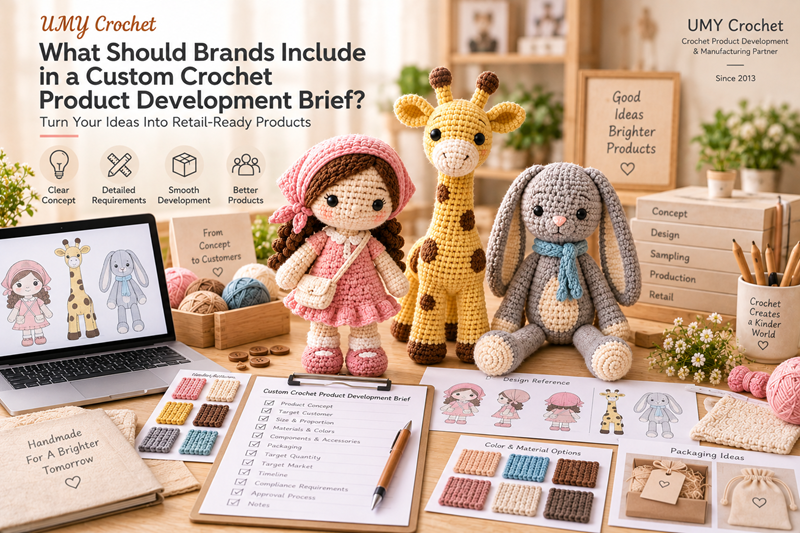
A good custom crochet product development brief should give the manufacturer enough information to understand what the product should be, who it is for, how it will be used, what must remain visually accurate, and what commercial constraints the project must meet.
At minimum, brands should define:
- Product concept and reference artwork
- Target customer and intended use
- Priority visual features
- Approximate dimensions
- Materials and color requirements
- Required accessories or components
- Target quantity
- Target cost or commercial price range
- Packaging requirements
- Destination market
- Intended age group, where relevant
- Compliance requirements that have already been identified
- Required delivery date
- Approval process and decision makers
The brief does not need to solve every technical detail before sampling begins. In fact, some construction decisions are better made together with an experienced crochet development partner.
Its purpose is different: to separate fixed requirements from flexible preferences before development starts.
That distinction helps designers, buyers, sourcing teams, and manufacturers make faster decisions during quotation, sampling, revision, costing, and production preparation.
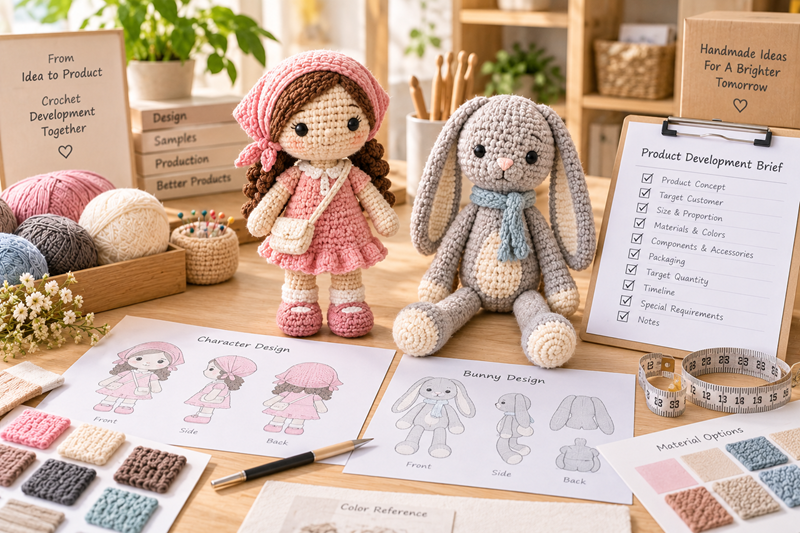
Why a Better Brief Produces a Better Development Process
Custom crochet development is a translation process.
A brand may begin with:
- A 2D character illustration
- A mascot
- A product sketch
- A photograph
- A cultural reference
- A campaign concept
- An existing product
- A general creative direction
The manufacturer then has to translate that information into a physical object made from yarn, stitches, filling, embroidery, accessories, and other components.
Not every detail translates literally.
A tiny graphic feature may be difficult to reproduce at a small crochet scale. A long thin element may need structural adjustment. A complex costume may add substantial labor. A specific yarn color may affect sourcing. Packaging dimensions may change once the final product size is known.
A strong brief gives the development team enough context to make these decisions without losing the original objective.
A weak brief often creates a different workflow:
Incomplete information → assumptions → sample → unexpected result → clarification → revision → additional cost and time
A stronger workflow is:
Clear objective → prioritized requirements → technical interpretation → sample → focused feedback → approved production reference
The goal is not to eliminate revision.
The goal is to make each revision meaningful.
1. Start With the Business Purpose, Not Only the Product
Before describing stitches or colors, explain why the product is being developed.
For example:
- Retail merchandise
- Museum shop product
- Corporate gift
- Event giveaway
- Brand mascot
- Licensed merchandise
- Promotional campaign
- Seasonal collection
- Collectible
- Gift-with-purchase program
This context influences development decisions.
The manufacturer should understand the commercial role of the product, not just its appearance.
Useful information to include
| Brief Item | Example Information |
|---|---|
| Project type | Retail merchandise |
| Intended user | Adult fans of the brand |
| Sales/distribution channel | Brand stores and online shop |
| Product role | Core mascot collectible |
| Planned launch | Autumn campaign |
| Destination market | Markets where the product will be sold |
| Expected quantity | Estimated initial order range |
This gives the development team a framework for later decisions.
2. Provide the Best Available Visual References
For character-based crochet products, visual references are often the most important part of the brief.
Useful references may include:
- Front-view artwork
- Side view
- Back view
- Character turnaround
- Color artwork
- Close-ups of important details
- Clothing references
- Accessory references
- Existing merchandise
- Approved brand guidelines
If only one front-view illustration exists, say so.
Do not assume the manufacturer knows what the back of the character should look like.
When information is missing, identify whether the manufacturer may propose a solution or whether the brand's design team must provide it.
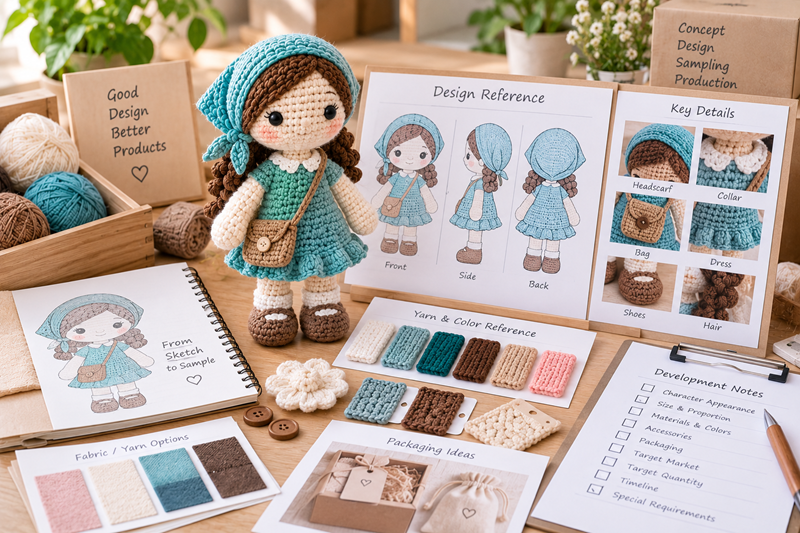
Separate reference from requirement
This distinction is especially useful.
A mood-board image might mean:
We like this general proportion.
It does not necessarily mean:
Copy this product.
Label references clearly so the development team knows why each image is included.
3. Identify the Features That Must Not Change
Not every detail has equal importance.
For a mascot, three or four features may carry most of the character recognition.
These could include:
- Head shape
- Eye position
- Signature hairstyle
- Ear shape
- Facial expression
- Clothing silhouette
- Specific color combination
- Distinctive accessory
- Logo placement
Brands should mark these as non-negotiable identity features.
Other details can be classified as flexible.
For example:
| Feature | Priority | Development Flexibility |
|---|---|---|
| Character head silhouette | Critical | Must remain recognizable |
| Brand color | Critical | Match approved reference as closely as practical |
| Small decorative buckle | Medium | Construction may be simplified |
| Internal structure | Technical | Manufacturer may propose |
| Stitch method | Technical | Manufacturer may propose |
| Packaging insert layout | Flexible during sampling | Finalize after product dimensions |
This priority system is more useful than telling the factory that every detail is equally important.
4. Define the Target Size and Proportions
A brief should normally include an approximate finished size.
For example:
- Approximately 12 cm tall
- Approximately 20 cm seated height
- Mini keychain format
- Palm-sized collectible
If a particular dimension is critical, specify how it should be measured.
Crochet products are three-dimensional and often irregular in shape. Height may change depending on whether ears, horns, hats, hair, or hanging loops are included.
Brands should also indicate whether proportions matter more than exact dimensions.
For character products, maintaining the relationship between:
- Head
- Body
- Arms
- Legs
- Ears
- Accessories
may be more important than achieving one exact overall measurement.
5. Specify Colors With Physical or Approved References
Descriptions such as:
- Light blue
- Warm beige
- Brand orange
- Soft pink
are useful for conversation but insufficient as production standards.
Where color accuracy matters, provide an approved reference such as:
- Physical color sample
- Approved yarn sample
- Approved prototype
- Recognized color specification used by the project
- Brand color reference
Digital screens can display colors differently, so screen images alone should not automatically become the final production reference.
The brief should also identify which colors are critical.
A mascot's signature brand color may require tighter control than a small internal accessory.
6. Explain Material Expectations Without Over-Specifying Too Early
If the brand already has mandatory material requirements, include them.
Examples might include:
- Preferred yarn composition
- Desired surface feel
- Filling requirements
- Embroidery preference
- Hardware restrictions
- Packaging material requirements
However, brands do not necessarily need to define every yarn specification before discussing the project with the manufacturer.
Sometimes the better approach is to explain the desired result:
Soft hand feel, matte appearance, clearly visible crochet texture, suitable for the intended product use.
The development partner can then evaluate practical material options.
Material selection affects more than appearance.
It can influence:
- Stitch definition
- Product structure
- Weight
- Color availability
- Cost
- Production repeatability
- Care requirements
- Compliance planning
7. List Every Accessory and Secondary Component
Small components are easy to overlook in an early brief.
Depending on the product, these may include:
- Clothing
- Hats
- Scarves
- Bags
- Shoes
- Buttons
- Embroidery
- Hanging loops
- Key rings
- Labels
- Hangtags
- Story cards
- Inserts
- Gift boxes
Create a component list before quotation.
This helps the manufacturer understand the complete product rather than pricing only the main crochet body.
For character development, the brief should also explain whether accessories are:
Permanent — attached to the product
or
Removable — separate components that the customer can remove.
That distinction can affect construction, packaging, product use, and applicable safety considerations.
8. State the Intended Age Group and Product Use
This information should be provided early, especially when the product could be interpreted as a children's product or toy.
Tell the manufacturer:
- Who is expected to use the product
- How it will be marketed
- Whether it is intended primarily as a toy, collectible, decoration, gift, accessory, or another product type
- Which markets it will enter
The manufacturer should not be expected to infer these requirements from a photograph.
Compliance planning is most useful when it begins during development, because it may influence choices such as:
- Small components
- Attachments
- Filling
- Labels
- Packaging
- Construction methods
Brands should confirm applicable requirements for their target market with appropriate compliance professionals and testing partners rather than relying on a generic product assumption.
9. Give the Manufacturer Commercial Boundaries
A product brief should not describe only the ideal creative outcome.
It should also describe the commercial reality.
Important information includes:
- Estimated order quantity
- Target product cost or budget range
- Target retail positioning, when relevant
- Packaging budget
- Delivery destination
- Required delivery date
- Planned launch date
These factors are connected.
For example, a highly detailed product may require:
- More crochet time
- More assembly
- More embroidery
- More components
- More quality-control points
If the target cost cannot support that complexity, it is better to discover the conflict during development than after the final sample has been approved.
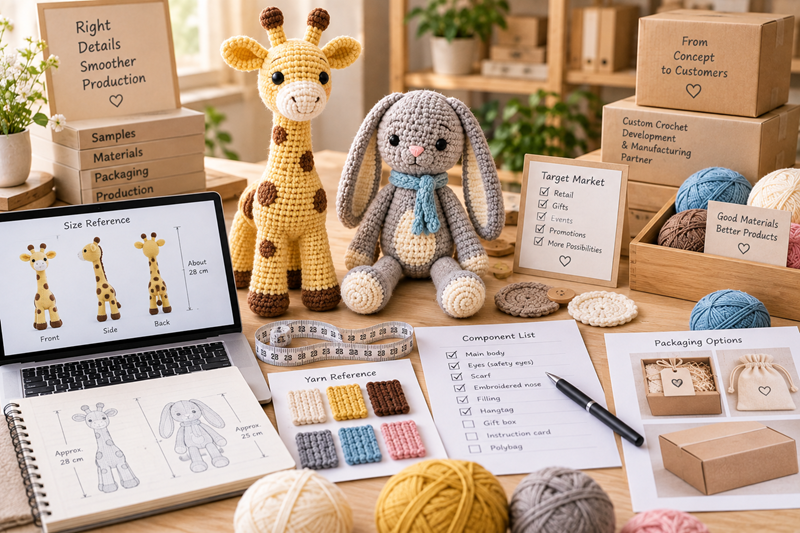
10. Separate the Launch Date From the Required Delivery Date
A campaign launch date is not the same as a factory completion date.
The project may also require time for:
- Final inspection
- Packing
- Export preparation
- International transportation
- Customs clearance
- Warehousing
- Distribution
- Retail setup
- Marketing photography
A useful brief therefore includes both:
Required product arrival date
and
Public launch or retail date
The sourcing team can then work backward with the manufacturer and logistics partners.
11. Include Packaging in the Development Brief
Packaging should not automatically be postponed until the product is finished.
The product and packaging often affect each other.
Packaging decisions may include:
- Polybag or protective packing
- Hangtag
- Belly band
- Printed box
- Gift box
- Display box
- Fabric pouch
- Story card
- Instruction card
- Retail barcode label
- Shipping configuration
For a museum product, packaging may need to explain cultural context.
For a corporate gift, it may carry a campaign message.
For retail merchandise, it may need to support shelf or hanging display.
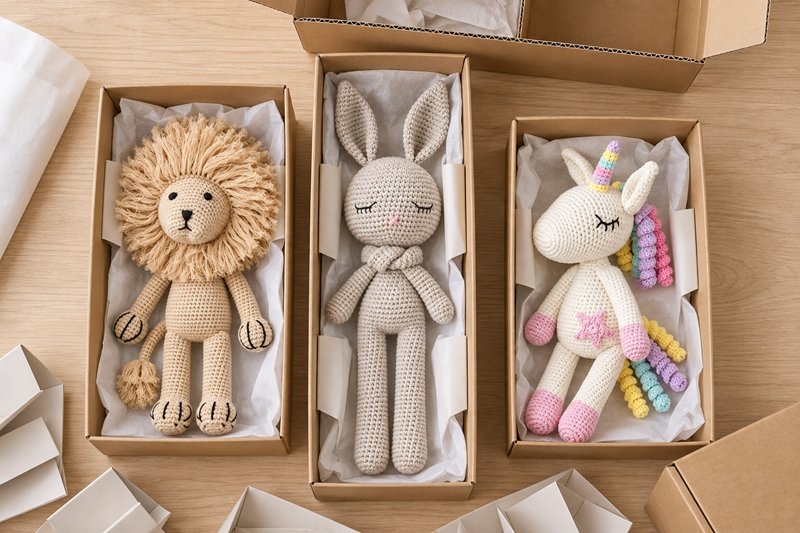
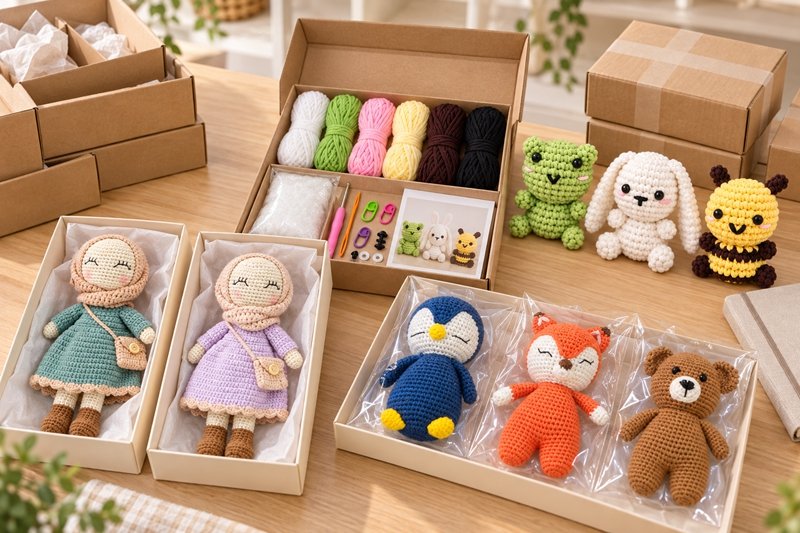
For a crochet kit, packaging must accommodate multiple components rather than only the finished product.
Include these expectations in the original brief, even if artwork will be finalized later.
12. Define What the Manufacturer Is Expected to Develop
"Custom product" can mean different things.
Clarify the expected development scope.
Brand-led development
The buyer may provide:
- Complete artwork
- Dimensions
- Colors
- Materials
- Packaging specifications
The manufacturer primarily translates the approved design into a producible crochet product.
Collaborative development
The buyer may provide:
- Character artwork
- Brand requirements
- Commercial objective
The manufacturer helps propose:
- Crochet construction
- Proportions
- Materials
- Detail solutions
- Product formats
- Packaging feasibility
Concept-led development
The buyer may begin with:
- A campaign
- Theme
- Audience
- Budget
- General creative direction
More product-development work may be required before sampling.
Defining the expected scope prevents confusion about who is responsible for unresolved design decisions.
13. Define the Sample Approval Process
A development brief should also explain how decisions will be made.
Useful questions include:
- Who reviews the first sample?
- Who has final approval authority?
- Will the design team and sourcing team review together?
- How should comments be consolidated?
- Which reference version is current?
- How will approved changes be recorded?
Conflicting feedback can create unnecessary revisions.
For example:
Marketing: make the product larger.
Sourcing: reduce cost.
Design: add more embroidery.
These requests may conflict.
Brands should consolidate feedback internally before sending the next revision request.
Use one revision record
For each sample round, record:
- Sample version
- Date
- Requested change
- Reason
- Priority
- Approval status
This creates a traceable development history.
14. Mark "Must-Have" and "Nice-to-Have" Requirements
One of the most practical improvements a buyer can make is to classify requirements.
Must-have
These may include:
- Character identity
- Brand colors
- Required size range
- Required delivery window
- Market requirements
- Essential accessory
- Approved packaging format
Nice-to-have
These might include:
- Additional embroidery
- Secondary accessory
- Premium packaging finish
- More complex clothing
- Optional decorative detail
If cost, timing, or construction becomes difficult, the development team immediately knows what can be adjusted first.
This makes value engineering more controlled.
15. Tell the Manufacturer What Success Looks Like
A brief should end with a simple definition of success.
For example:
Develop a 15–18 cm crochet version of our mascot for retail sale, preserving the character's head shape, signature blue color, facial expression, and red scarf. The product should fit our planned retail positioning and be developed together with suitable retail packaging for our target market.
That statement gives the project a decision-making filter.
When evaluating a sample, the team can ask:
- Is the character recognizable?
- Are the priority features correct?
- Is the size suitable?
- Is the construction commercially realistic?
- Does the packaging fit the intended channel?
- Can the approved design be standardized for production?
Without a success definition, sample feedback can become subjective.
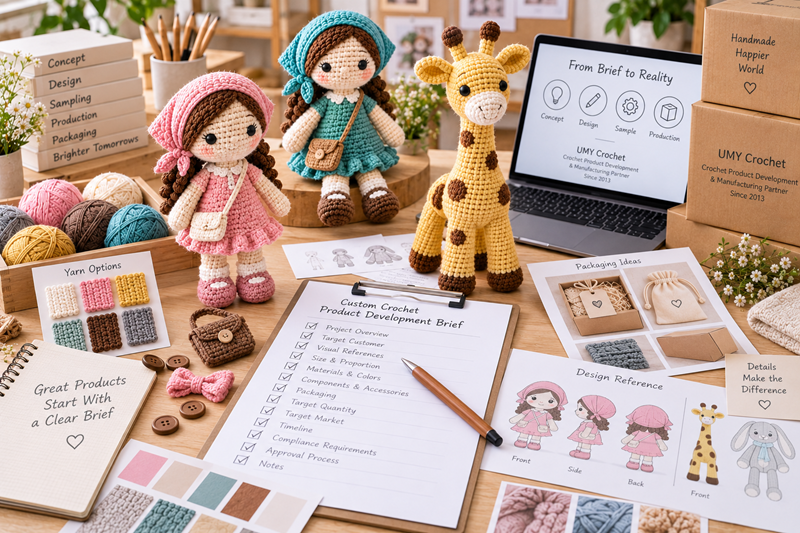
A Practical Custom Crochet Development Brief Template
Brands can use the following structure when preparing an RFQ or development request.
| Section | Information to Provide |
|---|---|
| Project overview | Project name, objective, product type |
| Target customer | Audience and intended use |
| Market | Destination country/region and sales channel |
| Visual references | Artwork, sketches, photos, brand guidelines |
| Critical features | Elements that must remain recognizable |
| Target size | Approximate dimensions and measurement method |
| Colors | Approved references and priority colors |
| Materials | Mandatory requirements or desired characteristics |
| Components | Clothing, accessories, hardware, labels, inserts |
| Quantity | Estimated initial order quantity |
| Commercial target | Target cost/budget and retail positioning where relevant |
| Packaging | Required packaging format and branding |
| Timing | Required arrival date and launch date |
| Product use | Intended classification/use and age group where relevant |
| Compliance | Requirements already identified for the target market |
| Development scope | What the brand supplies and what the manufacturer should propose |
| Approval | Decision makers and sample-review process |
| IP/confidentiality | Ownership, permitted use, NDA requirements where applicable |
What Should Be Sent With the First RFQ?
The first request does not need to contain a finished technical specification.
But sending only:
"Please quote this crochet doll."
with one image often leaves too many unknowns.
A more useful first RFQ package includes:
- Artwork or reference images
- Approximate size
- Estimated quantity
- Destination market
- Intended product use
- Target timing
- Packaging expectation
- Important materials or colors
- Target budget, when available
- Any known compliance or testing requirements
This gives the manufacturer enough information to identify major feasibility questions before detailed sampling begins.
Common Briefing Mistakes
Mistake 1: Sending Only a Picture
A picture explains appearance but usually does not explain quantity, size, use, market, packaging, budget, or deadline.
Mistake 2: Treating Every Detail as Fixed
This can prevent the manufacturer from proposing simpler construction or more production-friendly solutions.
Separate identity-critical details from technical details that can be developed collaboratively.
Mistake 3: Giving a Target Price Without Explaining the Product
Price depends on more than dimensions.
Crochet production can also be affected by:
- Stitch complexity
- Shape
- Color changes
- Accessories
- Embroidery
- Assembly
- Finishing
- Packaging
Mistake 4: Discussing Compliance After the Sample Is Approved
If product use or market requirements affect construction, late changes may require redevelopment.
Mistake 5: Leaving Packaging Until Mass Production
Custom packaging can introduce separate dimensions, artwork approvals, materials, minimum quantities, and lead times.
Mistake 6: Giving Feedback From Multiple Teams Separately
Design, marketing, sourcing, and management may have different priorities.
Consolidate feedback before sending it to the development partner.
How a Crochet Development Partner Uses the Brief
A useful development partner should do more than receive a specification and produce a sample.
The brief can become the basis for discussing:
- What can translate directly into crochet
- What needs adaptation
- Which details drive cost
- Which materials are practical
- Which components create production risk
- Which features require tighter quality standards
- What should be standardized before bulk production
- Which decisions need buyer approval
For custom projects, this is why UMY is positioned as a Crochet Product Development & Manufacturing Partner, rather than only a production source.
The objective is to help translate a commercial idea into a crochet product that can move through:
concept → sample → revision → approval → production standard → bulk manufacturing
while keeping the buyer's priorities visible throughout the process.
Pre-Sampling Checklist for Buyers
Before authorizing the first sample, check whether the team can answer these questions:
- [ ] What is the product for?
- [ ] Who is the target customer?
- [ ] Where will it be sold or distributed?
- [ ] What artwork is the current approved reference?
- [ ] Which visual features must not change?
- [ ] What is the approximate finished size?
- [ ] Which colors require close control?
- [ ] Are any materials mandatory?
- [ ] What accessories and secondary components are included?
- [ ] What is the estimated order quantity?
- [ ] What commercial cost range should development consider?
- [ ] What packaging is expected?
- [ ] What is the intended product use and age group, if relevant?
- [ ] What target-market requirements have already been identified?
- [ ] When must the goods arrive?
- [ ] Who gives final sample approval?
- [ ] Which requirements are must-have versus nice-to-have?
If several answers are still unknown, that does not always mean development must stop.
It means those points should be identified as open decisions, rather than silently left for the manufacturer to guess.
Frequently Asked Questions
Do brands need a complete technical specification before contacting a crochet manufacturer?
No. A brand can begin with artwork, project objectives, approximate size, quantity, market, timing, and other key commercial requirements. Technical construction details can often be developed collaboratively during sampling.
What is the most important information in a crochet development brief?
The most important information is the combination of the product objective, visual references, critical identity features, size, quantity, intended use, target market, commercial boundaries, packaging, and timing.
Should a brand provide a target cost?
How should brands specify crochet colors?
Use approved physical or project-recognized color references when color accuracy is important. Avoid relying only on broad descriptions such as "light pink" or on-screen images.
Should packaging be included in the initial brief?
Yes, at least at the requirement level. The final artwork may come later, but the manufacturer should know whether the product requires a hangtag, box, pouch, story card, retail display format, or other packaging.
What if the brand does not know which crochet construction method to use?
That can remain a manufacturer-led technical decision. The brand should describe the required appearance, feel, use, and non-negotiable visual details so the development partner can propose an appropriate construction.
Should compliance requirements be included in the brief?
Yes. The destination market, intended use, intended age group where relevant, and any requirements already identified by the buyer should be communicated early. Specific obligations depend on the product and jurisdiction and should be confirmed for the actual project.
Can one development brief cover several SKUs?
Yes, but separate shared collection requirements from SKU-specific requirements. Shared yarn palettes, packaging systems, labels, or construction standards can be documented once, while dimensions, colors, accessories, and artwork should remain clear for each SKU.
Final Takeaway
A custom crochet development brief is not simply a request for a quotation.
It is the working foundation for the entire project.
The most effective briefs answer four groups of questions:
Creative: What should the product look and feel like?
Commercial: What quantity, cost position, channel, and deadline must it support?
Technical: What dimensions, materials, components, packaging, and performance expectations matter?
Decision-making: What is fixed, what is flexible, and who approves the result?
When those answers are clear, the manufacturer can spend less time interpreting missing information and more time solving the actual product-development challenge.
For brands developing custom mascots, retail merchandise, museum products, corporate gifts, or character collections, UMY can support the process from initial concept and sample development through production-standard preparation and bulk manufacturing.
A useful first step is simple:
Send the brief with the best references you currently have—and clearly mark what is decided, what is flexible, and what still needs to be developed.
 Chinese