
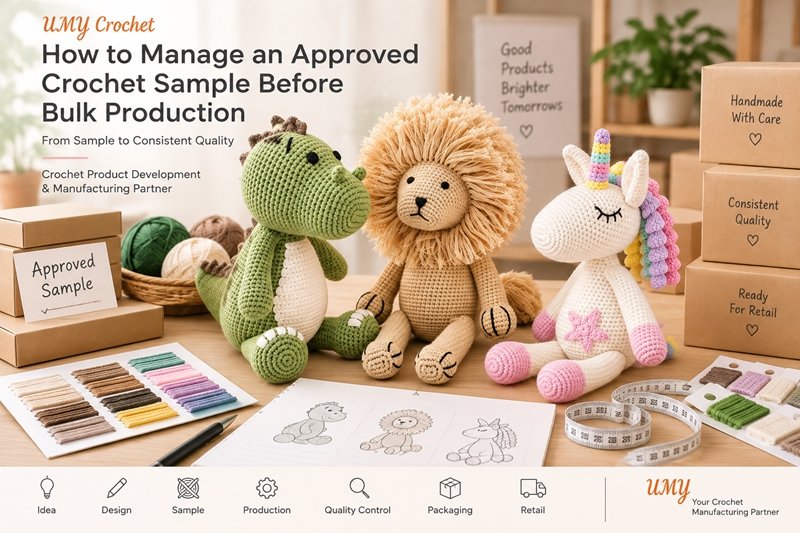
An approved crochet sample should become the production reference, not simply a sample that everyone remembers as “approved.”
Before bulk production begins, buyers and manufacturers should convert the approved sample into a controlled set of references covering the product’s dimensions, yarn and colors, crochet structure, facial features, clothing, accessories, finishing details, labels, and packaging. Any intentional change after approval should be documented rather than passed informally through messages.
This matters especially for handmade crochet products. Small variations are natural because stitch tension and hand assembly are not identical to machine production. However, natural handmade variation is different from an uncontrolled change in the product specification.
For brands, retailers, gift companies, and product development teams, the practical goal is therefore not to make every handmade unit mathematically identical. It is to define which characteristics must remain consistent, which dimensions require agreed tolerances, and which minor variations are acceptable because of the handmade process.
A well-managed approved sample creates a common reference for the buyer, product developer, production team, and quality-control process. It reduces interpretation during production and makes later inspection more objective.
At UMY Crochet, where we have worked with crochet product development and manufacturing since 2013, we treat sample approval as an important transition point:
Idea → Development Sample → Revision → Approved Sample → Production Reference → Bulk Production → Inspection → Packing
The stronger this handoff is, the easier it becomes to protect the original product concept during production.
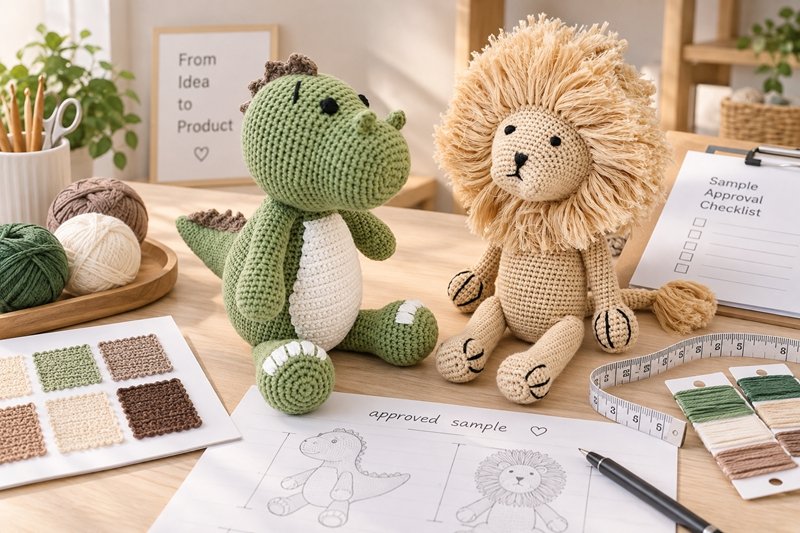
Why Sample Approval Is Not the End of Product Development
Buyers often spend considerable time refining a crochet sample.
They may adjust:
- body proportions,
- yarn colors,
- facial expressions,
- embroidery,
- clothing,
- accessories,
- labels,
- packaging,
- or small character details.
Eventually, the buyer says:
“Sample approved.”
That approval is important, but one more step is needed.
The manufacturer must translate the approved physical sample and related specifications into information that can be understood consistently by the people responsible for production.
This is the difference between sample approval and production handoff.
The approved sample answers:
Is this the product we want?
The production reference should also answer:
What exactly must be maintained when this product is reproduced in quantity?
For handmade products, that second question deserves careful attention.
What Is an Approved Crochet Sample?
An approved crochet sample is the version of a developed product that the buyer has accepted as the reference for bulk production, subject to the final commercial and production agreement.
Depending on the project, the reference may include more than the physical crochet item.
A useful approval package can include:
| Reference | What It Helps Control |
|---|---|
| Physical approved sample | Overall appearance and workmanship |
| Measurements | Size and proportion |
| Yarn/material reference | Material identity and construction |
| Color reference | Approved color direction |
| Detail photographs | Face, embroidery, accessories and finishing |
| Product specification | Construction and component requirements |
| Label/artwork files | Branding and product information |
| Packaging reference | Final presentation and packing configuration |
| Approval record | Which version was actually approved |
Not every project needs an unnecessarily complicated specification package.
A simple crochet flower and a detailed character doll do not require the same level of documentation.
The principle is to document enough information to remove ambiguity from the features that matter commercially.
1. Identify the Exact Approved Version
One surprisingly common development risk occurs when several samples exist at the same time.
For example:
- Sample 1 establishes the basic shape.
- Sample 2 changes the face.
- Sample 3 adjusts the yarn color.
- Sample 4 changes the clothing.
- A later photograph shows another small modification.
Before production, both sides should therefore identify one final approved version.
The approval record can state practical information such as:
- product or SKU name,
- sample version,
- approval date,
- approved photographs,
- remaining comments, if any,
- and packaging status.
The objective is simple:
Everyone involved in production should know which version is the master reference.
2. Record the Measurements That Affect Product Identity
A product can change visually even when only one or two dimensions change.
For a character, important measurements might include:
- total height,
- head width,
- body length,
- arm and leg length,
- ear size,
- accessory dimensions,
- or the relative position of important features.
For another product, a different set of measurements may matter.
A crochet flower might depend more on:
- flower diameter,
- stem length,
- leaf position,
- and bouquet proportion.
The specification should therefore focus on critical dimensions, rather than measuring every possible point without a reason.
Define Tolerances Where Needed
Because crochet is handmade, buyers should not assume that every finished item will match one measurement to the millimeter.
Instead, the project team should determine appropriate tolerances based on:
- product construction,
- yarn behavior,
- product size,
- handmade process,
- intended use,
- and buyer requirements.
Those tolerances should be agreed for the actual project rather than copied automatically from another product.
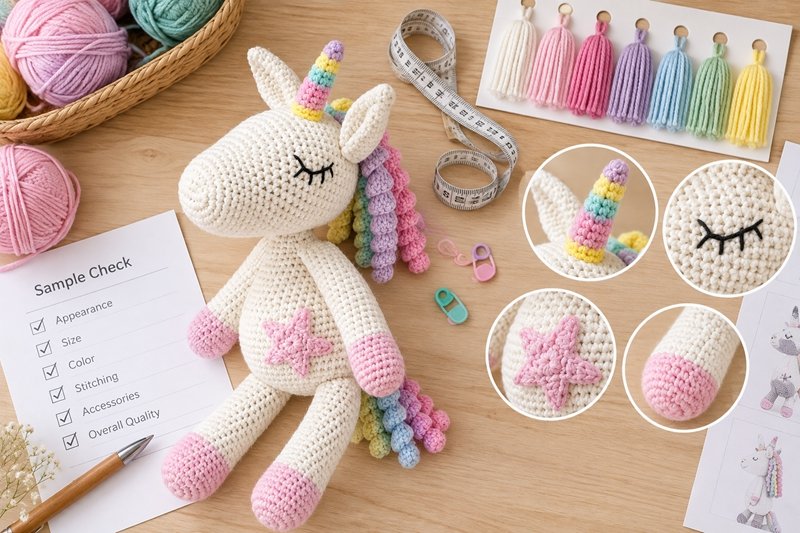
3. Lock the Yarn and Color References
Color can strongly influence how buyers perceive a crochet product.
A character with the wrong shade of hair, clothing, skin tone, or signature brand color may feel different even when its shape is correct.
Before production, important yarn information should therefore be confirmed.
Depending on the project, this can include:
- yarn type,
- yarn composition where specified,
- yarn thickness,
- approved yarn color,
- color combinations,
- and where each color is used.
Why Visual Descriptions Are Not Enough
Terms such as:
- beige,
- light brown,
- dusty pink,
- cream,
- dark green,
can be interpreted differently.
For color-sensitive projects, physical or otherwise clearly agreed references are more useful than descriptive names alone.
This becomes especially important for:
- brand mascots,
- licensed or authorized characters,
- cultural products,
- coordinated gift collections,
- and products designed to match branded packaging.
If a material must change after sample approval because of availability or another production issue, the substitute should not silently become the new standard.
The change should be reviewed and confirmed where it affects the approved product.
4. Define the Character Features That Cannot Drift
For character-based crochet products, not every detail has equal importance.
Some features carry much more of the character's identity.
These may include:
- eye position,
- eye shape,
- mouth placement,
- hairstyle,
- ears,
- horns,
- mane,
- headwear,
- clothing,
- signature accessories,
- embroidery,
- or characteristic body proportions.
During development, buyers and manufacturers should identify these critical visual features.
A useful question is:
If this detail changes, will the customer still recognize the same character?
If the answer is uncertain, the feature deserves stronger control.
Face Placement Deserves Special Attention
Small changes in facial positioning can noticeably change a character's expression.
Eyes that move slightly higher or lower can make a character appear:
- younger,
- older,
- happier,
- more serious,
- or simply different from the approved design.
For important character products, detailed reference photographs and relevant placement information can help the production team reproduce the intended expression more consistently.
5. Document Clothing and Accessories Separately
Crochet products often include components beyond the main body.
Examples include:
- hats,
- scarves,
- dresses,
- bags,
- bows,
- shoes,
- removable clothing,
- fabric details,
- key rings,
- hanging loops,
- and decorative accessories.
These components can create their own production questions.
For example:
- Is the accessory removable or permanently attached?
- Which direction should it face?
- Where should it be attached?
- What material should be used?
- What dimensions matter?
- Does its position affect the overall appearance?
If these details were carefully adjusted during sampling, they should not be left to memory when bulk production begins.
6. Separate Handmade Variation From Product Defects
This is one of the most important concepts in crochet quality management.
Handmade crochet products naturally show some variation.
Possible small variations can result from:
- individual crochet tension,
- yarn behavior,
- stuffing distribution,
- hand assembly,
- embroidery,
- and finishing.
The existence of variation does not automatically mean the product is defective.
However, “handmade” should not become a reason to accept uncontrolled differences.
A practical production reference should help distinguish between three categories:
| Category | Meaning |
|---|---|
| Critical product requirement | A feature that must follow the approved specification or applicable requirement |
| Agreed handmade tolerance | A controlled amount of variation considered acceptable for the project |
| Defect or unacceptable deviation | A difference that falls outside the agreed requirement or affects function, appearance, safety, or commercial acceptance |
The exact acceptance criteria depend on the product and project.
That is why the approved sample should work together with written specifications rather than acting as the only reference.
7. Confirm Labels and Packaging Before Production Moves Too Far
The crochet item may be approved while the retail presentation is still unfinished.
That creates another potential gap.
A retail-ready product may involve:
- hangtags,
- sewn labels,
- barcode labels,
- story cards,
- instruction cards,
- gift boxes,
- fabric pouches,
- inner packing,
- carton requirements,
- or other market-specific information.
Before bulk packing begins, buyers should confirm which packaging version belongs to the approved product.
This is particularly important when one crochet product is sold:
- under different private labels,
- in multiple markets,
- through different retailers,
- or in more than one packaging format.
8. Build a Production Reference Package
For more complex projects, it is useful to think beyond a single approved sample and create a production reference package.
The package does not need to be bureaucratic.
Its purpose is simply to keep the important information together.
A practical package may contain:
- the approved physical sample,
- approved product photographs,
- critical dimensions and tolerances,
- yarn and color references,
- construction notes,
- critical character details,
- clothing and accessory requirements,
- labels and artwork,
- packaging specifications,
- and the final approval record.
This gives different teams a common source of information.
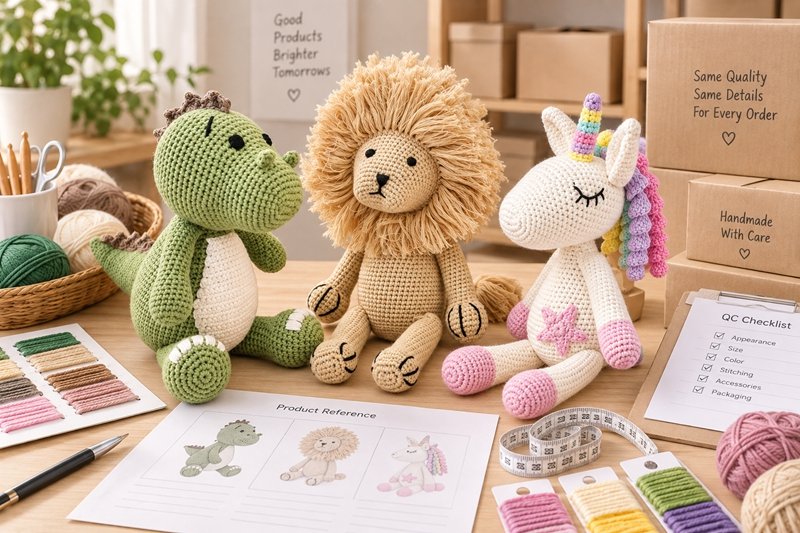
9. Control Changes After Sample Approval
A product can still encounter changes after approval.
For example:
- a specified material becomes unavailable,
- an accessory needs adjustment,
- packaging dimensions change,
- the buyer updates artwork,
- or a production issue requires a construction modification.
The important point is not to pretend that changes never happen.
The important point is to control them.
A useful change-control process asks:
- What is changing?
- Why is it changing?
- Does the change affect appearance, function, packaging, cost, timing, or applicable compliance requirements?
- Does the buyer need to review it?
- What becomes the new approved reference?
For a small non-visible process adjustment, another physical approval sample may not always be necessary.
For a change that materially affects the product, additional buyer confirmation may be appropriate.
The level of approval should match the significance of the change.
10. Use the Approved Sample During Production — Not Only Before It
The approved sample should remain relevant after production starts.
It can support several checkpoints.
Production Setup
The production team reviews the approved product and key requirements before work begins.
Early Production Comparison
Early units can be compared against the agreed reference to identify obvious misunderstandings before they affect a larger quantity.
In-Process Quality Control
Important features can be monitored while products are being crocheted, assembled, finished, and packed.
Final Inspection
Finished goods can be evaluated against the agreed specifications, approved reference, packaging requirements, and applicable project criteria.
This turns the approved sample into a practical quality tool rather than a development souvenir.
What Buyers Should Check Before Releasing Bulk Production
Before giving the final production go-ahead, a buyer can use the following checklist:
- [ ] Correct sample version has been identified.
- [ ] Key dimensions have been documented.
- [ ] Relevant tolerances have been agreed.
- [ ] Yarn and material references have been confirmed.
- [ ] Important colors have been confirmed.
- [ ] Critical character features are clearly defined.
- [ ] Clothing and accessories match the approved version.
- [ ] Embroidery and facial details are documented where necessary.
- [ ] Labels and branding files are final.
- [ ] Packaging status is clear.
- [ ] Any unresolved changes are recorded.
- [ ] Production and inspection teams have access to the appropriate references.
For licensed or third-party character projects, the buyer should also ensure that the necessary authorization and approval process is in place. A manufacturer should not assume that artwork supplied by a customer automatically carries production rights.
A Practical Example: Why the Handoff Matters
Consider a hypothetical brand developing a crochet character.
During sampling, the team makes several revisions:
- the head becomes slightly wider,
- the eyes move lower,
- the scarf changes color,
- the legs become shorter,
- and the hangtag artwork is updated.
The final sample looks correct, and the buyer approves it.
If production receives only an earlier specification sheet plus a message saying “final sample approved,” there is room for confusion.
The old measurements may still show the narrow head.
An earlier image may show the previous eye position.
The material list may contain the old scarf color.
The packaging folder may contain two versions of the hangtag.
The problem is not necessarily poor craftsmanship.
It is reference ambiguity.
A controlled handoff resolves those contradictions before bulk production starts.
How UMY Approaches the Sample-to-Production Transition
At UMY Crochet, product development is not treated as a separate activity that ends the moment a sample is accepted.
For custom crochet projects, the approved sample needs to be translated into a workable production reference.
Our development discussions may cover areas such as:
- product proportions,
- yarn selection,
- colors,
- character details,
- clothing,
- accessories,
- labels,
- packaging,
- and production feasibility.
UMY has worked in product development and manufacturing since 2013, and a typical crochet sampling cycle is approximately 7–15 days, depending on the complexity of the product, materials, accessories, revisions, and current project schedule.
The sampling period is useful not only for making the product look right.
It is also the stage where the team can identify which details need to be controlled during later production.
For buyers, this is an important distinction:
A good sample proves that the concept can work. A good production reference explains how the approved concept should continue to work at scale.
Approved Sample vs. Production Specification: Do You Need Both?
Usually, they serve different purposes.
The physical sample provides information that is difficult to communicate entirely through numbers:
- overall character,
- proportions,
- softness,
- three-dimensional shape,
- visual balance,
- and finishing quality.
The written or visual specification provides information that may be difficult to judge consistently from the sample alone:
- dimensions,
- tolerances,
- material references,
- color identification,
- component details,
- packaging instructions,
- and revision status.
For a straightforward product, the documentation can be simple.
For a detailed mascot, gift set, museum product, or multi-component design, more structured documentation may reduce production risk.
The best system is not necessarily the one with the most paperwork.
It is the one that makes the approved product unambiguous to the people who need to reproduce and inspect it.
Common Mistakes After Approving a Crochet Sample
Mistake 1: Approving Only Through a Chat Message
A message saying “looks good” may not identify which sample, photograph, packaging version, or revision is approved.
Mistake 2: Keeping Old Specifications Active
If the physical sample changes but the specification is not updated, two conflicting references remain.
Mistake 3: Assuming Handmade Means Anything Can Vary
Mistake 4: Changing Materials Without Reviewing the Result
A yarn or component substitution can affect color, texture, dimensions, appearance, or other product characteristics.
Mistake 5: Forgetting Packaging During Product Approval
A correct crochet product can still become a retail problem if the wrong label, card, box, or packing configuration is used.
Mistake 6: Treating the Approved Sample as a Display Item
The sample is most valuable when it actively supports production setup, comparison, and inspection.
Questions Buyers Can Ask Their Crochet Manufacturer
When evaluating a custom crochet manufacturing partner, buyers can ask:
- How is the approved sample identified before production?
- Which specifications are recorded from the final sample?
- How are yarn and colors controlled?
- How are critical character features communicated to production?
- How are handmade tolerances defined?
- What happens if a material or component needs to change?
- How are updated versions communicated?
- Is the approved reference available during quality inspection?
- How are packaging revisions controlled?
The answers can reveal how a supplier connects product development with production management.
Frequently Asked Questions
What is a golden sample in crochet manufacturing?
Buyers and manufacturers may use terms such as approved sample, golden sample, or master sample for a sample accepted as a reference for production. Terminology can vary between companies, so the important point is to clearly identify which physical sample and supporting specifications are authoritative for the project.
Should every crochet product have an approved sample?
For custom products, confirming the final developed version before bulk production is a practical way to reduce ambiguity. The level of documentation should reflect the product's complexity and commercial requirements.
Can bulk crochet products be exactly identical to the approved sample?
Handmade crochet naturally involves some variation. The practical objective is not mathematical identity but controlled consistency: critical features should meet agreed requirements, while appropriate handmade tolerances should be defined for the project.
What happens if the yarn changes after sample approval?
If the change could affect the approved product's color, texture, dimensions, appearance, performance, or other agreed requirements, it should be communicated and evaluated before becoming the production standard.
Should packaging be part of sample approval?
If packaging is part of the finished retail product, its final version should be controlled. Product and packaging approvals may occur at different times, but both should be clearly identified before the relevant production or packing stage.
How long does UMY usually take to develop a crochet sample?
UMY's typical sampling period is approximately 7–15 days, depending on product complexity, materials, accessories, revision requirements, and project scheduling. The actual timing should be confirmed for each project.
Final Takeaway
Managing an approved crochet sample is fundamentally about removing ambiguity before quantity increases.
Buyers do not need to eliminate the natural character of handmade production. They need to identify what must remain controlled:
the approved version, critical dimensions, yarn and colors, character features, components, finishing, labels, packaging, tolerances, and subsequent changes.
When the physical sample and production information tell the same story, the manufacturer has a clearer reference for production and the buyer has a stronger basis for quality evaluation.
For brands developing custom crochet products, that makes sample approval more than a milestone.
It becomes the bridge between creative product development and repeatable commercial manufacturing.
If you are preparing a custom crochet product for production, UMY can support the process from concept and sampling through product refinement, production, packaging, and retail-ready development.
 Chinese