
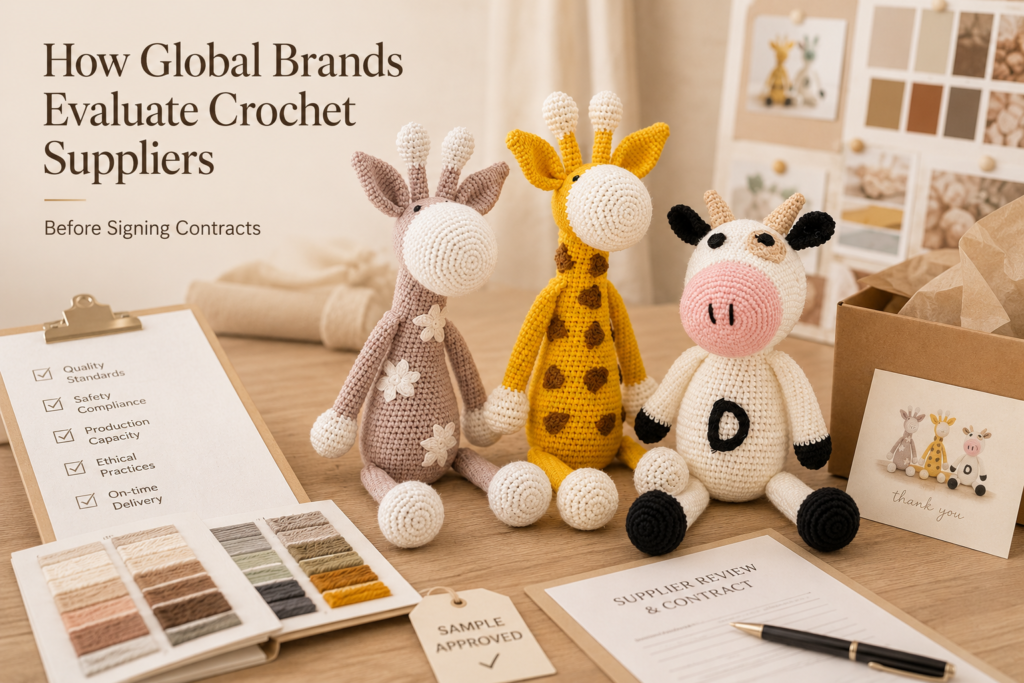
A Practical Supplier Evaluation Framework for Brands, Retailers, Gift Companies, and Product Developers
Choosing a crochet supplier is not simply a purchasing decision.
For global brands, it can affect:
- Product quality
- Delivery reliability
- Compliance risk
- Brand reputation
- Inventory planning
- Future product development
This is especially important in handmade crochet manufacturing.
Unlike highly automated production, crochet depends on skilled artisans, standardized patterns, material control, production planning, and quality management.
At U-MY Crochet, we have specialized in handmade crochet manufacturing since 2013, supporting retailers, gift brands, museum stores, distributors, e-commerce sellers, and product developers across more than 150 countries and regions.
Through years of working with international buyers, we have learned one important lesson:
Professional buyers do not select crochet suppliers based on price alone. They evaluate whether the supplier can reliably support the entire product lifecycle—from concept and sampling to production, compliance, packaging, and repeat orders.
This guide explains the main areas global brands typically evaluate before entering a long-term manufacturing relationship.

Why Crochet Supplier Evaluation Requires Extra Attention
Crochet manufacturing is different from many conventional production categories.
The final product may be handmade, but the manufacturing system still needs to operate professionally.
A reliable supplier must manage:
- Product development
- Pattern standardization
- Artisan coordination
- Material sourcing
- Quality control
- Compliance planning
- Packaging
- Export logistics
This means buyers should evaluate more than:
- Website appearance
- Product photos
- Quoted price
- Response speed
The more customized the project, the more important supplier capability becomes.
What Do Global Brands Evaluate Before Signing a Contract?
Although every company has its own procurement procedures, most serious buyers evaluate suppliers across several core areas:
- Company legitimacy
- Manufacturing experience
- Product specialization
- OEM and ODM capability
- Sampling performance
- Quality-control systems
- Production capacity
- Compliance support
- Material management
- Packaging capability
- Communication
- Delivery reliability
- Intellectual-property protection
- Social responsibility
- Commercial terms
A supplier does not need to be the largest company in the market.
It needs to be the right company for the project.
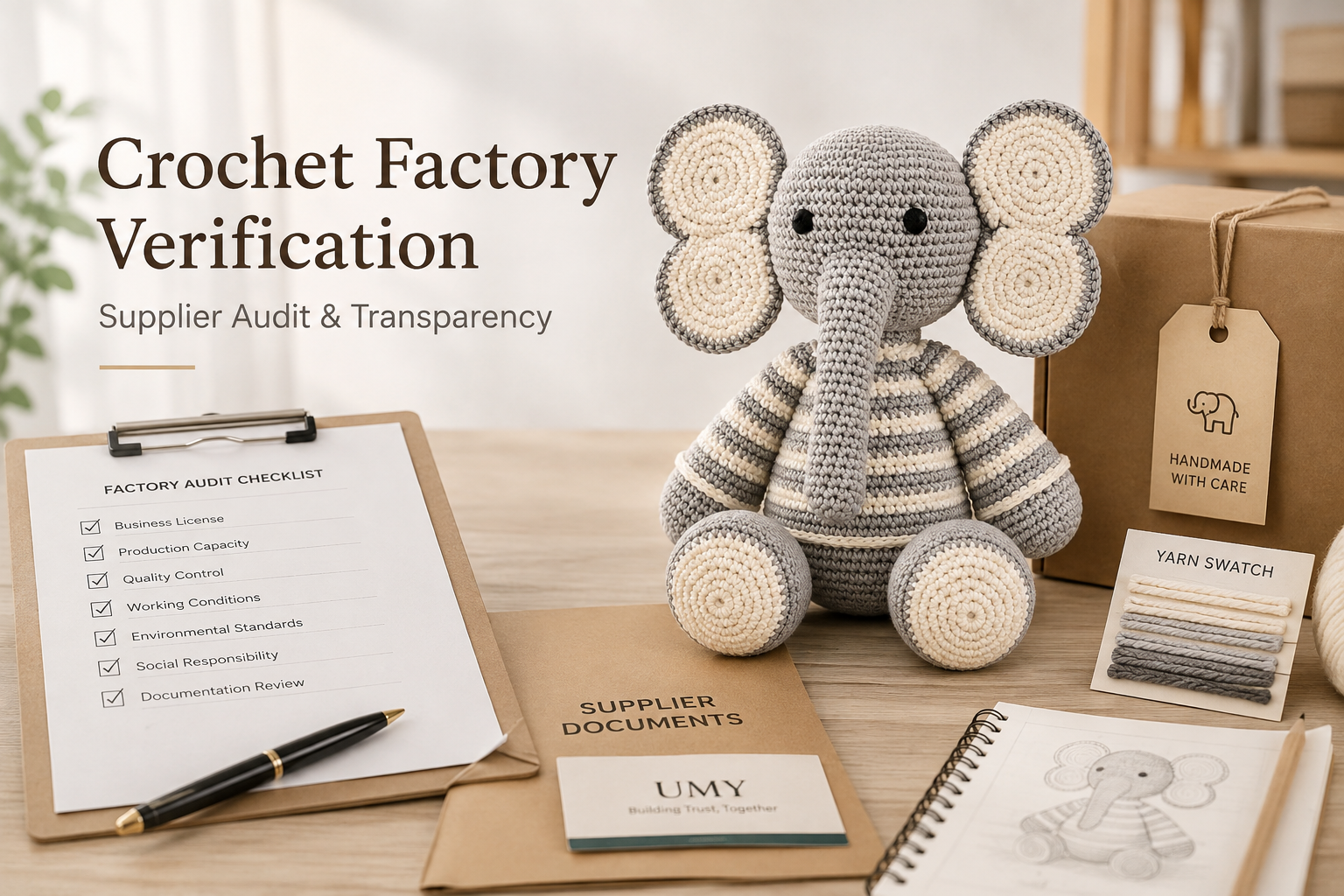
1. Company Legitimacy Comes First
Before discussing large orders, professional buyers usually verify that the supplier is a real operating business.
They may request:
- Business license
- Registered company name
- Factory or office address
- Export history
- Main markets
- Company website
- Trade references where appropriate
For handmade industries, buyers may also ask how production is structured.
For example:
- Which operations take place centrally?
- Which operations are performed by distributed artisan groups?
- Where are products assembled and inspected?
- Is subcontracting used?
Transparency matters.
A professional manufacturer should be able to explain how products move through the production system.
2. Buyers Evaluate Relevant Crochet Experience
Years in business are useful, but relevant experience matters more.
A company may have decades of textile experience without deep knowledge of crochet products.
Global brands often ask:
- How long have you specialized in crochet?
- Which crochet categories do you manufacture?
- Which export markets do you serve?
- Have you developed similar products before?
Relevant experience may include:
- Crochet dolls
- Mascots
- Baby gifts
- Keychains
- Crochet flowers
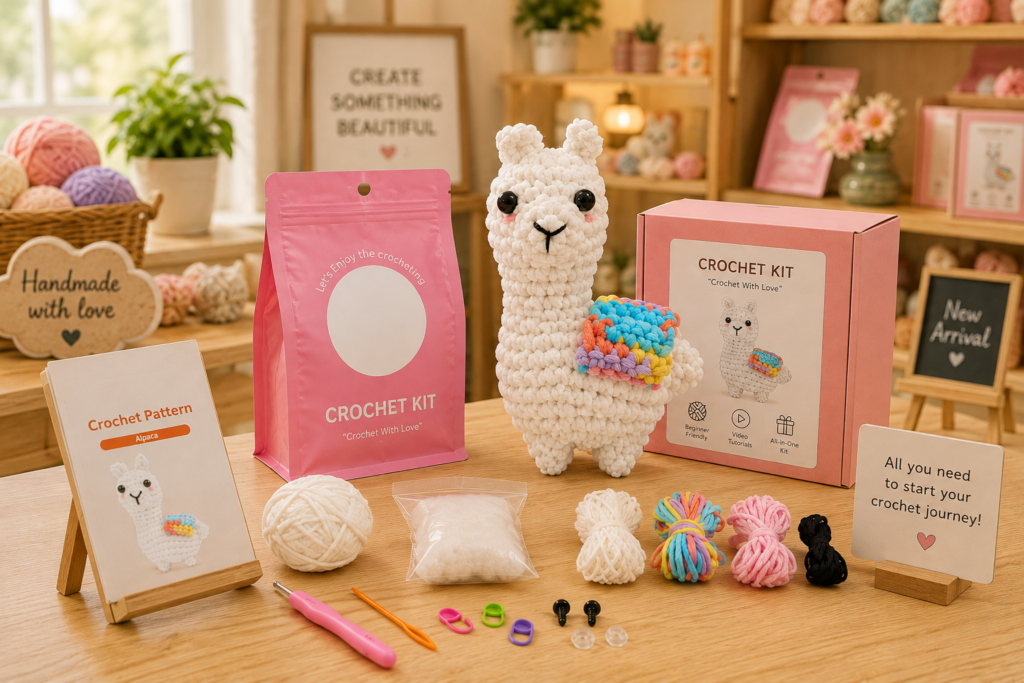
- DIY kits
- Museum souvenirs
- Seasonal collections
- Gift sets
The supplier should understand the manufacturing challenges specific to the buyer's product.
3. Product Specialization Matters More Than Catalog Size
A large product catalog can look impressive.
But buyers should ask:
Does this supplier genuinely understand the category we want to develop?
For example, a supplier experienced mainly in basic crochet animals may not automatically be the best choice for:
- Complex brand mascots
- Baby rattles
- Museum collections
- Multi-product gift programs
Different products require different technical knowledge.
4. OEM and ODM Capability Is Carefully Reviewed
One of the biggest differences between crochet suppliers is how much development support they provide.
OEM
The buyer already has:
- Artwork
- Product design
- Technical requirements
- Brand specifications
The factory manufactures according to those requirements.
ODM
The buyer may begin with:
- A concept
- A reference image
- A theme
- A target market
The supplier helps develop the product.
For brands without large internal development teams, ODM capability can be especially valuable.
Buyers may evaluate whether the supplier can help with:
- Product structure
- Pattern development
- Material selection
- Cost optimization
- Packaging
- Collection expansion
One principle we consistently see is:
A strong development partner reduces problems before bulk production begins.
5. Sample Quality Is One of the Strongest Supplier Tests
Samples reveal much more than product appearance.
They also reveal:
- Communication quality
- Development speed
- Technical understanding
- Attention to detail
- Problem-solving ability
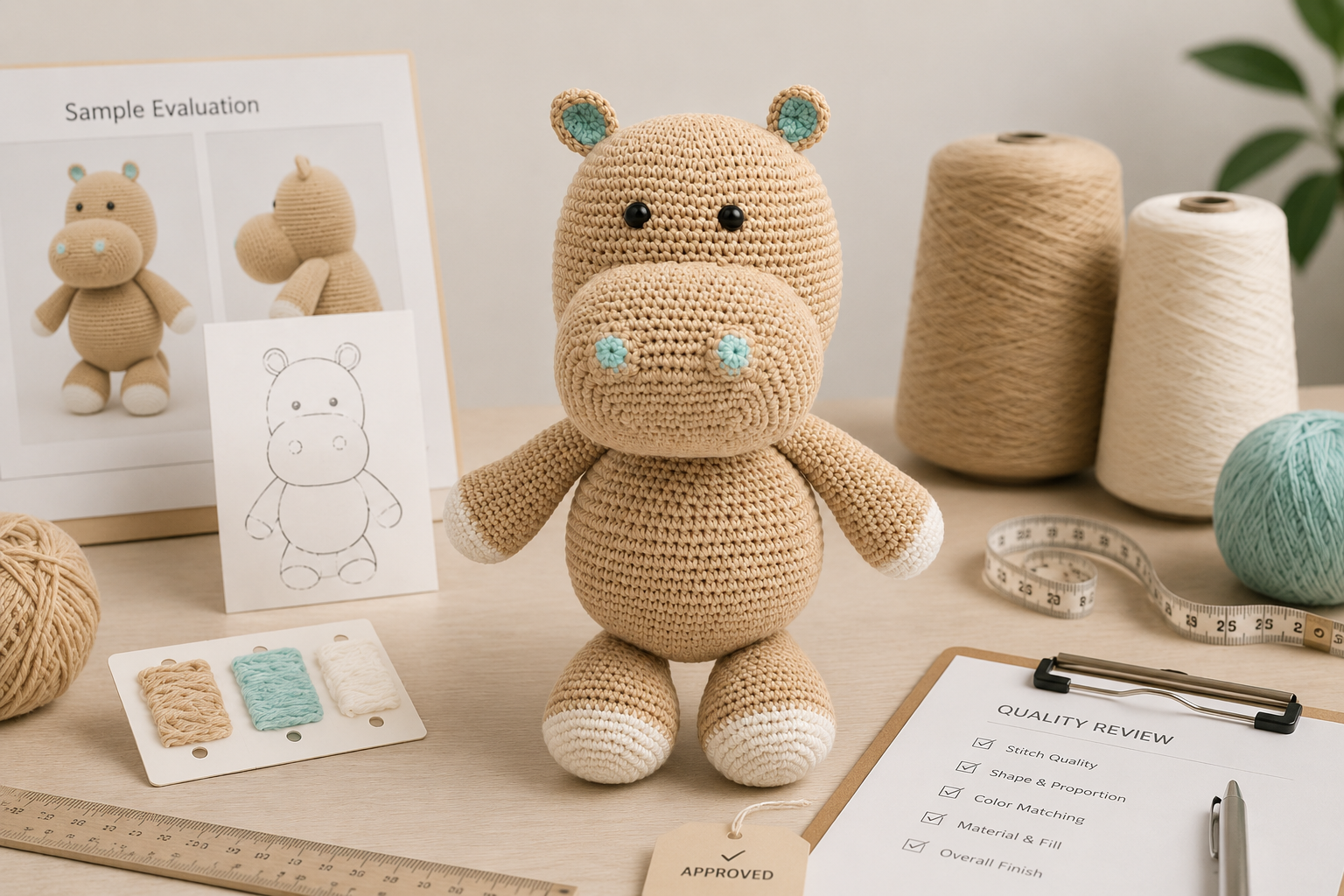
During sampling, buyers may evaluate:
- Proportions
- Stitch consistency
- Color accuracy
- Facial details
- Accessories
- Materials
- Overall finishing
For custom crochet projects, initial sample development may commonly require approximately 7–15 working days depending on complexity and materials.
However, speed should not be evaluated alone.
A slightly slower supplier that understands the brief correctly may be more valuable than a faster supplier requiring repeated corrections.
6. Brands Examine How the Factory Handles Revisions
The first sample is not always perfect.
This is normal in product development.
What matters is how the supplier responds.
Professional buyers observe:
- Does the supplier understand feedback accurately?
- Are changes documented?
- Are revisions implemented consistently?
- Does the supplier explain manufacturing limitations?
For example, vague feedback such as:
"Make the face friendlier."
may need to be translated into practical changes such as:
- Adjust eye spacing
- Change mouth shape
- Modify head proportion
A capable supplier helps convert creative feedback into manufacturable solutions.
7. Quality-Control Systems Matter More Than Quality Claims
Almost every supplier says:
"We have strict quality control."
Global brands usually want to know what that actually means.
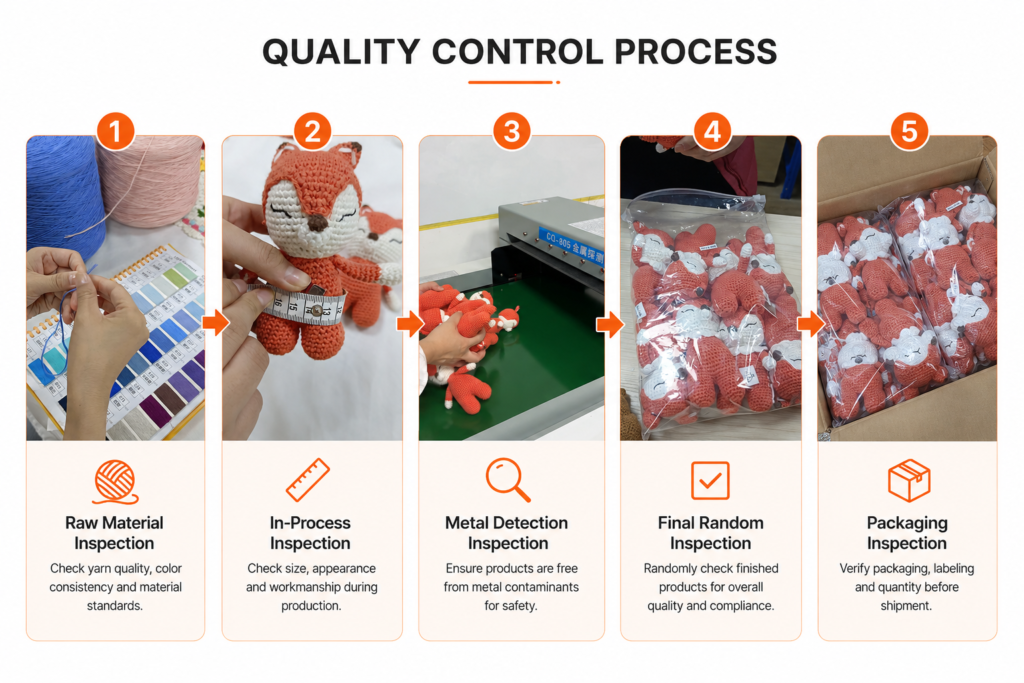
Professional buyers may ask about:
- Incoming material inspection
- First-production checks
- In-process inspection
- Assembly inspection
- Final inspection
- Packaging inspection
- Defect handling
For handmade crochet, buyers may also ask:
- How are size tolerances controlled?
- How is stitch consistency managed?
- How are facial features positioned?
- How are approved samples used?
The goal is not machine-level uniformity.
The goal is controlled consistency.
8. The Golden Sample Becomes a Critical Reference
Once the sample is approved, the buyer and supplier should establish a production reference.
This approved sample may define:
- Size
- Shape
- Colors
- Materials
- Expression
- Accessories
- Filling
- Packaging
For handmade products, the golden sample is especially important.
It helps align:
- Artisans
- Supervisors
- Quality inspectors
- Customer expectations
A supplier that cannot clearly translate an approved sample into bulk-production standards may create unnecessary risk.
9. Production Capacity Is Evaluated Carefully
Capacity is not simply about artisan headcount.
Brands want to know whether the supplier can manage their specific order.
Useful questions include:
- What is your monthly capacity?
- How many artisans support production?
- How is work allocated?
- How do you manage peak seasons?
- Can you support repeat orders?
For handmade crochet, scalability depends on:
- Standardized patterns
- Material availability
- Artisan training
- Production planning
- Quality management
A large network without strong management does not automatically create reliable capacity.
10. Brands Ask What Happens When Demand Increases
A supplier may handle the first 500 pieces successfully.
But what happens if the product becomes a bestseller?
Experienced buyers evaluate whether the supplier can grow from:
Test Order
↓
Repeat Order
↓
Seasonal Volume
↓
Long-Term Program
This is especially important for:
- Retailers
- E-commerce brands
- Seasonal collections
- Character merchandise
The ideal supplier supports both initial testing and future scaling.
11. Material Management Is Another Major Evaluation Area
- Color inconsistency
- Delays
- Quality variation
- Reorder difficulties
Global brands may ask:
- Where do you source yarn?
- How do you control color batches?
- Can materials be reserved for repeat orders?
- What alternatives are available?
For collections using shared colors, material consistency becomes especially important.
A visible color difference between SKUs can weaken the entire product presentation.
12. Compliance Experience Can Influence Supplier Selection
For toys and children's products, compliance can become a critical supplier-selection factor.
The exact requirements depend on:
- Product type
- Intended use
- Intended age
- Destination market
- Materials
Depending on the project and market, buyers may need to consider standards or requirements related to:
- ASTM F963
- CPSIA
- CPC
- EN71
- CE
- UKCA
- AS/NZS toy safety standards
A professional supplier should not simply say:
"We have certificates."
Instead, the supplier should understand that compliance depends on the specific product and market.
13. Buyers Verify Test Reports Rather Than Accepting Logos
Seeing certification logos on a website is not enough.
Professional buyers may request:
- Recent test reports
- Product description
- Tested materials
- Applicable standard
- Testing laboratory
They may compare the documents with the product being developed.
This is one reason early compliance planning is important.
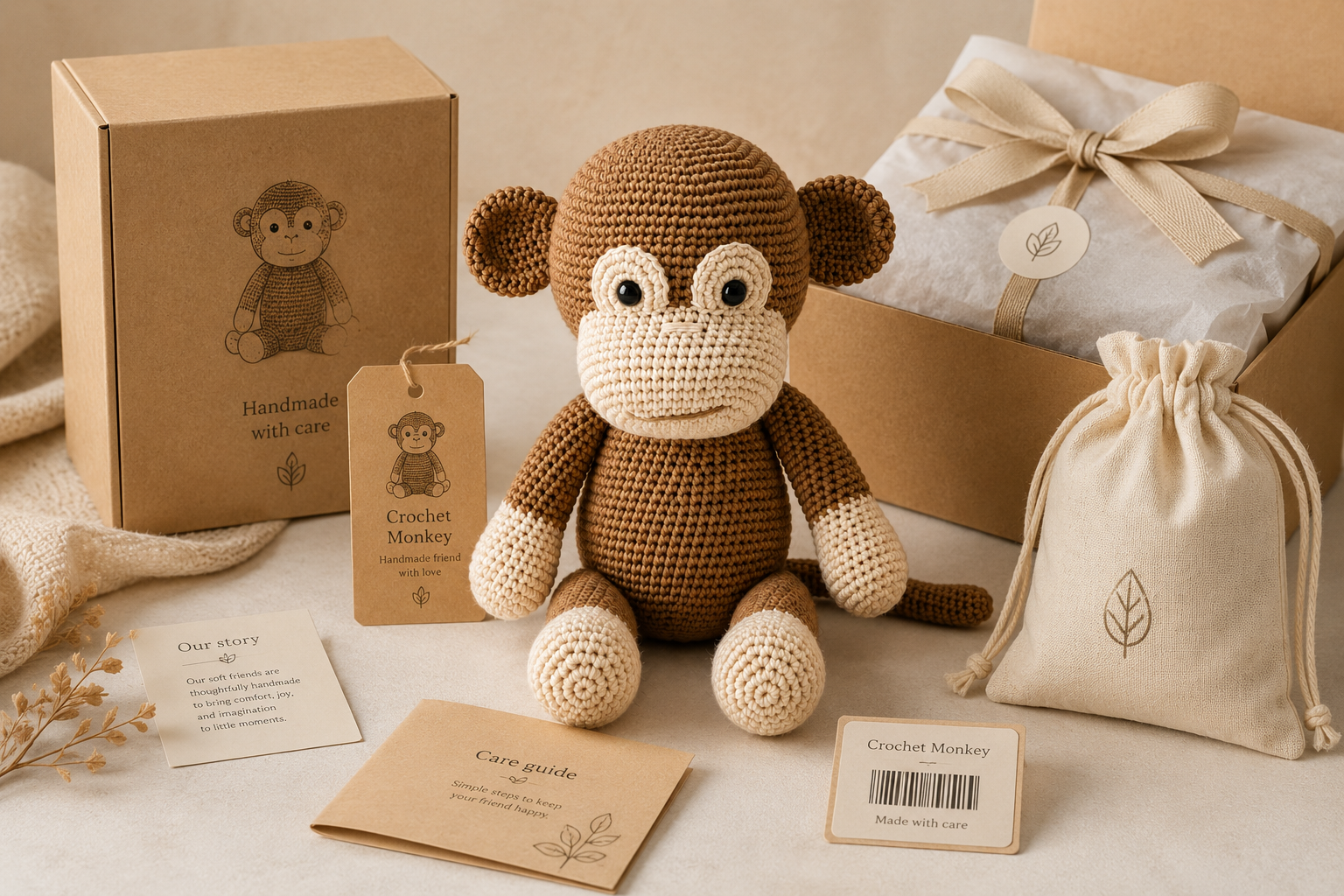
14. Packaging Capability Is Increasingly Important
Global brands often need products ready for retail.
Packaging requirements may include:
- Custom boxes
- Hangtags
- Story cards
- Barcodes
- Labels
- Gift packaging
- Instruction cards
A supplier with packaging-development capability can reduce the need to coordinate multiple vendors.
For gift brands and museum stores, packaging can also support:
- Storytelling
- Brand identity
- Perceived value
15. Brands Evaluate Communication Throughout the Entire Process
Communication quality is often one of the earliest indicators of project-management quality.
Buyers notice:
- Response speed
- Accuracy
- Technical knowledge
- Follow-up
- Problem transparency
Strong suppliers do not simply answer:
"Yes, we can do it."
They explain:
- What is possible
- What may need adjustment
- What affects cost
- What affects lead time
Professional buyers often prefer realistic answers over overly optimistic promises.
16. Delivery Reliability Matters More Than the Fastest Promise
A short lead time is attractive.
A reliable lead time is more valuable.
Before signing contracts, brands may ask:
- What is the normal production lead time?
- What happens during peak season?
- How is production tracked?
- What happens if materials are delayed?
The supplier should distinguish between:
- Sample lead time
- Production lead time
- Packaging lead time
- Shipping time
For seasonal programs, these distinctions are critical.
17. Intellectual Property Protection Is Important for Custom Projects
Brands developing:
- Original characters
- Mascots
- Licensed products
- Exclusive collections
need to protect creative assets.
Before signing a contract, buyers may clarify:
- Who owns the artwork?
- Who owns the crochet pattern?
- Can the factory resell the design?
- Can the supplier display samples publicly?
- Is confidentiality required?
For sensitive projects, buyers may use:
- NDAs
- Confidentiality clauses
- Design-ownership agreements
A professional custom manufacturer should respect customer intellectual property and clearly define usage rights.
18. Social Responsibility Is Becoming Part of Supplier Evaluation
Because crochet is labor-intensive, buyers may want to understand the human side of production.
Questions can include:
- How are artisans organized?
- How are production standards communicated?
- Is subcontracting disclosed?
- What social-audit documentation is available?
- How are long-term artisan relationships managed?
Handmade does not automatically mean ethical.
Responsible sourcing requires evidence rather than assumptions.
For global brands, production transparency may increasingly influence supplier selection.
19. Commercial Terms Are Evaluated in Context
Price is important.
But professional buyers usually compare more than unit price.
They may review:
- MOQ
- Sample fees
- Packaging cost
- Payment terms
- Production lead time
- Freight terms
- Testing costs
- Reorder flexibility
A lower unit price may create higher total cost if the project requires:
- More revisions
- Additional inspection
- Separate packaging suppliers
- Rework
- Delays
This is why experienced buyers evaluate total project value.
20. Global Brands Often Use a Supplier Scorecard
Larger buyers may formalize supplier evaluation through a scorecard.
A simplified version could look like this:
| Evaluation Area | Example Weight |
|---|---|
| Product Quality | 20% |
| Development Capability | 15% |
| Price Competitiveness | 15% |
| Production Capacity | 10% |
| Compliance | 10% |
| Delivery Reliability | 10% |
| Communication | 10% |
| Social Responsibility | 5% |
| Packaging & Retail Support | 5% |
The exact weighting varies.
For a complex mascot project, development capability may receive more weight.
For a large repeat program, capacity and delivery may matter more.
The key principle is:
The supplier should be evaluated according to the business risk of the project.
A Practical Pre-Contract Crochet Supplier Checklist
Before signing a manufacturing agreement, buyers can review the following.
Company Verification
- Business license reviewed
- Factory address verified
- Export experience checked
- Main markets confirmed
Product Capability
- Relevant category experience confirmed
- OEM/ODM capability reviewed
- Sample approved
- Revision performance evaluated
Production
- Capacity confirmed
- Artisan network explained
- Material sourcing reviewed
- Peak-season planning discussed
Quality
- Golden sample agreed
- QC workflow reviewed
- Tolerances confirmed
- Inspection expectations defined
Compliance
- Target market confirmed
- Required testing identified
- Available reports reviewed
Commercial Terms
- MOQ confirmed
- Price confirmed
- Packaging cost confirmed
- Payment terms agreed
- Lead time confirmed
IP and Confidentiality
- Design ownership clarified
- Confidentiality terms agreed
- Usage rights confirmed
This turns supplier selection into a structured decision rather than an impression.
Red Flags Global Buyers Should Watch For
Certain behaviors can indicate higher supplier risk.
Extremely Low Price Without Explanation
If one quotation is dramatically lower than all others, ask why.
Possible differences may involve:
- Materials
- Product size
- Workmanship
- Packaging
- Inspection
Refusing to Explain Production
A professional manufacturer should be able to describe how products are developed, made, inspected, and packed.
Generic Certificates With No Product Connection
Compliance documents should be relevant to the actual product.
Sample Quality Changes Between Revisions
Inconsistent sampling may signal weak internal standards.
Promising Everything Immediately
Statements such as:
"Any design, any quantity, any delivery date."
should be evaluated carefully.
Professional manufacturers usually explain limitations.
Unclear Intellectual-Property Policies
Custom designs should have clearly defined ownership and confidentiality terms.
Real Development Insight: Supplier Evaluation Begins During Sampling
One important lesson we have learned is that buyers do not need to wait until mass production to evaluate a supplier.
Sampling itself provides valuable evidence.
During the sample stage, brands can evaluate:
Does the supplier understand the brief?
Do they identify technical problems?
Are revisions implemented correctly?
Do they communicate delays honestly?
Can they explain cost changes?
These behaviors often predict what the production relationship will look like later.
A custom sample is not only a product prototype. It is also a small-scale test of the supplier relationship.
Why Supplier Development Can Be More Valuable Than Constant Supplier Switching
When a reliable supplier understands:
- Brand standards
- Product expectations
- Packaging requirements
- Quality tolerances
future projects often become easier.
Over time, the supplier may develop better knowledge of:
- Preferred materials
- Character styles
- Target costs
- Retail requirements
This can improve:
- Sampling speed
- Communication
- Reorder consistency
- Collection expansion
For complex handmade products, long-term supplier relationships can therefore create operational value.
How U-MY Supports Global B2B Buyers
U-MY Crochet has specialized in handmade crochet manufacturing since 2013.
Our product-development capabilities include:
- Crochet dolls
- Custom mascots
- Baby gift products
- Keychains
- Crochet flowers
- DIY crochet kits
- Gift sets
- Museum souvenirs
- Seasonal collections
We support both OEM and ODM development.
Our broader capabilities include:
- Custom sampling
- Material selection
- Production standardization
- Quality management
- Packaging customization
- Collection development
- International compliance planning
Our objective is not simply to receive purchase orders.
We aim to help customers move from:
Concept
↓
Sample
↓
Validated Product
↓
Stable Production
↓
Repeat Collection
Frequently Asked Questions
What should buyers check before choosing a crochet supplier?
Buyers should evaluate company legitimacy, relevant product experience, sampling, quality control, production capacity, compliance support, communication, delivery, packaging, IP protection, and commercial terms.
Is price the most important supplier-selection factor?
How can a buyer verify a crochet factory?
Buyers can review business documents, factory information, production processes, samples, quality systems, export experience, and third-party audit or inspection information where relevant.
Why is sampling important before signing a large contract?
Sampling allows buyers to evaluate product quality, communication, development capability, revision efficiency, and technical understanding before committing to larger orders.
What compliance documents should buyers request?
The required documents depend on the exact product and market. Buyers should request relevant test reports and verify that the reports apply to the product's materials, intended age group, and destination market.
Should buyers sign an NDA with a crochet factory?
For confidential artwork, original characters, licensed IP, or unreleased collections, brands may choose to use NDAs or contractual confidentiality clauses.
How do global brands evaluate handmade production capacity?
Is a large factory always safer than a smaller specialist?
Not necessarily. Relevant expertise, systems, transparency, communication, and project fit can matter more than company size alone.
Conclusion
Global brands do not choose crochet suppliers based on a single quotation.
They evaluate a manufacturing system.
They want to understand:
- Who the supplier is
- What the supplier knows
- How products are developed
- How handmade quality is controlled
- Whether production can scale
- Whether compliance risks are understood
- Whether designs are protected
- Whether deadlines can be trusted
At U-MY Crochet, our experience since 2013 has shown us that the strongest buyer-supplier relationships begin before the contract is signed.
They begin during:
- Supplier verification
- Technical discussion
- Sampling
- Revision
- Quality planning
The most useful question for a global buyer is therefore not:
"Which crochet supplier offers the lowest price?"
It is:
"Which supplier gives us the strongest evidence that they can protect our product, our timeline, and our brand as the business grows?"
That is the difference between selecting a vendor and building a reliable long-term manufacturing partnership.
 Chinese