
A Practical Guide to Managing Consistency, Safety, and Inspection in Handmade Crochet Manufacturing
Handmade crochet products are created differently from machine-made goods.
Every piece is made through human craftsmanship, which gives crochet products their warmth, texture, and character.
But for global brands and retailers, handmade quality must still be controlled.
Buyers need products that are:
- Consistent
- Safe
- Clean
- Properly finished
- Correctly packaged
- Ready for retail
At U-MY Crochet, we have specialized in handmade crochet manufacturing since 2013, supporting retailers, gift companies, museum stores, baby brands, distributors, and product developers across more than 150 countries and regions.
Through years of working on crochet dolls, mascots, baby products, gift sets, flowers, keychains, and seasonal collections, we have learned one important principle:
This guide explains how quality control works in professional handmade crochet production and what buyers should look for when evaluating a crochet manufacturer.
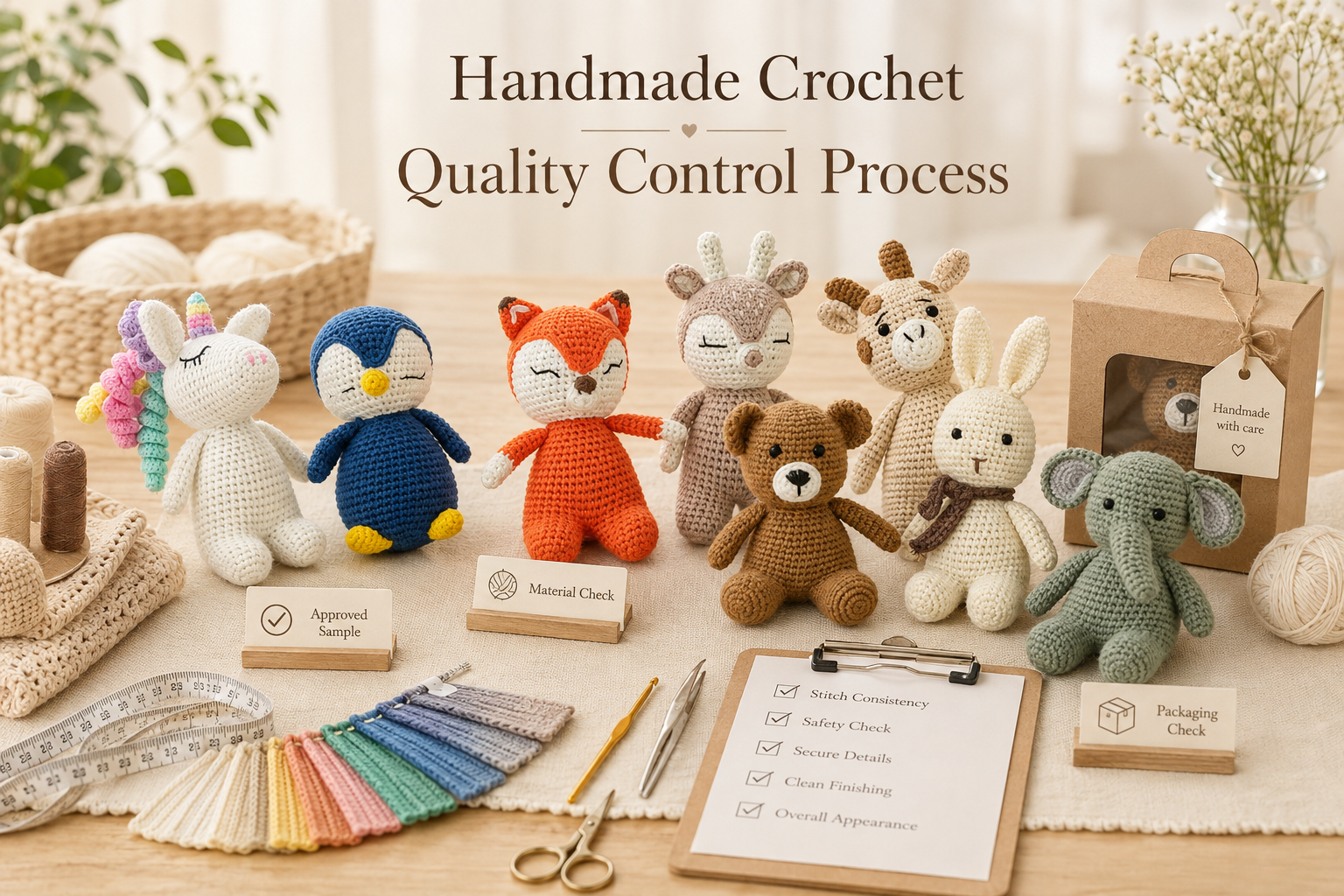
Why Quality Control Is More Complex in Handmade Crochet Production
In automated manufacturing, machines can repeat the same operation thousands of times.
Crochet is different.
Human factors influence:
- Stitch tension
- Shape
- Size
- Filling
- Embroidery
- Assembly
- Accessory placement
Two experienced artisans can follow the same pattern and still create slight differences.
This is normal.
The objective of professional quality control is therefore not to eliminate every handmade variation.
The objective is to define:
- What variation is acceptable
- What variation affects function
- What variation affects appearance
- What must be corrected before shipment
This is what we mean by controlled consistency.
What Does Quality Control Mean in Crochet Manufacturing?
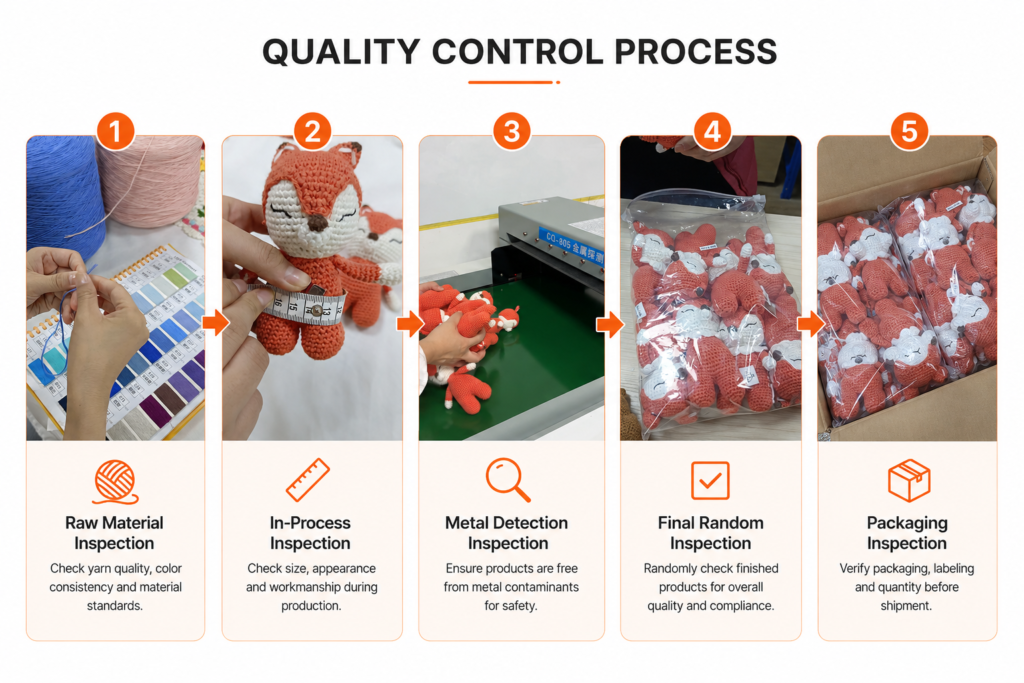
Professional crochet quality control usually covers five main areas:
- Materials
- Construction
- Appearance
- Safety
- Packaging
Each area requires its own standards.
For example, a product can look attractive but still fail quality requirements if:
- An accessory is loose
- The filling is uneven
- The dimensions are incorrect
- The packaging is damaged
- The wrong yarn color was used
Quality control must therefore evaluate the complete product, not only the crochet stitches.
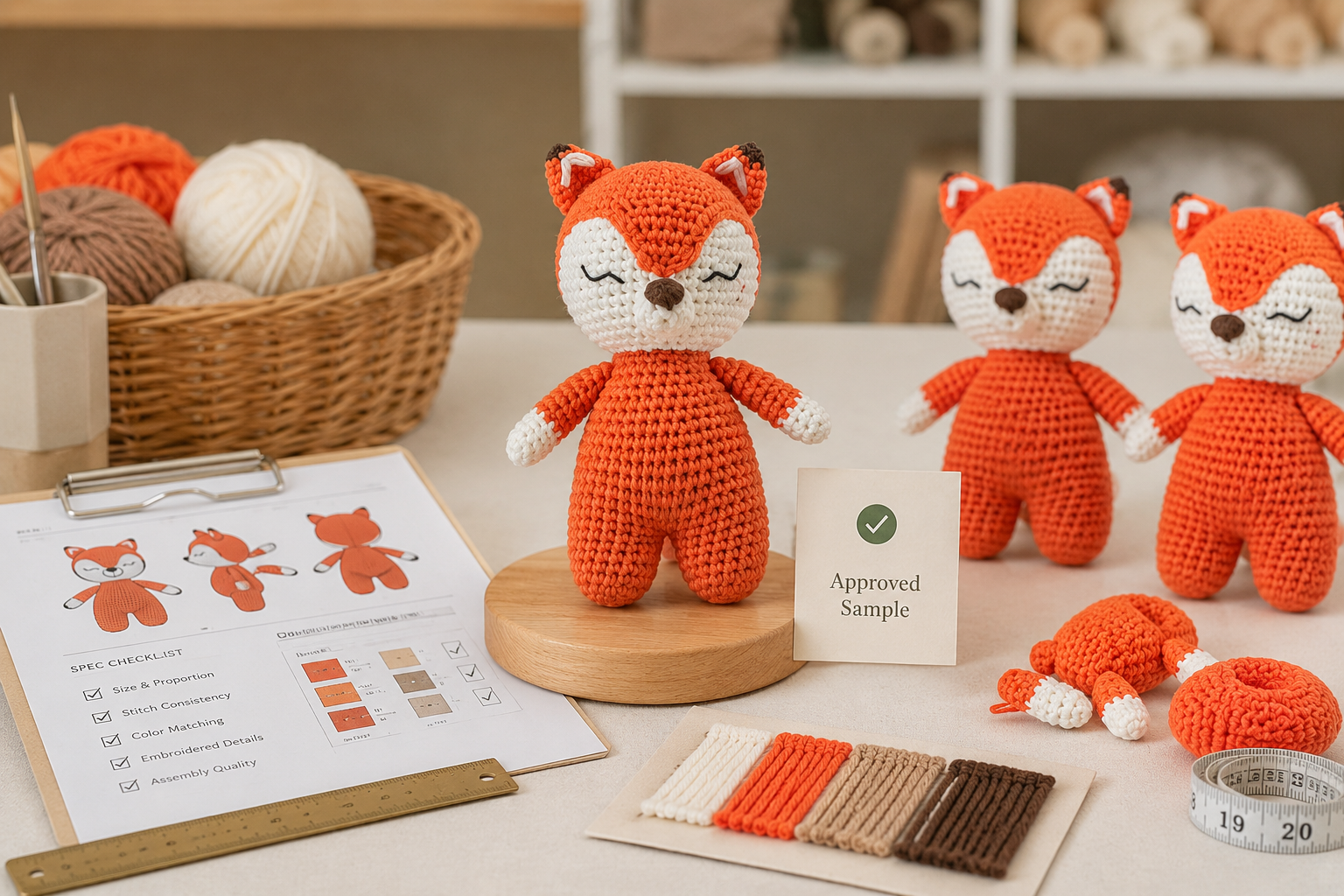
The Golden Sample: The Most Important Quality Reference
Before mass production begins, buyers and manufacturers should agree on an approved reference sample.
This is often called the:
- Golden sample
- Approved sample
- Master sample
- Production reference sample
The golden sample establishes the expected standard for:
- Size
- Shape
- Colors
- Facial expression
- Accessories
- Filling
- Embroidery
- Overall finish
For handmade production, written specifications alone are usually not enough.
The physical approved sample gives artisans, supervisors, and inspectors a clear visual benchmark.
One lesson we have learned is:
The stronger the approved sample, the easier it is to control bulk production.
Quality Control Begins Before Production
One common mistake is assuming that inspection happens only after products are finished.
Professional quality management starts much earlier.
Before production, the factory should confirm:
- Approved design
- Crochet pattern
- Material list
- Yarn colors
- Accessories
- Filling
- Labels
- Packaging
- Size specifications
If these elements are unclear, quality problems become much harder to control later.
Stage 1: Incoming Material Inspection
The first quality-control stage is checking materials before they enter production.
Typical checks may include:
Yarn
Inspect:
- Color
- Thickness
- Texture
- Batch consistency
- Cleanliness
A small yarn-color difference may become obvious when hundreds of products are displayed together.
Filling Material
Check:
- Cleanliness
- Material type
- Density
- Storage condition
Filling affects:
- Shape
- Weight
- Hand feel
Accessories
These may include:
- Safety eyes
- Wooden rings
- Buttons
- Zippers
- Keychain hardware
- Decorative parts
Inspectors should confirm:
- Correct size
- Correct color
- Surface condition
- Attachment suitability
Packaging Materials
Inspect:
- Printing
- Colors
- Dimensions
- Barcodes
- Labels
- Structural condition
Packaging defects can turn an acceptable product into an unacceptable retail shipment.
Stage 2: First-Article Production Check
Before a large batch is produced, professional factories may review the first finished production units.
The objective is simple:
Confirm that bulk production is actually following the approved sample.
This review may compare:
- Dimensions
- Shape
- Yarn
- Stitch density
- Embroidery
- Accessories
- Filling
- Assembly
If a problem appears here, it can be corrected before the same mistake is repeated across hundreds or thousands of units.
This is why early inspection is often more valuable than relying only on final inspection.
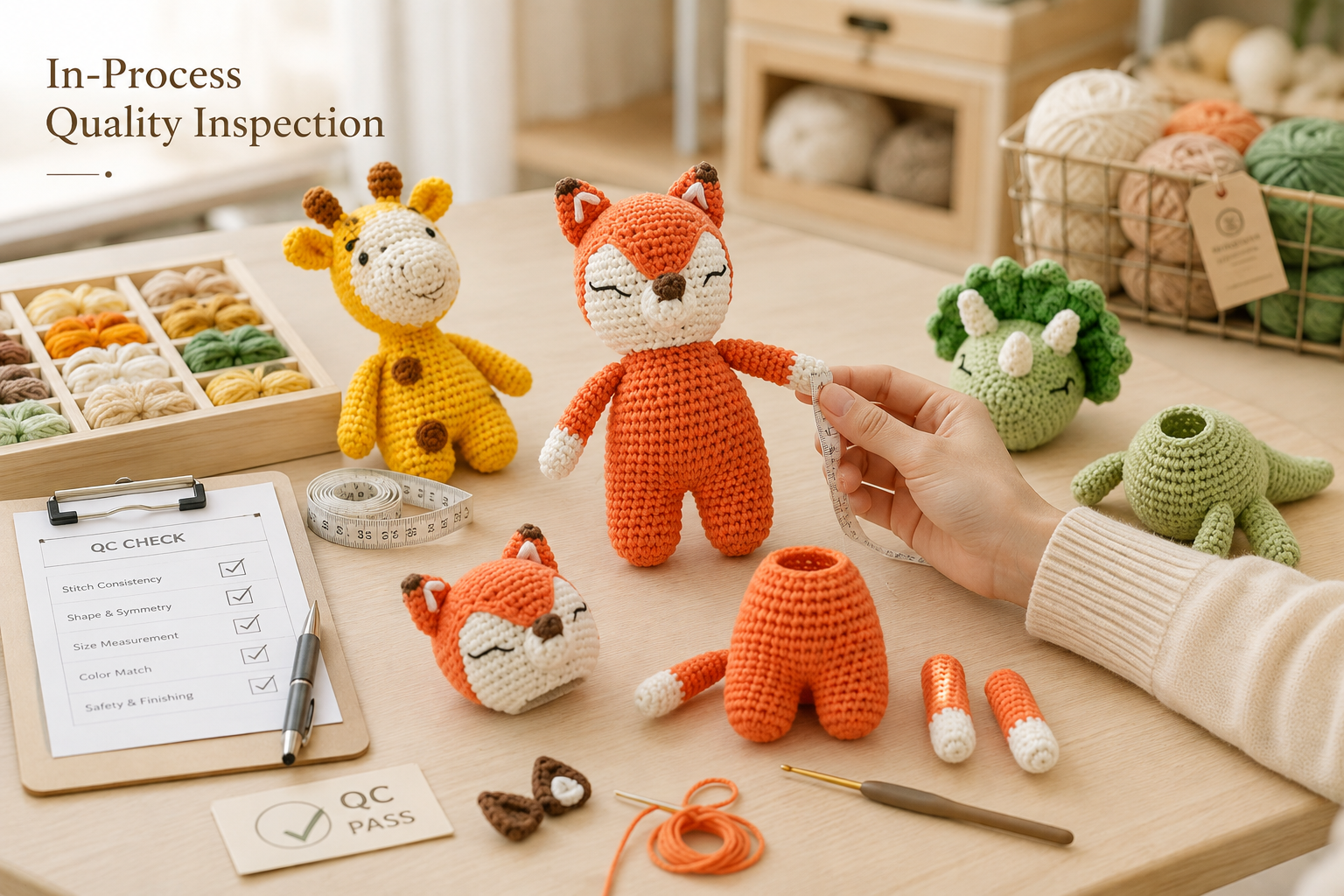
Stage 3: In-Process Quality Control
During production, inspectors or supervisors monitor products before they are completely finished.
This allows problems to be identified at the stage where they are easiest to correct.
Typical in-process checks include:
- Stitch consistency
- Size
- Component shape
- Color accuracy
- Missing stitches
- Loose yarn
- Correct component quantities
For example, if a crochet head is consistently too large, the problem can be corrected before assembly.
Without in-process inspection, the factory may only discover the issue after hundreds of finished dolls have already been assembled.
Stage 4: Assembly Quality Control
Many crochet products are made from several separate parts.
A character may include:
- Head
- Body
- Arms
- Legs
- Ears
- Clothing
- Accessories
Assembly has a major impact on final appearance.
Inspectors may check:
- Limb symmetry
- Head positioning
- Ear alignment
- Accessory placement
- Seam strength
- Embroidery positioning
Small assembly differences can significantly change a character's expression.
This is especially important for:
- Brand mascots
- Licensed characters
- Museum products
- Collectible dolls
where visual recognition must remain consistent.
Stage 5: Filling and Shape Control
Filling is often underestimated.
Too much filling can make a product:
- Hard
- Distorted
- Larger than specification
Too little filling can make it:
- Soft
- Uneven
- Collapsed
Professional production should establish filling references based on the approved sample.
Inspectors evaluate:
- Firmness
- Weight distribution
- Shape
- Symmetry
For character products, filling can directly affect whether the product looks like the approved design.
Stage 6: Embroidery and Facial Expression Inspection
For crochet dolls and mascots, the face is usually one of the most important quality areas.
A few millimeters of difference in eye or mouth placement can completely change the expression.
Quality control may therefore focus closely on:
- Eye positioning
- Mouth shape
- Eyebrow placement
- Embroidered logos
- Facial symmetry
This is especially important when a brand mascot has a recognizable expression.
One principle we often use in character development is:
If customers recognize the face first, the face should receive some of the strictest quality control.
Stage 7: Accessory Attachment and Functional Checks
Products may include:
- Keychain rings
- Bags
- Hats
- Clothing
- Wooden parts
- Decorative accessories
Inspectors should verify:
- Correct attachment
- Position
- Strength
- Completeness
For removable accessories, functional testing may also be necessary.
For example:
- Does the garment fit properly?
- Does the keychain hardware open and close correctly?
- Does the removable bag stay attached as intended?
Stage 8: Product Safety Checks
For products intended for children, quality control may also need to consider safety-related requirements.
The exact requirements depend on:
- Target country
- Product classification
- Intended age group
- Materials
- Accessories
Potential areas include:
- Small parts
- Attachment strength
- Flammability
- Chemical requirements
- Labeling
- Traceability
Depending on the market, relevant requirements may include standards or regulations related to:
- ASTM F963
- CPSIA
- CPC
- EN71
- CE
- UKCA
- AS/NZS toy safety requirements
A professional manufacturer should discuss compliance planning before mass production, not after the goods are finished.
Needle Control and Foreign-Material Prevention
For toy and gift products, manufacturers may also establish procedures to reduce the risk of foreign materials entering finished goods.
These can include:
- Controlled sewing needles
- Broken-needle procedures
- Workstation checks
- Final inspection
- Needle detection where appropriate
The exact procedure depends on the product and production process.
Buyers should ask the manufacturer to explain how needle and foreign-material risks are managed rather than assuming every supplier uses the same method.
Stage 9: Final Appearance Inspection
Before packaging, finished products are reviewed as complete units.
Final appearance inspection may include:
- Correct design
- Clean surface
- No loose yarn
- Correct dimensions
- Correct colors
- Symmetry
- Proper accessories
- Correct labels
- Good overall presentation
Inspectors compare finished goods against:
- Approved sample
- Product specification
- Customer requirements
The objective is to identify defects before products enter retail packaging.
What Are Common Crochet Quality Defects?
Typical handmade crochet defects may include:
| Quality Area | Common Defect |
|---|---|
| Size | Product too large or too small |
| Shape | Uneven or distorted body |
| Stitching | Loose or inconsistent stitches |
| Color | Wrong yarn or batch variation |
| Filling | Too firm, too soft, or uneven |
| Face | Misaligned embroidery |
| Assembly | Uneven limbs or accessories |
| Finishing | Loose yarn ends |
| Hardware | Incorrect or weak attachment |
| Packaging | Wrong label or damaged box |
A professional quality-control system should define which defects require:
- Immediate correction
- Rework
- Rejection
Handmade Variation vs Quality Defect
This is one of the most important concepts for crochet buyers.
Not every difference is a defect.
Because products are handmade, slight differences may naturally occur in:
- Stitch texture
- Shape
- Facial expression
- Product dimensions
However, these differences should remain within agreed tolerances.
For example:
A slight difference in stitch tension may be acceptable.
A product that is significantly larger than the approved size may not be.
The buyer and manufacturer should therefore agree on realistic standards before production begins.
Why Size Tolerances Matter
Suppose the approved crochet doll is 20 cm tall.
Expecting every handmade product to measure exactly 20.000 cm is unrealistic.
Instead, a production specification may define an acceptable tolerance.
The exact tolerance should depend on:
- Product type
- Size
- Construction
- Customer requirements
This prevents subjective arguments during inspection.
The same principle can apply to:
- Width
- Accessory position
- Weight
- Embroidery placement
Clear tolerances make handmade quality easier to manage.
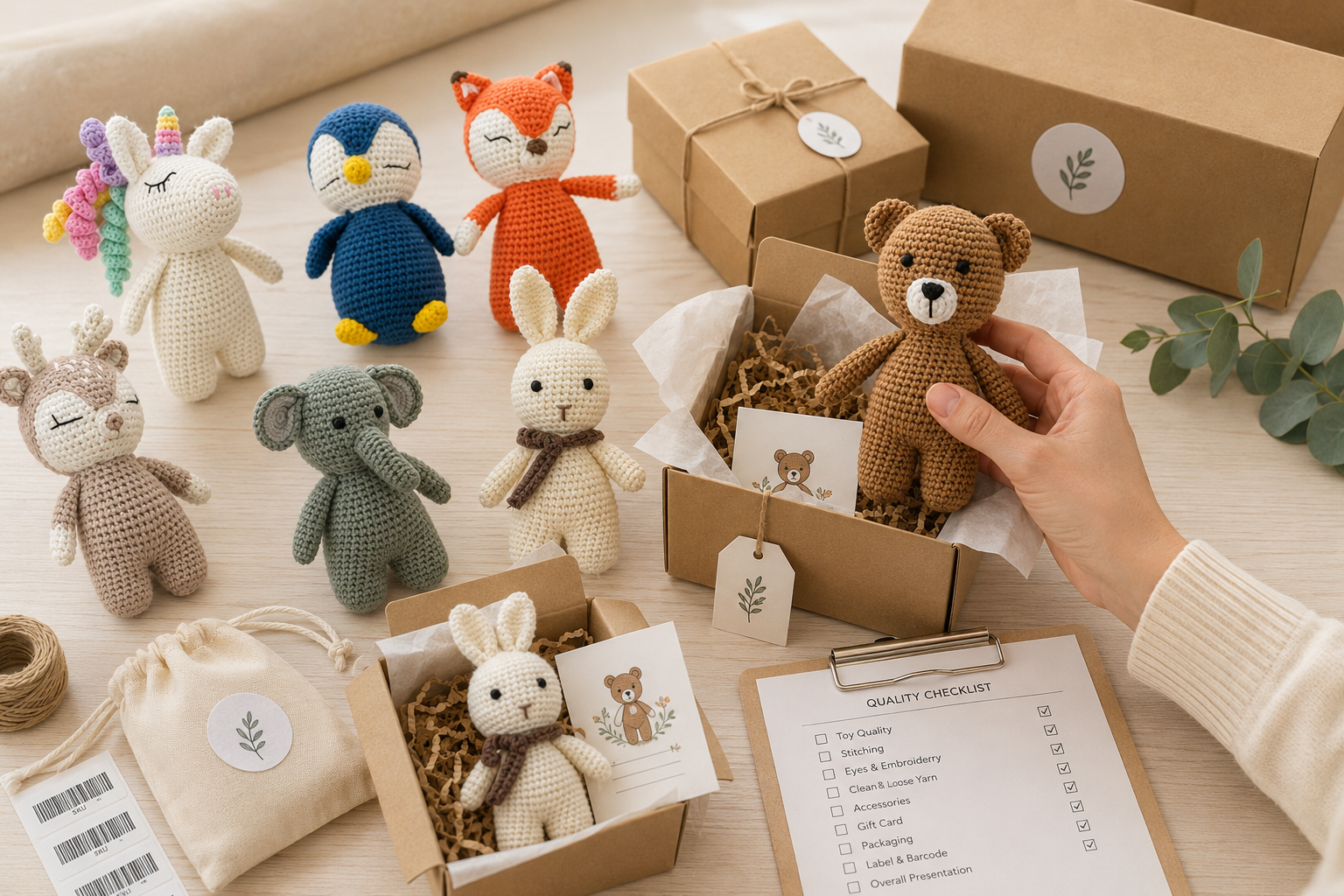
Stage 10: Packaging Inspection
Packaging is part of final product quality.
Before shipment, quality teams may check:
- Correct product inside
- Correct SKU
- Correct barcode
- Correct label
- Packaging condition
- Product orientation
- Quantity per carton
- Carton markings
For gift sets, inspectors may also verify:
- All components are included
- Cards are correct
- Accessories match
- Products are arranged properly
A beautiful product inside the wrong package is still a quality problem.
Stage 11: Pre-Shipment Inspection
Before goods leave the factory, a final shipment-level inspection can help confirm that the order is ready.
Depending on buyer requirements, inspection may review:
- Quantity
- Workmanship
- Dimensions
- Packaging
- Labeling
- Carton condition
Some buyers use internal QC teams.
Others use third-party inspection companies.
For larger orders, buyers may specify an AQL-based inspection approach.
The exact inspection plan should be agreed before production.
What Is AQL in Crochet Product Inspection?
AQL stands for Acceptable Quality Limit.
For handmade products, AQL does not replace production quality control.
It provides an additional method for evaluating the finished shipment.
Buyers should agree with the supplier on:
- Inspection level
- Defect classification
- Critical defects
- Major defects
- Minor defects
before inspection begins.
Critical, Major, and Minor Defects
Quality teams often classify problems according to severity.
Critical Defects
Problems that may create serious safety or regulatory risks.
Examples may include unsafe components or prohibited materials.
Major Defects
Problems that materially affect product use, appearance, or customer acceptance.
Examples may include:
- Incorrect product
- Significant dimensional difference
- Missing components
Minor Defects
Smaller cosmetic issues that do not significantly affect normal use.
The exact classification should be defined according to the product and buyer requirements.
Real Production Insight: Why Early QC Saves More Than Final Inspection
Consider this sequence:
Incorrect Head Size
↓
Detected during crochet stage
↓
Head can be remade
Compare that with:
Incorrect Head Size
↓
Not detected
↓
Head is assembled
↓
Face is embroidered
↓
Product is filled
↓
Product is packaged
Now the same original problem requires significantly more rework.
This is why professional QC should be distributed throughout production rather than concentrated at the end.
The best final inspection is the one that finds very few surprises because earlier quality controls already worked.
How Quality Control Supports Large-Scale Handmade Production
Buyers sometimes assume that increasing artisan numbers automatically increases quality risk.
It can—if production is not organized.
Professional scaling depends on:
- Approved patterns
- Unified materials
- Artisan training
- Skill-based production allocation
- In-process inspection
- Centralized finishing
- Final QC
The factory does not expect hundreds of artisans to independently interpret the customer's artwork.
They follow the same production standard.
That is how handmade crochet can move from:
One successful sample
to
Commercial-scale production
without losing the character of the original design.
Quality Control for Custom Crochet Mascots
Mascot projects require especially careful control because the product represents a brand.
Important areas may include:
- Brand colors
- Facial expression
- Signature accessories
- Clothing
- Logo details
- Character proportions
When reviewing a mascot design before production, it can be helpful to identify:
Critical Identity Features
Elements that must remain highly consistent.
Supporting Details
Elements where minor variation is acceptable.
Handmade Characteristics
Small differences that do not affect brand recognition.
This helps QC teams focus attention where it creates the most value.
Quality Control for Baby Crochet Products
Baby products may require additional attention because buyers may have stricter expectations regarding:
- Materials
- Construction
- Cleanliness
- Attachment strength
- Product safety
Depending on intended use and market, buyers should review applicable regulatory requirements during development.
The quality plan may need to consider:
- Yarn
- Filling
- Wooden accessories
- Small parts
- Labels
- Age recommendations
A product should not be described or marketed for babies without understanding the requirements that may apply in the destination market.
Quality Control for Crochet Gift Sets
Gift sets introduce another layer of complexity.
Quality control must evaluate both:
Individual components
and
Complete set assembly
Inspectors may check:
- Correct combination of products
- Packaging condition
- Greeting cards
- Labels
- Product arrangement
- Quantity
If a set contains products from several supply partners, coordination becomes even more important.
Why Material Lot Control Matters
A repeat order may use the same yarn color code but still show slight differences between material batches.
For large retail programs, material management should consider:
- Batch consistency
- Sufficient quantity reservation
- Reorder planning
This is especially important when several SKUs in one collection use matching colors.
A visible color mismatch between products can weaken the entire retail presentation.
How Buyers Can Improve Quality Before Production Starts
Buyers can improve final quality by providing better information early.
Useful information includes:
- Artwork
- Dimensions
- Pantone or color references where needed
- Material expectations
- Packaging specifications
- Product-use information
- Target market
- Approved sample comments
Vague instructions create subjective quality standards.
Detailed instructions create measurable standards.
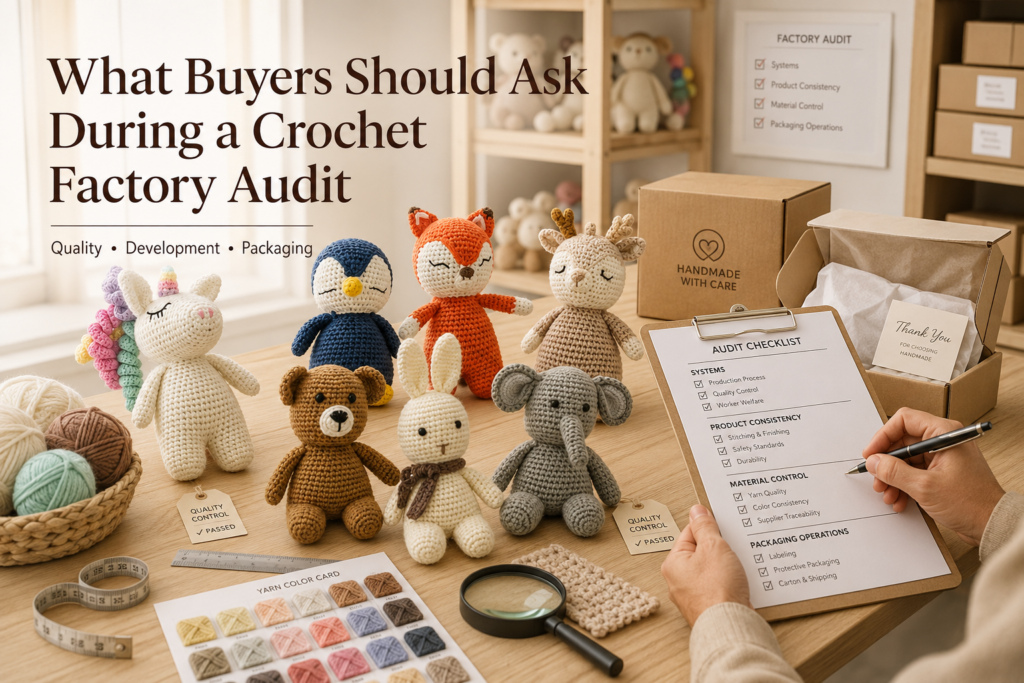
Questions Buyers Should Ask a Crochet Factory About Quality Control
Before placing a large order, consider asking:
- How do you approve production samples?
- How are crochet patterns standardized?
- How are yarn colors controlled?
- Do you inspect incoming materials?
- What in-process inspections are performed?
- How is artisan work supervised?
- How do you control size variation?
- How are facial features inspected?
- What happens when defective products are found?
- How do you manage needle control?
- Do you support AQL inspection?
- Can third-party inspectors visit before shipment?
- How are packaging errors prevented?
- How do you manage repeat-order consistency?
The answers can reveal whether QC is a real manufacturing system or simply a marketing statement.
Common Quality-Control Mistakes Buyers Make
Mistake 1: Approving a Sample Too Quickly
The approved sample becomes the production reference.
Take time to review it carefully.
Mistake 2: Expecting Machine-Level Uniformity
Define realistic tolerances rather than impossible standards.
Mistake 3: Giving Subjective Feedback
Comments such as:
“Make it cuter.”
are difficult to control.
More useful feedback might be:
“Move both eyes approximately 3 mm closer together.”
Mistake 4: Checking Quality Only Before Shipment
Final inspection cannot efficiently fix problems already repeated across an entire order.
Mistake 5: Ignoring Packaging QC
Retail customers experience both product and packaging.
Mistake 6: Changing Standards During Production
Frequent specification changes after bulk production begins increase:
- Confusion
- Rework
- Cost
- Delay
Finalize key requirements before scaling.
How U-MY Approaches Handmade Crochet Quality Management
U-MY Crochet has specialized in handmade crochet manufacturing since 2013.
Our product categories include:
- Crochet dolls
- Custom mascots
- Baby products
- Crochet flowers
- Keychains
- Gift sets
- DIY crochet products
- Seasonal collections
Our quality-management approach is built around the principle of controlled consistency.
Depending on the project, quality control can include:
Approved Sample Management
Establishing the physical production reference.
Material Inspection
Checking yarn, filling, accessories, and packaging components.
Production Monitoring
Reviewing handmade components during production.
Assembly Inspection
Checking shape, positioning, and finishing.
Final Inspection
Reviewing completed products against approved standards.
Packaging Control
Confirming labels, products, and retail presentation before shipment.
For children's products and regulated markets, compliance requirements should be reviewed according to the exact product, intended age group, materials, and destination market.
What We Have Learned From Handmade Quality Control
After years of developing and producing custom crochet products, several lessons consistently stand out.
Quality Cannot Be Inspected Into a Product at the End
It needs to be built into the process.
Handmade Does Not Mean Uncontrolled
Variation can be managed through clear standards.
The Approved Sample Matters
It provides the visual reference for production.
Earlier Feedback Costs Less
Product Development and QC Are Connected
The best quality strategy begins before the first bulk stitch is made.
Frequently Asked Questions
How do crochet factories maintain consistent quality when every item is handmade?
Are handmade crochet products supposed to look exactly identical?
Not completely. Small variations are natural in handmade production. The objective is controlled consistency within agreed size, appearance, and workmanship standards.
What is a golden sample?
A golden sample is the approved physical reference used to guide bulk production and inspection.
What quality problems are common in crochet products?
What is AQL inspection?
Should quality inspection happen only after production?
No. Strong quality management includes incoming material checks, first-production review, in-process inspection, assembly checks, final inspection, and packaging control.
How do factories control the appearance of crochet mascots?
They use approved samples, color references, patterns, measurements, facial-placement references, filling standards, and focused inspection of signature character features.
Can buyers arrange third-party inspection?
Often yes. Buyers should discuss third-party inspection requirements with the manufacturer before shipment and agree on the inspection standard in advance.
Does a certificate guarantee product quality?
No. Compliance testing and production quality control serve different purposes. A product may require applicable testing while still needing strong manufacturing QC for appearance, consistency, workmanship, and packaging.
Conclusion
Quality control in handmade crochet manufacturing is not about making every product look machine-made.
A professional quality system combines:
- Approved samples
- Controlled materials
- Clear specifications
- Skilled artisans
- In-process inspections
- Final quality checks
- Packaging control
At U-MY Crochet, our experience since 2013 has taught us that the strongest quality programs begin long before final inspection.
They begin when the product is designed, sampled, documented, and prepared for production.
For buyers evaluating crochet manufacturers, the most important question is therefore not simply:
“Do you have quality control?”
It is:
“How does your quality-control system prevent small handmade variations from becoming large commercial problems?”
A manufacturer that can answer that question clearly is much more likely to deliver reliable handmade products at scale.
 Chinese