
Inside the Production Systems That Make Handmade Crochet Scalable
When buyers first learn that crochet products are handmade, one question almost always follows:
"How can a handmade factory produce thousands—or even hundreds of thousands—of crochet products every year?"
Unlike plastic toys, garments, or injection-molded products, crochet cannot simply be produced by adding more machines.
Instead, successful crochet manufacturing depends on something much more valuable:
A well-organized artisan production system.
After more than 12 years of specializing in handmade crochet manufacturing, U-MY Crochet has supported retailers, museum stores, gift brands, e-commerce sellers, distributors, and corporate buyers across more than 150 countries and regions.
During that time, we have learned an important truth:
Scaling handmade production is not about having the most artisans—it is about building the right management system.
This article explains how professional crochet factories organize thousands of artisans while maintaining quality, consistency, and reliable delivery.
Handmade Crochet Cannot Be Managed Like Conventional Manufacturing
Many buyers compare crochet factories with traditional manufacturing plants.
However, the production models are fundamentally different.
Traditional factories rely on:
- Automated machinery
- Fixed production lines
- Standardized machine operations
Crochet production relies on:
- Skilled artisans
- Standardized patterns
- Material coordination
- Production scheduling
- Quality supervision
- Centralized finishing
Machines create consistency through automation.
Crochet factories create consistency through systems.
That distinction changes everything.
Why Large Crochet Factories Don't Keep Thousands of Workers Inside One Building
Many buyers imagine a crochet factory as a giant workshop filled with thousands of artisans.
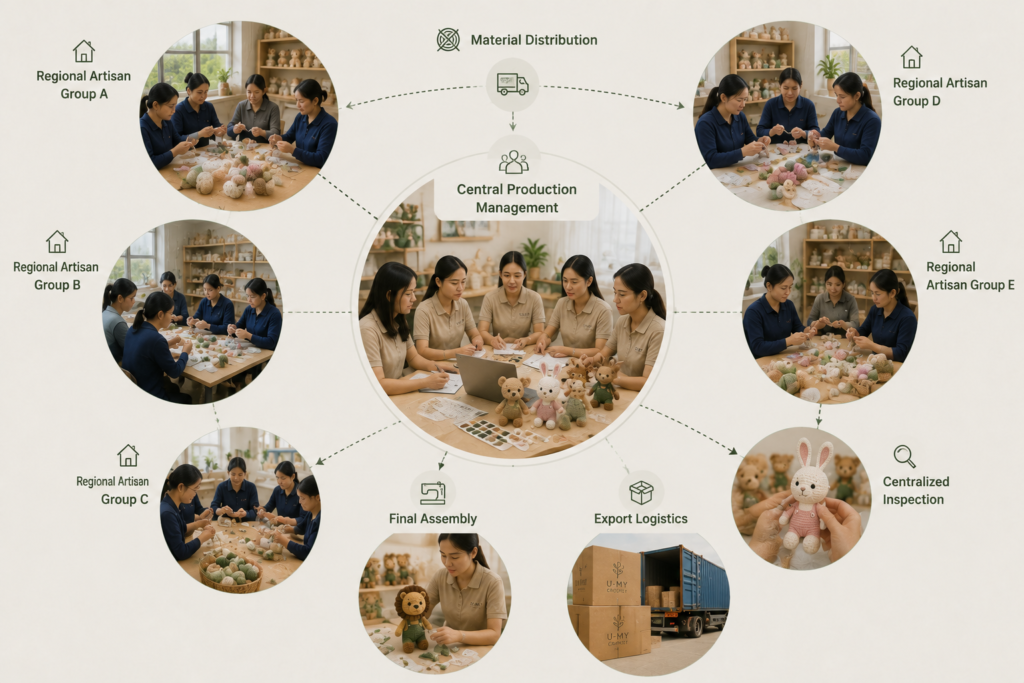
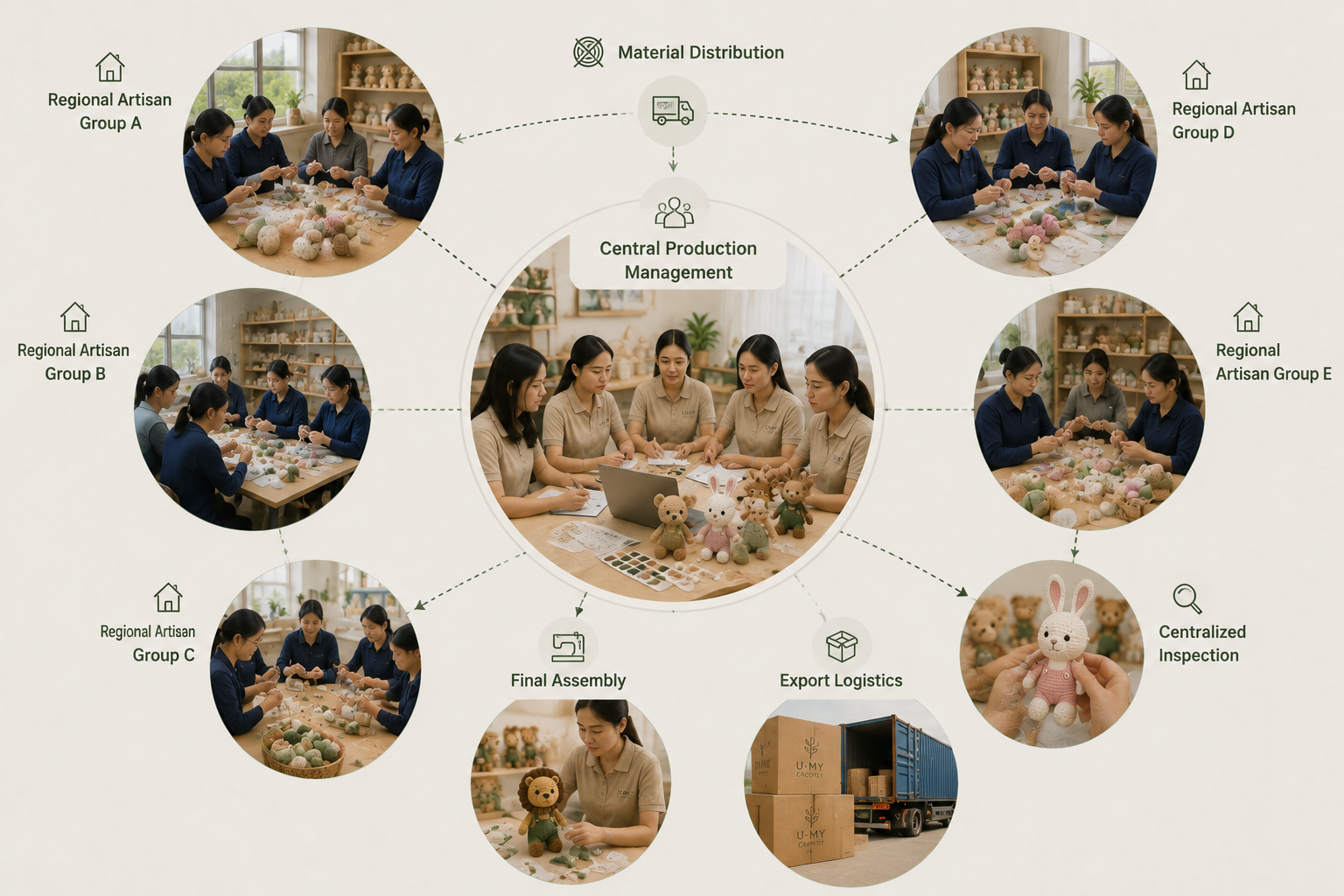
In reality, professional crochet manufacturers usually operate through a distributed production network.
This model combines:
- Central production management
- Regional artisan groups
- Material distribution
- Unified quality standards
- Centralized inspection
- Final assembly
- Export logistics
Instead of requiring every artisan to work in one location, the factory coordinates production across multiple trained teams.
This approach provides greater flexibility while maintaining production standards.
The Six Core Systems Behind Large-Scale Handmade Crochet Production
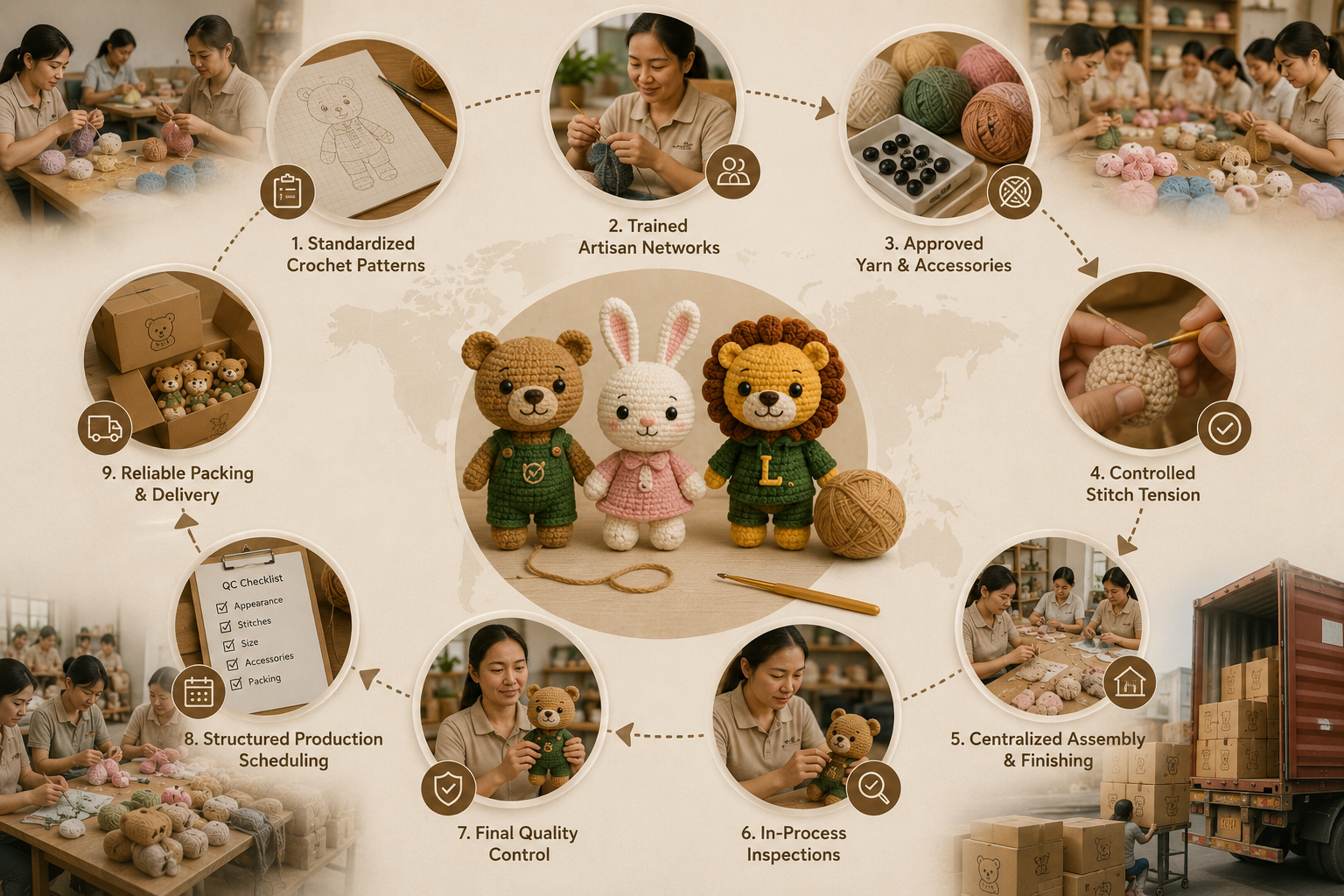
Professional crochet factories rarely rely on one process alone.
Instead, they integrate several management systems that work together.
1. Standardized Pattern System
Everything begins with one approved version of the product.
Before production starts, the factory creates:
- Approved crochet patterns
- Stitch instructions
- Material specifications
- Yarn color references
- Filling standards
- Assembly guides
Only after these standards are finalized is production assigned to artisans.
This reduces variation before manufacturing even begins.
2. Material Distribution System
Professional factories never allow artisans to source materials independently.
Instead, factories centrally prepare:
- Yarn
- Filling
- Safety eyes
- Labels
- Accessories
- Packaging materials
Every production batch uses approved materials from the same inventory.
This improves consistency across large orders.
3. Production Allocation System
Not every artisan makes every product.
Factories usually assign work according to experience.
For example:
| Product Type | Typical Assignment |
|---|---|
| Beginner designs | Newly trained artisans |
| Standard dolls | Experienced crochet teams |
| Complex mascots | Senior artisans |
| Mini keychains | High-efficiency production groups |
| Premium collections | Specialist development teams |
Matching product complexity with artisan experience improves both efficiency and quality.
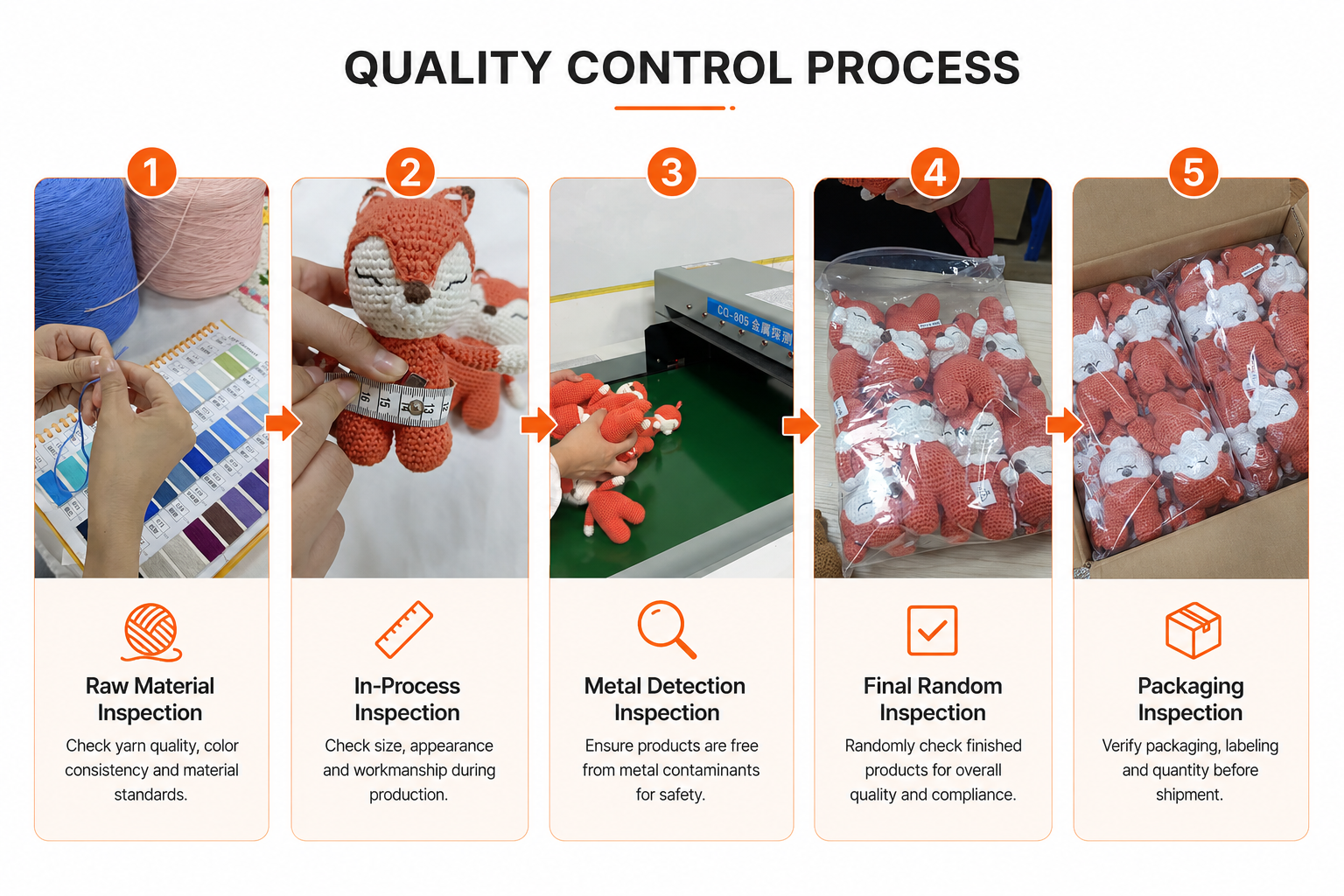
4. Multi-Stage Quality Control
Quality is not inspected only after production.
Professional factories monitor quality throughout the process.
Typical checkpoints include:
Raw Materials
- Yarn inspection
- Color verification
- Accessory inspection
During Crochet
- Stitch consistency
- Size measurements
- Pattern accuracy
Assembly
- Embroidery
- Filling
- Shape adjustment
- Accessory installation
Final Inspection
- Appearance
- Packaging
- Labels
- Product cleanliness
By identifying issues early, factories reduce costly rework later.
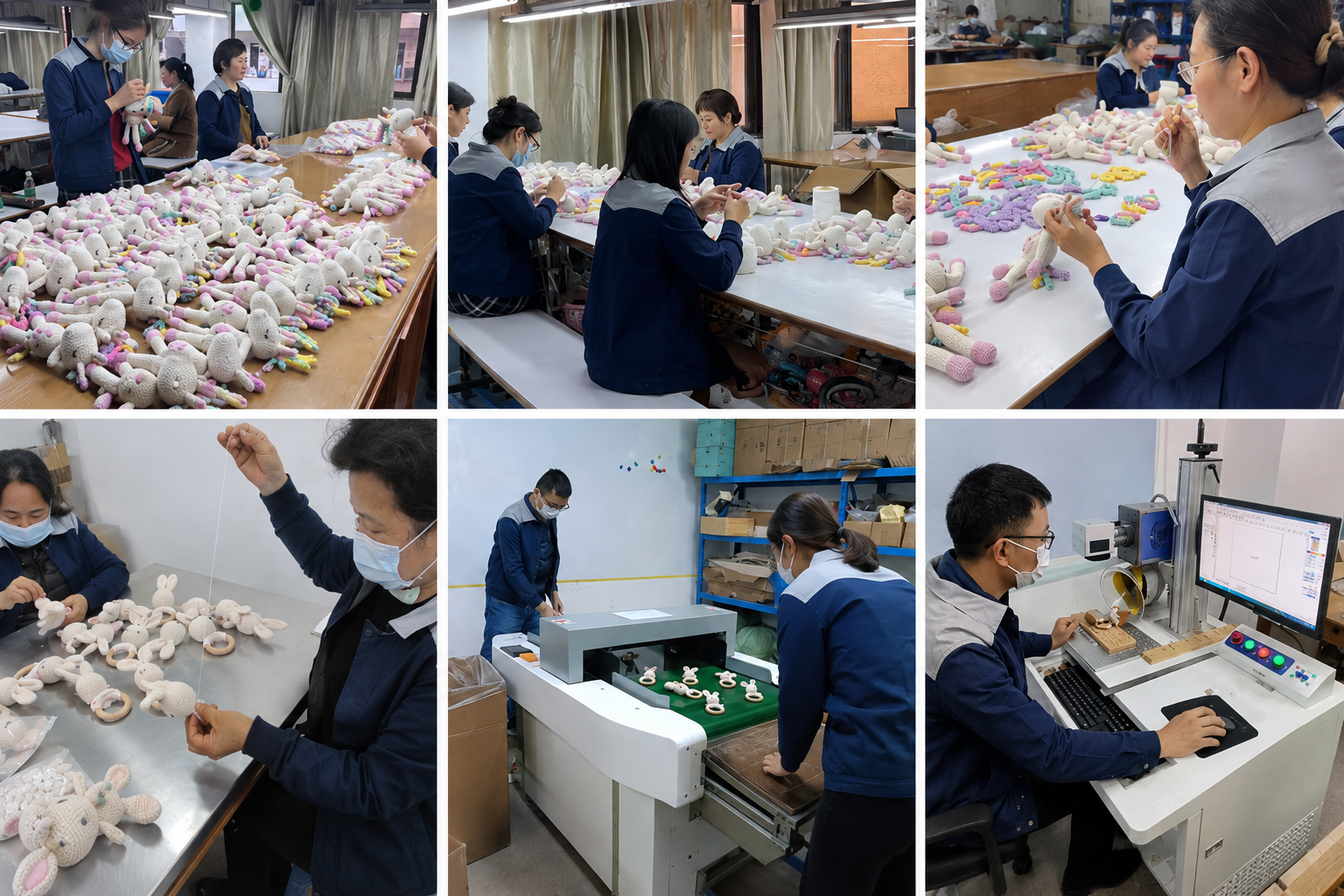
5. Centralized Assembly and Finishing
Many crochet products are not completed by a single artisan.
Instead:
One artisan may crochet the body.
Another team may install accessories.
Another team may perform stuffing.
Finally, trained inspectors complete:
- Shape correction
- Cleaning
- Packaging
- Final approval
Centralized finishing helps maintain a consistent retail appearance.
6. Production Planning System
Professional crochet factories rarely produce products in the order they are received.
Instead, planners consider:
- Delivery dates
- Product complexity
- Material availability
- Seasonal demand
- Artisan availability
- Packaging schedules
Good planning keeps production balanced throughout the year.
How Professional Factories Maintain Consistency Across Thousands of Artisans
One of the biggest concerns among international buyers is product consistency.
Professional manufacturers achieve consistency through:
Approved Samples
Every production batch follows one approved reference sample.
Standard Operating Procedures (SOPs)
Each production step follows documented instructions.
Regular Training
Artisans receive ongoing technical training to maintain production standards.
Technical Supervision
Production supervisors monitor output and solve technical issues before they affect larger batches.
Batch Inspection
Products are reviewed throughout production—not only at the end.
One lesson we have learned is:
Consistency is created through repeatable systems, not individual talent alone.
Technology Still Plays an Important Role
Although crochet itself is handmade, technology supports nearly every other stage of production.
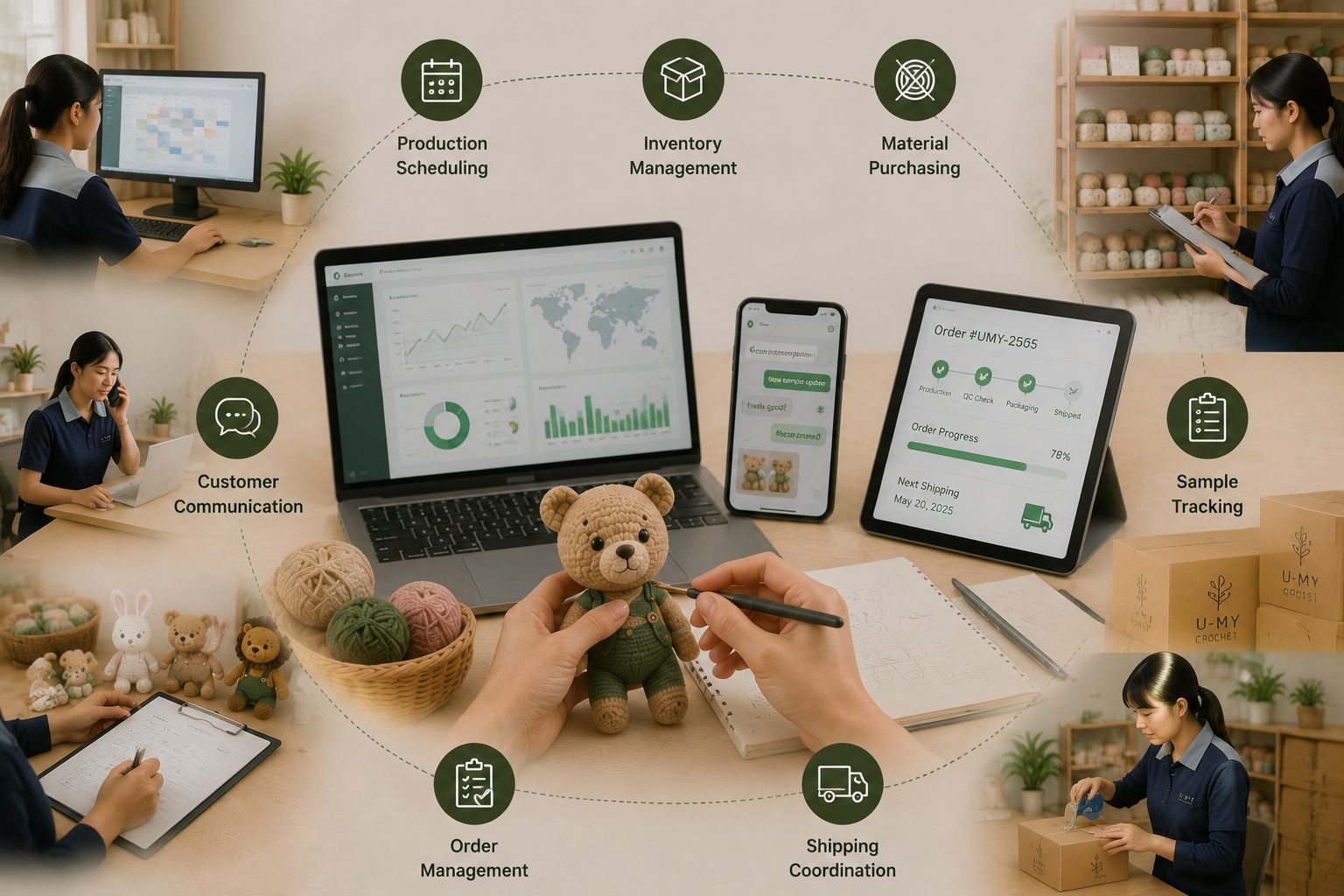
Professional factories often use digital tools for:
- Production scheduling
- Inventory management
- Material purchasing
- Customer communication
- Sample tracking
- Order management
- Shipping coordination
Technology improves visibility while artisans preserve the handmade character of every product.
Real Project Example: Scaling a Seasonal Retail Program
A retail customer initially ordered one custom crochet mascot.
The first order included several hundred pieces.
Within months, demand expanded significantly.
Instead of assigning all production to one artisan group, the factory:
- Standardized the pattern
- Prepared centralized material kits
- Divided production across multiple trained teams
- Increased inspection frequency
- Centralized assembly and packaging
The customer successfully expanded the product into:
- Gift-box editions
- Mini keychains
- Seasonal versions
- Limited collections
Without changing the product design, production capacity increased while maintaining consistent quality.
This project reinforced an important lesson:
Scaling handmade production begins with standardization—not simply adding more artisans.
Why Communication Is Just as Important as Production
Large production programs require constant coordination.
Professional factories should provide buyers with:
- Sample updates
- Production schedules
- Material confirmations
- Inspection reports
- Shipping plans
- Packaging progress
Transparent communication helps buyers:
- Plan inventory
- Schedule marketing
- Prepare product launches
- Coordinate retail deliveries
A factory that communicates well often manages production well.
What Buyers Should Ask Before Choosing a Large Crochet Factory
When evaluating suppliers, ask questions that reveal how production is organized.
For example:
Production
- How many artisans support production?
- How is work distributed?
- How do you manage seasonal capacity?
Quality
- How many inspection stages do you use?
- Do you have approved samples?
- How do you maintain consistency?
Product Development
- Do you support OEM?
- Do you provide ODM services?
- How long does sample development take?
Materials
- Are materials centrally supplied?
- How do you maintain color consistency?
- How are accessories controlled?
Delivery
- How do you manage production planning?
- What happens if demand suddenly increases?
- How do you coordinate packaging?
The answers often reveal more than factory size alone.
Common Misconceptions About Large Crochet Factories
"More artisans automatically mean better production."
Only if production systems are well organized.
"Handmade production cannot scale."
Professional factories have demonstrated that handmade production can successfully support international retail programs.
"Every artisan works independently."
Professional manufacturers operate within standardized production systems.
"Quality depends entirely on artisan skill."
Quality also depends on:
- Training
- Materials
- Supervision
- Inspection
- Production management
"Crochet factories only make toys."
Many factories also manufacture:
- Baby gifts
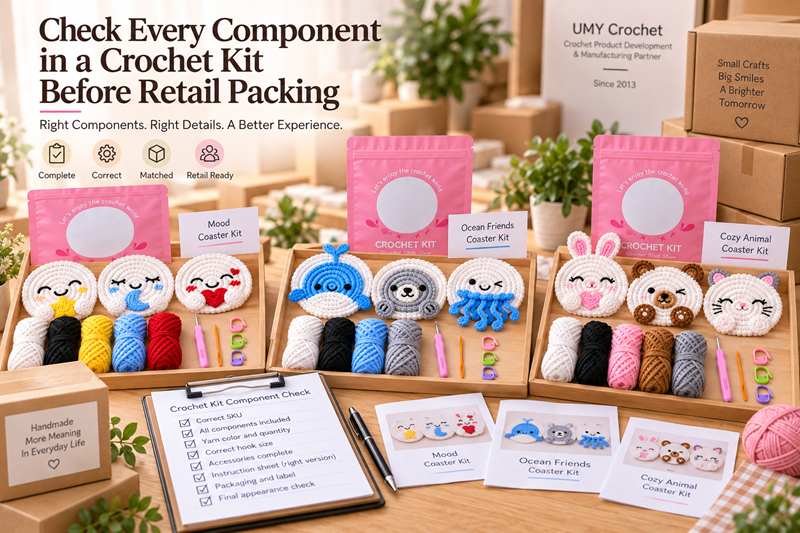
- DIY kits
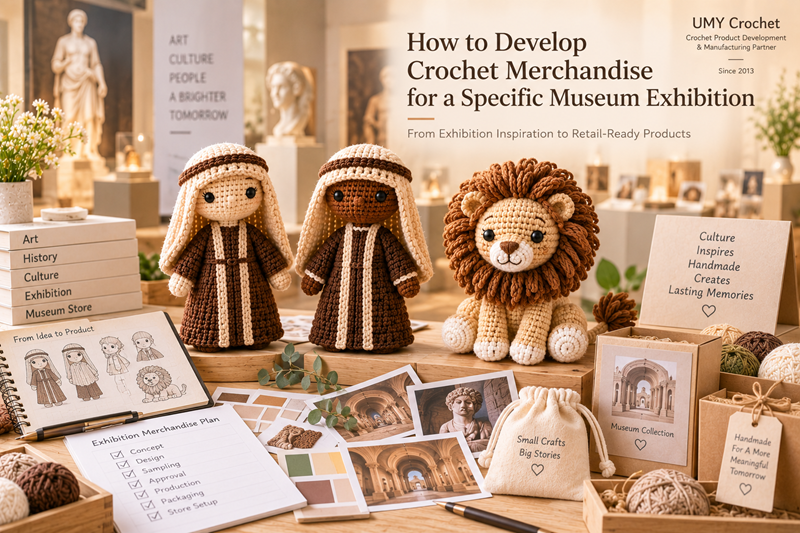
- Museum souvenirs
- Home décor
- Promotional products
- Corporate gifts
- Fashion accessories
What We Have Learned After More Than 12 Years
Working with global brands has shown us that buyers care about much more than production capacity.
They also value:
- Reliability
- Transparency
- Product development
- Stable quality
- Flexible cooperation
- Predictable delivery
The strongest crochet factories combine:
✓ Skilled artisans.
✓ Standardized production.
✓ Professional management.
✓ Continuous improvement.
U-MY Crochet's Production Model
Since 2013, U-MY Crochet has specialized in professional handmade crochet manufacturing.
Today, our production system includes:
- A network of more than 2,000 trained artisans
- Centralized product development
- Standardized crochet patterns
- Unified material management
- Multi-stage quality inspections
- OEM and ODM support
- Sample development within approximately 7–15 working days
- Packaging customization
- Collection planning
- Export support for customers in more than 150 countries and regions
Our goal is not to replace handmade craftsmanship.
Our goal is to organize it professionally.
Frequently Asked Questions
Can handmade crochet products really be produced at scale?
Why don't crochet factories employ all artisans inside one building?
Distributed artisan networks provide greater flexibility while allowing factories to coordinate production, quality control, assembly, and export through centralized management.
How do crochet factories maintain consistent quality?
Consistency comes from approved samples, standardized patterns, material control, multi-stage inspections, and continuous artisan training.
How many artisans does a large crochet factory need?
There is no fixed number.
The key factor is how effectively production is organized, supervised, and supported by quality-management systems.
Is a larger factory always better?
Not necessarily.
A factory with excellent production systems, communication, and product development may outperform a much larger factory with weaker management.
Final Thoughts
The success of large-scale crochet manufacturing does not depend on having the largest workshop or the greatest number of artisans.
It depends on creating a production system where thousands of skilled people can work toward one consistent standard.
After more than a decade of supporting international brands, we believe the most successful crochet factories share one characteristic:
They combine the artistry of handmade craftsmanship with the discipline of professional manufacturing.
Because while every crochet piece is handmade, every successful production program is carefully organized.
Looking for a Professional Crochet Manufacturing Partner?
Whether you need OEM production, ODM product development, museum gift collections, seasonal retail programs, or custom crochet mascots, U-MY Crochet can help you transform creative ideas into scalable, market-ready products with reliable quality and global delivery.
Contact us today to discuss your next crochet manufacturing project.

 Chinese