
A Practical Guide for Global Buyers Choosing the Right Crochet Manufacturing Partner
When sourcing handmade crochet products, one of the first decisions buyers face is whether to work directly with a crochet factory or through a trading company.
At first glance, the difference may not seem obvious.
Both may have professional websites.
Both may offer OEM and ODM services.
Both may provide quotations, samples, and export support.
So how can buyers tell them apart?
More importantly, which option is better for their business?
After more than 12 years of specializing in crochet manufacturing, U-MY Crochet has supported retailers, museum stores, gift brands, distributors, e-commerce sellers, and corporate buyers across more than 150 countries and regions.
Throughout hundreds of projects, we have learned one important lesson:
The right partner depends less on the company label and more on its actual capabilities, transparency, and value throughout the product development process.
This guide explains the key differences between professional crochet factories and trading companies, helping you choose the best partner for your next project.
What Is a Crochet Factory?
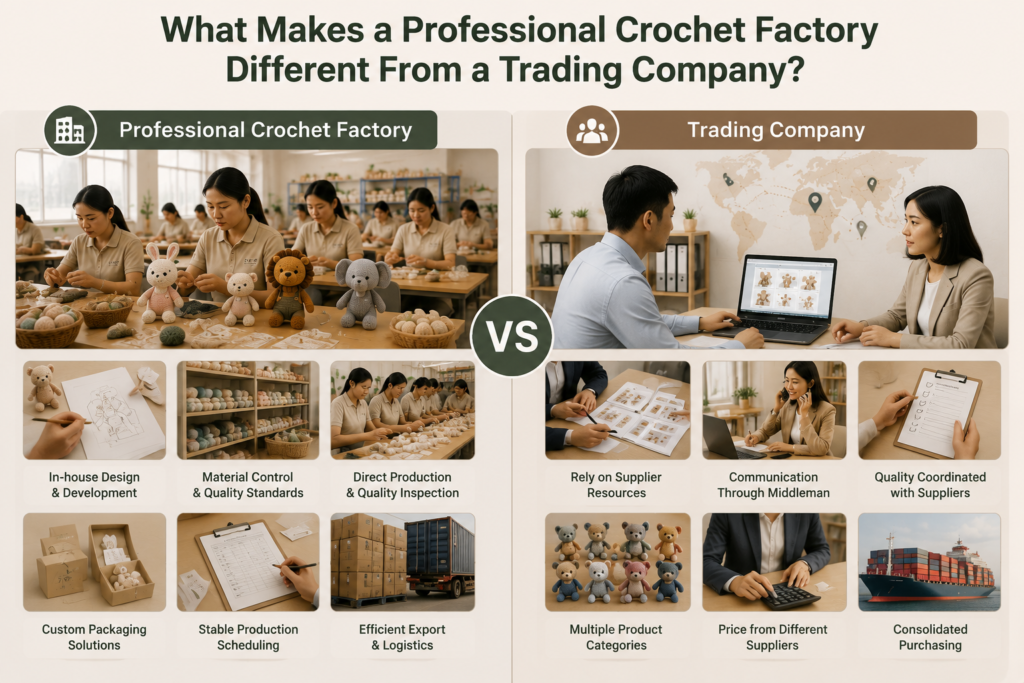
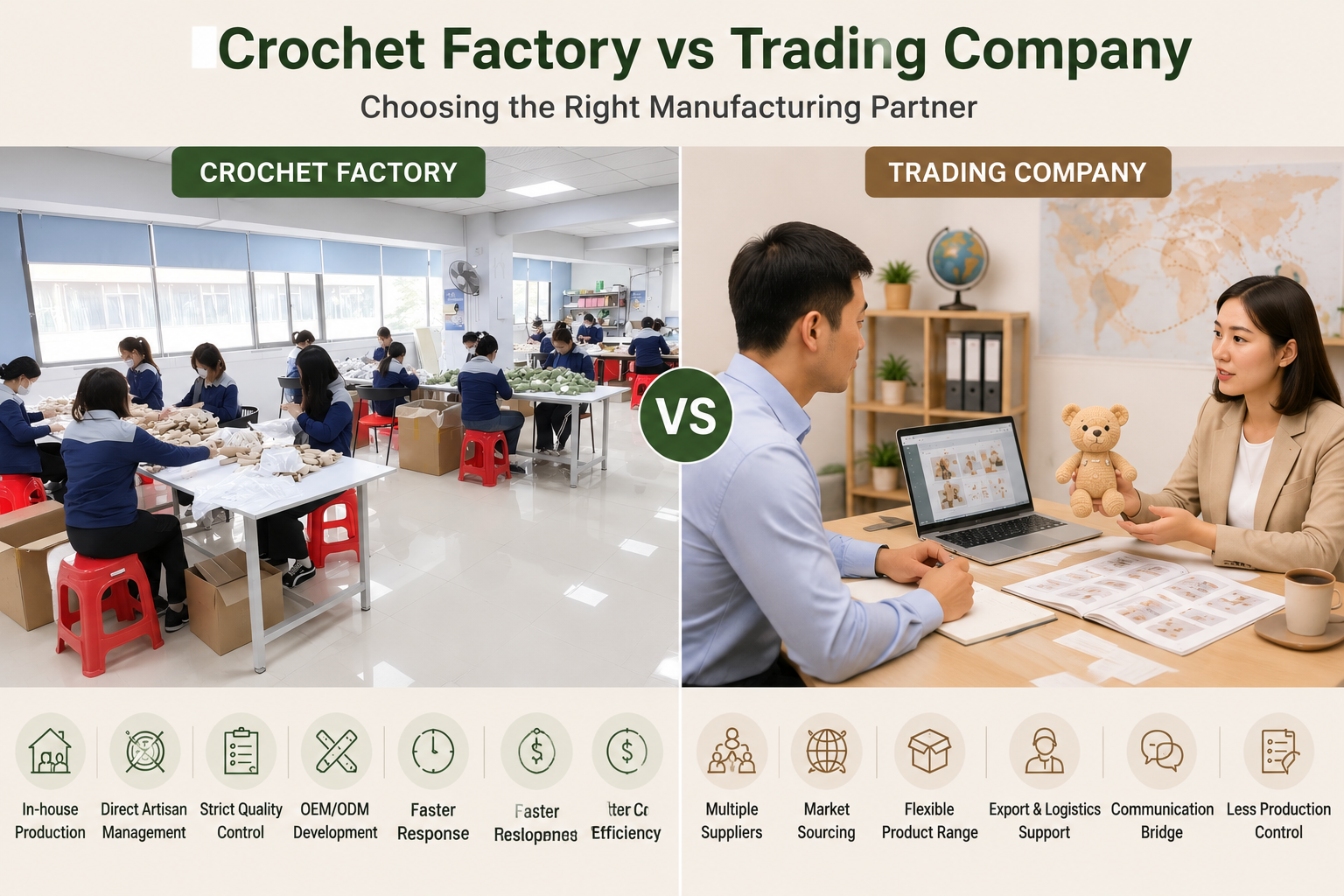
A crochet factory is a company that directly manages or organizes the production of crochet products.
Unlike automated manufacturing plants, professional crochet factories typically coordinate:
- Product development
- Pattern engineering
- Material sourcing
- Artisan management
- Quality control
- Assembly
- Packaging
- Export logistics
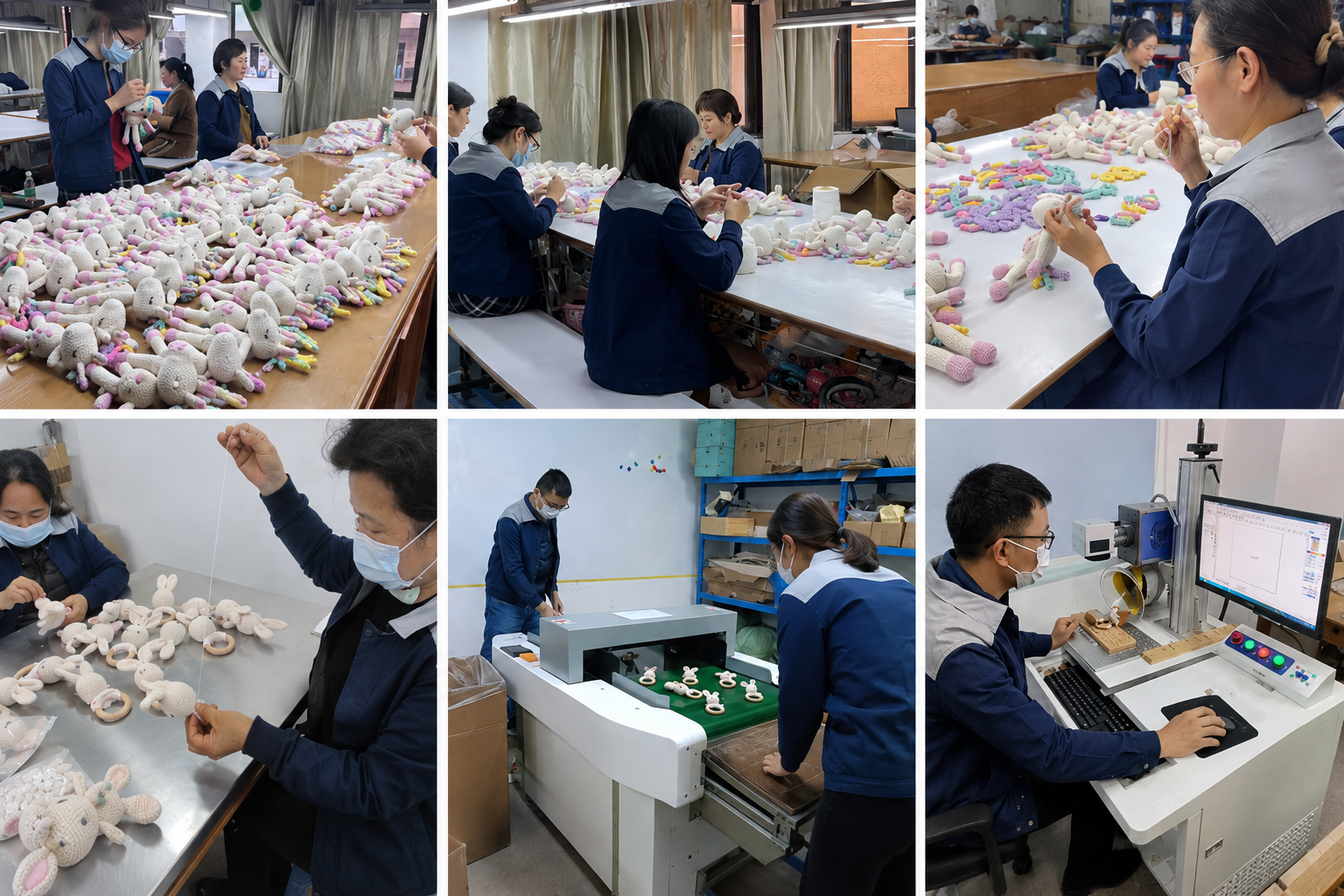
Because crochet products are handmade, many factories operate through distributed artisan networks rather than placing every worker inside a single workshop.
Their primary responsibility is manufacturing.
This allows factories to participate in every stage of product creation—from the first sketch to the finished retail product.
What Is a Trading Company?
A trading company generally acts as an intermediary between buyers and manufacturers.
Instead of producing products directly, a trading company may:
- Source products from multiple factories
- Coordinate quotations
- Consolidate shipments
- Handle export documentation
- Manage communication between buyer and supplier
Some trading companies specialize in particular product categories and build long-term relationships with reliable manufacturers.
Others simply compare prices among different suppliers.
The quality of trading companies varies significantly depending on their experience and management systems.
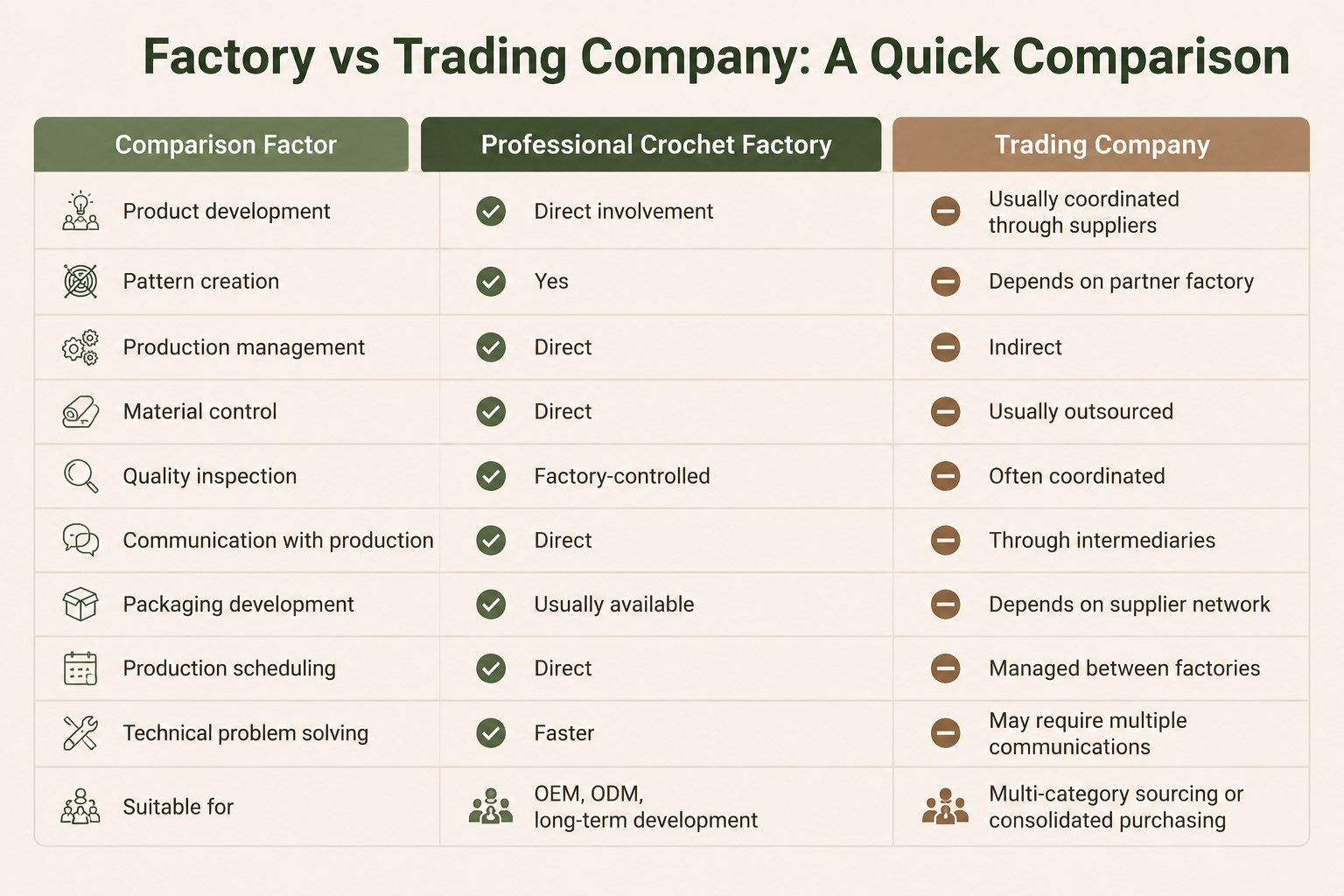
Factory vs Trading Company: A Quick Comparison
| Comparison Factor | Professional Crochet Factory | Trading Company |
|---|---|---|
| Product development | Direct involvement | Usually coordinated through suppliers |
| Pattern creation | Yes | Depends on partner factory |
| Production management | Direct | Indirect |
| Material control | Direct | Usually outsourced |
| Quality inspection | Factory-controlled | Often coordinated |
| Communication with production | Direct | Through intermediaries |
| Packaging development | Usually available | Depends on supplier network |
| Production scheduling | Direct | Managed between factories |
| Technical problem solving | Faster | May require multiple communications |
| Suitable for | OEM, ODM, long-term development | Multi-category sourcing or consolidated purchasing |
Neither model is inherently better.
The best choice depends on your business needs.
How Product Development Differs
One of the biggest differences appears during product development.
Professional crochet factories usually employ designers, pattern developers, and technical teams who can evaluate a product before production begins.
For example, they may recommend:
- Stitch improvements
- Material alternatives
- Structural reinforcement
- Cost optimization
- Packaging solutions
Trading companies often need to consult external factories before answering technical questions.
This can increase communication time during development.
One thing we have consistently observed is:
The earlier technical issues are solved, the smoother mass production becomes.
Who Controls Production?
This is one of the most important questions buyers should ask.
Professional crochet factories generally manage:
- Production planning
- Material distribution
- Artisan assignments
- Quality standards
- Production schedules
This allows them to respond quickly when adjustments are needed.
Trading companies typically coordinate between buyers and manufacturers.
Although experienced trading companies can manage projects well, production decisions usually depend on the factory they are working with.
Communication Makes a Big Difference
For international buyers, communication directly affects project success.
Working directly with a factory often provides:
- Faster technical answers
- Quicker sample revisions
- Direct production updates
- Better understanding of manufacturing limitations
Trading companies may provide excellent customer service, but technical questions sometimes require additional communication with production partners.
This extra step can extend decision-making during complex projects.
Who Offers Better Customization?
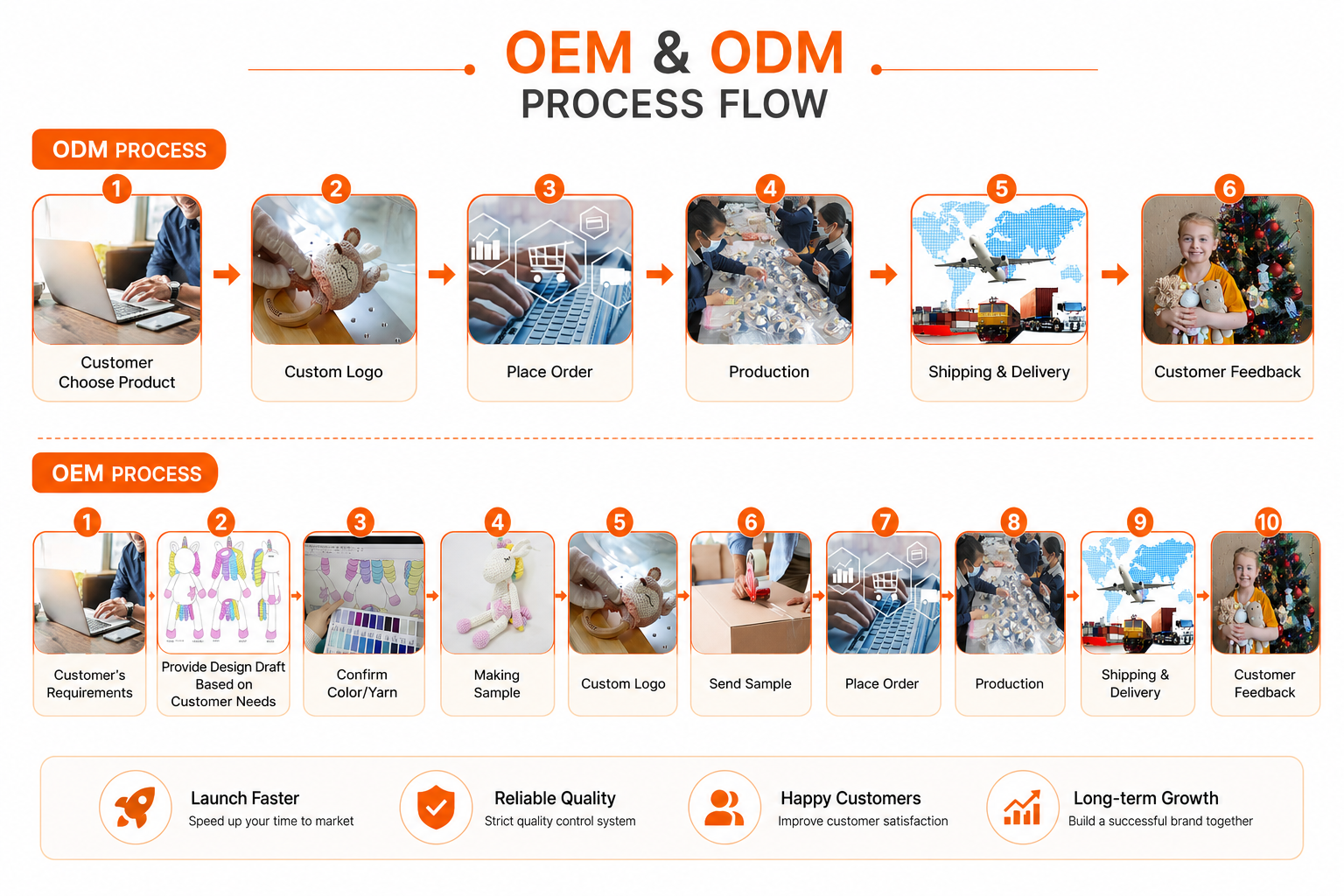
For standard products, both factories and trading companies may offer customization.
However, for complex OEM or ODM projects, professional crochet factories often have greater flexibility.
Typical customization includes:
- Character development
- Custom colors
- Private labels
- Packaging
- Gift boxes
- Story cards
- Accessories
- Product collections
Because factories participate directly in development, modifications can often be implemented more efficiently.
Quality Control: Who Is Responsible?
Quality control is another important difference.
Professional crochet factories usually establish inspection procedures throughout production.
These may include:
Material Inspection
Checking:
- Yarn quality
- Color consistency
- Filling materials
- Accessories
In-Process Inspection
Reviewing:
- Stitch consistency
- Product dimensions
- Shape accuracy
Final Inspection
Verifying:
- Appearance
- Packaging
- Labels
- Cleanliness
Trading companies may also perform inspections, but the production process itself is generally managed by the manufacturing partner.
When comparing suppliers, ask:
- Who performs inspections?
- How many inspection stages are there?
- Who approves production samples?
Which Option Is Better for OEM Projects?
If your project includes:
- Original designs
- Brand mascots
- Museum products
- Seasonal collections
- Product development
Working directly with a professional crochet factory often offers advantages.
Because development, sampling, production, and packaging are coordinated by one organization, communication tends to be more efficient.
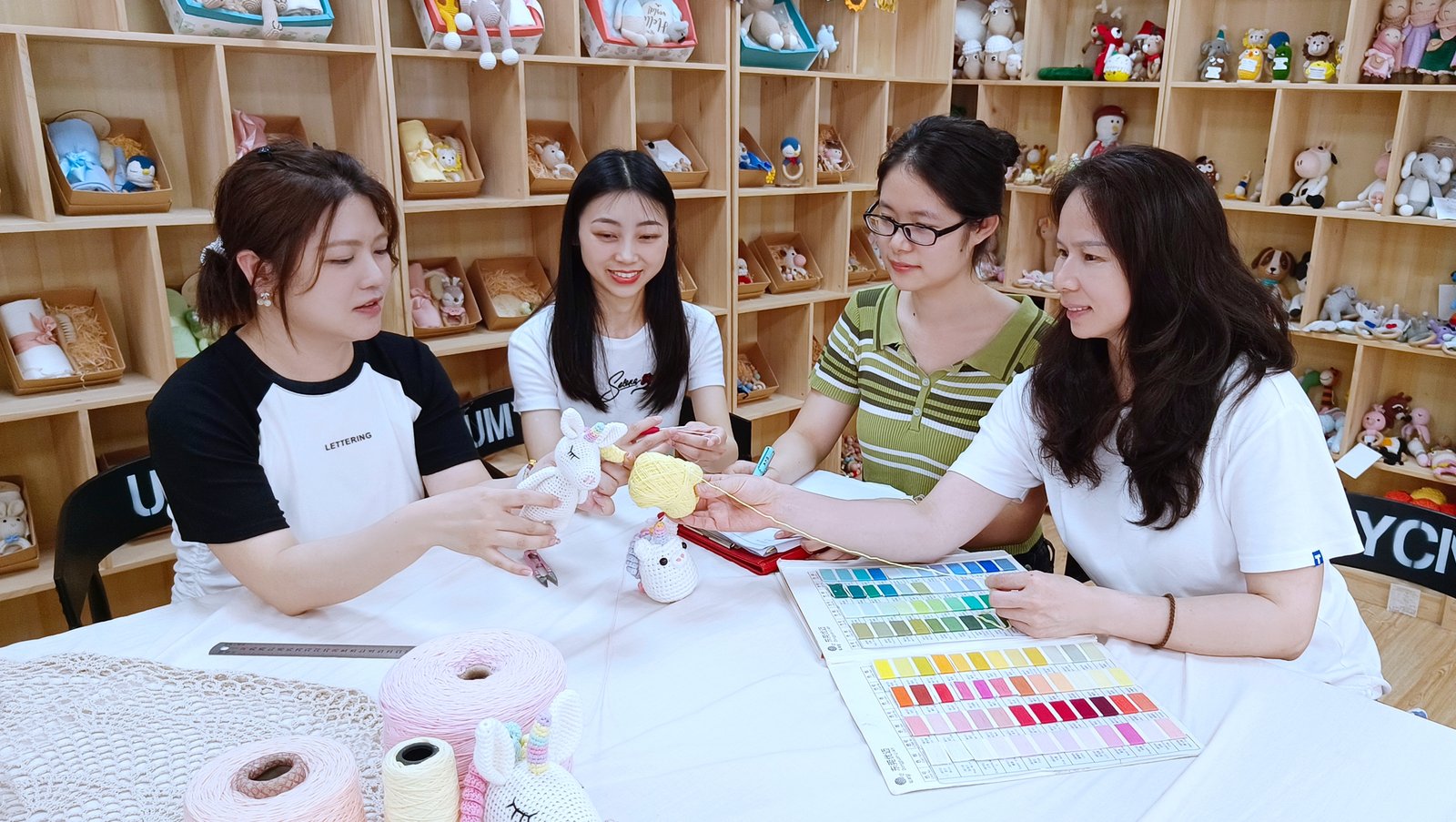
At U-MY Crochet, many projects begin with nothing more than:
- A sketch
- A mascot illustration
- A reference image
- A product concept
Our development team then transforms these ideas into commercially manufacturable crochet products.
When a Trading Company Can Be a Good Choice
Trading companies can be valuable under certain circumstances.
For example, if you need:
- Multiple unrelated product categories
- One consolidated shipment
- Supplier sourcing across industries
- Purchasing support in unfamiliar markets
An experienced trading company may simplify procurement.
Some buyers also prefer working with one purchasing partner instead of managing multiple factories directly.
The key is choosing a trading company that understands both your products and your quality expectations.
Real Project Example
A gift company planned to launch a custom crochet mascot together with matching gift boxes and promotional accessories.
Initially, the buyer contacted several suppliers through trading companies.
The quotations were competitive, but each technical change required multiple rounds of communication between the trading company and the factory.
The customer later chose to work directly with a crochet manufacturer.
Because the design team, production planners, packaging specialists, and quality inspectors all worked within the same organization, sample revisions became much faster.
The project expanded from one mascot into:
- Mini keychains
- Gift sets
- Retail packaging
- Seasonal editions
The customer reduced development time while simplifying communication.
This experience reinforced an important lesson:
The greatest advantage of working directly with a professional factory is not lower pricing—it is better collaboration throughout the entire project.
Questions Buyers Should Ask Before Choosing a Supplier
Whether you work with a factory or a trading company, ask the following questions.
Company Background
- How long have you been in business?
- What are your main export markets?
- What crochet products do you specialize in?
Product Development
- Do you support OEM?
- Do you provide ODM services?
- Who develops crochet patterns?
Production
- Who manages production?
- How is quality controlled?
- How are artisans organized?
Samples
- How long does sample development take?
- How many revisions are included?
- Who approves production samples?
Packaging
- Can you customize retail packaging?
- Can you develop gift sets?
- Do you provide branded accessories?
Compliance
- Can you support product testing?
- What experience do you have with international toy safety standards?
- How do you manage compliance planning?
Common Misconceptions
"Trading companies never add value."
Some experienced trading companies provide excellent sourcing management and logistics support.
The key is understanding exactly what services they provide.
"Factories are always cheaper."
Not necessarily.
Total project cost depends on:
- Development efficiency
- Communication
- Quality
- Packaging
- Delivery
- Revision frequency
"Factories only manufacture."
Professional crochet factories often support:
- Product design
- Collection planning
- Packaging development
- Quality improvement
- Compliance planning
"Trading companies don't understand products."
Some specialize in specific industries and possess deep product knowledge.
The important question is whether they can provide the technical support your project requires.
What We Have Learned After More Than 12 Years
Working with international buyers has shown us that the best partnerships are built on transparency.
Regardless of whether a buyer chooses a factory or a trading company, successful projects usually share several characteristics:
✓ Clear communication.
✓ Honest capabilities.
✓ Reliable quality.
✓ Professional project management.
✓ Long-term cooperation.
Rather than asking:
"Are you a factory or a trading company?"
A better question is:
"How will you help my product succeed?"
Why Many Global Brands Choose Professional Crochet Factories
Professional crochet factories are often preferred when brands require:
- Long-term OEM partnerships
- ODM development
- Complex mascots
- Museum souvenirs
- Retail-ready packaging
- Product collections
- Technical product improvements
Because development and manufacturing are managed within one organization, buyers often experience:
- Faster decision-making
- Better technical support
- More efficient sample revisions
- Stronger product consistency
About U-MY Crochet Factory
Founded in 2013, U-MY Crochet is a professional handmade crochet manufacturer based in China.
We support customers across more than 150 countries and regions, including:
- Retail brands
- Museum stores
- Gift companies
- Baby product brands
- E-commerce businesses
- Corporate buyers
- Distributors
Our capabilities include:
- More than 12 years of crochet manufacturing experience
- A network of more than 2,000 artisans
- OEM and ODM services
- Custom mascot development
- Sample development within approximately 7–15 working days
- Packaging customization
- Gift-set development
- Collection planning
- International quality management
Our goal is not simply to manufacture crochet products.
We help brands turn ideas into scalable, retail-ready collections.
Frequently Asked Questions
Is it better to work directly with a crochet factory?
If your project requires custom development, OEM, ODM, packaging, or long-term cooperation, working directly with a professional crochet factory often improves communication and development efficiency.
When should I choose a trading company?
Trading companies can be a good option when sourcing multiple unrelated product categories or consolidating purchases from several manufacturers.
Can a factory also provide export services?
Yes. Many professional crochet factories handle quotations, sampling, production, packaging, export documentation, and international shipping coordination.
How can I verify whether a company is a real crochet factory?
Ask about:
- Product development
- Production management
- Quality-control procedures
- Sample process
- Factory location
- Production workflow
- Artisan organization
Professional manufacturers can usually explain these systems in detail.
Does working directly with a factory always reduce costs?
Not always.
The greatest advantage is often improved communication, better technical support, faster development, and stronger quality control throughout the project.
Final Thoughts
Choosing between a crochet factory and a trading company is not about deciding which model is universally better.
It is about choosing the partner that best supports your business goals.
If your project focuses on custom product development, long-term brand growth, and reliable manufacturing, a professional crochet factory can often provide greater technical expertise and closer collaboration.
After more than a decade of working with brands around the world, we believe successful partnerships are built on more than transactions.
They are built on shared goals, open communication, and continuous product improvement.
Looking for a Professional Crochet Manufacturing Partner?
Whether you are developing a custom mascot, launching a museum gift collection, expanding a retail product line, or sourcing OEM and ODM crochet products, U-MY Crochet is ready to support your project from concept to global delivery.
Contact us today to discuss your next crochet manufacturing project.
 Chinese