
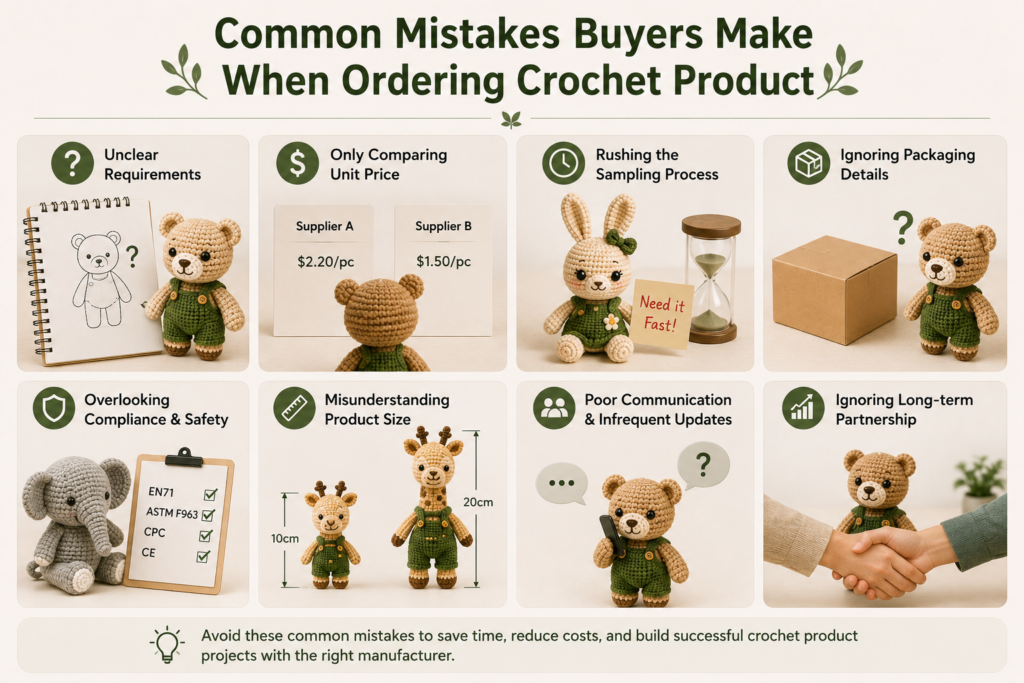
A Practical Guide to Avoiding Costly Mistakes in Crochet Sourcing
Ordering custom crochet products may seem straightforward at first glance.
Many buyers assume that once they find a supplier, approve a sample, and place an order, the rest of the process will run smoothly.
However, after more than 12 years of crochet manufacturing experience at UMY Crochet Factory and supporting customers across more than 150 countries and regions, we've learned that successful projects depend on much more than product design alone.
In reality, most sourcing problems are not caused by crochet production itself.
They usually stem from misunderstandings about pricing, sampling, packaging, timelines, compliance, and supplier relationships.
Whether you are developing crochet dolls, gift sets, museum souvenirs, baby products, DIY kits, or seasonal collections, understanding these common mistakes can save time, reduce costs, and improve long-term business results.
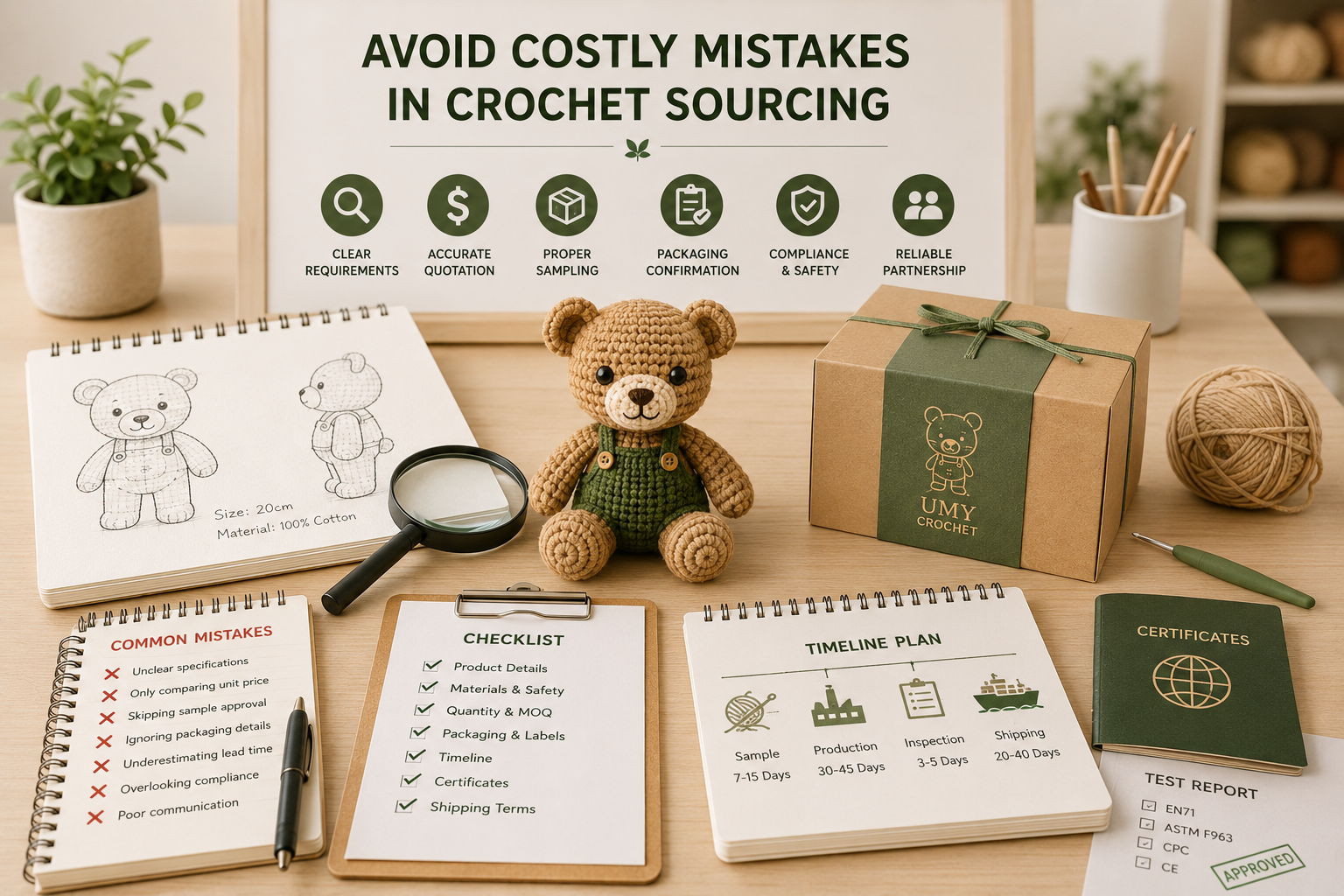
Why Crochet Projects Sometimes Fail
Unlike mass-produced plastic products, crochet items involve a combination of:
- Handmade craftsmanship
- Material sourcing
- Sampling
- Quality control
- Packaging
- Compliance requirements
- International logistics
Because so many steps are interconnected, small decisions made early in the project can have significant consequences later.
Over the years, we've observed that the buyers who achieve the best results are not necessarily those with the biggest budgets.
Instead, they are the ones who understand how the entire supply chain works.
One thing we've consistently learned is:
Successful crochet projects are usually the result of good planning rather than good luck.
Mistake #1: Focusing Only on Factory Price
One of the most common mistakes buyers make is choosing suppliers based solely on unit price.
At first glance, a lower quotation may seem attractive.
However, experienced importers know that factory price is only one component of the total cost.
The true cost of a crochet project often includes:
- Sampling fees
- Packaging costs
- Compliance testing
- Shipping expenses
- Import duties
- Warehousing
- Inventory risks
In many cases, the cheapest supplier ultimately becomes the most expensive option.
One lesson we've learned from supporting global customers is:
Small savings on production costs can easily be outweighed by quality problems, delays, or inefficient logistics.
Mistake #2: Choosing a Supplier Too Quickly
Many buyers compare suppliers based only on:
- Product photos
- Online reviews
- Price lists
- Messaging speed
Unfortunately, these factors reveal very little about actual manufacturing capability.
When evaluating a crochet supplier, buyers should also consider:
- Production experience
- Sample quality
- Quality control systems
- Export experience
- Communication efficiency
- Compliance knowledge
A marketplace profile is not the same as manufacturing capability.
The most successful buyers spend time understanding how a factory operates before committing to larger orders.
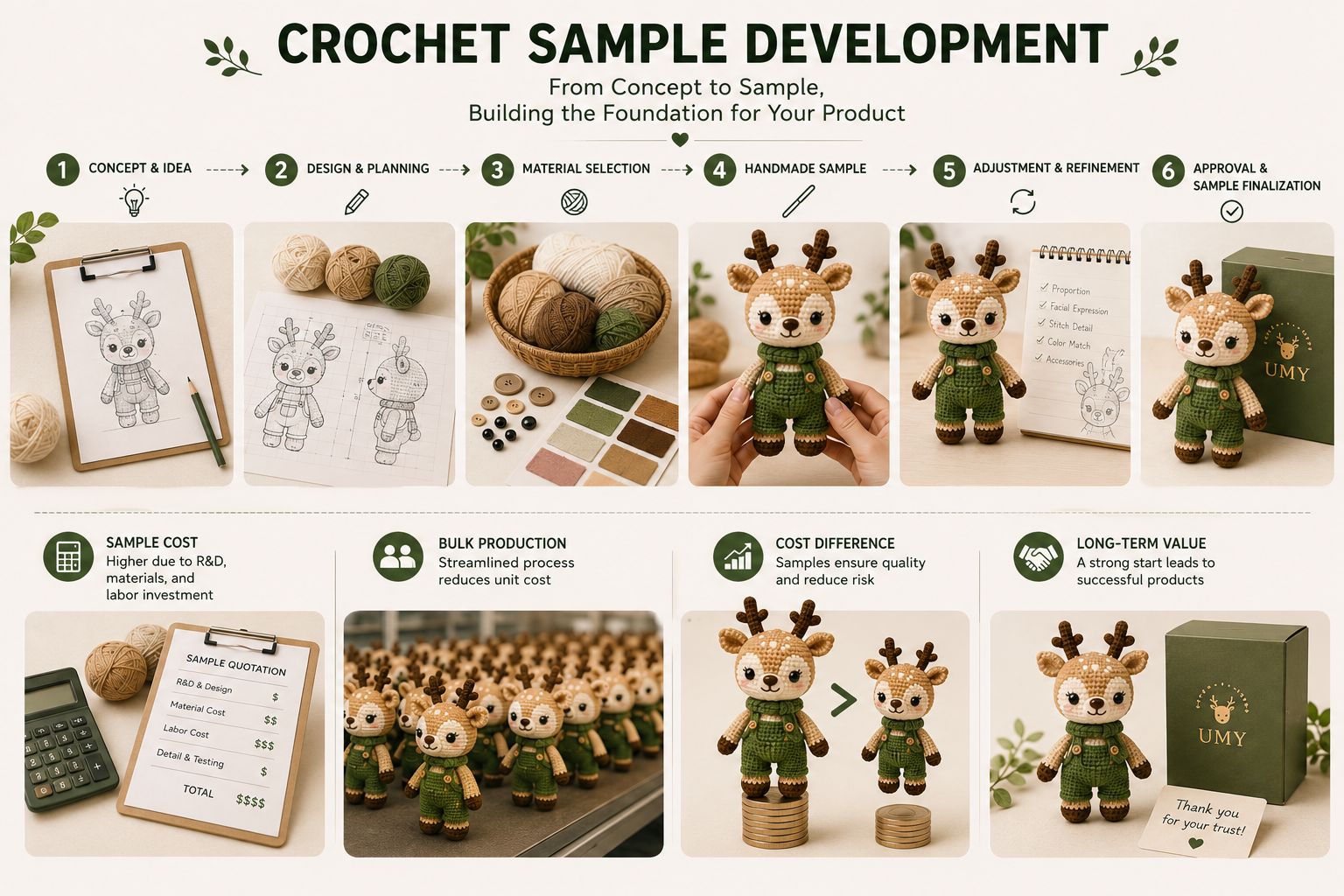
Mistake #3: Underestimating the Importance of Sampling
Some buyers view samples as a formality.
In reality, the sampling stage is one of the most important phases of product development.
A crochet sample helps verify:
- Product proportions
- Colors and materials
- Stitch details
- Safety requirements
- Packaging compatibility
- Production feasibility
Skipping revisions or rushing sample approval often creates larger problems during mass production.
At UMY Crochet Factory, we've found that investing additional time during sampling usually reduces production risks later.
Mistake #4: Ignoring Packaging Until the End
Packaging is often treated as an afterthought.
However, packaging affects far more than presentation.
It can influence:
- Shipping costs
- MOQ requirements
- Product protection
- Retail display value
- Customer experience
Many buyers focus exclusively on product design and only discuss packaging after production has begun.
This often leads to:
- Higher costs
- Delayed timelines
- Additional design revisions
One thing we've consistently observed is:
Customers rarely evaluate crochet products alone—they evaluate the entire experience.
Mistake #5: Delaying Compliance Planning
Compliance requirements are frequently overlooked, especially by first-time buyers.
Many customers focus heavily on:
- Product appearance
- Pricing
- Packaging
Only to discover later that additional certifications are required.
Depending on the destination market, crochet products may require:
- CPC
- ASTM F963
- CE
- EN71
- UKCA
- AS/NZS ISO 8124
Compliance planning should begin during product development—not after production has finished.
Early planning often saves both time and money.
Mistake #6: Setting Unrealistic Timelines
Handmade crochet products require time.
Unlike machine-produced products, crochet production involves:
- Pattern development
- Material preparation
- Sample making
- Quality inspection
- Packaging
- Shipping coordination
Many buyers underestimate how long these steps actually take.
Typical project timelines may include:
| Stage | Estimated Time |
|---|---|
| Design review | 1–2 days |
| Material preparation | 2–5 days |
| Sample development | 7–15 working days |
| Production planning | 3–7 days |
| Mass production | Depends on quantity |
| Packaging and inspection | 3–7 days |
One lesson we've learned after supporting customers across more than 150 countries and regions is:
Production problems are often planning problems.
The buyers who plan earlier usually enjoy smoother launches and fewer delays.
Mistake #7: Ordering Too Many Products Too Soon
Many new brands assume that larger orders automatically reduce risk.
In practice, the opposite is often true.
Large first orders may create:
- Inventory pressure
- Cash flow problems
- Storage costs
- Slow-moving stock
Experienced buyers often begin with:
- Smaller collections
- Limited product ranges
- Standard packaging
- Market testing
Once customer demand is validated, they expand gradually.
Successful product lines are usually built step by step.
Mistake #8: Treating Manufacturers as Vendors Instead of Partners
Perhaps the biggest mistake buyers make is viewing manufacturers as simple suppliers.
The strongest projects happen when factories are involved early in decision-making.
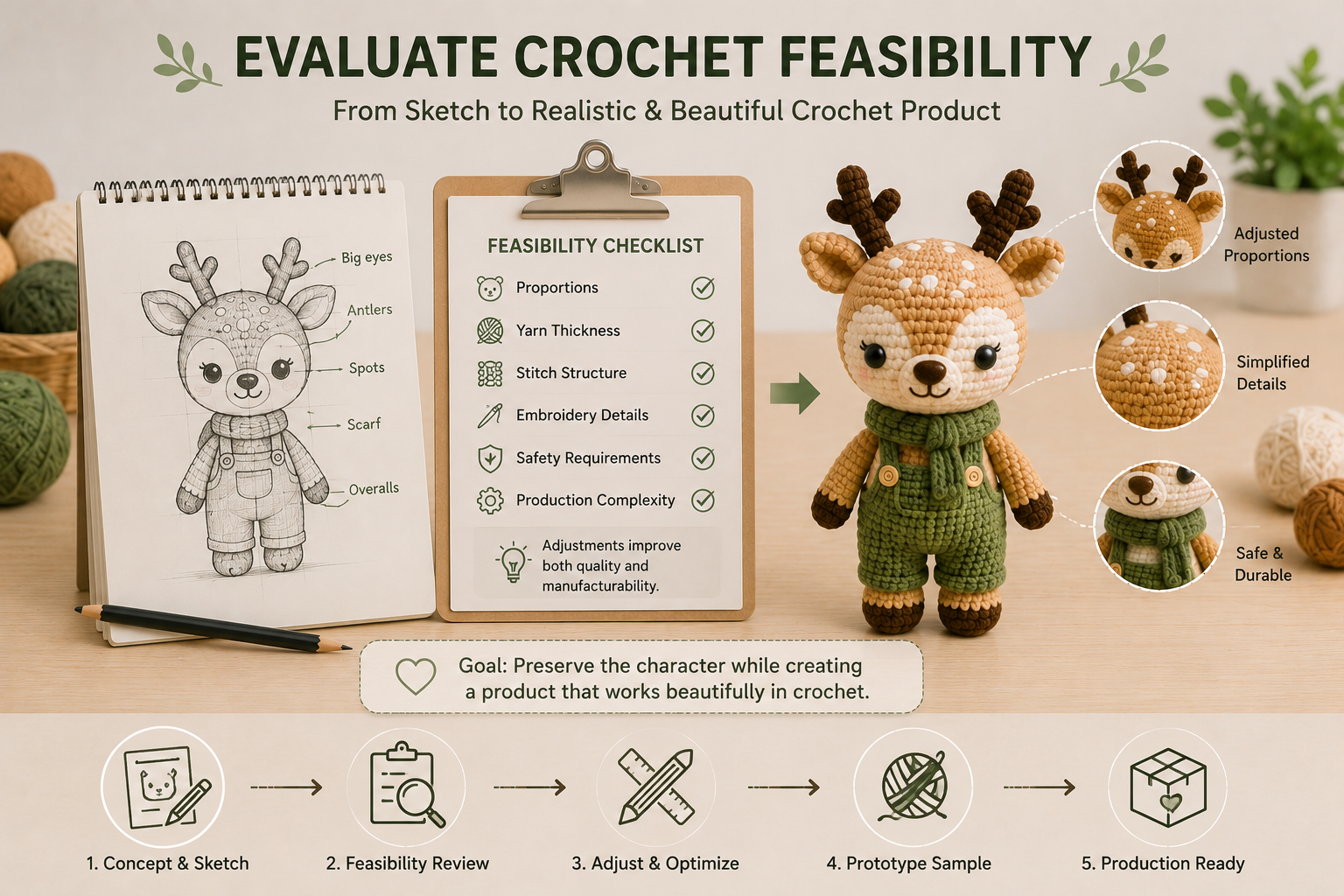
Experienced crochet manufacturers can often help buyers optimize:
- Product design
- Packaging solutions
- Production efficiency
- Compliance strategies
- Shipping methods
- Cost structures
After more than 12 years in the industry, we've found that the most successful customers are those who treat manufacturers as long-term partners rather than short-term vendors.
Real Project Example: Solving Problems Before Production
One retailer approached us to develop a seasonal crochet gift collection.
Initially, the customer planned to launch twelve different designs simultaneously, each with its own packaging.
During the development process, we identified several challenges:
- Packaging costs were unusually high.
- Production planning would become more complex.
- Shipping volume would increase significantly.
- Inventory risks would rise.
Instead of proceeding with the original plan, we suggested:
- Consolidating several products into one themed collection
- Standardizing gift box sizes
- Sharing packaging components
- Launching fewer products initially
The result was a more efficient product line with lower logistics costs and better inventory management.
This project reinforced one important lesson:
The best sourcing decisions optimize the entire business—not just the product itself.
What Successful Buyers Do Differently
Across projects developed for customers in more than 150 countries and regions, we've noticed several common patterns among successful buyers.
They:
✓ Focus on total landed cost rather than factory price.
✓ Start compliance discussions early.
✓ Invest time in sampling.
✓ Launch smaller collections before scaling.
✓ Prioritize long-term supplier relationships.
✓ View manufacturers as development partners.
UMY Crochet Factory at a Glance
Since 2013, UMY has specialized exclusively in crochet manufacturing.
Today, we support:
- Retailers
- Museum stores
- Gift brands
- Distributors
- Startups
- Corporate buyers
Across more than 150 countries and regions.
Our capabilities include:
- 12+ years of crochet manufacturing experience
- 2,000+ artisan production network
- OEM and ODM development
- Sample development within approximately 7–15 working days
- Product design optimization
- Packaging customization
- International quality management systems
- Export support and logistics coordination
Our goal is not simply to manufacture crochet products, but to help customers build sustainable and commercially successful product programs.
Frequently Asked Questions
What is the biggest mistake first-time buyers make?
Many first-time buyers focus exclusively on factory price while underestimating the importance of packaging, compliance, and logistics.
Should I prioritize low MOQ or supplier reliability?
A reliable supplier with slightly higher MOQs often creates less risk than an unreliable supplier offering extremely low minimum quantities.
How many sample revisions are normal?
Most custom crochet projects require at least one or two rounds of revisions before mass production begins.
Can manufacturers help optimize costs?
Yes.
Experienced manufacturers can often suggest improvements in:
- Packaging
- Product dimensions
- Material selection
- Shipping efficiency
- Production planning
How early should compliance planning begin?
Ideally, compliance requirements should be discussed before sampling starts.
Making changes after production has begun is usually more expensive.
Final Thoughts
Ordering crochet products successfully involves much more than finding a supplier and negotiating a price.
After supporting customers across more than 150 countries and regions, we've learned that the most successful projects are built on careful planning, strong communication, and long-term collaboration.
Avoiding common sourcing mistakes helps buyers:
✓ Reduce risk
✓ Control costs
✓ Improve product quality
✓ Launch faster
✓ Build stronger supplier relationships
Rather than asking:
"How can I get the lowest price?"
Experienced buyers ask:
"How can I build the strongest product program?"
That shift in perspective often makes all the difference.
Planning Your Next Crochet Project?
At UMY Crochet Factory, we work closely with retailers, gift brands, museum stores, and distributors to support every stage of crochet product development—from sampling and compliance to packaging and production planning.
Whether you're launching your first crochet collection or expanding an existing product line, our team is ready to help you avoid costly mistakes and bring your ideas to market more efficiently.
Contact us today to discuss your project.
 Chinese