
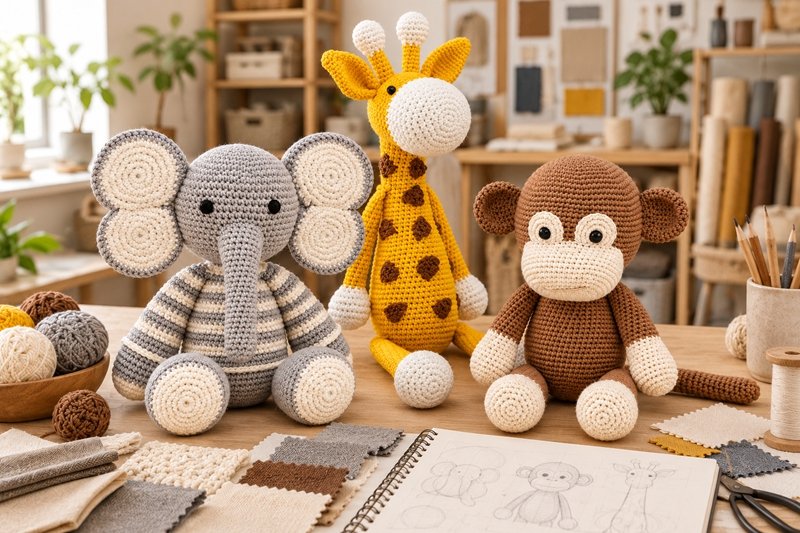
Specify each connection between crochet and fabric components by defining its location, joining method, supporting materials and required finished appearance. Evaluate the connection in the assembled product, using representative materials and the intended production sequence. Approval should cover both the visible result and the construction details needed to reproduce it.
This guide is for toy brands, character developers and purchasing teams developing products that combine crochet details with fabric bodies, clothing or panels. It addresses connection specifications after the broad construction route has been selected.
Treat Each Connection as a Development Decision
A hybrid product brings together components with different structures.
A crochet ear attached to a fabric head, a crochet panel joined to a sewn body and a fabric garment secured to a crochet figure create different development questions. Their attachment methods should follow the intended use, materials and product geometry.
Begin by identifying every connection in the design.
For each one, ask:
- What components are being joined?
- What position and orientation must they maintain?
- Is the connection intended to remain fixed?
- Which parts of the attachment will remain visible?
- At what stage will the connection be made?
- What evidence is needed before approval?
If the manufacturing route is still undecided, first review Handmade Crochet vs Machine-Knitted Toys: How Should Brands Choose?.
Create a Connection Map
Prepare an annotated drawing or sample photograph that identifies each attachment point.
Use consistent references across the drawing, component list and sample comments. These references are project identifiers, rather than universal manufacturing codes.
For example:
| Connection | Specification questions | Evidence to review |
|---|---|---|
| Crochet ear to fabric head | Where is the base positioned, and which direction does the ear face? | Front, side and rear views; attachment detail |
| Crochet limb to sewn body | What is the insertion depth or attachment area? | Construction sample and assembled profile |
| Crochet panel to fabric surface | How are the edges supported and finished? | Edge detail and overall surface appearance |
| Fabric clothing to crochet body | Is the garment fixed or removable, and where is it secured? | Dressing or attachment demonstration |
| Crochet decoration at a fabric seam | When is it inserted, and how is its position controlled? | Assembly sequence and finished seam sample |
Include views that explain depth and orientation. A front-view drawing may show where a component appears without showing how it is joined.
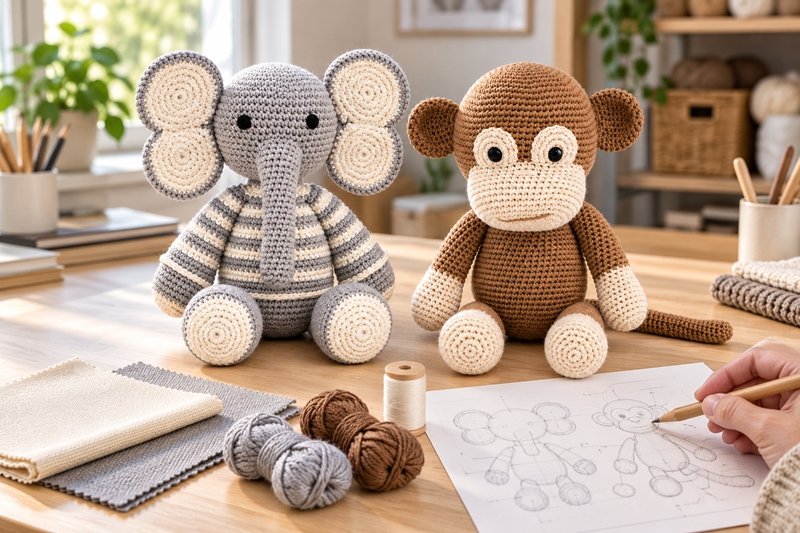
Define the Location With Repeatable Reference Points
Descriptions such as “attach near the top” leave too much room for interpretation.
Choose reference points that can be found on the actual component. Depending on the design, these may include a centerline, an approved seam, a component edge or a defined position in the crochet construction.
Document:
- The reference point used for positioning.
- The measurement direction.
- The condition of the component during measurement.
- The required orientation.
- Any agreed positional tolerance.
- How left and right components are distinguished.
Specify whether measurements are taken before or after stuffing and final shaping. Measurements taken under different conditions may describe different positions.
Describe the Joining Construction
An external photograph cannot fully define an attachment.
Record the proposed joining method and the materials it uses. Where relevant, the development specification should identify:
- Joining thread or yarn.
- Attachment area or seam path.
- Component preparation.
- Edge treatment.
- Any proposed internal support or backing.
- How thread or yarn ends are finished.
- Which construction details are concealed after assembly.
These details should be developed and evaluated for the specific product. Avoid treating a preferred joining method as suitable for every combination of crochet and fabric.
If backing or reinforcement is proposed, include it in the component specification and sample. Assess its effect on shape, feel, assembly and the finished product’s requirements.
Evaluate the Materials Together
Review the connection using the intended crochet and fabric materials.
An early sample made with substitute fabric may help explore shape, but it does not establish that the final combination will behave identically.
Observe whether assembly produces:
- Puckering around the attachment.
- Distortion of the crochet component.
- Uneven edges or visible gaps.
- Unwanted twisting.
- Excessive bulk.
- Exposed joining material.
- Changes to the intended silhouette.
Investigate the cause before changing the visible design. A positioning issue, material mismatch and assembly-sequence problem may require different solutions.
Where a yarn change is proposed, assess the affected connection as part of material revalidation.
Review a Connection Sample Before Completing the Whole Product
For an uncertain construction, a focused connection sample can make review easier.
The sample should reproduce the relevant material combination, attachment area and local shape. A flat material sample may be useful for some questions, while a curved or stuffed section may be needed for others.
Use it to examine construction access, edge appearance and the practical assembly method.
Then review the connection again in the complete product. The surrounding structure may affect its position, appearance or handling.
Do not approve the entire product solely because an isolated connection sample looks satisfactory.
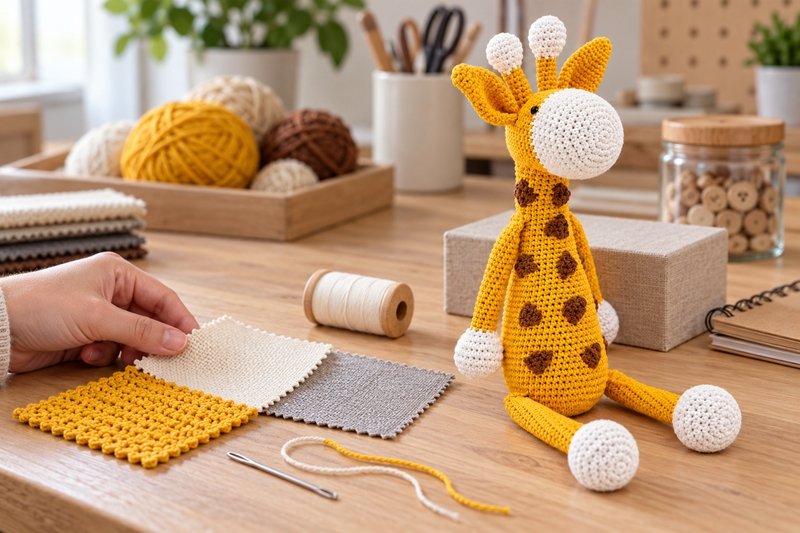
Specify the Assembly Sequence
A connection that is straightforward on an open fabric panel may become difficult to access after the body is closed.
Discuss the proposed sequence with the development team:
- Prepare the crochet and fabric components.
- Identify their orientation and attachment positions.
- Complete connections that require internal access.
- Assemble the surrounding structure.
- Add stuffing or shaping where applicable.
- Complete remaining attachments and finishing.
- Inspect the assembled product.
Adapt this sequence to the design. The purpose is to identify dependencies before approving a construction that cannot be repeated conveniently.
Separate Appearance Review From Performance Evaluation
Define separate review questions.
| Review area | What the buyer should establish |
|---|---|
| Position | Whether the component is attached at the agreed location and orientation |
| Appearance | Whether the seam, edges and surrounding surfaces match the approved reference |
| Assembly | Whether the documented method can reproduce the intended result |
| Function | Whether the connection supports the product’s intended use |
| Performance evaluation | Which assessments, methods and acceptance criteria are required |
| Documentation | Which sample and specification versions were reviewed |
Agree performance evaluation with the appropriate technical specialists for the intended product and market. A connection review does not replace evaluation of the complete toy.
Keep records precise. Avoid describing a sample as “fully approved” when only its appearance has been accepted.
Approve the Complete Product and Its Construction Record
Once the connection method is selected, evaluate it in a representative complete sample.
Check the silhouette from several angles. Confirm that paired components remain visually coordinated and that attached parts do not interfere with surrounding details.
The approval record should connect:
- The finished sample.
- The connection map.
- The material specification.
- Construction details.
- Assembly instructions.
- Agreed appearance criteria.
- Required evaluation records.
- Any unresolved conditions.
For the wider approval scope, see What Should Buyers Approve in a Crochet Pre-Production Sample?.
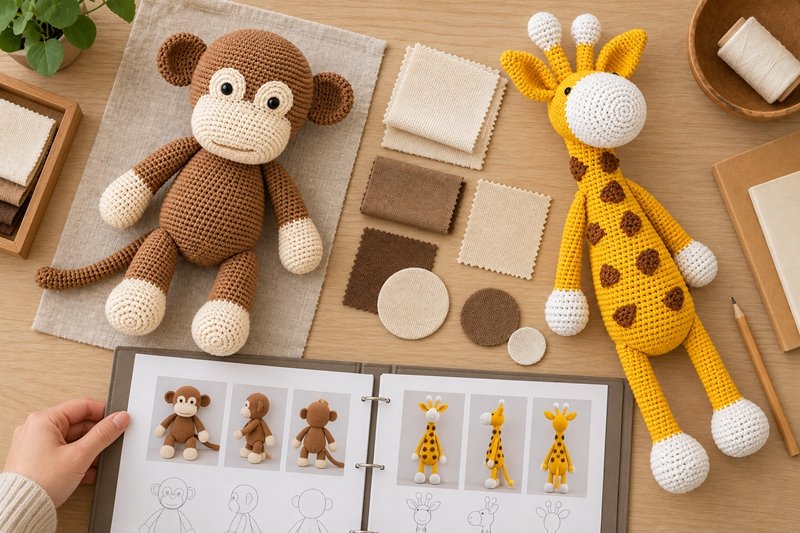
Control Changes After Approval
Changes to either side of a connection may affect the assembled result.
Review proposed changes to yarn, fabric, backing, component dimensions, joining materials or assembly order. Identify which connections are affected and what needs to be checked again.
For example, changing a fabric panel’s shape may move the attachment position even when the crochet component remains unchanged.
Keep earlier versions available for comparison, but clearly identify the current production reference. Record the authorization and effective scope of each change.
Discussing a Hybrid Product With UMY Crochet
For a hybrid product discussion, provide drawings or references showing which parts are crochet, which parts are fabric and how the finished product should look and function.
Ask the development team to identify connection questions requiring samples, material confirmation or specialist evaluation. Agree the development scope and responsibilities before treating an early appearance sample as a production specification.
Frequently Asked Questions
Can one attachment method be used throughout a hybrid toy?
Only where it is suitable for the specific connections. Different materials, shapes and access conditions may require different constructions.
Is a photograph enough to specify a connection?
A photograph helps explain appearance and position, but concealed construction and assembly details usually need additional documentation.
Should connection samples use the final materials?
Use representative intended materials for approval. Record substitutions in exploratory samples and reassess the relevant details when final materials become available.
Can connections be approved before stuffing?
Some construction details can be reviewed before stuffing, but assess the finished position and appearance in the complete product as well.
Does an attractive seam prove that a connection performs as required?
No. Appearance review and performance evaluation answer different questions. Agree the necessary assessments separately.
When should an approved connection be reviewed again?
Assess changes to connected materials, dimensions, joining materials, support components or assembly methods, and determine the required revalidation.
Request a Hybrid Construction Review
Send UMY Crochet your product drawing, proposed crochet and fabric materials, connection references and intended product requirements.
Request a project-specific assessment of attachment locations, construction samples, assembly dependencies and the evidence needed before production approval.
 Chinese