
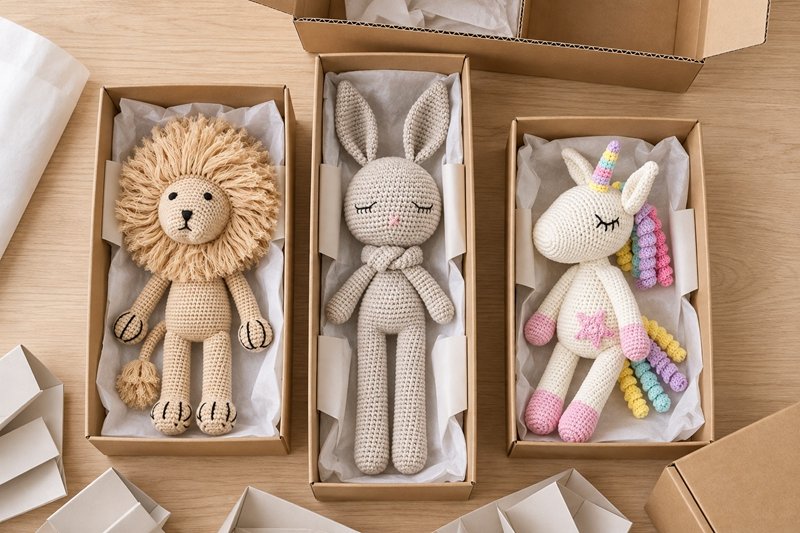
Validate protective packaging by checking the actual crochet product inside its proposed retail pack and shipping carton, then assessing its condition after unpacking under agreed conditions. The review should cover shape, surface appearance, accessories, packaging condition and the work required to prepare the product for sale. A smaller package is commercially useful only when the product still arrives in an acceptable condition.
This guide is for brands, retailers, gift companies and importers preparing crochet dolls, flowers, decorative gifts or coordinated gift sets for shipment. It focuses on physical protection and arrival presentation, from packaging samples through production packing approval.
Start With the Condition the Buyer Expects on Arrival
Before choosing an insert or reducing carton space, define what the receiving team should be able to do when it opens the shipment.
A product destined for a staffed gift shop may allow a simple, agreed arrangement step. A product delivered directly to a gift recipient may need to look presentable immediately.
These are different packaging requirements.
Record the intended arrival condition in practical terms:
- Which product features must retain their approved shape?
- May any part be folded or repositioned during packing?
- Is gentle hand shaping permitted after unpacking?
- Must the product remain inside its retail packaging for display?
- Are staff expected to assemble or arrange any components?
- What visible packaging damage would make the unit unsuitable for sale?
Avoid relying on descriptions such as “well protected” or “easy to restore.” State the permitted handling and the appearance that must result.
For the broader presentation brief, see How to Design Retail-Ready Packaging for Crochet Products.
Identify the Features Most Exposed to Packing Pressure
Different crochet products need different protection priorities.
A compact stuffed doll, a flower bouquet and a gift set containing rigid accessories should not automatically use the same packing method.
| Product feature | Packing concern to examine | Evidence to collect |
|---|---|---|
| Stuffed body or head | Flattening, distortion or pressure marks | Before-and-after photographs from consistent angles |
| Ears, limbs or other projections | Prolonged folding or pressure at attachment points | Packed position and unpacked condition |
| Long yarn details, hair or fringe | Tangling, snagging or trapped fibers | Close-up photographs and handling observations |
| Flower heads and leaves | Loss of arrangement or pressure on projecting details | Side and overhead views before packing and after unpacking |
| Rigid accessories in a gift set | Direct contact with softer crochet surfaces | Product placement and contact-point review |
| Retail box, window or insert | Crushing, movement or contact with the product | Closed-pack inspection and unpacking record |
| Tags, ribbons and story cards | Creasing, displacement or surface marking | Condition and position after unpacking |
Use this review to decide where support or separation may be needed. Avoid adding packaging materials without identifying the problem they are intended to solve.
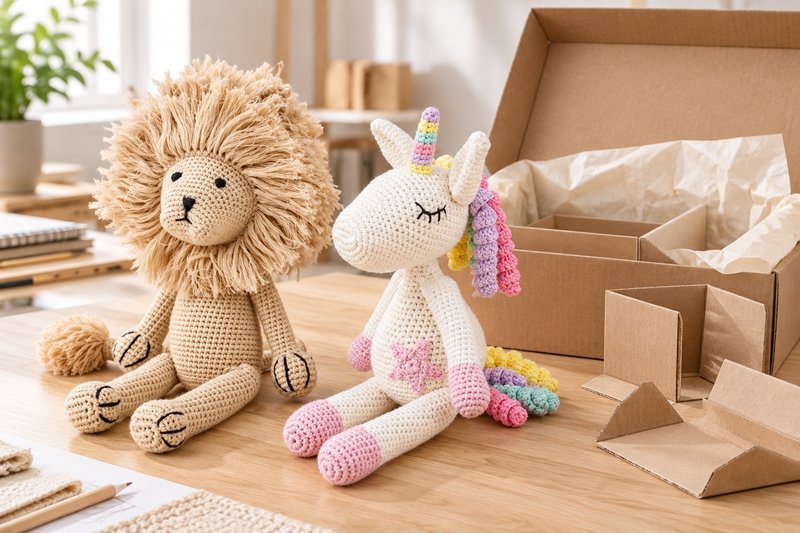
Evaluate the Product, Retail Pack and Shipping Carton Together
Packaging performance depends on the complete arrangement.
A retail box may hold a product neatly on a desk but behave differently when stacked inside a shipping carton. An insert may support the body while placing pressure on the ears. A carton may close successfully only because the packer compresses its contents.
Build the sample using the proposed production configuration:
- Use products representative of the intended production specification.
- Include the actual or proposed retail packaging materials.
- Add the intended accessories, tags, cards and protective layers.
- Pack the planned number and arrangement of retail units into the shipping carton.
- Record internal dimensions, product orientation and closure method.
- Photograph the arrangement before closing each packaging layer.
Check Contact Points
Look for places where one item presses against another.
Within a gift set, a rigid accessory may rest against a crochet face or flatten a decorative feature. Between retail packs, a projecting ribbon or unsecured component may become trapped.
Check whether the proposed separation remains in place when the package is handled. A divider that shifts away from the intended contact point may provide little practical protection.
Check How the Pack Is Closed
Observe the packing action itself.
Does the operator need to push down on the product to close the lid? Does adhesive contact the yarn? Does the closure trap a limb, flower petal or loose yarn detail?
Compare Packaging Options Under Consistent Conditions
When comparing two packaging proposals, keep the product specification and evaluation conditions consistent.
For example, comparing one option containing a freshly packed sample with another containing a product stored under pressure for much longer can produce a misleading conclusion.
Record:
- Product and packaging versions.
- Number of units packed.
- Packing orientation and arrangement.
- Time spent in the packed condition.
- Storage or handling conditions used in the evaluation.
- Any transport simulation or trial shipment.
- Time between unpacking and inspection.
- Any handling used to restore presentation.
Inspect Immediately After Opening and After the Agreed Recovery Period
The first inspection shows the condition the receiver encounters. A later inspection can show whether temporary compression resolves within the agreed receiving process.
Keep these observations separate.
Immediate Inspection
Before adjusting the product, photograph it as received.
Check the outer carton, retail packaging, product position, visible shape, surface condition and accessories. Record whether any part has moved outside its intended support.
Recovery Inspection
If a recovery period is permitted, define its duration and conditions before the trial.
Specify whether the product may simply rest unpacked or whether a documented hand-shaping step is allowed. Do not introduce heat, steam, washing or other treatment unless it has been specifically assessed and approved for the product.
A useful record distinguishes:
- Acceptable immediately after opening.
- Acceptable after the agreed recovery process.
- Requiring additional handling beyond the agreed process.
- Remaining outside the agreed appearance or functional requirements.
This distinction helps the buyer assess the receiving workload as well as the product condition.
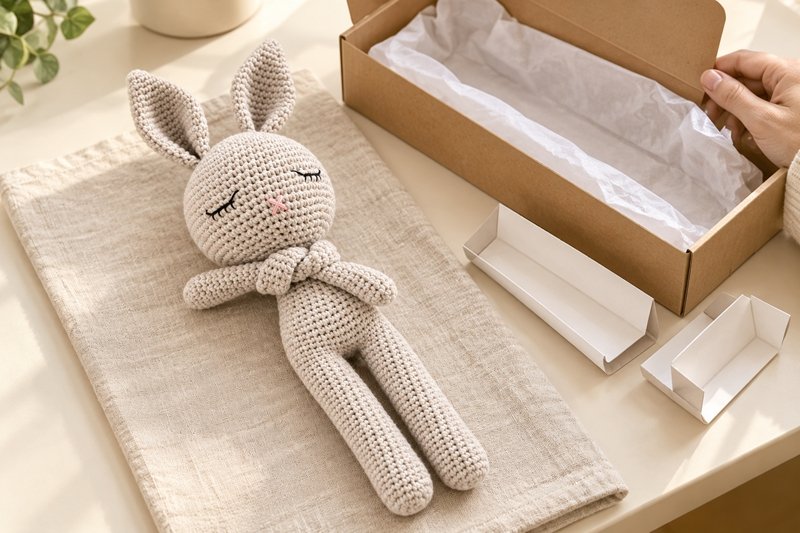
Set Acceptance Criteria Before Reviewing Results
Agree the decision rules before evaluating the packaging sample.
The following framework is a starting point for discussion, rather than a universal acceptance standard.
| Review area | Define before the trial | Decision if the requirement is not met |
|---|---|---|
| Product shape | Required profile and permitted recovery process | Revise clearance, orientation or support and repeat the affected evaluation |
| Surface appearance | Acceptable condition against the approved reference | Investigate contact, pressure or abrasion points |
| Accessories and attachments | Required position, condition and function | Review separation and restraint |
| Retail packaging | Condition needed for the intended sales channel | Adjust materials or carton arrangement |
| Receiving workload | Permitted preparation steps and effort | Simplify the unpacking process or revise the pack |
| Carton configuration | Approved unit count and arrangement | Reassess changes before production packing |
Take photographs under reasonably consistent lighting and camera angles. They support a more useful comparison than unrelated images taken at different distances.
Do not use a different product style as evidence that a particular SKU has passed its packaging review.
Balance Freight Space With Protection and Receiving Work
Reducing package volume can affect freight planning, but volume should be assessed alongside other consequences.
Compare packaging options across:
- Packed dimensions and weight.
- Packaging materials and assembly work.
- Product protection.
- Suitability for shelf display or gifting.
- Unpacking and arrangement requirements.
- Additional repacking materials needed at destination.
A proposal that saves carton space may create extra work for the retailer. Conversely, a larger presentation box may require further protection during distribution.
Use measured packaging samples for the comparison. Avoid presenting estimated savings as confirmed results.
For the wider purchasing calculation, see How to Calculate Landed Cost for Imported Crochet Products.
Turn the Approved Trial Into a Repeatable Packing Method
An approved packaging sample needs supporting instructions so the production team can reproduce it.
Prepare a packing reference that identifies:
- Product SKU and approved version.
- Retail packaging materials and versions.
- Product orientation inside the pack.
- Location of supports, separators and accessories.
- Placement of tags and printed materials.
- Retail units per shipping carton.
- Carton arrangement and closure method.
- Reference photographs.
- Approval date and responsible reviewer.
Record any conditions attached to approval. For example, approval of one carton arrangement should not automatically authorize a higher unit count.
Reassess relevant changes, including a different product size, revised accessory, replacement insert, smaller box or changed carton arrangement.
A change that appears minor in a purchasing spreadsheet may alter how pressure reaches the product.
Preparing a Packaging Review With UMY Crochet
UMY Crochet is a product development and manufacturing partner for crochet, DIY craft kits, knitted toys and creative gifts.
For a packaging review, provide the product reference, intended sales channel, proposed pack format, expected order configuration and delivery route. Include any receiving instructions or packaging requirements supplied by your retailer or distribution partner.
The project discussion should establish which product and packaging samples are needed, what arrival condition will be assessed and whether specialist testing is required. Agree the validation scope, responsibilities, cost and timing before proceeding.
Frequently Asked Questions
Can crochet products be compressed for shipping?
Some configurations may tolerate an agreed degree of compression, but this must be evaluated using the actual product, materials, packed duration and recovery requirements. Approval for one product does not establish suitability for another.
Is a retail gift box enough to protect a crochet product in transit?
That depends on the complete shipping arrangement. Review the product inside the retail box and the retail box inside the proposed shipping carton.
Should packaging approval include a packed sample?
Yes. A drawing or empty packaging sample cannot show how the product sits inside the pack, where pressure occurs or how it looks after unpacking.
How long should a product be left to recover after unpacking?
Agree a period that fits the receiving process and evaluate it with representative samples. Avoid assuming a universal recovery time for all crochet products.
Does an internal packing trial replace transport testing?
An internal trial can reveal packing problems, but it does not replace a defined test required by a buyer or distribution channel. Confirm the applicable evaluation scope before making performance claims.
When should packaging be reviewed again?
Review changes that could affect protection or presentation, including product dimensions, accessories, packaging materials, supports, unit counts and carton arrangements.
Discuss a Protective Packaging Evaluation
Send UMY Crochet your product photographs or design references, proposed packaging, sales channel, order configuration and intended delivery route.
Ask for a project-specific review of packaging sample requirements, product support, unpacking expectations and the evidence needed before packing approval.
 Chinese