
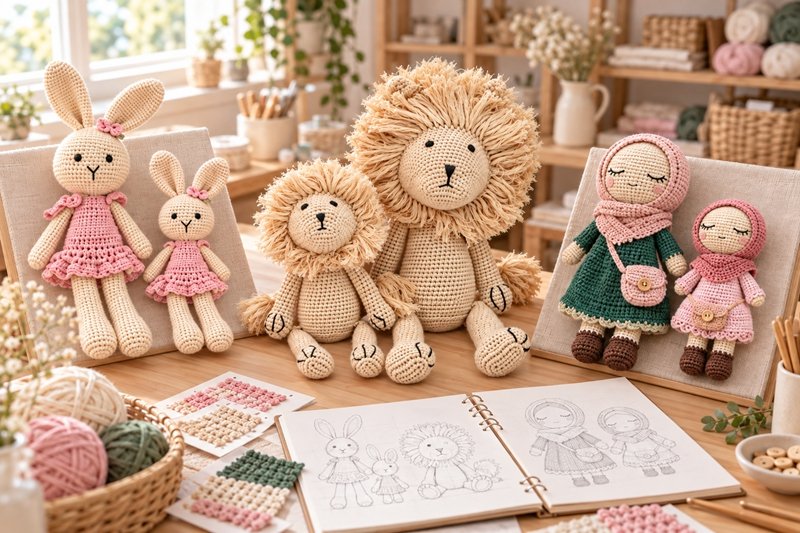
Developing a crochet character in multiple sizes requires a separate construction review for each size, guided by the same approved identity references. Keep the character’s defining silhouette, facial relationships, colors and signature details consistent, while adapting stitches, materials and assembly where necessary. Simply multiplying stitch counts or changing yarn thickness does not guarantee a recognizable size range.
This guide is for brands, IP owners, cultural merchandise teams and product developers extending one character into smaller or larger crochet versions. It focuses on size development within a character family, rather than choosing between dolls, keychains and other merchandise formats.
Identify What Makes the Character Recognizable
Before developing another size, define the features that carry the character’s identity.
These may include:
- Head shape and its relationship to the body.
- Muzzle or facial profile.
- Eye position and intended expression.
- Ear, horn or tail silhouette.
- A distinctive hairstyle or mane.
- Clothing shapes and color placement.
- A signature accessory or decorative feature.
Not every detail has equal importance.
Create an identity reference that distinguishes:
- Features that must remain recognizable at every size.
- Details that may be adapted with approval.
- Elements that need a new construction assessment.
Where the character belongs to a licensed project, the authorized approval team should confirm these boundaries.
Define the Purpose of Each Size
A size range should serve a clear product requirement.
A smaller version might need to fit a compact retail package or travel display. A larger version might need greater shelf presence or more space to express detailed features.
For each version, record:
- Target dimensions and measurement method.
- Intended use and audience.
- Required pose.
- Packaging or display constraints.
- Material preferences.
- Required accessories.
- Commercial quantity assumptions.
- Approval responsibilities.
Do not assume that the smallest and largest versions have identical requirements.
For the separate decision about product formats, see How to Choose the Right Crochet Product Format for a Brand Character.
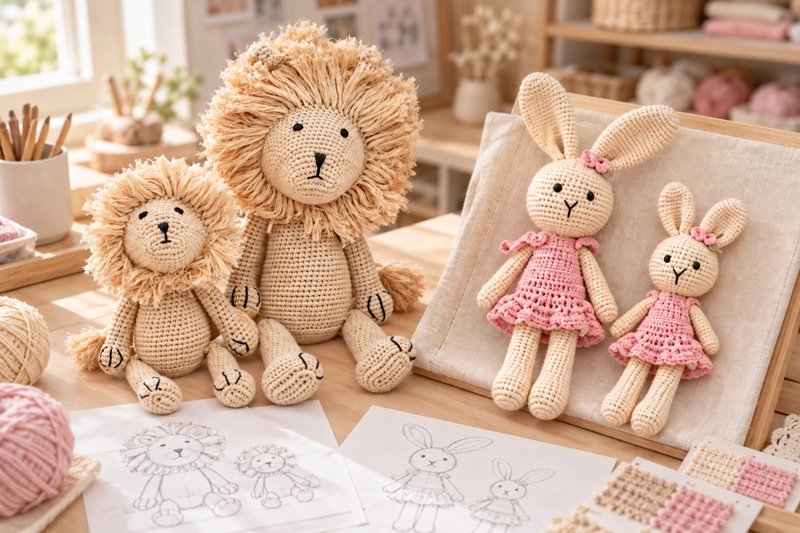
Assess Each Feature Before Changing the Pattern
Use a feature review to decide what can carry across and what needs redevelopment.
| Feature | What to preserve | What may require adaptation | What to check in the sample |
|---|---|---|---|
| Head and body | Recognizable silhouette and proportion relationships | Shaping sequences and part construction | Front and side profiles |
| Eyes and expression | Character expression and facial relationships | Embroidery method and placement references | Readability at the intended viewing distance |
| Muzzle or nose | Profile and visual identity | Stitch structure and assembly | Projection, alignment and face balance |
| Ears or horns | Shape, direction and identifying outline | Thickness, shaping and attachment | Stability and silhouette |
| Limbs | Intended proportions and pose | Stitch counts, filling and joining method | Position and overall balance |
| Clothing | Signature silhouette and color placement | Fine trims, closures and construction | Recognition and fit |
| Decorative details | Essential identity cues | Small motifs or finishing techniques | Visibility and workmanship |
| Packaging | Intended presentation | Box dimensions and internal support | Fit without unacceptable distortion |
The table is a development framework. Final decisions depend on the actual character, material and intended use.
Why Direct Pattern Scaling Can Change the Design
Crochet construction uses discrete stitches and rounds.
A shape cannot always be reduced by the same proportion in every direction. At a smaller scale, removing a round may noticeably change the head or muzzle. At a larger scale, repeating a shaping sequence may create a contour that differs from the original.
Assembly also affects the result. A small change in where an ear or arm is attached can have a greater visual effect on a miniature version.
Treat the existing pattern as a reference, then develop the structure needed for the new size.
The goal is to preserve the visual relationships that matter, rather than to preserve every instruction unchanged.
Review Yarn and Hook Choices Together
Changing yarn or hook size can help explore a different finished scale, but it also changes the product’s surface and behavior.
Assess:
- Stitch definition.
- Fabric density.
- Shape and flexibility.
- Filling visibility.
- Detail readability.
- Assembly and attachment behavior.
- The resulting dimensions.
A thicker yarn may make a larger product quickly, but its stitch scale may obscure fine facial details. A thinner yarn may support smaller features, while requiring a different pattern and assembly approach.
Material changes should be evaluated through a complete sample. Do not approve a yarn solely because its color resembles the original.
Also separate material decisions from size decisions in the development record. Otherwise, it becomes difficult to identify why a sample’s appearance changed.
Protect Facial Relationships in Smaller Versions
Small characters leave less space for facial details.
Eye spacing, nose position and embroidery thickness can significantly influence the expression. If each feature is reduced independently, the face may become crowded or lose its intended character.
Define the relationships between features, including:
- Eyes relative to the head width.
- Nose or muzzle relative to the eye line.
- Expression details relative to the mouth area.
- Facial features relative to hair, headwear or surrounding decoration.
Then review the result at its actual physical size.
An enlarged close-up can help inspect workmanship, but it can make tiny details appear more readable than they are in normal presentation.
Where simplification is necessary, submit the proposed version for approval. Avoid quietly removing a signature feature during sampling.
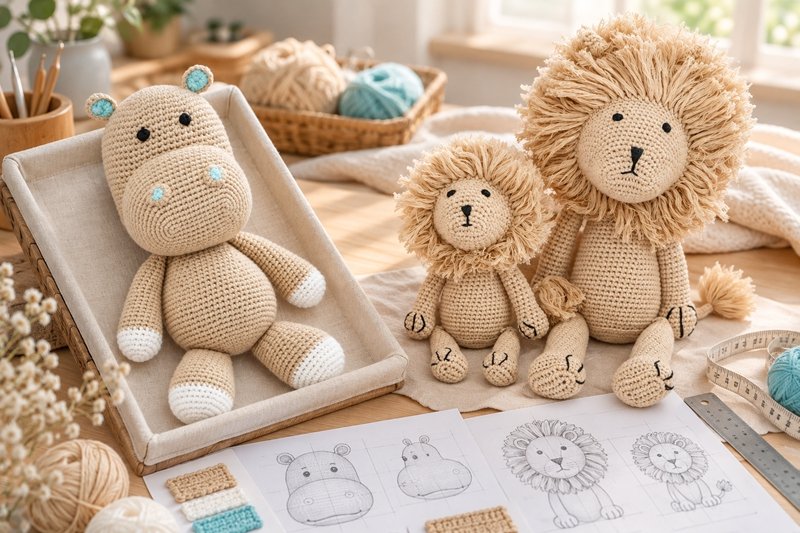
Reassess Structure in Larger Versions
A larger version may need changes to maintain its approved shape and pose.
Review how the increased dimensions affect:
- Head support.
- Body fullness and contour.
- Limb position.
- Long ears, tails or other extensions.
- Clothing fit.
- Accessory placement.
- The product’s resting or display position.
More filling does not automatically solve a shape problem. It can change the surface, distort the silhouette or affect how parts sit together.
Evaluate construction and filling together. Check the sample in the positions relevant to its intended presentation, rather than relying on one front-facing photograph.
Any changes affecting required function or product safety need their own appropriate evaluation.
Compare Samples Against One Identity Reference
Review each size individually and then review the family together.
Individual review checks whether that version meets its own specification.
Family review checks whether the versions still look like the same character.
Use consistent review conditions:
- Photograph the samples from comparable front, side and rear angles.
- Keep lighting and product positioning consistent.
- Record the actual dimensions.
- Review each sample at physical size.
- Compare the defining silhouette and facial relationships.
- Record differences requiring correction or approval.
Normalized photographs can help compare proportions, but they should be clearly identified during review. They must not replace photographs showing the actual size relationship.
Keep styling differences separate from construction differences. A flexible limb arranged differently for a photograph may not indicate a pattern problem.
Set Separate Specifications for Every Size
Once approved, each size needs its own controlled product specification.
Record:
- Size or SKU identification.
- Pattern version.
- Yarn and material references.
- Dimensions and measurement methods.
- Facial placement references.
- Construction and filling requirements.
- Accessories and attachment details.
- Appearance acceptance criteria.
- Packaging configuration.
- Approval evidence.
Do not use one sample to approve the entire size range.
A successful medium version does not establish that the smaller version’s details or the larger version’s structure are acceptable.
For the management of approved references, see How to Manage an Approved Crochet Sample Before Bulk Production.
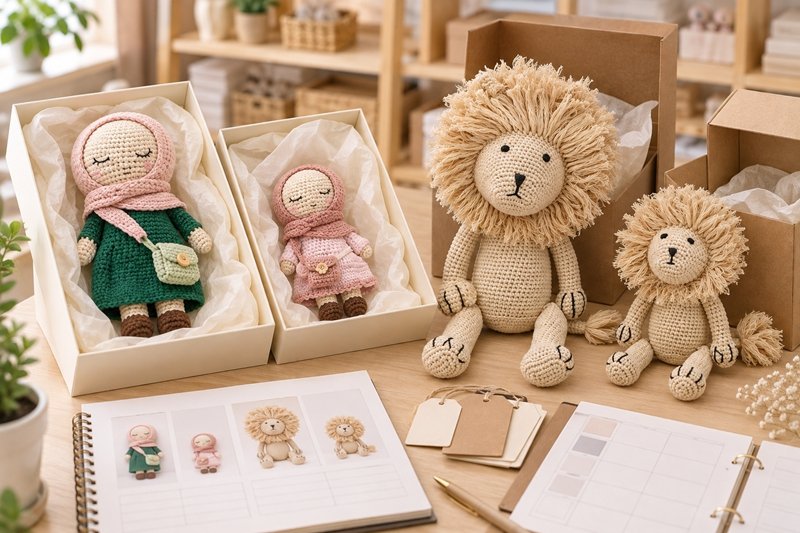
Review Packaging and Presentation for Each Version
The packaging should support the approved product without changing its appearance.
Check whether:
- Ears, horns or other extensions have adequate clearance.
- The product fits in its intended position.
- Internal support preserves the shape.
- Accessories remain visible and appropriately positioned.
- The package suits the planned retail display.
- Product identification distinguishes the sizes correctly.
If a smaller version is shown beside a larger one in retail imagery, represent their size relationship accurately.
Avoid presenting an unapproved prototype as a finished member of the collection.
Discuss Multi-Size Character Development With UMY Crochet
For a character size project, a useful development discussion connects identity requirements with pattern construction, materials, sample review and packaging.
A practical sequence is:
- Establish the approved character reference.
- Define the purpose and dimensions of each version.
- Identify essential and adaptable features.
- Assess construction and material options.
- Develop and review each sample.
- Compare the versions as a character family.
- Confirm separate specifications and packaging.
This framework helps the buyer evaluate whether each version is both recognizable and practical to produce.
Frequently Asked Questions
Can a crochet character be resized by changing yarn thickness?
Changing yarn can alter the finished scale, but it also affects texture, detail and structure. Review the complete sample before approving the approach.
Should every size use the same pattern?
Not necessarily. Each version may need different shaping or assembly to preserve the character’s identity.
Which details should remain consistent?
The features that define recognition, such as silhouette, facial relationships, color placement and signature elements. Agree those priorities before development.
Can small decorative details be simplified?
Yes, where the responsible approval team accepts the change. Document the simplification and confirm that the character remains recognizable.
Does a larger version need more stuffing?
It may need a different filling configuration, but construction and shape should be reviewed together. More filling alone is not a reliable solution.
Can one approved sample cover several sizes?
Each size should have its own approved reference and specification. Review the range together as well as checking each version separately.
What should buyers provide before requesting additional sizes?
Provide the approved character reference, target dimensions, intended use, essential identity features, material preferences and packaging constraints.
Request a Multi-Size Character Development Assessment
Share your approved character images, existing sample references, proposed size range and the features that must remain recognizable.
Ask UMY Crochet to assess the construction requirements and discuss sampling, material options and approval criteria for each size.
 Chinese