
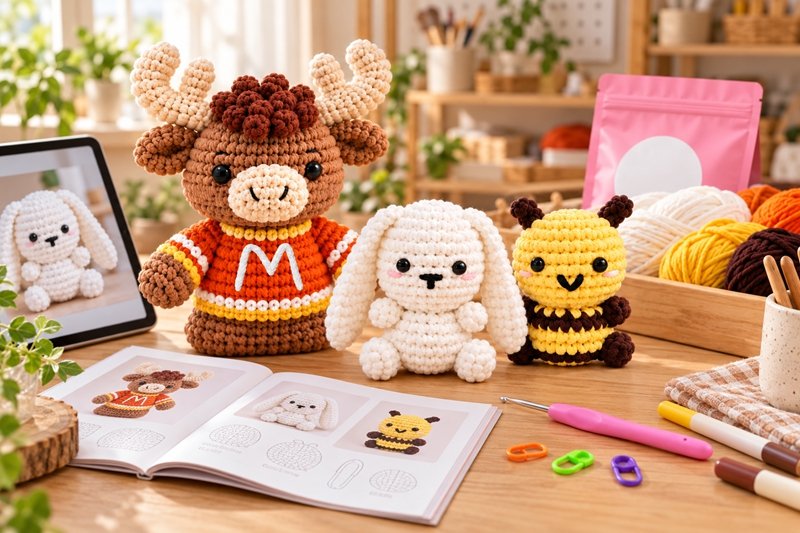
Validate crochet kit instructions by asking people who match the intended skill level to make the product using the exact materials, tools, written instructions and videos planned for the retail kit. Record where they hesitate, need help or produce a different result, then revise and retest the affected steps before approving the final version.
A complete kit is not necessarily a usable kit. Buyers also need to establish whether its instructions reliably guide the intended customer from opening the package to finishing the product.
Who Should Validate Crochet Kit Instructions?
This guide is for crochet kit brands, craft retailers, private-label buyers and product development teams preparing a kit for retail.
Instruction testing is particularly useful when:
- A new character introduces unfamiliar shaping or assembly.
- An existing pattern is adapted for beginners.
- The yarn, hook, accessories or construction method changes.
- Written instructions and videos are produced separately.
- A tutorial is translated for a new customer market.
- Several kits share tutorial sections but use different finishing steps.
The purpose is to evaluate the learning experience. This does not replace component checks, product safety assessment or other requirements applicable to the intended product and market.
For the wider product development process, see How to Develop a Private-Label Crochet Kit From Concept to Retail.
1. Define What the Customer Is Expected to Know
“Beginner” can describe different starting points.
Someone who has never held a crochet hook needs different support from someone who already understands a magic ring, single crochet, increases and decreases.
Before testing, define:
| Starting point | What the instructions should establish |
|---|---|
| No previous crochet experience | How to hold the tools, manage yarn and work the starting method |
| Familiar with basic stitches | How to read the pattern, track rounds and complete the kit-specific construction |
| Able to crochet simple shapes | How to manage assembly, placement and finishing details |
| Returning to crochet after a break | How to recover essential techniques and follow the kit’s terminology |
Select testers who fit the stated starting point. An experienced crocheter can check technical accuracy, but their success alone does not establish that a tutorial works for beginners.
Also define the expected outcome: what customers should make, what normal variation is acceptable and which parts require close visual guidance.
2. Freeze a Test Version of the Complete Kit
Testing is useful only when the materials and instructions represent the intended retail experience.
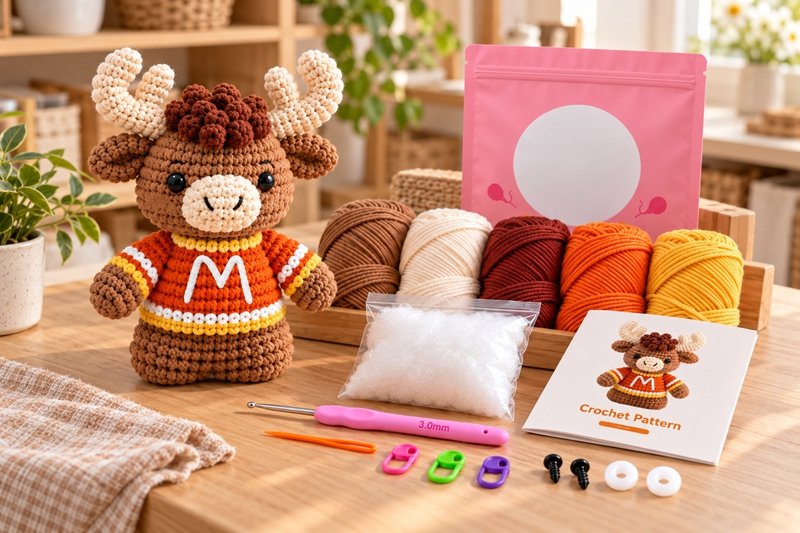
Prepare a test kit containing:
- The proposed yarn and quantity for each color.
- The intended hook and tools.
- All accessories and finishing materials.
- The complete written pattern.
- The matching video tutorial, if included.
- The intended access method for digital content.
- A reference image of the expected finished product.
Give the test version a clear identifier. Record the product revision, written pattern revision and video revision together.
If a tester uses a different hook, substitutes yarn or follows an older video, their result may not reveal whether the proposed retail kit works.
3. Check Technical Accuracy Before User Testing
A technical review should identify errors that would prevent a fair usability test.
Check that:
- Abbreviations are defined and used consistently.
- Round and row numbers follow the intended sequence.
- Stitch totals agree with the instructions.
- Repeated sections identify the correct rounds or rows.
- Color changes appear in the correct locations.
- Front-loop and back-loop instructions are clearly distinguished.
- Assembly steps match the finished reference sample.
- Written instructions and videos show the same construction version.
Pay particular attention to phrases that an experienced maker may interpret automatically.
For example, “repeat as before” is unclear if the referenced section contains a different yarn color, stitch count or finishing step. State exactly what repeats and identify any exception.
Similarly, a stitch marker instruction should explain what the marker identifies. A marker placed in the first stitch of a round serves a different purpose from a marker used to show an adjustable starting chain.
4. Observe Testers Without Solving Every Problem for Them
Ask testers to work through the kit using the support available to a retail customer.
Explain that the instructions are being evaluated. Encourage them to describe uncertainty instead of hiding it.
During the first attempt, record:
- The step where they stop or reread.
- What they believe the instruction means.
- Whether they consult the video or reference image.
- Any outside assistance they request.
- Whether an error is noticed immediately or much later.
- Whether they can recover using the provided guidance.
If assistance is necessary, record the intervention. A completed product made with repeated personal coaching should not be treated as evidence of independent completion.
There is no universal tester count that guarantees a usable tutorial. Choose a testing scope appropriate to the product’s complexity and launch risk, and include more than one perspective.
5. Record Problems in a Way the Development Team Can Use
“Too difficult” is not a sufficiently specific revision note.
A useful record identifies the exact step, the observed behavior and the proposed change.
| Test area | What to observe | Possible revision |
|---|---|---|
| Starting method | Tester cannot see where to insert the hook | Add a close-up and a clearly numbered explanation |
| Round tracking | Tester moves the marker inconsistently | Explain when to move it and what it marks |
| Stitch counts | Tester discovers an error several rounds later | Add counts and selected checkpoints |
| Shaping | Tester finishes the stitches but gets an unexpected form | Clarify tension, orientation or stuffing guidance |
| Assembly | Features are attached in inconsistent positions | Add round references, alignment points and placement photos |
| Video navigation | Tester repeatedly searches for one technique | Add clearly named sections or timestamps |
| Finishing | Tester does not know how to secure the yarn end | Show the finishing action and the expected appearance |
Separate technical errors from usability problems.
A wrong stitch count requires correction. A correct instruction that testers repeatedly misunderstand requires a clearer explanation or visual.
6. Validate Written Instructions and Videos Together
Written patterns and videos should support the same product version.
Compare them step by step:
- Does the video use the yarn and hook intended for the kit?
- Do the round numbers and stitch counts match?
- Are color changes shown at the same point?
- Are pieces assembled in the same order?
- Do both formats explain the same feature placement?
- Does the finished video sample match the approved reference?
If a tutorial section is shared across several kits, verify that it applies to each one.
A reusable starting-method video may be suitable for multiple products. A shared assembly section may not be suitable when their body shapes, attachment points or accessories differ.
Check Digital Access as Part of the Test
If the kit includes a QR code or link, test the actual access journey.
Confirm that:
- The printed code can be scanned at its intended size.
- It opens the correct kit and language.
- The required tutorial can be found easily.
- Videos are readable on the devices customers are expected to use.
- Any access restrictions are clearly explained.
- The destination is controlled and maintained by the responsible party.
A working video does not help if the retail card directs the customer to the wrong product.
7. Review Completion, Material Use and Finished Results
Compare the finished test products with the approved reference.
Review:
- Overall shape and proportions.
- Placement of facial features and accessories.
- Assembly quality.
- Whether the supplied yarn was sufficient.
- Whether the provided tools worked for the specified steps.
- Which mistakes affected the final result.
- Whether the instructions explained acceptable handmade variation.
Record completion time where it helps development, but avoid turning a few test results into a guaranteed customer promise. Experience, working pace, interruptions and mistakes can change how long a project takes.
If yarn runs short, investigate the cause. It may involve the supplied quantity, tester tension, pattern interpretation, reworking or a combination of factors.
Do not assume that every tester must produce an identical handmade result. Define the features that matter and distinguish normal variation from a tutorial problem.
8. Revise and Retest Before Approval
Prioritize problems by their effect on completion.
Blocking problems prevent the customer from progressing, such as a missing step or an incorrect stitch count.
Major usability problems allow progress but repeatedly lead to incorrect assembly, substantial reworking or outside assistance.
Minor clarity problems create hesitation without materially affecting completion.
Correct the blocking and major problems, then retest the affected sections with someone who has not already learned the solution. Where a change affects stitch counts, shaping or assembly order, test through the downstream steps as well.
9. Establish a Clear Instruction Approval Record
Before retail packing, keep an approval record that connects the product to its learning materials.
Include:
- Product name and SKU.
- Approved physical reference sample.
- Yarn, hook and component specification.
- Final written pattern version.
- Final video version and access destination.
- Languages reviewed.
- Test findings and completed revisions.
- Any unresolved issue and the decision made about it.
- Approval date and responsible reviewer.
A later material or construction change may require instruction revalidation. For example, a different yarn can affect visibility, handling, dimensions and yarn consumption even when the pattern wording remains unchanged.
For the related challenge of maintaining an approved product across replenishment orders, see How to Keep Handmade Crochet Products Consistent Across Repeat Orders.
How to Discuss Instruction Validation With UMY Crochet
UMY Crochet is a product development and manufacturing partner for crochet, DIY craft kits, knitted toys and creative gifts.
When discussing a crochet kit project, connect the product sample, materials, construction method and tutorial requirements from the beginning. Buyers should also agree who is responsible for technical pattern review, target-user testing, translation, video approval and ongoing digital access.
A practical project review can follow this sequence:
- Define the intended customer’s starting skill level.
- Review the proposed product and construction challenges.
- Align the physical sa## 9. Establish a Clear Instruction Approval Record
Before retail packing, keep an approval record that connects the product to its learning materials.
Include:
- Product name and SKU.
- Approved physical reference sample.
- Yarn, hook and component specification.
- Final written pattern version.
- Final video version and access destination.
- Languages reviewed.
- Test findings and completed revisions.
- Any unresolved issue and the decision made about it.
- Approval date and responsible reviewer.
A later material or construction change may require instruction revalidation. For example, [a different yarn can affect visibility, handling, dimensions and yarn consumption even when the pattern wording remains unchanged.](https://pubmed.ncbi.nlm.nih.gov/33428371/)
For the related challenge of maintaining an approved product across replenishment orders, see How to Keep Handmade Crochet Products Consistent Across Repeat Orders.and responsibility for recording findings.
- Review revisions before approving the retail kit version.
The scope should be agreed for the specific project. A manufacturing sample review and a buyer-led customer usability test address different questions, and both may be useful before launch.
Frequently Asked Questions
Is a technically correct pattern enough for a beginner crochet kit?
No. Technical accuracy is necessary, but beginners may still struggle with terminology, orientation, feature placement or recovery from mistakes. Test whether the intended user can follow it.
Should experienced crocheters test the instructions?
Yes, for technical review. Also include testers who match the kit’s advertised starting skill level so that usability problems are not overlooked.
Should testers use the exact retail materials?
Use the intended materials and tools wherever possible. Substitutions can affect handling, stitch visibility, yarn consumption and the finished result.
Can a video replace the written pattern?
That depends on the intended kit experience. If both are provided, they should match. If the kit relies on video, test access, navigation and whether customers can follow all required steps.
Must every tester finish without help?
Record all assistance and assess it against the intended customer experience. Repeated help at the same step is a strong reason to revise that section.
When should instructions be retested?
Retest after changes that affect construction, interpretation or completion. Material substitutions, revised stitch counts, new assembly steps and significant tutorial edits can all justify another test.
What should be approved before retail packing?
Approve the product reference, material specification, written pattern, video content and access method as one coordinated kit version.
Discuss Your Crochet Kit’s Instruction Validation Scope
Share your proposed finished product, target customer skill level, kit contents and available pattern or video drafts with UMY Crochet.
Request a development review to identify construction challenges and agree which instruction checks, sample revisions and testing responsibilities should be resolved before retail production.

 Chinese