
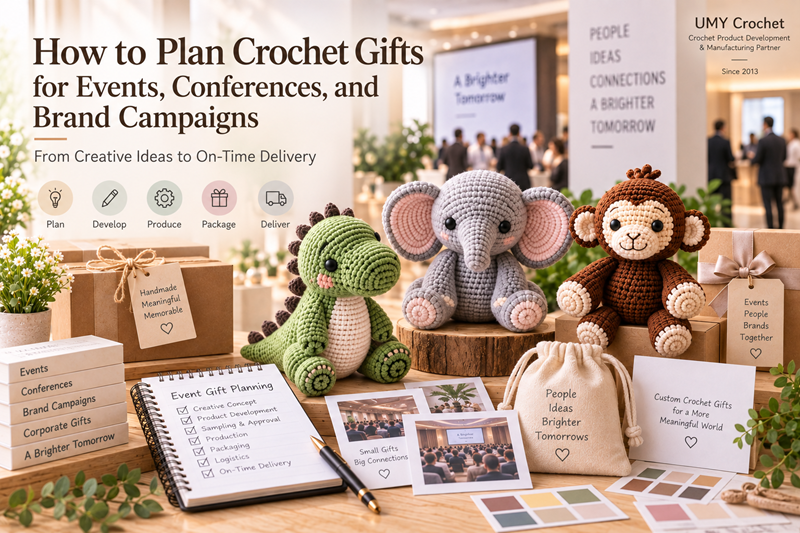
Crochet gifts for events, conferences, and brand campaigns should be planned backward from the distribution date, not forward from the product idea.
Before asking a manufacturer to make samples, buyers should define five things: who will receive the gift, what the campaign should communicate, how many units are needed, how the product will be distributed, and the date by which finished goods must be ready. These decisions determine the appropriate product format, customization level, packaging, sampling schedule, production plan, and quality-control requirements.
A 100-piece VIP gift program and a large conference giveaway may use the same brand character but require very different product solutions. A full-size crochet mascot in a presentation box may suit speakers or VIP guests, while a smaller character, keychain, ornament, or simplified branded item may be more practical for wider distribution.
The most important procurement principle is simple:
Design the crochet gift around the campaign objective and operational constraints—not around the product alone.
For event buyers, this approach reduces late-stage redesigns and helps align creative ideas with quantity, budget, packaging, production, logistics, and the immovable event deadline.
Why Event Crochet Gifts Need a Different Planning Process
Corporate gifting and event gifting overlap, but they are not identical procurement situations.
An ordinary corporate gift program may sometimes allow flexibility in delivery timing. An event project usually does not.
The products may be required for:
- Conferences
- Trade shows
- Product launches
- Brand activations
- Company anniversaries
- Employee events
- Customer events
- Exhibitions
- Promotional campaigns
- Partner meetings
If an event opens on a fixed date, a product arriving afterward has lost much of its intended purpose.
That changes how buyers should manage development.
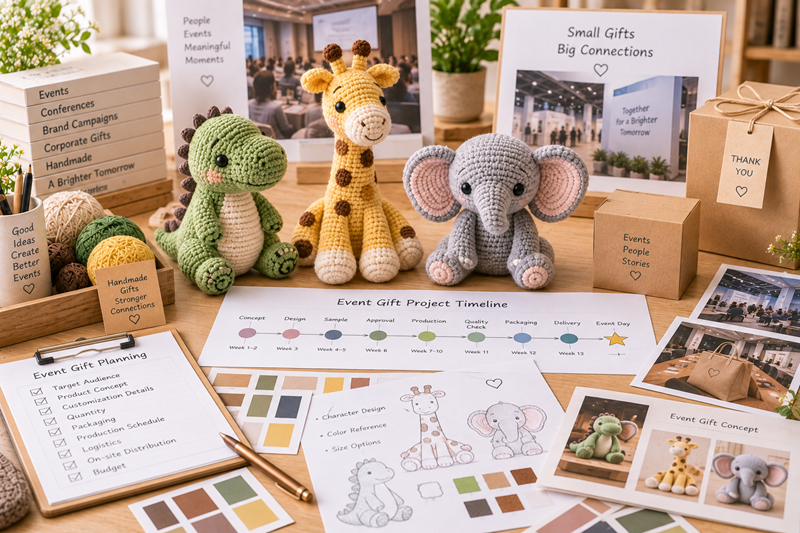
The project must account for more than manufacturing time. It may also require:
- Concept approval
- Artwork preparation
- Crochet sample development
- Sample review
- Revisions
- Final sample approval
- Material preparation
- Production
- Quality control
- Packaging
- Export or domestic transportation
- Delivery to the event organizer
- Venue receiving and internal distribution
For this reason, the event date should be treated as the final constraint around which the rest of the project is built.
Step 1: Define What the Gift Is Supposed to Achieve
Do not begin with:
“Which crochet product should we order?”
Begin with:
“What should recipients remember after receiving it?”
Different objectives lead to different product decisions.
| Campaign Objective | Possible Crochet Direction | Key Planning Priority |
|---|---|---|
| Brand recognition | Crochet mascot or recognizable brand character | Character recognition |
| Conference giveaway | Mini character, keychain, or compact item | Portability and distribution |
| VIP appreciation | Larger character or gift set | Presentation and perceived value |
| Product launch | Campaign-specific character or themed accessory | Message relevance |
| Employee event | Friendly character or commemorative item | Emotional connection |
| Anniversary | Limited-edition version of an existing character | Occasion-specific details |
| Social campaign | Visually distinctive character | Photogenic presentation |
| Partner gifting | Product plus message card or gift packaging | Context and presentation |
The product should serve the communication goal.
This prevents a common problem: developing an attractive crochet item that has little connection to the event itself.
Step 2: Segment the Recipients Before Choosing the Product
Not every person at an event necessarily needs the same gift.
Buyers should identify recipient groups before confirming product specifications.
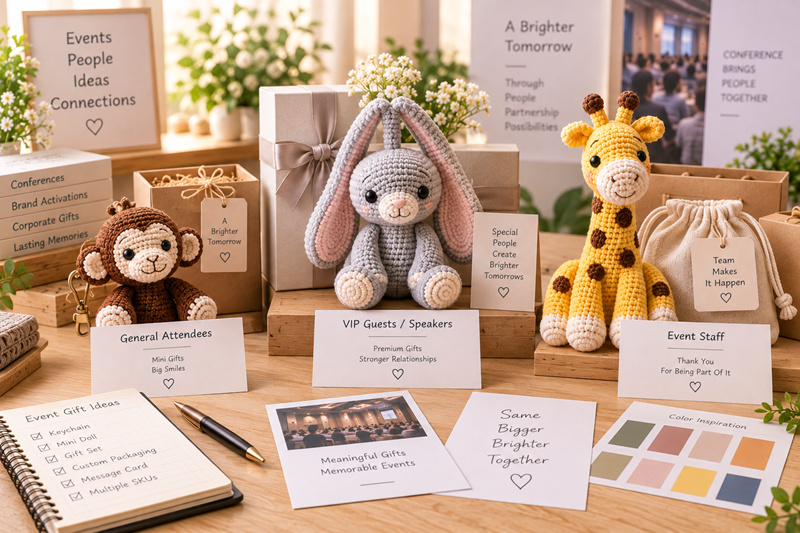
Possible groups include:
- General attendees
- Speakers
- VIP guests
- Employees
- Partners
- Distributors
- Media
- Influencers
- Customers
- Competition winners
- Event staff
This matters because quantity, budget, perceived value, and distribution method may vary significantly between groups.
For example:
General Attendees
A compact item may be easier to distribute in larger quantities.
Possible formats include:
- Mini crochet characters
- Keychains
- Bag charms
- Small ornaments
VIP Guests or Speakers
A more presentation-focused gift may be appropriate.
Possible formats include:
- Full-size crochet mascot
- Character gift set
- Crochet product with story card
- Product in a custom gift box or pouch
Employees or Internal Teams
The gift may focus more strongly on:
- Appreciation
- Team identity
- Milestones
- Campaign participation
The same campaign can therefore support more than one product format without losing its central creative concept.
Step 3: Confirm Quantity Before Finalizing Complexity
Quantity is not just a purchasing number.
It affects product development.
A complex design with numerous small components may be practical for a limited VIP run but inefficient for a much larger event distribution program.
Before sampling, tell the manufacturer:
- Estimated total quantity
- Quantity by recipient group
- Whether quantities are fixed or provisional
- Whether multiple versions are required
- Whether reserve units are needed
- Whether products will ship to one location or several
This information helps the development team evaluate whether the proposed construction is appropriate for the program.
A Useful Rule
As quantity increases, buyers should become more disciplined about:
- Number of colors
- Number of components
- Accessory complexity
- Packaging steps
- SKU count
- Manual finishing requirements
The objective is not necessarily to make the product simpler.
It is to make complexity intentional.
Step 4: Choose a Product Format That Fits the Distribution Environment
A gift can look excellent in a presentation meeting and still be inconvenient at the actual event.
Consider how recipients will receive, carry, store, and transport it.
For Conference Bags
A smaller, lighter format may be preferable.
For Booth Giveaways
Products should be easy for staff to handle and replenish.
For Seated Events
Individual placement at each seat may allow more elaborate presentation.
For VIP Gift Rooms
Larger gift boxes or multi-item sets may be practical.
For International Attendees
Package volume and portability may deserve additional attention because recipients may need to pack the gift into luggage.
Ask operational questions early:
- Will the product go inside an attendee bag?
- Will staff hand it out?
- Will it be displayed at a booth?
- Will it be placed on tables?
- Does it need individual packaging?
- Will recipients travel with it?
- Does the packaging need to protect the product during event handling?
These questions can change the ideal product format.
Step 5: Decide Which Brand Elements Actually Need to Appear
A branded gift does not need to carry every element of a corporate identity.
In many cases, stronger results come from identifying the few elements recipients are most likely to recognize.
These might include:
- Brand mascot
- Character silhouette
- Signature colors
- Clothing
- Campaign accessory
- Event-specific detail
- Hangtag
- Story card
- Packaging
- Logo placement
If an existing mascot is being adapted into crochet, identify its non-negotiable recognition features before sampling.
For example:
- Head-to-body proportion
- Signature ears
- Hairstyle
- Facial expression
- Clothing color
- Special accessory
Not every two-dimensional detail will translate equally well into yarn construction.
The development brief should distinguish between:
Must preserve
and
Can adapt
That gives the sampling team clearer priorities.
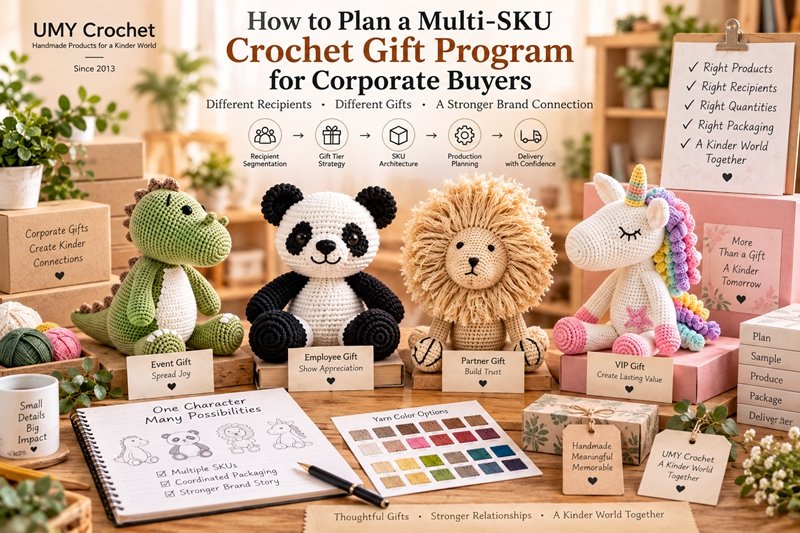
Step 6: Decide Whether the Event Needs One SKU or a Gift System
Some campaigns need one product.
Others benefit from a coordinated family of products.
For example:
One campaign character
→ Full-size VIP mascot
→ Mini attendee version
→ Keychain version
→ Staff gift
→ Social-media giveaway
→ Post-event merchandise
This approach can create consistency across multiple touchpoints.
However, additional SKUs also create additional work.
Each version may require:
- Sampling
- Approval
- Material planning
- Production tracking
- QC references
- Packaging
- Quantity allocation
Do not create multiple SKUs simply because the manufacturer can make them.
Create them when each SKU has a clear role.
Step 7: Build the Packaging Around the Distribution Method
Packaging should be decided early because it affects more than appearance.
It can influence:
- Product protection
- Packing labor
- Carton volume
- Event handling
- Recipient experience
- Brand storytelling
Possible options include:
- Individual polybags where appropriate
- Kraft boxes
- Gift boxes
- Fabric pouches
- Paper sleeves
- Hangtags
- Message cards
- Story cards
For event programs, buyers should ask two separate questions:
What does the recipient need?
This relates to presentation and experience.
What does the event operation need?
This relates to handling, identification, storage, and distribution.
Packaging should fit both the brand objective and the operational reality.
Step 8: Use the Message Card to Explain Why the Gift Exists
A customized crochet product may be memorable visually, but recipients may not automatically understand its meaning.
A short card can explain:
- What the character represents
- Why it was created
- How it connects to the event
- What campaign message it supports
- Whether it is a limited event edition
This is especially useful when the crochet item includes subtle brand references rather than a prominent logo.
The gift can then function as a piece of storytelling rather than simply branded merchandise.
Keep the message concise.
Recipients should understand the connection within seconds.
Step 9: Work Backward From the Required Delivery Date
For an event project, “event date” and “factory completion date” should never be treated as the same date.
The goods may still need time for:
- Final inspection
- Packing
- Export preparation
- Transportation
- Customs clearance where applicable
- Local delivery
- Warehouse receiving
- Venue transfer
- Event setup
A practical planning structure is:
| Milestone | Buyer Question |
|---|---|
| Event date | When will recipients actually receive the gift? |
| Venue-ready date | When must goods be physically available to the event team? |
| Logistics buffer | What transportation and receiving time is required? |
| Packing completion | When must all units be packed and counted? |
| Production completion | When must crochet production finish? |
| Final sample approval | What is the latest safe approval date? |
| Sampling | How much development and revision time is needed? |
| Brief approval | When must artwork, quantity, budget, and requirements be frozen? |
The exact timeline varies by project.
The important point is to calculate the schedule backward rather than assuming production can simply “fit” before the event.
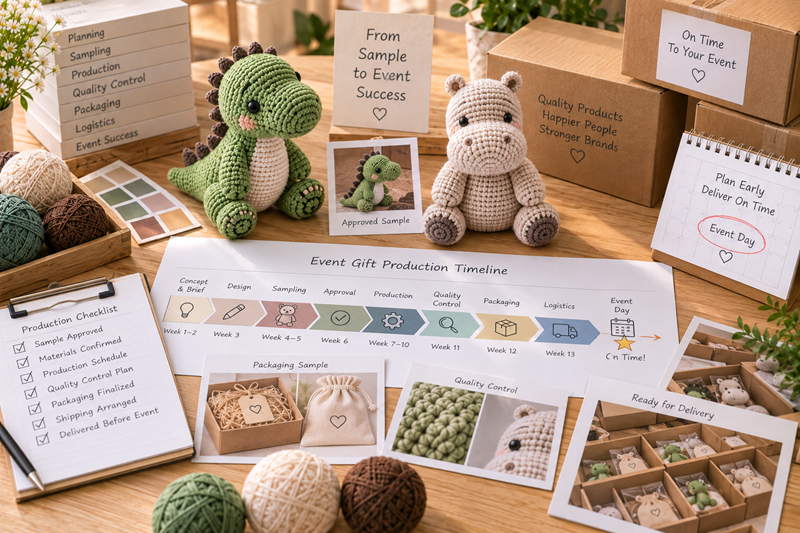
Step 10: Freeze the Right Details Before Production
Late changes are particularly risky when an event date cannot move.
Before production approval, buyers should confirm the final reference for:
- Product dimensions
- Overall proportions
- Yarn colors
- Facial details
- Clothing
- Accessories
- Embroidery
- Labels
- Hangtags
- Packaging
- Printed cards
- Quantity by SKU
- Packing method
The approved sample should become a practical production reference.
If several product versions exist, each version should be clearly identified.
Avoid approving a sample while leaving major packaging or branding decisions unresolved.
Those unresolved details can become production bottlenecks later.
Step 11: Plan Quality Control Around What Recipients Will Notice
Handmade crochet products naturally contain small variations.
The objective of commercial production is therefore not machine-level identity.
It is controlled consistency.
For an event gift, QC should focus especially on features that influence:
- Character recognition
- Presentation
- Function
- Packaging
- Quantity accuracy
Examples include:
Product Appearance
Check:
- Overall shape
- Proportions
- Color consistency
- Facial placement
- Accessories
- Visible stitch quality
Construction
Check:
- Attached components
- Seams
- Finishing
- Product stability where relevant
Branding
Check:
- Correct labels
- Correct hangtags
- Correct printed materials
- Correct campaign version
Packaging
Check:
- Correct product inside
- Correct card
- Correct SKU
- Packaging condition
- Packing orientation where required
For event programs with multiple recipient tiers, packing accuracy becomes especially important.
Step 12: Create a Distribution Map Before Goods Leave the Factory
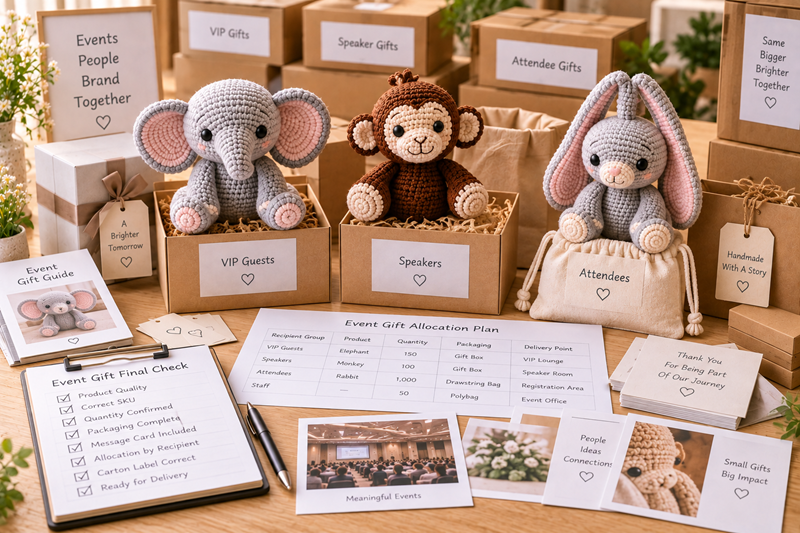
A surprisingly useful procurement document is a simple allocation table.
For example:
| Recipient / Location | Product Version | Planned Quantity | Packaging | Delivery Point |
|---|---|---|---|---|
| General attendees | Mini mascot | — | Individual pack | Registration area |
| Speakers | Full-size mascot | — | Gift box | Speaker lounge |
| VIP guests | Premium gift set | — | Gift box + card | VIP desk |
| Staff | Staff edition | — | Simple pack | Event office |
| Social campaign | Campaign edition | — | Mail-ready pack | Marketing team |
Quantities should be completed using the actual event plan rather than assumed figures.
This table helps connect manufacturing with real-world distribution.
It can also help prevent last-minute confusion about which cartons belong where.
What Should Be in the Manufacturer Brief?
At minimum, provide:
Campaign Information
- Event or campaign type
- Purpose of the gift
- Target recipients
- Key message
Product Information
- Reference artwork
- Character files
- Required colors
- Preferred product format
- Approximate size requirements
- Required accessories
Commercial Information
- Estimated quantity
- Number of SKUs
- Target budget or cost range if available
- Packaging expectations
Branding Information
- Logo files if required
- Brand colors
- Campaign artwork
- Hangtag or card requirements
Schedule Information
- Event date
- Required delivery date
- Destination
- Internal approval deadlines
Compliance Information
- Target market
- Intended age group where relevant
- Intended use
- Buyer-specific testing or documentation requirements
A complete brief allows the manufacturer to identify conflicts early.
Event Crochet Gift Planning Checklist
Before approving production, buyers can use the following checklist.
Strategy
- [ ] Is the campaign objective clear?
- [ ] Are recipient groups defined?
- [ ] Does each product have a specific role?
- [ ] Is the gift appropriate for the distribution environment?
Product
- [ ] Is the product format approved?
- [ ] Are critical brand features identified?
- [ ] Are colors approved?
- [ ] Are accessories approved?
- [ ] Is the final sample approved?
Quantity
- [ ] Is the total quantity confirmed?
- [ ] Are quantities allocated by SKU?
- [ ] Are recipient tiers accounted for?
- [ ] Has the buyer decided whether reserve units are required?
Packaging
- [ ] Is individual packaging confirmed?
- [ ] Are story or message cards finalized?
- [ ] Are labels and hangtags correct?
- [ ] Does the packaging suit event handling?
Schedule
- [ ] Is the event date confirmed?
- [ ] Is the required delivery date earlier than the event date?
- [ ] Is logistics time included?
- [ ] Is there time for sampling and revisions?
- [ ] Are internal approval deadlines clear?
Quality Control
- [ ] Is there an approved reference sample?
- [ ] Are critical dimensions defined?
- [ ] Are brand-critical details identified?
- [ ] Are packaging checks included?
- [ ] Are SKU and quantity checks included?
Common Mistakes When Planning Crochet Gifts for Events
Mistake 1: Starting With the Product Instead of the Campaign
A cute product is not automatically the right campaign gift.
Define the message and recipient first.
Mistake 2: Treating Every Recipient the Same
A conference attendee, keynote speaker, employee, and VIP partner may require different formats or presentation levels.
Mistake 3: Adding Too Many Custom Details
More customization creates more development and production variables.
Prioritize details that recipients will actually recognize.
Mistake 4: Leaving Packaging Until the End
Packaging affects production, carton planning, handling, and presentation.
It should be developed alongside the product.
Mistake 5: Using the Event Date as the Delivery Deadline
Goods need to arrive before setup and distribution.
Build in the appropriate logistics and operational buffer for the project.
Mistake 6: Making Late Changes After Sample Approval
Changes to colors, accessories, packaging, or printed materials can affect materials and production planning.
Freeze specifications deliberately.
Mistake 7: Forgetting Allocation
For multi-tier programs, manufacturing the correct total quantity is not enough.
The correct products must reach the correct recipients and locations.
How U-MY Supports Event and Campaign Crochet Product Development
For brands, agencies, gift companies, and corporate buyers, the manufacturing requirement is broader than simply producing a crochet item.
An event project may involve coordination between:
- Product development
- Sampling
- Materials
- Handmade production
- Quality control
- Packaging
- Packing
- Delivery planning
U-MY positions its role as a Crochet Product Development & Manufacturing Partner, supporting custom crochet projects from concept translation through production preparation.
Depending on the project brief, development may involve products such as:
- Crochet mascots
- Character dolls
- Mini characters
- Keychains
- Ornaments
- Gift-oriented crochet products
- Coordinated packaging
The appropriate solution depends on the campaign rather than a fixed product formula.
For buyers, the most productive first conversation is therefore not simply:
“Can you make this?”
It is:
“Here is the audience, objective, quantity, distribution method, required date, and product idea. How should we develop it for production?”
That provides a much stronger foundation for an event-specific project.
Frequently Asked Questions
What crochet products work well for conference giveaways?
Compact products such as mini characters, keychains, bag charms, and small branded crochet items can be practical because they are easier to distribute and carry. The final format should depend on audience, quantity, budget, campaign objective, and packaging requirements.
Can the same crochet mascot be used for both VIP gifts and attendee giveaways?
Yes. A character concept can potentially be adapted into multiple formats, such as a larger presentation product for VIP recipients and a smaller version for wider distribution. Each format should still be sampled and approved for its intended use.
When should we start developing crochet gifts for an event?
Start early enough to accommodate briefing, sampling, revisions, approval, materials, handmade production, QC, packaging, transportation, and event receiving. There is no single lead time that applies to every project, so the schedule should be calculated backward from the required venue-ready date.
Should we put our logo directly on the crochet product?
Not necessarily. Brand identity can also be communicated through character design, colors, clothing, accessories, labels, hangtags, story cards, or packaging. The best method depends on the product and campaign.
How should we plan quantities for different attendee groups?
Create an allocation plan by recipient type, product version, packaging, and distribution location. Use the actual registration, invitation, staffing, or campaign plan to determine quantities rather than relying on generic percentages.
Can crochet gifts be packed as complete event gift sets?
They can be developed as part of a broader gift presentation, subject to the project's packaging and packing requirements. The crochet product can act as the emotional or character-based centerpiece, while cards, pouches, boxes, or other approved components complete the experience.
How do we maintain consistency across handmade event gifts?
Use an approved reference sample, controlled materials, standardized production instructions, defined critical details, and quality checkpoints. Handmade variation is natural; the procurement objective is controlled consistency in the features that matter to product identity and presentation.
What information should we send before requesting a sample?
Provide the campaign objective, recipient, artwork or references, approximate quantity, preferred format and size, branding requirements, packaging expectations, target market, required delivery date, and destination. The clearer the brief, the easier it is to evaluate a workable development direction.
Final Takeaway
Successful event merchandise is not planned as an isolated product.
It is planned as a time-bound recipient experience.
The strongest procurement process connects:
Campaign objective
→ Recipient
→ Product format
→ Brand translation
→ Quantity
→ Packaging
→ Approved sample
→ Production
→ Quality control
→ Logistics
→ Event distribution
For brands, conference organizers, marketing agencies, and corporate procurement teams, this sequence helps turn a creative crochet idea into a product that can function in the real conditions of an event.
A memorable gift still needs good design.
But for a fixed-date campaign, good design must also arrive in the right format, in the right quantity, with the right presentation, at the right place, before the right date.
For custom event or campaign development, U-MY can work from your character artwork, campaign concept, recipient plan, quantity, packaging requirements, and delivery schedule to evaluate an appropriate crochet product-development direction.
 Chinese