
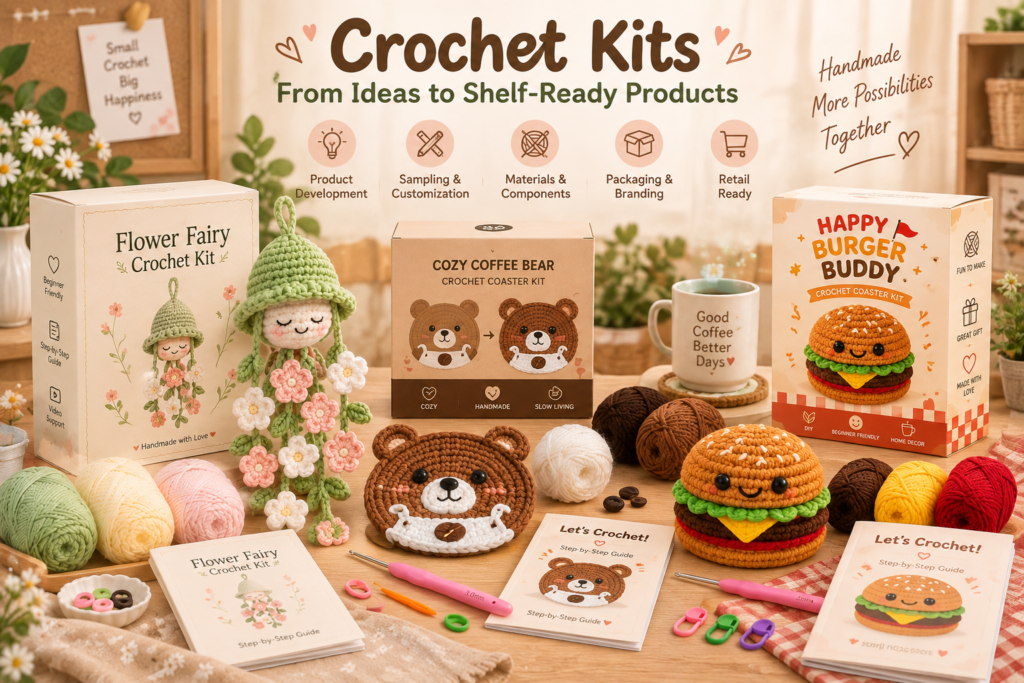
Developing a retail-ready crochet kit requires more than putting yarn and a crochet hook into a box. For brands, retailers, gift companies, and e-commerce sellers, a successful crochet kit must work as both a craft experience and a commercial product. The project needs a clear finished design, an appropriate difficulty level, correctly calculated materials, understandable instructions, practical packaging, and a production specification that can be repeated consistently.
A typical development process starts by defining the target customer and the finished crochet product. The supplier can then translate that concept into a sample, determine yarn and accessory requirements, test the making process, prepare the kit components, and develop the packaging configuration. Before bulk production, buyers should approve not only the finished crochet item but also the contents and presentation of the complete kit.
The most important purchasing principle is simple: develop the experience inside the box, not just the object shown on the box.
For B2B buyers, this means evaluating whether a manufacturing partner can coordinate product development, sampling, materials, instructions, component control, packaging, and final assembly as one project. A visually attractive crochet design may generate the first sale, but a well-planned kit experience is what makes the product practical for retail.
What Is a Retail Crochet Kit?
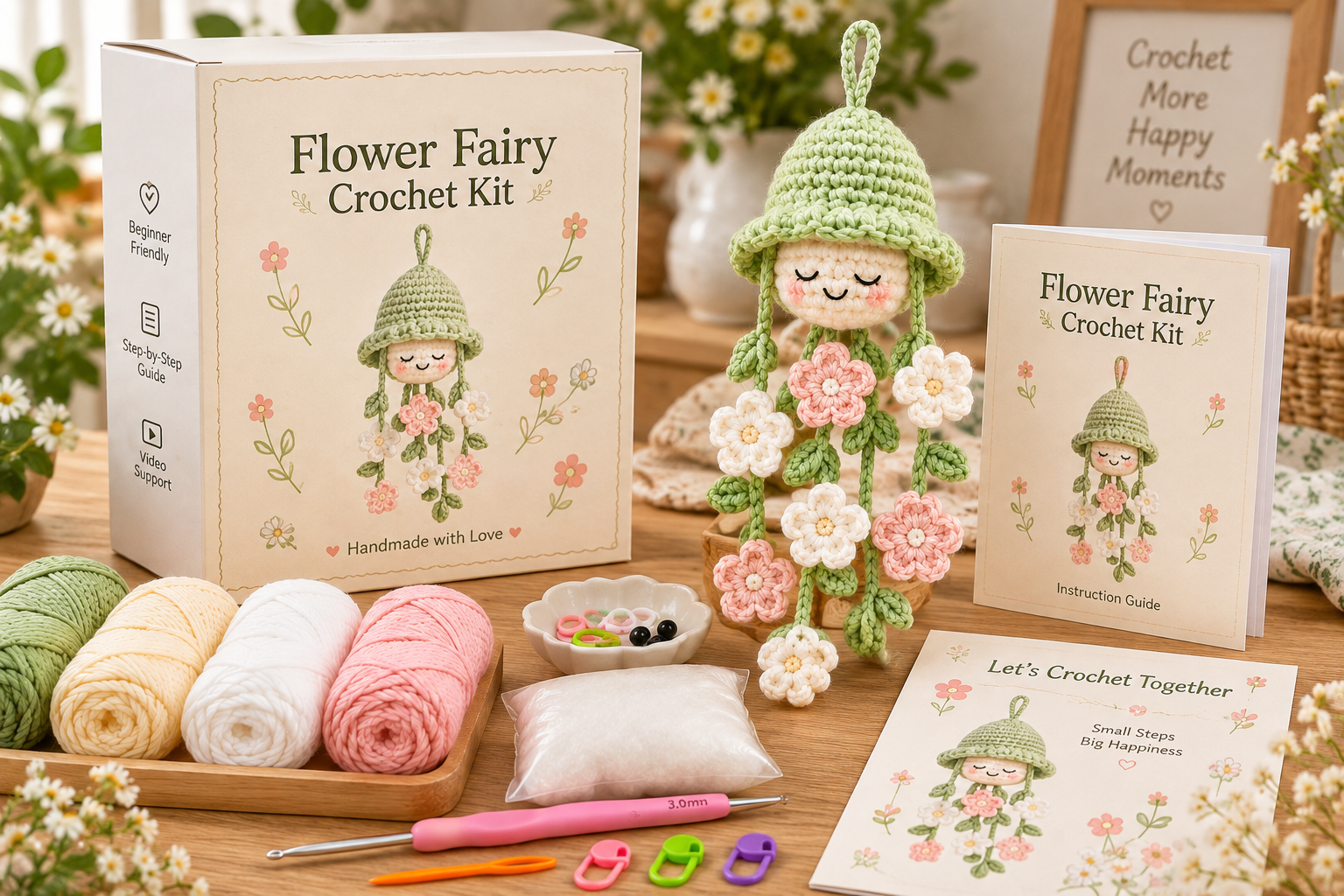
A retail crochet kit is a packaged product containing the materials and guidance a customer needs to make a specific crochet item or project.
Depending on the design, a kit may include:
- Yarn in the required colors and quantities
- Crochet hook
- Filling material
- Sewing or tapestry needle
- Stitch markers
- Eyes, buttons, or other approved accessories where appropriate
- Printed instructions
- QR-linked digital instructions or supporting content
- Finished-product reference images
- Branded packaging
- Labels, warning information, or market-specific product information where required
Not every kit needs every component. The correct configuration depends on the project, intended user, retail price positioning, target market, and packaging strategy.
This distinction matters for buyers because a crochet kit is a multi-component product. One missing or poorly specified component can affect the entire customer experience.
For example, a beautifully designed character kit can still disappoint customers if the yarn quantity is too tight, the hook does not suit the yarn, or the instructions assume skills that the target customer does not have.
Step 1: Define the Customer Before Developing the Crochet Kit
One of the first decisions should be who will actually use the kit.
Buyers should define at least four things before sampling:
| Development Question | Why It Matters |
|---|---|
| Who is the intended user? | Determines difficulty and instruction style |
| What should the customer make? | Determines construction, yarn, and components |
| Where will the kit be sold? | Influences packaging and presentation |
| What retail position is intended? | Influences materials, accessories, packaging, and product complexity |
A museum gift shop, for example, may prioritize storytelling and cultural interpretation. A craft retailer may care more about technique and project difficulty. An e-commerce brand may need packaging that photographs clearly and survives parcel fulfillment.
These are different product-development problems even if the crochet item inside the kit is similar.
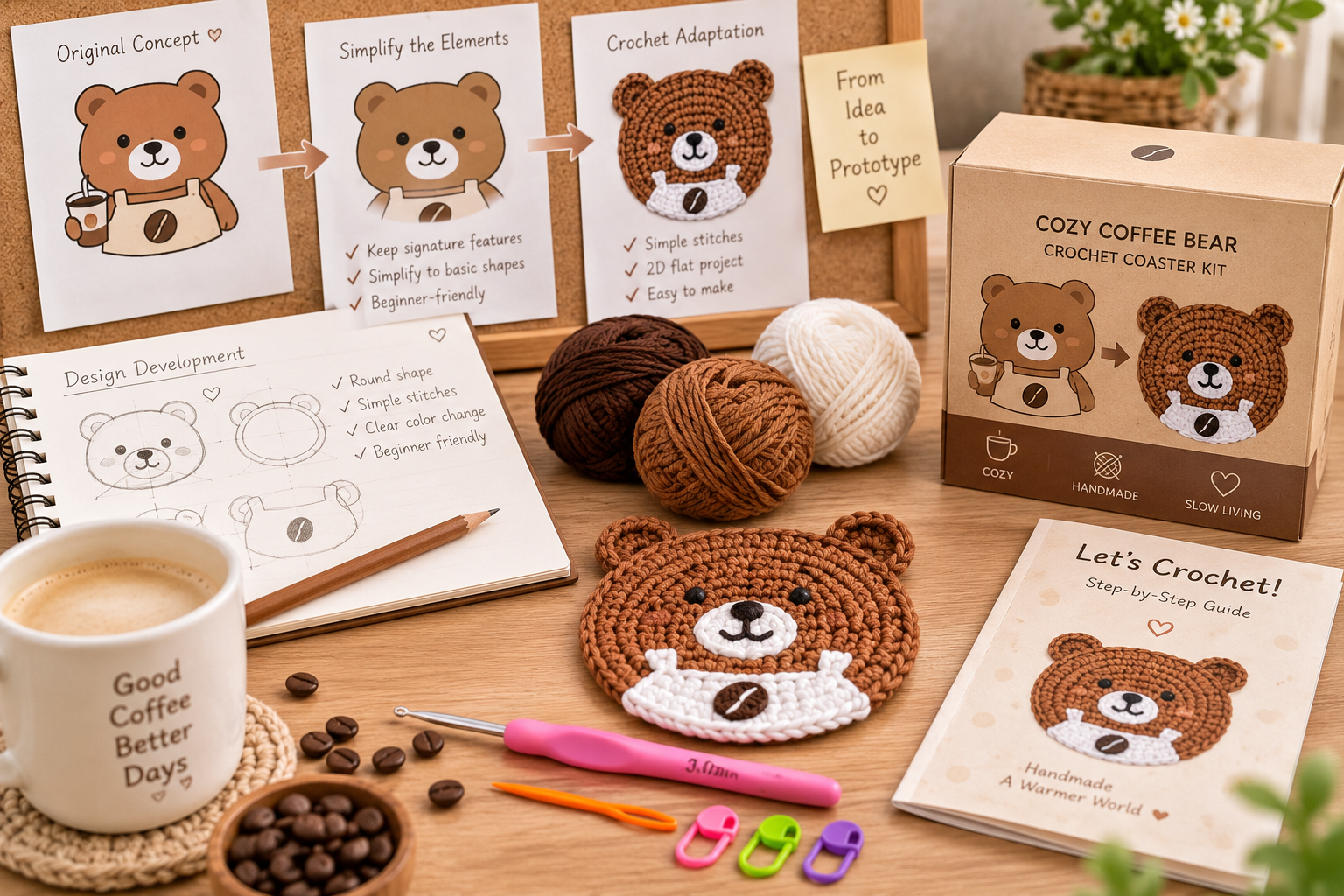
Step 2: Design the Finished Product First
The finished crochet object is the foundation of the kit.
Before calculating kit contents, the development team needs to determine what the customer is expected to make. This may begin with:
- A buyer's sketch
- Character artwork
- Reference images
- A product brief
- Dimensions
- Preferred colors
- Brand guidelines
- An existing approved design
The design then needs to be translated into a crochet construction that is practical for the intended user.
This is different from developing a finished crochet product for wholesale delivery. When a factory produces the finished item, experienced makers perform the work. In a consumer kit, the design must ultimately be reproducible by the kit customer.
Design for Recognition and Makeability
A good kit design balances two objectives:
Recognition: The finished project should retain the important visual characteristics of the original concept.
Makeability: The construction should be realistic for the intended customer.
For a character, mascot, animal, flower, or decorative object, the development team can identify the features that carry the most visual identity and protect those features while simplifying less important details.
This becomes particularly important for branded characters and legally authorized IP projects. The goal is not simply to make the most detailed crochet interpretation possible. The goal is to create an interpretation that customers can realistically complete while maintaining the approved character identity.
Step 3: Set a Realistic Difficulty Level
Terms such as "beginner," "easy," and "intermediate" should not be treated only as marketing labels.
The actual construction should support the claimed difficulty.
A development team can review factors such as:
- Number of stitch types
- Number of separate pieces
- Frequency of color changes
- Shaping complexity
- Sewing and assembly requirements
- Embroidery requirements
- Small decorative details
- Amount of counting required
- Finishing techniques
A product with a simple appearance is not automatically beginner-friendly.
For example, a small character may require several tiny pieces, frequent increases and decreases, detailed facial placement, and complicated assembly. A larger, visually simple product may actually be easier for a new crocheter.
Consider the Entire Making Journey
Buyers should ideally evaluate the prototype by following the process from beginning to end.
Questions worth asking include:
- Where is a beginner most likely to become confused?
- Which step is hardest to explain?
- Are left/right or front/back orientations clear?
- Are assembly positions easy to identify?
- Does the customer need a technique that has not been introduced?
- Is the expected finished size clear?
This review can uncover problems that are invisible when evaluating only the completed sample.
Step 4: Calculate Yarn and Components With Production in Mind
Once the construction is stable, the kit components can be specified.
Yarn planning should consider more than color. Relevant variables can include:
- Fiber composition
- Yarn thickness
- Yarn structure
- Color
- Required amount
- Handling characteristics
- Appearance in the finished product
The amount supplied also needs to be appropriate for the project. Consumption can vary between makers because crochet tension varies.
This is one reason buyers should avoid finalizing kit quantities based only on an early visual prototype.
Other components should also be standardized. If the kit includes a hook, needle, filling, stitch marker, eyes, or other accessories, each component needs a defined specification so that purchasing and packing teams know what belongs in the finished kit.
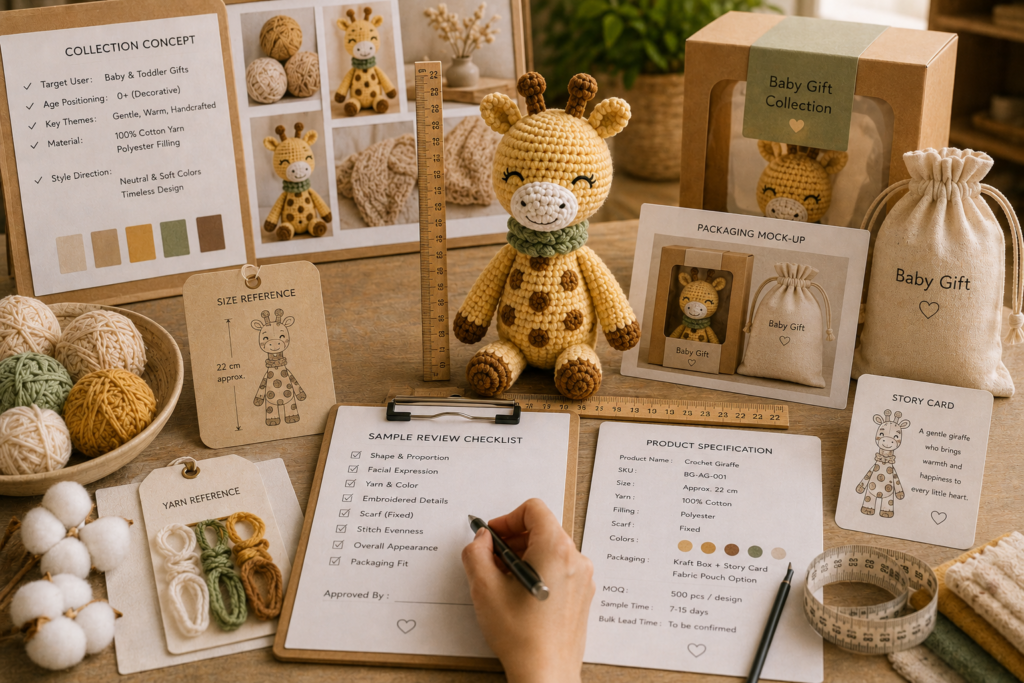
Build a Kit Bill of Materials
A practical crochet kit should have a controlled bill of materials, or BOM.
A simplified example might look like this:
| Component | Specification to Control |
|---|---|
| Main yarn | Fiber, thickness, color, quantity |
| Accent yarn | Color and quantity |
| Crochet hook | Required size/type |
| Filling | Material and quantity |
| Needle | Type and size where applicable |
| Accessories | Type, color, dimensions, quantity |
| Instructions | Version and language |
| Packaging | Box/bag specification |
| Labels/cards | Approved artwork/version |
The BOM becomes especially important once the project moves from sampling into repeat production.
Step 5: Develop Instructions Alongside the Physical Sample
Instructions should not be treated as something to add after the product is finished.
Product construction and instructional content affect each other.
If a step is extremely difficult to explain, the construction may need to be reconsidered. If several parts look nearly identical before assembly, the instructions may need clearer identification. If a particular technique is essential, the kit may need additional guidance.
Instructions may use:
- Written crochet terminology
- Stitch abbreviations
- Step numbering
- Diagrams
- Process photography
- Illustrations
- Assembly guidance
- QR-linked digital resources
The exact format depends on the buyer's market and product strategy.
A QR code can be useful for supplementary guidance, but buyers should decide who hosts and maintains the linked content. A QR code should not become a substitute for planning the instructional experience.
Version Control Matters
Instruction revisions should be controlled just like physical sample revisions.
Imagine that the development team changes the number of rounds in one part of the product but the packaging team still uses the previous instruction file. The yarn quantities may be correct and the product photo may look correct, yet customers receive obsolete directions.
For retail kits, therefore, the approved instruction version should be part of the final production specification.
Step 6: Treat Packaging as Part of Product Development
Packaging is not merely the final decoration around a crochet kit.
It affects:
- Component organization
- Shelf presentation
- E-commerce photography
- Product protection
- Perceived value
- Instructions and storytelling
- Packing efficiency
- Shipping volume
The packaging format may be a box, pouch, bag, or another structure appropriate to the project.
The best choice depends on what the kit contains and how it will be sold.
A compact package may reduce unnecessary volume, but it still needs enough room for yarn and other components to be packed reliably. A premium gift-oriented kit may justify more elaborate presentation. An e-commerce product may need to prioritize protection and fulfillment efficiency.
### Plan the Information Hierarchy
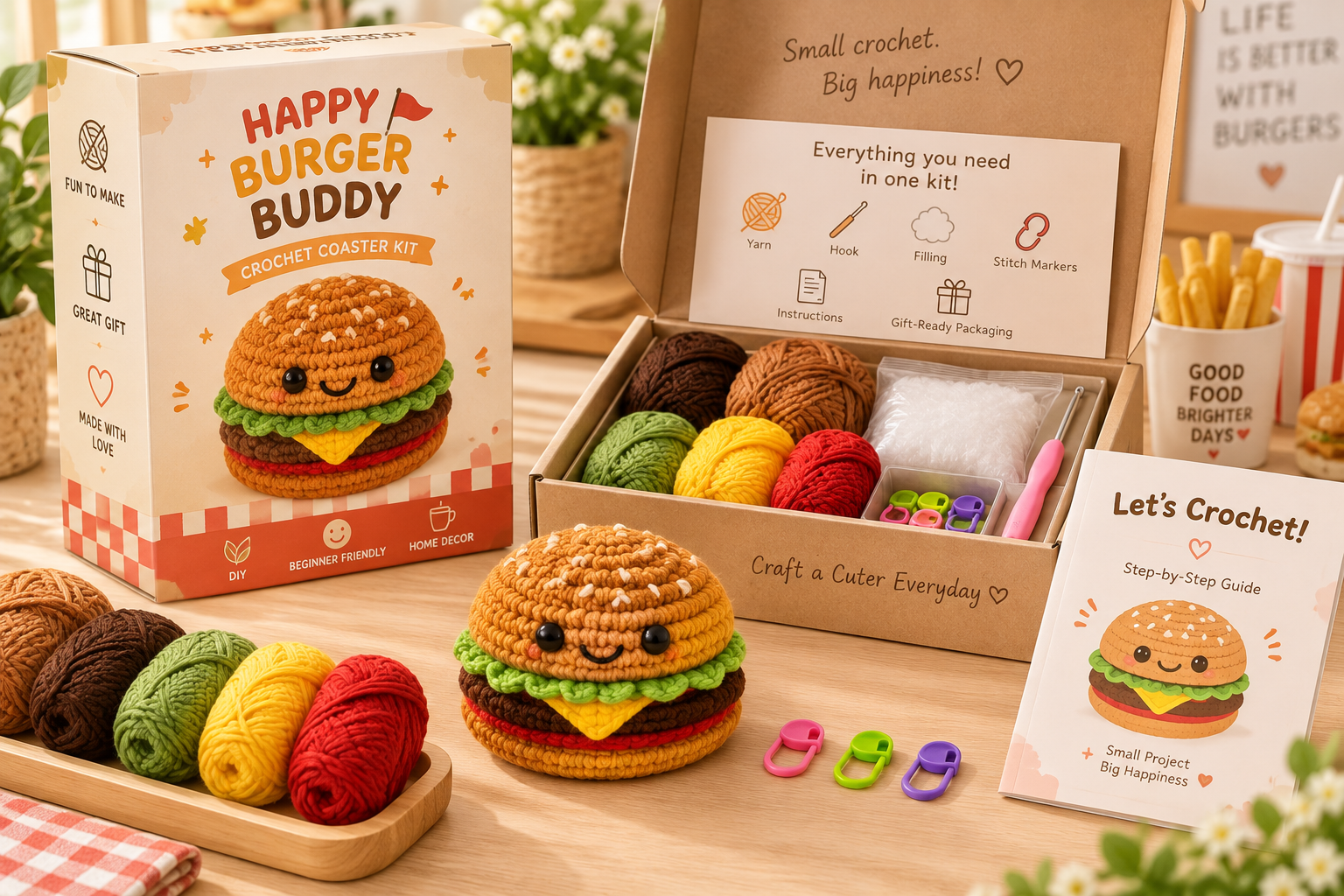
A customer viewing the package should be able to understand the product quickly.
Depending on the project, useful front- or back-of-pack information may include:
- What the customer will make
- Finished-product image
- Skill level
- Key included materials
- Approximate finished dimensions where appropriate
- Brand identity
- Instruction access
- Required information for the target market
Legal, labeling, safety, and testing requirements vary by product, component, age positioning, and destination market. Buyers should confirm applicable requirements for the actual product and sales market rather than assuming that one compliance approach applies to every crochet kit.
Step 7: Approve the Complete Kit, Not Only the Crochet Sample
A common development mistake is approving the finished crochet object while treating the other components as secondary. Before production, buyers should review the kit as a complete retail unit.
That review can include:
- Finished crochet reference sample
- Yarn colors and quantities
- Hook and tools
- Filling and accessories
- Instruction version
- Packaging structure
- Printed artwork
- Component arrangement
- Outer presentation
This is effectively a system-level approval.
Each individual component can be correct while the complete kit still has a problem. The box may be too small. Instructions may cover a product detail that changed during sampling. Two similar yarn colors may be difficult for customers to distinguish. Components may shift unattractively inside the packaging.
Evaluating the assembled kit helps identify these interactions.
Step 8: Plan Quality Control at More Than One Level
Quality control for a crochet kit has several layers.
Level 1: Component Quality
Are the specified yarn, tools, accessories, printed materials, and packaging correct?
Level 2: Quantity Control
Does every package contain the correct number or amount of each component?
Level 3: Version Control
Are the current approved instructions, artwork, labels, and specifications being used?
Level 4: Kit Assembly
Are components organized and packed according to the approved configuration?
Level 5: Finished Retail Presentation
Does the completed package match the approved retail sample and presentation standard?
Step 9: Decide Whether to Start With Stock Products or Full Custom Development
Not every buyer needs to begin with a completely new crochet design.
For brands testing a new category, there may be two broad sourcing paths:
| Approach | Useful When | Main Trade-Off |
|---|---|---|
| Existing/stock-based product | Faster market testing and smaller initial commitment | Less product exclusivity |
| Custom-developed product | Stronger differentiation and brand-specific design | More development work and typically higher production commitment |
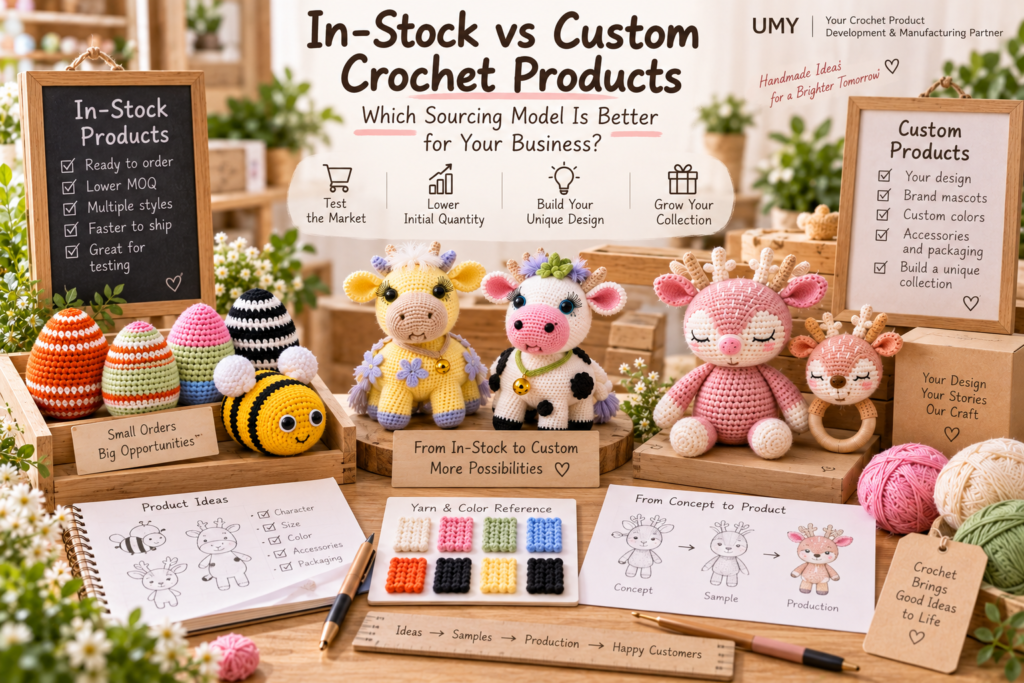
UMY's typical stock MOQ is around 10–50 pieces per style, depending on the available product.
For handmade custom crochet products, the typical MOQ is 500 pieces per style, although some simple designs may be evaluated from 300 pieces per style.
These figures are general working ranges rather than guarantees for every project. Actual feasibility depends on the design, materials, components, packaging, and project requirements.
Step 10: Build a Sampling Plan Before Bulk Production
A crochet kit can involve several approval points rather than one sample.
A project may move through:
- Concept review
- Crochet prototype
- Construction adjustment
- Material confirmation
- Instruction development
- Packaging development
- Complete kit assembly
- Final approval for production
The exact sequence can change according to the project.
At UMY, custom product sampling typically takes around 7–15 days, depending on design complexity and project requirements. Packaging development, instruction preparation, revisions, or additional components can add separate work and should be planned according to the actual project.
The key purchasing lesson is to avoid treating the sample lead time as the entire product-development timeline.
A buyer launching for a fixed retail season should work backward from the required delivery date and allow time for decisions and revisions.
Common Crochet Kit Development Mistakes
Several problems can be reduced through better planning.
1. Choosing the Product Before Defining the User
A design can be attractive but inappropriate for the intended skill level.
2. Calculating Materials Too Early
Consumption based on an unstable prototype may need to change after construction revisions.
3. Writing Instructions After Everything Else
Late instructional problems can force unexpected product changes.
4. Approving Components Separately
The full kit needs to work as one retail product.
5. Designing Packaging Without the Real Contents
Final yarn, filling, tools, and printed materials affect package dimensions and arrangement.
6. Using "Beginner" as a Marketing Term Without Testing the Construction
Difficulty should reflect the actual making process.
7. Ignoring Repeat-Order Documentation
A successful first order is more valuable when specifications can support consistent future production.
What Should You Send a Crochet Kit Manufacturer?
A useful initial development brief can include:
- Product concept or reference
- Sketches or artwork
- Desired finished dimensions
- Target customer
- Intended skill level
- Preferred yarn or material direction
- Required kit components
- Target market
- Packaging concept
- Branding requirements
- Expected order quantity
- Target launch timing
Not every project will have all this information at the beginning.
How UMY Approaches Crochet Kit Product Development
Dongguan U-MY Garment Co., Ltd. has worked in product development and manufacturing since 2013.
For crochet kit projects, the objective is not simply to supply a crochet item. The project can require coordination between the crochet design, sampling process, material specifications, kit components, packaging, and retail presentation.
That is why we approach these projects as product development programs.
Depending on the buyer's requirements, development can begin with an original concept, artwork, a custom crochet design, or an appropriate existing product direction. The project requirements are then evaluated before sampling and production.
For buyers, this approach creates a clearer path from:
idea → crochet prototype → kit specification → packaging → production → retail product
The exact scope should always be confirmed for the individual project, especially when specialized packaging, market-specific labeling, testing, or third-party intellectual property is involved.
UMY does not assume authorization to manufacture third-party characters or protected designs. Buyers developing licensed or protected IP products should have the appropriate rights or authorization for the intended project.
Buyer Checklist: Is Your Crochet Kit Ready for Production?
Before approving a retail crochet kit, buyers can use the following checklist:
- [ ] Target customer is clearly defined
- [ ] Difficulty level matches the actual construction
- [ ] Finished crochet sample is approved
- [ ] Yarn specifications are confirmed
- [ ] Yarn quantities are confirmed
- [ ] Tools and accessories are specified
- [ ] Instruction content is approved
- [ ] Instruction version is controlled
- [ ] Packaging structure is approved
- [ ] Packaging artwork is approved
- [ ] Complete kit has been reviewed as one unit
- [ ] Component quantities can be checked during packing
- [ ] Target-market requirements have been evaluated
- [ ] Repeat-order specifications are documented
- [ ] Bulk production details and MOQ are confirmed
FAQ
What should be included in a crochet kit?
The contents depend on the project, but a kit may include yarn, a crochet hook, filling, a needle, stitch markers, accessories, instructions, and branded packaging. Buyers should define exactly which materials the customer receives and which, if any, they must provide separately.
Can a manufacturer develop a crochet kit from a sketch?
Yes, a suitable development project can begin from sketches, artwork, reference images, or a product brief. The concept must then be translated into a workable crochet construction, sampled, and adapted to the intended kit user.
How long does crochet kit sampling take?
UMY's custom product sampling typically takes around 7–15 days, depending on the design and project. A complete retail kit may require additional time for instructions, packaging, revisions, or special components, so buyers should distinguish crochet sample time from the total kit-development schedule.
What is the MOQ for a custom crochet kit?
MOQ depends on the product and project structure. UMY's handmade custom crochet products typically start at 500 pieces per style, while some simple designs may be evaluated from 300 pieces per style. Stock products typically have much lower MOQs, often around 10–50 pieces per style. Packaging and other customized components can also affect project feasibility.
Should instructions be developed by the brand or the manufacturer?
This depends on the project scope and each party's capabilities. Regardless of who prepares them, the instructions should be checked against the approved physical construction and controlled as part of the product specification.
Can crochet kits use custom private-label packaging?
Yes, private-label packaging can be incorporated into a custom development project when the packaging requirements are defined and feasible. Buyers should plan packaging early because dimensions, component arrangement, printed information, and presentation all interact with the physical kit.
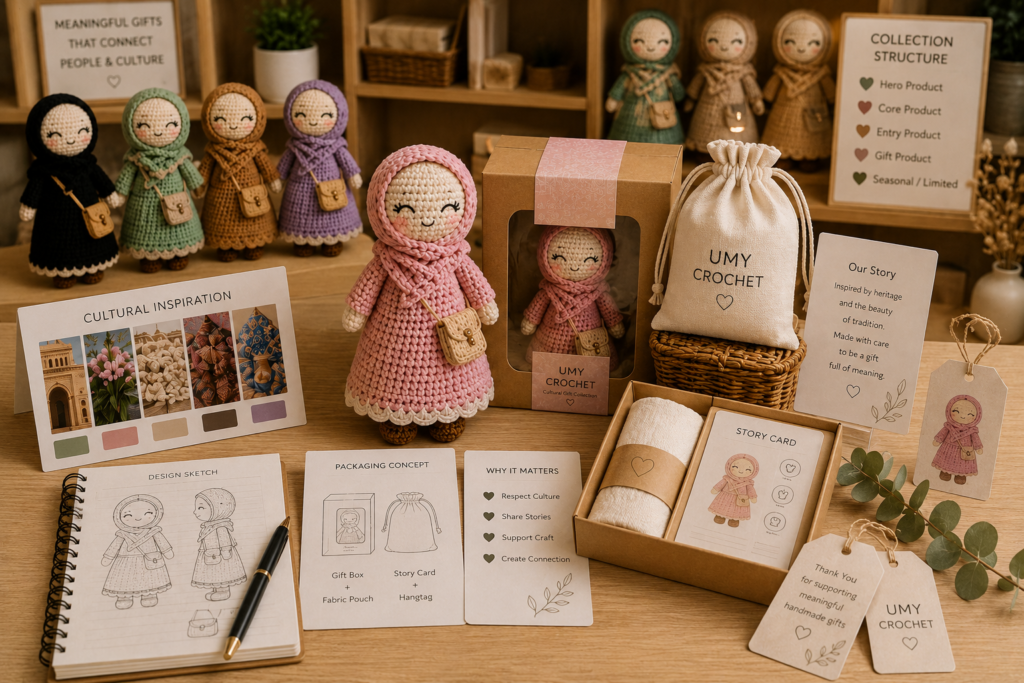
Are crochet kits suitable for museum or cultural retail?
They can be. A kit can combine a craft activity with a story, character, artwork, or cultural theme. Any protected artwork, character, or third-party intellectual property should only be developed with appropriate authorization.
From Craft Idea to Commercial Product
A retail crochet kit succeeds when the design, making experience, materials, instructions, packaging, and production system work together.
For buyers, the most useful question is therefore not simply:
"Can this crochet product be made?"
It is:
"Can this concept be developed into a kit that customers can understand, complete, enjoy, and buy confidently at retail?"
Answering that question early helps brands avoid treating product design, instructions, packaging, and manufacturing as separate tasks.
If you are developing a private-label crochet kit for a retail, gift, e-commerce, museum, cultural, or branded product program, UMY can evaluate the concept and help determine the practical next steps for sampling and manufacturing.
 Chinese