
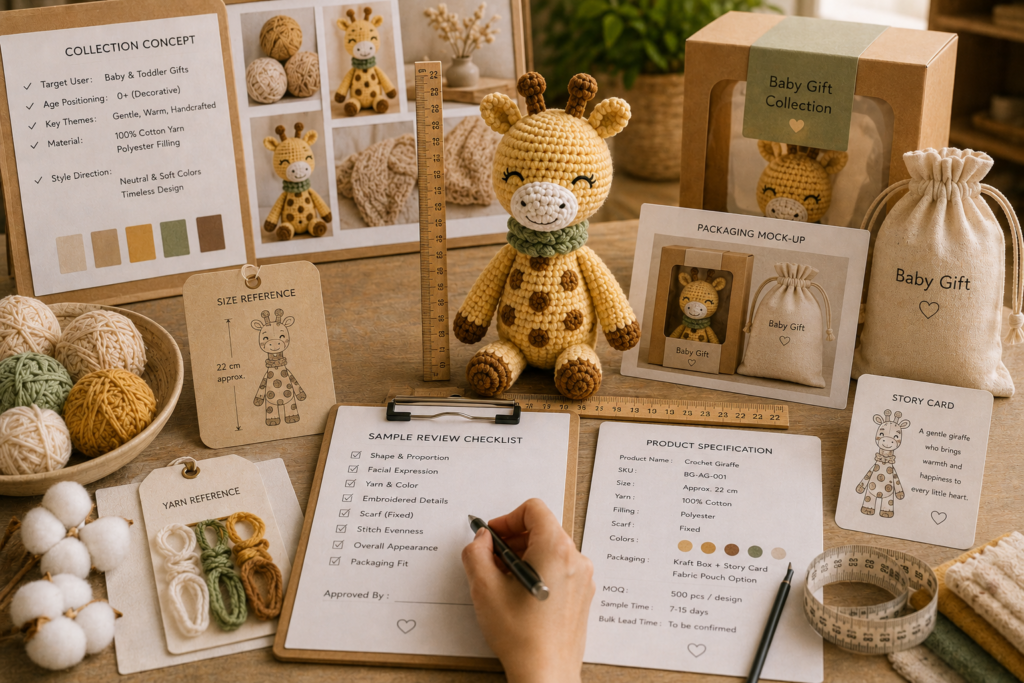
Before developing a custom crochet product for a baby-gift collection, brands should define much more than the character design.
The most important decisions are the intended user, intended product use, product category, target market, construction, materials, accessories, packaging, price position, and compliance plan.
A practical development sequence is:
Recipient & Age Positioning → Intended Use → Product Format → Construction → Materials & Components → Design → Compliance Planning → Sample → Packaging → Production Standard
This matters because a crochet product described as a newborn gift, nursery decoration, children's toy, rattle, comfort product, or gift-set component may require different design and commercial decisions.
Baby-gift buyers should therefore avoid beginning with only:
“Can you make this animal in crochet?”
A better starting question is:
“Who will receive this product, how is it intended to be used, where will it be sold, and what requirements must the final product meet?”
Those answers can affect everything from component selection and product size to labeling, testing, packaging, and quality control.
The goal is not simply to create a cute crochet product.
It is to develop a product that is appropriate for its intended use, commercially workable, consistent in production, and clearly positioned for the target market.
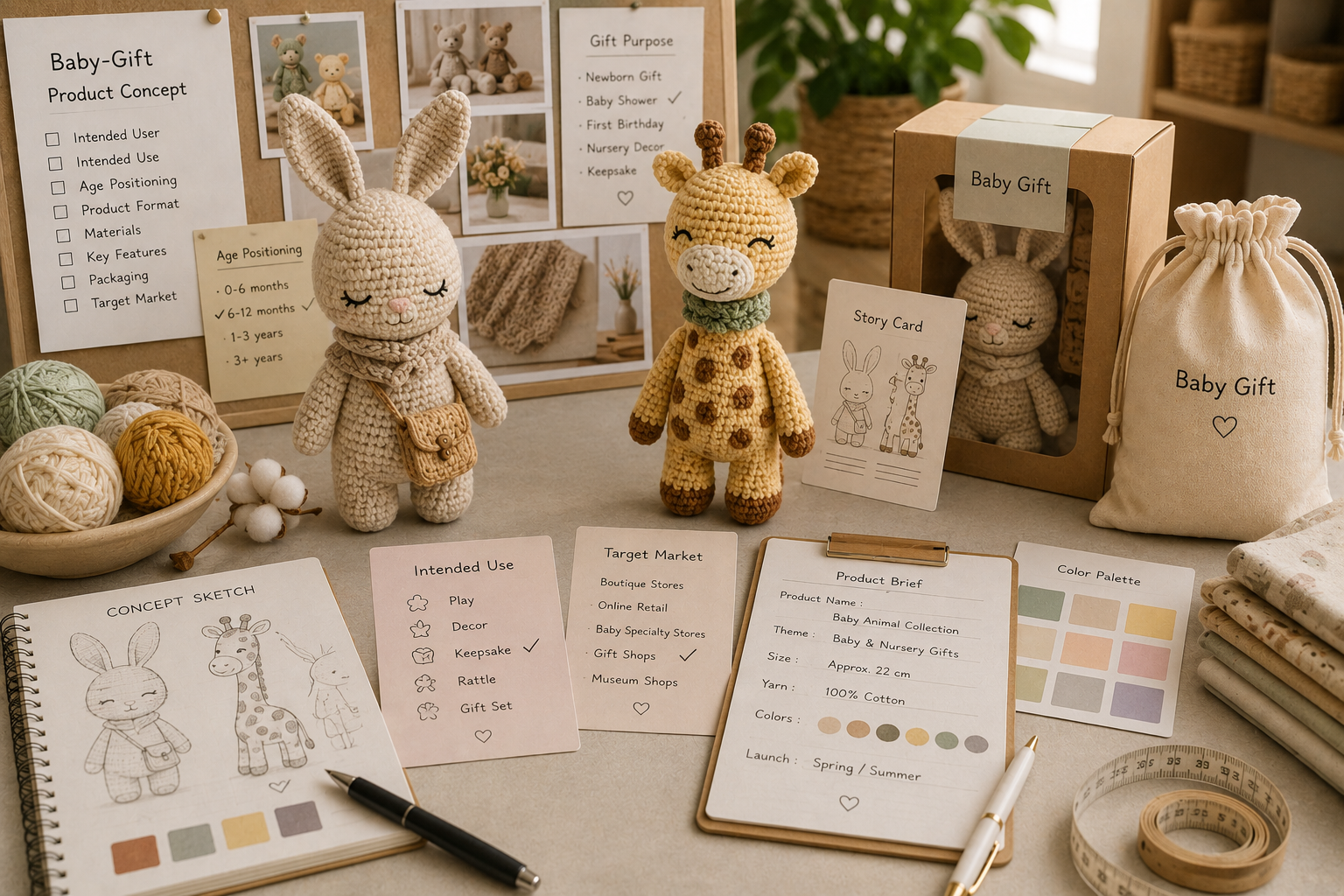
Why Baby-Gift Product Development Needs a Clearer Brief
Baby gifting is emotionally driven.
Customers may be buying for:
- A newborn
- A baby shower
- A first birthday
- A family celebration
- A nursery gift
- A keepsake
- A seasonal baby collection
But the emotional purpose of the gift does not automatically define the physical product.
A soft crochet animal could potentially be developed as:
- A decorative gift
- A children's play product
- A collectible keepsake
- A rattle
- Part of a gift set
- A nursery-themed retail item
These applications may look similar in product photography while involving different design considerations.
That is why baby-gift brands should define the intended use before asking a manufacturer to finalize the design.
1. Define the Intended Recipient and Age Positioning
The first question should be:
Who is the product intended for?
Do not leave the answer as simply “babies.”
The buyer should define the intended age positioning as clearly as the project requires.
This information may influence:
- Product construction
- Component selection
- Size
- Accessories
- Packaging
- Labeling
- Testing
- Instructions or warnings where applicable
Why Age Positioning Matters During Design
A decorative product purchased by an adult as a nursery keepsake and a product intentionally sold for children's play may need to be evaluated differently.
The product should therefore be designed around its actual intended use rather than around a marketing image alone.
[Internal Link Opportunity: What Certifications Do Crochet Toys Need?]
2. Define the Intended Use
Baby-gift brands should write a simple intended-use statement before product development begins.
For example:
“This product is intended as a giftable crochet character for retail sale in [target market], positioned for [defined use and age category].”
The exact wording will depend on the project.
The purpose is to remove ambiguity.
Useful questions include:
- Is the product intended for play?
- Is it primarily decorative?
- Is it a keepsake?
- Is it part of a rattle product?
- Is it packaged with other baby-gift items?
- Will the product be marketed specifically for newborns?
- Will it be sold in a baby boutique or a general gift store?
- Will customers reasonably expect a particular function from it?
If the intended use changes later, the design and compliance plan may also need to be reviewed.
3. Choose the Product Format Before Developing Details
A baby-gift collection can contain several crochet product formats.
Possible concepts may include:
Crochet Animal or Character
Useful as a hero product or giftable character.
Mini Character
Potentially useful for a smaller product tier, subject to the intended use and applicable requirements.
Rattle Concept
Gift Set
A crochet product may be combined with other approved gift components in a coordinated package.
Nursery-Themed Keepsake
A brand may develop a product primarily around presentation and gifting rather than active play.
4. Define the Product's Physical Interaction
Buyers should consider how the intended user or gift recipient will physically interact with the item.
Ask:
- Will the product be held frequently?
- Does it contain protruding details?
- Does it have separate accessories?
- Are there removable components?
- Does it include a functional insert?
- Does it have long decorative elements?
- Are embroidered details possible instead of separate components?
- Will clothing or accessories be permanently attached?
These questions help the manufacturer understand which design features deserve additional attention.
Do Not Design Only for the Product Photo
A bow, button, flower, scarf, or other decorative component may look attractive in a rendering.
The buyer should also ask:
Does this detail make sense for the intended use of the actual product?
Visual design and physical use should be reviewed together.
5. Define Which Features Are Essential and Which Are Optional
Before sampling, separate the design into:
Core Features
Features that define the product or character.
Examples may include:
- Animal species
- Main silhouette
- Face
- Brand color
- Distinctive ears
- Signature shape
Optional Features
Details that may be simplified if they create unnecessary manufacturing or product complexity.
Examples may include:
- Secondary accessories
- Decorative layers
- Complex clothing
- Small embellishments
This helps the manufacturer protect the product's identity while developing a commercially workable structure.
6. Define Materials by Function, Not Marketing Language
Buyers often begin with broad requests such as:
- Cotton
- Natural yarn
- Soft yarn
- Eco-friendly yarn
- Baby yarn
These descriptions are not enough to define a production specification.
Material selection should consider the actual product and intended use.
A product specification may need to define:
- Yarn type
- Yarn thickness
- Color
- Filling
- Embroidery thread
- Internal components where applicable
- Packaging materials
- Other accessories
7. Identify Every Component Before Sampling
Baby-gift products should be reviewed as complete physical products.
A component list may include:
| Component | Development Question |
|---|---|
| Main yarn | What specification and color are required? |
| Filling | What structure and quantity support the intended shape? |
| Face | Embroidered or another approved construction? |
| Accessories | Are they necessary and appropriate for the intended use? |
| Internal insert | Does the product include a functional component such as a rattle? |
| Clothing | Is it fixed or removable? |
| Label | Where will product information be placed? |
| Packaging | What retail and information requirements must it support? |
The manufacturer should understand the complete product before a final sample is approved.
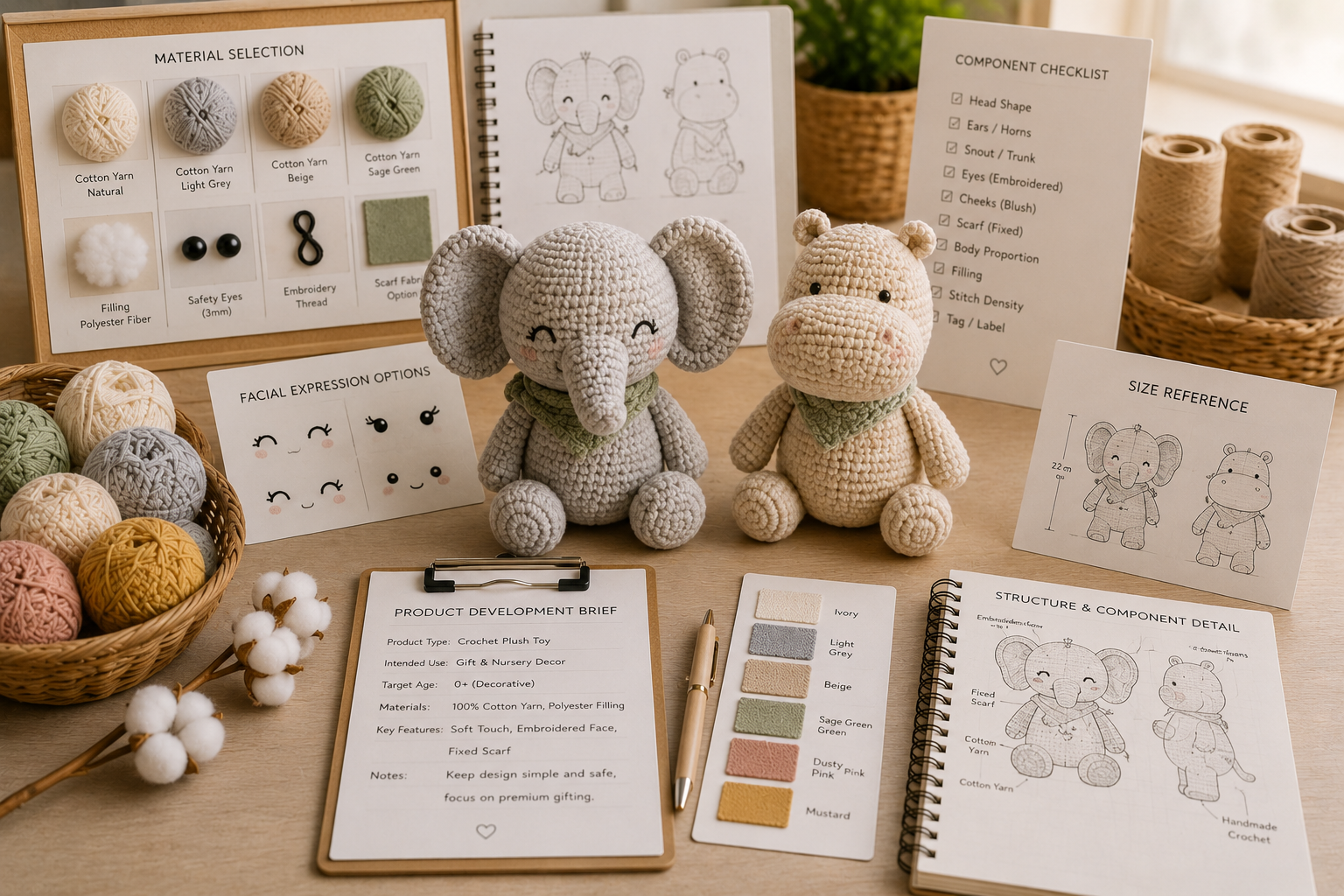
8. Be Careful With Small Decorative Components
Small components deserve particular attention in children's product development.
Rather than assuming a specific design is appropriate, buyers should ask the manufacturer and relevant compliance specialists to review the complete construction for the intended product category and market.
Design decisions may involve:
- Facial details
- Buttons
- Decorative beads
- Eyes
- Bells
- Charms
- Clothing fasteners
- Flowers
- Other attached accessories
Where a visual effect can be achieved through a simpler construction, buyers may want to evaluate that option.
The correct decision depends on the specific product.
The general principle is:
Do not add a separate component unless it creates enough product value to justify the additional construction and review requirements.
9. Define the Face Early
A brand may choose:
- Open eyes
- Closed embroidered eyes
- Minimal facial features
- A smiling expression
- A neutral expression
The approved face should become part of the production reference.
For handmade crochet, important details may include:
- Eye placement
- Eye spacing
- Nose position
- Mouth shape
- Embroidery direction
Small changes can make the same character look noticeably different.
This is especially important when the brand plans to reorder the product or expand it into a collection.
10. Choose a Color System for the Collection
A collection may use:
- Warm neutrals
- Soft greens
- Cream
- Beige
- Muted pink
- Gentle yellow
- Gray
- Other brand-specific colors
The right colors depend on the brand.
For example:
Bunny + Giraffe + Elephant + Hippo
may use a coordinated group of yarn colors while keeping each product visually distinct.
This can support:
- Stronger collection identity
- More organized material planning
- Easier packaging design
- More consistent retail presentation
11. Decide Whether You Are Developing One Product or a Collection
Baby-gift brands should consider future assortment structure before finalizing the first product.
One product may eventually expand into:
Hero Character
↓
Second Animal
↓
Mini Version
↓
Gift Set
↓
Seasonal Color
↓
Newborn Collection
Planning this early does not mean launching everything at once.
It means avoiding design decisions that make future expansion unnecessarily difficult.
A Focused First Collection
An illustrative baby-gift range could contain:
| Product Role | Example Format |
|---|---|
| Hero | Standard crochet animal |
| Core | Second coordinated character |
| Gift | Boxed crochet product |
| Premium | Multi-item gift presentation |
The buyer can then expand based on actual market response.
12. Define the Target Retail Price Before Making the Product Too Complex
Baby products can accumulate expensive decorative details quickly.
Additional:
- Yarn colors
- Embroidery
- Clothing
- Accessories
- Separate crochet components
- Packaging elements
can increase development and manufacturing complexity.
Before sampling, brands should ideally define:
- Target retail position
- Target product cost
- Expected quantity
- Packaging level
This gives the development team commercial boundaries.
Both can be good products.
They simply need different design strategies.
13. Decide What the Gift Experience Should Feel Like
Baby-gift customers are often buying for someone else.
This means the gift experience can be as important as the physical crochet product.
The buyer should define the desired presentation.
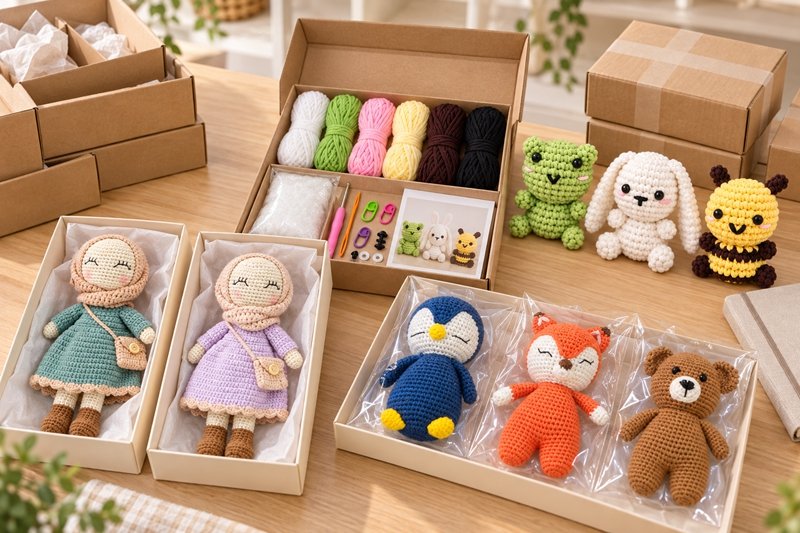
Possible packaging directions include:
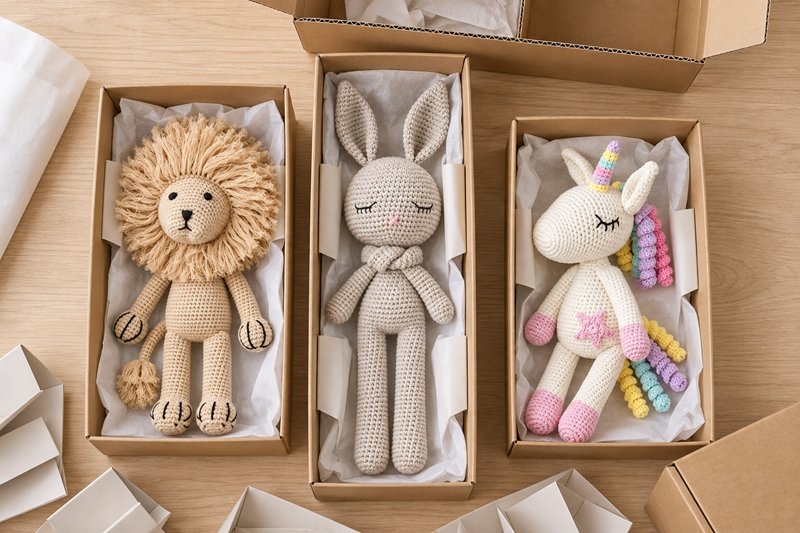
- Gift box
- Kraft box
- Fabric pouch
- Sleeve
- Hangtag
- Story card
- Greeting card
- Multi-item gift set
Useful questions include:
- Should the product be visible before opening?
- Is it intended for gifting without additional wrapping?
- Does the box need to hold more than one product?
- What information needs to appear on the packaging?
- Is the product sold online, in boutiques, or both?
- Does the packaging need to support a baby-shower or newborn-gift positioning?
14. Keep Packaging Claims Separate From Product Appearance
A soft-looking crochet product can visually communicate warmth and comfort.
That appearance should not be used as evidence for unsupported product claims.
Before using language such as:
- Safe for newborns
- Non-toxic
- Organic
- Hypoallergenic
- Certified
- Sustainable
- Suitable from birth
the brand should confirm whether the statement is accurate, applicable, and supported for that specific product.
Packaging claims should be reviewed just as carefully as the physical product.
15. Define the Destination Market Before Finalizing the Product
Baby-gift brands should tell the manufacturer where the product will be sold.
Requirements can differ by:
- Country or region
- Product classification
- Intended age
- Intended use
- Materials
- Construction
- Components
The exact requirements should be confirmed for the specific project.
A product developed for one market should not automatically be assumed to meet the requirements of another.
This is why target-market information belongs in the original development brief.
16. Plan Compliance Before Mass Production
Compliance should not be treated as a document collected after manufacturing.
It can influence product development.
Depending on the product and market, planning may need to consider matters such as:
- Product classification
- Age grading
- Physical construction
- Mechanical characteristics
- Material restrictions
- Labeling
- Traceability
- Applicable testing
- Required documentation
A Useful Development Sequence
Product Concept
↓
Intended Use & Age
↓
Target Market
↓
Construction
↓
Compliance Requirements Confirmed
↓
Sample
↓
Testing / Verification as Applicable
↓
Production
17. Treat Rattles and Other Functional Baby Products as Separate Development Projects
Adding a functional element changes the product.
For example, a crochet rattle is not simply a standard crochet doll with an object placed inside.
The complete product should be evaluated according to its:
- Intended function
- Construction
- Internal component
- Size
- Materials
- Target age
- Market requirements
Similarly, if a gift set includes products from different categories, each component may need its own evaluation.
Baby-gift brands should identify these product functions before quotation and sampling.
18. Define What Will Be Included in a Baby Gift Set
A gift set adds more variables than a single product.
A buyer may consider a combination such as:
- Crochet animal
- Gift card
- Fabric pouch
- Storage box
- Another approved gift item
Each component can introduce its own:
- Specification
- Supplier
- MOQ
- Production schedule
- Packaging requirement
- Quality-control point
A complete gift set should therefore be reviewed as one retail unit.
19. Develop the Physical Sample Before Approving Packaging Artwork
A digital product rendering is not enough to finalize packaging dimensions.
The actual crochet sample allows the buyer to review:
- Size
- Shape
- Compression
- Accessories
- Product position
- Box fit
Once the sample structure is stable, packaging can be developed more accurately.
UMY's custom crochet sampling typically takes around 7–15 days, depending on design complexity, materials, accessories, revisions, and current project scheduling.
Additional revisions may require additional development time.
20. Evaluate the Sample From More Than One Perspective
A baby-gift sample should not be reviewed only for cuteness.
The product team should evaluate several areas.
Brand Review
- Does it fit the brand?
- Is the expression appropriate?
- Are colors correct?
- Does it feel giftable?
Product Review
- Are proportions correct?
- Are construction details consistent?
- Are all components necessary?
- Does the product perform as intended?
Commercial Review
- Does the design fit the required price position?
- Is the packaging practical?
- Can it become part of a collection?
Compliance Review
- Has the intended age and use been defined?
- Is the target market confirmed?
- Do construction decisions support the applicable requirements?
Production Review
- Can the product be repeated consistently?
- Are the materials available?
- Are there unnecessary complexity points?
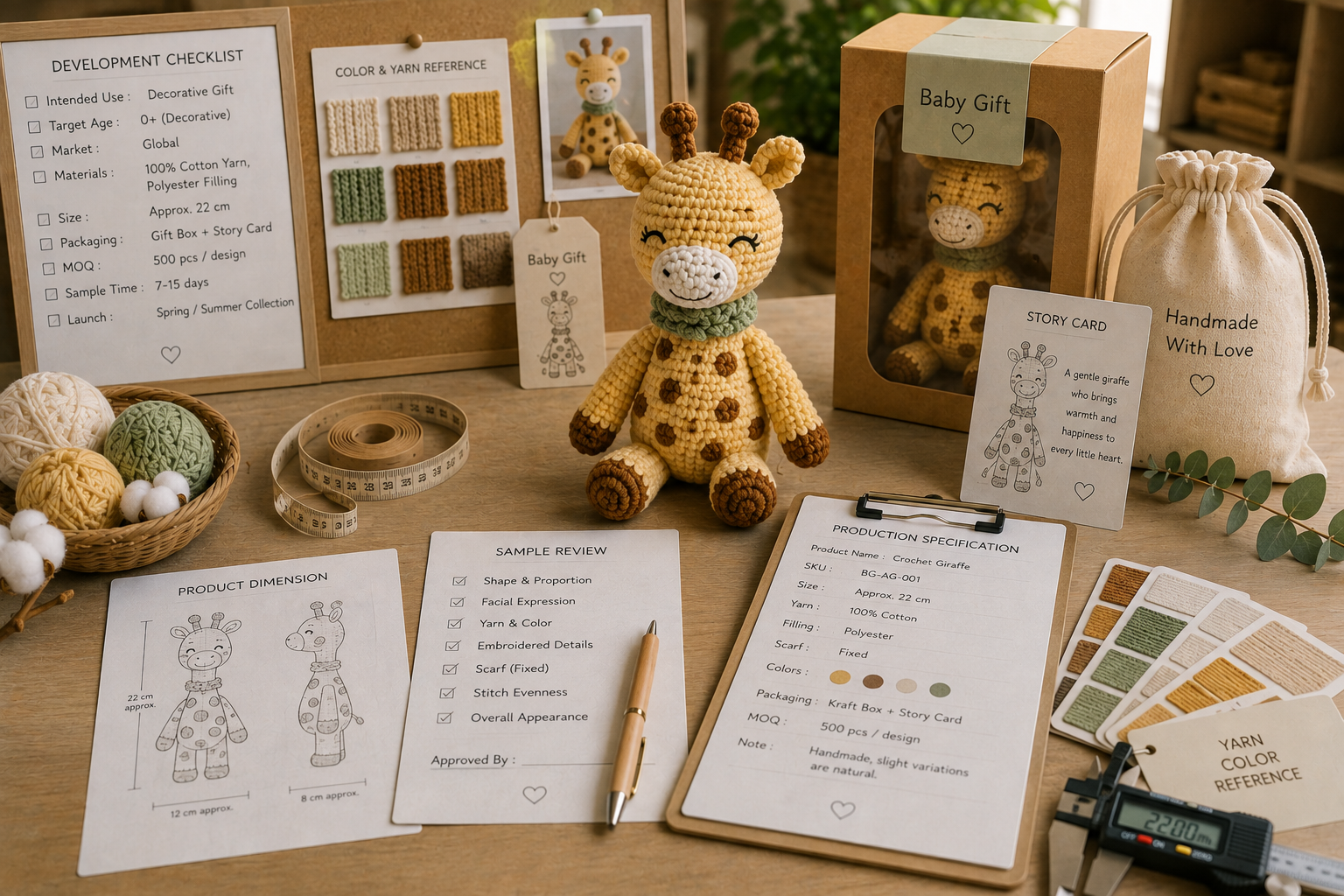
21. Turn the Approved Sample Into a Production Standard
Once a sample is approved, it should become more than a visual reference.
Important product details may need to be documented, such as:
- Dimensions
- Yarn
- Colors
- Stitch structure
- Facial placement
- Filling
- Accessories
- Functional components where applicable
- Packaging
- Labels
For handmade production, minor variation is natural.
The objective is controlled consistency, so that the same SKU remains recognizably consistent across the production batch and future reorders.
22. Plan Quality Control Around the Complete Product
Quality control for a baby-gift crochet product should begin before final inspection.
Potential control points may include:
Material Confirmation
Check approved yarn, filling, components, and packaging materials.
Initial Production Review
Compare early units with the approved reference.
In-Process Review
Identify repeated construction or appearance problems while production is ongoing.
Final Packed-Unit Review
Confirm that:
- Correct product
- Correct label
- Correct card
- Correct packaging
- Correct SKU
are assembled together.
A commercially correct product is the complete retail unit—not only the crochet item.
23. Consider Reorders During Initial Development
Baby collections often use long-running neutral or animal themes.
If the buyer expects repeat orders, it is useful to plan for:
- Yarn continuity
- Color references
- Product specifications
- Packaging files
- SKU identification
- Approved samples
before the first production batch ends.
This makes future replenishment easier to manage.
24. Understand MOQ Before Building Too Many SKUs
A baby-gift collection can quickly become complex.
For example:
4 animals × 3 colors = 12 SKUs
That may create more inventory and production complexity than the buyer expected.
UMY's custom handmade crochet products are normally quoted around 500 pieces per design.
Some simpler designs that are suitable for production may be evaluated from approximately 300 pieces per design, depending on the actual project.
Packaging, functional components, and other materials may have separate production requirements.
25. Prepare a Complete Baby-Gift Product Brief
Before requesting a custom development quotation, baby-gift brands should prepare as much of the following information as possible:
Customer & Market
- Target customer
- Intended recipient
- Intended age positioning
- Intended use
- Destination market
- Sales channel
Product
- Product format
- Artwork or reference
- Approximate size
- Required colors
- Essential design features
- Accessories
- Functional components, if any
Materials
- Preferred material direction
- Required specifications where known
- Restrictions or requirements
Commercial Plan
- Estimated quantity
- Number of SKUs
- Target cost
- Retail positioning
- Launch timing
Packaging
- Packaging format
- Private-label requirements
- Cards or inserts
- Retail presentation
Compliance
- Known market requirements
- Required testing or documentation
- Buyer or retailer standards
If some information is still undecided, identify it as an open development question instead of guessing.
A Pre-Development Decision Table for Baby-Gift Brands
| Question | Why It Should Be Defined Early |
|---|---|
| Who is the intended user? | Influences product positioning and development |
| What is the intended use? | Helps define the product category and construction |
| Where will it be sold? | Influences compliance and labeling planning |
| Is it decorative or intended for play/function? | Changes development requirements |
| Does it contain functional components? | May require additional product evaluation |
| What are the essential visual features? | Protects brand identity during simplification |
| Which materials are required? | Influences construction, sourcing, and verification |
| What is the target retail price? | Controls design complexity |
| What packaging is needed? | Influences dimensions, cost, and merchandising |
| How many SKUs are planned? | Affects MOQ and inventory strategy |
| Will the product be reordered? | Makes production references more important |
Common Mistakes Baby-Gift Brands Should Avoid
Mistake 1: Saying Only “It Is for Babies”
Define the actual intended age, use, market, and product category as clearly as possible.
Mistake 2: Choosing Materials Based Only on Marketing Words
“Soft,” “natural,” and “cotton” do not replace a product specification or required verification.
Mistake 3: Adding Decorative Components Without Reviewing Their Purpose
Every additional component creates another production variable.
Mistake 4: Thinking About Compliance After the Product Is Finished
Compliance planning should begin while the product is still being developed.
Mistake 5: Calling a Product “Newborn-Safe” Because It Looks Soft
Product claims require appropriate support for the actual product and target market.
Mistake 6: Developing Too Many SKUs at Once
A focused collection is easier to develop, test, produce, and replenish.
Mistake 7: Approving the Product but Ignoring the Packaging
The customer receives the complete retail unit.
Mistake 8: Treating a Functional Product Like an Ordinary Doll
How UMY Approaches Custom Crochet Baby-Gift Development
UMY has been involved in crochet product development and manufacturing since 2013.
Baby-gift products are one of the product directions that can be developed through OEM or ODM cooperation.
Depending on the project, development discussions may include:
- Crochet animals
- Custom characters
- Baby gift collections
- Rattle concepts
- Gift-set concepts
- Yarn and color selection
- Product sizing
- Packaging
- Private-label presentation
- Collection expansion
- Production consistency
A structured development process may follow:
Buyer Brief → Intended Use & Market Review → Product Concept → Material & Construction Evaluation → Sample → Buyer Review → Compliance Planning / Verification → Packaging → Approved Production Standard → Bulk Production
The exact construction, testing, labeling, MOQ, and compliance requirements should be confirmed project by project.
UMY's role as a product-development and manufacturing partner is to help translate the buyer's commercial concept into a repeatable physical product.
Frequently Asked Questions
What information should a baby-gift brand provide before developing a custom crochet product?
At minimum, provide the intended recipient, age positioning, intended use, destination market, product concept, approximate size, quantity, packaging direction, and any known compliance requirements. Artwork and material preferences are also useful.
Can a crochet animal be developed as a newborn gift?
A brand can develop crochet products for baby-gift collections, but the intended use, product classification, construction, materials, labeling, and applicable market requirements should be defined for the specific product. “Newborn gift” should not be treated as a substitute for product requirements.
Is cotton yarn automatically suitable for baby products?
A fiber description alone does not establish that a complete product meets applicable requirements. Material suitability should be considered together with the product's construction, intended use, target market, and any required testing or documentation.
Can UMY develop crochet rattles?
Rattles are within UMY's baby-product development direction. Because a rattle has a functional component, its construction and applicable requirements should be evaluated specifically for the project rather than treating it as an ordinary crochet doll.
How long does a custom crochet baby-product sample take?
UMY's typical crochet sampling period is around 7–15 days, depending on design complexity, materials, accessories, revisions, and project scheduling.
What is the MOQ for a custom crochet baby product?
UMY's custom handmade crochet products are normally quoted around 500 pieces per design. Some simpler production-suitable projects may be evaluated from approximately 300 pieces per design. The actual MOQ may also be influenced by materials, components, packaging, and the complete product specification.
Should packaging be developed before the crochet sample?
Packaging direction can be planned early, but final dimensions are better confirmed using a sufficiently stable physical sample.
Can several baby animals use the same packaging?
Potentially, if their sizes and retail positioning are compatible. Shared packaging may reduce complexity, while SKU-specific labels, cards, sleeves, or other identifiers can distinguish the products.
What compliance requirements apply to crochet baby products?
The answer depends on the product category, intended use, age grading, destination market, materials, construction, and components. Applicable testing, labeling, documentation, and other requirements should be confirmed for the specific project.
Should baby-gift brands start with one product or a collection?
A focused collection can be useful, but too many SKUs increase development and inventory complexity. Many brands can benefit from starting with a small number of strong products and expanding after the initial range is validated.
Conclusion
The best time to define a baby-gift product is before the first crochet sample is made.
Brands should clarify:
Who the product is for
How it will be used
Where it will be sold
What it is made from
Which components it contains
How it will be packaged
What commercial price point it needs to support
and
Which requirements apply to the complete product
before moving too far into development.
This turns the development process from:
“Make us a cute crochet baby product.”
into:
“Develop a clearly defined product for a clearly defined customer, use, market, and retail program.”
That difference matters.
For baby-gift brands, successful custom crochet development is therefore not only about softness, color, or emotional appeal.
It is about connecting:
Product Definition + Intended Use + Construction + Materials + Compliance Planning + Packaging + Retail Strategy + Production Consistency
from the beginning.
 Chinese