
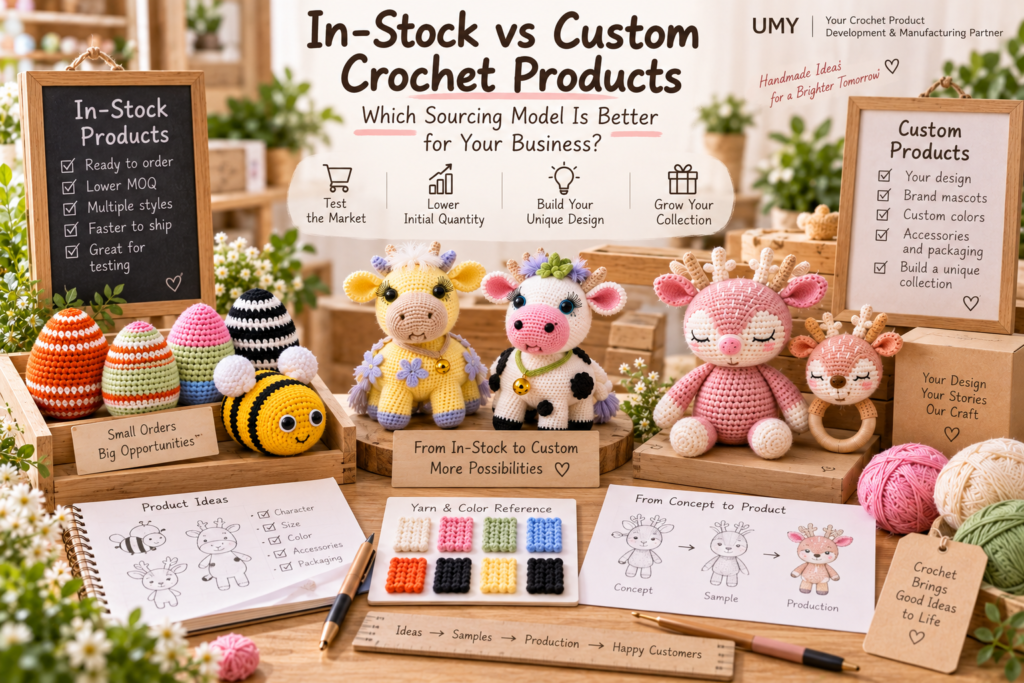
Choosing between in-stock and custom crochet products is not simply a question of which option has the lower MOQ. For retailers, gift companies, e-commerce sellers, museums, and emerging brands, the better sourcing model depends on how much market uncertainty you have, how quickly you need to launch, how differentiated the product must be, and how much development commitment you are prepared to make.
In-stock crochet products are generally better suited to buyers who want to test a category quickly, purchase smaller quantities, evaluate customer response, or add products without beginning a full development program. At UMY, typical stock MOQs are around 10–50 pieces per style, depending on actual availability.
Custom handmade crochet products are better suited to buyers who need proprietary designs, brand-specific colors, mascots, themed collections, special product structures, or stronger retail differentiation. UMY's typical handmade custom crochet MOQ is around 500 pieces per style, although some simple designs may be evaluated from approximately 300 pieces per style.
Neither model is automatically better.
The most practical sourcing strategy is often to match the level of product customization to the level of market confidence. A buyer can use stock products to validate demand, then invest in custom development when sales data, customer feedback, or brand strategy justifies a more differentiated product.
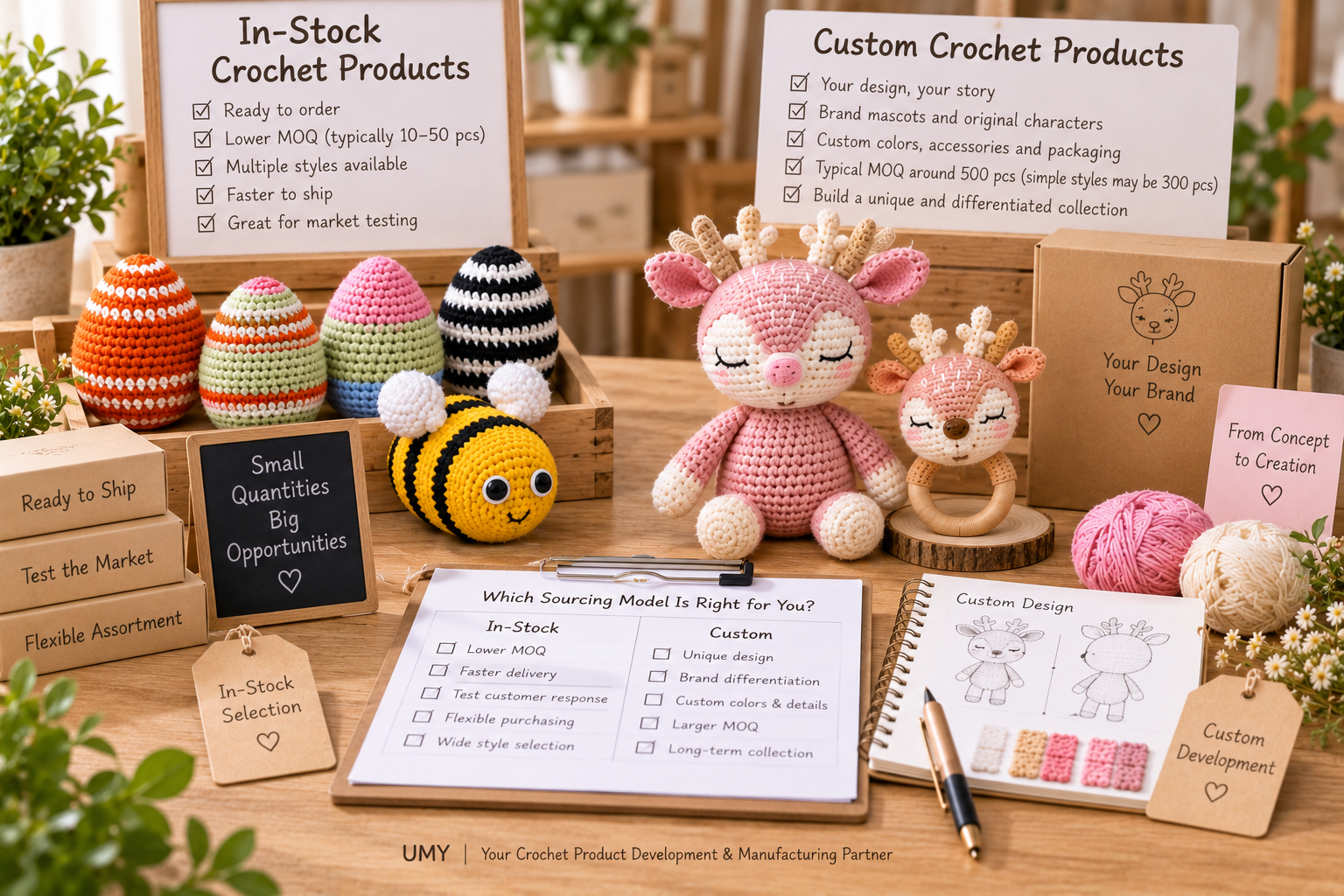
What Is the Difference Between In-Stock and Custom Crochet Products?
The main difference is how much of the product has already been developed before the buyer enters the project.
In-Stock Crochet Products
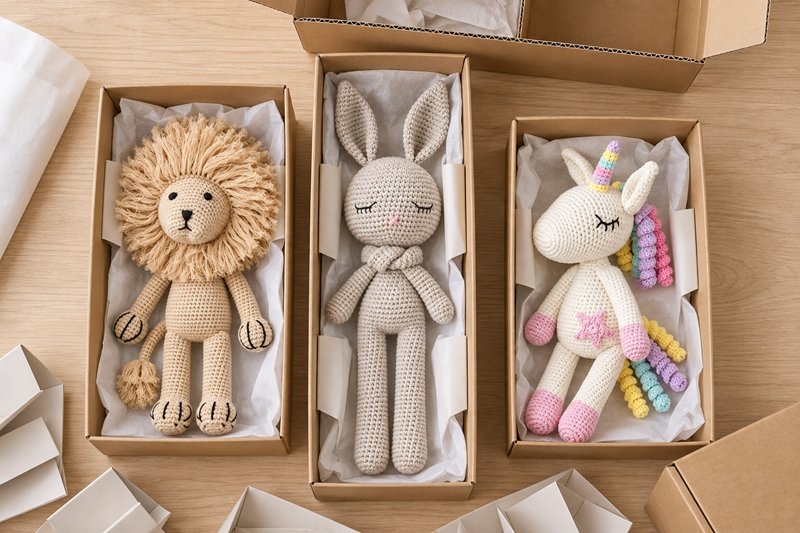
An in-stock product already exists in an available design or specification.
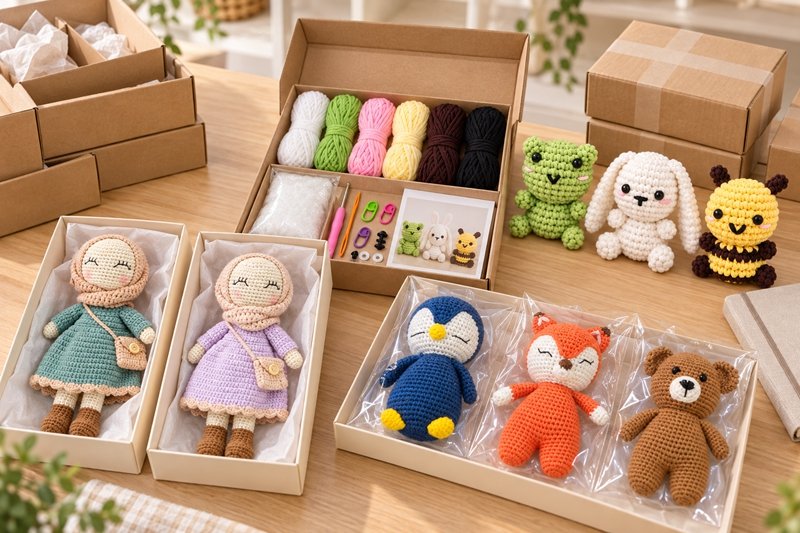
Depending on availability, a buyer may be able to select from existing:
- Crochet animals
- Decorative items
- Gifts
- Accessories
- Seasonal products
- Small crochet products
- Existing colors or styles
Because the core product has already been developed, buyers can usually avoid much of the work involved in creating a new crochet design from the beginning.
Custom Crochet Products
A custom product is developed around specific buyer requirements.
The project may begin with:
- A sketch
- Character artwork
- Brand mascot
- Reference image
- Existing product concept
- Cultural theme
- Color specification
- Product brief
- Authorized IP artwork
The Core Trade-Off: Speed and Flexibility vs Differentiation
A useful way to compare the two sourcing models is to look at what the buyer is trying to optimize.
| Purchasing Priority | In-Stock Products | Custom Products |
|---|---|---|
| Lower initial quantity | Strong advantage | Usually less suitable |
| Faster category testing | Strong advantage | Requires development |
| Unique product identity | Limited | Strong advantage |
| Brand-specific design | Limited | Strong advantage |
| Custom character development | Not the main model | Appropriate |
| Development flexibility | Limited to available products | High |
| Initial development work | Lower | Higher |
| Collection exclusivity | Limited | Potentially much stronger |
| Market validation | Very useful | Better after concept confidence |
| Long-term branded program | Can be a starting point | Often more suitable |
This table should not be interpreted as a universal rule.
Actual availability, customization scope, materials, packaging, quantities, and timing should be confirmed for each project.
When In-Stock Crochet Products Make More Sense
In-stock sourcing is especially useful when the buyer's biggest uncertainty is not manufacturing—it is whether customers will buy the category.
A company entering crochet products for the first time may not yet know:
- Which animal or theme will sell
- Which colors customers prefer
- Which price position works
- Whether the category fits the existing assortment
- Whether customers respond better online or in stores
- How quickly inventory will move
Committing immediately to a fully custom program may answer the design question before the business has answered the demand question.
A smaller stock order can provide useful commercial information first.
Example: An E-Commerce Seller Testing Crochet Gifts
Imagine an online gift seller that currently sells stationery and small lifestyle products.
The team believes handmade-style crochet gifts could work well with its audience but has never sold the category.
Instead of beginning with six fully custom characters, the seller could test several available crochet products in smaller quantities.
The test can help answer:
- Which product types receive clicks?
- Which products convert?
- Which colors perform better?
- What customer questions appear?
- Are customers buying them as gifts?
- Which price points work with the existing assortment?
The objective is not merely to sell a small batch.
It is to reduce uncertainty before committing more resources to product development.
When Custom Crochet Development Makes More Sense
Custom development becomes more valuable when differentiation is central to the business case.
A buyer may need custom development when the product must represent:
- A brand mascot
- Original character
- Museum object
- Cultural concept
- Corporate identity
- Event theme
- Proprietary collection
- Specific visual language
- Authorized licensed property
In these situations, selecting an existing generic crochet item may undermine the purpose of the project.
A museum shop developing merchandise around a recognizable collection object, for example, needs the crochet interpretation to connect with that object.
A company developing a mascot gift needs the finished product to retain the character's recognizable features.
A retailer building an exclusive collection may need colors, forms, packaging, and SKU relationships that are not available in stock products.
Custom development is therefore not simply "more expensive stock sourcing."
It solves a different commercial problem.
Step 1: Identify What You Are Trying to Validate
Before choosing a sourcing model, ask:
What is still uncertain?
If the uncertainty is mainly customer demand, stock products can often provide a practical test.
If customer demand is already established but the buyer needs stronger differentiation, custom development may be the more logical investment.
Common uncertainties include:
Category Uncertainty
"Will our customers buy crochet products at all?"
This favors a lower-commitment test.
Product Uncertainty
"We know crochet sells, but we do not know which designs our customers prefer."
A multi-style stock test may help.
Design Uncertainty
"We know what customers want, but we need to turn our concept into a manufacturable product."
This points toward custom sampling.
Scale Uncertainty
"We have a successful product, but we do not know how much inventory to commit to next."
This is more of a replenishment and forecasting problem than an initial product-development problem.
Understanding which uncertainty you are solving prevents MOQ from becoming the only decision criterion.
Step 2: Compare the Real Cost of Market Entry
Buyers sometimes compare only the unit price of two sourcing options.
That can hide the larger commercial picture.
The initial cost of entering a product category can include:
- Product quantity
- Sampling
- Design work
- Packaging
- Photography
- Listing preparation
- Inventory storage
- Marketing
- Fulfillment
- Unsold inventory risk
A lower unit price does not necessarily create a lower-risk launch if it requires significantly more inventory than the business can confidently sell.
Similarly, a small stock order may have a different unit economics profile but provide valuable market information before a larger commitment.
The relevant question is:
How much capital and development effort must we commit before we learn whether the product works?
That is a more useful purchasing question than unit price alone.
Step 3: Understand What MOQ Is Actually Telling You
MOQ is often treated as a supplier restriction.
In reality, it can reflect the production structure behind the product.
For an existing stock product, much of the development and inventory preparation may already exist.
That makes smaller transactions possible.
For a custom handmade crochet product, the project can involve:
- New sample development
- Yarn preparation
- Color coordination
- Production instructions
- Maker allocation
- Quality references
- Accessories
- Packaging coordination
- Production planning
At UMY, typical stock MOQ is around 10–50 pieces per style.
For handmade custom crochet products, the typical MOQ is around 500 pieces per style, with some simple designs potentially evaluated from around 300 pieces per style.
For custom knitted or plush products, typical MOQ starts around 1,000 pieces per style.
These are working ranges rather than guarantees for every project. Actual feasibility depends on design, materials, components, packaging, and production requirements.
Step 4: Consider How Much Customization You Really Need
Customization is not always an all-or-nothing decision.
Before developing a completely new product, buyers should identify what actually needs to be unique.
Possible customization needs can include:
- Product shape
- Character
- Color
- Size
- Accessories
- Clothing
- Embroidery
- Hangtag
- Story card
- Packaging
- Gift presentation
A buyer whose main goal is branded presentation may not need to redesign the physical crochet product completely.
Conversely, changing only a tag will not create meaningful differentiation if the commercial concept depends on a unique character.
The sourcing model should therefore follow the source of differentiation.
Can You Private Label an Existing Crochet Product?
Potentially, depending on the available product and project requirements.
For some buyers, an existing product combined with appropriate private-label presentation can create a useful intermediate sourcing strategy.
For example, a retailer may begin with an available crochet product while developing:
- Custom hangtags
- Story cards
- Gift packaging
- Collection presentation
- Retail merchandising
This does not turn the physical product into an exclusive custom design.
However, it can help a buyer evaluate how crochet products perform within its brand environment before committing to original product development.
Packaging feasibility and minimum quantities should still be confirmed for the actual project.
Step 5: Use Stock Products to Learn, Not Just to Buy Less
The strategic value of low-quantity sourcing is information.
A test order can produce evidence that helps shape the next product decision.
Buyers can monitor:
- Sell-through
- Product-page conversion
- Customer feedback
- Returns
- Gift purchasing patterns
- Color preferences
- Popular product sizes
- Repeat purchase behavior
- Seasonal response
Not every business will have access to all these metrics.
The principle is simply to decide what you want to learn before placing the test order.
Otherwise, a low-MOQ purchase can become a small transaction that generates little useful information.
Step 6: Know When a Stock Product Has Done Its Job
A stock product does not need to remain the permanent sourcing model.
It may be a bridge.
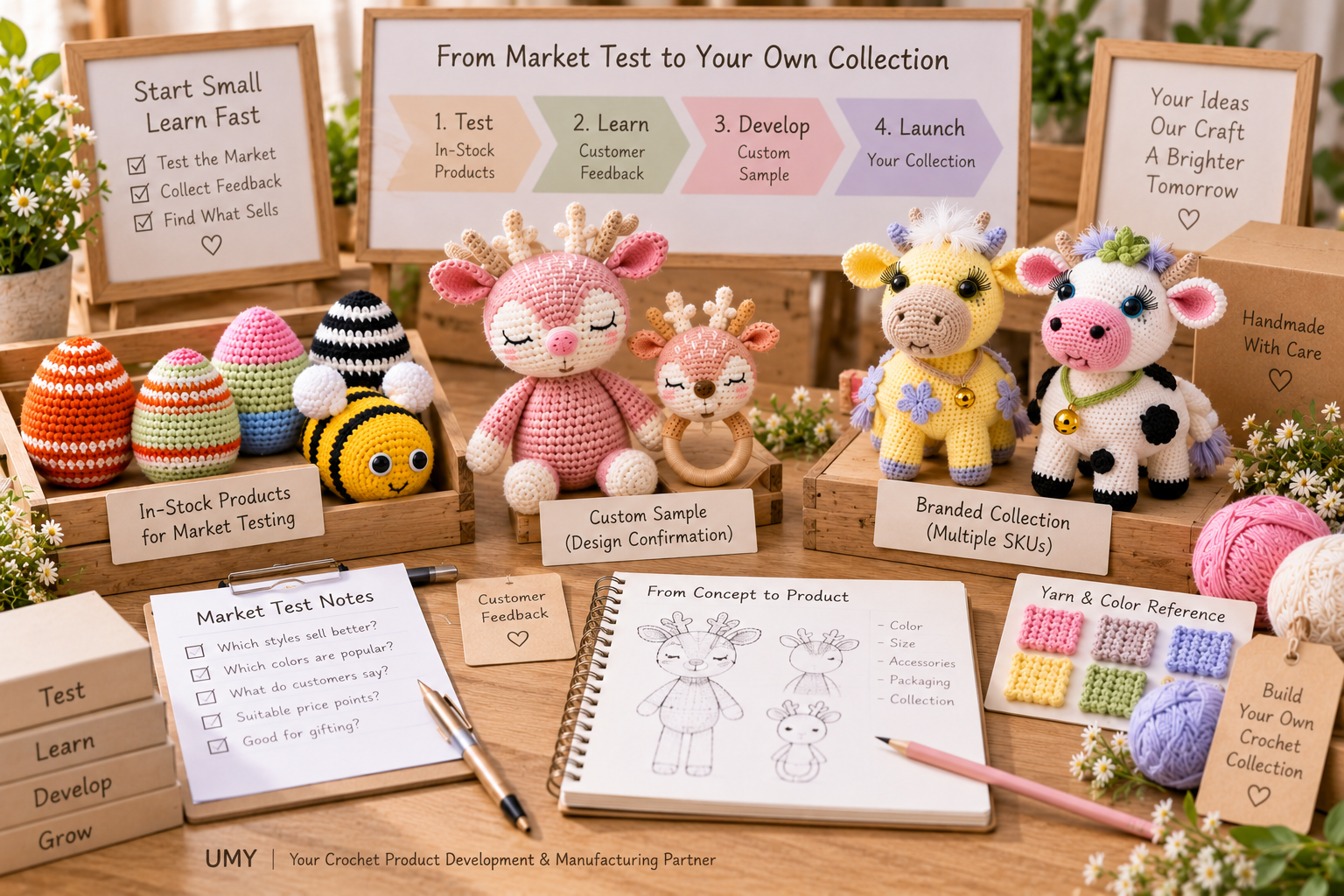
A useful progression can look like this:
For example, a retailer may discover that customers consistently choose:
- Small giftable animals
- Soft pastel colors
- Products below a certain physical size
- Items with strong character faces
- Products that work well as seasonal gifts
Those observations can become inputs for a custom collection.
The custom program is then based on evidence rather than only intuition.
Step 7: Avoid Copying a Successful Stock Product Into a Custom Design
There is an important distinction between learning from commercial performance and copying a product.
A buyer can learn that customers prefer:
- Certain categories
- Sizes
- Color families
- Gift formats
- Product functions
That does not mean another company's protected character, artwork, or distinctive design should be copied.
Custom development should begin from the buyer's own concept, properly authorized assets, or an original design direction.
UMY does not assume authorization to manufacture third-party intellectual property.
For mascot, licensed, cultural, or branded projects, buyers should have appropriate rights or authorization for the intended design.
Step 8: Decide Whether You Need a Product or a Product Program
This is one of the most important distinctions for growing brands.
A buyer may initially need one product.
Later, the business may need a repeatable development system for:
- Multiple characters
- Seasonal variations
- Gift sets
- Different sizes
- Accessories
- Retail packaging
- Replenishment
- New markets
At that point, supplier capability should be evaluated beyond whether one sample looks good.
The buyer may need a partner that can support:
concept → sampling → material specification → production → packaging → repeat orders → collection expansion
This is where custom development can become more valuable than simply purchasing individual products.
Stock vs Custom for Different Types of Buyers
Different buyers can use the two models differently.
Small Retailers
Once specific designs or themes demonstrate demand, the retailer can evaluate whether custom products make commercial sense.
E-Commerce Sellers
Successful product directions can then inform private-label or custom development.
Gift Companies
Museums and Cultural Institutions
A museum may use available products for general gift assortment, but products representing specific collection objects, cultural stories, exhibitions, or institutional mascots usually require more deliberate custom development and appropriate rights.
Corporate Buyers
For general gifting, an existing product with appropriate packaging may sometimes be sufficient.
For a campaign centered on a company mascot, branded character, or specific corporate concept, custom development is more relevant.
Stock vs Custom for Seasonal Products
Seasonality changes the sourcing calculation.
A buyer developing products for:
- Christmas
- Easter
- Valentine's Day
- Halloween
- Mother's Day
- A museum exhibition
- A corporate event
has a fixed commercial window.
If development begins too late, a highly customized product may create unnecessary timing pressure.
An available product may sometimes provide a faster route when the primary goal is to participate in a seasonal selling period.
For recurring seasons, the buyer can take a longer view.
One possible strategy is:
Year 1: test the category with available products.
After the season: analyze performance.
Year 2: launch a custom collection based on the strongest commercial signals.
This transforms seasonal purchasing into a product-development learning cycle.
What About Sampling Time?
Custom development requires time before bulk production.
At UMY, custom product sampling typically takes around 7–15 days, depending on design complexity and actual project requirements.
This should not be confused with the total project timeline.
A custom program may also require time for:
- Buyer feedback
- Sample revisions
- Material confirmation
- Packaging development
- Artwork approval
- Testing or labeling decisions where applicable
- Production
- Packing and shipping
Stock sourcing reduces or removes some product-development steps because the core item already exists.
However, custom packaging or other modifications can still introduce additional development requirements.
Buyers working toward a fixed launch date should compare the complete project timeline, not only the stated sample time.
How to Decide: A Practical Buyer Framework
Buyers can evaluate five questions.
1. Is Demand Proven?
If no, consider a smaller stock test.
If yes, stronger customization may be easier to justify.
2. Does the Product Need to Be Unique?
If the business case depends on a proprietary character, cultural concept, mascot, or exclusive design, custom development is more appropriate.
3. How Much Inventory Risk Can You Accept?
A smaller stock order can reduce initial exposure.
A custom project usually requires a larger commitment.
4. How Much Time Is Available?
Existing products can reduce development time.
Custom projects should allow time for sampling and approval.
5. What Is the Long-Term Goal?
If the goal is simply to add a few crochet products to an assortment, stock sourcing may be sufficient.
If the goal is to build a recognizable product line, custom development may provide more long-term value.
A Hybrid Sourcing Strategy Can Be Stronger Than Choosing One Forever
Businesses do not necessarily need to identify themselves permanently as either "stock buyers" or "custom buyers."
The two models can serve different stages.
| Business Stage | Possible Sourcing Approach |
|---|---|
| Exploring the category | Small stock order |
| Testing multiple styles | Several stock SKUs |
| Identifying customer preferences | Analyze test results |
| Building differentiation | Develop custom sample |
| Launching branded collection | Custom production |
| Expanding assortment | Mix custom hero products with suitable supporting products |
| Replenishing winners | Repeat-order production with controlled references |
This progression can help buyers match investment with evidence.
It also positions sourcing as part of product strategy rather than only purchasing administration.
Common Mistakes When Choosing Between Stock and Custom
1. Choosing Only by Unit Price
The lowest unit cost does not necessarily create the lowest commercial risk.
2. Starting With Too Many Custom SKUs
Every custom SKU adds development, approval, inventory, and replenishment complexity.
3. Expecting Stock Products to Deliver Full Exclusivity
Existing products can be useful for testing, but they do not provide the same differentiation as original custom development.
4. Treating MOQ as the Only Risk
Timing, packaging, inventory, product-market fit, and development resources also matter.
5. Customizing Before Knowing What Customers Want
A highly specific product does not solve uncertain demand.
6. Testing Without Defining What You Want to Learn
A test order should produce information that supports the next decision.
7. Ignoring the Transition to Repeat Orders
If a product succeeds, buyers should already be thinking about specifications, packaging, and replenishment consistency.
How UMY Supports Both Sourcing Paths
Dongguan U-MY Garment Co., Ltd. has worked in product development and manufacturing since 2013.
Our role can differ according to the buyer's stage.
For buyers who need to test the market, available products can provide a lower-quantity entry point where suitable stock exists.
For buyers who already have a defined concept, UMY can evaluate custom product development from artwork, sketches, product briefs, or other appropriate references.
Custom handmade crochet development can involve:
- Design interpretation
- Sampling
- Material selection
- Color development
- Product specification
- Production planning
- Quality control
- Packaging coordination
- Repeat-order support
The objective is not to push every buyer into the same sourcing model.
A small retailer testing its first crochet assortment has a different commercial problem from a brand launching an original mascot collection.
The sourcing path should reflect that difference.
Buyer Checklist: Stock or Custom?
Use this checklist before requesting quotations.
Consider In-Stock Products If:
- [ ] You are entering the crochet category for the first time
- [ ] Demand is not yet proven
- [ ] You want to test several product styles
- [ ] Lower initial quantity is important
- [ ] Product exclusivity is not yet essential
- [ ] You have a short launch window
- [ ] You want customer data before custom development
Consider Custom Development If:
- [ ] You have an original product concept
- [ ] You need a brand-specific character or mascot
- [ ] Product differentiation is central to the project
- [ ] You have appropriate rights for protected IP
- [ ] You need specific colors, forms, or accessories
- [ ] You are building a coordinated collection
- [ ] Demand or strategic commitment justifies a larger production program
- [ ] You can allow time for sampling and approvals
FAQ
What is the MOQ for in-stock crochet products?
UMY's typical stock MOQ is around 10–50 pieces per style, depending on actual product availability. The exact quantity should be confirmed for the selected item.
What is the MOQ for custom handmade crochet products?
UMY's typical handmade custom crochet MOQ is around 500 pieces per style. Some simple designs may be evaluated from approximately 300 pieces per style. Actual feasibility depends on the design and project requirements.
Is in-stock sourcing only for small businesses?
No. Larger retailers and brands can also use stock products for assortment testing, seasonal opportunities, market validation, or supporting products. The model is defined by the sourcing objective rather than company size.
Can I test stock products before developing a custom collection?
Yes. This can be a useful strategy when the objective is to understand customer preferences before committing to original development. Test results can inform categories, colors, sizes, gift formats, and other decisions for a later custom program.
Are custom crochet products exclusive?
Custom development can create a buyer-specific design, but ownership, exclusivity, intellectual property, and related commercial terms should be clearly agreed for the actual project. Buyers should not assume that every form of customization automatically creates the same legal or commercial rights.
Can I add private label packaging to an existing product?
This may be possible depending on the product, packaging requirements, and order structure. Packaging feasibility should be evaluated separately because customized packaging components can have their own production requirements.
How long does a custom crochet sample take?
UMY's typical custom sampling period is around 7–15 days, depending on design complexity and project requirements. Revisions, packaging, special components, and other approvals can add time to the overall development schedule.
When should I move from stock to custom sourcing?
There is no fixed sales threshold. A useful point to consider custom development is when you have enough confidence in the category to justify greater product differentiation and production commitment. Customer feedback, repeat sales, assortment strategy, and brand objectives can all inform that decision.
Choose the Sourcing Model That Matches Your Level of Certainty
The difference between in-stock and custom crochet sourcing can be summarized in one principle:
Use flexibility when you are still learning. Invest in differentiation when you know what you want to build.
Stock products can help buyers enter a category, test demand, compare styles, and reduce initial inventory exposure.
Custom development can help buyers create proprietary characters, stronger brand identity, coordinated collections, specialized merchandise, and products that cannot be achieved by selecting from an existing assortment.
For many businesses, the strongest strategy is not choosing one model forever.
It is moving deliberately from:
test → learn → develop → scale → replenish
For retailers, gift companies, e-commerce sellers, museums, cultural institutions, corporate buyers, and brands evaluating crochet products, UMY can help assess whether an available product, a custom development project, or a staged combination of both is the more practical next step.
 Chinese