
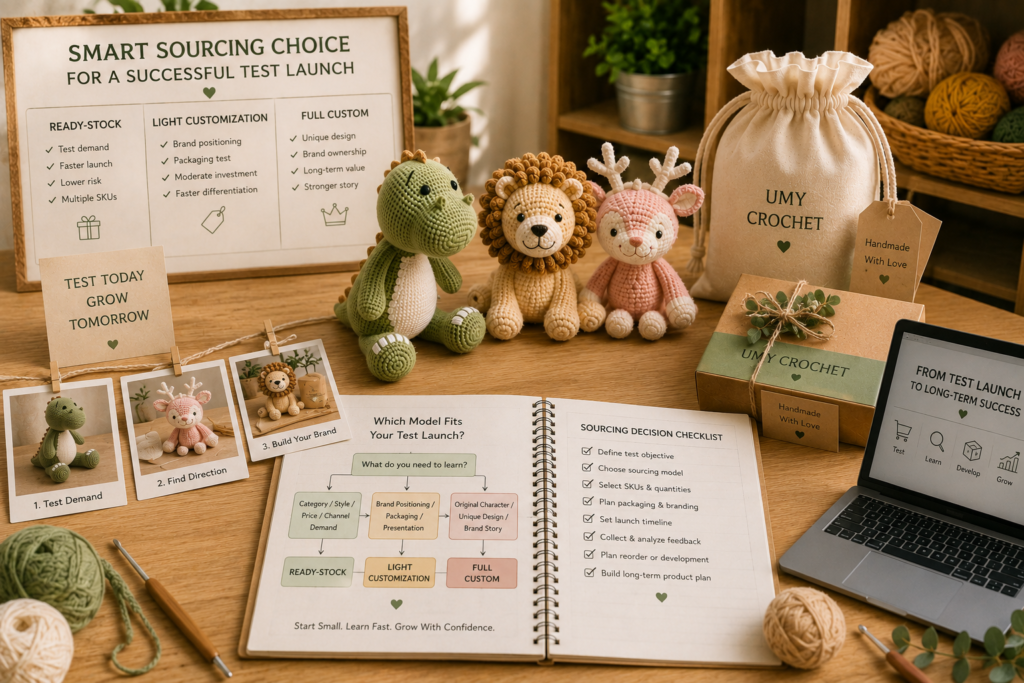
For a crochet product test launch, the right sourcing model depends on what the buyer is actually trying to validate.
If the main question is “Will customers buy this type of crochet product?”, ready-stock sourcing is usually the lower-risk starting point because it requires less development, supports smaller quantities, and allows buyers to test several products more quickly.
If the main question is “Will customers respond to our own character, design, packaging, or brand concept?”, custom crochet is more appropriate because the product itself needs to represent the final commercial idea.
A third option—light customization—can sit between the two. Existing product structures may sometimes be adapted through colors, labels, accessories, or packaging without developing an entirely new crochet product from the beginning.
A practical rule is:
Use ready stock to test demand, light customization to test positioning, and full customization to test a differentiated product concept.
For many retailers and e-commerce brands, a staged approach is more useful than committing immediately to the most complex sourcing model.
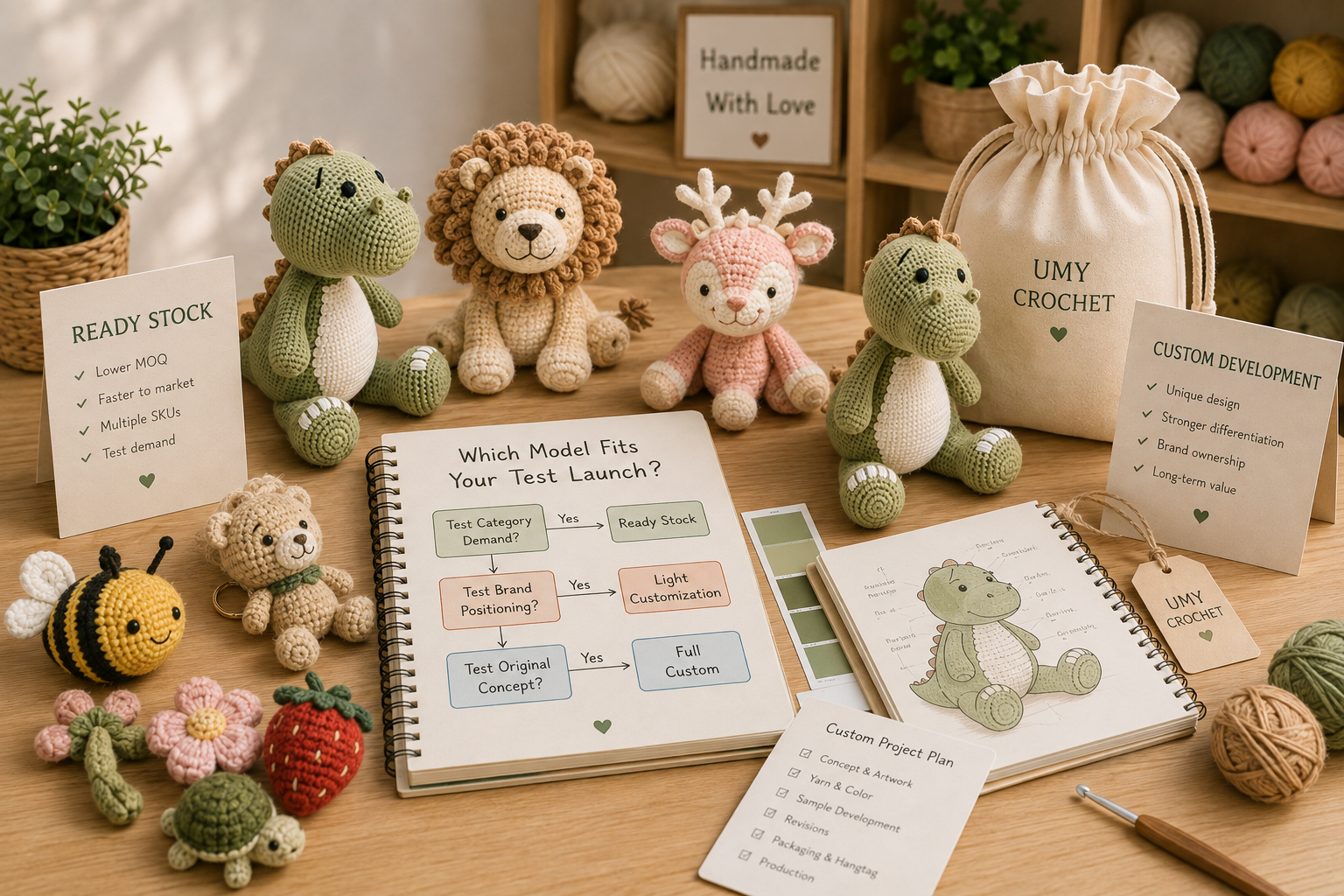
Why the Sourcing Model Matters During a Test Launch
A test launch is not simply a small order.
It is a commercial experiment designed to answer specific questions before a buyer invests more heavily.
Those questions may include:
- Which product style attracts the most attention?
- Which price point works?
- Which color sells best?
- Which customer segment responds?
- Does packaging influence conversion?
- Can a character support repeat purchases?
- Should the buyer expand into related SKUs?
- Is there enough demand to justify custom development?
The sourcing model determines what can realistically be tested.
For example, a buyer who purchases five ready-stock crochet animals is testing category and assortment demand.
A buyer who develops an original mascot is testing something different:
whether a proprietary product concept can create commercial value.
These are not the same experiment.
Before choosing ready stock or custom crochet, define the question the launch needs to answer.
The Three Main Sourcing Paths
For practical B2B decision-making, crochet sourcing can be viewed in three broad categories:
- Ready-stock sourcing
- Light customization
- Full custom development
Each has a different role.
| Sourcing Model | Best For | Main Advantage | Main Limitation |
|---|---|---|---|
| Ready Stock | Fast market testing | Lower commitment and faster selection | Limited exclusivity |
| Light Customization | Testing brand positioning | More differentiation without starting from zero | Customization scope depends on the product |
| Full Custom | Testing an original commercial concept | Strongest differentiation and brand ownership | More development time and higher commitment |
The right choice depends on the uncertainty the buyer is trying to reduce.
What Is Ready-Stock Crochet Sourcing?
For a test launch, this can be useful when the buyer wants to evaluate:
- Customer interest in crochet
- Product categories
- Retail pricing
- Color preferences
- Giftability
- Store placement
- Online conversion
- Seasonal demand
At UMY, ready-stock MOQ is typically around 10–50 pieces per style, subject to actual product availability and confirmation.
That makes ready stock particularly useful for buyers that want to compare several SKUs without placing a large quantity behind one untested design.
Example
Instead of launching 500 pieces of one new crochet animal, a retailer might begin with several existing styles in smaller quantities.
The purpose is not to determine which custom character is best.
The purpose is to learn:
- Which silhouettes attract customers
- Which product sizes move faster
- Which price bands work
- Which themes generate repeat interest
Those findings can later influence a more focused custom collection.
When Ready Stock Is Usually the Better Test-Launch Model
Ready stock is often the stronger option when the buyer's biggest uncertainty is market demand rather than product design.
1. You Are Entering the Crochet Category for the First Time
A retailer that has never sold handmade crochet may not yet know:
- How customers respond
- Which styles fit the assortment
- What price point works
- How much shelf space to allocate
Developing an exclusive product before answering these questions can create unnecessary risk.
Ready stock provides a simpler learning stage.
2. You Need to Test Several Product Types
A buyer may want to compare:
- Dolls
- Animals
- Flowers
- Keychains
- Seasonal ornaments
- Gift items
Smaller ready-stock quantities make broader assortment testing more practical.
3. Your Launch Window Is Short
Full customization requires development decisions before production begins.
If the sales window is approaching quickly, an existing product may be more realistic than starting with:
Concept → Sample → Revision → Approval → Production
4. You Are Testing a New Sales Channel
A brand may already understand its customer but still be uncertain about a new channel.
Examples include:
- Opening a marketplace store
- Entering museum retail
- Testing a pop-up
- Trying a new wholesale account
- Adding physical retail to an online business
In these situations, the product does not always need to be fully custom at the beginning.
5. Cash Exposure Needs to Stay Limited
This does not guarantee commercial success, but it allows the buyer to collect information before making a larger decision.
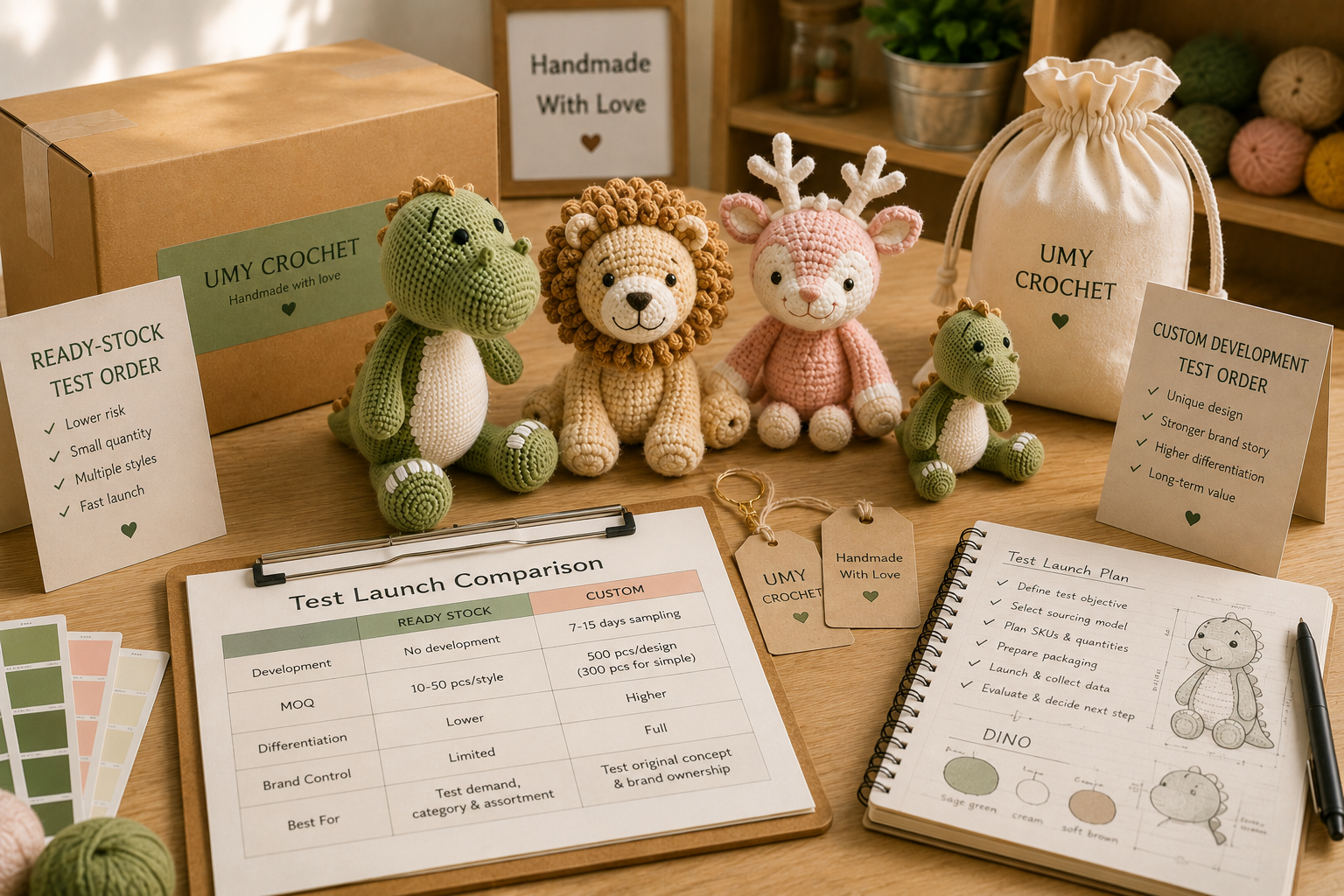
What Ready Stock Cannot Test Well
Ready-stock products have an important limitation:
They cannot fully validate a product that does not yet exist.
A ready-stock animal may tell a brand that customers like crochet animals.
It does not automatically tell the brand whether customers will buy:
- Its original mascot
- Its own color palette
- A licensed character
- Its cultural concept
- Its premium packaging
- Its branded gift program
Ready stock tests the market category more effectively than it tests a unique brand proposition.
That distinction is important.
Otherwise, buyers may draw the wrong conclusion from a successful or unsuccessful test.
What Is Light Customization?
Light customization sits between ready stock and full custom development.
Instead of creating an entirely new crochet structure, an existing product may sometimes be adapted through selected elements such as:
- Color
- Clothing
- Simple accessories
- Hangtags
- Labels
- Story cards
- Packaging
- Collection presentation
The exact options depend on the existing product, materials, production feasibility, and order quantity.
Light customization is useful when the buyer wants to answer:
Can we make an existing product feel relevant to our brand or retail concept without developing everything from zero?
It can be a practical bridge between market testing and proprietary product development.
When Light Customization Makes Sense
1. The Product Shape Already Works
If an existing crochet animal or character structure fits the commercial need, changing every construction detail may not add enough value.
A buyer may get more useful differentiation from:
- A new palette
- A signature accessory
- A branded tag
- A story card
- Retail packaging
2. Packaging Is Part of the Test
Sometimes the product itself is not the biggest uncertainty.
The buyer wants to know whether stronger presentation can support:
- A higher perceived value
- Better gifting
- A museum or cultural story
- A seasonal program
- A branded retail concept
In this case, packaging can become part of the experiment.
3. You Want a Faster Route Toward Brand Differentiation
A business may not yet be ready to commit to a completely new handmade design but still wants something less generic than standard wholesale.
Light customization can create an intermediate commercial step.
What Is Full Custom Crochet Development?
The input may be:
- Original artwork
- A brand mascot
- A character concept
- Product sketches
- A cultural design direction
- A retail collection brief
- An authorized IP design
The development process may include:
Concept → Crochet Interpretation → Yarn Selection → Sample → Revision → Approved Reference → Packaging → Production
At UMY, custom handmade crochet is normally quoted around 500 pieces per design.
For simpler designs that are suitable for production, projects may be evaluated from approximately 300 pieces per design, subject to the actual design and project assessment.
Custom crochet therefore requires a different type of commitment from ready-stock sourcing.
When Full Custom Crochet Is the Better Test
A custom test makes sense when the thing being tested is the unique product concept itself.
1. You Are Testing an Original Brand Mascot
If the commercial opportunity depends on a recognizable proprietary character, an unrelated ready-stock animal cannot validate the idea.
The actual character needs to be developed.
2. Product Differentiation Is the Business Model
Some brands do not want to compete by selecting the same products available to other buyers.
Their value may come from:
- Exclusive design
- Character identity
- Storytelling
- Specialized packaging
- Collection architecture
In that case, custom development is not an optional later step.
It is part of what the customer is buying.
3. The Product Must Match a Specific Story or Institution
- Character
- Artwork
- Object
- Cultural story
- Identity
A generic ready-stock item may be unsuitable because the connection itself creates the value.
4. You Already Have Evidence That the Category Works
A retailer that has already sold crochet successfully may not need another generic demand test.
The next question may be:
Can we create something exclusive that gives customers a reason to choose us?
That is a custom-development question.
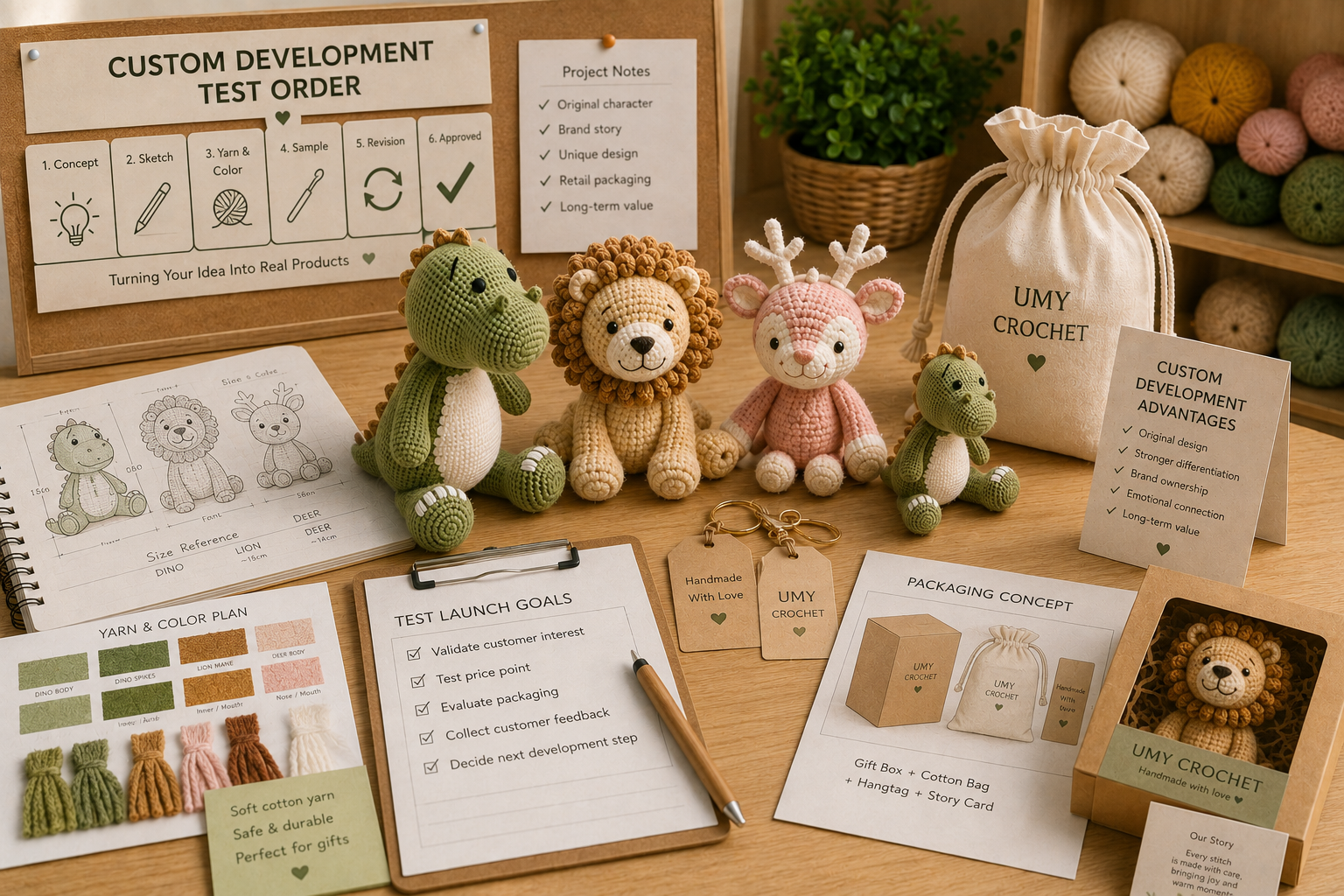
Ready Stock vs Custom Crochet: A Direct Comparison
| Decision Factor | Ready Stock | Light Customization | Full Custom |
|---|---|---|---|
| Market-entry speed | Highest | Medium to high | Lower due to development |
| Initial development work | Low | Moderate | High |
| Product differentiation | Low | Medium | High |
| Brand control | Limited | Moderate | High |
| Suitable for testing multiple SKUs | Strong | Moderate | More difficult |
| Original character testing | Weak | Limited | Strong |
| Packaging customization | Project dependent | Often relevant | Can be integrated into development |
| Inventory commitment | Lower for available stock | Project dependent | Higher |
| Best question answered | “Will this category sell?” | “Will this positioning work?” | “Will our unique product concept work?” |
The most important difference is not simply MOQ.
It is what kind of business uncertainty each model can resolve.
Do Not Choose a Sourcing Model Based Only on MOQ
MOQ matters, especially for a test launch.
But using MOQ as the only decision criterion can lead to the wrong product strategy.
For example:
A low-MOQ ready-stock product may be financially easier to test.
On the other hand, developing a fully custom product simply because customization sounds more premium may create unnecessary complexity when the buyer has not yet proven basic demand.
A stronger decision process considers:
- What needs to be learned
- How much differentiation is required
- Launch timing
- Available budget
- Number of SKUs
- Inventory tolerance
- Packaging requirements
- Future reorder strategy
- Long-term brand plans
A Practical Test-Launch Decision Framework
Before requesting products, complete this sentence:
After this launch, we need to know whether ____.
The answer helps identify the right sourcing model.
“We need to know whether customers will buy crochet products.”
Start with ready stock.
“We need to know which crochet style performs best.”
Start with several ready-stock SKUs.
“We need to know whether our branding improves the product.”
Consider light customization.
“We need to know whether our mascot works as merchandise.”
Use custom development.
“We need to know whether customers will pay more for a gift-ready version.”
Test packaging and presentation.
“We already know the category sells and want something exclusive.”
Move toward custom development.
This makes the sourcing choice a business decision rather than simply a purchasing decision.
A Staged Launch Can Be Better Than an Either-Or Decision
Ready stock and custom crochet do not need to be competing strategies.
They can be different stages of the same product-development journey.
A retailer might use the following sequence:
Stage 1: Ready-Stock Test
Test:
- Category demand
- Product sizes
- Colors
- Price points
- Sales channels
Stage 2: Focused Reorder
Reorder the products that perform best and remove weak SKUs.
Stage 3: Light Customization
Adapt proven product directions using:
- Packaging
- Brand colors
- Accessories
- Labels
- Story cards
Stage 4: Full Custom Development
Develop an exclusive product based on what the earlier tests revealed.
Stage 5: Collection Expansion
Once the custom hero product is proven, expand into:
- Mini versions
- Keychains
- Gift sets
- Seasonal editions
- Related characters
This staged approach helps each investment answer a new commercial question.
How to Evaluate a Ready-Stock Test
Do not judge the launch only by whether products sold.
Record what each SKU teaches you.
Useful information may include:
- Sell-through by style
- Sell-through by color
- Price acceptance
- Customer comments
- Gift purchases
- Repeat purchases
- Most-viewed online products
- Add-to-cart behavior
- In-store handling
- Requests for other colors or characters
- Products customers compare with each other
A test should generate decisions.
If a buyer learns nothing except “some products sold,” the test has not been used fully.
How to Evaluate a Custom Product Test
Custom products need a different evaluation framework.
The buyer may want to assess:
- Character recognition
- Customer response to the story
- Perceived uniqueness
- Brand fit
- Giftability
- Packaging response
- Price acceptance
- Interest in related products
- Social or campaign usefulness
- Potential for future extensions
A custom character does not need to become a huge collection immediately.
The first product can act as a commercial prototype for a broader idea.
Consider Replenishment Before the First Test Order
A test launch is only valuable if the buyer knows what happens when a product succeeds.
Before launching, ask:
- Can this product be reordered?
- Is it ready stock or produced after order confirmation?
- Are materials likely to remain available?
- Will the same color references be maintained?
- Does packaging need another production run?
- Does the reorder have a different MOQ?
- How much lead time should be allowed?
- Which information from the first batch needs to be retained?
Availability should be confirmed when a reorder is needed.
Custom products create another requirement:
The approved production references need to be controlled so the next batch remains consistent with the first one.
Why Batch Consistency Matters for Handmade Crochet
Handmade does not mean uncontrolled.
For products that move from testing into regular retail, the manufacturer should establish references for important details such as:
- Yarn
- Color
- Dimensions
- Stitch structure
- Filling
- Facial features
- Accessories
- Clothing
- Packaging
The goal is not to eliminate the handmade nature of the product.
The goal is to make sure customers purchasing the same SKU receive a product that remains recognizably consistent.
This becomes particularly important when a retailer moves from a small launch into repeated orders.
How Sampling Changes the Decision
Ready-stock sourcing does not require the same development process as a new custom design.
Custom crochet does.
At UMY, custom crochet sampling typically takes around 7–15 days, depending on:
- Design complexity
- Materials
- Accessories
- Revisions
- Current project scheduling
That timeframe should be treated as part of the launch plan rather than as an isolated production detail.
A custom project may also need time for:
- Artwork review
- Sample feedback
- Revision
- Packaging development
- Final approval
If the launch date does not allow enough time for these decisions, buyers may need to:
- Reduce complexity
- Use an existing structure
- Simplify packaging
- Move to light customization
- Choose ready stock
This is a commercial trade-off, not necessarily a compromise in quality.
What About MOQ for a Test Launch?
UMY's current general sourcing framework is:
Ready Stock
Typically around 10–50 pieces per style, depending on actual stock and product confirmation.
Custom Handmade Crochet
Normally around 500 pieces per design.
Some simpler and production-suitable designs may be evaluated from approximately 300 pieces per design.
Light Customization
There is no single universal MOQ because feasibility can depend on:
- Existing product
- Required changes
- Materials
- Labels
- Packaging
- Printing
- Number of SKUs
he complete project should be evaluated before a quantity is confirmed.
Which Model Fits Different Buyer Types?
New E-Commerce Seller
Usually begin with:
Ready stock
Primary goal:
Test demand without developing too many assumptions at once.
Independent Retailer
Often use:
Ready stock → light customization
Primary goal:
Identify customer preferences, then develop stronger store differentiation.
Established Gift Brand
Often use:
Light customization or full custom
Primary goal:
Create products that fit an existing brand and gifting strategy.
Brand With an Original Mascot
Usually use:
Full custom
Primary goal:
Translate owned artwork into a recognizable physical product.
Museum or Cultural Institution
Often use:
Custom or carefully adapted development
Primary goal:
Connect product design to a specific cultural or institutional story.
Corporate Buyer
May use:
Ready stock, light customization, or custom
depending on whether the project requires a general gift, branded presentation, or original company character.
Common Mistakes Buyers Make When Choosing a Test-Launch Model
Mistake 1: Developing Custom Products Before Defining the Test
If the buyer cannot explain what the first launch needs to prove, custom development can become directionless.
Mistake 2: Assuming Ready Stock Validates a Custom Idea
A generic product can test category demand.
It cannot fully test a proprietary character or unique brand concept.
Mistake 3: Choosing Only by the Lowest MOQ
Lower quantity is useful only if the product answers the right business question.
Mistake 4: Testing Too Many SKUs
More choices do not automatically produce better information.
A focused assortment is easier to evaluate.
Mistake 5: Ignoring Replenishment
A successful SKU creates a new problem if the buyer has no reorder plan.
Mistake 6: Customizing Details Customers Do Not Notice
Extra complexity should create visible customer value.
Prioritize the features most likely to affect:
- Recognition
- Story
- Giftability
- Brand fit
- Purchase decisions
Mistake 7: Scaling Before Understanding Why the Product Worked
Do not simply reorder the bestseller.
Try to understand what drove the result.
That knowledge should influence the next collection.
A Practical Buyer Checklist
Before choosing a sourcing model for a crochet test launch, confirm:
- [ ] What commercial question are we testing?
- [ ] Do we need an exclusive design?
- [ ] Is an existing product suitable?
- [ ] How many SKUs do we need to compare?
- [ ] What is the target launch date?
- [ ] What quantity can we responsibly test?
- [ ] Does packaging need to be part of the test?
- [ ] Are brand colors or labels important?
- [ ] Is an original character involved?
- [ ] Do we have the right to use all supplied artwork or IP?
- [ ] What customer feedback will we collect?
- [ ] How will we measure product performance?
- [ ] What happens if the product sells faster than expected?
- [ ] Can the product be reordered?
- [ ] When would we move from ready stock to custom development?
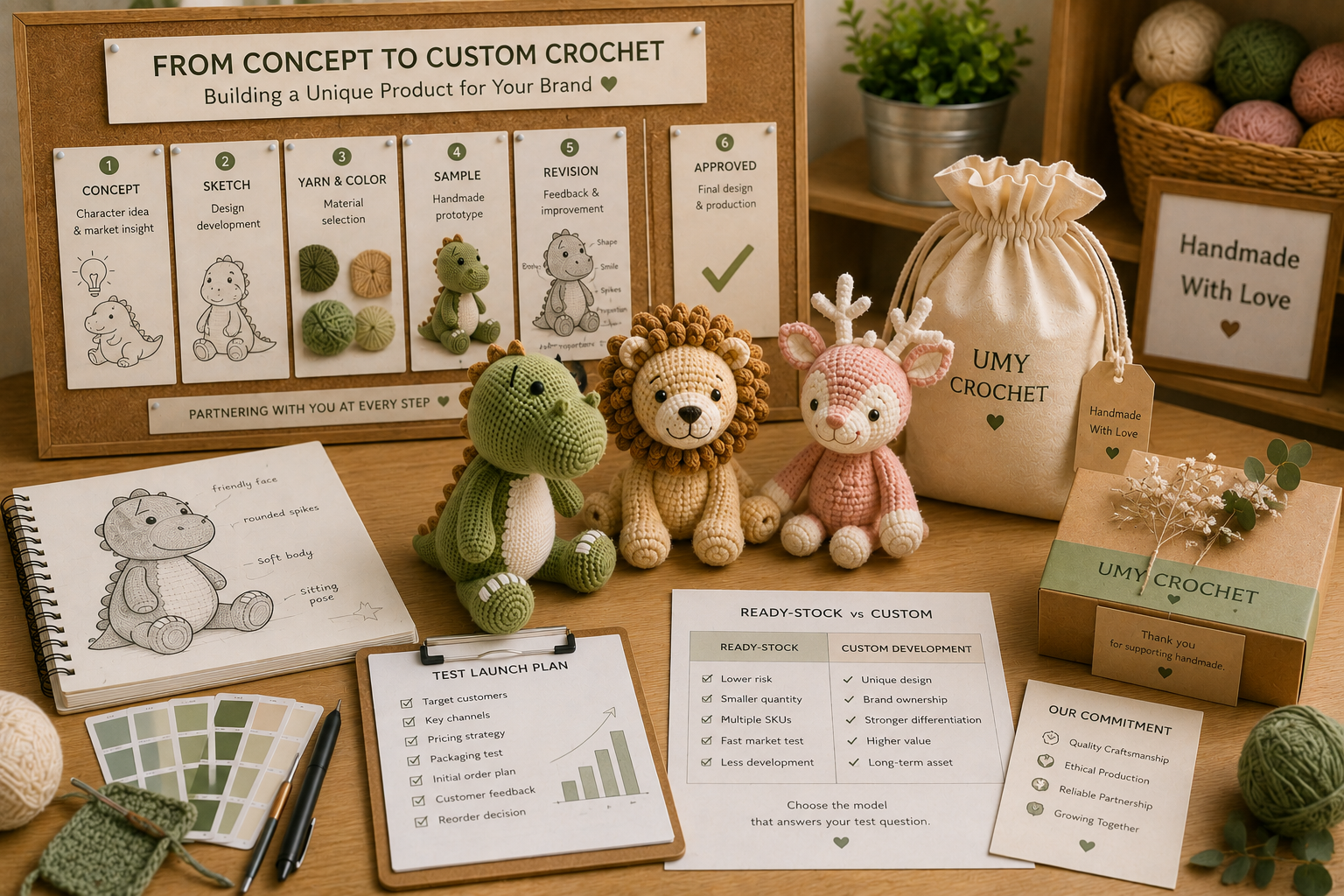
How UMY Supports Different Test-Launch Paths
UMY has been involved in crochet product development and manufacturing since 2013.
Different buyers enter the process at different stages.
For suitable projects, the sourcing path may include:
Ready-Stock Wholesale
Appropriate for buyers that need:
- Smaller initial quantities
- Faster category testing
- Multiple product styles
- Lower development requirements
Light Customization
Existing products may be evaluated for changes such as:
- Color
- Selected accessories
- Labels
- Hangtags
- Story cards
- Packaging
The feasibility depends on the actual product and project.
OEM Custom Development
Suitable when the buyer provides:
- Original artwork
- Character concepts
- Product specifications
UMY can help translate the concept into a crochet product for sampling and production assessment.
ODM Development
Suitable when the buyer needs additional support with:
- Product concepts
- Character direction
- Collection structure
- Gift combinations
- Packaging direction
The objective is not to push every buyer toward maximum customization.
It is to identify the development level that matches the buyer's current commercial stage.
Frequently Asked Questions
Is ready-stock crochet better for a new retailer?
It can be. Ready stock is especially useful when a retailer needs to test the crochet category, several SKUs, price points, or customer preferences before committing to a more customized product.
What is the MOQ for ready-stock crochet products?
At UMY, ready-stock MOQ is typically around 10–50 pieces per style, depending on actual product availability and confirmation.
What is the MOQ for custom handmade crochet?
Custom handmade crochet is normally around 500 pieces per design. Some simpler designs that are suitable for production may be evaluated from approximately 300 pieces per design.
Can I add my brand to a ready-stock crochet product?
Some projects may support lighter customization through labels, tags, packaging, colors, or selected product details. Feasibility and quantity should be evaluated for the specific product.
Should I use ready stock to test my brand mascot?
Ready stock can help test general crochet demand, product size, pricing, or retail channels, but it cannot fully validate a proprietary mascot. If the mascot itself is the commercial idea, a custom sample is more relevant.
How long does a custom crochet sample take?
UMY's typical sampling period is around 7–15 days, depending on design complexity, materials, accessories, revisions, and project scheduling.
Can a test launch combine ready stock and custom products?
Yes. They can serve different purposes. For example, ready-stock products may establish category demand while one custom hero product tests a more exclusive brand concept.
What should I do if a ready-stock product becomes a bestseller?
First confirm reorder availability and timing. Then evaluate what made the product successful. Depending on your strategy, you may continue replenishing it, customize the presentation, or use the demand insight to develop an exclusive related product.
Conclusion
The best sourcing model for a crochet test launch is not simply the one with the smallest order or the fastest production.
It is the one that answers the right commercial question.
Choose ready stock when you need to learn whether customers want the category, style, size, or price point.
Choose light customization when you want to test stronger brand positioning without developing the entire product from zero.
Choose full custom crochet when the unique design, mascot, story, or collection concept is what needs to be validated.
And remember that these options can form a sequence rather than a permanent choice:
Ready Stock → Market Learning → Light Customization → Custom Hero Product → Reorder → Collection Expansion
For retailers, e-commerce sellers, gift companies, and brands, this staged approach can turn a small test order into something more valuable than a one-time sales experiment.
It can become a structured path toward a more differentiated and scalable crochet product program.
 Chinese