
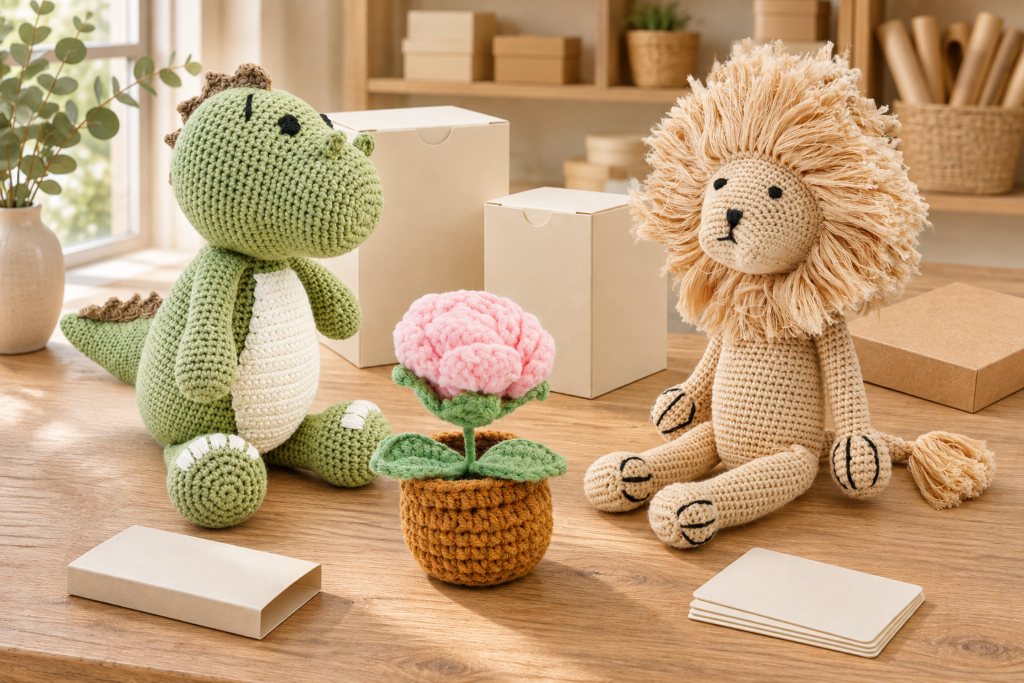
Buyers may be able to customize labels, gift cards, sleeves and selected packaging around an existing crochet product without changing its underlying construction. Changes to yarn, dimensions, facial features, clothing or attachments require a separate review because they can affect the product itself, even when the requested difference appears small.
The practical starting point is to identify exactly what stays unchanged, what will be added or replaced, and what evidence is needed before approving the finished sale configuration.
What Does Semi-Custom Mean for Crochet Products?
For a crochet sourcing project, Semi-custom means retaining an existing product design while making a defined set of agreed modifications.
It is a project scope, rather than a universal package of available services. One project might retain the product and its individual bag while adding a buyer-approved gift card. Another might require a new retail box, a different label and a revised packing arrangement.
Those two projects have different material, assembly and approval requirements.
This guide is for brands, gift companies, retailers and distributors that have identified an existing crochet style and want to adapt its presentation before ordering. Buyers still deciding between existing designs and full development can first review Ready-Stock vs Custom Crochet: Which Sourcing Model Fits a Test Launch?.
Which Changes Can Preserve the Existing Product?
Start by separating changes around the product from changes to its materials or construction.
| Requested change | Can the existing product remain unchanged? | What needs review? |
|---|---|---|
| Printed gift or story card | Often, if supplied separately | Artwork, dimensions, placement and packing method |
| Packaging sleeve | Potentially | Fit around the actual package, product visibility and assembly |
| Branded retail box | Potentially | Internal space, support, presentation and packing method |
| Hangtag | Potentially | Attachment location, application method and appearance |
| Sewn brand label | Requires construction review | Seam access, position, appearance and production stage |
| Different yarn color | Requires material and sample review | Yarn availability, color reference and finished appearance |
| Different yarn type | Requires product revalidation | Texture, dimensions, shape and construction |
| Revised face, clothing or accessories | Requires design review | Recognition, placement, assembly and specifications |
| Smaller or larger version | Requires separate development | Proportions, pattern, materials and construction |
These are assessment categories. They do not confirm that every change is available for every style or stock batch.
For example, adding a separate gift card may leave a finished crochet animal untouched. Adding a sewn label may require access to a seam that is already closed. The commercial request sounds similar—“add our branding”—but the manufacturing work is different.
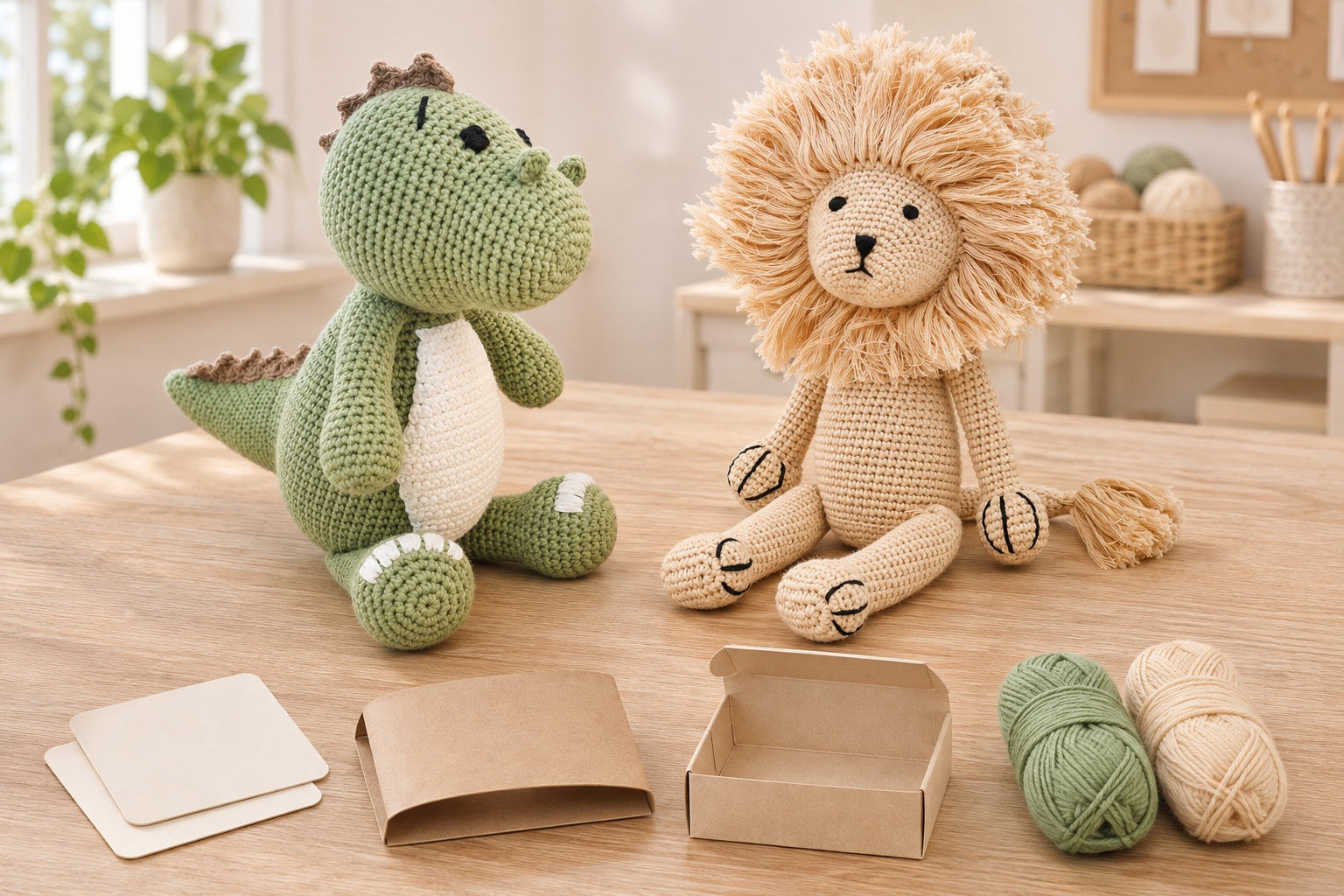
What Should Buyers Confirm About the Base Product?
A Semi-custom brief needs an identifiable starting point.
Before reviewing branding, confirm:
- The selected style and variant.
- The physical sample or reference images used for selection.
- The material and construction information available.
- The proposed quantity by style and color.
- Whether the order uses finished stock or a new production run.
- The existing individual packaging.
- Which components are included in the sale unit.
An existing design and available finished stock are different things. A manufacturer may retain a design for future production without having the requested quantity ready to pack.
Likewise, choosing an existing design does not automatically reserve stock, yarn or packaging. Ask the supplier to state what has been checked and when availability needs reconfirmation.
How Should Buyers Define Branding Changes?
“Add our logo” leaves too many practical decisions unresolved. Define the branding carrier, its location and how it will be applied.
Separate Cards and Inserts
Specify the card dimensions, approved artwork, print finish, language and intended position.
Check whether the card sits inside the package, remains visible from the front, or is handed to the recipient separately. A loose insert may move during handling or cover a feature the buyer wants customers to see.
Hangtags
Confirm the attachment point before approving the artwork.
Review whether the tag covers the face, changes the hanging position, catches on the yarn surface or becomes difficult to remove. Do not assume an existing loop is suitable for every tag or attachment method.
Sewn Labels
A sewn label needs a construction decision as well as an artwork decision.
Agree on its dimensions, material, fold, position and application stage. If the product is already finished, ask whether application can be completed consistently without changing its appearance.
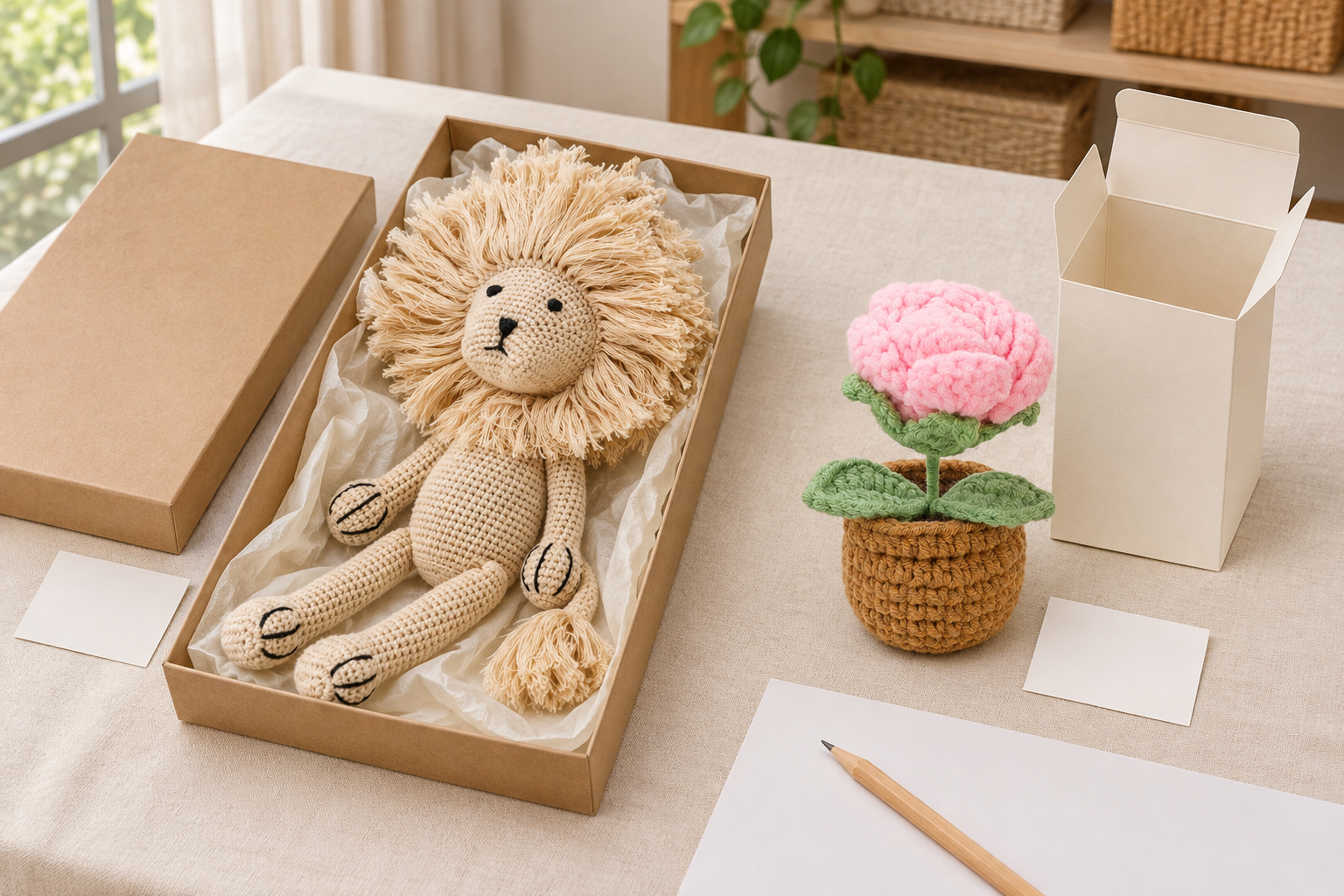
Packaging Sleeves and Boxes
Approve packaging around the actual product and its intended contents. Check clearance, support, closure and removal.
For a broader packaging brief, see Private Label Packaging for Crochet Products: What Retail Buyers Should Plan Before Production.

When Does a Small Request Become Product Development?
The size of the visible change does not reliably indicate the amount of development work.
A new yarn may alter the finished dimensions. A revised embroidered expression may need placement trials. A new outfit may change the silhouette or require a different assembly sequence.
Use three questions to assess a request:
- Does it change a material, pattern, component or construction method?
- Could it affect appearance, dimensions, use or packaging fit?
- Does the existing approved reference still describe the proposed product accurately?
If a change affects the product specification, identify the necessary sample work before treating it as a routine branding adjustment.
For material changes specifically, review What Should Brands Recheck When Changing Yarn in a Crochet Product?.
What Should a Semi-Custom Approval Include?
Approve the complete sale configuration, with its limitations clearly stated.
A useful approval record identifies:
- The base product reference and version.
- The features that must remain unchanged.
- Each approved addition or replacement.
- Artwork and packaging versions.
- Attachment and packing instructions.
- The contents of one sale unit.
- Outstanding decisions and the person responsible for each.
- The sample or evidence used for approval.
Similarly, an unbranded product sample does not demonstrate how the final label, tag and box work together. Where physical review is needed, request a representative assembled configuration and record any differences from the intended production materials.
How Should Buyers Compare Cost and Timing?
Ask for a breakdown that separates the existing product from the requested modifications.
Relevant items may include artwork preparation, printed materials, packaging development, application work, assembly, sampling and packing. Confirm which items are included and which depend on a later decision.
Timing also depends on the slowest unresolved requirement. Available finished products may still need printed packaging, an assembled sample or buyer approval before packing can begin.
Request an estimated schedule based on the agreed scope and stated assumptions. Reconfirm it if the quantity, artwork, materials or configuration changes.
How Can Buyers Start a Semi-Custom Review With UMY Crochet?
For an existing-style project, a useful review sequence is:
- Identify the selected product and proposed order quantities.
- Define the branding and packaging requests.
- Separate presentation changes from product changes.
- Confirm feasibility, sample needs and quotation scope.
- Review the assembled sale configuration.
- Record the approved references before execution.
This gives the buyer and development team a clear basis for discussing what can be retained, what needs adjustment and what requires further validation.
Frequently Asked Questions
Can we add our brand to an existing crochet design?
Potentially. Confirm the branding format, application location, selected product and order scope. Separate cards, hangtags, sewn labels and printed packaging require different reviews.
Is changing the yarn color always Semi-custom?
No. A color change requires material availability and sample review. The scope depends on the yarn, production arrangement and effect on the finished product.
Can finished stock receive a sewn label?
That depends on the construction, seam access and proposed application method. Request a physical review before assuming that a label can be added consistently.
Can we keep the product and replace only the packaging?
Potentially, but the replacement packaging still needs to fit the product and its contents. Confirm protection, presentation, closure and packing work.
Does Semi-custom always have a lower MOQ?
No universal MOQ follows from the term. Product availability, printed-material minimums, packaging quantities and application work all influence the order requirements.
Do we need a sample if the product design stays unchanged?
A representative assembled sample may be needed to assess new branding, packaging fit and the complete sale configuration. Agree on what each approval covers.
Request a Semi-Custom Scope Review
Send UMY Crochet the existing product reference, quantities by variant, destination market, intended selling channel, branding artwork and packaging requirements.
Identify which product features must remain unchanged and which modifications you want assessed. Request a scope review covering feasibility, required samples, quotation inclusions and the proposed approval sequence.
<!--[googlesitekit-end-of-content]-->
 Chinese