
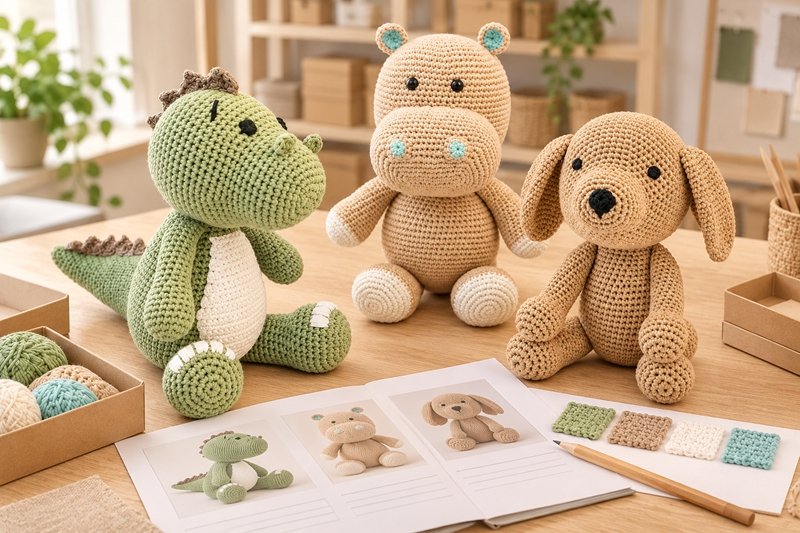
Handle a design change during crochet bulk production by identifying the affected work, assessing the practical options and obtaining written authorization before implementing the revision. Record which units will follow the original specification and which will follow the new one. Update the relevant samples, instructions and packing references before releasing affected production.
This guide is for brands, gift companies and purchasing teams managing an order that has already entered production. It focuses on buyer-requested design changes. Work that fails to meet an existing approved specification requires a separate nonconformity review.
Separate a Design Change From a Production Correction
Establish what has changed before discussing a solution.
A design change introduces a new requirement. A correction addresses work that does not meet the existing requirement.
For example:
- Changing an approved scarf color is a design change.
- Using a scarf color different from the approved specification requires a correction review.
- Moving an approved embroidered feature is a design change.
- An embroidered feature outside its agreed position requires a correction review.
The physical work may look similar, but the decision context is different.
Record the approved requirement, the observed condition and the requested result. Where the cause is disputed, keep that uncertainty visible while assessing the affected work.
Submit One Clear Change Request
Consolidate the request before asking the production team to implement it.
Include:
- Order and SKU references.
- Current approved version.
- Exact proposed change.
- Marked photographs or drawings.
- Reason for the request.
- Intended scope.
- Required delivery date.
- Person authorized to approve the decision.
Specify whether the request applies to the entire order, unfinished units, a particular allocation or future orders only.
Avoid instructions such as “make it slightly smaller” without an agreed reference. Clarify what must change and what must remain unchanged.
Establish the Production Position
The available options depend on what has already been made.
Ask for a dated production snapshot using consistent stages. Distinguish quantities that are confirmed from those still being checked.
| Production stage | Questions to resolve |
|---|---|
| Materials purchased or prepared | Can they support the revision, and what is already committed? |
| Crochet components in progress | Which components are affected, and how much work is complete? |
| Components completed | Can they be used unchanged, modified or reassigned with approval? |
| Assembly underway | What access remains for the proposed change? |
| Finished products awaiting inspection | Can the change be made without creating further issues? |
| Products packed | What unpacking, revision and repacking would be required? |
| Goods dispatched | What separate destination-side decisions are needed? |
Use quantities that can be reconciled. A component count is not necessarily a finished-unit count, and the same work should not appear in several stages.
Identify materials or work held outside the immediate packing area where relevant to the order.
Agree the Scope of Any Temporary Hold
Some requests require affected work to pause while the decision is reviewed.
Identify the specific SKU, component or operation to hold. Confirm who communicates the instruction and who acknowledges it.
The hold record should state:
- What work is affected.
- What activity must pause.
- Whether unaffected work may continue.
- How affected materials and units will be identified.
- Who can authorize release.
Avoid assuming that a message has stopped work everywhere it needs to. Obtain confirmation from the responsible production coordinator.
A clearly bounded hold also helps prevent unaffected production from being delayed unnecessarily.
Assess More Than the Visible Design Detail
A small visual revision can affect other parts of the product.
Review the proposed change against materials, construction, assembly, appearance, packaging and any existing evaluation requirements.
Examples include:
- A larger accessory changing the product’s packing space.
- A yarn change affecting dimensions and appearance.
- A moved feature requiring access to a closed component.
- A revised garment opening affecting dressing.
- A new component changing the assembly sequence.
Identify what must be reviewed again before accepting the revised product.
For material substitutions specifically, see What Should Brands Recheck When Changing Yarn in a Crochet Product?.
Compare Practical Options
Request clearly defined alternatives rather than assuming that every unit can be changed in the same way.
| Option | When to consider it | What to confirm |
|---|---|---|
| Apply the revision to future orders | Current production cannot reasonably change | Current order acceptance and future specification |
| Apply it to unfinished work only | The buyer can accept distinct versions | Quantities, identification and allocation |
| Rework affected units | A suitable method can be demonstrated | Sample result, scope, time and additional checks |
| Remake affected components or units | Modification cannot achieve the required result | Material availability, disposition and revised schedule |
| Use a combined approach | Production is at several stages | A clear decision for each identified group |
Assess feasibility before selecting an option.
Do not describe rework as successful until the proposed method has been reviewed on representative affected work.
Validate a Rework Method Before Applying It Widely
Where rework is proposed, use a representative affected unit to assess the actual method.
Review:
- Access to the area being changed.
- Removal or alteration of existing work.
- Appearance after modification.
- Effect on surrounding components.
- Finishing and any concealed details.
- Additional evaluation needs.
- Practical production handling.
Record whether the reviewed sample was reworked or newly made. The distinction matters when authorizing the remaining units.
If the method does not produce an acceptable result, reconsider the available options.
Confirm Cost and Schedule Effects
Request an impact assessment tied to the identified scope.
Potential items include additional materials, labor, sampling, inspection, unpacking, repacking and revised delivery arrangements.
Ask the team to distinguish:
- Confirmed impacts.
- Estimates.
- Dependencies.
- Unresolved questions.
- The conditions under which the assessment remains valid.
Confirm the schedule after considering material availability, sample review and any further assessment required. Avoid treating an initial discussion as a confirmed delivery commitment.
Where an event or launch date cannot move, use the revised information to decide which option remains commercially workable.
Authorize the Selected Plan in Writing
The final decision should tell the production team exactly what to do.
Record:
- Approved revised design and version.
- Affected SKUs and quantities.
- Work to remain unchanged.
- Selected treatment for each production stage.
- Reviewed sample or rework reference.
- Agreed cost and schedule implications.
- Required checks.
- Responsibility for implementation.
- Release authority.
- Any conditions still open.
Ensure that the person approving the plan has the appropriate project authority.
A general approval such as “please proceed” is difficult to apply when several options remain in the conversation.
Keep Original and Revised Versions Identifiable
If both versions remain in the order, agree how they will be managed.
Define whether they may share a SKU or require separate identification within the buyer’s system. Confirm the corresponding product images, packing references and destination allocations.
Physical segregation may be needed while the work is being completed.
Check that revised parts cannot be unintentionally combined with original parts where the combination is outside the approved plan.
Do not leave the packing team to infer which version belongs in each shipment.
Update Production and Packing References
Replace outdated working instructions at the points where they are used.
Depending on the change, update:
- Approved sample references.
- Material and component lists.
- Construction instructions.
- Appearance and measurement requirements.
- Inspection references.
- Retail packaging.
- Product photographs.
- Carton or destination allocations.
Retain the superseded version for traceability while making the current instruction clear.
For sample control, see How to Manage an Approved Crochet Sample Before Bulk Production.
Reconcile Quantities Before Closing the Change
At completion, account for the affected materials and units.
Record the quantities:
- Accepted under the original specification.
- Completed under the revised specification.
- Reworked and accepted.
- Awaiting further action.
- Assigned another authorized disposition.
Confirm that the totals relate to the same scope and do not double-count units.
Close the change only when the selected plan has been implemented and the required records and release decisions are complete.
Discussing a Production Change With UMY Crochet
For a change request during an active project, provide the approved reference, proposed revision and required scope.
Ask for a project-specific review of the production position, affected materials, sample requirements and practical alternatives. Confirm feasibility and commercial implications before authorizing implementation.
The available solution depends on the product and the actual stage of work.
Frequently Asked Questions
Can a crochet design be changed after production starts?
Possibly. Feasibility depends on the affected details, available materials and production stage. Review the scope before committing to a method.
Is a newly made sample enough to approve rework?
Not necessarily. It demonstrates the revised design, but a representative reworked unit is needed to assess the proposed modification method.
Should all production stop during a change review?
Define the affected work and dependencies. Agree which operations must pause and whether unaffected work can continue.
Can original and revised versions ship together?
Only under an explicit plan accepted by the buyer, with suitable identification and allocation. Do not mix versions by assumption.
Does a small design change always have a small schedule impact?
No. A visually small change may affect materials, access, assembly, packaging or further evaluation. Assess the actual work involved.
What evidence is needed to close a change request?
Retain the authorized plan, relevant sample references, implementation checks, quantity reconciliation and final release decision.
Request a Production Change Assessment
Send UMY Crochet the current approved product reference, marked revision request, affected SKUs and required delivery date.
Request an assessment of production-stage impacts, sample or rework validation, practical options and the approvals needed before implementation.
<!--[googlesitekit-end-of-content]-->
 Chinese