
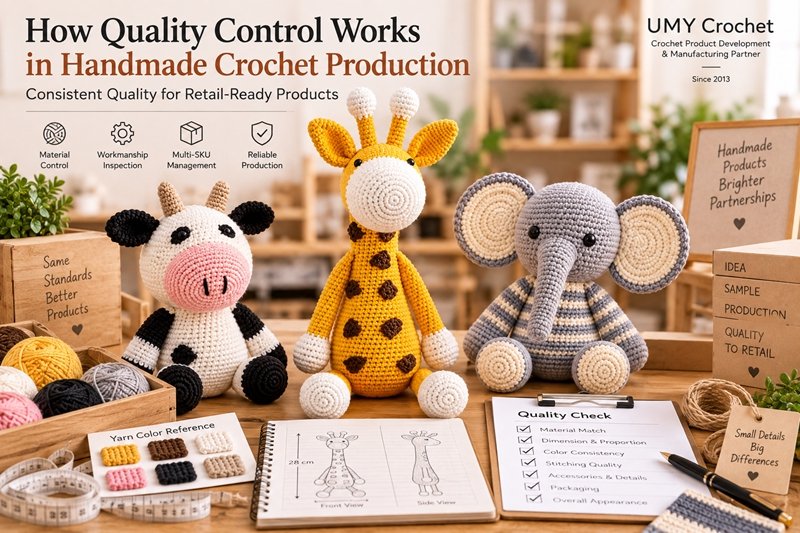
Quality control in handmade crochet production is not about making every stitch look mechanically identical. It is about defining which product characteristics must remain consistent, establishing an approved reference, controlling materials and workmanship during production, and identifying unacceptable variation before products reach retail packaging.
For B2B buyers, an effective crochet quality-control system should normally cover four areas:
- Product specification — dimensions, proportions, colors, construction, facial details, accessories, and other critical features.
- Material control — approved yarns, filling, components, labels, and packaging materials.
- Workmanship control — stitch quality, shaping, stuffing, assembly, finishing, and appearance.
- Inspection and corrective action — checking products during production and before packing, separating nonconforming pieces, and correcting recurring problems.
The central challenge is balancing two realities: crochet is made by hand, so some natural variation is unavoidable; commercial buyers still need products that look and perform consistently enough to represent the same approved design.
A good QC system therefore does not simply ask whether two handmade pieces are identical. It asks whether every piece remains within the agreed product standard.
Why Handmade Crochet Needs a Different Quality-Control Approach
Crochet production depends heavily on human workmanship.
Even when artisans use the same yarn and instructions, small differences can occur in:
- Stitch tension
- Shaping
- Stuffing density
- Assembly
- Facial-detail placement
- Final dimensions
This is fundamentally different from expecting a machine to repeat the same programmed operation.
However, buyers should not interpret this as meaning that anything is acceptable because a product is handmade.
A commercial crochet program still needs recognizable standards.
For example, a brand mascot cannot gradually develop a different expression from piece to piece. A retailer cannot receive one SKU in noticeably different sizes without prior agreement. A gift set cannot contain inconsistent accessories simply because the main product was handmade.
The purpose of QC is therefore to determine:
Where is natural handmade variation acceptable, and where would variation damage product identity, function, safety, packaging, or retail presentation?
That distinction should be made before large-scale production rather than after the goods are finished.
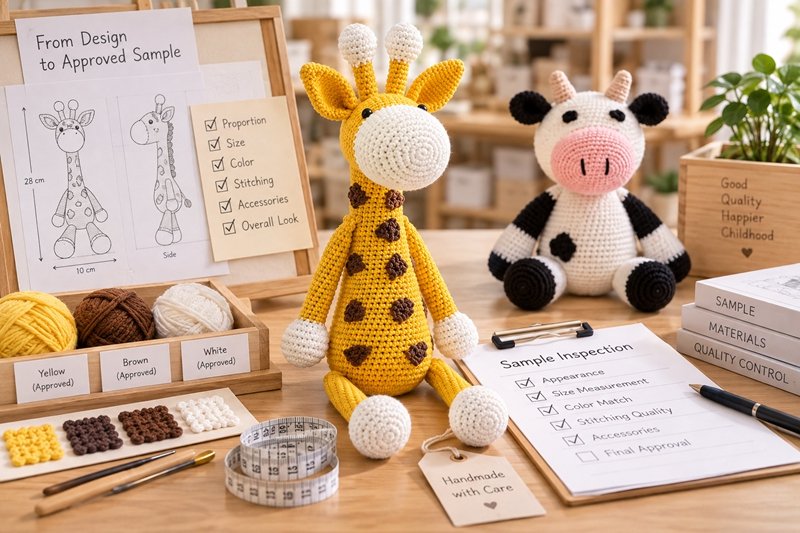
1. Quality Control Starts With the Approved Sample
One of the most important QC tools in custom crochet manufacturing is the approved sample.
A buyer may begin with an illustration or product idea, but artwork alone does not necessarily describe how a three-dimensional crochet product should look.
During sampling, decisions may be made about:
- Head-to-body proportion
- Finished dimensions
- Yarn colors
- Yarn thickness
- Stitch construction
- Stuffing level
- Facial expression
- Hair or mane
- Clothing
- Accessories
- Embroidery
- Decorative components
- Packaging presentation
After revisions, the approved sample becomes an important physical reference for production.
This is why sample approval should be treated as more than a simple email saying, "Looks good."
The buyer and manufacturer should understand exactly which version has been approved.
The Version-Control Problem
Imagine that Sample A has the correct body shape but the wrong scarf color.
Sample B corrects the scarf but changes the eye position.
Sample C finally receives approval.
If production instructions still contain information from Samples A or B, inconsistencies can appear even though the final sample itself was correct.
Good quality control therefore begins with:
Approved design → Approved sample → Current specification → Production reference
All four should point toward the same product.
2. Buyers Should Define Critical Product Characteristics
Not every dimension or stitch needs the same level of control.
A more practical approach is to identify the characteristics that most strongly affect the product.
For a crochet character, these may include:
- Overall height
- Head proportion
- Eye position
- Facial embroidery
- Ear shape
- Hair or mane
- Signature clothing
- Brand-specific colors
- Character-defining accessories
For a crochet flower, the important characteristics may be different:
- Flower diameter
- Petal arrangement
- Stem length
- Color combination
- Bouquet composition
For a retail gift set, quality may also depend on:
- Correct SKU
- Correct accessory
- Correct story card
- Correct label
- Correct box configuration
A buyer does not necessarily need to create dozens of unnecessary measurements.
Instead, the QC specification should focus first on characteristics that influence:
Recognition + Function + Commercial Presentation + Project Requirements
3. How Should Buyers Think About Handmade Tolerances?
One of the most difficult questions in handmade production is:
How much variation is acceptable?
There is no single universal tolerance that applies to every crochet product.
A small keychain, a large decorative doll, a baby-oriented item, and a complicated mascot may require different controls.
The tolerance should therefore be agreed according to the actual product.
Natural Handmade Variation
Examples may include small differences in:
- Individual stitch tension
- Minor shaping
- Slight positioning differences
- Surface appearance
provided those differences do not materially change the approved product.
Potentially Unacceptable Variation
Depending on the specification, problems may include:
- Incorrect yarn color
- Missing components
- Clearly distorted proportions
- Incorrect character features
- Loose assembly
- Incorrect accessories
- Significant size deviation
- Poor finishing
- Incorrect packaging
The key principle is:
Handmade variation should be defined, not assumed.
If the buyer expects a particularly sensitive dimension, appearance, or placement to remain within a certain range, that expectation should be discussed during development.
4. Material Control Comes Before Workmanship Inspection
A beautifully crocheted product can still be wrong if it is made with the wrong material.
Quality control should therefore begin before an artisan starts crocheting.
Depending on the product, material verification may include:
- Yarn type
- Yarn composition
- Yarn thickness
- Yarn color
- Filling
- Embroidery thread
- Fabric components
- Buttons or eyes where applicable
- Labels
- Decorative accessories
- Packaging materials
This is particularly important for products that will be reordered.
A substitute yarn may appear similar at first but could change:
- Color
- Hand feel
- Stitch appearance
- Product dimensions
- Finished weight
- Overall visual consistency
If an approved material is unavailable, the buyer should understand how substitutions are handled.
For custom projects, material changes should normally be evaluated and approved rather than silently introduced into production.
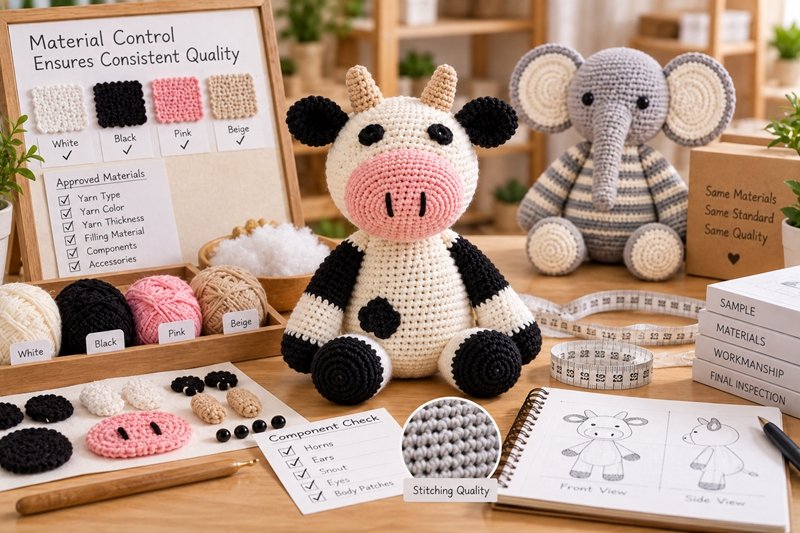
5. Color Control Is Especially Important for Brand Products
Color may be a decorative choice for a generic product.
For a branded character, it can be part of the identity.
Imagine a mascot with:
- A specific blue hat
- A distinctive red scarf
- A particular skin tone
- A signature uniform
For collection development, color control also helps several SKUs look intentional when displayed together.
Buyers should therefore ask:
- How is the approved yarn color recorded?
- How are similar colors distinguished?
- What happens if the original yarn is unavailable?
- How are replacement materials approved?
- How will the same color be managed for a repeat order?
The appropriate method depends on the project and supplier, but the commercial objective is consistent:
Everyone should know which material and color the buyer actually approved.
6. Workmanship Inspection Should Focus on Product-Specific Risks
Consider a crochet animal with long ears.
The ears may become a critical visual feature.
For another character, the most important issue may be:
- Hair placement
- Embroidered expression
- Hat position
- Clothing
- Tail shape
- Decorative accessory
The QC team should know what makes the design recognizable.
Common Workmanship Areas to Review
Depending on the design, inspection can include:
| QC Area | What May Be Checked |
|---|---|
| Stitching | Visible workmanship, unwanted gaps, consistency |
| Shape | Overall silhouette and major proportions |
| Stuffing | Shape, firmness, distribution |
| Assembly | Position and attachment of components |
| Facial details | Placement and recognizable expression |
| Clothing | Correct style, color, position, finishing |
| Accessories | Correct component and attachment |
| Finishing | Loose yarn ends, unwanted marks, visible defects |
| Dimensions | Key measurements defined for the product |
The inspection criteria should reflect the actual product rather than applying an identical checklist to every SKU.
7. Quality Should Be Checked During Production, Not Only at the End
Final inspection is important.
But waiting until every product has been completed can make recurring problems much more expensive to correct.
A more useful production-control structure is:
Material Verification → Early Production Check → In-Process Inspection → Finishing Check → Final Inspection → Packaging Check
The exact stages can vary depending on product complexity and order size.
The principle is to identify problems early.
Example
Suppose the approved character has a distinctive hat.
During early production, the QC team notices that the hat is consistently being positioned too high.
If the problem is found after a small number of pieces, the production instruction can be clarified.
If it is discovered only after the entire order is packed, corrective action becomes much more difficult.
This is why quality control should be integrated into production rather than treated as a final gate.
8. What Happens When an Item Fails Inspection?
Finding a defect is only one part of quality management.
The next question is:
What happens to the product and what happens to the process?
A nonconforming product may need to be:
- Identified
- Separated
- Evaluated
- Reworked when appropriate
- Re-inspected
- Rejected if it cannot meet requirements
But if the same problem appears repeatedly, inspecting out defective pieces is not enough.
The supplier should investigate why the issue keeps occurring.
Possible causes might include:
- Unclear production instructions
- Incorrect material
- Misunderstood dimensions
- Difficult construction
- Inconsistent assembly technique
- Outdated sample information
- Insufficient inspection at an earlier stage
The goal of corrective action is therefore not simply to repair one piece.
It is to reduce the chance that the same problem continues through the batch.
9. How Do Factories Control Multiple Artisans?
For handmade crochet, buyers often wonder how multiple people can produce the same design.
The answer should not depend on expecting every artisan to crochet identically.
Instead, production control needs shared references.
These may include:
- Approved samples
- Product specifications
- Yarn references
- Construction instructions
- Critical measurements
- Visual details
- Inspection criteria
When a design is new or complicated, the supplier may also need to clarify difficult construction points before broader production begins.
What Buyers Should Look For
A buyer evaluating a handmade manufacturer should ask:
If several artisans make this product, what common reference are they all following?
That question gets to the heart of scalable handmade production.
10. Multi-SKU Collections Create Additional QC Risks
Quality control becomes more complicated when an order contains multiple related products.
Consider a collection with:
- Four animal characters
- Two sizes per character
- Several colorways
- Matching keychains
- Different hangtags
- Different gift boxes
Each individual product may pass workmanship inspection, but errors can still occur at the collection level.
Examples include:
- Correct product with the wrong hangtag
- Correct character in the wrong box
- Wrong accessory assigned to one SKU
- Similar yarn colors mixed between products
- Incorrect quantity in an assortment
- Old packaging used for a revised SKU
For this reason, multi-SKU quality control should include both:
Product-level inspection and assortment-level verification.
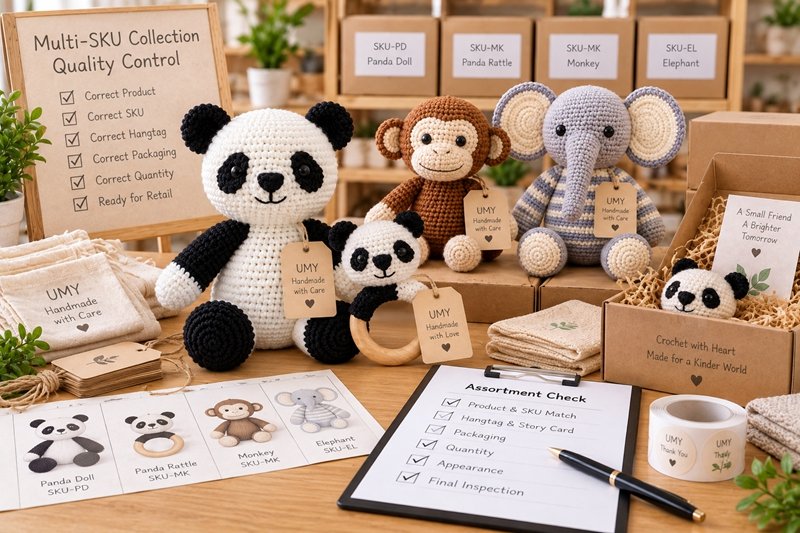
11. Packaging Is Part of Quality Control
For a retail buyer, the finished product is not simply the crochet item.
It may be:
Product + Label + Hangtag + Story Card + Packaging + Assortment
Packaging errors can create commercial problems even when the crochet product itself is correct.
For example:
- A barcode may belong to another SKU.
- A story card may be placed with the wrong character.
- A gift set may be missing one component.
- A product may be packed in the wrong box size.
- A retailer-specific label may be missing.
Packaging QC should therefore confirm the requirements that have actually been agreed for the project.
For brands, museums, gift companies, and corporate buyers, this is particularly important because packaging may carry much of the product's story and brand presentation.
12. Quality Control and Product Safety Are Related but Not Identical
Buyers should distinguish manufacturing QC from regulatory compliance.
Quality control may check whether a product matches its approved specification.
Compliance assessment asks whether the product meets applicable legal or market requirements.
The requirements can depend on factors such as:
- Product category
- Intended use
- Intended age group
- Materials
- Components
- Destination market
Testing or certification should therefore be confirmed for the actual product and target market.
A factory should not assume that a test report for one product automatically applies to every other crochet item.
Likewise, visual QC alone cannot replace required testing.
13. Why Quality Planning Should Begin During Sampling
Buyers sometimes think of quality control as something that happens after production starts.
For custom crochet, many important quality decisions are actually made during sampling.
Sampling determines:
- Whether the shape is practical
- Whether important details can be reproduced
- Whether yarn works with the construction
- Whether accessories are suitable
- Which dimensions matter
- Which visual characteristics define the design
A complicated illustration may contain details that look excellent in two dimensions but become difficult to reproduce consistently in yarn.
Solving those problems during sampling can improve production stability later.
At UMY Crochet, custom sampling typically takes around 7–15 days, depending on the design, materials, accessories, revisions, and current scheduling.
The purpose of sampling is not merely to create a photograph for approval.
It is also an opportunity to convert a creative idea into a product that can realistically move toward controlled production.
14. Quality Control for Repeat Orders Requires Good Reference Management
A repeat order introduces another question:
How do we make the new batch consistent with the product approved previously?
The challenge becomes greater when:
- Significant time has passed
- Yarn supply has changed
- Packaging has been revised
- The product contains many colors
- The collection has expanded
- Different components are now available
Before repeating production, the supplier and buyer may need to reconfirm:
- Current product specification
- Approved reference
- Material availability
- Color references
- Packaging version
- Any changes since the previous order
This does not mean every repeat order requires complete redevelopment.
It means previous approval should remain traceable enough to serve as a useful reference.
A Practical Quality-Control Framework for Crochet Buyers
Buyers can use the following framework when discussing a new custom project.
Before Sampling
Confirm:
- Intended product
- Target dimensions
- Important colors
- Critical visual details
- Intended use
- Packaging direction
- Target market where relevant
During Sampling
Review:
- Overall appearance
- Proportions
- Yarn and colors
- Construction
- Facial or character details
- Accessories
- Key measurements
- Packaging compatibility
Before Production
Confirm:
- Final approved sample
- Current specification
- Approved materials
- Critical QC points
- Packaging version
- SKU identification
During Production
Monitor:
- Materials
- Workmanship
- Critical dimensions
- Assembly
- Recurring defects
- Corrective action
Before Shipment
Verify:
- Finished appearance
- SKU quantities
- Packaging
- Labels and inserts
- Agreed inspection requirements
- Required project documentation
This framework can be adjusted according to the product.
What Quality Control Means at UMY Crochet
UMY has worked in product development and manufacturing since 2013.
For handmade crochet projects, our goal is not to remove every sign that a product was made by hand.
The goal is to establish enough control around the handmade process that brands and buyers can develop commercially workable products.
That means considering quality from the development stage:
Idea → Sample → Approval → Production Reference → Handmade Production → Inspection → Packaging
For custom handmade crochet, the typical MOQ is around 500 pieces per style, while simpler designs may, after evaluation, sometimes start at approximately 300 pieces per style.
Ready-stock products generally have much lower MOQs, often around 10–50 pieces per style, depending on actual stock availability.
These production models create different quality-control needs.
A ready-stock buyer may primarily need to confirm available products and packaging requirements.
A custom buyer needs more detailed control over design interpretation, materials, sample approval, production references, and batch execution.
This is why quality planning should match the sourcing model rather than relying on one generic QC procedure.
Common Quality-Control Mistakes Buyers Should Avoid
Mistake 1: Approving a Sample Without Defining What Matters
A sample can look good overall while leaving important dimensions, colors, or details unclear.
Identify critical characteristics before production.
Mistake 2: Expecting Handmade Products to Behave Like Molded Products
Crochet contains natural manual variation.
The solution is not to demand impossible mathematical uniformity. It is to define acceptable variation around commercially important characteristics.
Mistake 3: Accepting "It's Handmade" as an Explanation for Major Differences
Handmade variation should not justify incorrect colors, missing components, significantly distorted proportions, or other departures from agreed requirements.
Mistake 4: Checking Only the Finished Product
Materials, production instructions, in-process workmanship, and packaging all influence final quality.
Mistake 5: Ignoring Packaging QC
Retail-ready quality includes the correct product presentation, not merely correct crochet workmanship.
Mistake 6: Using One QC Standard for Every SKU
Different designs have different failure points.
A character's expression may be critical in one SKU while stem length may matter more in a flower product.
Frequently Asked Questions
How do manufacturers keep handmade crochet products consistent?
Consistency comes from controlling shared references such as approved samples, specifications, materials, critical dimensions, construction details, and inspection criteria. The goal is to keep commercially important characteristics within agreed standards while recognizing reasonable handmade variation.
Can every handmade crochet product be exactly identical?
Minor differences can occur because crochet involves manual workmanship. Buyers and suppliers should identify which characteristics require tight control and agree on acceptable variation for the specific design rather than assuming either perfect mechanical uniformity or unlimited variation.
When should crochet quality inspection happen?
Quality should be considered from sampling onward. Depending on the project, checks may occur during material preparation, early production, in-process work, finishing, final inspection, and packaging.
What should be included in a crochet QC checklist?
The checklist should reflect the actual product. Common areas include materials, color, dimensions, proportions, stitching, stuffing, assembly, facial details, accessories, finishing, packaging, and SKU identification.
Is an approved sample enough for quality control?
It is an important reference, but it works best together with current specifications, material references, critical measurements, revision control, and agreed inspection criteria.
How should brands handle quality control for several crochet SKUs?
Use clear SKU identification and product-specific references, then verify both individual product quality and assortment accuracy. Packaging, labels, accessories, and quantities should also be matched to the correct SKU.
Does factory QC guarantee regulatory compliance?
No. Manufacturing QC and regulatory compliance are related but separate. Applicable requirements should be confirmed according to the specific product, intended use, age group where relevant, materials, components, and destination market.
Final Buyer Takeaway
Quality control in handmade crochet manufacturing is not a choice between craftsmanship and consistency.
Commercially successful production needs both.
The handmade process gives crochet products their texture, character, and emotional appeal. A structured QC process helps protect the features that buyers, brands, and customers expect to remain consistent.
For buyers, the most useful question is therefore not:
"Will every stitch be identical?"
It is:
"Have we clearly defined the product standard, and does the manufacturer have a practical system for keeping production within that standard?"
That system begins with product development and the approved sample, continues through materials and handmade production, and ends only after the correct product has been inspected and matched with the correct retail packaging.
For brands, retailers, gift companies, cultural institutions, and authorized IP owners developing custom crochet products, UMY can support development from concept and sampling through production and packaging. Sharing your design, expected quantity, target market, critical product details, and packaging requirements at the beginning makes it easier to identify the right quality-control priorities before production starts.

 Chinese