
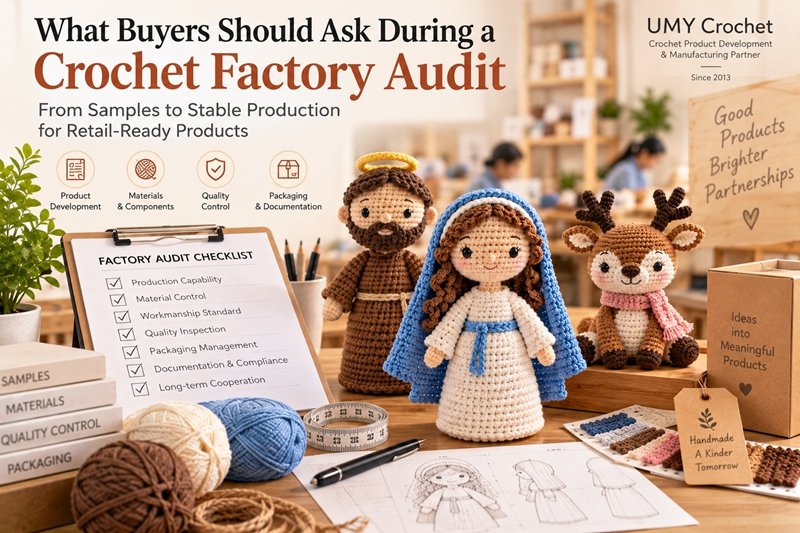
For brands, retailers, gift companies, and sourcing teams, a crochet factory audit should answer a practical question: Can this supplier turn an approved product concept into consistent, controllable, retail-ready production?
For handmade crochet products, buyers should look beyond factory size or a polished sample room. A useful audit should examine how the supplier manages product development, approved samples, yarn and material specifications, artisan instructions, workmanship standards, inspection, packaging, documentation, and corrective actions.
The most important questions include:
- Who controls the product specification after sample approval?
- How are yarn colors, dimensions, facial features, accessories, and stitch details communicated to production?
- How are handmade variations distinguished from unacceptable defects?
- What happens when production does not match the approved sample?
- How are materials, components, packaging, and inspection records managed?
- Can the supplier support the buyer's required testing or compliance process for the intended product and market?
- How will quality be maintained when the order contains multiple SKUs?
A crochet factory audit is therefore not simply a facility inspection. It is a way to understand whether the supplier has a repeatable management system around a handmade production process.
For buyers developing custom products, that distinction is critical.
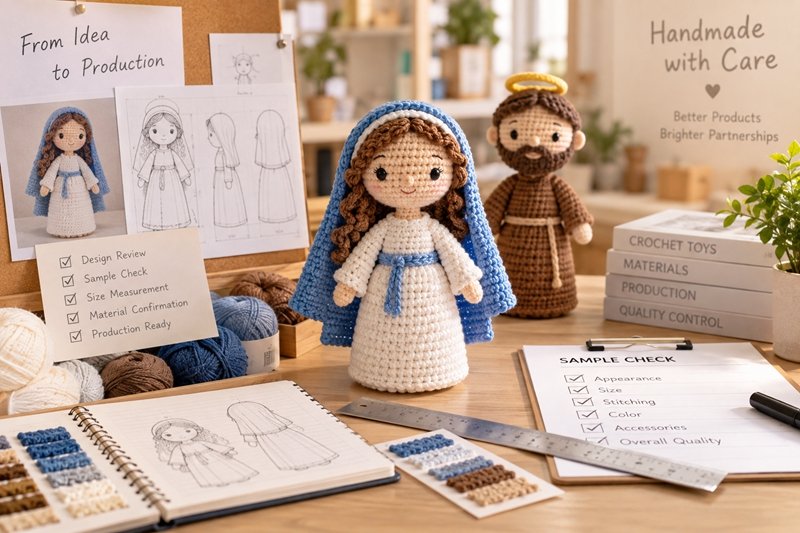
Why Auditing a Crochet Supplier Is Different From Auditing a Highly Automated Factory
Handmade crochet production has a characteristic that buyers need to understand from the beginning:
Human workmanship is part of the manufacturing process.
In a highly automated production line, machinery may control many dimensions and repetitive operations. In handmade crochet, product consistency depends much more heavily on how specifications are translated into practical production instructions and how workmanship is checked.
Two crocheters may naturally differ slightly in:
- Stitch tension
- Shaping
- Stuffing density
- Placement of facial details
- Assembly
- Finishing
That does not mean consistent commercial production is impossible.
It means the supplier needs a system that defines what must remain consistent and what level of handmade variation is acceptable.
For a buyer, the audit should therefore focus on the control system surrounding the craftsmanship, not only on the craftsmanship itself.
1. Who Owns the Product Specification After the Sample Is Approved?
One of the first questions to ask is:
What becomes the production reference after I approve the sample?
This matters because a custom crochet product often develops through several rounds.
A buyer may begin with:
- A character drawing
- Reference photographs
- Pantone or other color references
- Size requirements
- Packaging concepts
- Accessory specifications
The first sample may then require changes to proportions, yarn, embroidery, clothing, stuffing, or packaging.
Once the final sample is approved, the factory should have a clear way to transfer those decisions into production.
Ask what information is retained, such as:
- Approved sample
- Product dimensions
- Yarn specifications
- Color references
- Component details
- Stitch or construction instructions
- Accessory placement
- Embroidery details
- Packaging requirements
- Buyer-approved revisions
The key issue is not whether the supplier has an impressive-looking specification sheet.
The key issue is whether the people responsible for production and inspection are working from the same approved standard.
A Useful Follow-Up Question
Ask:
If I change one detail during sampling, how do you make sure the old version is not accidentally produced?
The answer can reveal how well the supplier manages revisions.
2. How Does the Factory Translate a Sample Into Repeatable Handmade Production?
A beautiful prototype proves that a product can be made once.
It does not automatically prove that it can be made consistently in quantity.
This is one of the most important distinctions in custom crochet sourcing.
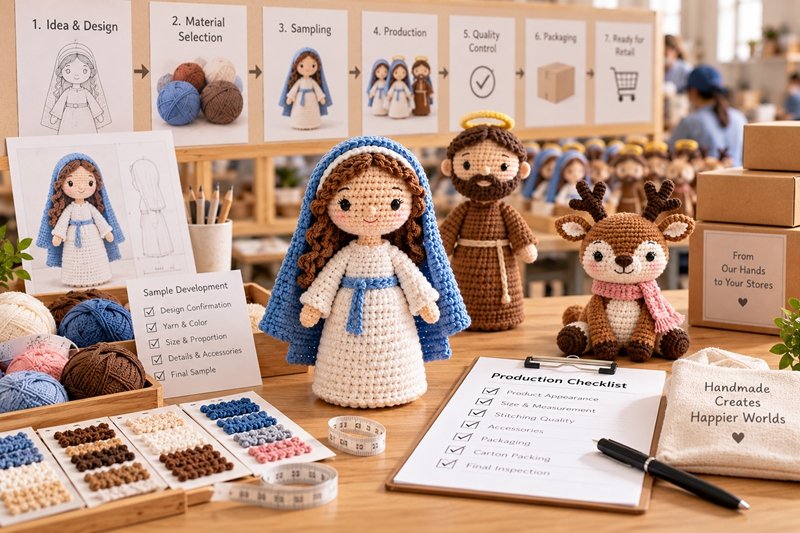
During an audit, buyers should understand how the supplier moves from:
Prototype → Approved Sample → Production Instructions → Production → Inspection
Questions may include:
- Are production instructions created from the approved sample?
- How are difficult construction details explained?
- How are proportions controlled?
- How are new workers or artisans introduced to a product?
- Is there a reference sample available during production?
- Who decides whether an appearance variation is acceptable?
For complicated characters, buyers should pay particular attention to recognizable features.
This is especially important for:
- Brand mascots
- Authorized character merchandise
- Museum and cultural products
- Collectible characters
- Coordinated retail collections
3. How Are Yarn, Colors, and Components Controlled?
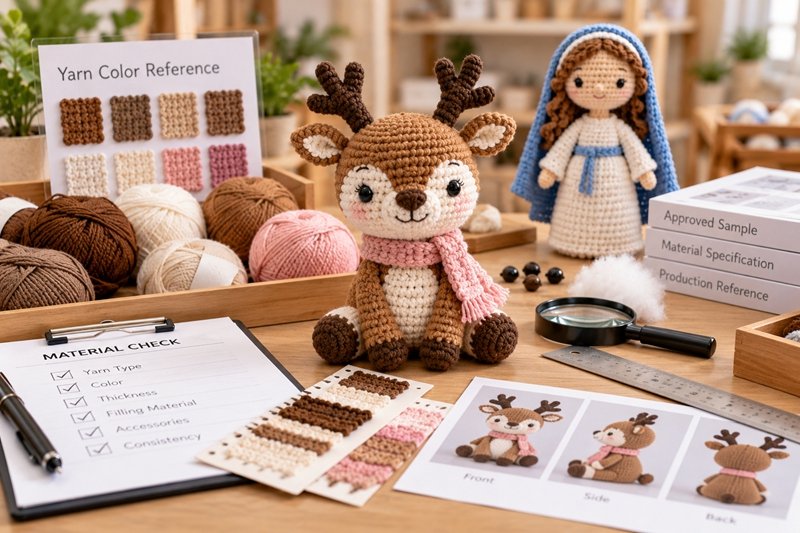
Materials should be a major part of the audit because a crochet product is visually and structurally dependent on yarn.
Ask the supplier how it controls:
- Yarn type
- Yarn composition
- Yarn thickness
- Color
- Filling material
- Embroidery thread
- Buttons or eyes, when applicable
- Decorative components
- Clothing materials
- Labels and packaging components
For a custom project, a buyer should also understand what happens if the originally approved material becomes unavailable.
Does the factory substitute it automatically?
Or does it communicate the issue and request approval before making a material change?
The second approach gives the buyer much greater control over the finished product.
Why Color Control Deserves Special Attention
A character or collection may use several closely related colors.
4. How Does the Factory Define Acceptable Handmade Variation?
This is one of the most valuable questions in a crochet factory audit.
Handmade products should not be evaluated as though every stitch were machine-generated. At the same time, "handmade" should not become an excuse for uncontrolled quality.
The buyer and supplier need a practical distinction between:
Natural handmade variation and a product defect.
For example, slight differences in stitch tension may be inherent to handwork.
However, buyers may reasonably expect tighter control over characteristics such as:
- Overall size
- Character proportions
- Color
- Missing components
- Facial expression
- Accessory position
- Secure assembly
- Visible finishing problems
- Packaging configuration
The appropriate tolerances depend on the product and project.
Instead of asking only, "Can you make every piece exactly the same?", ask:
Which characteristics do you control tightly, what variation should I expect, and how will we agree on the acceptance standard before production?
That question creates a much more useful quality discussion.
5. What Happens Before Full Production Begins?
Buyers should ask whether there is a controlled transition between sample approval and bulk production.
For a new custom design, this stage can identify problems that were not obvious when making a single prototype.
For example:
- A detail may be too time-consuming to reproduce efficiently.
- An accessory may be difficult to position consistently.
- A yarn combination may behave differently during repeated production.
- Packaging dimensions may need adjustment.
- Instructions may need clarification before work is distributed.
The goal is to discover these issues before they become hundreds of finished units.
For a multi-SKU collection, this becomes even more important because each design may have different construction risks.
6. How Is Quality Checked During Handmade Production?
Do not limit the audit to a final inspection table.
Ask where quality control happens throughout the process.
A useful quality-control approach may include checks at different stages, depending on the product:
- Material and component verification
- Workmanship checks during production
- Assembly and finishing checks
- Comparison against approved requirements
- Final product inspection
- Packaging verification
The exact process can vary by factory and product.
What matters is whether defects can be detected before the entire order reaches final packing.
Ask to See the Process, Not Just Hear the Policy
Instead of asking:
Do you have quality control?
Ask:
Show me how an inspector would check this specific crochet product against the approved requirements.
That question is much harder to answer with a generic sales presentation.
7. How Does the Factory Handle Nonconforming Products?
Every manufacturing process can encounter quality problems.
A strong audit should therefore examine how problems are handled rather than expecting a supplier to claim that defects never occur.
Ask:
- How is a rejected item identified?
- Is it separated from acceptable production?
- Who decides whether it can be reworked?
- How is a repeated problem reported?
- How does the team prevent the same issue from continuing?
- What happens if the problem affects many units?
For handmade production, corrective action may involve more than removing defective pieces.
If several artisans are making the same error, the supplier may need to correct the underlying instruction, reference, technique, or inspection point.
That is why defect management can reveal more about a supplier than a perfect showroom sample.
8. Can the Supplier Manage Multiple SKUs Without Losing Control?
Many B2B crochet projects are collections rather than single products.
A retailer might purchase:
- Several animals
- Multiple character versions
- Different sizes
- Seasonal colorways
- Keychains and larger dolls
- Gift-box combinations
A museum might develop several objects or characters from one exhibition theme.
A brand may extend one mascot across multiple products.
Multi-SKU programs create additional control points:
| Control Area | What the Buyer Should Check |
|---|---|
| Product identity | Can different SKUs be clearly distinguished? |
| Yarn | Are colors and materials assigned correctly to each SKU? |
| Components | Are accessories matched to the correct product? |
| Specifications | Is the latest approved version used for each SKU? |
| Inspection | Are quality criteria appropriate for each design? |
| Packaging | Are labels, cards, boxes, and quantities matched correctly? |
| Shipment | Can the assortment be packed according to the buyer's requirements? |
This is particularly important for retail programs because a manufacturing error does not have to affect the crochet itself.
A perfectly made product placed in the wrong package can still become a commercial problem.
9. How Is Packaging Integrated Into Production Control?
Packaging should not be treated as an afterthought.
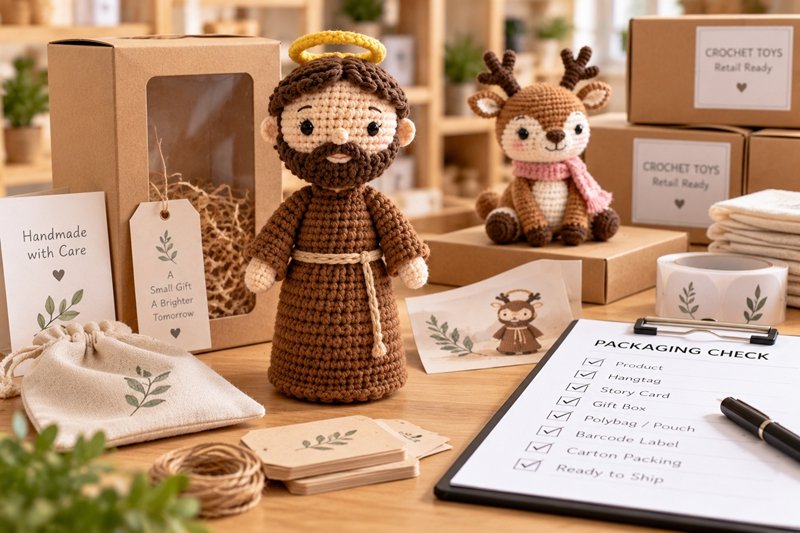
For retail-ready crochet products, packaging may include:
- Hangtags
- Story cards
- Branded labels
- Fabric pouches
- Gift boxes
- Instruction cards
- Barcode or retailer-specified labels
- Assortment or carton requirements
During the audit, buyers should determine who verifies that the correct product is matched with the correct packaging.
For culturally specific products, museum merchandise, character collections, or corporate gifts, the content printed on packaging may also require buyer approval.
The supplier should not be expected to make brand, legal, cultural, or compliance decisions on the buyer's behalf.
Instead, the development process should make approval responsibilities clear.
10. What Documentation Can the Factory Provide for the Project?
Documentation needs depend on the product, buyer, sales market, and applicable requirements.
A factory audit should therefore avoid a simplistic question such as:
Do you have all the certificates?
A more useful question is:
For this product and destination market, what documents can you provide, what testing may need to be arranged, and what information do you need from us?
Depending on the project, buyers may need to discuss:
- Material information
- Product specifications
- Inspection records
- Test reports where applicable
- Label information
- Packaging specifications
- Traceability or production records
- Buyer-specific documentation
11. How Does the Supplier Manage Buyer-Owned Designs and Authorized IP?
If the project involves an original mascot, proprietary artwork, or licensed character, the audit should include design-management questions.
Buyers can ask:
- Who can access our artwork?
- How are development files managed?
- How are approved revisions communicated?
- Can samples or finished products be displayed publicly?
- How is customer-specific information handled?
- What information do you require regarding authorization for licensed characters?
12. Can the Factory Explain Its Sampling and MOQ Logic?
An audit is also an opportunity to test whether the supplier's commercial model matches the buyer's project.
At UMY Crochet, custom handmade crochet projects typically use an MOQ of around 500 pieces per style. Simpler designs that are suitable for production may, after evaluation, sometimes start from approximately 300 pieces per style.
For ready-stock products, typical MOQs are much lower, often around 10–50 pieces per style, subject to actual availability.
Custom machine-made or plush products generally start from approximately 1,000 pieces per style.
These numbers should not be interpreted as universal industry rules. They reflect different production models, and the actual requirement should be confirmed for each project.
Buyers should therefore ask a supplier:
- What drives the MOQ for this design?
- Does complexity affect production feasibility?
- Does the MOQ apply per design, color, or size?
- Can multiple SKUs be combined?
- What changes would make a smaller initial order practical?
- Is the product truly custom, or is it based on an existing design?
A transparent supplier should be able to explain why a particular MOQ applies.
A Practical Crochet Factory Audit Checklist
Before approving a new manufacturing partner, buyers can use the following framework.
Product Development
- Can the team interpret drawings and product requirements?
- Is there a clear sampling and revision process?
- Is the final approved sample connected to production instructions?
- Are revisions controlled?
Materials
- Are yarn and components clearly specified?
- Are approved colors identifiable?
- Are substitutions communicated before use?
- Can materials be matched to the intended project requirements?
Handmade Production
- Are construction instructions clear?
- Is an approved reference available?
- Are critical visual characteristics identified?
- Are acceptable variations defined?
Quality Control
- Are checks performed before final packing?
- Can inspectors explain product-specific defects?
- Are nonconforming products separated and managed?
- Is there a process for correcting repeated problems?
Packaging
- Are packaging specifications controlled?
- Are products and packaging matched by SKU?
- Are buyer-approved labels and inserts verified?
- Can retail assortment requirements be followed?
Documentation and Compliance
- Can the supplier explain which documents relate to the actual product?
- Can project-specific testing be coordinated when required?
- Are compliance claims limited to documentation that can actually be verified?
Commercial Fit
- Does the MOQ match the project's realistic scale?
- Is the sample-development process compatible with the launch schedule?
- Can the supplier manage the number of planned SKUs?
- Can the relationship support future extensions or repeat orders?
Red Flags Buyers Should Notice During a Crochet Factory Audit
A factory does not need to use exactly the same system as another supplier.
However, several situations deserve further investigation.
The Sales Team Cannot Explain How the Approved Sample Reaches Production
If the only answer is "our workers know how to make it," the buyer may need to investigate specification control more deeply.
Material Substitutions Can Happen Without Approval
Uncontrolled substitutions can affect appearance, hand feel, construction, packaging, or product requirements.
"Handmade" Is Used to Explain Every Variation
Natural variation exists, but critical product characteristics still need agreed standards.
Quality Control Exists Only at the End
Late detection can make correction more difficult, particularly for large handmade batches.
Compliance Answers Are Overly General
Statements such as "all our products are certified" should be examined carefully. Applicability depends on the specific product, materials, intended use, target market, and supporting documentation.
The Factory Cannot Explain How Multiple SKUs Are Separated
This becomes a significant risk for collections with similar colors, components, packaging, or characters.
--
Remote Audit vs. On-Site Audit: What Can Buyers Check?
Not every sourcing project begins with an in-person factory visit.
A remote supplier review can still provide useful information if buyers request specific evidence rather than relying entirely on presentations.
For example, a buyer may ask the supplier to walk through:
- Sample-development areas
- Material storage
- Production organization
- Inspection procedures
- Finished-product handling
- Packaging workflow
The buyer can also select one sample product and ask the supplier to explain how its specification, materials, production reference, inspection criteria, and packaging are controlled.
An on-site audit allows deeper observation, but the same principle applies:
Follow one real product through the system.
That often reveals more than a long list of general questions.
Frequently Asked Questions
What should buyers check first when auditing a crochet factory?
Start with the connection between the approved sample and bulk production. Determine how product specifications, yarn colors, dimensions, construction details, accessories, revisions, and packaging requirements are communicated and controlled.
Is a beautiful crochet sample enough to qualify a supplier?
No. A sample demonstrates development capability, but buyers also need to evaluate whether the supplier can reproduce the approved design consistently, manage materials, inspect workmanship, control packaging, and respond to quality problems during production.
How much variation is acceptable in handmade crochet products?
There is no single universal tolerance for all crochet products. Buyers and suppliers should define critical characteristics and acceptable variation according to the specific design, intended use, commercial requirements, and approved sample.
Should buyers audit packaging as well as product quality?
Yes. For retail-ready programs, packaging is part of the finished product. Buyers should check how the factory controls hangtags, labels, story cards, gift boxes, SKU matching, quantities, and other project-specific packing requirements.
Does a factory audit replace product testing or regulatory review?
No. A factory audit evaluates manufacturing and management capabilities. Product testing and regulatory obligations depend on the specific product, intended use, target market, materials, age grading where relevant, and applicable requirements.
Should small brands conduct supplier audits?
The depth of the review can be proportionate to the project, but smaller brands still benefit from evaluating sample control, materials, production consistency, quality procedures, packaging, documentation, and communication before committing to a custom order.
Final Buyer Takeaway
A good crochet factory audit should not end with the question:
"Is this a real factory?"
It should answer a more commercially important question:
"Does this supplier have a workable system for turning our approved idea into consistent, controlled, retail-ready handmade products?"
For crochet manufacturing, buyers should examine the complete chain from product development and material selection to artisan instructions, quality inspection, packaging, and documentation.
The strongest supplier is not necessarily the one with the most impressive sample.
It is the one that can explain how the approved sample becomes a repeatable production standard—and show how that standard is protected throughout the order.
For brands, retailers, gift companies, cultural institutions, and authorized IP owners developing custom crochet products, UMY can support the process from concept and sampling through production and retail packaging. A productive first step is to share the product concept, expected quantity, target market, packaging requirements, and launch schedule so the project can be evaluated before sampling begins.


 Chinese