
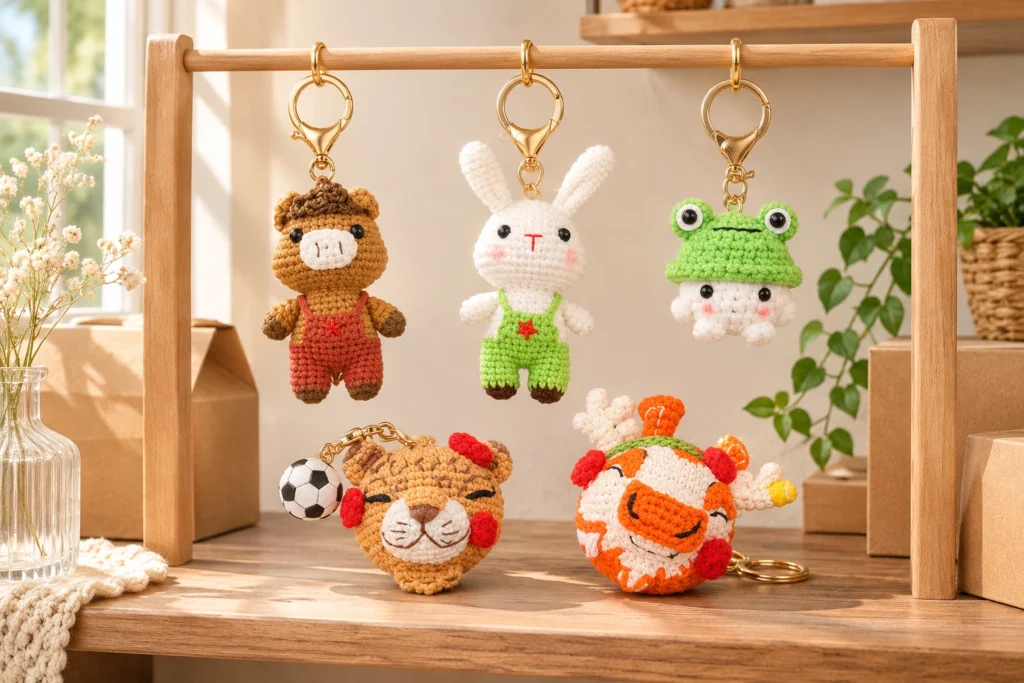
Crochet keychain hardware should be specified by the way the finished product will be used, attached, displayed, and handled—not by the appearance of the metal fitting alone. Before sampling, buyers should define the attachment type, the connection between the fitting and the crochet piece, the intended placement, and the checks that will be used to approve the finished sample.
This guide is for gift brands and retailers developing crochet keychains, bag charms, and small hanging gifts. It focuses on decisions that can be made during product development; the final specification should be validated against the actual design and intended market.
Start With the Customer’s Intended Use
A small crochet character may look similar in product photographs whether it has a split key ring, a swivel clasp, or a hanging loop. Those choices create different experiences once the product is in a customer’s hands.
| Intended use | Attachment question | Sample check |
|---|---|---|
| Keys | Can the customer add and remove keys as intended? | Test the ring with representative keys and inspect the crochet connection after handling. |
| Backpack or handbag | Can the product attach to the intended strap, zipper pull, or handle? | Try the clasp or loop on a representative attachment point. |
| Gift or seasonal hanging decoration | Does the product hang at the intended height and orientation? | Display it in the intended setting and check whether it twists or tilts. |
| Mixed-use gift collection | Can one attachment serve the planned uses without making the product awkward? | Review usability, appearance, and the added hardware cost together. |
These are development checks, not universal performance standards. The buyer and manufacturer should agree on the intended use and appropriate acceptance criteria for the specific product.
Specify the Complete Connection, Not Just the Clasp
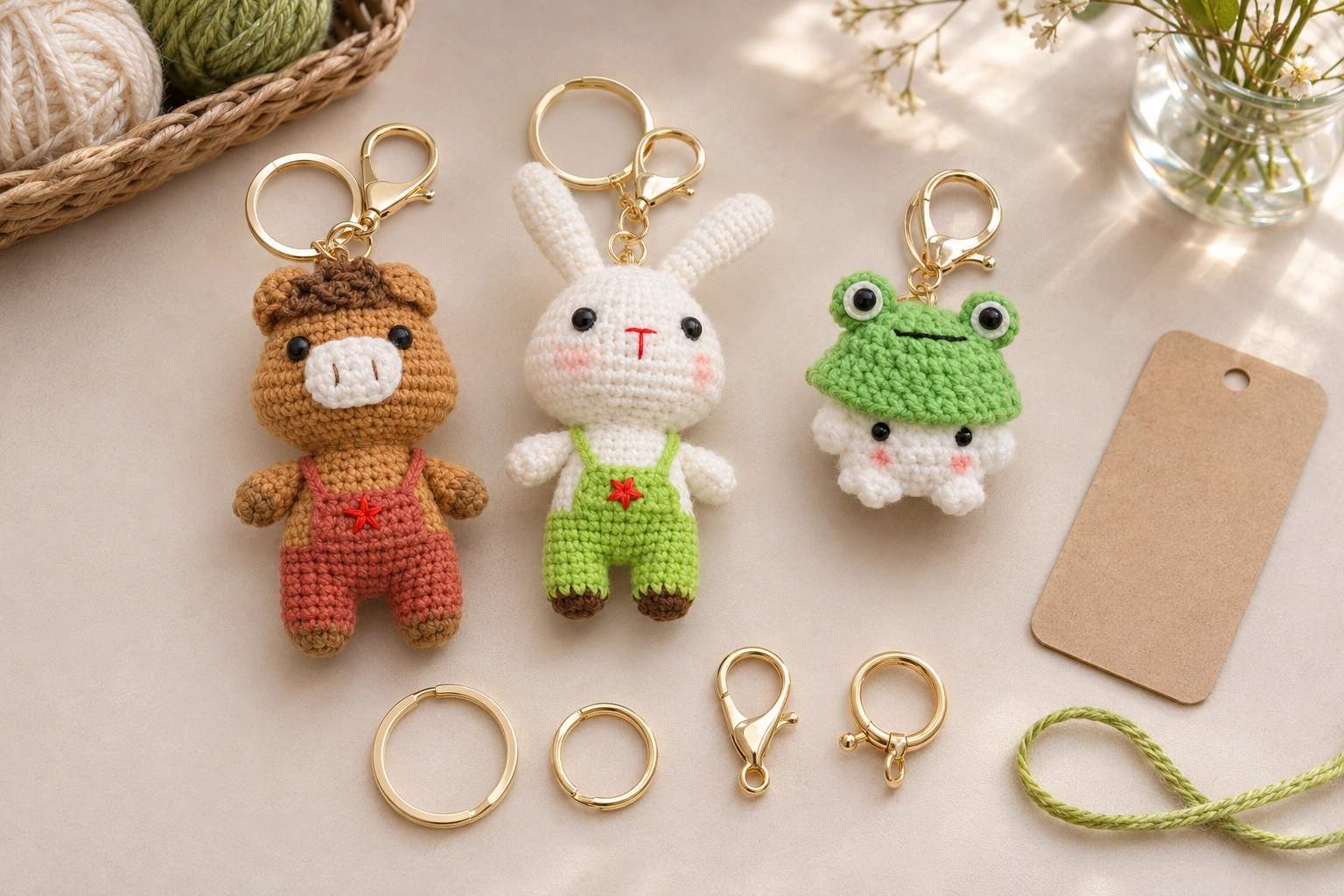
A request such as “add a gold key ring” leaves several important decisions open. The ring may be strong enough for the intended use, while the loop connecting it to the crochet body is poorly positioned or difficult to inspect.
A useful specification identifies:
- The outer fitting: split ring, clasp, clip, or another agreed component.
- The intermediate connection: jump ring, chain, fabric tab, crochet loop, or another approved method.
- The attachment point on the product: exact location and intended hanging direction.
- The visible finish: color, surface appearance, and how it should look alongside the yarn and other accessories.
- The product’s intended use: keys, a bag attachment, a hanging gift, or a defined combination.
- The approval method: photographs, physical sample checks, and any agreed handling or performance assessment.
The most important question is how the complete assembly behaves. A fitting should be reviewed together with the crochet structure to which it is attached.
Position Affects How the Character Looks
The attachment point can change the expression of a small character. A loop placed too far forward or backward may cause the character to lean, turn away, or hang sideways. On a flower or other asymmetrical shape, the correct position may differ from the visual center.
Ask for a hanging view of the sample, as well as a front view on the table. If the collection contains several shapes, review each shape individually instead of assuming that one attachment position will work for every SKU.
Compare Hardware Options Against the Collection Brief
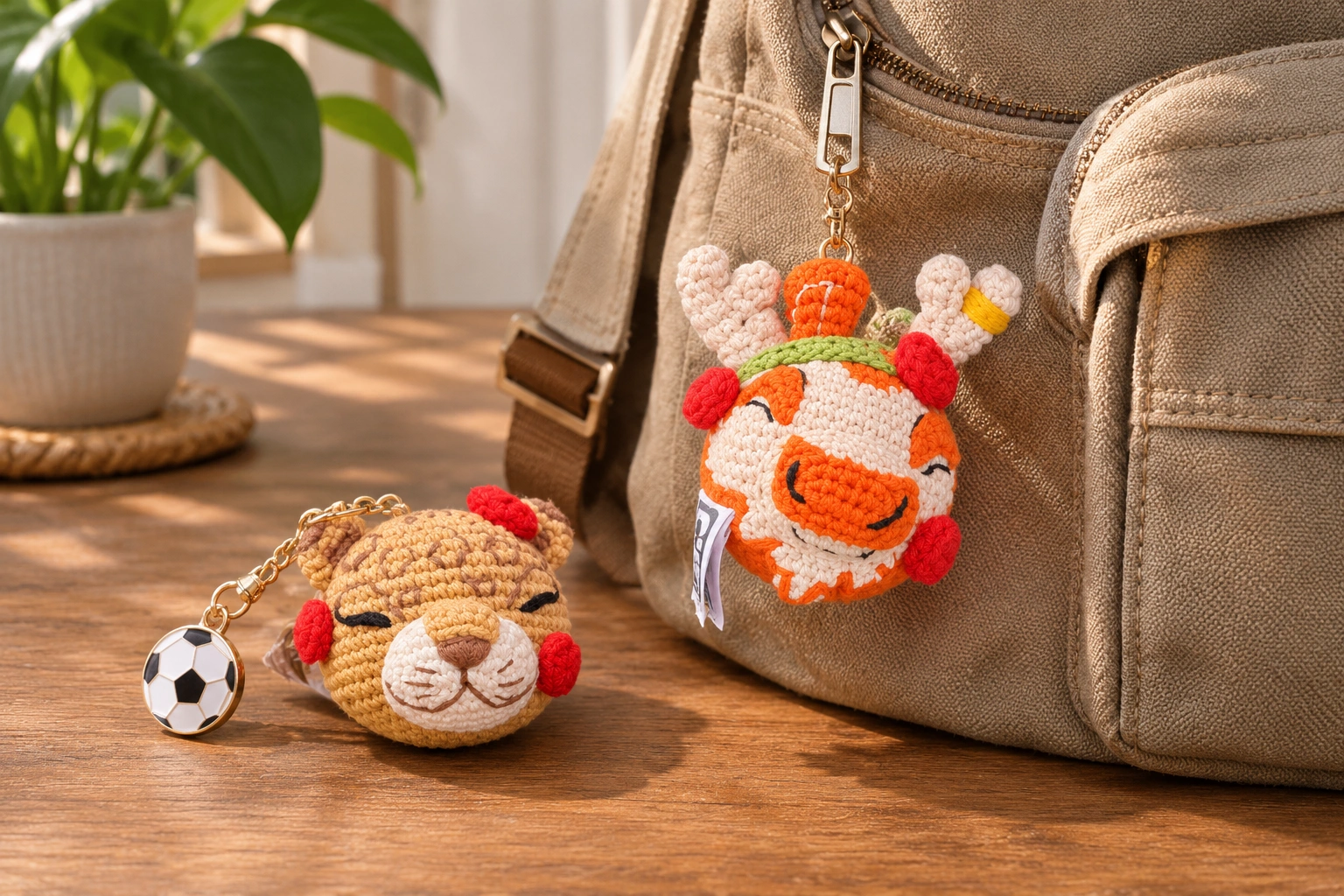
The best fitting depends on the assortment. A gift shop may want a familiar key ring, while a bag charm collection may need a clasp that customers can attach easily. Some buyers may consider a combined fitting, but additional components can affect appearance, packing dimensions, and cost.
During sample review, compare options against the same brief:
- Does the fitting match the product’s intended use?
- Is it comfortable to attach and remove?
- Does it visually overwhelm a small crochet piece?
- Does the product hang in the intended direction?
- Are the connection and attachment point accessible for inspection?
- Does the assembled product fit the planned retail packaging?
- Can the chosen hardware be specified consistently for every SKU that uses it?
Avoid choosing a fitting solely because it appears versatile. A simpler attachment can be a better choice when the product has one clearly defined use.
Build a Sample Approval Sheet for Each SKU
A collection-level instruction such as “all keychains use the same hardware” may be too broad. Individual shapes can differ in weight distribution, loop position, and the space available for a secure connection.
For each SKU, record the approved product image and the following details:
| Approval item | What to record |
|---|---|
| Product identification | SKU name, colorway, and approved sample reference |
| Intended use | Keychain, bag charm, hanging gift, or specified mixed use |
| Hardware | Component type, visible finish, and approved reference |
| Connection | Assembly method and location on the crochet piece |
| Orientation | Required front-facing appearance when suspended |
| Packaging | How the fitting sits inside or on the retail pack |
| Review | Agreed visual, handling, and other applicable checks |
Photograph the front, side, connection close-up, and hanging position of the approved sample. If the attachment changes during development, update the approval sheet rather than relying on an older photograph.
Review Packaging With the Hardware Attached
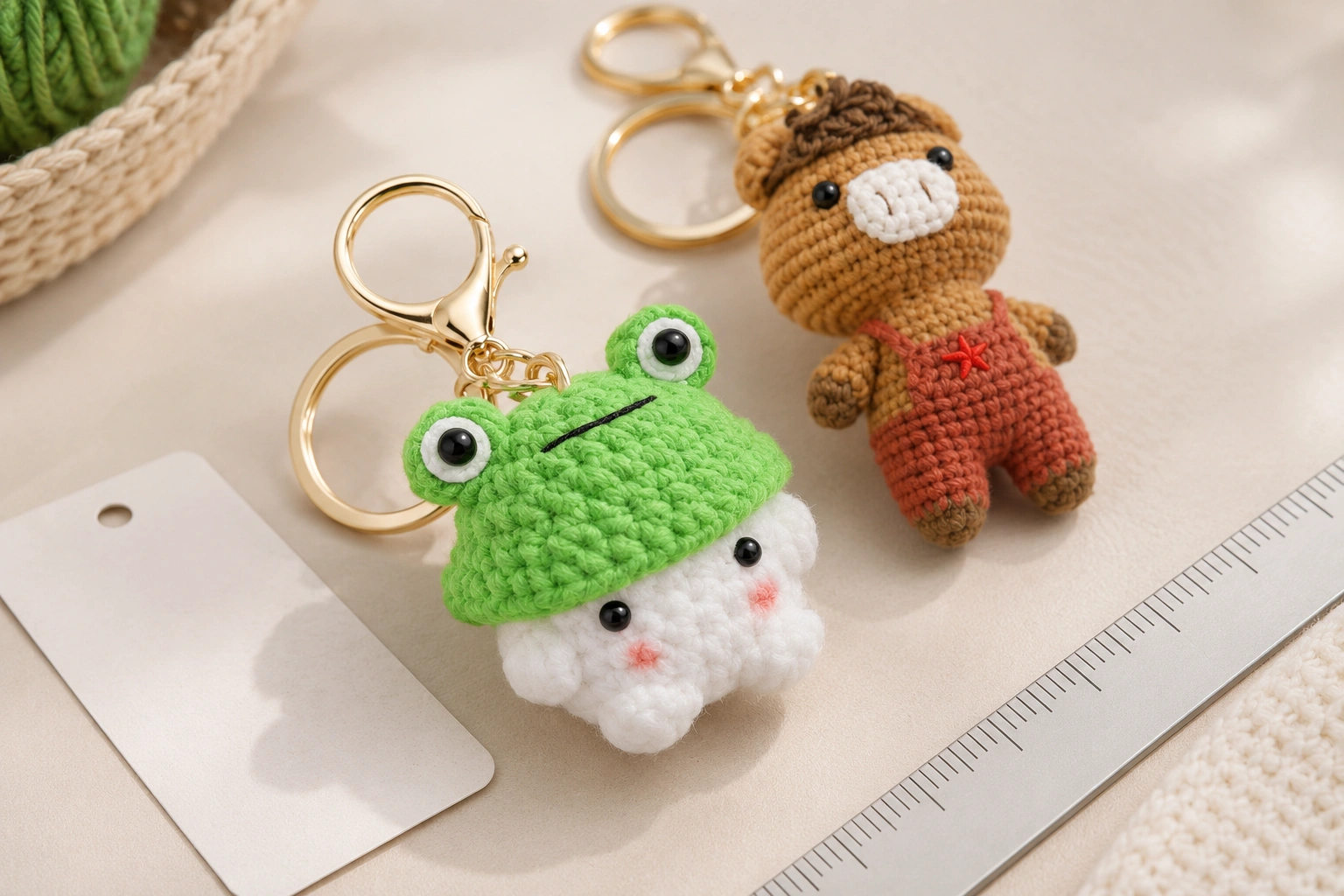
Hardware can catch on yarn, press against a character’s face, or make a small retail pack look untidy. A sample that looks good on a table may need a different packing arrangement.
Review the fully assembled product in its proposed packaging. Check whether the attachment is visible where intended, whether it interferes with the product’s presentation, and whether the pack protects the crochet surface during normal handling. If the retailer plans to hang the packaged item on a display fixture, test that presentation with the actual pack format.
How UMY Approaches a Hardware Brief
UMY Crochet develops crochet products and creative gifts for business buyers. For a keychain collection, the development conversation starts with the reference product, intended use, target size, attachment preference, and packaging plan. Sample review can then cover the crochet shape, connection point, hardware appearance, and hanging orientation together.
This approach helps the buyer make decisions from a complete sample rather than approving the crochet piece and its attachment separately. The final construction and checks should be agreed for the actual product and its target market.
Frequently Asked Questions
Can the same clasp be used across an entire crochet keychain collection?
Possibly, but each product shape still needs a hanging and connection check. A fitting that works on one character may make another tilt or rotate.
Should a crochet bag charm also include a key ring?
Include one when the intended customer use supports it. Extra hardware should be assessed for appearance, usability, packaging, and cost.
Is hardware color part of the approved sample?
Yes. Record the visible finish and retain an approved reference, especially when several SKUs are intended to look coordinated.
What photographs help approve a keychain sample?
Request a front view, side view, connection close-up, and a photograph of the product hanging from a representative attachment point.
When should packaging be reviewed?
Review it with the hardware attached during sampling, before confirming the retail presentation and packing specification.
Do all crochet keychains need the same connection method?
No. The product shape, intended use, and attachment location can call for different solutions. Confirm the complete assembly on each approved sample.
Discuss Your Collection Brief
If you are developing a crochet keychain or bag charm collection, share your product references, intended uses, preferred attachment styles, target dimensions, and packaging format with UMY Crochet. We can use that brief to assess sample construction and identify the hardware decisions that need approval before production.
<!--[googlesitekit-end-of-content]-->
 Chinese