
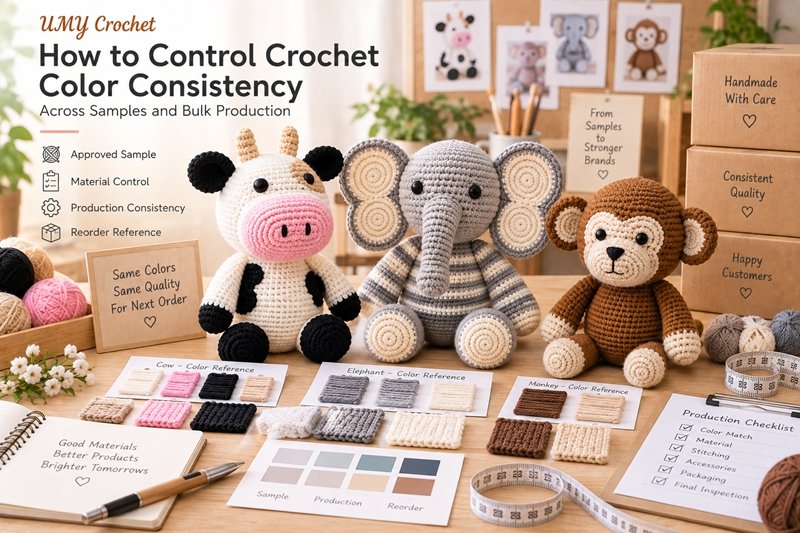
Color consistency in handmade crochet production should be managed as a reference-control process, not as a final visual check.
For B2B buyers, the practical approach is to approve the exact color direction during sampling, record the yarn reference used for the approved sample, control material substitutions, compare incoming yarn and production units against approved references, and define what level of variation is commercially acceptable before bulk production begins.
This matters because a crochet product can have the correct shape, dimensions, and stitching while still looking inconsistent on a retail shelf if its colors shift between samples, production batches, or reorders.
The objective is not to claim that every handmade unit will be visually identical under every lighting condition. The objective is to create a controlled system in which color decisions are documented, production materials are traceable to approved references, and unexpected differences are identified before they affect an entire order.
For brands, retailers, gift companies, and product-development teams, color control should therefore begin before the purchase order reaches bulk production.
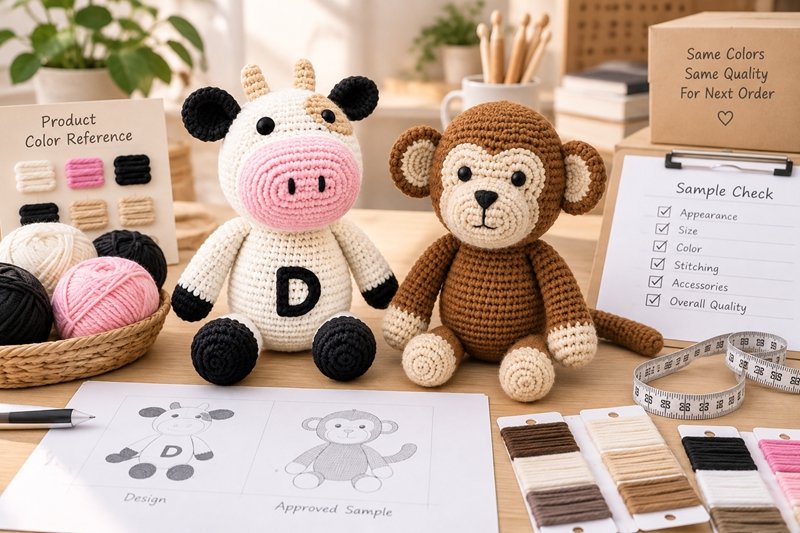
Why Is Color Consistency Difficult in Handmade Crochet Production?
Color may appear simple on a specification sheet.
In production, several variables can affect what a buyer actually sees.
These may include:
- Yarn selection
- Supplier or yarn-series changes
- Material composition
- Dye-lot differences
- Lighting conditions
- Photography and screen display
- Stitch density
- Product construction
- Combination with neighboring colors
- Replacement materials during reorders
A buyer may approve a product from a photograph and later discover that the physical yarn appears warmer, cooler, brighter, or more muted than expected.
This is why color approval should not depend on descriptions such as:
- light green
- beige
- dusty pink
- cream
- warm brown
Those descriptions are useful for communication, but they are not precise production references.
The more important question is:
Which physical material and color reference was actually approved for this product?
Start Color Control During Product Development
The best time to solve a color problem is before bulk materials are committed.
During development, a buyer may begin with:
- Brand guidelines
- Pantone references
- Artwork
- Product photographs
- Existing products
- Packaging artwork
- Physical fabric or yarn references
- General color descriptions
These inputs help communicate the intended direction.
However, a digital color reference and a physical yarn are not the same thing.
A manufacturer may need to identify available yarn options that visually support the design while also considering:
- Yarn type
- Thickness
- Texture
- Availability
- Minimum purchase requirements
- Product construction
- Commercial feasibility
For custom projects, this is part of product development rather than simply purchasing yarn.
Digital Color Is Not a Complete Production Standard
One common sourcing mistake is approving color only through a phone or computer screen.
Screens can display the same photograph differently.
Photography can also be affected by:
- White balance
- Exposure
- Ambient light
- Camera processing
- Editing
- Screen brightness
A photograph is useful for communication and remote review, but buyers should understand its limitation.
When color is commercially important, the approval process should identify the physical production reference behind the image.
That may be an approved yarn sample, yarn code, swatch, sample product, or another agreed reference appropriate to the project.
Build a Color Reference System Before Bulk Production
A practical crochet color-control system does not need to be complicated.
It does need to be clear.
For each important product color, the project record can identify:
| Control Item | What Should Be Recorded? | Why It Matters |
|---|---|---|
| Product area | Body, clothing, mane, accessory, embroidery, etc. | Prevents ambiguity about where the color belongs |
| Approved color direction | Buyer-approved visual target | Records the design intention |
| Yarn reference | Agreed yarn, code, swatch, or physical reference | Connects the design to production material |
| Approved sample | Physical product using the accepted color combination | Shows colors in the finished construction |
| Substitution status | Whether alternatives require approval | Prevents uncontrolled material changes |
| Packaging relationship | Relevant packaging or label colors | Helps maintain the complete retail presentation |
| Revision version | Current approved specification | Reduces the risk of using an outdated color |
The system becomes especially important when one SKU contains several colors.
A crochet character might use different yarns for:
- Main body
- Face
- Hair or mane
- Clothing
- Shoes
- Embroidery
- Accessories
Approving the product as simply “brown and cream” would leave too much room for interpretation.
Treat the Approved Sample as a Finished Color Reference
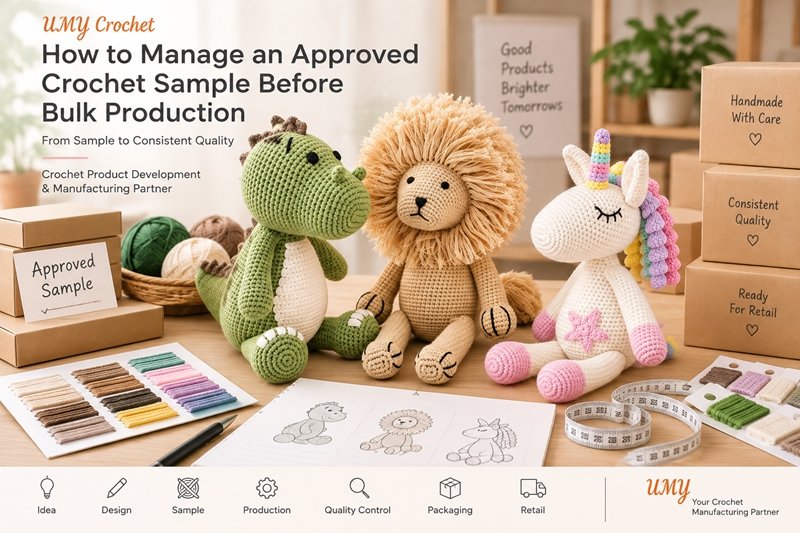
Once the buyer approves a physical sample, that sample becomes more than a design prototype.
It can also become a reference for the relationship between colors.
For example, a product may use:
- A muted green body
- A cream belly
- A darker neutral accent
- Black facial details
Each yarn can be reviewed individually, but the final appearance depends on how those colors work together.
The approved sample helps answer questions that isolated swatches cannot:
- Does the contrast feel correct?
- Is the accent color too dominant?
- Does the face remain visually clear?
- Does the product still match the intended collection?
- Do the colors work with the packaging?
This is one reason the approved sample should be controlled carefully after approval.
Do Not Change Yarn Without Reviewing the Color Impact
Material substitution is one of the clearest risks to color consistency.
A replacement yarn may appear similar but differ in:
- Shade
- Surface texture
- Thickness
- Sheen
- Fiber appearance
- Stitch definition
Even when two yarns look close as loose strands, they may look different after crochet construction.
For this reason, buyers should clarify how substitutions will be handled.
A useful project rule is:
If a material change can visibly affect the approved product, the change should be reviewed before it becomes the new production standard.
The exact approval process can vary by project.
The important point is to avoid silent substitutions.
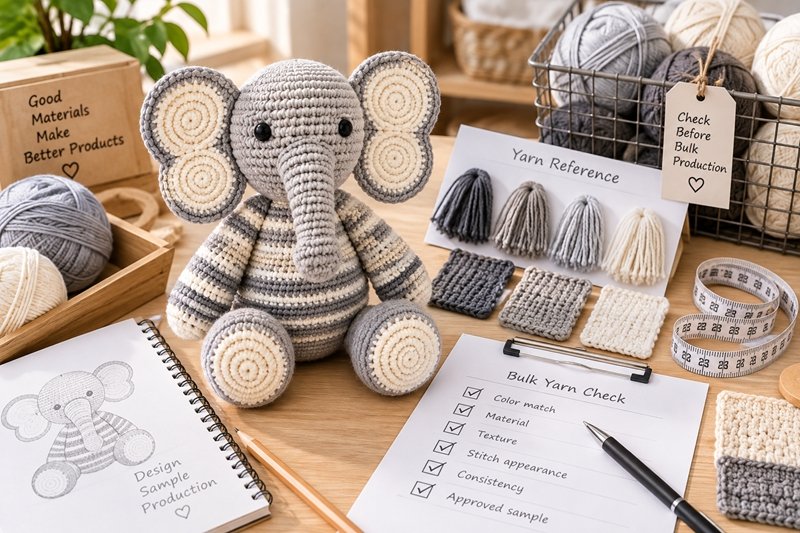
Check Bulk Yarn Before Too Much Production Is Completed
Color control should not wait until finished products are packed.
Once bulk yarn is prepared, it can be compared with the approved production reference before large quantities are crocheted.
This checkpoint can help identify obvious issues such as:
- Incorrect yarn
- Wrong shade
- Unexpected replacement material
- Major difference from the approved sample
- Mixed materials within the same production requirement
Compare Production Units With the Approved Sample
Material inspection alone is not enough.
The yarn must eventually be evaluated in the finished product.
During production, representative units can be compared with the approved sample for characteristics such as:
- Overall color impression
- Correct color placement
- Contrast between product areas
- Embroidery color
- Accessory color
- Combination with clothing or decorative components
This is especially useful for character products.
For branded products, color can be part of identity rather than decoration.
Color Consistency Does Not Mean Ignoring Handmade Variation
Handmade production should be controlled, but it should also be evaluated realistically.
Crochet is made by people, not molded by an automated machine.
Natural variation may occur in characteristics such as:
- Stitch tension
- Minor dimensions
- Filling distribution
- Positioning of handmade details
Color control is somewhat different because many important color decisions originate from the materials supplied to artisans.
This means buyers should separate two questions:
Is this normal handmade variation?
and
Has the production material or color standard changed?
A different yarn shade should not automatically be dismissed as “handmade variation.”
It may indicate a material-control issue that needs investigation.
Define Acceptable Variation Before a Disagreement Happens
Before production, buyers and manufacturers should agree on the relevant reference and review process.
Questions may include:
- What is the approved color reference?
- Is the physical approved sample retained?
- Which yarn references are recorded?
- What happens if the original yarn becomes unavailable?
- Who approves substitutions?
- At which production stages will color be checked?
- How will obvious mismatches be handled?
- Are packaging colors also part of the approval?
- Which product details are especially color-sensitive?
- How will the same references be preserved for future reorders?
These questions turn a subjective discussion into a more manageable production process.
Pay Special Attention to Multi-SKU Collections
Color management becomes more complex when a buyer develops a collection rather than one product.
Imagine a six-SKU animal collection.
The products may share:
- The same cream accent
- A coordinated neutral palette
- Matching scarves
- Common embroidery colors
- Related packaging
A better approach is to review the range as a system.
This allows buyers to ask:
- Are shared colors actually shared?
- Do the products look coordinated together?
- Is one SKU unexpectedly brighter or darker?
- Are common accessories consistent?
- Does the collection work with the same packaging family?
Packaging Should Be Included in the Color Review
The crochet product does not exist alone at retail.
It may appear with:
- Hangtags
- Printed boxes
- Sleeves
- Gift bags
- Story cards
- Display materials
A product can be individually attractive while looking disconnected from its packaging.
This is particularly relevant when brand colors or collection colors appear across both product and packaging.
The goal should therefore be a commercially coherent presentation rather than assuming two different materials will look identical under all conditions.
Reorders Need the Original Color Records
A successful SKU may need replenishment months later.
At that point, the sourcing team should not have to reconstruct the product from memory or old marketing photographs.
Useful reorder references may include:
- Approved product sample
- Yarn codes or material references
- Physical swatches where appropriate
- Product specification
- Packaging specification
- Approved artwork
- Revision history
Before a reorder begins, the manufacturer should also confirm whether the previously approved materials remain available.
If not, the replacement should be reviewed before the new batch becomes the reference for future production.
This protects the product from gradual, undocumented drift.
Watch for Version-Control Problems
Color inconsistency is not always caused by yarn.
Sometimes the wrong specification is used.
For example:
- Sample A used the first color proposal.
- Sample B changed the body color.
- Sample C changed the accessory color.
- The buyer approved Sample C.
- An old file still shows Sample A.
Without version control, different teams may work from different references.
The same problem can affect:
- Product development
- Purchasing
- Production
- QC
- Packaging
- Reorders
The final approved version should therefore be identifiable.
This is a simple administrative step with significant manufacturing value.
A Practical Color-Control Workflow
For a custom crochet project, buyers can use the following sequence.
Step 1: Define the Intended Color Direction
Provide brand references, artwork, physical references, or other useful design information.
Step 2: Select Practical Yarn Options
Evaluate available yarn against the desired appearance and product requirements.
Step 3: Build the Sample
Review the color in actual crochet construction rather than judging loose yarn alone.
Step 4: Revise if Necessary
Adjust colors together with proportions, details, and accessories.
Step 5: Approve the Final Sample
Identify the accepted product and material references.
Step 6: Record the Production Standard
Document yarn references, color placement, sample version, and relevant packaging details.
Step 7: Check Bulk Materials
Compare production yarn with the approved references before extensive handmade production.
Step 8: Review Early Production Units
Confirm that the finished product still reflects the approved color relationship.
Step 9: Include Color in Final QC
Check for incorrect colors, obvious mismatches, or unintended mixing before shipment.
Step 10: Preserve the References for Reorders
Keep the final standard identifiable for future replenishment.
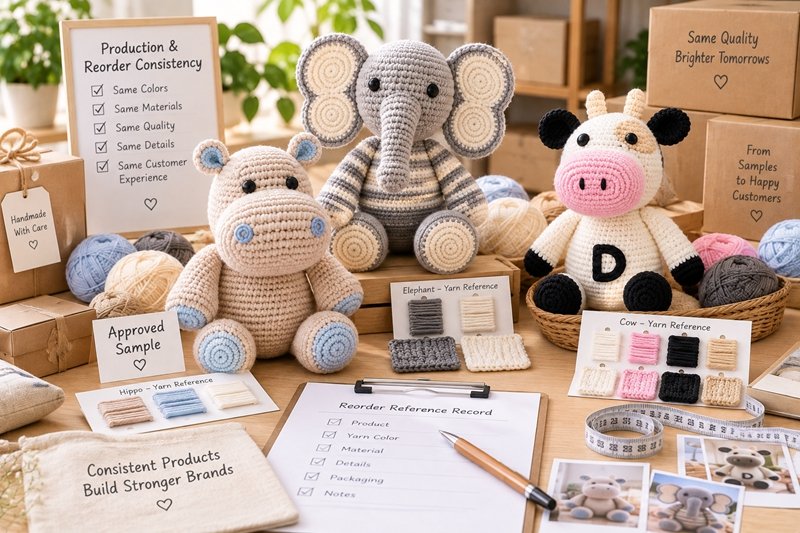
Buyer Checklist: Before Approving Color for Bulk Production
Before production starts, confirm:
- [ ] The product's important colors have been clearly identified.
- [ ] Physical yarn references are connected to the approved design where appropriate.
- [ ] The final sample uses the intended production colors.
- [ ] Color placement is documented.
- [ ] Material substitutions require an agreed review process.
- [ ] The approved sample can be used as a production reference.
- [ ] Bulk yarn will be checked before extensive production.
- [ ] Early production units will be compared with the approved standard.
- [ ] Packaging color relationships have been reviewed where relevant.
- [ ] Final references will be retained for reorders.
How UMY Approaches Color as Part of Product Development
At UMY Crochet, we position crochet manufacturing as a product-development process rather than simply converting an order quantity into finished pieces.
For a custom project, color decisions can interact with:
- Character identity
- Yarn availability
- Crochet construction
- Collection coordination
- Packaging
- Sampling
- Bulk-production consistency
- Future replenishment
That is why color should be resolved together with the product rather than treated as a cosmetic decision at the end.
For OEM projects, buyer-supplied artwork and references can guide development.
For projects requiring broader development support, color combinations can be considered as part of the overall product and collection direction.
In both cases, the important manufacturing principle is the same:
Once a color direction is approved, production needs a clear reference for reproducing that decision consistently.
Frequently Asked Questions
How do buyers control crochet color consistency?
Use approved physical product and yarn references, document the production materials, control substitutions, inspect bulk yarn, compare production units with the approved sample, and preserve the references for future orders.
Is a Pantone number enough to control crochet yarn color?
Not by itself. A color reference can communicate the intended direction, but the actual yarn is a physical material with its own texture and appearance. Buyers should approve the production material and finished sample rather than relying only on a digital or printed color reference.
Can yarn color vary between production batches?
Differences can occur depending on the yarn and supply situation. The practical response is to compare incoming material with the approved reference and investigate meaningful differences before extensive production.
Should buyers approve yarn before approving the crochet sample?
Yarn selection is part of sampling, but final approval should also consider how the color looks in the finished crochet product. Construction, neighboring colors, and product details can change the overall visual impression.
What happens if an approved yarn is unavailable for a reorder?
The manufacturer and buyer should identify an alternative and review its effect on the finished product before treating it as the new production standard. The change should be documented rather than introduced silently.
How should multi-color crochet products be controlled?
Record which approved yarn belongs to each product area, retain the final approved sample, and review the complete color combination during production rather than checking each yarn only in isolation.
Why is color version control important?
Because samples may change during development. Without a clearly identified final version, purchasing, production, QC, and packaging teams can accidentally use outdated references.
Conclusion
Color consistency in handmade crochet is not achieved by asking production to “make it the same.”
It is achieved by creating a chain of controlled references:
Design Direction → Yarn Selection → Physical Sample → Approval → Material Control → Production Comparison → Final QC → Reorder Reference
For B2B buyers, this process reduces ambiguity at one of the most visually sensitive points in handmade manufacturing.
The goal is not artificial machine-like uniformity.
The goal is controlled, documented consistency that protects the approved product identity across samples, bulk production, collections, and future replenishment.
If your team is developing a custom crochet product or collection, UMY can support the process from design adaptation and sampling through material coordination, production standardization, quality control, packaging, and bulk manufacturing.
 Chinese