
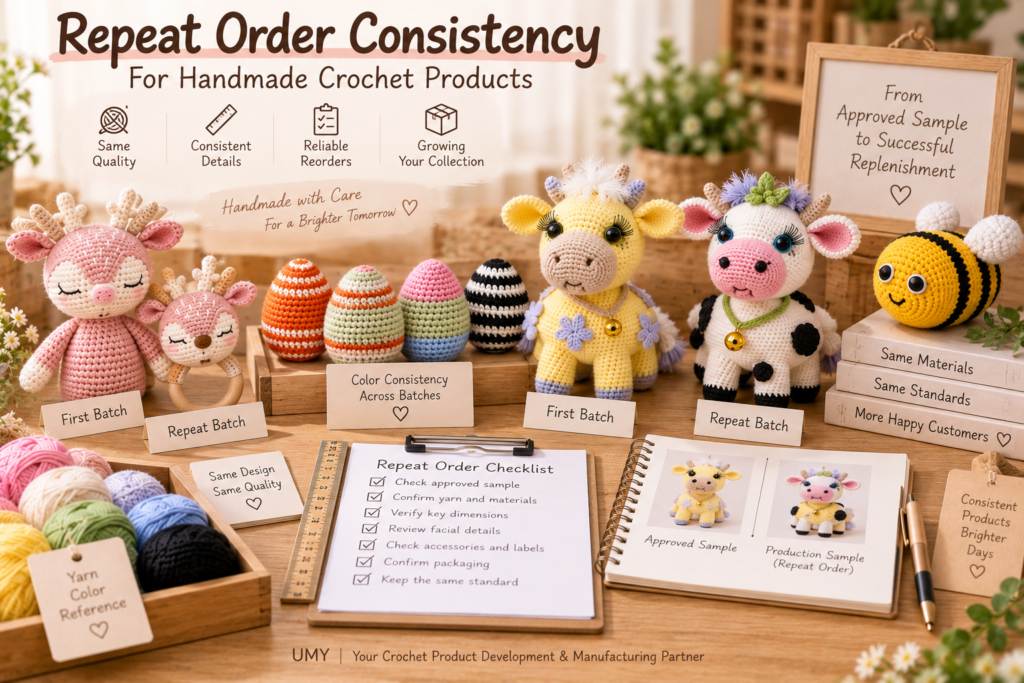
Keeping handmade crochet products consistent across repeat orders requires more than asking a supplier to "make the same product again." For brands, retailers, gift companies, museums, and sourcing teams, repeat-order consistency depends on preserving the approved product standard and the production information behind it.
A practical repeat-order control system should retain the approved sample, yarn specifications and color references, finished dimensions, stitch and construction details, filling level, facial placement, accessories, packaging specifications, and other critical appearance points. When a reorder begins, the supplier should compare current materials and pre-production samples against these references before bulk production proceeds.
The key purchasing principle is:
Do not manage a repeat order from memory. Manage it from documented references.
Some variation is inherent in handmade crochet production. Stitch tension, shaping, assembly, and finishing involve manual work, so expecting every piece to be mathematically identical is unrealistic. Commercial consistency instead means defining which characteristics must remain controlled, what level of handmade variation is acceptable, and how deviations will be identified before they affect an entire batch.
For buyers, this becomes increasingly important when a successful crochet product is reordered months later, expanded into multiple SKUs, sold alongside earlier inventory, or supplied to retail locations where customers may see different production batches together.
What Does Consistency Mean for a Handmade Crochet Product?
Consistency does not necessarily mean absolute physical uniformity.
A handmade crochet product is constructed through repeated manual operations. Small differences can occur in stitch tension, shaping, stuffing, sewing, embroidery, and final positioning.
The commercial objective is therefore to maintain a recognizable and controlled product standard.
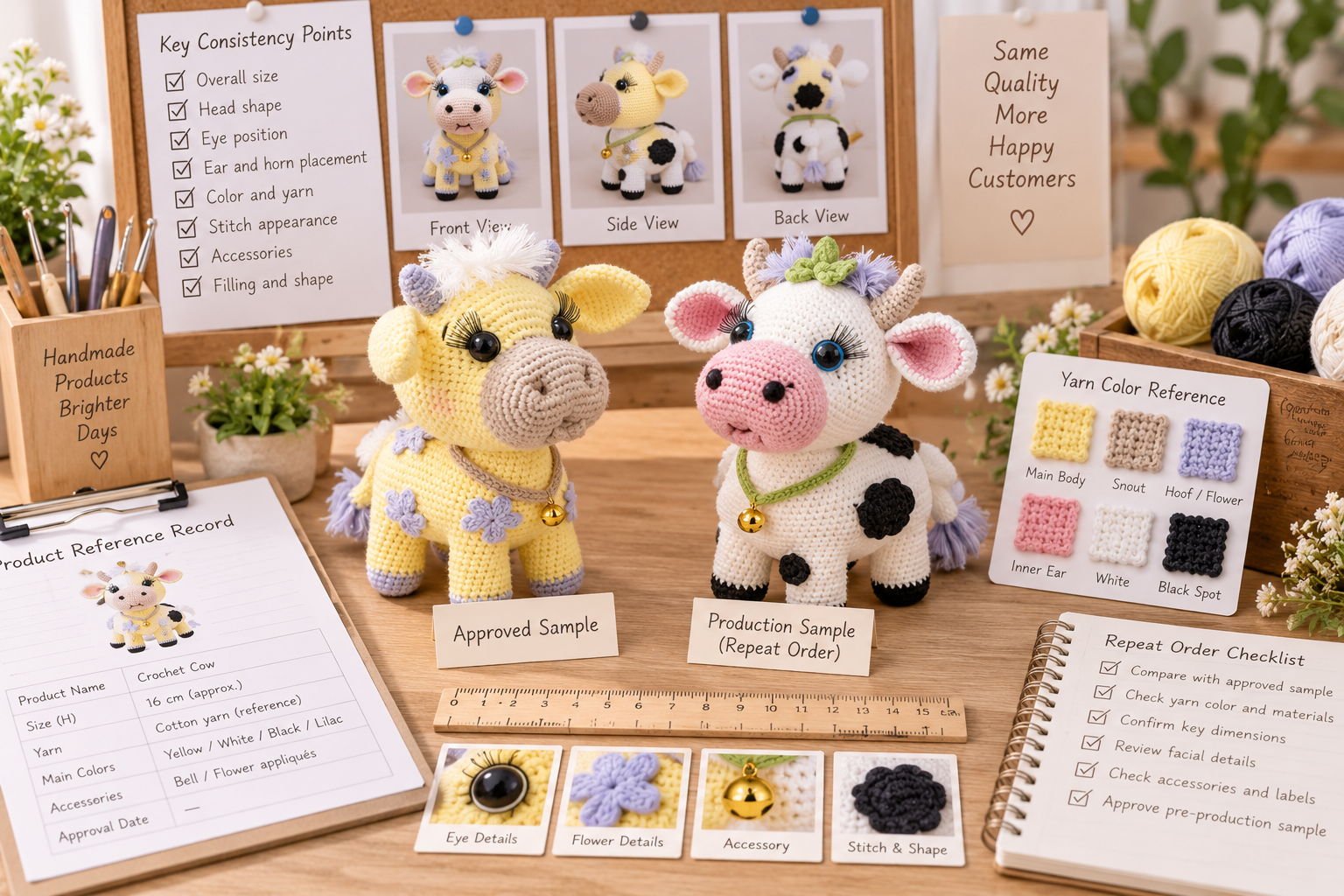
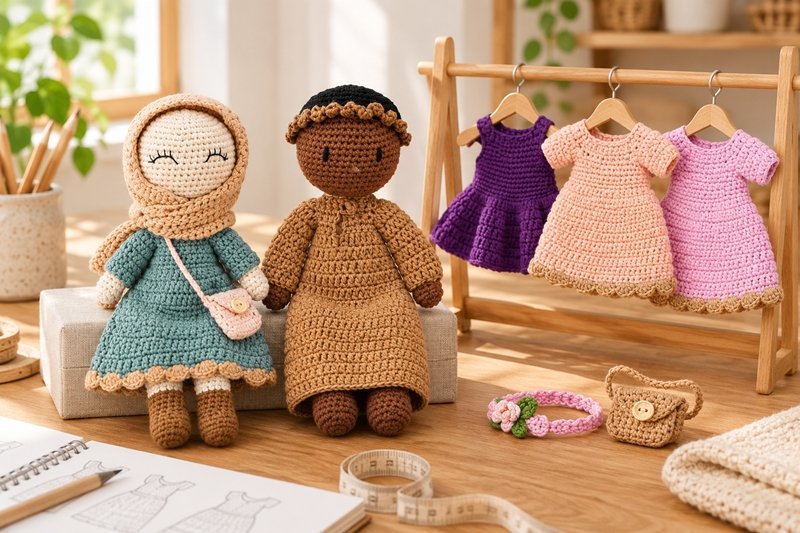
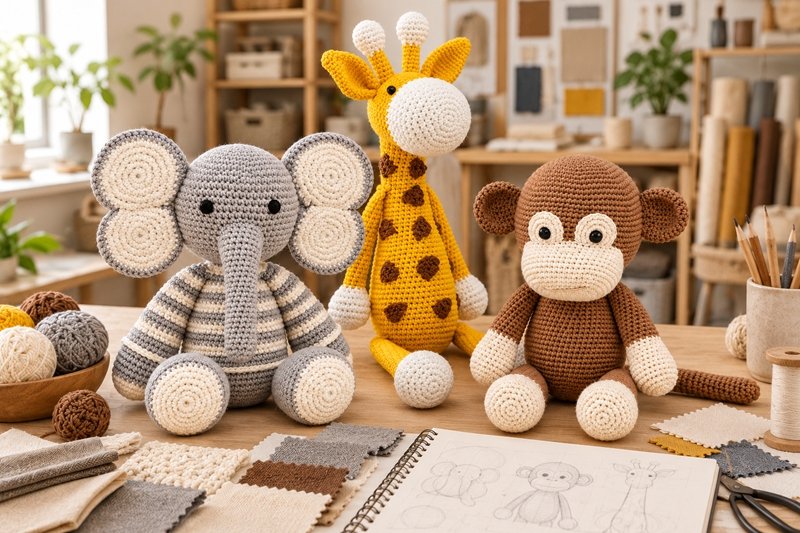
For a crochet character, for example, buyers may care about:
- Overall dimensions
- Body proportions
- Head shape
- Yarn color
- Stitch appearance
- Filling level
- Eye position
- Facial expression
- Ear position
- Limb length
- Clothing fit
- Accessories
- Embroidery
- Product weight where relevant
- Hangtag and packaging presentation
Not every dimension or visual detail needs the same tolerance.
A small difference in an inconspicuous handmade detail may be acceptable, while a small change in eye spacing can noticeably change a character's expression.
That distinction is important when defining quality expectations.
Why Repeat Orders Can Drift From the First Production
A buyer may assume that once a product has been successfully manufactured, every future order will automatically look identical.
In practice, several variables can change between production runs.
These can include:
- Yarn lots
- Material availability
- Dye-lot differences
- Operators
- Stitch tension
- Filling amount
- Accessory supply
- Embroidery placement
- Assembly technique
- Packaging artwork versions
- Production documentation
- Approved samples used for comparison
The longer the interval between orders, the more important documentation becomes.
If the original product was developed based mainly on informal communication, photographs, or individual operator knowledge, reproducing it later can become more difficult.
A repeatable product therefore needs a repeatable specification.
Step 1: Keep an Approved Physical Sample
One of the strongest references for a handmade crochet product is the approved physical sample.
Photographs are useful, but they do not communicate every characteristic.
A physical sample allows comparison of:
- Actual dimensions
- Three-dimensional proportions
- Yarn texture
- Filling firmness
- Stitch density
- Facial positioning
- Accessory placement
- Garment fit
- Overall hand feel
For products where appearance is particularly important, buyers and manufacturers should clearly identify which sample represents the approved production standard.
This avoids confusion when several development samples exist.
For example, a project may have:
- First prototype
- Revised color sample
- Size-adjusted sample
- Packaging sample
- Final approved production sample
Step 2: Document the Product Beyond the Sample
A physical sample is important, but it should not be the only source of information.
A repeat-order specification can record critical characteristics in written or visual form.
Depending on the product, documentation may include:
| Control Item | Example of What to Record |
|---|---|
| Finished size | Approved dimensions and measurement method |
| Yarn | Material, thickness, supplier/reference where applicable |
| Colors | Approved color references |
| Construction | Stitch/construction notes |
| Filling | Material and target appearance/firmness |
| Face | Eye, nose, mouth, embroidery placement |
| Accessories | Type, color, size, attachment |
| Clothing | Dimensions, colors, fit |
| Labels | Position and approved version |
| Packaging | Structure, artwork version, packing method |
This information reduces dependence on individual memory.
It also makes it easier to identify the source of a problem.
If a reorder looks different, the team can ask whether the change comes from the yarn, dimensions, filling, assembly, or another controlled element.
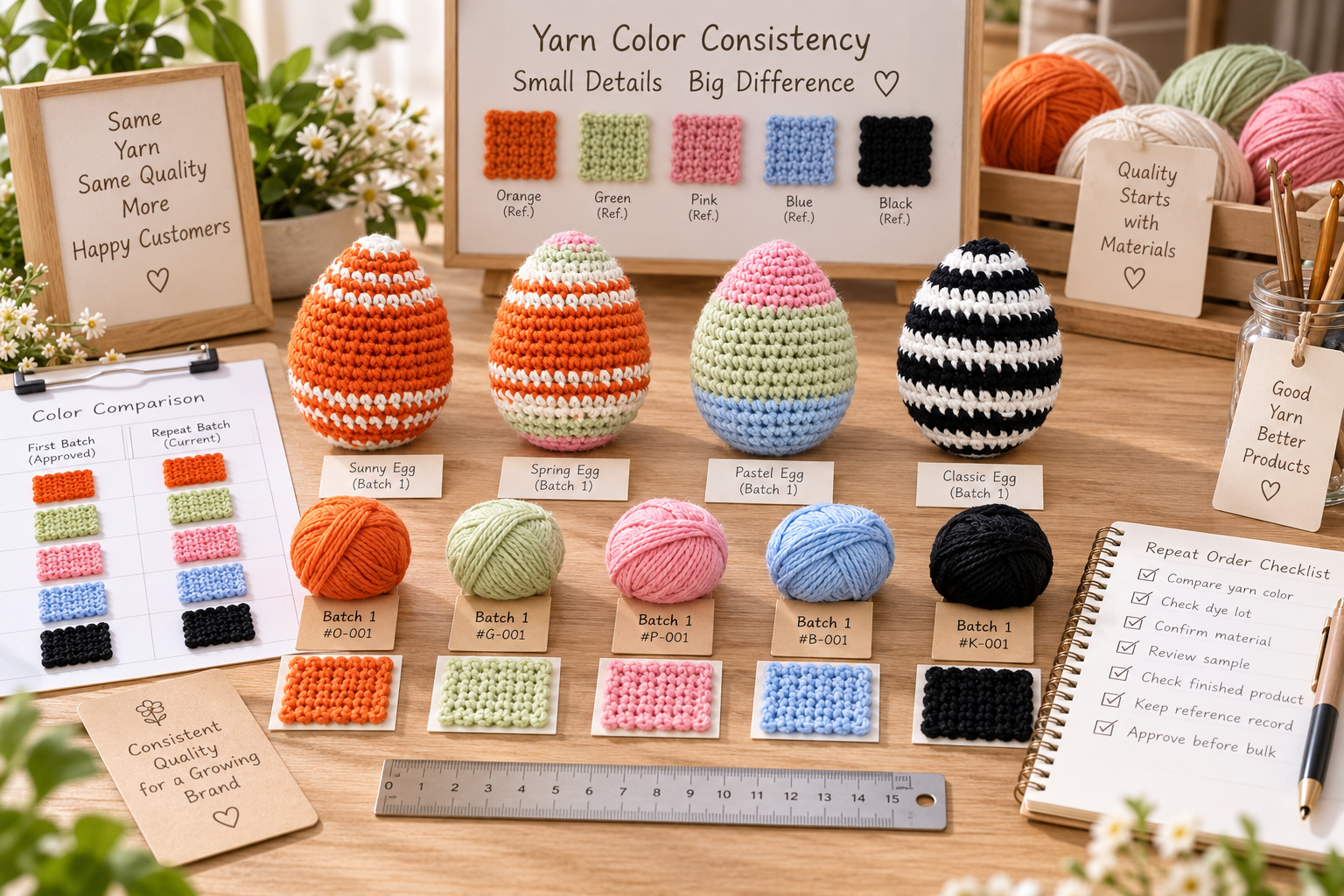
Step 3: Control Yarn Color Between Production Batches
Color is one of the first differences customers notice.
For products where color consistency is commercially important, buyers should establish an approved reference and compare new materials against it.
This is especially relevant for:
- Brand colors
- Character colors
- Skin or face colors
- Matching product collections
- Products sold as sets
- Reorders that will be displayed with existing inventory
A written description such as "light pink" is not enough to define a commercial color standard.
Use Physical References Where Appropriate
A retained yarn sample, approved product, supplier color reference, or other confirmed material reference can provide a stronger comparison point.
The appropriate method depends on the project.
The important principle is that a new production batch should not rely only on someone remembering what the previous pink, green, brown, or cream looked like.
Step 4: Define Which Dimensions Matter Most
Crochet products are flexible, so measurement methods should be practical and repeatable.
For a character product, buyers may want to control:
- Total height
- Head width
- Body width
- Limb length
- Ear or horn length
- Key accessory dimensions
For a flat product, the critical measurements may instead be:
- Width
- Height
- Diameter
- Thickness
- Opening size
The measurement method should also be understood.
The purpose of dimensional control is not to create unnecessary measurement points. It is to identify the dimensions that materially affect product appearance, function, packaging, or collection consistency.
Step 5: Control Proportion, Not Just Overall Size
Two crochet characters can have the same total height and still look noticeably different.
Why?
Because proportions matter.
For character-based products, buyers should therefore evaluate both dimensions and visual proportions.
This is particularly important for:
- Brand mascots
- Licensed designs
- Character collections
- Museum merchandise
- Products based on illustrations
- Matching sets
An approved sample can be especially useful here because it provides a three-dimensional reference for the overall silhouette.
Step 6: Treat the Face as a Critical Quality Area
For many crochet characters, the face has a disproportionate effect on perceived consistency.
Small changes in:
- Eye spacing
- Eye height
- Nose position
- Mouth shape
- Eyebrow angle
- Embroidery
- Blush placement
can create a different expression even when the body is otherwise consistent.
Buyers developing character products should identify these visually sensitive points during sampling.
Reference photographs can supplement the approved physical sample by showing the desired face directly from the front and from useful angles.
For products with embroidered or manually attached facial elements, placement references can help production teams understand which differences are acceptable and which change the character too much.
Step 7: Standardize Filling and Shape
Stuffing affects more than softness.
It can change:
- Product dimensions
- Head shape
- Body proportions
- Stability
- Facial appearance
- Packaging fit
- Overall hand feel
Under-filled products may look loose or flattened. Over-filled products may become too firm, distort stitch openings, or change proportions.
For repeat production, the target should be based on the approved appearance and construction rather than an undefined instruction to make the product "soft" or "firm."
Where relevant, filling quantity or production references can support greater consistency, but the final visual shape should still be evaluated.
Step 8: Check Stitch Appearance and Tension
Stitch tension influences the visual surface and dimensions of crochet products.
If tension changes significantly, a product may become:
- Larger or smaller
- Firmer or softer
- More open or more compact
- Different in shape
The goal is not to eliminate the handmade nature of the stitches.
Instead, the production team should maintain a stitch appearance reasonably consistent with the approved standard.
This is one reason material changes should not be treated casually. Changing yarn thickness or structure can affect stitch appearance even if the nominal color is similar.
Step 9: Control Accessories and Small Components
Small components can create large visual differences.
Examples include:
- Bells
- Buttons
- Bows
- Ribbons
- Wooden rings
- Decorative flowers
- Clothing
- Keychain hardware
- Hanging loops
- Labels
For repeat orders, buyers should check whether the same component remains available and whether a proposed replacement changes the product materially.
If a substitution is necessary, it should be evaluated before bulk use rather than discovered after finished goods are packed.
This is especially important when the component is part of the product's recognizable design.
Step 10: Use a Pre-Production Check for Reorders
A repeat order should not always jump directly from purchase order to full production simply because the product was made before.
A practical approach is to confirm the repeat-order standard before bulk work proceeds.
The review may include:
- Current yarn colors
- Current accessories
- Product dimensions
- Construction
- Facial appearance
- Filling
- Labels
- Packaging
- Any requested changes
The amount of re-sampling required depends on the product and whether anything has changed.
If the materials, specifications, and product remain stable, the process may be simpler than developing a completely new item.
If a material or component has changed, more review may be appropriate.
Step 11: Separate Intentional Changes From Production Variation
Repeat orders sometimes include deliberate updates.
A buyer may request:
- A new color
- Different packaging
- New hangtag
- Revised logo
- Updated accessory
- Different product size
- New market labeling
- Seasonal variation
These changes should be clearly distinguished from unintentional production variation.
Otherwise, a team may incorrectly treat an old specification as current or assume that a previous deviation has become the new standard.
A useful repeat-order record can identify:
UNCHANGED: characteristics that should remain consistent with the approved reference.
UPDATED: characteristics intentionally changed for the new order.
This simple distinction becomes especially valuable when several SKUs are being reordered at the same time.
Step 12: Keep Packaging Consistent Too
Repeat-order consistency does not stop at the crochet product.
Retail buyers may also need continuity in:
- Box dimensions
- Packaging materials
- Hangtags
- Story cards
- Printed colors
- Product names
- Barcodes
- QR codes
- Inserts
- Packing orientation
- Outer-carton configuration
An identical crochet product placed in noticeably different packaging can still create inconsistency at retail.
Artwork version control is therefore part of repeat-order management.
Repeat Orders Become More Complex With Multiple SKUs
A single-product reorder can already involve many variables.
A collection multiplies them.
Imagine a retailer carrying six related crochet characters. The products may share:
- Yarn families
- Construction methods
- Packaging
- Labels
- Accessories
- Collection colors
At the same time, each SKU has its own critical features.
A useful collection-level repeat-order system should therefore control both:
Shared standards — characteristics that apply across the collection.
SKU-specific standards — characteristics unique to each product.
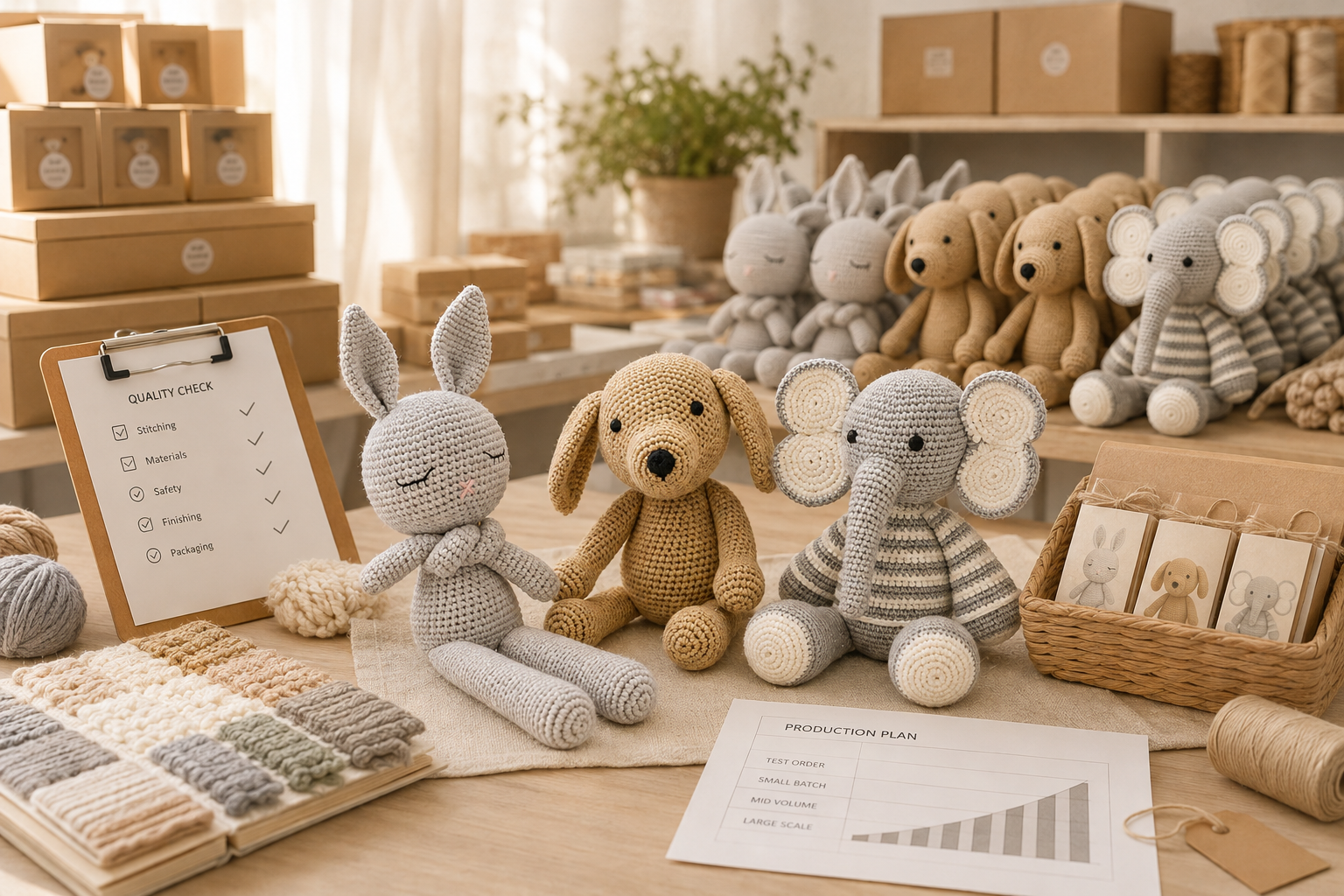
First Batch vs Repeat Batch: What Should Buyers Compare?
A practical comparison can focus on the areas that customers are most likely to notice.
| Comparison Area | Questions for the Buyer |
|---|---|
| Color | Does the new batch visually match the approved reference? |
| Size | Are critical dimensions within the agreed expectation? |
| Proportion | Does the silhouette remain recognizable? |
| Face | Is the expression consistent? |
| Stitching | Does the surface appearance match? |
| Filling | Is shape and firmness comparable? |
| Accessories | Are type, color, size, and position correct? |
| Labels | Is the correct version used? |
| Packaging | Does the packed unit match the approved presentation? |
This is more useful than evaluating consistency through a single general question such as "Does it look the same?"
What Level of Handmade Variation Is Acceptable?
There is no universal tolerance that applies to every crochet product.
Acceptability depends on:
- Product design
- Size
- Construction
- Function
- Customer expectation
- Brand positioning
- Critical visual features
- Agreed specification
Buyers should avoid assuming that handmade means "anything is acceptable."
They should also avoid imposing unrealistic machine-level uniformity on a manually constructed product.
The practical objective is to identify critical-to-quality characteristics.
For a mascot, facial expression and silhouette may be critical.
For a crochet basket, dimensions and function may matter more.
For a decorative flower, color and shape may dominate.
For a baby gift set, product construction, component requirements, intended use, and applicable market requirements require particular attention.
Quality criteria should follow the actual product.
What Happens When the Original Yarn Is No Longer Available?
Material discontinuation is a realistic repeat-order risk.
If the original yarn or component cannot be sourced, buyers should avoid approving a replacement based only on a supplier description.
A replacement can affect:
- Color
- Texture
- Thickness
- Stitch density
- Dimensions
- Softness
- Overall appearance
The alternative material should therefore be evaluated against the approved product standard.
Depending on the significance of the change, a revised sample may be appropriate before production.
If the replacement materially changes the product, the buyer should decide whether the new version becomes an updated approved standard for future orders.
How Repeat-Order Records Support Replenishment
For retailers, consistency is closely connected to replenishment.
A successful product may need to be reordered because:
- Inventory is running low
- A seasonal program is returning
- More stores are carrying the collection
- An online SKU continues to sell
- A museum exhibition is extended
- A corporate program is repeated
- A character collection is expanding
In these situations, development work from the first order becomes an asset.
Good records can reduce the need to reconstruct previous decisions from emails, photographs, or memory.
This does not mean every reorder will be identical in process or lead time. Material availability, packaging, quantities, and project requirements still need to be confirmed.
But documented references provide a much stronger starting point.
How UMY Approaches Repeat-Order Consistency
Dongguan U-MY Garment Co., Ltd. has worked in product development and manufacturing since 2013.
For custom crochet products, our development process treats the approved sample and product specifications as important references for production.
When a repeat order is evaluated, relevant factors can include:
- Approved product appearance
- Yarn and color requirements
- Dimensions
- Construction
- Accessories
- Packaging
- Requested changes
- Current material availability
If the buyer wants to change a color, accessory, packaging element, or other feature, that change should be identified rather than silently mixed into the previous specification.
For new custom handmade crochet development, UMY's typical sampling period is around 7–15 days, depending on the actual project. Repeat-order requirements should be evaluated according to whether materials, construction, packaging, or specifications have changed.
Typical working MOQ ranges remain project-dependent. UMY's handmade custom crochet products typically start around 500 pieces per style, while some simple designs may be evaluated from around 300 pieces per style. Stock products usually have much lower MOQs, often around 10–50 pieces per style.
These are general working ranges rather than guarantees for every reorder.
Buyer Checklist for a Crochet Repeat Order
Before confirming a repeat production run, buyers can review:
- [ ] Correct approved sample has been identified
- [ ] Product specification is available
- [ ] Current yarn has been compared with the approved reference
- [ ] Important colors are confirmed
- [ ] Critical dimensions are confirmed
- [ ] Product proportions remain consistent
- [ ] Facial placement is checked where relevant
- [ ] Filling and shape are reviewed
- [ ] Stitch appearance is appropriate
- [ ] Accessories match the approved specification
- [ ] Any material substitutions are disclosed and evaluated
- [ ] Intentional product changes are documented
- [ ] Correct labels are being used
- [ ] Packaging artwork version is confirmed
- [ ] Packed presentation matches the approved standard
- [ ] SKU-specific requirements are separated in multi-product orders
- [ ] Updated approvals are retained for future replenishment
FAQ
Can handmade crochet products be consistent across bulk and repeat orders?
Yes, they can be produced to a controlled commercial standard, although minor handmade variation should be expected. Consistency depends on approved references, material control, production specifications, and appropriate quality checks.
Why can yarn color change between repeat orders?
Yarn availability and production or dye lots can affect color appearance. For color-sensitive products, current material should be compared against an approved reference rather than relying only on a general color name.
Should buyers keep an approved crochet sample?
An approved physical sample is highly useful because it provides a reference for dimensions, proportions, texture, filling, facial placement, and overall appearance. Written specifications and photographs should supplement rather than completely replace it.
Does a repeat order need another sample?
It depends on the project. If materials, construction, accessories, or packaging have changed, additional confirmation may be appropriate. A repeat order using stable specifications may require less development than a new product.
How should buyers manage changes in a reorder?
Identify intentional changes clearly and separate them from characteristics that should remain unchanged. This prevents updated details from being confused with production deviations.
Can packaging change the perceived consistency of a product?
Yes. Changes in boxes, tags, printed colors, product orientation, or other packaging elements can make otherwise consistent products appear different at retail. Packaging specifications should therefore be part of repeat-order control.
What if the original material is discontinued?
A proposed replacement should be evaluated against the approved product because changes in yarn or components can affect color, texture, dimensions, stitch appearance, and overall design. A revised sample may be appropriate depending on the change.
Consistency Is a System, Not a Final Inspection
The strongest repeat-order programs do not rely only on inspecting finished products at the end.
Consistency begins much earlier:
approved sample → documented specification → material confirmation → repeat-order check → controlled production → packaging verification
For buyers, the most important question is not:
"Can the factory remember how it made this product?"
It is:
"Can the product standard be reproduced from clear, approved references?"
That distinction becomes increasingly important as a product succeeds, inventory is replenished, more SKUs are added, and production moves across different periods.
For brands, retailers, gift companies, museums, cultural institutions, e-commerce sellers, and other B2B buyers planning repeat crochet orders, UMY can evaluate the existing product references, identify requested changes, and determine the practical requirements for the next production run.
 Chinese