
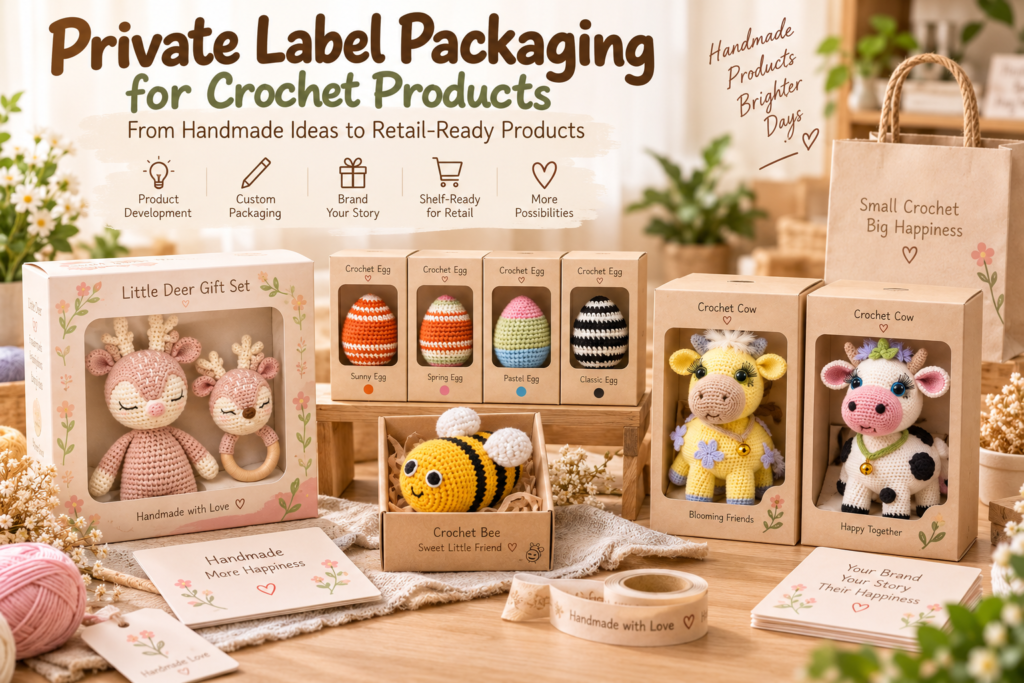
Private label packaging for crochet products should be planned before bulk production, not after the products are finished. For retailers, gift companies, e-commerce brands, and private-label buyers, packaging affects far more than appearance. It influences product protection, labeling space, retail presentation, packing efficiency, shipping volume, customer experience, and the information a buyer must approve before production.
A practical packaging development process usually starts with the actual crochet product: its dimensions, shape, compressibility, accessories, intended sales channel, and target positioning. Buyers can then select an appropriate packaging structure, determine how the product will sit inside it, define branding and printed materials, create packaging samples, and approve the complete packed unit before bulk assembly.
The key purchasing principle is:
Do not develop the crochet product and its packaging as two unrelated projects. Develop them as one retail-ready product system.
This is especially important for handmade crochet products because their three-dimensional shapes, yarn textures, flexible construction, decorative elements, and handmade variation can affect how they fit and present inside packaging. A packaging concept that looks attractive on a design screen may not work equally well with the physical product.
For B2B buyers, the goal is therefore not simply to ask, "Can you add our logo?" The better question is: What packaging configuration will protect, present, identify, and prepare this crochet product for the way we actually intend to sell it?
What Does Private Label Packaging Mean for Crochet Products?
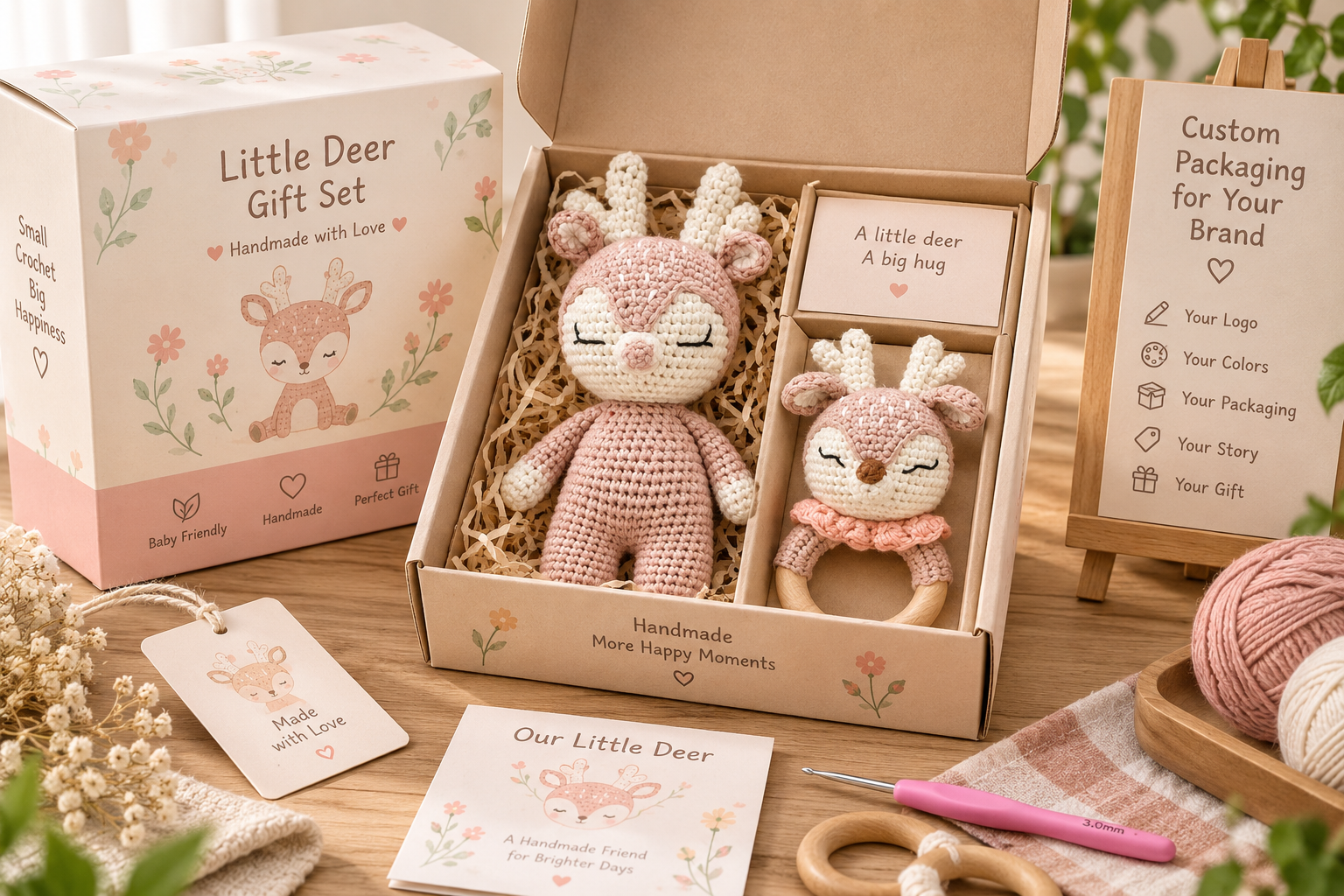
Private label packaging means developing packaging and presentation elements around a buyer's brand rather than supplying a product in generic retail presentation.
Depending on the project, this can involve:
- Branded boxes
- Paper sleeves
- Pouches or fabric bags
- Hangtags
- Header cards
- Product cards
- Story cards
- Instruction cards
- Inserts
- Stickers
- Barcode placement
- QR code placement
- Care information
- Market-specific labeling
- Gift packaging
- Inner packing arrangements
- Outer carton requirements
Not every crochet product needs all of these elements.
A small ornament may only require a hangtag or backing card. A premium crochet gift may need a rigid or folding box with a story card. A crochet kit can require considerably more packaging coordination because yarn, tools, instructions, and other components must be organized together.
The correct packaging system should therefore be based on the product, sales channel, customer experience, and commercial requirements rather than on a standard packaging template.
Start With the Product, Not the Packaging Artwork
One of the most useful things a retail buyer can do is finalize the physical product direction before locking the packaging structure.
- Yarn thickness
- Filling level
- Stitch construction
- Accessories
- Long ears, legs, tails, leaves, or flowers
- Clothing
- Hanging loops
- Product orientation
- Handmade dimensional variation
For that reason, packaging dimensions should ideally be evaluated using an actual product sample or a sufficiently stable prototype.
If packaging is ordered too early, several problems can appear later.
A box may technically fit the product but compress its shape. A decorative flower may bend against the lid. A hanging loop may be hidden. A character may rotate inside the package during transportation. A product designed to face forward on a retail shelf may sit too low inside the box.
These are packaging-development issues, not merely graphic-design issues.
Step 1: Define How the Product Will Be Sold
Before choosing a box, pouch, tag, or card, buyers should define the primary sales environment.
Different channels create different packaging priorities.
| Sales Channel | Packaging Priorities |
|---|---|
| Physical retail | Shelf presence, product visibility, hanging/display method, labeling |
| E-commerce | Shipping protection, photography, compactness, unboxing |
| Gift retail | Presentation, perceived value, storytelling |
| Museum store | Cultural context, story card, collection identity |
| Corporate gifting | Presentation, customization, gifting experience |
| Craft kit retail | Component organization, instructions, contents communication |
A product intended mainly for e-commerce may not need the same shelf-facing structure as one designed for a museum store.
Similarly, a corporate gift buyer may prioritize presentation and a branded message, while a mass retail buyer may pay greater attention to space efficiency, labeling, and standardized display.
Packaging decisions become much easier when the sales context is clear.
Step 2: Choose the Packaging Format
There is no single best packaging format for crochet products.
The format should fit the physical product and commercial objective.
Hangtags
Hangtags are useful when the crochet product itself should remain visible.
They can carry information such as:
- Brand identity
- Product name
- Collection name
- Story
- Care information
- Barcode
- QR code
- Required product information where applicable
They can be suitable for products displayed in baskets, on shelves, or through hanging systems, depending on the retailer's merchandising approach.
Boxes
Boxes can provide stronger presentation and additional printable space.
They may be appropriate for:
- Gift products
- Premium collections
- Crochet kits
- Character products
- Corporate gifts
- Museum merchandise
- Multi-piece sets
However, a box adds dimensions, material, packing operations, and shipping volume. Buyers should consider these factors alongside appearance.
Pouches and Fabric Bags
A pouch can create a softer handmade or gift-oriented presentation.
Depending on the project, it may also be reusable.
The important question is whether the pouch protects the product sufficiently and provides a practical way to communicate required product and brand information.
Backing Cards and Header Cards
Flat or relatively small crochet products can sometimes work well with cards.
Examples may include:
- Crochet ornaments
- Small decorative pieces
- Keychain-style products
- Flat crochet accessories
- Small souvenir items
Cards can help create a consistent collection presentation without hiding the handmade texture.
Gift Sets
Gift sets require another level of planning because multiple products must work together visually and physically.
The internal arrangement matters as much as the external box.
Step 3: Decide How Much of the Product Customers Should See
Crochet products often sell partly through their texture.
This creates an important packaging decision:
Should the product be fully visible, partly visible, or fully enclosed?
Each option has advantages.
A partially open package can combine product visibility with stronger branding.
A fully enclosed box provides more space for storytelling and can create a gift-like experience, but the package photography and artwork must communicate the product clearly.
The decision should reflect the sales channel.
For example, an online buyer may already see detailed product photography before receiving the package. A customer walking through a physical gift store may rely heavily on the package itself to understand what is inside.
Step 4: Plan the Product's Position Inside the Package
Packaging should control presentation, not simply contain the item.
A buyer should consider questions such as:
- Which direction should the character face?
- Should the product stand, sit, lie flat, or hang?
- Can the product move inside the package?
- Will long parts become bent?
- Does the packaging hide important details?
- Can the customer immediately understand the product?
- Is an insert or internal support necessary?
These questions are particularly important for crochet dolls, mascots, flowers, ornaments, and decorative products with irregular shapes.
A packaging insert can sometimes help maintain presentation, but it should be developed around the actual product rather than assumed from the beginning.
Step 5: Build a Clear Packaging Information Hierarchy
Packaging has limited space.
Trying to communicate everything with equal visual importance often creates clutter.
Instead, buyers can organize information into a hierarchy.
Primary Information
This is what a customer should recognize immediately.
It may include:
- Brand
- Product name
- Product type
- Character or collection identity
Secondary Information
This helps customers understand the product.
Examples include:
- Handmade positioning
- Key product characteristics
- Collection story
- Gift positioning
- Kit contents
- Skill level for a crochet kit
Supporting Information
This can include:
- Care guidance
- Product details
- QR code
- Barcode
- Manufacturer/importer information where applicable
- Required warnings or labeling where applicable
The exact legal and commercial information depends on the product and destination market.
Buyers should verify applicable requirements for their specific product rather than copying labels from an unrelated crochet item.
Step 6: Use Story Cards When the Story Adds Buyer Value
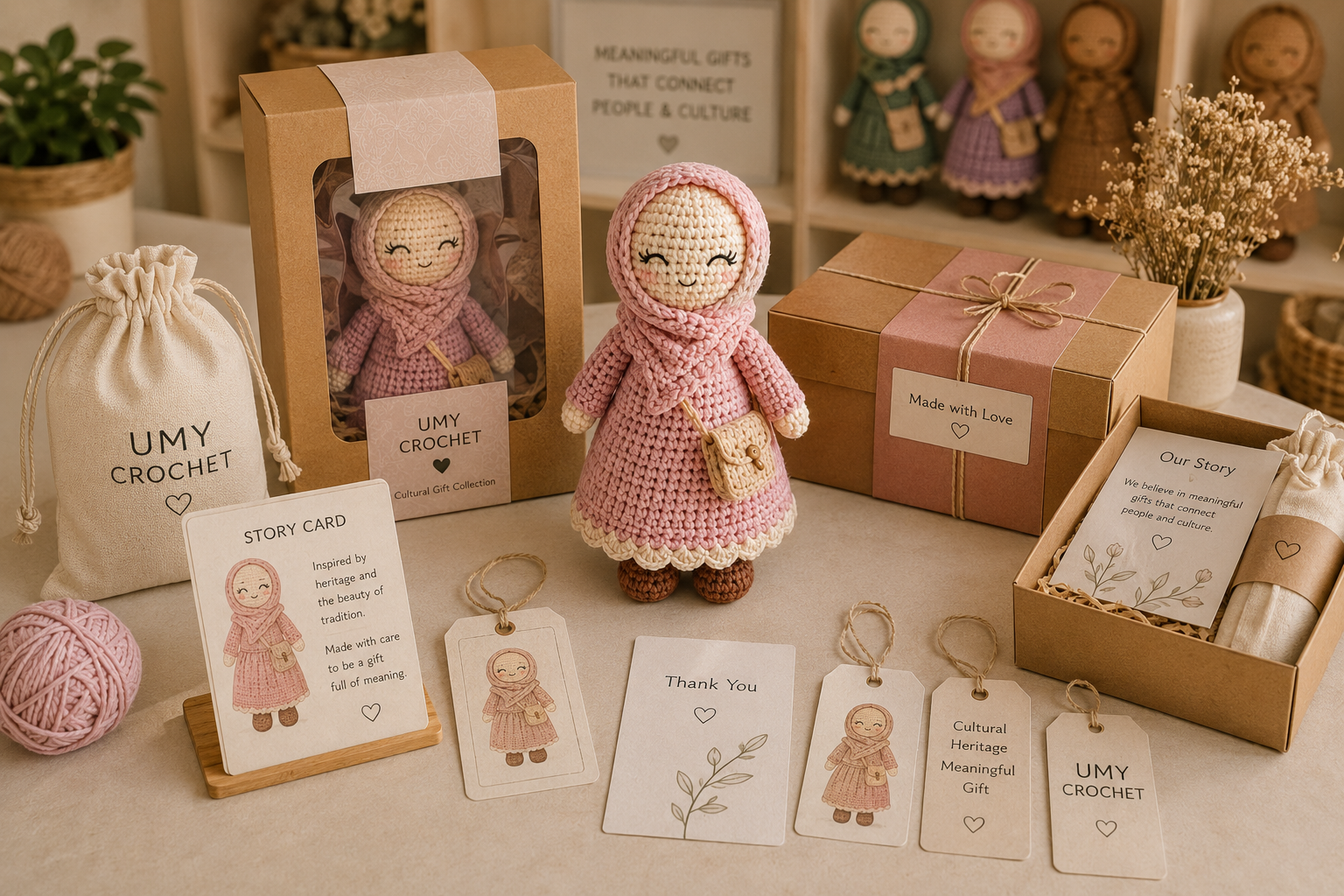
Crochet products can carry a strong visual and tactile identity, which makes story cards useful for certain retail programs.
A story card might explain:
- The inspiration behind the design
- A character's identity
- The collection theme
- Cultural context
- The creative process
- Gift meaning
- Care guidance
This can be especially relevant to museum stores, cultural institutions, destination retail, branded mascots, and gift collections.
However, storytelling should be genuine.
A buyer should not add unsupported claims about artisan origin, sustainability, cultural significance, certifications, or social impact simply because those messages look attractive on packaging.
Claims should match the real product and supply chain.
Step 7: Plan QR Codes for a Specific Purpose
QR codes can extend the packaging beyond the printed surface.
For example, a QR code could lead to:
- Crochet kit instructions
- Tutorial videos
- Product stories
- Care instructions
- Collection pages
- Authorized digital content
- Brand information
But the buyer should decide what the QR code does before printing thousands of packages.
Important questions include:
- Who controls the destination?
- Will the page remain available after the product is sold?
- Does the destination work well on mobile?
- Will different markets require different destinations?
- What happens if the content changes?
- Does the QR code need to be tested on the final printed sample?
A QR code is most useful when it serves a stable customer purpose.
For crochet kits in particular, digital support can complement printed instructions, but it should not be used as an excuse for unclear product documentation.
Step 8: Separate Branding From Required Product Information
Private label packaging gives buyers substantial freedom over visual identity, but branding and compliance information are different considerations.
A buyer may want:
- Logo
- Brand colors
- Character graphics
- Collection artwork
- Marketing statements
- Custom typography
- Gift messaging
At the same time, the product may require specific labels, warnings, traceability information, or other information depending on what the product is, how it is marketed, and where it is sold.
Requirements also vary by market.
Step 9: Control Packaging Artwork Versions
Physical packaging can be correct while the printed information is wrong.
This often happens when several files are being revised at the same time.
For example:
- The product name changes but an old box file remains.
- The barcode is replaced but an earlier artwork version goes to print.
- The character color changes but the package still shows the previous version.
- The instructions are updated but the QR destination is not.
- One SKU uses another SKU's label.
For a multi-SKU collection, this risk increases.
Buyers should therefore use clear artwork approval and version control.
A simple packaging specification can record:
| Item | Approval Point |
|---|---|
| Box structure | Dimensions, material, construction |
| Artwork | Approved version |
| Product image | Correct SKU/version |
| Hangtag | Artwork and attachment method |
| Story card | Content and language |
| Barcode | Correct code for SKU |
| QR code | Correct destination and scan test |
| Insert | Dimensions and product fit |
| Packing method | Product orientation and components |
This documentation becomes valuable for both first production and repeat orders.
Step 10: Sample the Packaging With the Actual Crochet Product
A digital packaging rendering is useful for design communication, but it cannot fully replace a physical packaging sample.
A physical sample allows buyers to evaluate:
- Product fit
- Internal movement
- Product compression
- Visibility
- Opening experience
- Printed appearance
- Component arrangement
- Overall proportions
The packaging should ideally be reviewed as a complete retail unit.
This is especially important if the product has been modified during sampling.
A few centimeters of dimensional change in a crochet character can affect packaging fit. A new accessory can change the internal arrangement. A thicker yarn may alter the overall volume.
Packaging development should therefore remain connected to product development until both are approved.
Step 11: Consider Packing and Shipping Efficiency
Retail packaging has to work beyond the shelf.
It also has to move through production, packing, cartons, transportation, warehousing, and fulfillment.
Buyers should consider:
- Individual package dimensions
- Empty space inside the package
- Outer carton configuration
- Product protection
- Packing complexity
- Whether packages can be stacked efficiently
- Whether delicate crochet details are protected
- Whether excessive compression changes the product shape
A larger package can create a stronger visual presentation, but it can also increase shipping volume.
A smaller package may improve logistics efficiency but create unnecessary compression.
The objective is not automatically to minimize packaging or maximize packaging. It is to find a practical balance between presentation, protection, and logistics.
Step 12: Plan Packaging Around MOQ and Production Reality
Custom packaging can have its own production requirements.
This means the crochet product MOQ and packaging feasibility should be considered together.
UMY's typical working ranges are:
- Stock products: usually around 10–50 pieces per style
- Custom handmade crochet products: typically around 500 pieces per style
- Some simple handmade crochet designs: may be evaluated from around 300 pieces per style
- Custom knitted or plush products: typically start around 1,000 pieces per style
These are general working ranges rather than guaranteed quantities for every project.
Packaging structures, printing methods, materials, number of SKUs, and other custom components can affect the practical order structure.
This matters particularly for buyers planning many designs.
For example, developing six crochet SKUs does not automatically mean that every customized packaging component can be economically produced in six completely different versions at a small quantity.
The packaging strategy should be discussed alongside the collection structure.
A Smarter Approach for Multi-SKU Collections
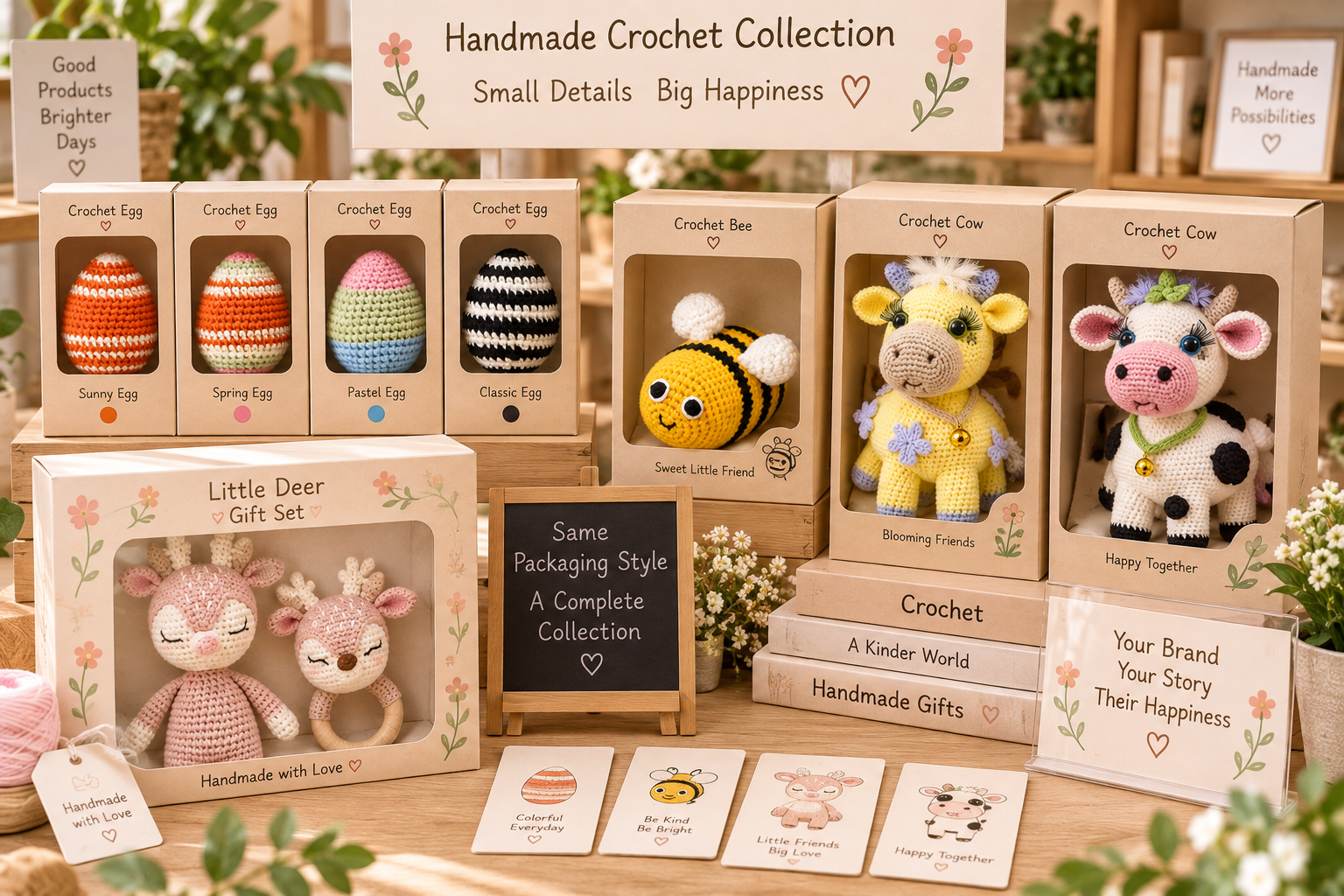
Retailers often want multiple products to look like one coordinated collection.
That does not necessarily require completely different packaging for every SKU.
A collection can sometimes share:
- Box dimensions
- Packaging structure
- Brand layout
- Background design
- Story-card format
- Hangtag shape
- Typography
- Packaging materials
SKU-specific elements can then change where necessary, such as:
- Product name
- Character image
- Color accent
- Barcode
- Product-specific information
This approach can simplify the visual system and may make future collection expansion easier.
It also creates a more coherent shelf presentation.
Packaging for Museum and Cultural Products
Museum and cultural retail creates additional opportunities for packaging to contribute to the product.
A crochet souvenir may represent:
- An artwork
- Historical object
- Animal
- Building
- Local symbol
- Cultural motif
- Exhibition theme
- Institution mascot
In these projects, the package can help connect the physical crochet item to its original story.
Packaging for Corporate Crochet Gifts
Corporate gift projects have different priorities from ordinary retail.
The buyer may want to incorporate:
- Corporate colors
- Logo
- Event theme
- Gift message
- Branded tag
- Presentation box
- Thank-you card
- Campaign-specific insert
The crochet product can remain the central handmade element while the packaging carries more of the corporate identity.
Common Private Label Packaging Mistakes
1. Designing the Box Before the Product Is Stable
The final crochet dimensions may no longer fit the packaging correctly.
2. Focusing Only on the Logo
Private label development involves structure, information, presentation, and packing—not just branding.
3. Ignoring Product Orientation
A character facing sideways or becoming compressed can reduce the intended retail effect.
4. Using Too Much Packaging Text
A clear information hierarchy usually communicates better than filling every available surface.
5. Printing Before Testing QR Codes and Barcodes
Functional elements should be checked on the final artwork or sample.
6. Treating Every SKU as an Independent Packaging Project
Shared packaging architecture can make a collection more coherent and easier to manage.
7. Forgetting Repeat Orders
Packaging specifications and artwork versions should be documented so later orders can be compared with the approved standard.
What Should Buyers Prepare for a Packaging Project?
A useful private label packaging brief can include:
- Crochet product or sample
- Product dimensions
- Number of SKUs
- Brand logo
- Brand guidelines
- Preferred packaging format
- Reference packaging
- Sales channel
- Target market
- Required languages
- Product information
- Barcode requirements
- QR code requirements
- Story or marketing content
- Expected order quantity
- Target launch timing
If some information is not available yet, it can be identified during development.
The important point is to separate decisions that must be made early from decisions that can wait until the product sample is more stable.
How UMY Approaches Crochet Product and Packaging Development
Dongguan U-MY Garment Co., Ltd. has worked in product development and manufacturing since 2013.
For private-label projects, our role is not limited to making a crochet object and leaving the buyer to solve every downstream product issue separately.
Depending on the project scope, development can involve coordination between:
concept → design → sampling → product specification → packaging → production → retail presentation
Custom crochet sampling typically takes around 7–15 days, depending on the actual design and project requirements. Packaging sampling, artwork revisions, specialized components, and other development work should be planned separately according to the project.
This integrated approach is particularly useful when the buyer is developing:
- Retail crochet collections
- Crochet kits
- Gift sets
- Mascot merchandise
- Museum souvenirs
- Cultural products
- Corporate gifts
- Private-label e-commerce products
The objective is to evaluate whether the product and its packaging work together before the project moves into bulk production.
Buyer Checklist Before Approving Private Label Packaging
Before releasing packaging for production, buyers can review the following:
- [ ] Crochet product sample is sufficiently stable
- [ ] Final product dimensions have been checked
- [ ] Packaging structure fits the actual product
- [ ] Product orientation is defined
- [ ] Delicate features are protected
- [ ] Packaging artwork is approved
- [ ] Correct SKU name is shown
- [ ] Product image matches the approved product
- [ ] Hangtags or cards are approved
- [ ] Barcode information is correct
- [ ] QR code has been tested where used
- [ ] Required market information has been evaluated
- [ ] Complete packed sample has been reviewed
- [ ] Packing method is documented
- [ ] Outer-carton implications have been considered
- [ ] Artwork version is controlled
- [ ] Repeat-order references are retained
FAQ
Can crochet products use custom private label packaging?
Yes. Depending on the project, crochet products can be developed with customized boxes, pouches, hangtags, cards, inserts, and other packaging elements. Feasibility depends on the product, packaging structure, quantities, and project requirements.
When should packaging development begin?
Packaging planning can begin during product development, but final dimensions and structure should be checked against a sufficiently stable physical product. Ordering packaging too early can create fit problems if the crochet sample changes.
Is a custom box necessary for every crochet product?
No. Some products may work better with a hangtag, card, pouch, or simpler presentation. The appropriate packaging depends on the sales channel, product positioning, protection requirements, and buyer objectives.
Can multiple crochet products share one packaging design?
They can sometimes share a packaging structure or visual system while using SKU-specific artwork, labels, product names, or barcodes. This can be useful when developing a coordinated retail collection.
Can a QR code be added to crochet product packaging?
Yes, where appropriate. Buyers should define the destination, maintain the linked content, and test the QR code before final printing
Does private label packaging affect MOQ?
It can. Custom packaging and printed components may have their own production requirements, so buyers should evaluate the product and packaging order structure together rather than assuming that the crochet product MOQ automatically applies to every packaging component.
What information is required on crochet packaging?
There is no universal answer for every crochet product. Applicable information depends on product type, intended use, age positioning, destination market, and other factors. Buyers should confirm the requirements that apply to the actual product and market rather than relying on generic packaging examples.
From Handmade Product to Retail-Ready Brand Experience
Private label packaging should make a crochet product easier to identify, protect, understand, merchandise, gift, and reorder.
That requires more than attractive graphics.
Retail buyers should connect five decisions:
the product → the customer → the sales channel → the packaging structure → the production specification
When those decisions are made together, packaging becomes part of product development rather than a last-minute container.
For brands, retailers, gift companies, museums, cultural institutions, e-commerce sellers, and corporate buyers developing crochet merchandise, UMY can evaluate both the crochet product and its packaging requirements as part of a broader product-development and manufacturing project.


 Chinese