
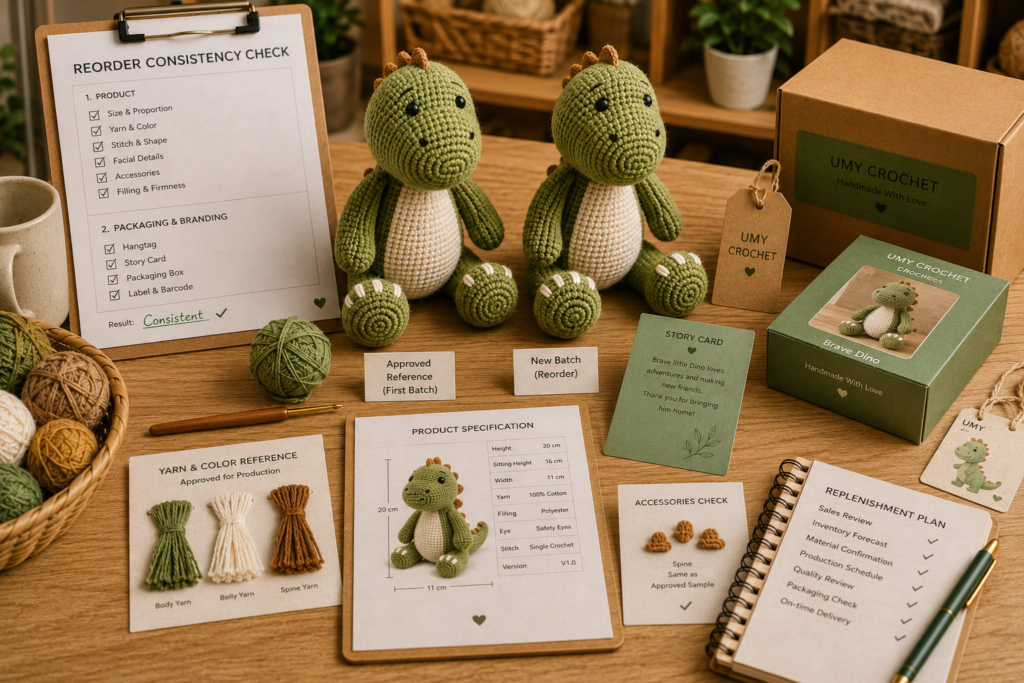
Reordering handmade crochet products successfully is not as simple as sending the previous purchase order again.
The safest approach is to treat the first approved production as a controlled product standard and use that standard to prepare every future reorder. Buyers should preserve the approved sample, yarn and color references, dimensions, facial placement, accessories, packaging files, SKU information, and any agreed production details that define what the product should look like.
Before confirming a reorder, the buyer and manufacturer should also check whether anything has changed:
- Is the same yarn still available?
- Are the approved colors still available?
- Have any accessories changed?
- Is the packaging artwork still current?
- Has the quantity changed significantly?
- Is the destination market or product requirement different?
- Does the buyer want improvements based on customer feedback?
Because crochet is handmade, minor variation is natural. The goal is not machine-level duplication. The goal is controlled consistency—making sure each new batch remains recognizably the same SKU and meets the approved commercial standard.
A practical reorder process is:
Sales Review → Reorder Forecast → Specification Check → Material Confirmation → Change Control → Production Reference → Quality Review → Packaging Verification → Shipment
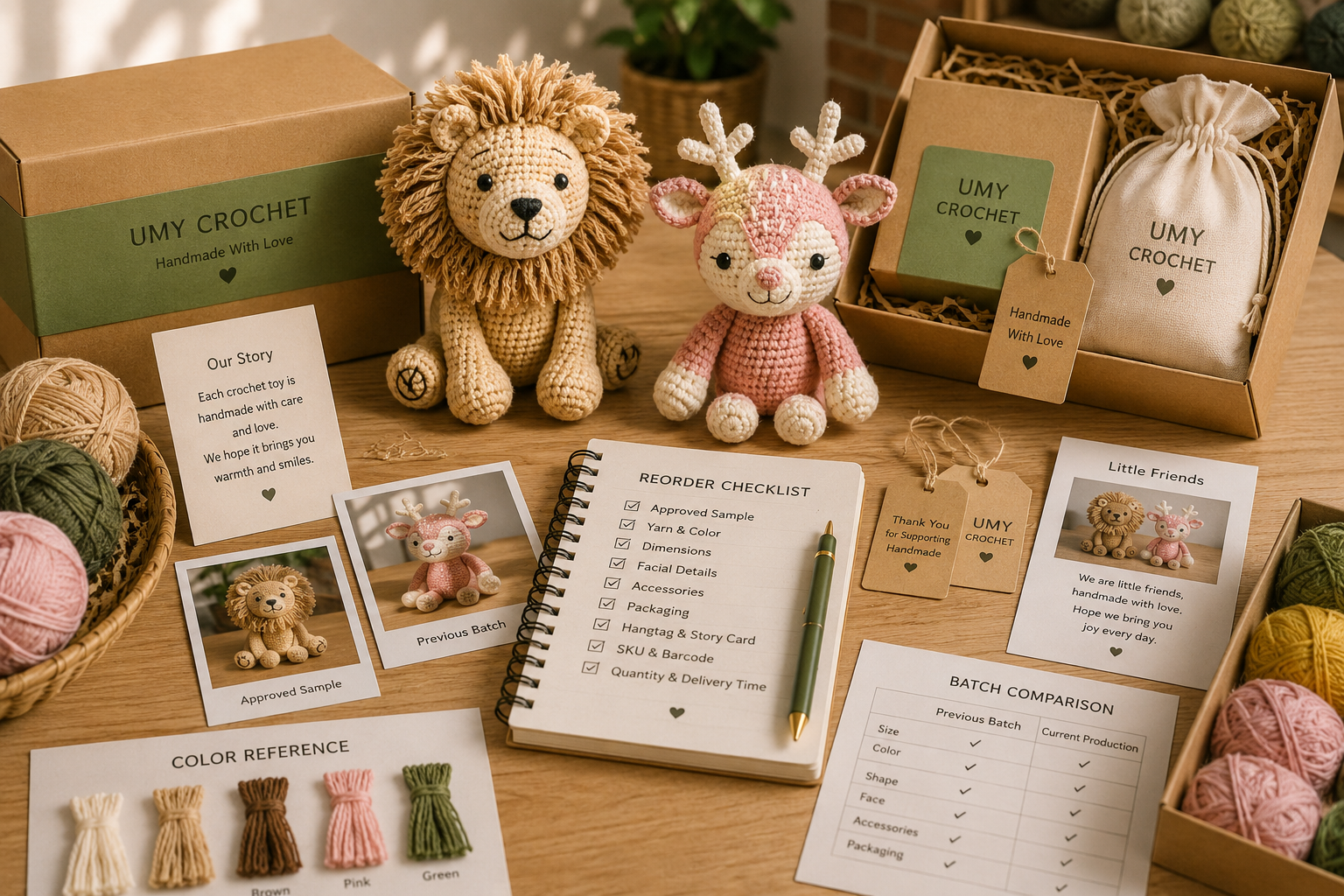
Why Reorders Need Their Own Process
The first order and the second order solve different business problems.
The first order asks:
Can we develop and sell this product successfully?
A reorder asks:
Can we reproduce the successful product without losing what customers already recognize?
That changes the buyer's priorities.
During initial development, teams may focus heavily on:
- Design
- Sampling
- Cost
- Packaging
- Launch timing
During reorders, the focus shifts toward:
- Product consistency
- Material continuity
- Forecast accuracy
- Version control
- Production planning
- Packaging consistency
- Replenishment timing
A reorder should therefore begin with the previous approved product—not with memory.
Handmade Consistency Does Not Mean Machine-Level Uniformity
Handmade crochet products naturally contain small variations.
Two artisans may create slightly different stitch tension.
A finished character may show small differences in:
- Shape
- Positioning
- Filling
- Stitch appearance
- Hand finishing
This is part of handmade production.
However, that does not mean every difference is acceptable.
For a commercial SKU, buyers should expect important characteristics to remain controlled, including:
- Overall dimensions
- Character proportions
- Yarn colors
- Facial placement
- Main stitch structure
- Filling level
- Accessories
- Clothing
- Branding
- Packaging presentation
The objective is to preserve the product's identity while allowing for reasonable handmade variation.
A useful distinction is:
Natural handmade variation = acceptable
Uncontrolled product drift = a problem
What Causes Product Drift Between Reorders?
Product drift happens when a new batch gradually becomes different from the approved version.
It may not begin with one dramatic change.
Instead, several small changes accumulate.
For example:
Original yarn unavailable
↓
New yarn selected
↓
New yarn is slightly thicker
↓
Finished body becomes larger
↓
Packaging fit changes
↓
Product no longer matches the original shelf presentation
This is why reorder consistency depends on more than checking the final product.
Changes upstream can affect the entire SKU.
Common sources of drift include:
- Yarn substitution
- Dye-lot or color differences
- Different yarn thickness
- New accessories
- Different filling
- Pattern changes
- Uncontrolled dimensions
- Facial placement variation
- New packaging suppliers
- Updated printing
- Different labels
- Informal production changes
The buyer may approve some of these changes.
The key is that they should be identified and reviewed, not introduced accidentally.
Step 1: Keep an Approved Reference Sample
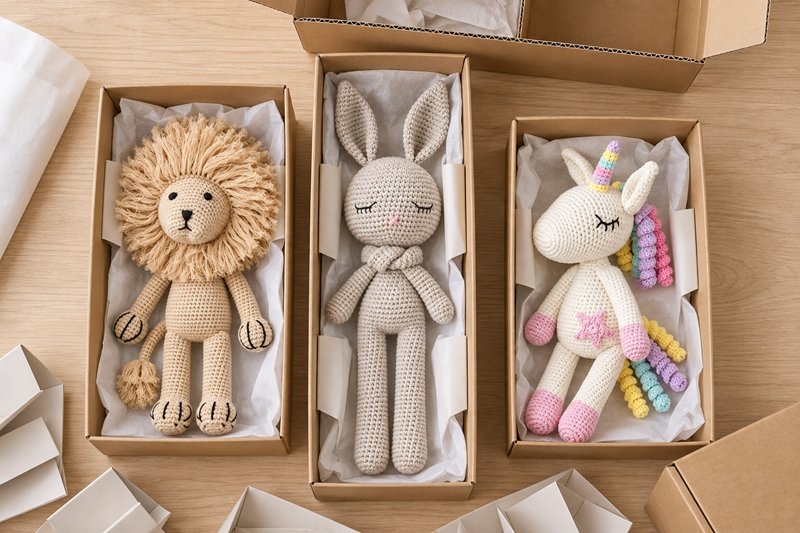
One of the most useful tools for a custom crochet reorder is the approved physical reference sample.
This may be called:
- Approved sample
- Golden sample
- Production reference
- Master sample
Whatever terminology is used, its purpose is the same:
It shows what the commercial product is supposed to be.
A useful approved reference helps production teams compare:
- Shape
- Proportions
- Size
- Facial expression
- Color
- Accessories
- Filling
- Clothing
- Finishing
For character products, this is particularly important because small differences can change the personality of the character.
Buyers Should Keep Their Own Reference Too
Where practical, the buyer should also retain an approved unit from the successful batch.
That allows future comparisons between:
Previous retail product
and
New reorder product
instead of relying only on photographs.
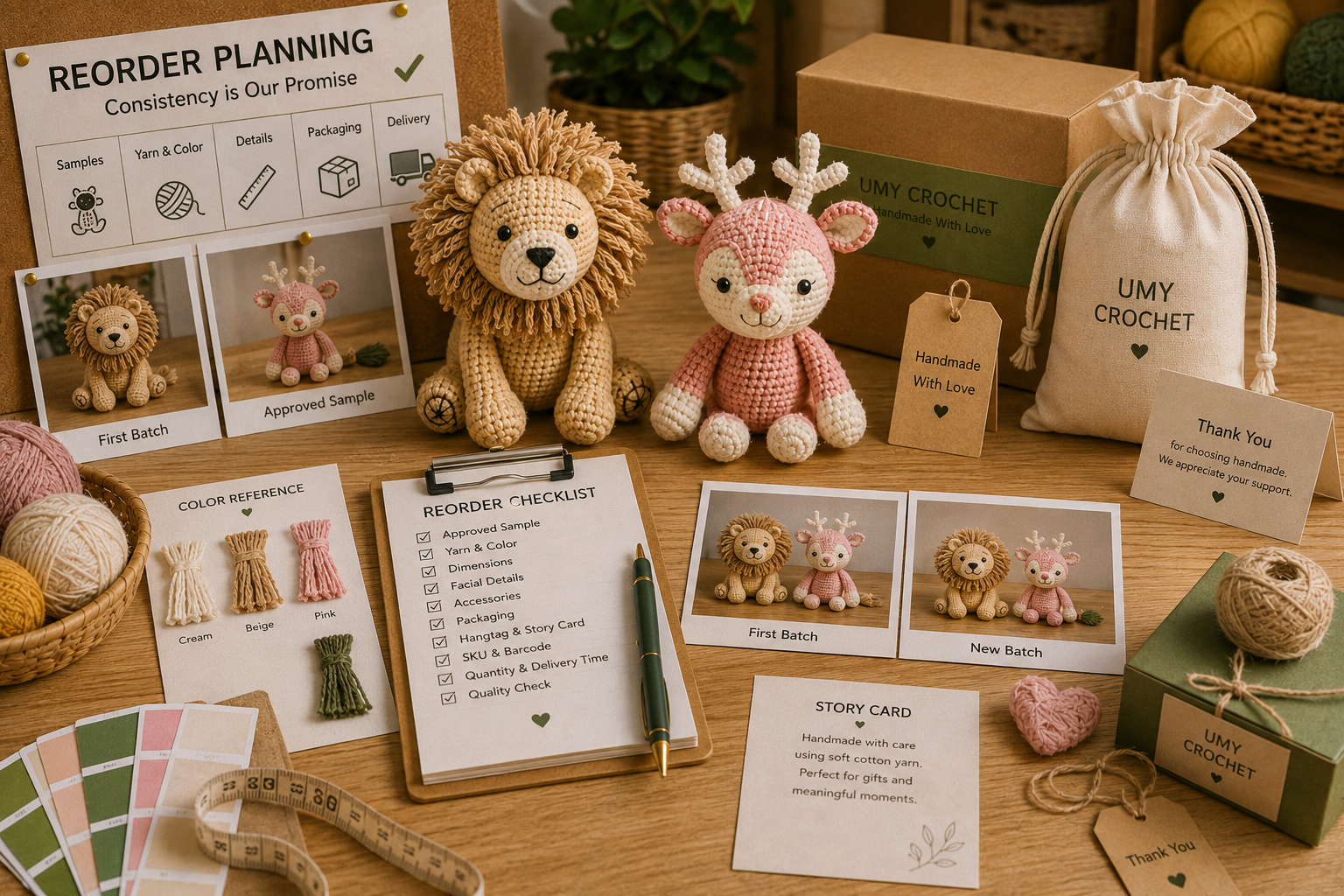
Step 2: Preserve the Product Specification
A physical sample is valuable, but it should not be the only reference.
Important product information should also be documented.
Depending on the SKU, the reorder file may include:
| Product Element | Reorder Reference |
|---|---|
| Product code | Approved SKU |
| Finished size | Target dimensions |
| Yarn | Approved type or reference |
| Colors | Approved color references |
| Pattern | Current production version |
| Face | Eye, nose, mouth positioning |
| Filling | Approved appearance and firmness |
| Accessories | Type, color, size, attachment |
| Clothing | Construction and positioning |
| Branding | Label, hangtag, embroidery, etc. |
| Packaging | Approved structure and artwork version |
This becomes increasingly important when a buyer has:
- Several similar characters
- Multiple sizes
- Seasonal editions
- Different packaging versions
- Retailer-specific SKUs
Without clear records, one SKU can easily be confused with another.
Step 3: Confirm Yarn Before the Reorder Starts
Yarn is one of the most important consistency variables in crochet manufacturing.
Changing yarn can affect:
- Color
- Texture
- Stitch definition
- Product size
- Hand feel
- Structure
- Finished appearance
For this reason, buyers should not assume:
"Same color name" means "same material."
A supplier may offer several shades described as green, pink, cream, or brown.
They may look similar individually but noticeably different when the previous and new batches are displayed together.
Ask These Questions Before Reordering
- Is the original yarn still available?
- Is the same color reference available?
- Has the supplier changed the yarn specification?
- Is sufficient material available for the reorder?
- Will several SKUs need the same color?
- Is there a risk that the replacement yarn changes product dimensions?
If substitution becomes necessary, the replacement should be evaluated before full production.
Step 4: Treat Color as a Controlled Product Feature
Color is especially important for:
- Brand mascots
- Licensed or authorized characters
- Museum products
- Coordinated collections
- Seasonal products
- Products sold beside previous inventory
Imagine a retailer still has 40 units from the first batch and receives 300 units from the reorder.
If the new green is visibly different, customers may effectively see two versions of the same SKU.
That can create problems for:
- Shelf presentation
- Product photography
- Online listings
- Customer expectations
- Collection consistency
For important colors, the reorder process should compare new materials with an approved reference rather than relying only on a color description.
Step 5: Reconfirm Dimensions and Proportions
Size consistency is not only about the total height.
For crochet characters, several proportions may influence recognition:
- Head width
- Head-to-body ratio
- Limb length
- Ear size
- Tail length
- Clothing size
- Accessory placement
This is particularly important for brand characters and mascots.
The product should remain recognizable from batch to batch.
Step 6: Control Facial Placement Carefully
Customers often notice the face before anything else.
[Small changes in:
- Eye spacing
- Eye height
- Nose position
- Mouth shape
- Embroidery angle
can change the character's expression.](https://pmc.ncbi.nlm.nih.gov/articles/PMC12032488/)
A reorder that becomes:
- Happier
- Sadder
- Wider-eyed
- More serious
- Less symmetrical
may technically contain the same components but still feel like a different character.
For this reason, facial placement should be treated as a key production reference for character-based products.
Photographs, measurements, or positioning references can help support consistency.
Step 7: Review Accessories and Clothing
Accessories often create the most recognizable features of a custom crochet product.
Examples include:
- Hats
- Scarves
- Dresses
- Bags
- Glasses
- Crowns
- Flowers
- Uniforms
- Character props
During a reorder, buyers should confirm that the accessory has not changed in:
- Color
- Material
- Size
- Construction
- Position
- Attachment method
This matters particularly when an accessory carries brand meaning.
If customers recognize a mascot through a specific hat or clothing color, that detail should not drift casually between batches.
Step 8: Use Change Control Instead of Silent Substitution
Not every reorder must be identical to the first order.
Sometimes change is useful.
A buyer may want to:
- Improve packaging
- Strengthen an attachment
- Simplify an unnecessary detail
- Update a color
- Replace an unavailable material
- Change a label
- Add a new story card
The problem is not change.
The problem is uncontrolled change.
A simple reorder change process can be:
- Identify the proposed change
- Explain why it is needed
- Evaluate appearance and production impact
- Review a sample or reference where appropriate
- Obtain approval
- Update the product specification
- Record the new version
This prevents the team from asking six months later:
"Which version are we actually producing?"
Create Version Numbers Where Useful
For more complex products, simple version control can help.
For example:
- Dino Green V1 — original launch
- Dino Green V1.1 — packaging update
- Dino Green V2 — approved yarn replacement
The exact naming system is less important than maintaining clarity.
Step 9: Do Not Let Customer Feedback Create Accidental SKU Changes
After a first launch, buyers often receive useful customer feedback.
Examples might include:
- "The scarf comes loose."
- "The box is difficult to open."
- "Customers prefer the darker green."
- "The keychain feels too large."
- "The story card is popular."
This feedback can improve future production.
But buyers should separate two decisions:
Replenishment
Produce the successful SKU again.
Product Revision
Create an improved or changed version.
If these decisions are mixed together, the second batch may no longer match existing inventory or product photography.
A better approach is to ask:
Does this feedback justify changing the current SKU, or should it become a future version?
Not every improvement needs to be introduced immediately.
Step 10: Check Packaging Versions Before Reordering
Packaging is often overlooked during reorder planning.
The crochet product may be correct while the packaging has changed.
Buyers should confirm:
- Correct box
- Correct pouch
- Correct hangtag
- Correct story card
- Correct barcode
- Correct SKU label
- Correct retailer information
- Correct language version
- Correct artwork file
Packaging Inventory Can Affect Reorder Quantity
There may also be packaging materials remaining from the previous order.
Before printing more, check:
- What packaging inventory remains?
- Can it still be used?
- Does it match the current product?
- Has branding changed?
- Has required information changed?
- Is the packaging structurally suitable for the new batch?
This helps avoid unnecessary waste and version confusion.
Step 11: Review Product Requirements Again if the Market or Use Changes
A reorder may appear identical but still involve a new commercial situation.
For example, the first batch may have been sold:
- In one country
while the reorder will be sold:
- In several markets
Or the product may move from:
- Decorative gift positioning
to
- A children's product program
Buyers should therefore avoid assuming that approval for one commercial context automatically covers another.
If the market, use, age positioning, construction, or labeling changes, applicable requirements should be reviewed for the specific project.
Step 12: Forecast Reorders Before Inventory Reaches Zero
Product consistency is not only a manufacturing issue.
It is also a planning issue.
If a buyer waits until inventory is almost gone before placing the reorder, the project may become unnecessarily urgent.
An urgent reorder can reduce flexibility around:
- Material sourcing
- Production scheduling
- Packaging
- Quality review
- Shipping method
A basic reorder trigger can use:
Average Sales Rate + Inventory on Hand + Manufacturing Time + Shipping Time + Safety Buffer
The exact formula depends on the buyer's business.
But the principle is universal:
Reorder before the stockout becomes an emergency.
A Simple Reorder Example
Suppose a retailer has one successful crochet character.
The buyer reviews:
- Current inventory
- Weekly sales
- Upcoming promotions
- Seasonal demand
- Reorder quantity
- Production planning
- Freight method
Instead of waiting until only a few pieces remain, the buyer begins discussions early enough for the manufacturer to check:
- Yarn availability
- Packaging availability
- Production scheduling
- Product specification
- Any proposed changes
This creates more time to solve problems before they affect retail availability.
Step 13: Do Not Automatically Reorder the Same Quantity
A successful first order does not mean the second order should be identical in quantity.
Use actual sales information.
Consider:
- Sell-through speed
- Current inventory
- Expected growth
- Seasonal changes
- Marketing campaigns
- Number of stores
- New sales channels
- Product lifecycle
For example, a retailer may discover:
- Hero character sells fastest
- Mini keychain sells steadily
- Premium gift set sells slower
- Seasonal version has a shorter selling window
The next purchase should reflect those differences.
This is especially important for collections.
Step 14: Plan Materials Across Multiple SKUs
If several products share materials, buyers and manufacturers may be able to plan the reorder as a collection rather than as isolated SKUs.
Products may share:
- Yarn colors
- Filling
- Labels
- Hangtags
- Boxes
- Story cards
- Accessories
For example, three characters may use the same cream yarn.
Planning that material together can improve visibility into total demand.
However, shared materials also create dependencies.
If the cream yarn changes, three SKUs may be affected instead of one.
Collection-level planning should therefore combine efficiency with clear material control.
Step 15: Confirm the First Production Units Against the Approved Reference
An early production comparison can help confirm:
- Product size
- Shape
- Yarn
- Color
- Facial placement
- Accessories
- Packaging
before too much of the order has been completed.
This is especially valuable when:
- A long time has passed since the previous order
- Materials changed
- Quantity increased substantially
- Packaging changed
- A new version was approved
Early confirmation can make systematic differences easier to identify.
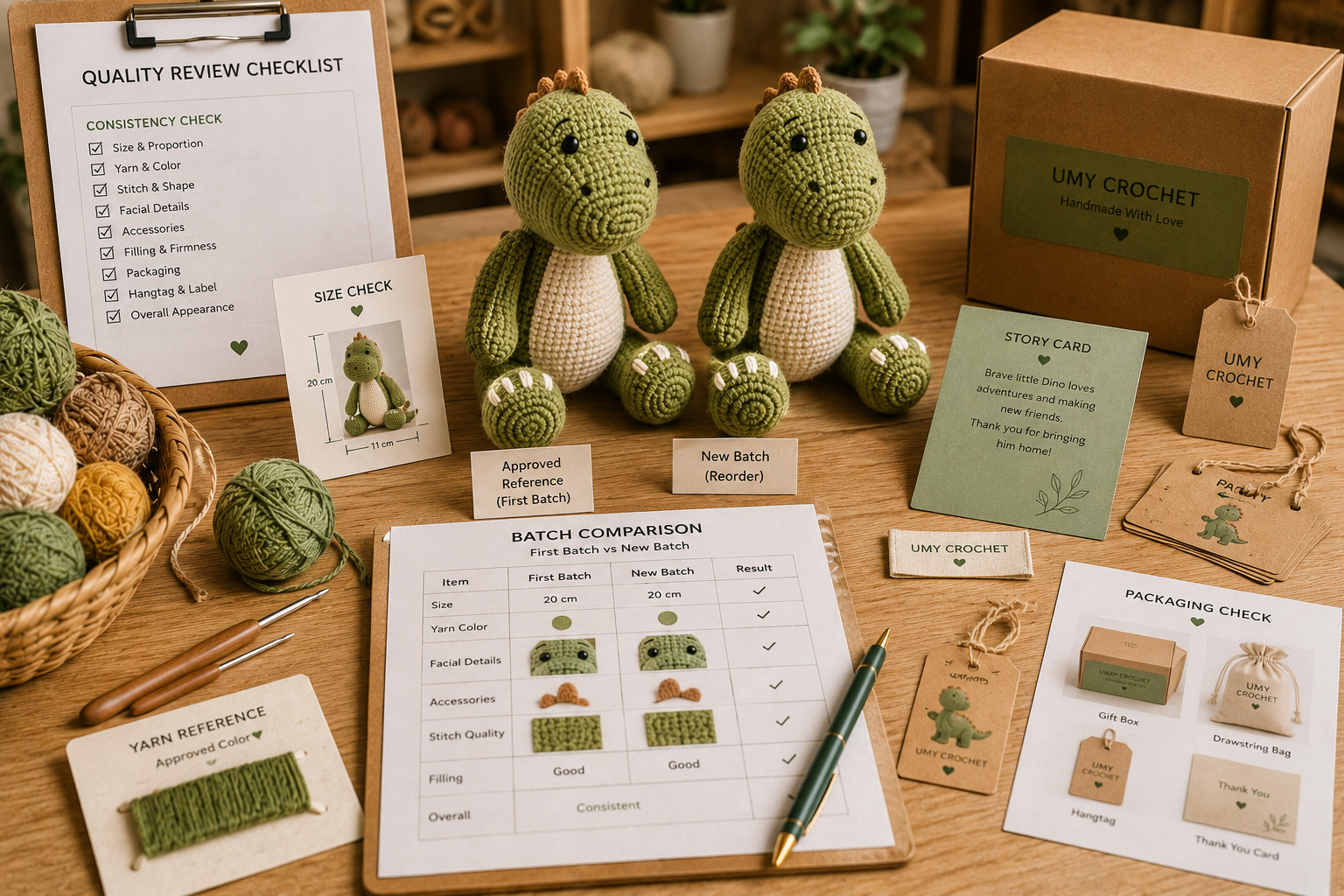
Step 16: Keep Packaging and Product QC Connected
The customer's SKU is not only the crochet item.
In retail, the complete SKU may be:
Crochet Product + Hangtag + Story Card + Label + Packaging
If any one of those elements is wrong, the reorder may create a retail problem.
For example:
- Correct dinosaur + wrong story card
- Correct doll + previous barcode
- Correct character + wrong packaging color
- Correct product + missing accessory
The final reorder review should therefore consider the complete retail unit.
Ready Stock and Custom Crochet Need Different Reorder Questions
Reorder planning differs depending on the sourcing model.
Ready-Stock Reorder
Key questions include:
- Is the SKU still available?
- Is current stock sufficient?
- Has the product changed?
- Is the same color available?
- What quantity can be confirmed?
Ready-stock availability should be confirmed at the time of reorder rather than assumed.
Custom Crochet Reorder
Key questions include:
- Is the approved specification still current?
- Are the original materials available?
- Does the buyer want any revisions?
- Is the packaging version unchanged?
- Is the reorder quantity different?
- Does production planning need adjustment?
Custom reorders depend more heavily on reference control.
Reordering After a Long Gap Needs Extra Attention
A reorder after three months and a reorder after several years are not the same situation.
The longer the gap, the more likely something may have changed.
Possible changes include:
- Yarn availability
- Color availability
- Accessory supply
- Packaging suppliers
- Artwork
- Buyer branding
- Product requirements
- Retail positioning
Before restarting an older SKU, review it as an active commercial product rather than assuming every historic component is still available.
In some cases, a confirmation sample may be appropriate before production.
How to Handle Necessary Material Substitutions
Sometimes the original material is no longer available.
That does not automatically mean the SKU must be discontinued.
The manufacturer and buyer can evaluate a replacement.
For yarn, compare:
- Color
- Thickness
- Texture
- Hand feel
- Stitch appearance
- Finished size
For accessories, compare:
- Appearance
- Dimensions
- Material
- Function
- Attachment
For packaging, compare:
- Structure
- Dimensions
- Material
- Print appearance
- Retail presentation
The replacement should be evaluated based on how it affects the complete product.
A substitution should not be accepted simply because the new component has the same supplier description.
When Should You Create a New SKU Instead of Calling It a Reorder?
Sometimes a product changes enough that it should no longer be treated as the same SKU.
Possible examples include:
- Major size change
- Different colorway
- New clothing
- New character expression
- New target market
- New product function
- Major packaging repositioning
- Significant design revision
There is no universal threshold.
The commercial question is:
Would a customer reasonably consider the new item the same product?
If the answer is uncertain, the buyer should consider whether the change requires:
- A new SKU
- A new product listing
- New photography
- New packaging
- New compliance review
- Separate inventory records
Clear SKU architecture helps avoid confusion later.
A Practical Reorder Consistency Checklist
Before confirming a handmade crochet reorder, buyers can review the following:
Sales and Inventory
- [ ] Current inventory checked
- [ ] Sell-through reviewed
- [ ] Reorder quantity justified
- [ ] Upcoming campaigns considered
- [ ] Stockout risk evaluated
Product
- [ ] Approved reference available
- [ ] Product dimensions confirmed
- [ ] Character proportions confirmed
- [ ] Face and embroidery references available
- [ ] Accessories confirmed
- [ ] Clothing confirmed
- [ ] Filling standard confirmed
Materials
- [ ] Yarn availability confirmed
- [ ] Yarn colors confirmed
- [ ] Replacement materials identified if necessary
- [ ] Shared materials across SKUs reviewed
Packaging
- [ ] Packaging version confirmed
- [ ] Artwork version confirmed
- [ ] Hangtag confirmed
- [ ] Story card confirmed
- [ ] Barcode or SKU label confirmed
- [ ] Remaining packaging inventory checked
Production
- [ ] Current specification confirmed
- [ ] Proposed changes documented
- [ ] Production schedule reviewed
- [ ] Early production reference planned
- [ ] Final packed-unit review planned
Commercial Requirements
- [ ] Target market confirmed
- [ ] Product use confirmed
- [ ] Age positioning confirmed where relevant
- [ ] Changed requirements reviewed where applicable
Common Reorder Mistakes Buyers Should Avoid
Mistake 1: Saying “Same as Last Time” Without Documentation
The longer the time between orders, the less reliable memory becomes.
Use approved references.
Mistake 2: Approving Material Substitutions by Description Alone
“Green cotton yarn” does not define a commercial product precisely enough.
Evaluate the effect on the finished SKU.
Mistake 3: Ignoring Packaging
A correct crochet product with incorrect packaging is still an incorrect retail unit.
Mistake 4: Introducing Multiple Changes at Once
Mistake 5: Reordering Too Late
Urgency reduces planning flexibility.
Mistake 6: Treating Every Customer Suggestion as an Immediate Revision
Some feedback should influence future versions rather than changing the current bestseller.
Mistake 7: Expecting Handmade Products to Look Machine-Identical
The correct goal is controlled consistency, not eliminating every natural handmade difference.
Mistake 8: Accepting Uncontrolled Variation Because the Product Is Handmade
How UMY Approaches Crochet Reorders
UMY has been involved in product development and manufacturing since 2013.
For custom handmade crochet programs, a reorder can be managed around the approved product and production references rather than beginning the development process from zero.
Depending on the project, reorder preparation may include:
- Reviewing the approved sample
- Confirming yarn and colors
- Checking accessories
- Reviewing product specifications
- Confirming packaging
- Identifying requested changes
- Checking production planning
- Reviewing initial production output
- Maintaining consistency across the complete retail unit
When a change is necessary, the goal is to understand its effect before it becomes part of the new batch.
This is especially important for brands building:
- Long-term characters
- Retail collections
- Seasonal programs
- Gift lines
- Museum merchandise
- Replenishment programs
A successful reorder should feel familiar to the returning customer even though it was made in a new production batch.
Frequently Asked Questions
Can handmade crochet products be consistent across reorders?
Yes. Handmade products naturally have minor variation, but commercial consistency can be managed through approved reference samples, product specifications, controlled materials, production standards, and quality checkpoints.
Should every crochet reorder require a new sample?
Not necessarily. It depends on the project. A confirmation sample may be useful when materials, design, packaging, or specifications have changed, or when a significant amount of time has passed since the previous production.
What happens if the original yarn is unavailable?
Can colors change between crochet production batches?
Small material variation may occur, but important commercial colors should be controlled against approved references. Buyers should especially review color when old and new inventory may be sold together.
Should packaging be checked again on a reorder?
Yes. Confirm the correct artwork, box or pouch, hangtag, story card, SKU label, barcode, and any market-specific information before packaging production or assembly begins.
When should retailers place a crochet reorder?
There is no universal reorder point. Buyers should work backward from expected inventory depletion while considering sales rate, production planning, shipping time, upcoming promotions, and a reasonable safety buffer.
Can I change my crochet product during a reorder?
Yes, but changes should be documented and evaluated. If the change significantly alters the product, the buyer may want to treat it as a new version or new SKU rather than silently replacing the existing one.
Do ready-stock crochet products remain permanently available?
Not necessarily. Availability can change, so stock and product status should be reconfirmed when a reorder is needed.
What information should I send when reordering custom crochet?
Useful information includes the previous product or PO reference, SKU, quantity, required delivery timing, packaging version, and any requested changes. If nothing should change, make that expectation explicit and confirm the approved production reference.
Conclusion
A successful handmade crochet reorder is not created by simply repeating the previous purchase order.
It is created by preserving the product knowledge behind the successful SKU.
That means controlling:
Approved Sample + Materials + Color + Dimensions + Character Details + Accessories + Packaging + Version History + Production References
while also planning the commercial side of replenishment:
Sales Rate + Inventory + Forecast + Production Timing + Shipping Buffer
Handmade products will always contain some natural variation.
That is part of their character.
But successful brands and retailers should not allow natural variation to become uncontrolled drift.
The goal is controlled consistency—so that a customer who buys the product today and another customer who buys the reorder months later still recognize the same product, character, quality level, and retail experience.
For long-term crochet programs, that discipline turns a successful first batch into something much more valuable:
a repeatable product that can be replenished, scaled, and developed into a lasting collection.
 Chinese