
A Complete Guide to Getting Faster, More Accurate Quotes for Custom Crochet Products
One of the most common questions buyers ask after finding a crochet manufacturer is:
"Can you give me a price?"
Our answer is always:
Absolutely—but first we need to understand your project.
Many buyers worry that they don't have enough information before requesting a quotation.
Others assume they need professional technical drawings or detailed specifications before contacting a factory.
In reality, that's rarely the case.
At UMY Crochet Factory, we have specialized in crochet manufacturing since 2013, helping retailers, museum stores, gift brands, distributors, startups, and corporate buyers across more than 150 countries and regions develop custom crochet products.
After supporting thousands of quotation requests over the past 12 years, we've found that the speed and accuracy of a quotation depends largely on the quality of information provided—not on the complexity of the product.
This guide explains exactly what crochet factories need before preparing an accurate quotation and how buyers can make the quotation process faster, smoother, and more efficient.
Why Accurate Project Information Matters
Many buyers believe pricing is determined only by product size.
In reality, crochet manufacturing involves many interconnected variables.
Before preparing a quotation, manufacturers need to evaluate:
- Product complexity
- Labor time
- Material consumption
- Packaging
- Production efficiency
- Sampling requirements
- Compliance requirements
- Delivery schedule
One lesson we've learned is:
Better project information leads to better quotations—not necessarily more complicated information.
What Happens Before a Crochet Factory Calculates a Price?
Before preparing a quotation, experienced manufacturers usually complete an internal project evaluation.
This typically includes:
- Product assessment
- Technical feasibility review
- Material estimation
- Labor estimation
- Packaging evaluation
- Production planning
- Compliance review
- Shipping preparation
Only after these factors are reviewed can an accurate quotation be prepared.
The 8 Essential Pieces of Information Every Factory Needs
1. Product Images or Design References
The most important information is simply:
What do you want to make?
Useful references include:
- Product photos
- Hand sketches
- AI-generated artwork
- Character illustrations
- Existing samples
- Mood boards
Perfect drawings are not required.
Our development team evaluates the overall concept rather than artistic quality.
2. Product Size
Size directly affects:
- Yarn consumption
- Labor hours
- Packaging dimensions
- Shipping costs
Whenever possible, provide approximate measurements such as:
- Height
- Width
- Diameter
Even estimated dimensions help us prepare a more accurate quotation.
3. Estimated Order Quantity
Quantity significantly influences production efficiency.
Typical information includes:
- Initial order quantity
- Future production plans
- Expected annual demand
One thing we've consistently observed is:
Buyers who share realistic quantity expectations usually receive more practical production recommendations.
4. Materials
If you have material preferences, let your manufacturer know.
Examples include:
- Organic cotton
- Velvet yarn
- Recycled fibers
- Wooden rings
- Embroidered details
- Safety eyes
If you aren't sure which materials are appropriate, your manufacturer should recommend suitable options based on your market.
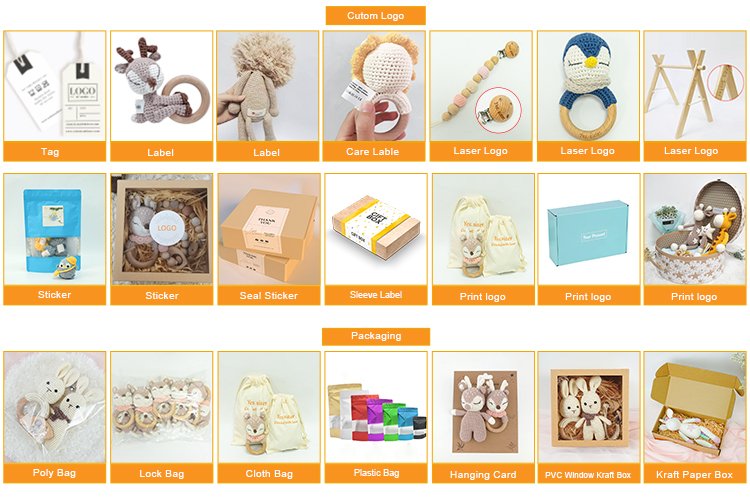
5. Packaging Requirements
Packaging is often underestimated.
Please indicate whether you need:
- Poly bags
- Kraft gift boxes
- Printed gift boxes
- Story cards
- Hang tags
- Barcode labels
- Display packaging
One lesson we've learned from thousands of quotation requests is:
Packaging sometimes affects pricing as much as the product itself.
6. Target Market
Different countries have different requirements.
For example:
United States:
- CPC
- ASTM F963
European Union:
- CE
- EN71
United Kingdom:
- UKCA
Australia:
- AS/NZS ISO 8124
Knowing your destination market allows manufacturers to recommend appropriate materials and compliance solutions from the beginning.
7. Expected Delivery Timeline
Please tell your manufacturer:
- Product launch date
- Event date
- Seasonal sales schedule
- Promotional campaign timing
Production planning becomes much more efficient when delivery expectations are known early.
8. Customization Requirements
Tell the factory what needs to be customized.
Examples include:
- Colors
- Clothing
- Accessories
- Embroidery
- Packaging
- Brand labels
- Story cards
- Product combinations
The more clearly your expectations are communicated, the more accurate the quotation becomes.
Information That Is Helpful—But Not Required
Many first-time buyers worry they cannot request a quotation because they don't yet have every project detail.
Don't worry.
At UMY, we regularly help customers who begin with only:
- A sketch
- A product photo
- An idea
- A target customer
- A rough budget
Our development team helps fill in the remaining technical details throughout the project.
One thing we've learned is:
Good collaboration fills the gaps.
How Experienced Crochet Factories Evaluate Quotations
An experienced crochet manufacturer doesn't simply calculate material costs.
Instead, the quotation process considers:
Product complexity
How many production steps are required?
Handmade labor time
How long will each product take to complete?
Material consumption
How much yarn and accessory material is required?
Production efficiency
Can production be standardized?
Packaging
Will custom packaging require additional setup?
Quality control
Are additional inspection procedures necessary?
Compliance
Will testing or certification affect production?
A reliable quotation reflects the complete manufacturing process—not just the product itself.
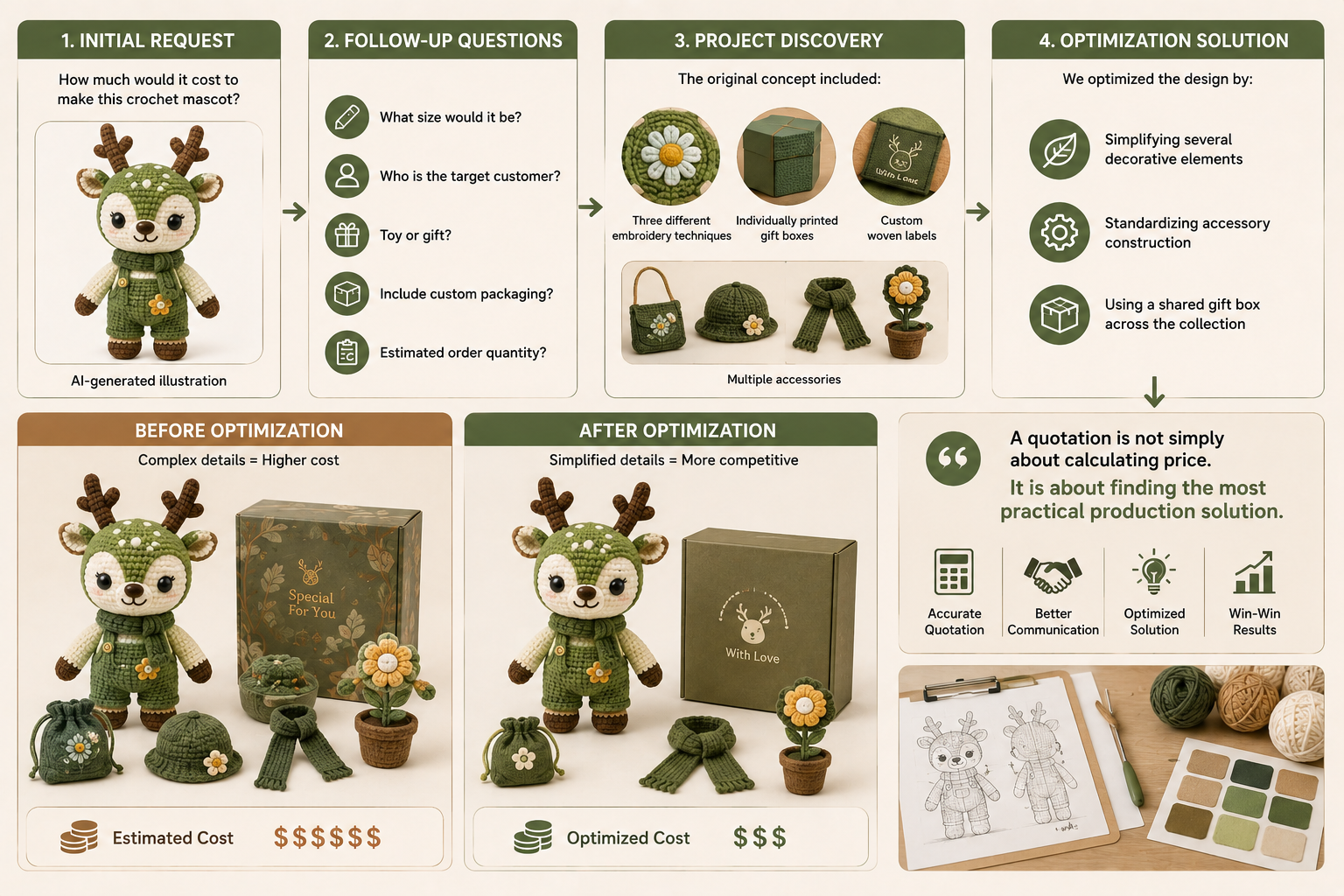
Real Project Example: From Inquiry to Accurate Quotation
One startup gift brand contacted us with a simple request:
"How much would it cost to make this crochet mascot?"
Initially, the customer only provided an AI-generated illustration.
Instead of immediately estimating a price, our team asked several follow-up questions:
- What size would the product be?
- Who is the target customer?
- Is it intended as a toy or a gift?
- Will it include custom packaging?
- What is the estimated order quantity?
After discussing the project, we discovered that the original concept included:
- Three different embroidery techniques
- Individually printed gift boxes
- Custom woven labels
- Multiple accessories
These details significantly affected production costs.
Together, we optimized the design by:
- Simplifying several decorative elements
- Standardizing accessory construction
- Using a shared gift box across the collection
The final quotation became more competitive while preserving the product's overall appearance and brand identity.
This project reinforced one important lesson:
A quotation is not simply about calculating price.
It is about finding the most practical production solution.
What We Commonly Observe Across Quotation Requests
After supporting customers across more than 150 countries and regions, we've noticed several consistent patterns.
Buyers often believe they need every detail before contacting a factory.
In reality, experienced manufacturers can usually guide product development from relatively simple reference materials.
Product complexity influences price more than size.
A small character with multiple accessories often costs more than a larger product with a simple structure.
Packaging is frequently overlooked.
Many buyers focus entirely on the crochet product while forgetting that packaging may significantly influence overall project costs.
Early communication saves time.
Projects with clear communication generally require fewer quotation revisions and move into sampling more quickly.
Long-term cooperation begins with accurate information.
The most successful partnerships usually begin with transparent discussions rather than immediate price negotiations.
One lesson we've consistently learned is:
Accurate quotations are built through collaboration—not guesswork.
Common Mistakes Buyers Make Before Requesting a Quote
Asking Only for "Your Best Price"
Price without project information is rarely meaningful.
An experienced manufacturer needs to understand the complete project before providing an accurate quotation.
Ignoring Packaging Requirements
Packaging influences:
- Cost
- MOQ
- Production planning
- Shipping
Waiting until production begins often creates unnecessary revisions.
Not Mentioning the Target Market
Compliance requirements vary significantly between countries.
Sharing your destination market early allows the factory to recommend appropriate materials and testing requirements.
Changing Product Specifications After Quotation
Major changes to:
- Size
- Materials
- Accessories
- Packaging
often require a revised quotation.
The earlier these details are discussed, the smoother the development process becomes.
Focusing Only on Unit Price
Experienced buyers evaluate much more than cost.
They also consider:
- Product quality
- Development capability
- Lead time
- Consistency
- Communication
- Long-term partnership value
One thing we've consistently observed is:
The lowest quotation rarely delivers the lowest overall business cost.
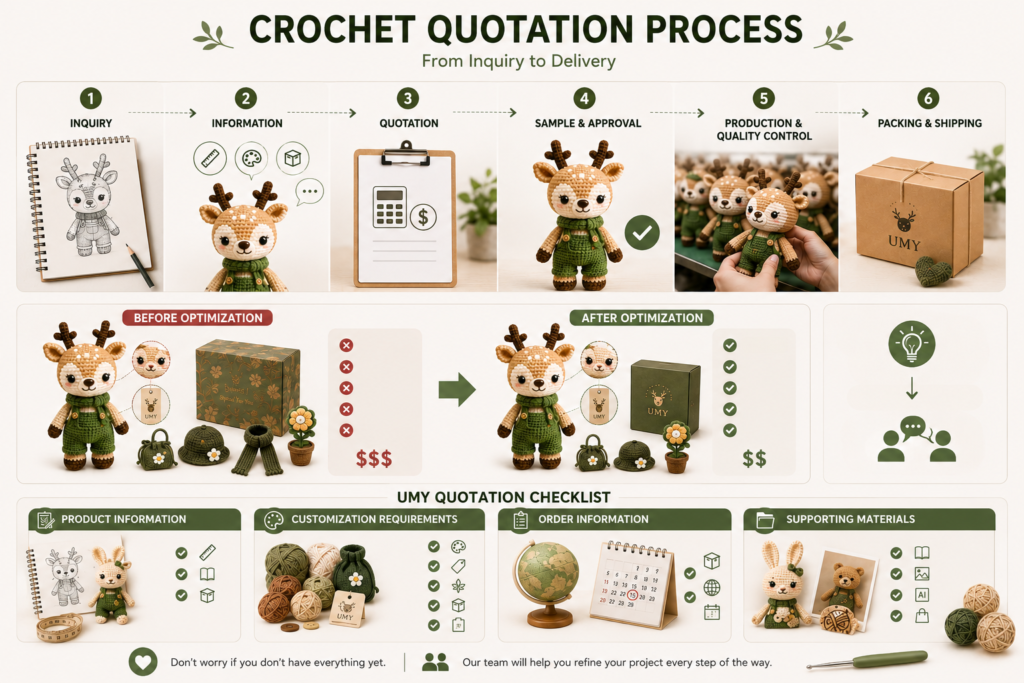
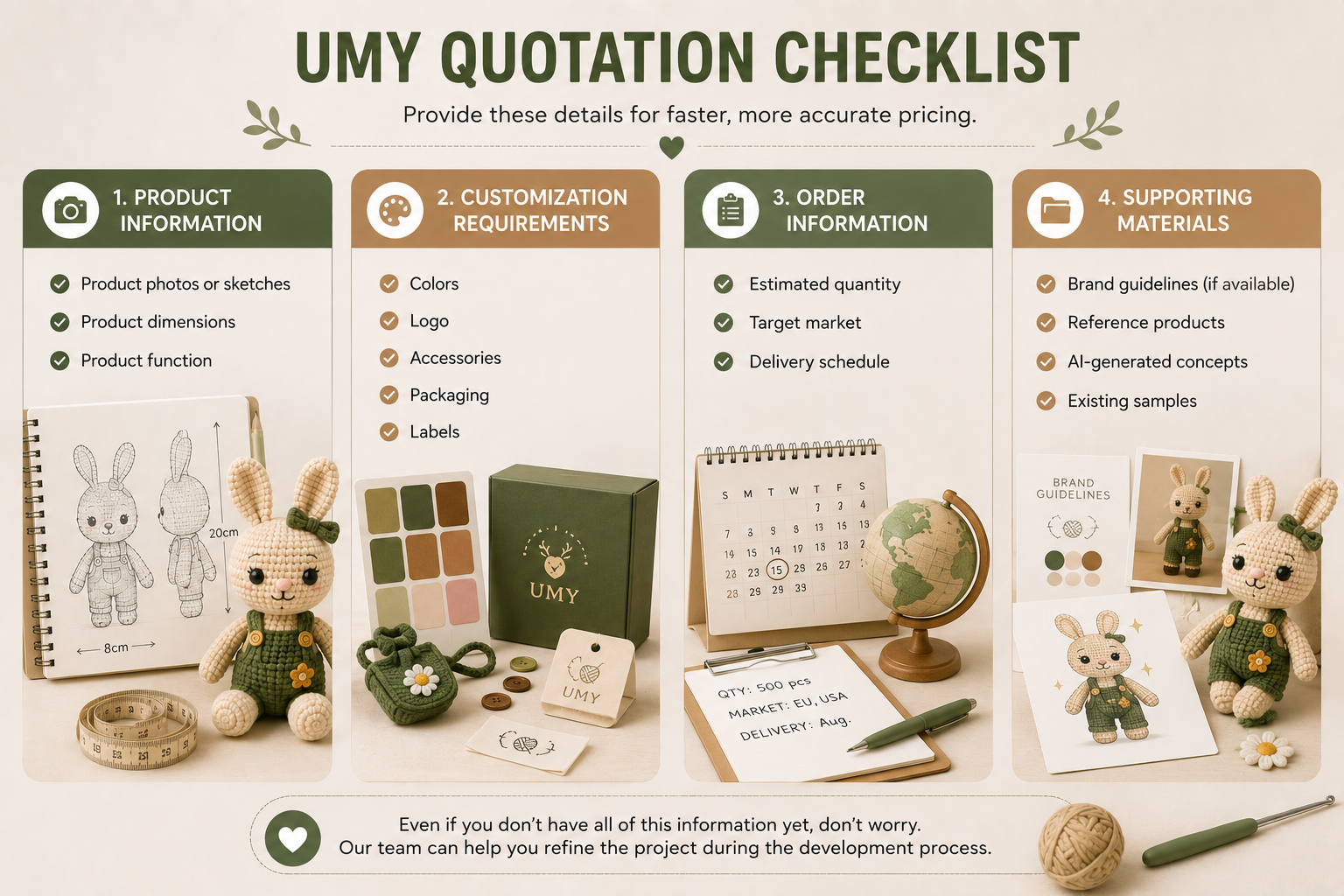
UMY Quotation Checklist
Before requesting a quotation, preparing the following information helps manufacturers provide faster and more accurate pricing.
Product Information
✓ Product photos or sketches
✓ Product dimensions
✓ Product function
Customization Requirements
✓ Colors
✓ Logo
✓ Accessories
✓ Packaging
✓ Labels
Order Information
✓ Estimated quantity
✓ Target market
✓ Delivery schedule
Supporting Materials
✓ Brand guidelines (if available)
✓ Reference products
✓ AI-generated concepts
✓ Existing samples
Even if you don't have all of this information yet, don't worry.
Our team can help you refine the project during the development process.
Why Experienced Manufacturers Ask So Many Questions
Some buyers worry that too many questions will slow down the quotation process.
In reality, the opposite is true.
Each question helps reduce uncertainty.
By understanding your goals early, manufacturers can recommend:
- Better construction methods
- More suitable materials
- Cost-saving opportunities
- Faster production solutions
- Packaging improvements
After supporting custom crochet projects for more than 12 years, we've found that the best quotations are rarely the fastest—they are the most accurate.
UMY Crochet Factory at a Glance
Since 2013, UMY has specialized exclusively in crochet manufacturing.
Today we support customers across more than 150 countries and regions, helping transform ideas into commercially successful crochet products.
Our capabilities include:
- 12+ years of crochet manufacturing experience
- Customers in 150+ countries and regions
- 2,000+ artisan production network
- OEM and ODM product development
- Sample development in approximately 7–15 working days, depending on project complexity
- Product design optimization
- Packaging development
- International quality management processes
- Support for retailers, museum stores, gift brands, distributors, startups, and corporate buyers
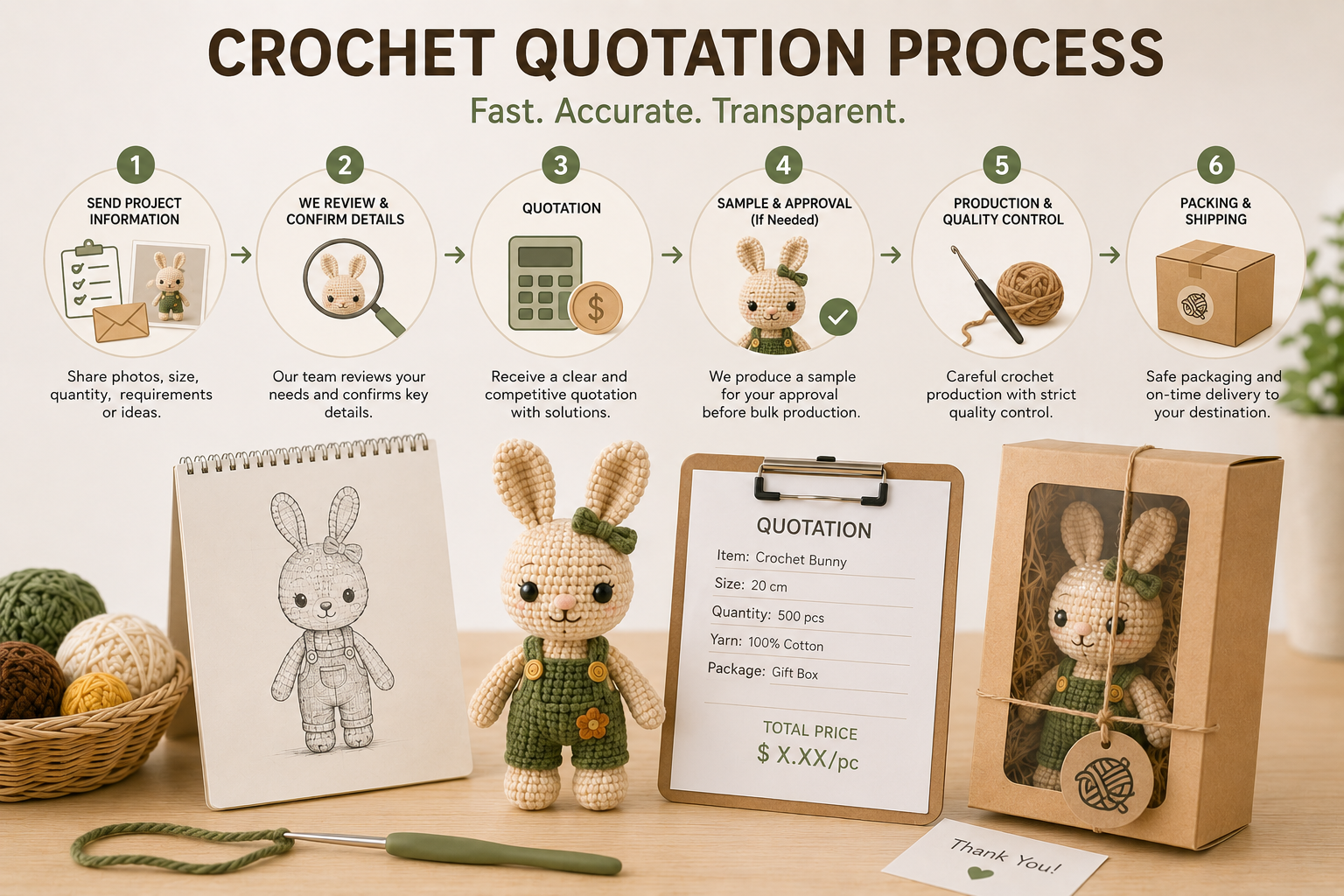
From quotation and sampling to production and packaging, our team supports every stage of product development.
Frequently Asked Questions
Can I request a quotation with only a product photo?
Yes.
A reference photo is often enough for an initial evaluation.
Additional project details can be discussed afterward.
Do I need professional technical drawings?
No.
Sketches, AI-generated artwork, illustrations, and product photos are all useful starting points.
What information most affects pricing?
The primary factors include:
- Product complexity
- Size
- Materials
- Quantity
- Packaging
- Customization requirements
Can you recommend ways to reduce costs?
Absolutely.
Our development team frequently suggests design and packaging optimizations that improve production efficiency while maintaining product quality.
How quickly can I receive a quotation?
Most quotation requests can receive an initial evaluation within 1–3 working days, depending on project complexity and the completeness of the information provided.
Will my quotation change later?
Minor adjustments usually have little impact.
However, significant changes to product size, materials, packaging, or customization requirements may require a revised quotation.
Final Thoughts
Requesting a quotation is more than asking for a price.
It is the beginning of a successful product development partnership.
After supporting retailers, museum stores, gift brands, distributors, startups, and corporate buyers across more than 150 countries and regions, we've learned that the most successful projects begin with open communication and clear project goals.
An accurate quotation reflects much more than manufacturing costs.
It reflects:
✓ Product feasibility
✓ Material selection
✓ Production planning
✓ Packaging strategy
✓ Compliance requirements
✓ Long-term commercial success
The more your manufacturing partner understands your project, the better they can recommend solutions that balance quality, efficiency, and cost.
Ready to Request a Quote for Your Custom Crochet Project?
At UMY Crochet Factory, we help buyers transform ideas into production-ready crochet products with transparent quotations and practical manufacturing advice.
Whether you have a simple sketch, an AI-generated concept, or a fully developed product specification, our team can guide you through every stage—from quotation and sample development to packaging and large-scale production.
Contact us today to discuss your project and receive a quotation tailored to your business goals.
 Chinese