
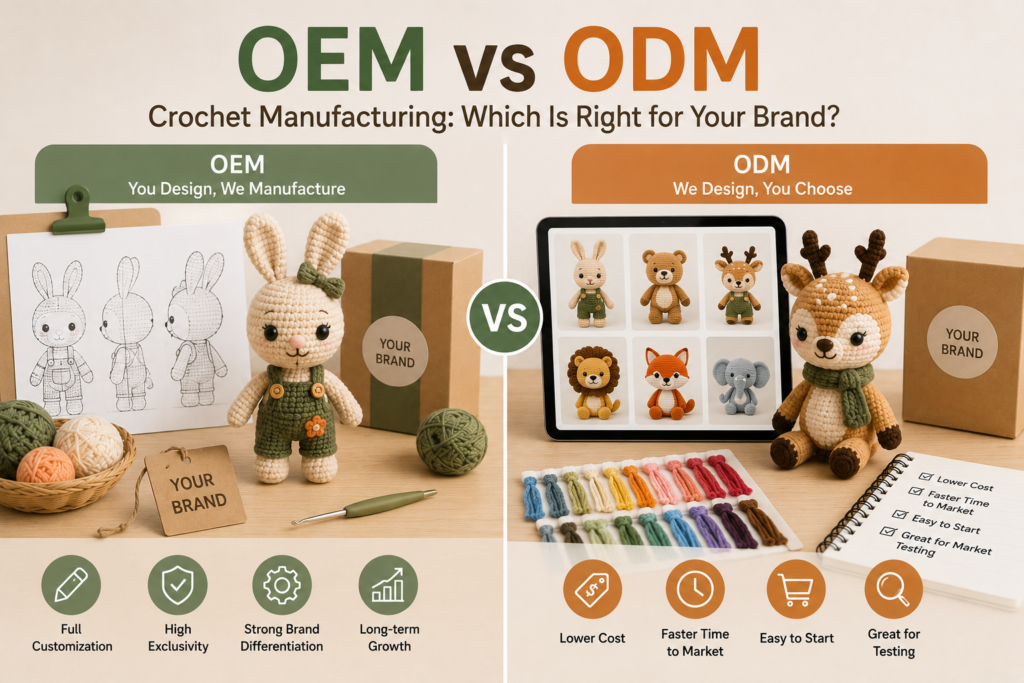
A Practical Guide for Brands, Retailers, Museum Stores, and Product Developers
One of the most common questions we hear from buyers developing crochet products is:
Should we choose OEM or ODM manufacturing?
It's a simple question—but the answer depends entirely on your business goals.
After more than 12 years of specializing in crochet manufacturing, we've helped retailers, museum stores, gift brands, distributors, startups, and corporate buyers across more than 150 countries and regions develop successful crochet collections.
Over the years, we've noticed that many buyers misunderstand the difference between OEM and ODM.
Some believe OEM simply means adding a logo.
Others assume ODM means selecting products directly from a catalog.
In reality, both manufacturing models can help brands succeed when applied at the right stage of business growth.
One lesson we've learned is this:
OEM and ODM are not competing manufacturing models—they are different business strategies.
This guide explains how each model works, when to use them, and how experienced buyers decide which approach delivers the best long-term value.
Why Understanding OEM vs ODM Matters
Choosing the wrong manufacturing model can affect much more than product cost.
It influences:
- Development time
- Product uniqueness
- Brand positioning
- Inventory risk
- Market entry speed
- Long-term profitability
We've worked with customers who initially requested OEM development but later discovered ODM better suited their launch schedule.
We've also seen brands begin with ODM and gradually transition into exclusive OEM collections after validating market demand.
Understanding these differences early helps buyers make smarter investment decisions.
What Is OEM Crochet Manufacturing?
OEM stands for:
Original Equipment Manufacturer.
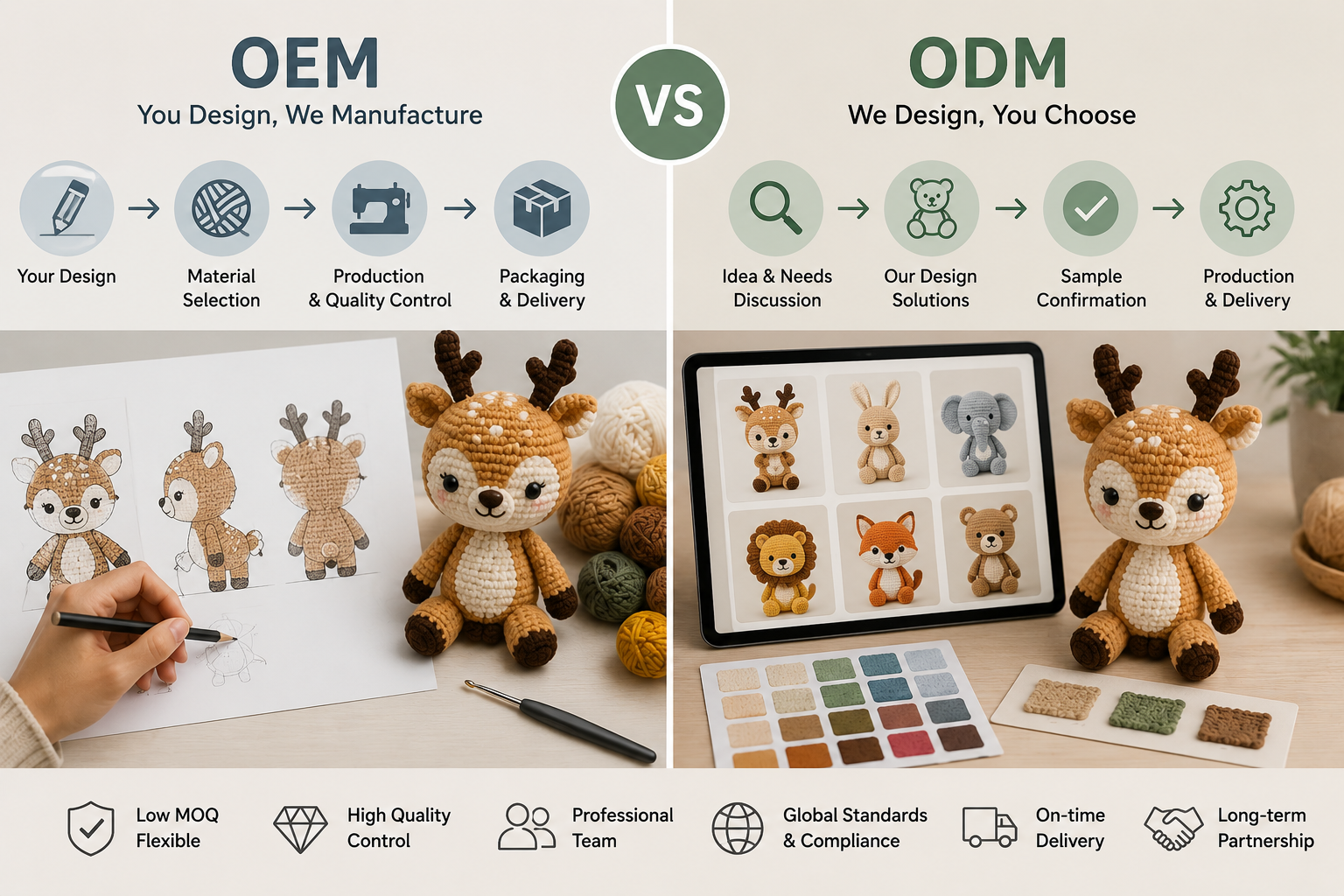
In an OEM project, the customer owns the original product concept.
This may include:
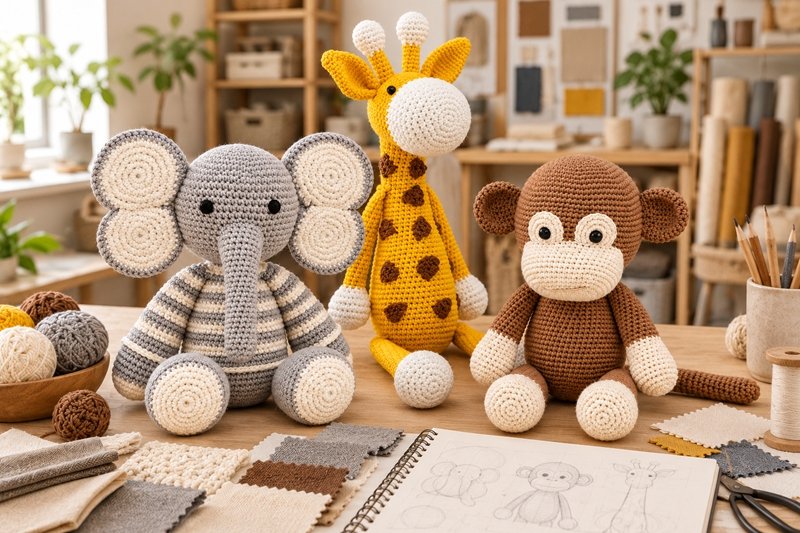
- Hand sketches
- Character illustrations
- Product concepts
- Technical drawings
- Mood boards
- Packaging ideas
- Brand guidelines
Typical OEM services include:
- Design evaluation
- Crochet pattern development
- Material sourcing
- Prototype development
- Sample revisions
- Production planning
- Quality control
- Packaging customization
- Export support
OEM provides brands with complete ownership over the final product design.
What Is ODM Crochet Manufacturing?
ODM stands for:
Original Design Manufacturer.
Instead of starting from scratch, the manufacturer already has existing product designs that customers can customize.
Examples include:
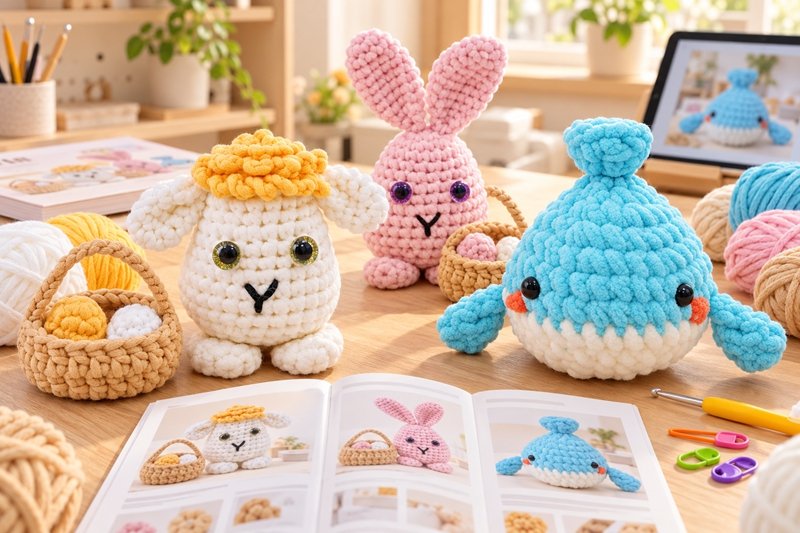
- Crochet animals
- Crochet flowers
- Baby rattles
- Crochet keychains
- Gift sets
- Seasonal collections
- Home décor
Customers typically customize:
- Colors
- Accessories
- Packaging
- Hang tags
- Logo labels
- Story cards
Since the basic product already exists, ODM projects usually require less development time and lower upfront investment.
For many businesses, ODM offers an excellent way to test new markets before investing in completely original products.
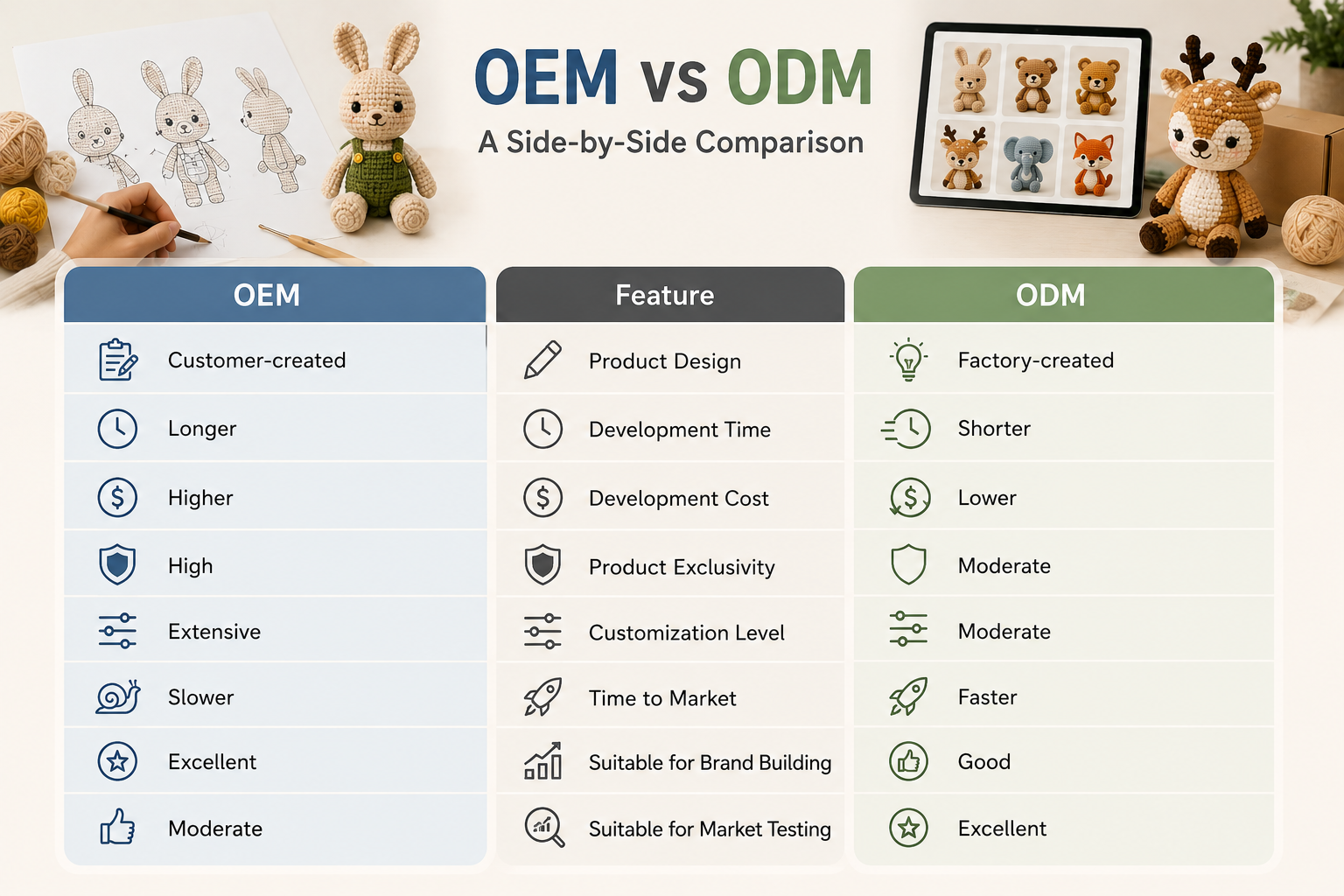
OEM vs ODM: A Side-by-Side Comparison
| Feature | OEM | ODM |
|---|---|---|
| Product Design | Customer-created | Factory-created |
| Development Time | Longer | Shorter |
| Development Cost | Higher | Lower |
| Product Exclusivity | High | Moderate |
| Customization Level | Extensive | Moderate |
| Time to Market | Slower | Faster |
| Suitable for Brand Building | Excellent | Good |
| Suitable for Market Testing | Moderate | Excellent |
Neither option is universally better.
The right choice depends on your commercial objectives.
When Should You Choose OEM?
OEM is generally the better choice if your goal is to build long-term brand differentiation.
Typical OEM projects include:
- Original mascots
- Licensed characters
- Museum souvenirs
- Cultural collections
- IP merchandise
- Corporate brand characters
- Premium gift collections
One thing we've consistently observed across custom projects is:
OEM requires more planning and development, but it creates products competitors cannot easily copy.
When Should You Choose ODM?
ODM is often the better choice when speed, flexibility, and lower development costs are priorities.
Common ODM applications include:
- Seasonal promotions
- Holiday collections
- Employee gifts
- Retail replenishment
- Promotional giveaways
- Startup product launches
- Market validation programs
Because development starts from an existing design platform, production can begin much faster.
Many successful startups begin with ODM before expanding into proprietary OEM collections.
UMY Decision Matrix: Which Manufacturing Model Fits Your Business?
One advantage of working with an experienced crochet manufacturer is receiving guidance—not just production.
Below is the decision framework we frequently use when advising customers.
| Buyer Type | Recommended Model | Why |
|---|---|---|
| Startup Brand | ODM | Faster launch, lower investment, reduced development risk |
| Museum Store | OEM | Original storytelling and exclusive cultural collections |
| Gift Brand | OEM + ODM | Combine signature products with fast-moving seasonal items |
| Corporate Gift Buyer | ODM | Faster production and flexible branding |
| Retail Chain | OEM + ODM | Build exclusive hero products while maintaining quick replenishment |
| Established Consumer Brand | OEM | Stronger long-term brand differentiation |
One lesson we've learned after supporting customers worldwide is:
Successful brands rarely choose only OEM or only ODM forever.
Instead, they choose the strategy that best matches their current stage of growth.
How Buyers Usually Make the Decision
Rather than asking:
"Which manufacturing model is better?"
Experienced buyers ask:
Do we already have original artwork?
If yes, OEM is often the better choice.
Do we need products within a short timeframe?
ODM generally provides faster development.
Is product exclusivity important?
Choose OEM.
Are we validating a completely new market?
ODM reduces risk while gathering market feedback.
Is long-term brand value more important than short-term launch speed?
OEM usually creates greater long-term value.
Do we expect multiple future product extensions?
OEM often provides a stronger foundation for expanding into collections and product ecosystems.
Real Project Example: OEM Development
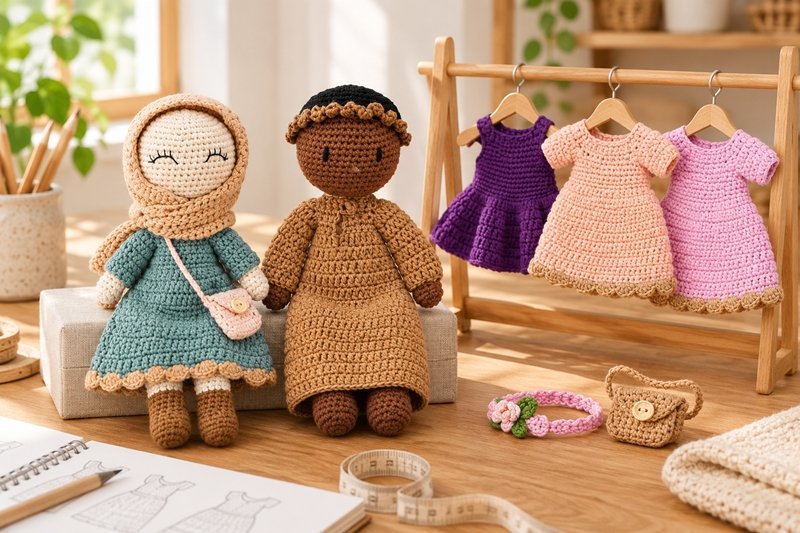
One museum retailer approached us with several hand-drawn sketches inspired by a local cultural exhibition.
The objective wasn't simply to manufacture crochet dolls.
The customer wanted to create a memorable visitor experience.
Working together, we developed:
- Original crochet characters
- Custom clothing
- Story cards
- Gift packaging
- Display-ready retail presentation
The initial project launched with one exclusive character.
Following positive customer response, the retailer gradually expanded the collection into multiple related products across subsequent seasons.
This project reinforced an important lesson:
OEM development often creates long-term product ecosystems rather than individual products.
Real Project Example: ODM Development
Not every project requires completely original product development.
One corporate customer contacted us with a tight production schedule for an employee appreciation program.
Instead of developing a brand-new product from scratch, they selected one of our existing crochet character designs as the foundation.
Together, we customized:
- Brand colors
- Logo hang tags
- Greeting cards
- Gift packaging
- Product combinations
Because the product structure had already been tested and standardized, development moved significantly faster than a typical OEM project.
The customer successfully launched the program within their required timeline while maintaining strong brand presentation.
This project reminded us that:
Choosing ODM does not mean sacrificing brand identity. It means building efficiently on a proven manufacturing foundation.
Can OEM and ODM Work Together?
Absolutely.
In fact, many of the most successful brands we've supported combine both manufacturing models throughout their growth journey.
Rather than choosing one model forever, they adjust their strategy as their business evolves.
A typical growth path looks like this:
Stage 1 — Market Validation
Launch several ODM products with customized branding.
Goal:
- Test customer demand
- Minimize development costs
- Enter the market quickly
Stage 2 — Brand Recognition
Develop one or two flagship OEM products.
Goal:
- Differentiate the brand
- Build intellectual property
- Strengthen customer recognition
Stage 3 — Collection Expansion
Continue using ODM for fast-moving seasonal products while expanding OEM collections.
Goal:
- Maintain product freshness
- Improve development efficiency
- Balance innovation with commercial stability
After supporting projects across more than 150 countries and regions, we've found that this hybrid strategy often delivers the best balance between creativity, speed, and long-term profitability.
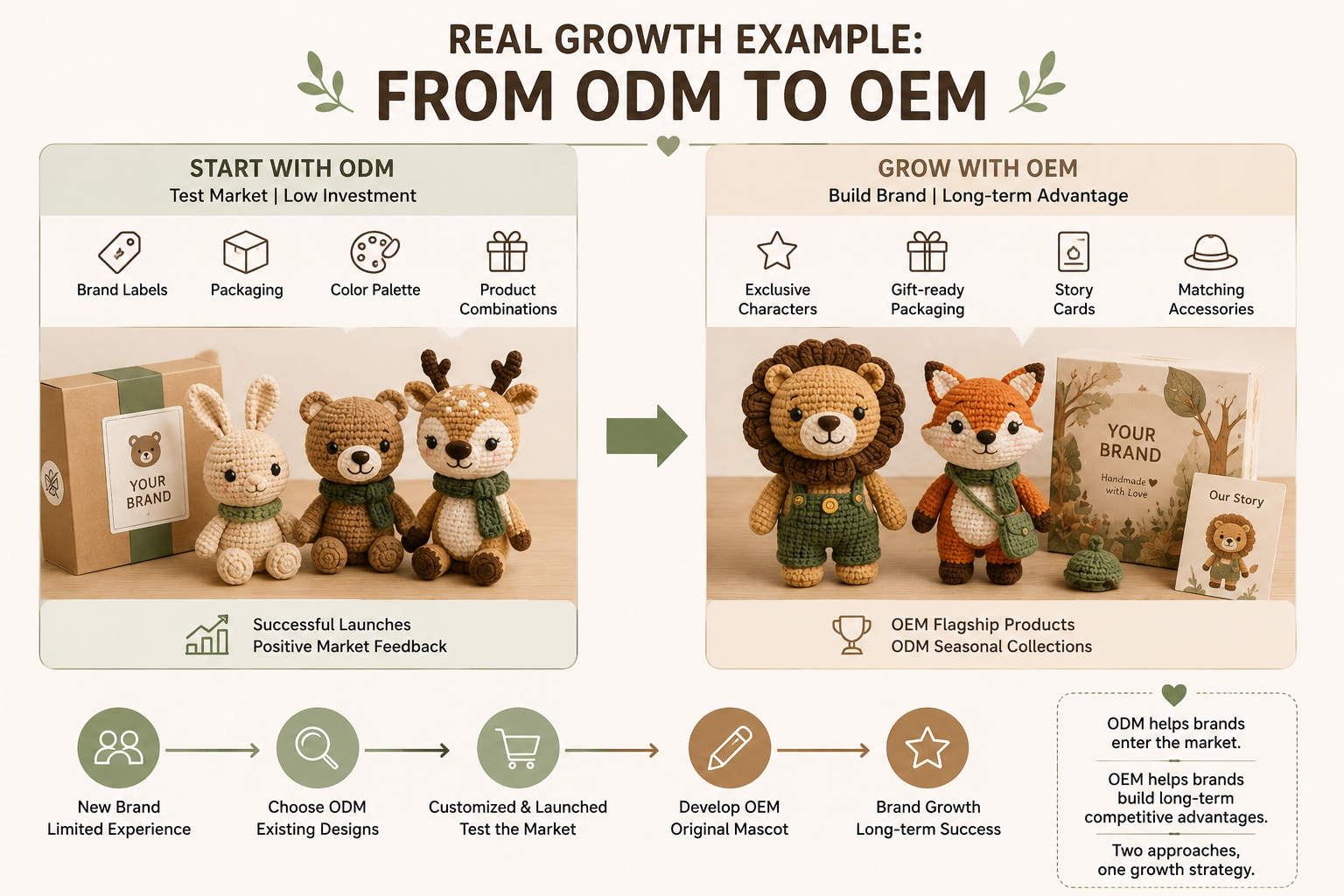
Real Growth Example: From ODM to OEM
One startup brand initially approached us with limited experience in product development.
Instead of investing heavily in original product design, they selected several existing crochet products through our ODM program.
We customized:
- Brand labels
- Packaging
- Color palette
- Product combinations
The initial collection allowed the customer to test the market with relatively low investment.
After several successful product launches and positive customer feedback, the brand returned with an original mascot concept.
Together we developed:
- Exclusive crochet characters
- Gift-ready packaging
- Story cards
- Matching accessories
Today, their product line includes both OEM flagship products and ODM seasonal collections.
This project reinforced one important lesson:
ODM helps brands enter the market. OEM helps brands build long-term competitive advantages.
The two approaches are complementary—not contradictory.
What We Commonly Observe Across Successful Brands
After more than 12 years of crochet manufacturing, we've noticed several consistent patterns among successful customers.
Startups usually prioritize speed.
They often begin with ODM products to reduce investment risk and validate customer demand.
Established brands focus on exclusivity.
As competition increases, OEM development becomes an important tool for creating products competitors cannot easily replicate.
Museum stores value storytelling.
Original cultural narratives and exclusive product collections generally make OEM the preferred choice.
Corporate buyers prioritize efficiency.
Many corporate gifting projects benefit from ODM because production schedules are often fixed.
The strongest brands rarely depend on only one manufacturing model.
Instead, they combine OEM and ODM strategically throughout different stages of business growth.
Common Misconceptions About OEM and ODM
"OEM Always Means Better"
Not necessarily.
For some projects, ODM provides a faster and more profitable path to market.
"ODM Products Can't Be Customized"
This is one of the biggest misconceptions we encounter.
Many ODM products can still be customized through:
- Brand colors
- Packaging
- Accessories
- Labels
- Story cards
- Product combinations
A thoughtfully customized ODM product can still feel highly distinctive.
"OEM Is Only for Large Companies"
This is another common misunderstanding.
Many startups begin OEM development with just one signature product.
Rather than launching an entire collection immediately, they build their brand around one memorable flagship item before expanding.
"Lower Development Cost Always Means Better Business"
Development cost is only one part of the equation.
Experienced buyers also evaluate:
- Market differentiation
- Customer loyalty
- Brand recognition
- Long-term profitability
Sometimes investing more at the beginning creates significantly greater commercial value over time.
What We've Learned After 12 Years of Crochet Manufacturing
They are business decisions.
The customers who achieve the greatest long-term success usually focus on questions like:
- How can this product strengthen our brand?
- Will this design remain relevant in future collections?
- Can this concept be expanded into additional products?
- Does this investment support long-term business growth?
One lesson we've consistently learned is:
The most successful brands don't simply manufacture products—they build product systems.
OEM and ODM are simply different tools for achieving that goal.
UMY Crochet Factory at a Glance
Since 2013, UMY has specialized exclusively in crochet manufacturing.
Today we support customers across more than 150 countries and regions through comprehensive OEM and ODM services.
Our capabilities include:
- 12+ years of crochet manufacturing experience
- Customers in 150+ countries and regions
- 2,000+ artisan production network
- OEM and ODM product development
- Sample development in approximately 7–15 working days, depending on project complexity
- International quality management processes
- Support for retailers, museum stores, gift brands, distributors, startups, and corporate buyers
- Product development, packaging design, sampling, and mass production under one roof
Whether you're developing an original crochet mascot or launching a fast-moving retail collection, our team helps transform ideas into commercially successful products.
Frequently Asked Questions
Is OEM more expensive than ODM?
Generally, yes.
OEM requires additional design, sampling, and development work before production begins.
However, the long-term value of product exclusivity often justifies the investment.
Can ODM products still include my own branding?
Absolutely.
Many ODM projects include:
- Custom logos
- Hang tags
- Packaging
- Greeting cards
- Product combinations
- Brand color customization
Which option is better for startups?
For many startups, ODM provides a practical starting point because it reduces development costs and shortens time to market.
As the business grows, many gradually transition into OEM.
Which option is better for museum stores?
Can one manufacturer provide both OEM and ODM services?
Yes.
An experienced crochet manufacturer should be capable of supporting both models and recommending the most appropriate solution based on your project goals.
How do I know which option is right for my business?
The answer depends on several factors, including:
- Budget
- Timeline
- Product uniqueness
- Brand strategy
- Long-term growth plans
An experienced manufacturing partner should help evaluate these factors before production begins.
Final Thoughts
Choosing between OEM and ODM is not about deciding which manufacturing model is "better."
It's about selecting the strategy that best supports your current stage of business development.
After helping customers across more than 150 countries and regions develop crochet products, we've found that successful buyers rarely make decisions based solely on development cost.
Instead, they evaluate:
✓ Product uniqueness
✓ Speed to market
✓ Brand positioning
✓ Customer experience
✓ Long-term collection potential
Looking for an OEM or ODM Crochet Manufacturing Partner?
At UMY Crochet Factory, we help startups, retailers, museum stores, gift brands, distributors, and corporate buyers choose the manufacturing strategy that best fits their business goals.
Whether you're transforming an original sketch into an exclusive crochet collection or customizing an existing design for rapid market entry, our team supports every stage of the journey—from concept development and sampling to packaging design and large-scale production.
Contact us today to discuss your next crochet project and discover which manufacturing model is right for your brand.
 Chinese